REVIEW 3 major objections 2 minor 1 cited by
Vision-centric foundation models hold logical ego-motion concepts but fail to ground them in camera observations, often losing to classical geometry.
Reviewed by Pith at T0; open to challenge. T0 means a machine referee read the full paper against a public rubric. the ladder, T0–T4 →
T0 review · grok-4.5
2026-07-12 18:44 UTC pith:GLKGAV5X
load-bearing objection The abstract promises a useful ego-motion diagnostic for driving VLMs, but the supplied manuscript body is an unrelated MAE-nnFormer medical segmentation paper, so the central claims cannot be checked. the 3 major comments →
EgoDyn-Bench: Evaluating Ego-Motion Understanding in Vision-Centric Foundation Models for Autonomous Driving
The pith
A machine-rendered reading of the paper's core claim, the machinery that carries it, and where it could break.
Core claim
Current vision-centric foundation models exhibit a structural Perception Bottleneck for ego-motion: they hold logical physical concepts but consistently fail to align those concepts with visual observations, often underperforming classical non-learned geometric baselines. The failure holds across model scale and domain-specific training. Providing explicit trajectory encodings substantially restores physical consistency, revealing a functional disentanglement in which ego-motion logic is derived almost exclusively from language while visual observations contribute negligible temporal signal.
What carries the argument
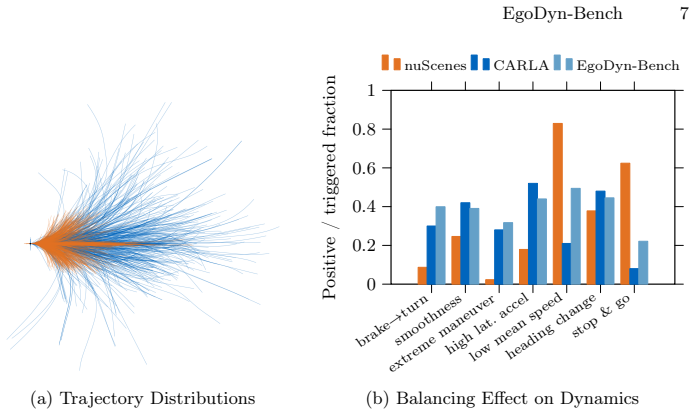
EgoDyn-Bench: a diagnostic benchmark that maps continuous vehicle kinematics to discrete motion concepts via a deterministic oracle, decoupling a model's internal physical logic from its visual perception so the two can be evaluated separately.
Load-bearing premise
The paper treats its deterministic oracle that turns continuous vehicle kinematics into discrete motion labels as a faithful ground truth for semantic ego-motion understanding; if that mapping is coarse, miscalibrated, or sensitive to prompt format, both the bottleneck diagnosis and the language-versus-vision conclusion lose force.
What would settle it
If a vision-centric model, without any explicit trajectory tokens, matches or exceeds both the classical geometric baselines and the oracle-aligned scores on EgoDyn-Bench across the same diverse driving scenes, the claimed Perception Bottleneck would be refuted.
If this is right
- Ego-motion understanding can be diagnosed without conflating perception errors with failures of physical logic.
- Scaling model size or adding domain-specific driving data alone will not close the vision–physics gap under current architectures.
- Explicit trajectory encodings are a practical short-term route to more consistent physical behavior across model families.
- Architectures that couple visual temporal signal more tightly to physical reasoning are required for reliable embodied driving AI.
- Classical non-learned geometric methods remain necessary reference points when evaluating foundation models on ego-motion.
Where Pith is reading between the lines
- The same language-heavy, vision-light pattern may appear for other continuous physical quantities that models verbalize but do not measure from video, such as slip, braking distance, or road friction.
- Objectives that force vision encoders to predict short-horizon kinematics would test whether the bottleneck is architectural or mainly objective-driven.
- Safety arguments for VLM-based driving stacks should treat language-side physics as ungrounded until vision-aligned ego-motion metrics are passed.
Editorial analysis
A structured set of objections, weighed in public.
Referee Report
Summary. The submission's title and abstract introduce EgoDyn-Bench, a diagnostic benchmark that maps continuous vehicle kinematics to discrete motion concepts via a deterministic oracle in order to evaluate semantic ego-motion understanding in vision-centric foundation models for autonomous driving. The abstract claims a large-scale audit of 20+ models (closed-source MLLMs, open-source VLMs, specialized VLAs) that identifies a 'Perception Bottleneck'—models hold logical physical concepts but fail to align them with visual observations, often underperforming classical geometric baselines—and further claims that explicit trajectory encodings restore physical consistency, implying ego-motion logic lives almost exclusively in the language modality. The supplied full manuscript body, however, is an unrelated medical-image-segmentation paper on MAE-pretrained nnFormer for brain-tumor segmentation (Dice tables, TransUNet/Swin-UNETR comparisons, medical references). No methods, oracle definition, model list, geometric baselines, trajectory-encoding ablations, or EgoDyn-Bench results appear.
Significance. If the abstract's empirical claims were substantiated, the work would be significant for embodied AI and autonomous driving: a standardized diagnostic that separates physical logic from visual perception, evidence of a structural vision–physics coupling deficit that persists across scale and domain training, and a practical pathway (trajectory encodings) toward physically aligned models. Those contributions cannot be assessed from the document under review, because the body contains none of the claimed experiments, code/dataset links notwithstanding. The mismatch itself nullifies any claim to significance within the present manuscript.
major comments (3)
- Title/abstract vs. full text: The manuscript body (Sections I–VI, Tables I–II, References) is an entirely different paper on MAE-enhanced nnFormer for volumetric brain-tumor segmentation (Dice 86.3→88.7, comparisons to TransUNet/Swin-UNETR/UNETR). None of the EgoDyn-Bench claims—oracle mapping, 20+ model audit, geometric baselines, trajectory-encoding restoration, or Perception Bottleneck—are present. The central claims are therefore unsupported by any evidence in the document.
- Absence of load-bearing experimental content: There is no definition of the deterministic kinematics-to-concept oracle, no prompt/answer protocol, no model list or evaluation protocol, no comparison to classical geometric baselines, and no trajectory-encoding ablation. Without these, neither the bottleneck diagnosis nor the language-vs-vision disentanglement conclusion can be verified, confounded, or reproduced.
- Irreconcilable scope: The body discusses medical segmentation architecture, unlabeled-data efficiency, and Dice scores; the abstract discusses autonomous-driving VLMs and ego-motion physics. This is not a presentation issue but a complete substitution of content, rendering the submission non-reviewable as a scientific contribution on the stated topic.
minor comments (2)
- Even within the medical body, Table I and Table II report slightly inconsistent baseline Dice numbers (86.3 / 86.4 / 86%), and the narrative repeats the same claims across Sections IV–VI with little additional analysis.
- Abstract links (project page, code, dataset) cannot substitute for the missing methods and results sections inside the manuscript itself.
Circularity Check
No circular derivation chain: body is an empirical MAE-nnFormer medical segmentation paper with no EgoDyn-Bench content; abstract claims have no supporting derivation to inspect.
full rationale
The supplied full manuscript text is a standard empirical medical-imaging paper (MAE pretraining of an nnFormer encoder for brain-tumor segmentation). It reports Dice scores (baseline ~86.3–86.4 vs. proposed 88.7), compares against TransUNet/Swin-UNETR/UNETR, and concludes that self-supervised pretraining improves data efficiency and convergence. These are experimental outcomes measured against external ground-truth segmentations; nothing is defined in terms of the reported metric, no parameter is fitted and then re-presented as a prediction of a closely related quantity, and no uniqueness theorem or load-bearing ansatz is imported via self-citation. The abstract’s EgoDyn-Bench / Perception-Bottleneck / language-vs-vision claims do not appear anywhere in the body (no oracle, no model audit, no trajectory encodings, no geometric baselines). Consequently there is no derivation chain for those claims that could reduce to its inputs by construction. Circularity score is therefore 0; residual concerns about oracle faithfulness or abstract–body mismatch are correctness/reproducibility issues, not circularity.
Axiom & Free-Parameter Ledger
free parameters (2)
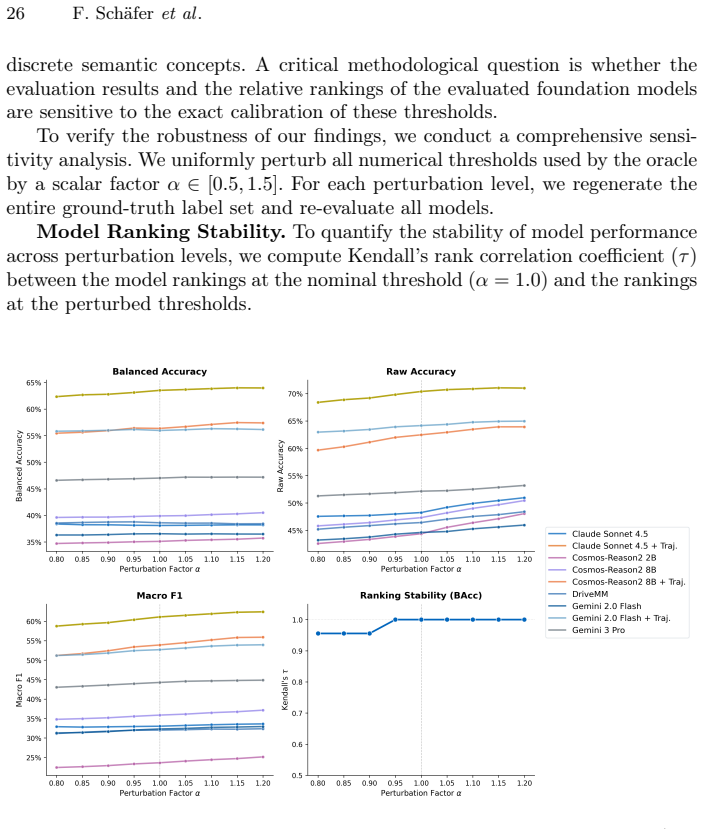
- oracle discretization thresholds (kinematics → discrete motion concepts)
- prompt / answer format for VLM queries
axioms (3)
- domain assumption A deterministic mapping from continuous vehicle kinematics to discrete motion concepts is a valid ground truth for semantic ego-motion understanding.
- domain assumption Classical non-learned geometric baselines are fair comparators for vision-centric foundation models on this task.
- ad hoc to paper Restored consistency when trajectory encodings are provided implies ego-motion logic lives almost exclusively in the language modality and vision contributes negligible temporal signal.
invented entities (3)
-
EgoDyn-Bench
no independent evidence
-
Perception Bottleneck (as structural deficit in vision–physics coupling)
no independent evidence
-
Deterministic kinematics-to-concept oracle
no independent evidence
read the original abstract
While Vision-Language Models (VLMs) have advanced high-level reasoning in autonomous driving, their ability to ground this reasoning in the underlying physics of ego-motion remains poorly understood. We introduce EgoDyn-Bench [Project page: (https://tum-avs.github.io/EgoDyn-Bench-Website/), Code: (https://github.com/TUM-AVS/EgoDyn-Bench), Dataset: (https://huggingface.co/datasets/fnc1901/EgoDyn-Bench)], a diagnostic benchmark for evaluating the semantic ego-motion understanding of vision-centric foundation models. By mapping continuous vehicle kinematics to discrete motion concepts via a deterministic oracle, we decouple a model's internal physical logic from its visual perception. Our large-scale empirical audit spanning 20$+$ models, including closed-source MLLMs, open-source VLMs across multiple scales, and specialized VLAs, identifies a significant Perception Bottleneck: while models exhibit logical physical concepts, they consistently fail to accurately align them with visual observations, frequently underperforming classical non-learned geometric baselines. This failure persists across model scales and domain-specific training, indicating a structural deficit in how current architectures couple visual perception with physical reasoning. We demonstrate that providing explicit trajectory encodings substantially restores physical consistency across all evaluated models, revealing a functional disentanglement between vision and language: ego-motion logic is derived almost exclusively from the language modality, while visual observations contribute negligible temporal signal. This structural finding provides a standardized diagnostic framework and a practical pathway toward physically aligned embodied AI. Ego-motion - Physical Reasoning - Foundation Models
Figures



Forward citations
Cited by 1 Pith paper
-
Imagined Rollouts are Kinematic, Not Dynamic: A Diagnosis of Long-Horizon World-Model Failure
DreamerV3's imagined rollouts are insensitive to friction changes that cause real gait collapse, revealing that world models extrapolate kinematically rather than dynamically.
Reference graph
Works this paper leans on
-
[1]
U-Net: Convolutional Net- works for Biomedical Image Segmentation,
O. Ronneberger, P. Fischer, and T. Brox, “U-Net: Convolutional Net- works for Biomedical Image Segmentation,” inProc. Int. Conf. Med. Image Comput. Comput.-Assist. Interv. (MICCAI), 2015, pp. 234–241
2015
-
[2]
3D U-Net: Learning Dense V olumetric Segmentation from Sparse Annotation,
¨O. C ¸ ic ¸ek, A. Abdulkadir, S. S. Lienkamp, T. Brox, and O. Ronneberger, “3D U-Net: Learning Dense V olumetric Segmentation from Sparse Annotation,” inProc. Int. Conf. Med. Image Comput. Comput.-Assist. Interv. (MICCAI), 2016, pp. 424–432
2016
-
[3]
V-Net: Fully Convolutional Neural Networks for V olumetric Medical Image Segmentation,
F. Milletari, N. Navab, and S.-A. Ahmadi, “V-Net: Fully Convolutional Neural Networks for V olumetric Medical Image Segmentation,” inProc. 4th Int. Conf. 3D Vision (3DV), 2016, pp. 565–571
2016
-
[4]
Attention U-Net: Learning Where to Look for the Pancreas,
O. Oktayet al., “Attention U-Net: Learning Where to Look for the Pancreas,”arXiv preprint arXiv:1804.03999, 2018
Pith/arXiv arXiv 2018
discussion (0)
Sign in with ORCID, Apple, or X to comment. Anyone can read and Pith papers without signing in.