Recognition: unknown
Physics-based modeling of cyclic and calendar aging of LIBs with Si-Gr composite anodes
Pith reviewed 2026-05-07 11:39 UTC · model grok-4.3
The pith
A physics-based model separates standard SEI growth from silicon-specific degradation processes like particle cracking and loss of active material in lithium-ion batteries.
A machine-rendered reading of the paper's core claim, the machinery that carries it, and where it could break.
Core claim
We develop a physics-based model to describe degradation during battery cycling under various protocols and storage conditions, with varying check-up (CU) frequencies. The model can disentangle basic degradation mechanisms, such as the growth of the Solid-Electrolyte Interphase (SEI), from silicon mechanisms, such as particle cracking, SEI growth on cracks, and loss of active material (LAM). We investigate the impact of CUs on the observed storage degradation and the reason behind the increased degradation in batteries, including silicon in the anode. Additionally, we relate the observed degradation to operating conditions, enabling future optimization of battery use and design.
What carries the argument
The physics-based degradation model that couples SEI growth on graphite and silicon surfaces with silicon particle cracking, SEI formation on fresh crack surfaces, and loss of active material to simulate both cyclic and calendar aging under changing check-up schedules.
If this is right
- Check-up frequency directly alters the measured calendar degradation rate, so test protocols must account for this effect.
- Silicon-induced mechanisms explain the accelerated fade seen when silicon is added to graphite anodes.
- Degradation rates become predictable from operating variables such as C-rate, temperature, and state-of-charge windows.
- The same framework can be used to compare and optimize future anode designs or usage strategies.
Where Pith is reading between the lines
- Long-duration tests could be shortened by using the model to interpolate between measured check-ups.
- The approach suggests that minimizing crack formation would reduce both cyclic and storage losses more effectively than targeting SEI growth alone.
- Standardized battery-testing procedures might need revision to avoid check-up-induced bias when comparing cells with different silicon contents.
Load-bearing premise
The rates and parameters for silicon particle cracking, crack-SEI growth, and loss of active material stay the same across every cycling protocol and storage condition without needing new measurements or refitting.
What would settle it
Independent microscopy or thickness measurements of cracked silicon particles and SEI layers taken from cells run under the same conditions but held out from the fitting set would yield values that the model cannot reproduce.
Figures




read the original abstract
Higher energy density and longer lifetime are the requirements for next-generation lithium-ion batteries. A promising anode material is silicon, which offers high specific capacity, but its significant volume change during lithiation and delithiation enormously reduces battery lifetime. A physical understanding of the processes degrading the battery is key to mitigate this effect and advance in the field. We develop a physics-based model to describe degradation during battery cycling under various protocols and storage conditions, with varying check-up (CU) frequencies. The model can disentangle basic degradation mechanisms, such as the growth of the Solid-Electrolyte Interphase (SEI), from silicon mechanisms, such as particle cracking, SEI growth on cracks, and loss of active material (LAM). We investigate the impact of CUs on the observed storage degradation and the reason behind the increased degradation in batteries, including silicon in the anode. Additionally, we relate the observed degradation to operating conditions, enabling future optimization of battery use and design.
Editorial analysis
A structured set of objections, weighed in public.
Referee Report
Summary. The manuscript develops a physics-based model for cyclic and calendar aging in lithium-ion batteries with Si-Gr composite anodes. It claims to describe degradation under varied cycling protocols, storage conditions, and check-up frequencies while disentangling baseline mechanisms (e.g., SEI growth) from silicon-specific ones (particle cracking, SEI growth on cracks, and loss of active material).
Significance. If the separation of mechanisms holds with transferable parameters, the framework would be valuable for lifetime prediction and optimization of high-energy-density anodes. The explicit treatment of check-up effects on observed storage degradation and linkage to operating conditions adds practical utility, but significance hinges on demonstrating that silicon-mechanism rates are not merely fitted artifacts.
major comments (2)
- [Model parameterization and results sections] The central claim of mechanism disentanglement (abstract) rests on silicon-specific parameters (cracking rates, SEI-on-cracks kinetics, LAM) being transferable across protocols and storage conditions. If these rates are calibrated exclusively against the same capacity-fade and resistance curves used for the SEI model, the attribution becomes non-unique and dependent on functional-form choices rather than independent physical constraints. This is load-bearing for the paper's main contribution.
- [Validation and discussion of silicon mechanisms] No independent validation (e.g., post-mortem particle morphology, SEI thickness measurements, or separate cracking experiments) is referenced to confirm that the silicon sub-model parameters remain fixed and predictive when cycling protocols or CU frequencies change. Without such checks, the reported separation of degradation contributions cannot be distinguished from post-hoc fitting.
minor comments (2)
- [Abstract and introduction] Notation for check-up frequency (CU) and its quantitative impact on storage degradation should be defined earlier and used consistently in figures and equations.
- [Results] The abstract states the model 'can disentangle' mechanisms; the results section should include a dedicated table or plot showing the fractional contribution of each mechanism under different conditions to make this concrete.
Simulated Author's Rebuttal
We thank the referee for the constructive comments, which help clarify the scope and limitations of our modeling framework. We respond to each major comment below.
read point-by-point responses
-
Referee: [Model parameterization and results sections] The central claim of mechanism disentanglement (abstract) rests on silicon-specific parameters (cracking rates, SEI-on-cracks kinetics, LAM) being transferable across protocols and storage conditions. If these rates are calibrated exclusively against the same capacity-fade and resistance curves used for the SEI model, the attribution becomes non-unique and dependent on functional-form choices rather than independent physical constraints. This is load-bearing for the paper's main contribution.
Authors: The silicon-specific sub-models employ distinct physical rate equations drawn from the silicon anode literature (volume-expansion-driven cracking, fresh-surface SEI growth, and LAM). These equations have different functional dependencies on SOC, time, and cycle count than the baseline SEI growth term. A single parameter set is shown to reproduce capacity and resistance evolution across multiple independent cycling protocols, storage conditions, and check-up frequencies without re-fitting. This cross-protocol consistency supplies additional constraints on the silicon parameters beyond any single curve. We will add a dedicated subsection on parameter sensitivity and identifiability in the revised manuscript to make this argument more explicit. revision: partial
-
Referee: [Validation and discussion of silicon mechanisms] No independent validation (e.g., post-mortem particle morphology, SEI thickness measurements, or separate cracking experiments) is referenced to confirm that the silicon sub-model parameters remain fixed and predictive when cycling protocols or CU frequencies change. Without such checks, the reported separation of degradation contributions cannot be distinguished from post-hoc fitting.
Authors: Validation in the manuscript is performed by demonstrating that the same silicon-parameter set remains predictive when the operating protocol or check-up frequency is altered. The model also reproduces the experimentally observed dependence of apparent calendar aging on check-up frequency, which arises directly from the silicon-cracking term. While post-mortem morphology or dedicated cracking experiments would provide valuable orthogonal confirmation, such measurements were outside the scope of the reported full-cell electrochemical campaign. We will expand the discussion section to explicitly state this limitation and outline the type of future experiments that could further test the silicon sub-model. revision: partial
Circularity Check
No significant circularity: model parameters drawn from literature and fitted to independent electrochemical datasets
full rationale
The derivation chain relies on established physical mechanisms (SEI growth, particle cracking, LAM) taken from prior literature rather than self-defined or self-cited uniqueness theorems. Silicon-specific rate constants are calibrated to capacity-fade and resistance data across protocols but are not presented as 'predictions' that reduce to the same fitted values by construction; instead the model structure allows separation via differing dependencies on C-rate, temperature, and storage time. No ansatz is smuggled via self-citation, no renaming of known empirical patterns occurs, and the central claim of disentangling mechanisms rests on the physics-based functional forms rather than tautological reparameterization. The framework is therefore self-contained against external benchmarks.
Axiom & Free-Parameter Ledger
axioms (2)
- domain assumption SEI growth follows a diffusion-limited or kinetic-limited law whose rate constants can be taken from prior graphite and silicon studies.
- domain assumption Silicon particle cracking can be described by a mechanical stress threshold that depends on lithiation state and particle size.
Reference graph
Works this paper leans on
-
[1]
Physics-based modeling of cyclic and calendar aging of LIBs with Si-Gr composite anodes
and the lack of individual markers for each mech- ∗ birger.horstmann@dlr.de anism render the essential task of accurately modeling the mechanisms extremely challenging. Therefore, isolat- ing the degradation mechanisms to obtain valid physical conclusions and models about the individual processes is crucial. The dependence on operating conditions can be u...
work page internal anchor Pith review Pith/arXiv arXiv 2026
-
[2]
These experiments have been ana- lyzed with mechanistic modeling of storage and cycling aging [28, 29], as well as empirical modeling of particle versus SEI cracking [30]
performed storage and cycling experiments at vari- ous test conditions. These experiments have been ana- lyzed with mechanistic modeling of storage and cycling aging [28, 29], as well as empirical modeling of particle versus SEI cracking [30]. Complementing, we present a physics-based approach in this work covering all of these aspects within one consiste...
-
[3]
The SEI layer pre- vents further contact but continues to grow over time due to the transport of SEI educts through the SEI layer, thereby reducing the battery’s capacity and power
Continuous SEI growth When the electrolyte comes into contact with the neg- ative electrode, electrons from the electrode react with electrolyte molecules, consuming Li-ions to form a SEI layer on the negative electrode [5]. The SEI layer pre- vents further contact but continues to grow over time due to the transport of SEI educts through the SEI layer, t...
-
[4]
Periodic cycling means repeated mechanical loads, which cause material fatigue and, consequently, cracks
Particle cracking Due to the significant volume expansion during lithi- ation and delithiation [43], silicon particles experience substantial mechanical stresses. Periodic cycling means repeated mechanical loads, which cause material fatigue and, consequently, cracks. In materials science, material fatigue is statistically an- alyzed using W¨ ohler curves...
-
[5]
The minimal hydro- static stress is assumed to be zero for complete cycles (σh,surf,min = 0)
stresses at the surface of the particle, which were de- rived for spherical particles [44–48]. The minimal hydro- static stress is assumed to be zero for complete cycles (σh,surf,min = 0). Inserting this into the first line of eq. (5) yields the second line, with a rate constantkcr and the stress exponent m. The tangential stress at the surface is given b...
-
[6]
The model uses a single parameter set to describe the experimental data across all different usage conditions
Parameters Given the importance of avoiding overfitting, we sum- marize here the parameters required for the degradation model and how they are estimated. The model uses a single parameter set to describe the experimental data across all different usage conditions. • continuous SEI growth: determined by the diffu- sion coefficient of electrons De− in eq. ...
-
[7]
To disentangle the degradation measured during regular cycling from that solely due to the CUs, we first investigate the CUs’ im- pact
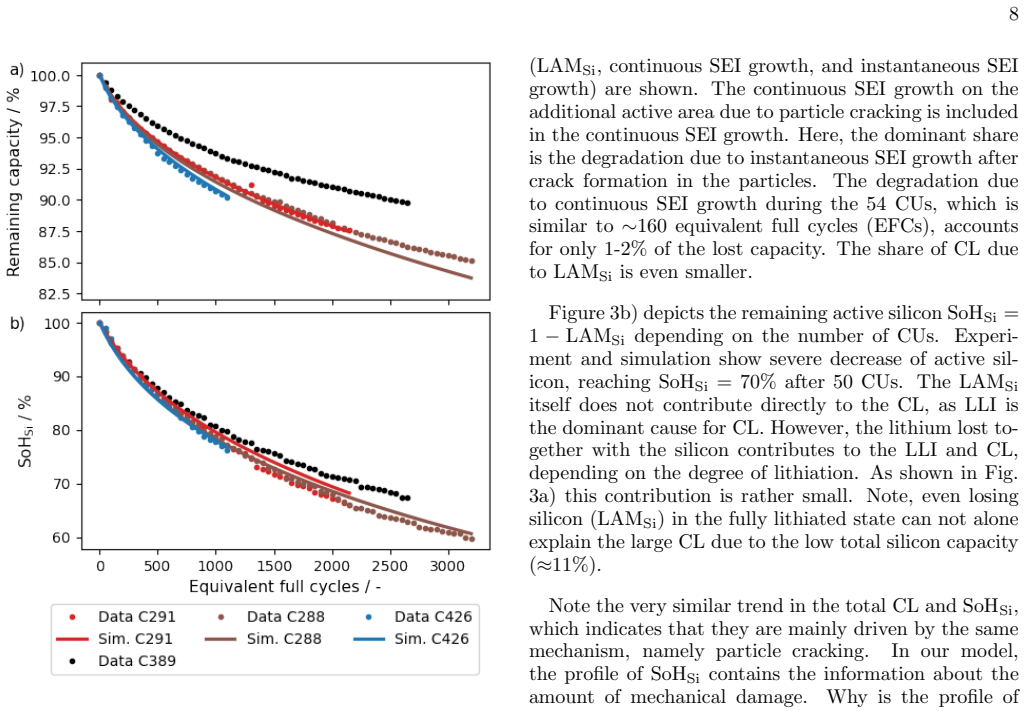
Degradation during check-ups As each cell undergoes several CUs (every 50 EFCs), they can significantly contribute to cell degradation and affect the degradation pathways. To disentangle the degradation measured during regular cycling from that solely due to the CUs, we first investigate the CUs’ im- pact. Figure 3 shows the measured and simulated CL and ...
-
[8]
Cycling in intermediate SoC regions The results for the cells cycled in the intermediate SoC region at T = 20°C (cells C288, C291, C426) are shown in Fig. 4. The black dots represent the data from the CU cell C389 and are included to visualize the degradation that would occur solely due to the CU. Therefore, the black dots do not refer to the number of EF...
-
[9]
Cycling with high DoD The results for the cells cycled with high DoD (≥ 80%) at T = 20°C (cells C249, C429) and T = 35°C (C428) are presented in Fig. 7. Notably, the model accurately pre- dicts the CL and SoH Si for cells C428 and C429, even under severe degradation conditions. For cell C249, the simulation captures the overall degradation trends well, th...
-
[10]
These cases are excluded from the model quality overview in Fig
Cycling at elevated temperatures For further validation and to assess the model’s limita- tions, we also examine cells cycled at high temperatures (T ≥ 50°C). These cases are excluded from the model quality overview in Fig. 2 for two main reasons. First, higher temperatures can trigger multiple effects that are not explicitly accounted for in the current ...
-
[11]
Vetter, P
J. Vetter, P. Nov´ ak, M. Wagner, C. Veit, K.-C. M¨ oller, J. Besenhard, M. Winter, M. Wohlfahrt-Mehrens, C. Vogler, and A. Hammouche, Ageing mechanisms in lithium-ion batteries, Journal of Power Sources 147, 269 (2005)
2005
-
[12]
C. R. Birkl, M. R. Roberts, E. McTurk, P. G. Bruce, and D. A. Howey, Degradation diagnostics for lithium ion cells, Journal of Power Sources 341, 373 (2017)
2017
-
[13]
J. S. Edge, S. O’Kane, R. Prosser, N. D. Kirkaldy, A. N. Patel, A. Hales, A. Ghosh, W. Ai, J. Chen, J. Yang, S. Li, M. C. Pang, L. B. Diaz, A. Tomaszewska, M. W. Mar- zook, K. N. Radhakrishnan, H. Wang, Y. Patel, B. Wu, and G. J. Offer, Lithium ion battery degradation: what you need to know (2021)
2021
-
[14]
Barr´ e, B
A. Barr´ e, B. Deguilhem, S. Grolleau, M. G´ erard, F. Suard, and D. Riu, A review on lithium-ion battery ageing mechanisms and estimations for automotive ap- plications, Journal of Power Sources 241, 680 (2013)
2013
-
[15]
Peled and S
E. Peled and S. Menkin, Review—sei: Past, present and future, Journal of The Electrochemical Society 164, A1703 (2017). 15
2017
-
[16]
Winter, The solid electrolyte interphase-the most important and the least understood solid electrolyte in rechargeable li batteries, Z
M. Winter, The solid electrolyte interphase-the most important and the least understood solid electrolyte in rechargeable li batteries, Z. Phys. Chem 223, 1395 (2009)
2009
-
[17]
Waldmann, B.-I
T. Waldmann, B.-I. Hogg, and M. Wohlfahrt-Mehrens, Li plating as unwanted side reaction in commercial li- ion cells – a review, Journal of Power Sources 384, 107 (2018)
2018
-
[18]
Q. Liu, C. Du, B. Shen, P. Zuo, X. Cheng, Y. Ma, G. Yin, and Y. Gao, Understanding undesirable anode lithium plating issues in lithium-ion batteries, RSC Advances 6, 88683 (2016)
2016
-
[19]
I. D. Campbell, M. Marzook, M. Marinescu, and G. J. Of- fer, How observable is lithium plating? differential volt- age analysis to identify and quantify lithium plating fol- lowing fast charging of cold lithium-ion batteries, Journal of The Electrochemical Society 166, A725 (2019)
2019
-
[20]
J. M. Reniers, G. Mulder, and D. A. Howey, Review and performance comparison of mechanical-chemical degra- dation models for lithium-ion batteries, Journal of The Electrochemical Society 166, A3189 (2019)
2019
-
[21]
Y. Liao, H. Zhang, Y. Peng, Y. Hu, J. Liang, Z. Gong, Y. Wei, and Y. Yang, Electrolyte degradation during ag- ing process of lithium-ion batteries: Mechanisms, char- acterization, and quantitative analysis, Advanced Energy Materials 14, 10.1002/aenm.202304295 (2024)
-
[22]
S. E. O’Kane, W. Ai, G. Madabattula, D. Alonso- Alvarez, R. Timms, V. Sulzer, J. S. Edge, B. Wu, G. J. Offer, and M. Marinescu, Lithium-ion battery degrada- tion: how to model it, Physical Chemistry Chemical Physics 24, 7909 (2022)
2022
-
[23]
P. Keil, S. F. Schuster, J. Wilhelm, J. Travi, A. Hauser, R. C. Karl, and A. Jossen, Calendar aging of lithium-ion batteries, Journal of The Electrochemical Society 163, A1872 (2016)
2016
-
[24]
Single, A
F. Single, A. Latz, and B. Horstmann, Identifying the mechanism of continued growth of the solid–electrolyte interphase, ChemSusChem 11, 1950 (2018)
1950
-
[25]
K¨ obbing, A
L. K¨ obbing, A. Latz, and B. Horstmann, Growth of the solid-electrolyte interphase: Electron diffusion versus sol- vent diffusion, Journal of Power Sources 561, 232651 (2023)
2023
-
[26]
M. C. J. Philipp, Y. Kuhn, A. Latz, and B. Horstmann, Physics-based inverse modeling of battery degra- dation with bayesian methods, ChemSusChem 18, 10.1002/cssc.202402336 (2025)
-
[27]
Majherova, E
V. Majherova, E. Fiamegkou, P. Nakhanivej, G. Bree, J. A. Gott, A. S. Menon, G. J. P. Fajardo, W. D. Widanalage, A. Dimitrijevic, M. Belekoukia, R. Jervis, W. M. Dose, M. J. Loveridge, and L. F. J. Piper, Re- vealing how silicon oxide accelerates calendar ageing of commercial 21700 nickel-rich lithium-ion cells, Journal of The Electrochemical Society 172,...
2025
-
[28]
X. Li, A. M. Colclasure, D. P. Finegan, D. Ren, Y. Shi, X. Feng, L. Cao, Y. Yang, and K. Smith, Degrada- tion mechanisms of high capacity 18650 cells contain- ing si-graphite anode and nickel-rich nmc cathode, Elec- trochimica Acta 297, 1109 (2019)
2019
-
[29]
X. Su, Q. Wu, J. Li, X. Xiao, A. Lott, W. Lu, B. W. Shel- don, and J. Wu, Silicon-based nanomaterials for lithium- ion batteries: A review, Advanced Energy Materials 4, 10.1002/aenm.201300882 (2014)
-
[30]
Deshpande, M
R. Deshpande, M. Verbrugge, Y.-T. Cheng, J. Wang, and P. Liu, Battery cycle life prediction with coupled chem- ical degradation and fatigue mechanics, Journal of The Electrochemical Society 159, A1730 (2012)
2012
-
[31]
Laresgoiti, S
I. Laresgoiti, S. K¨ abitz, M. Ecker, and D. U. Sauer, Mod- eling mechanical degradation in lithium ion batteries dur- ing cycling: Solid electrolyte interphase fracture, Journal of Power Sources 300, 112 (2015)
2015
-
[32]
M. P. Bonkile, Y. Jiang, N. Kirkaldy, V. Sulzer, R. Timms, H. Wang, G. Offer, and B. Wu, Is silicon worth it? modelling degradation in composite silicon–graphite lithium-ion battery electrodes, Journal of Power Sources 606, 10.1016/j.jpowsour.2024.234256 (2024)
-
[33]
O. H. Basquin, The exponential law of endurance tests, American Society for Testing and Materials Proceedings 10, 625 (1910)
1910
-
[34]
L. Wildfeuer, A. Karger, D. Ayg¨ ul, N. Wassiliadis, A. Jossen, and M. Lienkamp, Experimental degrada- tion study of a commercial lithium-ion battery, Journal of Power Sources 560, 10.1016/j.jpowsour.2022.232498 (2023)
-
[35]
M. J. Lain, J. Brandon, and E. Kendrick, Design strate- gies for high power vs. high energy lithium ion cells, Bat- teries 5, 64 (2019)
2019
-
[36]
Schmitt, M
J. Schmitt, M. Schindler, A. Oberbauer, and A. Jossen, Determination of degradation modes of lithium-ion bat- teries considering aging-induced changes in the half-cell open-circuit potential curve of silicon–graphite, Journal of Power Sources 532, 231296 (2022)
2022
-
[37]
Kitada, O
K. Kitada, O. Pecher, P. C. M. M. Magusin, M. F. Groh, R. S. Weatherup, and C. P. Grey, Unraveling the reac- tion mechanisms of sio anodes for li-ion batteries by com- bining in situ7li and ex situ7li/29si solid-state nmr spec- troscopy, Journal of the American Chemical Society141, 7014 (2019)
2019
-
[38]
A. Karger, J. Schmitt, C. Kirst, J. P. Singer, L. Wild- feuer, and A. Jossen, Mechanistic calendar aging model for lithium-ion batteries, Journal of Power Sources 578, 10.1016/j.jpowsour.2023.233208 (2023)
-
[39]
Karger, J
A. Karger, J. Schmitt, C. Kirst, J. P. Singer, L. Wild- feuer, and A. Jossen, Mechanistic cycle aging model for the open-circuit voltage curve of lithium-ion batteries, Journal of Power Sources 593, 233947 (2024)
2024
-
[40]
A. Karger, S. E. J. O’Kane, M. Rogge, C. Kirst, J. P. Singer, M. Marinescu, G. J. Offer, and A. Jossen, Mod- eling particle versus sei cracking in lithium-ion battery degradation: Why calendar and cycle aging cannot sim- ply be added, Journal of The Electrochemical Society 10.1149/1945-7111/ad76da (2024)
-
[41]
Doyle, T
M. Doyle, T. F. Fuller, and J. Newman, Mod- eling of galvanostatic charge and discharge of the lithium/polymer/insertion cell, Journal of The Electro- chemical Society 140, 1526 (1993)
1993
-
[42]
S. G. Marquis, V. Sulzer, R. Timms, C. P. Please, and S. J. Chapman, An asymptotic derivation of a single par- ticle model with electrolyte, Journal of The Electrochem- ical Society 166, A3693 (2019)
2019
-
[43]
Sulzer, S
V. Sulzer, S. G. Marquis, R. Timms, M. Robinson, and S. J. Chapman, Python battery mathematical modelling (pybamm), Journal of Open Research Software 9, 14 (2021)
2021
-
[44]
C.-H. Chen, F. B. Planella, K. O’Regan, D. Gastol, W. D. Widanage, and E. Kendrick, Development of ex- perimental techniques for parameterization of multi-scale lithium-ion battery models, Journal of The Electrochem- ical Society 167, 080534 (2020). 16
2020
-
[45]
W. Ai, N. Kirkaldy, Y. Jiang, G. Offer, H. Wang, and B. Wu, A composite electrode model for lithium-ion bat- teries with silicon/graphite negative electrodes, Journal of Power Sources 527, 231142 (2022)
2022
-
[46]
G.-H. Kim, K. Smith, K.-J. Lee, S. Santhanagopalan, and A. Pesaran, Multi-domain modeling of lithium-ion batteries encompassing multi-physics in varied length scales, Journal of The Electrochemical Society 158, A955 (2011)
2011
-
[47]
K¨ obbing, Y
L. K¨ obbing, Y. Kuhn, and B. Horstmann, Slow volt- age relaxation of silicon nanoparticles with a chemo- mechanical core–shell model, ACS Applied Materials & Interfaces 16, 67609 (2024)
2024
-
[48]
L. K¨ obbing, A. Latz, and B. Horstmann, Voltage hysteresis of silicon nanoparticles: Chemo-mechanical particle-sei model, Advanced Functional Materials 34, 10.1002/adfm.202308818 (2024)
-
[49]
Kupper, B
C. Kupper, B. Weißhar, S. Rißmann, and W. G. Bessler, End-of-life prediction of a lithium-ion battery cell based on mechanistic aging models of the graphite electrode, Journal of The Electrochemical Society 165, A3468 (2018)
2018
-
[50]
von Kolzenberg, A
L. von Kolzenberg, A. Latz, and B. Horstmann, Solid–electrolyte interphase during battery cycling: The- ory of growth regimes, ChemSusChem 13, 3901 (2020)
2020
-
[51]
D. Li, D. Danilov, Z. Zhang, H. Chen, Y. Yang, and P. H. L. Notten, Modeling the sei-formation on graphite electrodes in lifepo 4 batteries, Journal of The Electro- chemical Society 162, A858 (2015)
2015
-
[52]
F. T. Krauss, I. Pantenburg, V. Lehmann, M. Stich, J. O. Weiersh¨ auser, A. Bund, and B. Roling, Elucidating the transport of electrons and molecules in a solid electrolyte interphase close to battery operation potentials using a four-electrode-based generator-collector setup, Journal of the American Chemical Society 10.1021/jacs.4c03029 (2024)
-
[53]
B. A. Boukamp, G. C. Lesh, and R. A. Huggins, All-solid lithium electrodes with mixed-conductor matrix, Journal of The Electrochemical Society 128, 725 (1981)
1981
-
[54]
Y. Dai, L. Cai, and R. E. White, Simulation and analysis of stress in a li-ion battery with a blended limn 2 o 4 and lini 0.8 co 0.15 al 0.05 o 2 cathode, Journal of Power Sources 247, 365 (2014)
2014
-
[55]
Wu and W
B. Wu and W. Lu, A battery model that fully couples mechanics and electrochemistry at both particle and elec- trode levels by incorporation of particle interaction, Jour- nal of Power Sources 360, 360 (2017)
2017
-
[56]
E. Bohn, T. Eckl, M. Kamlah, and R. McMeeking, A model for lithium diffusion and stress generation in an intercalation storage particle with phase change, Journal of The Electrochemical Society 160, A1638 (2013)
2013
-
[57]
J. Li, N. Lotfi, R. G. Landers, and J. Park, A single par- ticle model for lithium-ion batteries with electrolyte and stress-enhanced diffusion physics, Journal of The Elec- trochemical Society 164, A874 (2017)
2017
-
[58]
R. Fu, M. Xiao, and S.-Y. Choe, Modeling, validation and analysis of mechanical stress generation and dimension changes of a pouch type high power li-ion battery, Journal of Power Sources 224, 211 (2013)
2013
-
[59]
Y. He, L. Jiang, T. Chen, Y. Xu, H. Jia, R. Yi, D. Xue, M. Song, A. Genc, C. Bouchet-Marquis, L. Pullan, T. Tessner, J. Yoo, X. Li, J.-G. Zhang, S. Zhang, and C. Wang, Progressive growth of the solid–electrolyte in- terphase towards the si anode interior causes capacity fading, Nature Nanotechnology 16, 1113 (2021)
2021
-
[60]
Wetjen, S
M. Wetjen, S. Solchenbach, D. Pritzl, J. Hou, V. Tileli, and H. A. Gasteiger, Morphological changes of silicon nanoparticles and the influence of cutoff potentials in silicon-graphite electrodes, Journal of The Electrochem- ical Society 165, A1503 (2018)
2018
-
[61]
X. H. Liu, L. Zhong, S. Huang, S. X. Mao, T. Zhu, and J. Y. Huang, Size-dependent fracture of silicon nanopar- ticles during lithiation, ACS Nano 6, 1522 (2012)
2012
-
[62]
Wildfeuer, N
L. Wildfeuer, N. Wassiliadis, A. Karger, F. Bauer, and M. Lienkamp, Teardown analysis and characterization of a commercial lithium-ion battery for advanced algo- rithms in battery electric vehicles, Journal of Energy Storage 48, 103909 (2022)
2022
-
[63]
Zhang, A review of the electrochemical perfor- mance of alloy anodes for lithium-ion batteries, Journal of Power Sources 196, 13 (2011)
W.-J. Zhang, A review of the electrochemical perfor- mance of alloy anodes for lithium-ion batteries, Journal of Power Sources 196, 13 (2011)
2011
-
[64]
Hartmann, L
L. Hartmann, L. Reuter, L. Wallisch, A. Beiersdor- fer, A. Adam, D. Goldbach, T. Teufl, P. Lamp, H. A. Gasteiger, and J. Wandt, Depletion of electrolyte salt upon calendaric aging of lithium-ion batteries and its ef- fect on cell performance, Journal of The Electrochemical Society 171, 060506 (2024)
2024
-
[65]
Li and J
J. Li and J. R. Dahn, An in situ x-ray diffraction study of the reaction of li with crystalline si, Journal of The Electrochemical Society 154, A156 (2007)
2007
discussion (0)
Sign in with ORCID, Apple, or X to comment. Anyone can read and Pith papers without signing in.