REVIEW 1 major objections 1 cited by
A bidirectional ring topology on FPGAs runs full-scale cortical microcircuit SNNs at RTF 0.83 while matching NEST activity statistics.
Reviewed by Pith at T0; open to challenge. T0 means a machine referee read the full paper against a public rubric. the ladder, T0–T4 →
T0 review · grok-4.3
2026-07-01 07:51 UTC pith:HNQL6W6S
load-bearing objection NeuroRing claims a bidirectional ring plus stream-dataflow on FPGAs can run the cortical microcircuit faster than real time while matching NEST, but the abstract supplies no data or methods to check any of it. the 1 major comments →
NeuroRing: Scaling Spiking Neural Networks via Multi-FPGA Bidirectional Ring Topologies and Stream-Dataflow Architectures
The pith
A machine-rendered reading of the paper's core claim, the machinery that carries it, and where it could break.
Core claim
NeuroRing shows that a stream-dataflow architecture on FPGAs connected by a bidirectional ring topology supports modular multi-FPGA scaling of spiking neural networks, maintains numerical and statistical equivalence to the NEST reference model on the cortical microcircuit benchmark, and delivers an RTF of 0.83 together with strong and weak scaling and competitive energy efficiency on two programmable devices.
What carries the argument
Bidirectional ring topology paired with stream-dataflow architecture that routes sparse spikes across FPGAs while managing synchronization.
Load-bearing premise
The ring topology and stream-dataflow design can keep communication and synchronization overheads low enough at scale that performance does not degrade and that the HLS implementation stays statistically identical to NEST.
What would settle it
Executing the full-scale cortical microcircuit on the two-FPGA NeuroRing system and finding either that spike-rate or correlation statistics diverge from the NEST reference or that the measured RTF exceeds 1.0.
If this is right
- The cortical microcircuit benchmark runs faster than real time while retaining NEST activity statistics.
- Strong and weak scaling hold across the tested FPGA configurations.
- Energy efficiency remains competitive with other programmable platforms for the same workloads.
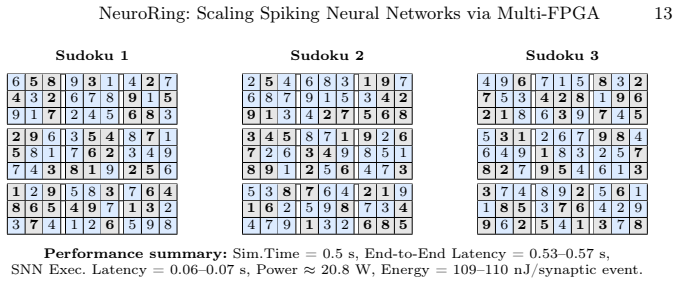
- The same architecture handles a Sudoku constraint-satisfaction workload without changes to the core design.
- Integration with NEST enables direct use of existing large-scale models and analysis tools.
Where Pith is reading between the lines
- Adding more FPGAs to the ring could extend the same scaling behavior to networks larger than the cortical microcircuit.
- The HLS-based implementation lowers the barrier for neuroscientists to experiment with custom FPGA mappings of their models.
- The ring-plus-stream approach may transfer to other event-driven domains such as real-time sensor processing or robotic control.
- Statistical equivalence to NEST opens the possibility of using NeuroRing for hybrid CPU-FPGA workflows where only the most demanding subnetworks run on hardware.
Editorial analysis
A structured set of objections, weighed in public.
Referee Report
Summary. The manuscript introduces NeuroRing, a modular SNN accelerator based on a stream-dataflow architecture and bidirectional ring topology implemented in HLS on FPGAs. It claims integration with the NEST simulator, preservation of key activity statistics, faster-than-real-time execution of the full-scale cortical microcircuit with RTF of 0.83 on two FPGAs, meaningful strong and weak scaling, and competitive energy efficiency. The evaluation is performed on the cortical microcircuit benchmark and a Sudoku workload.
Significance. If the reported performance and equivalence hold, NeuroRing would represent a significant advance in providing a programmable, scalable FPGA platform for large-scale spiking neural network simulations, addressing challenges in sparse communication and synchronization that limit existing platforms. However, with only the abstract available, the significance cannot be fully assessed.
major comments (1)
- [Abstract] Abstract: The abstract states performance metrics such as RTF of 0.83 and scaling results but provides no methods, data, error analysis, or implementation details. This is load-bearing for the central claim that the bidirectional ring topology combined with stream-dataflow architecture manages sparse spike communication and synchronization overheads at scale without performance degradation while maintaining numerical equivalence to NEST.
Simulated Author's Rebuttal
We thank the referee for their review. We address the single major comment below. Since only the abstract is available in this context, our response is necessarily limited to what the abstract itself states.
read point-by-point responses
-
Referee: [Abstract] Abstract: The abstract states performance metrics such as RTF of 0.83 and scaling results but provides no methods, data, error analysis, or implementation details. This is load-bearing for the central claim that the bidirectional ring topology combined with stream-dataflow architecture manages sparse spike communication and synchronization overheads at scale without performance degradation while maintaining numerical equivalence to NEST.
Authors: Abstracts are intentionally concise summaries and do not contain methods, data, or detailed analysis; those elements appear in the body of the full manuscript (implementation in HLS, stream-dataflow architecture, bidirectional ring topology, NEST integration, cortical microcircuit results with activity statistics, RTF measurements, and scaling experiments). The abstract accurately reports the headline outcomes from those sections. We cannot expand on the supporting data or error analysis here because only the abstract text is provided in the current review materials. revision: no
- Full manuscript sections containing methods, implementation details, data, error analysis, and scaling results are not available, preventing a complete point-by-point defense of the load-bearing claims.
Circularity Check
No circularity detectable from abstract-only text
full rationale
Only the abstract is available, containing no equations, derivations, parameter fits, or self-citations. All claims rest on reported benchmark results (RTF 0.83, activity statistics preservation, scaling) rather than any internal reduction to inputs by construction. No load-bearing steps exist to analyze for self-definitional, fitted-prediction, or citation-chain circularity.
Axiom & Free-Parameter Ledger
read the original abstract
Spiking neural networks (SNNs) are a promising paradigm for energy-efficient event-driven computation, but large-scale SNN execution remains challenging because sparse spike communication and synchronization can dominate runtime. Existing solutions across CPU, GPU, ASIC, and FPGA platforms offer different trade-offs between programmability, efficiency, and scalability. To address this gap, we present NeuroRing, a modular and scalable SNN accelerator based on a stream-dataflow architecture and a bidirectional ring topology, implemented in High-Level Synthesis (HLS) on FPGAs. NeuroRing supports modular single- and multi-FPGA deployment and is compatible with existing SNN workflows through integration with the NEST simulator. We evaluate NeuroRing on the cortical microcircuit benchmark and a Sudoku constraint-satisfaction workload. Results show that NeuroRing preserves the key activity statistics of the NEST reference model, achieves faster-than-real-time execution of the full-scale cortical microcircuit with a real-time factor (RTF) of 0.83, exhibits meaningful strong and weak scaling, and provides competitive energy efficiency on two programmable FPGAs. These results position NeuroRing as a flexible and scalable platform for both neuroscience simulation and broader event-driven applications.
Figures


Forward citations
Cited by 1 Pith paper
-
AIGOR: A Modular, Event-Driven Neuromorphic Architecture for Configurable SNN Inference
AIGOR generates modular, timestep-synchronized FPGA SNN cores from a declarative spec and matches snnTorch accuracy and NEST spike patterns on the same Versal cores across two FPGAs.
discussion (0)
Sign in with ORCID, Apple, or X to comment. Anyone can read and Pith papers without signing in.