Recognition: 2 theorem links
Analyzing Unsolicited Internet Traffic: Measuring IoT Security Threats via Network Telescopes
Pith reviewed 2026-05-08 18:32 UTC · model grok-4.3
The pith
A tiny fraction of IP addresses drives most unsolicited IoT scanning traffic.
A machine-rendered reading of the paper's core claim, the machinery that carries it, and where it could break.
Core claim
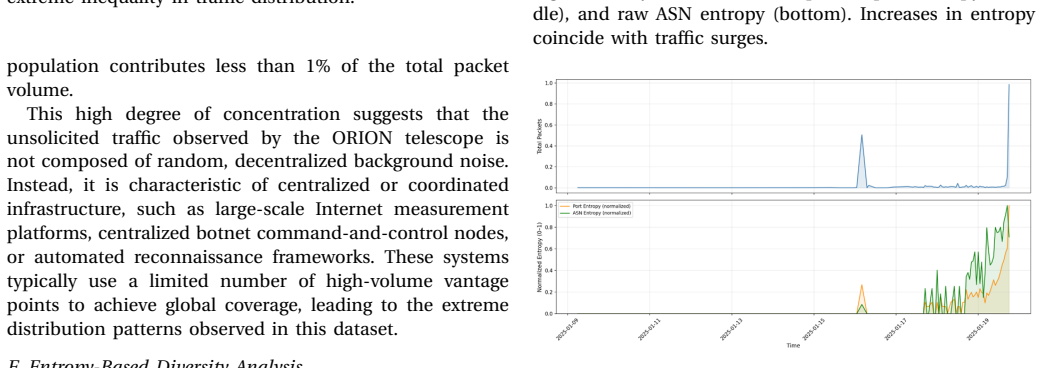
Analysis of traffic captured by the ORION network telescope during January 2025 reveals a highly structured and centralized ecosystem in which the top 1 percent of source IP addresses generate over 81 percent of total packets, with dominant activity on ports 23 and 2323 and synchronized entropy surges that indicate coordinated multi-vector IoT reconnaissance campaigns.
What carries the argument
Privacy-preserving metadata analysis paired with lightweight behavioral heuristics that detect scanning and backscatter patterns plus synchronized entropy surges without payload inspection.
If this is right
- Blocking or rate-limiting the small set of dominant source addresses could reduce the bulk of observed scanning volume.
- The continued dominance of Telnet ports shows that weak-credential attacks on legacy IoT devices remain widespread.
- Entropy-based signals offer a practical marker for identifying coordinated, multi-vector reconnaissance in near real time.
- The same lightweight analysis can support educational datasets and operational threat monitoring without requiring deep packet inspection.
Where Pith is reading between the lines
- The same metadata-only approach could be adapted to live network sensors for early warning of emerging botnet activity.
- Similar centralization patterns may appear when the method is applied to traffic from other geographic or institutional telescopes.
- Device manufacturers could prioritize default-credential changes on ports 23 and 2323 as a high-impact mitigation step.
- Longer observation windows might reveal whether the top sources rotate or remain stable over months.
Load-bearing premise
Metadata and simple behavioral rules alone can reliably separate coordinated scanning campaigns from ordinary background traffic.
What would settle it
A new telescope dataset in which the top 1 percent of sources no longer produce over 81 percent of traffic or in which entropy surges fail to align with known attack events would undermine the central claims.
Figures



read the original abstract
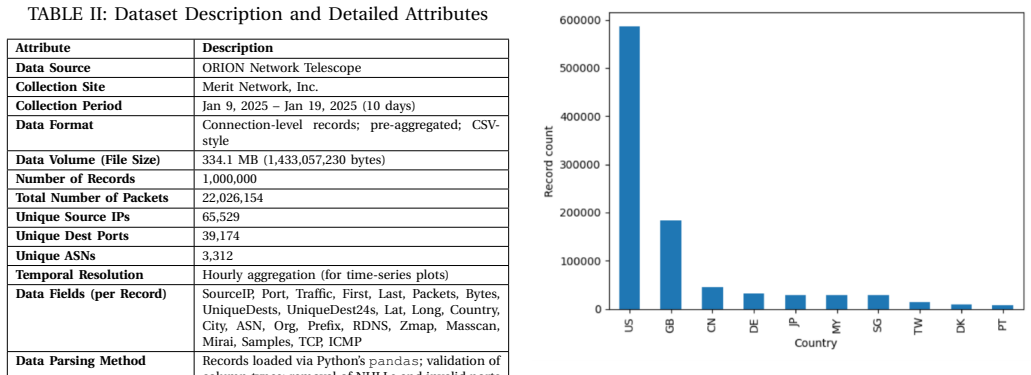
Network telescopes serve as a critical passive monitoring tool for capturing unsolicited Internet traffic, providing insights into global scanning and reconnaissance behavior. This study analyzes a 10-day dataset during January 2025 consisting of approximately 22 million packets collected by the ORION network telescope at Merit Network. By employing privacy-preserving metadata analysis and lightweight behavioral heuristics, we identify scanning and backscatter patterns without payload inspection. Our results reveal a highly structured and centralized ecosystem, where the top 1% of source IP addresses generate over 81% of total traffic. A significant finding is the dominance of Port 23 (Telnet) and Port 2323 (Telnet Alt), which highlights the persistent nature of IoT security threats and widespread attempts to exploit weak credentials in legacy IoT devices. Furthermore, synchronized surges in packet volume and Shannon entropy indicate coordinated, multi-vector reconnaissance campaigns. These findings offer a practical framework for identifying large-scale threat activity and support cybersecurity research and education.
Editorial analysis
A structured set of objections, weighed in public.
Referee Report
Summary. The manuscript analyzes approximately 22 million packets of unsolicited traffic captured over 10 days in January 2025 by the ORION network telescope. Using privacy-preserving metadata analysis and lightweight behavioral heuristics without payload inspection, it identifies scanning and backscatter patterns. Key results include a highly centralized traffic distribution (top 1% of source IPs generating >81% of traffic), dominance of Telnet ports 23 and 2323, and interpretation of synchronized packet-volume and Shannon-entropy surges as evidence of coordinated multi-vector IoT reconnaissance campaigns. The work proposes a practical framework for large-scale threat identification.
Significance. If the heuristics prove robust and the coordination interpretation is validated, the observational dataset and metadata-only approach would provide useful empirical evidence on the structure of IoT scanning ecosystems and a scalable monitoring method. The privacy-preserving design and focus on legacy IoT ports are strengths. However, the absence of ground-truth validation or ablation studies currently limits the reliability of the central threat-attribution claims.
major comments (2)
- Abstract and results: The claim that synchronized surges in packet volume and Shannon entropy indicate 'coordinated, multi-vector reconnaissance campaigns' is load-bearing for the paper's contribution on threat identification, yet it rests on lightweight behavioral heuristics applied to metadata alone. No details are given on exact heuristic definitions, parameter sensitivity, comparison against known botnet timelines, or ablation versus simpler volume thresholds; alternative explanations (diurnal effects, single-source rate variations, backscatter) are not addressed. This leaves the coordination inference under-supported.
- Methodology: The manuscript states that scanning and backscatter patterns are distinguished without payload inspection, but provides no quantitative description of the heuristics, validation against ground truth, error bars, or robustness checks. Because these distinctions underpin both the port-dominance findings and the entropy-volume correlation, the lack of methodological transparency weakens the central claims.
minor comments (2)
- Abstract: The data-collection period and volume are stated, but the manuscript would benefit from explicit mention of the telescope's vantage point characteristics and any filtering applied before the 22-million-packet count.
- Presentation: Figures or tables reporting the top-1% traffic share and port distributions should include confidence intervals or sensitivity ranges to allow readers to assess stability of the 81% figure.
Simulated Author's Rebuttal
We thank the referee for the constructive and detailed feedback. We agree that the manuscript requires greater methodological transparency and explicit discussion of alternative explanations to strengthen the central claims. We address each major comment below and will revise the paper accordingly.
read point-by-point responses
-
Referee: Abstract and results: The claim that synchronized surges in packet volume and Shannon entropy indicate 'coordinated, multi-vector reconnaissance campaigns' is load-bearing for the paper's contribution on threat identification, yet it rests on lightweight behavioral heuristics applied to metadata alone. No details are given on exact heuristic definitions, parameter sensitivity, comparison against known botnet timelines, or ablation versus simpler volume thresholds; alternative explanations (diurnal effects, single-source rate variations, backscatter) are not addressed. This leaves the coordination inference under-supported.
Authors: We acknowledge that the coordination inference requires stronger support through explicit methodology. In the revised manuscript we will add a new subsection detailing the exact heuristic: synchronized surges are flagged when both packet volume and Shannon entropy (computed over 5-minute bins on destination-port distributions) exceed a z-score threshold of 2.0 relative to a 24-hour rolling baseline. We will include a parameter-sensitivity table showing how results change across thresholds (1.5–3.0) and bin sizes (1–15 min). Alternative explanations will be discussed, including diurnal cycles (ruled out by the multi-port, multi-day persistence) and backscatter (inconsistent with the observed source-IP concentration and entropy rise). Direct timeline matching to specific botnets is limited by the anonymized telescope data; we will reference Mirai-era reports as contextual support and rephrase the claim as 'suggestive of coordinated activity' rather than definitive. These additions will appear in both the Methodology and Results sections. revision: yes
-
Referee: Methodology: The manuscript states that scanning and backscatter patterns are distinguished without payload inspection, but provides no quantitative description of the heuristics, validation against ground truth, error bars, or robustness checks. Because these distinctions underpin both the port-dominance findings and the entropy-volume correlation, the lack of methodological transparency weakens the central claims.
Authors: We agree that quantitative detail is currently insufficient. The revised Methodology section will specify the classification rules: scanning is identified by high source-IP diversity (>100 distinct sources per port in a bin) combined with low per-source entropy (<1.5 bits), while backscatter is flagged by concentrated destination-IP responses with elevated TCP flags. We will provide the Shannon-entropy formula used, pseudocode for the surge detector, and bootstrap-derived error bars on the top-1% traffic share. Robustness will be demonstrated by repeating the analysis with varied window sizes and noise-injection tests. Full ground-truth validation is not feasible with passive metadata-only telescope data; we will state this limitation explicitly and instead cross-validate against synthetic scanning traces and published IoT-botnet traffic signatures. These changes will be incorporated as a new 'Heuristic Definitions and Validation' subsection. revision: partial
- Ground-truth validation of the coordination and scanning/backscatter heuristics, which cannot be obtained from this passive, metadata-only observational dataset without additional active or payload-bearing data sources.
Circularity Check
No significant circularity in observational traffic analysis
full rationale
The paper reports direct empirical measurements from a fixed 10-day ORION telescope dataset using metadata-only heuristics. Key results (top 1% IPs generating 81% traffic, Telnet port dominance, volume-entropy surges) are statistical summaries of observed packets, not outputs of equations, fitted parameters, or models that reduce to inputs by construction. No derivations, self-citations, uniqueness theorems, or ansatzes appear in the provided text. The coordination interpretation is post-hoc labeling of patterns, not a load-bearing derivation. This is self-contained data analysis against external benchmarks.
Axiom & Free-Parameter Ledger
axioms (2)
- domain assumption Network telescopes passively capture unsolicited internet traffic that reflects global scanning and reconnaissance behavior.
- domain assumption Behavioral heuristics applied to metadata alone can distinguish scanning patterns and backscatter without false positives from other traffic.
Forward citations
Cited by 1 Pith paper
-
Characterizing AI-Assisted Bot Traffic in Darknet Data: Implications for ICS and IIoT Security
Darknet analysis shows ICS bot traffic doubling from 0.82% to 1.51% over four years, with micro-pacing enabling 97.47% evasion of standard volumetric IDS thresholds.
Reference graph
Works this paper leans on
-
[1]
A lightweight machine learning approach for anomalous unsolicited network traffic detection by observing network telescopes,
S. Ismail, S. Dandan, and M. King, “ A lightweight machine learning approach for anomalous unsolicited network traffic detection by observing network telescopes,” in2025 IEEE 15th Annual Computing and Communication Workshop and Conference (CCWC), 2025, pp. 00 407–00 413
2025
-
[2]
Merit network telescope: Processing and initial insights from nearly 20 years of darknet traffic for cybersecurity research,
S. Ismail, E. Hammad, W . Hatcher, S. Dandan, A. Alomari, and M. Spratt, “Merit network telescope: Processing and initial insights from nearly 20 years of darknet traffic for cybersecurity research,” inProceedings of the IEEE UEMCON 2025 Conference, October 23–24 2025, accepted
2025
-
[3]
Less is more? exploring the impact of scaled-down network telescopes on security and research,
A. V . Camargo, L. M. Bertholdo, and L. Z. Granville, “Less is more? exploring the impact of scaled-down network telescopes on security and research,” inSimpósio Brasileiro de Redes de Computadores e Sistemas Distribuídos (SBRC). SBC, 2024, pp. 1050–1063
2024
-
[4]
Lessons learned from operating a large network telescope,
A. Männel, J. Mücke, K. Claffy, M. Gao, R. K. Mok, M. Nawrocki, T . C. Schmidt, and M. Wählisch, “Lessons learned from operating a large network telescope,” inProceedings of the ACM SIGCOMM 2025 Conference, 2025, pp. 826–841
2025
-
[5]
Have you syn me? characterizing ten years of internet scanning,
H. Griffioen, G. Koursiounis, G. Smaragdakis, and C. Doerr, “Have you syn me? characterizing ten years of internet scanning,” inProceedings of the 2024 ACM on Internet Measurement Conference, 2024, pp. 149– 164
2024
-
[6]
ORION: Observatory for cyber-risk insights and outages of networks,
“ORION: Observatory for cyber-risk insights and outages of networks,” accessed: September 23, 2024. [Online]. Available: https://www.merit.edu/research/projects/orion-network-telescope/
2024
-
[7]
Characterizing internet background traffic from a spain-based net- work telescope,
R. García-Peñas, R. A. Rodríguez-Gómez, and G. Maciá-Fernández, “Characterizing internet background traffic from a spain-based net- work telescope,”Computers & Security, vol. 159, p. 104693, 2025
2025
-
[8]
A comparative study of packet capture tools for reliable network telescope traffic collection,
S. Ismail, E. Hammad, S. Dandan, W . Hatcher, and A. Alomari, “ A comparative study of packet capture tools for reliable network telescope traffic collection,” inProceedings of the IEEE UEMCON 2025 Conference, October 23–24 2025, accepted
2025
-
[9]
i-darkvec: Incremental embeddings for darknet traffic analysis,
L. Gioacchini, L. Vassio, M. Mellia, I. Drago, Z. B. Houidi, and D. Rossi, “i-darkvec: Incremental embeddings for darknet traffic analysis,”ACM Transactions on Internet Technology, vol. 23, no. 3, pp. 1–28, 2023
2023
-
[10]
Identifying and differentiat- ing acknowledged scanners in network traffic,
M. P . Collins, A. Hussain, and S. Schwab, “Identifying and differentiat- ing acknowledged scanners in network traffic,” in2023 IEEE European Symposium on Security and Privacy Workshops (EuroS&PW). IEEE, 2023, pp. 567–574
2023
-
[11]
Characterizing large-scale adversarial activities through large-scale honey-nets,
T . Haikal, E. Hammad, and S. Ismail, “Characterizing large-scale adversarial activities through large-scale honey-nets,” inProceedings of the IEEE UEMCON 2025 Conference, October 23–24 2025, accepted
2025
-
[12]
A search engine backed by internet-wide scanning,
Z. Durumeric, D. Adrian, A. Mirian, M. Bailey, and J. A. Halderman, “ A search engine backed by internet-wide scanning,” inProceedings of the 22nd ACM SIGSAC conference on computer and communications security, 2015, pp. 542–553
2015
-
[13]
Darknet threats and detection strategies: A concise overview,
M. J. Obaidat, I. A. Al-Syouf, Y. F . Awawdeh, A. E. Masa’ deh, and Q. A. Al-Haija, “Darknet threats and detection strategies: A concise overview,” in2025 16th International Conference on Information and Communication Systems (ICICS). IEEE, 2025, pp. 1–6
2025
-
[14]
Detecting and Interpreting Changes in Scanning Behavior in Large Network Telescopes,
M. Kallitsis, R. Prajapati, V . Honavar, D. Wu, and J. Yen, “Detecting and Interpreting Changes in Scanning Behavior in Large Network Telescopes,”IEEE Transactions on Information Forensics and Security, vol. 17, pp. 3611–3625, 2022. [Online]. Available: http://dx.doi.org/10.1109/TIFS.2022.3211644
-
[15]
Threat Intelligence Generation Using Network Telescope Data for Industrial Control Systems,
O. Cabana, A. M. Youssef, M. Debbabi, B. Lebel, M. Kassouf, R. Atallah, and B. L. Agba, “Threat Intelligence Generation Using Network Telescope Data for Industrial Control Systems,”IEEE Transactions on Information Forensics and Security, vol. 16, pp. 3355–3370, 2021. [Online]. Available: http://dx.doi.org/10.1109/TIFS.2021.3078261
-
[16]
A framework for the application of network telescope sensors in a global ip network,
B. V . W . Irwin, “ A framework for the application of network telescope sensors in a global ip network,” 2011
2011
discussion (0)
Sign in with ORCID, Apple, or X to comment. Anyone can read and Pith papers without signing in.