Recognition: unknown
Time-Dependent Dynamical Dimensional Transmutation in the SU(2) Gross-Neveu Model with Time-Dependent Interaction Strength
Pith reviewed 2026-05-08 16:10 UTC · model grok-4.3
The pith
Time progression in the time-dependent SU(2) Gross-Neveu model equates to renormalization group flow in the static version.
A machine-rendered reading of the paper's core claim, the machinery that carries it, and where it could break.
Core claim
The central discovery is that identifying the time t of the driven model with ln Λ of the static model makes the time-dependent coupling follow the RG flow, preserving integrability via the generalized Bethe ansatz. This leads to a time-dependent dynamical dimensional transmutation in the adiabatic regime, where the mass gap evolves as m(Δt) = m0 e^{-π α0 Δt}, and to asymptotic freedom at large times where the system reaches the UV fixed point of the SU(2)_1 WZNW model. Thus time evolution is shown to be equivalent to RG flow.
What carries the argument
The exact matching of the time-dependent coupling strength's trajectory to the renormalization group flow equations of the static model, with time identified as the logarithm of the cutoff.
If this is right
- A time-dependent mass gap is generated in the adiabatic regime according to m(Δt) = m0 e^{-π α0 Δt}.
- The model flows to the SU(2)_1 WZNW model at large times, corresponding to the UV fixed point.
- The adiabatic regime corresponds to the scaling regime of the static model.
- The system is integrable only when the coupling follows the RG trajectory exactly.
Where Pith is reading between the lines
- This construction offers a way to dynamically simulate renormalization group flows using time-dependent Hamiltonians in quantum systems.
- Analogous time-dependent versions of other integrable models could reveal similar equivalences between time evolution and scaling flows.
- The exponential decay of the mass gap with time might be observable in experimental setups with tunable fermion interactions.
Load-bearing premise
The time-dependent coupling can be engineered to have trajectories in time that precisely match the renormalization group flow equations of the static model under the identification of time with the log of the cutoff.
What would settle it
An experiment or numerical simulation of the time-dependent SU(2) Gross-Neveu model with the specified coupling showing no exponential decay in the mass gap during the adiabatic regime, or no approach to the WZNW model at late times, would falsify the claimed equivalence.
Figures
read the original abstract
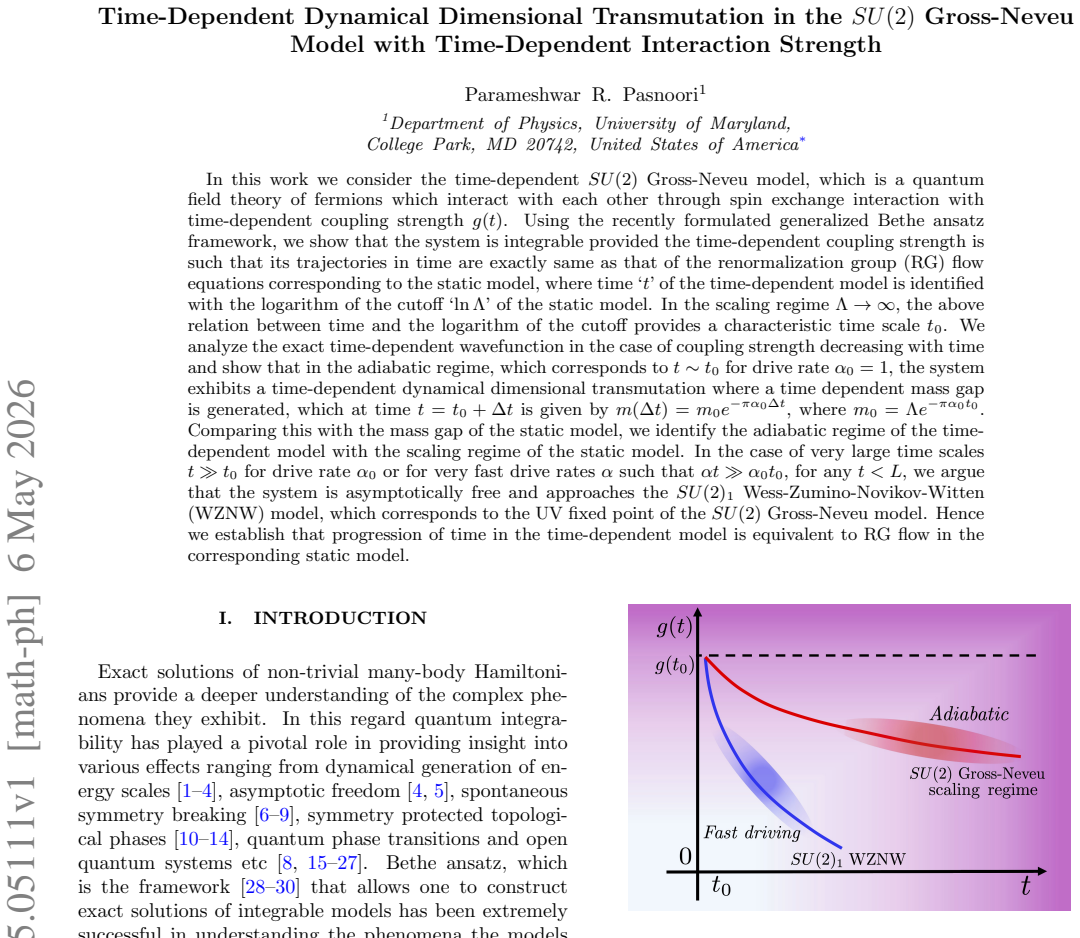
In this work we consider the time-dependent $SU(2)$ Gross-Neveu model, which is a quantum field theory of fermions which interact with each other through spin exchange interaction with time-dependent coupling strength $g(t)$. Using the recently formulated generalized Bethe ansatz framework, we show that the system is integrable provided the time-dependent coupling strength is such that its trajectories in time are exactly same as that of the renormalization group (RG) flow equations corresponding to the static model, where time `$t$' of the time-dependent model is identified with the logarithm of the cutoff `$\ln \Lambda$' of the static model. In the scaling regime $\Lambda\rightarrow\infty$, the above relation between time and the logarithm of the cutoff provides a characteristic time scale $t_0$. We analyze the exact time-dependent wavefunction in the case of coupling strength decreasing with time and show that in the adiabatic regime, which corresponds to $t\sim t_0$ for drive rate $\alpha_0=1$, the system exhibits a time-dependent dynamical dimensional transmutation where a time dependent mass gap is generated, which at time $t=t_0+\Delta t$ is given by $m(\Delta t)=m_0 e^{-\pi\alpha_0\Delta t}$, where $m_0=\Lambda e^{-\pi \alpha_0 t_0}$. Comparing this with the mass gap of the static model, we identify the adiabatic regime of the time-dependent model with the scaling regime of the static model. In the case of very large time scales $t\gg t_0$ for drive rate $\alpha_0$ or for very fast drive rates $\alpha$ such that $\alpha t \gg \alpha_0t_0$, for any $t<L$, we argue that the system is asymptotically free and approaches the $SU(2)_1$ Wess-Zumino-Novikov-Witten (WZNW) model, which corresponds to the UV fixed point of the $SU(2)$ Gross-Neveu model. Hence we establish that progression of time in the time-dependent model is equivalent to RG flow in the corresponding static model.
Editorial analysis
A structured set of objections, weighed in public.
Referee Report
Summary. The paper considers the time-dependent SU(2) Gross-Neveu model with time-dependent coupling g(t). It claims that the model is integrable via the generalized Bethe ansatz when g(t) trajectories exactly match the RG flow of the static model, with the identification t ↔ ln Λ. In the adiabatic regime for decreasing g(t), an exact time-dependent wavefunction yields a dynamical mass gap m(Δt) = m0 exp(−π α0 Δt). For large t ≫ t0 or fast drives, the system is argued to approach the SU(2)_1 WZNW model, establishing that time progression is equivalent to RG flow in the static model.
Significance. If the central mapping and derivations are rigorously justified, the work would provide a dynamical realization of dimensional transmutation and a direct link between unitary evolution in a driven integrable QFT and the RG trajectory of its static counterpart. This has potential implications for non-equilibrium QFT and driven integrable systems. The derivation of the exact wavefunction in the adiabatic regime via the generalized Bethe ansatz framework is a technical strength.
major comments (3)
- [Abstract] The abstract states that the exact wavefunction and mass-gap formula follow from the generalized Bethe ansatz once g(t) matches the RG flow, but provides no derivation steps or verification that the framework extends to the time-dependent case; the central mapping t ↔ ln Λ is asserted rather than derived.
- [adiabatic regime analysis] The reported mass gap m(Δt) = m0 exp(−π α0 Δt) with m0 = Λ exp(−π α0 t0) is obtained by direct comparison with the known static-model gap after the t ↔ ln Λ identification; the functional form is therefore imported rather than independently derived from the time-dependent equations.
- [large time scales discussion] For t ≫ t0 or α t ≫ α0 t0, the claim that the system approaches the SU(2)_1 WZNW model rests on a qualitative argument for asymptotic freedom without deriving the time-dependent wavefunction, spectrum, or correlation functions that would confirm the UV fixed-point equivalence.
minor comments (2)
- Clarify the distinction between the drive rate α0 and any other α appearing in the large-time discussion.
- Include the specific citation for the 'recently formulated generalized Bethe ansatz framework' when first referenced.
Simulated Author's Rebuttal
We thank the referee for the detailed and constructive report. The comments highlight areas where the presentation of the central mapping and derivations can be clarified and strengthened. Below we respond point by point to the major comments, indicating the revisions we will implement in the revised manuscript.
read point-by-point responses
-
Referee: [Abstract] The abstract states that the exact wavefunction and mass-gap formula follow from the generalized Bethe ansatz once g(t) matches the RG flow, but provides no derivation steps or verification that the framework extends to the time-dependent case; the central mapping t ↔ ln Λ is asserted rather than derived.
Authors: We agree that the abstract is too concise on this point. In the main text (Sections 2 and 3) we derive the integrability condition by substituting the time-dependent coupling into the generalized Bethe ansatz equations and requiring consistency with the static RG beta function, which directly yields the identification t ↔ ln Λ together with the characteristic scale t0. The abstract will be revised to briefly indicate these steps and the resulting equivalence. revision: partial
-
Referee: [adiabatic regime analysis] The reported mass gap m(Δt) = m0 exp(−π α0 Δt) with m0 = Λ exp(−π α0 t0) is obtained by direct comparison with the known static-model gap after the t ↔ ln Λ identification; the functional form is therefore imported rather than independently derived from the time-dependent equations.
Authors: The functional form is indeed matched via the central t ↔ ln Λ identification, which is the main result of the work. However, we first obtain the explicit time-dependent wavefunction in the adiabatic regime (t ∼ t0) directly from the generalized Bethe ansatz with the RG-matched g(t); the mass gap then follows from the asymptotic behavior of this wavefunction. We will add an expanded paragraph in Section 4 that isolates this derivation before performing the comparison, making the logical order clearer. revision: yes
-
Referee: [large time scales discussion] For t ≫ t0 or α t ≫ α0 t0, the claim that the system approaches the SU(2)_1 WZNW model rests on a qualitative argument for asymptotic freedom without deriving the time-dependent wavefunction, spectrum, or correlation functions that would confirm the UV fixed-point equivalence.
Authors: We acknowledge that the argument in the current Section 5 is qualitative, relying on the vanishing of g(t) at large t (corresponding to the UV regime) and the known fixed-point structure of the static model. A fully rigorous derivation of the time-dependent spectrum and correlators in this regime would require additional technical work beyond the present scope. We will revise the section to state the limitations explicitly, provide a sketch of the asymptotic Bethe equations for small g(t), and note that a complete confirmation of the WZNW equivalence is left for future study. revision: partial
Circularity Check
Equivalence of time progression to RG flow is imposed by construction via g(t) matching and t ↔ ln Λ identification
specific steps
-
self definitional
[Abstract]
"we show that the system is integrable provided the time-dependent coupling strength is such that its trajectories in time are exactly same as that of the renormalization group (RG) flow equations corresponding to the static model, where time `t' of the time-dependent model is identified with the logarithm of the cutoff `ln Λ' of the static model"
The model is defined by requiring g(t) to follow the static RG trajectory under the t ↔ ln Λ map; therefore any claimed equivalence between unitary time evolution and RG flow is true by the choice of coupling rather than emerging from the dynamics.
-
self definitional
[Abstract]
"the system exhibits a time-dependent dynamical dimensional transmutation where a time dependent mass gap is generated, which at time t=t0+Δt is given by m(Δt)=m0 e^{-πα0Δt}, where m0=Λ e^{-π α0 t0}. Comparing this with the mass gap of the static model, we identify the adiabatic regime of the time-dependent model with the scaling regime of the static model"
The explicit functional form m(Δt) = m0 exp(−π α0 Δt) with m0 = Λ exp(−π α0 t0) is obtained by matching to the known static-model gap after the t ↔ ln Λ identification; it is not independently derived from the time-dependent wavefunction or generalized Bethe ansatz.
full rationale
The paper conditions integrability and all subsequent results on choosing the time-dependent coupling g(t) to exactly replicate the static model's RG flow equations under the explicit identification t = ln Λ. The adiabatic-regime mass gap is then presented by direct comparison to the static-model gap rather than computed from the time-dependent Bethe-ansatz equations. While the generalized Bethe ansatz supplies a non-trivial integrability condition, the central claim that 'progression of time ... is equivalent to RG flow' reduces to this definitional setup plus a qualitative argument for the UV regime; the functional forms are imported rather than independently derived.
Axiom & Free-Parameter Ledger
free parameters (2)
- α0
- t0
axioms (2)
- domain assumption The system remains integrable when the time-dependent coupling g(t) follows the RG flow trajectory of the static model.
- ad hoc to paper Time t in the driven model can be identified with ln Λ of the static model.
Reference graph
Works this paper leans on
-
[1]
which provides a unifying framework to obtain exact solutions of Hamiltonians with time-dependent coupling strengths [32–34]. In this framework, the problem of solving the time- dependent Schrodinger equation can be reduced to a set of matrix difference equations, namely quantum Knizhnik-Zamolodchikov (qKZ) equations [35–38]. The FIG. 1: Figure depicts ad...
work page internal anchor Pith review Pith/arXiv arXiv 2026
-
[2]
One takes the scal- ing limitλ→ ∞whileg→0 such that the physical mass mis fixed
wheregis the coupling strength. One takes the scal- ing limitλ→ ∞whileg→0 such that the physical mass mis fixed. Thus, comparing the above we identify the adiabatic regime of the time-dependent model with the scaling regime of the static model. In other words, the time-dependent model exhibits a time-dependent dynam- ical dimensional transmutation where t...
-
[3]
For earlier time scales such that t≪t 0, where the drive rate is much faster compared to the above drive rate, the exact wavefunction (29) cannot be approximated by the saddle point of the Yang-Yang action, and thereby it does not take the form where it is proportional to the instantaneous eigenstates. This sug- gests that these earlier times scalest≪t 0 ...
-
[4]
using the framework developed in [31], where the 12 exact solution to the time-dependent Schrodinger equa- tion was constructed. Following the recent work [34], here we have shown that the functional form of the time- dependent coupling strength which preserves integrabil- ity is such that its trajectories in time are exactly that of the renormalization g...
-
[5]
P. W. Anderson, G. Yuval, and D. R. Hamann, Phys. Rev. B1, 4464 (1970)
1970
-
[6]
Andrei and J
N. Andrei and J. H. Lowenstein, Phys. Rev. Lett.46, 356 (1981)
1981
-
[7]
Andrei, Phys
N. Andrei, Phys. Rev. Lett.45, 379 (1980)
1980
-
[8]
Andrei and J
N. Andrei and J. H. Lowenstein, Phys. Rev. Lett.43, 1698 (1979)
1979
-
[9]
D. J. Gross and A. Neveu, Phys. Rev. D10, 3235 (1974)
1974
-
[11]
Takahashi,Thermodynamics of One-Dimensional Solvable Models, by Minoru Takahashi, Cambridge, UK: Cambridge University Press, 1999(1999)
M. Takahashi,Thermodynamics of One-Dimensional Solvable Models, by Minoru Takahashi, Cambridge, UK: Cambridge University Press, 1999(1999)
1999
-
[12]
P. R. Pasnoori, Y. Tang, J. Lee, J. H. Pixley, N. Andrei, and P. Azaria, Phys. Rev. B112, 075121 (2025)
2025
-
[13]
B. S. Shastry, Phys. Rev. Lett.56, 1529 (1986)
1986
-
[14]
P. R. Pasnoori, N. Andrei, and P. Azaria, Phys. Rev. B 102, 214511 (2020)
2020
-
[15]
P. R. Pasnoori, N. Andrei, and P. Azaria, Phys. Rev. B 104, 134519 (2021)
2021
-
[16]
P. R. Pasnoori, P. Azaria, C. Rylands, and N. Andrei, Phys. Rev. B113, 054509 (2026)
2026
-
[17]
Realizing a symmetry protected topological phase in a superconduct- ing circuit,
P. R. Pasnoori, P. Azaria, and A. Mizel, “Realizing a symmetry protected topological phase in a superconduct- ing circuit,” (2025), arXiv:2503.13406 [quant-ph]
-
[18]
Duality symmetry, zero energy modes and boundary spectrum of the sine-gordon/massive thirring model,
P. R. Pasnoori, A. Mizel, and P. Azaria, “Duality symmetry, zero energy modes and boundary spectrum of the sine-gordon/massive thirring model,” (2025), arXiv:2503.14776 [hep-th]
-
[19]
P. R. Pasnoori and P. Azaria, Phys. Rev. B113, 075121 (2026)
2026
-
[20]
P. R. Pasnoori, C. Rylands, and N. Andrei, Phys. Rev. Res.2, 013006 (2020)
2020
-
[21]
M. V. Medvedyeva, F. H. L. Essler, and T. c. v. Prosen, Phys. Rev. Lett.117, 137202 (2016)
2016
-
[22]
P. R. Pasnoori, N. Andrei, C. Rylands, and P. Azaria, Phys. Rev. B105, 174517 (2022)
2022
-
[23]
Nakagawa, N
M. Nakagawa, N. Kawakami, and M. Ueda, Phys. Rev. Lett.121, 203001 (2018)
2018
-
[24]
Melin, Y
V. Melin, Y. Sekiguchi, P. Wiegmann, and K. Zarembo, Phys. Rev. Lett.133, 101601 (2024)
2024
-
[25]
P. R. Pasnoori, J. Lee, J. H. Pixley, N. Andrei, and P. Azaria, Phys. Rev. B107, 224412 (2023)
2023
-
[26]
B. Buca, C. Booker, M. Medenjak, and D. Jaksch, New Journal of Physics22, 123040 (2020). 13
2020
-
[27]
P. R. Pasnoori, Y. Tang, J. Lee, J. H. Pixley, P. Azaria, and N. Andrei, Phys. Rev. B113, 054424 (2026)
2026
-
[28]
Kattel, P
P. Kattel, P. R. Pasnoori, J. H. Pixley, P. Azaria, and N. Andrei, Phys. Rev. B109, 174416 (2024)
2024
-
[29]
A. A. Ziolkowska and F. H. Essler, SciPost Phys.8, 044 (2020)
2020
-
[30]
Kattel, A
P. Kattel, A. Zhakenov, P. R. Pasnoori, P. Azaria, and N. Andrei, Phys. Rev. B111, L201106 (2025)
2025
-
[31]
Kattel, P
P. Kattel, P. R. Pasnoori, J. H. Pixley, and N. Andrei, Phys. Rev. B111, 224407 (2025)
2025
-
[32]
Bethe, Zeitschrift fur Physik71, 205 (1931)
H. Bethe, Zeitschrift fur Physik71, 205 (1931)
1931
-
[33]
Hulthen, ¨Uber das Austauschproblem eines Kristalles, Ph.D
L. Hulthen, ¨Uber das Austauschproblem eines Kristalles, Ph.D. thesis, , Stockholm College (1938)
1938
-
[34]
E. K. Sklyanin, L. A. Takhtadzhyan, and L. D. Fad- deev, Teoreticheskaya i Matematicheskaya Fizika Kvan- tovyj metod obratnoj zadachi 1,40, 194 (1979)
1979
-
[35]
P. R. Pasnoori, Phys. Rev. B112, L060409 (2025)
2025
-
[36]
P. R. Pasnoori, Phys. Rev. B113, 094514 (2026)
2026
-
[37]
Exact many-body wavefunction of the kondo model with time-dependent interaction strength,
P. R. Pasnoori and E. A. Yuzbashyan, “Exact many-body wavefunction of the kondo model with time-dependent interaction strength,” (2025), arXiv:2509.05640 [cond- mat.str-el]
-
[38]
P. R. Pasnoori, “Quantum integrability of hamiltoni- ans with time-dependent interaction strengths and the renormalization group flow,” (2025), arXiv:2512.13625 [quant-ph]
-
[39]
F. A. Smirnov, Journal of Physics A: Mathematical and General19, L575 (1986)
1986
-
[40]
I. B. Frenkel and N. Y. Reshetikhin, Communications in Mathematical Physics146, 1 (1992)
1992
-
[41]
Reshetikhin, Letters in Mathematical Physics26, 153 (1992)
N. Reshetikhin, Letters in Mathematical Physics26, 153 (1992)
1992
-
[42]
Reshetikhin, Letters in Mathematical Physics26, 167 (1992)
N. Reshetikhin, Letters in Mathematical Physics26, 167 (1992)
1992
-
[43]
K. G. Wilson, Phys. Rev. B4, 3174 (1971)
1971
-
[44]
K. G. Wilson, Rev. Mod. Phys.47, 773 (1975)
1975
-
[45]
C. G. Callan, Phys. Rev. D2, 1541 (1970)
1970
-
[46]
Symanzik, Communications in Mathematical Physics 18, 227 (1970)
K. Symanzik, Communications in Mathematical Physics 18, 227 (1970)
1970
-
[47]
Hoare, N
B. Hoare, N. Levine, and A. A. Tseytlin, Journal of High Energy Physics2020, 20 (2020)
2020
-
[48]
P. B. Wiegmann, Journal of Physics C: Solid State Physics14, 1463 (1981)
1981
-
[49]
Wess and B
J. Wess and B. Zumino, Physics Letters B37, 95 (1971)
1971
-
[50]
Witten, Nuclear Physics B223, 422 (1983)
E. Witten, Nuclear Physics B223, 422 (1983)
1983
-
[51]
Destri and J
C. Destri and J. Lowenstein, Nuclear Physics B205, 369 (1982)
1982
-
[52]
R. J. Baxter, Annals of Physics70, 193 (1972)
1972
-
[53]
C. N. Yang, Phys. Rev. Lett.19, 1312 (1967)
1967
-
[54]
S. N. M. Ruijsenaars, Journal of Mathematical Physics 38, 1069 (1997), https://pubs.aip.org/aip/jmp/article- pdf/38/2/1069/19136488/1069 1 online.pdf
1997
-
[55]
Babujian, M
H. Babujian, M. Karowski, and A. Zapletal, Journal of Physics A: Mathematical and General30, 6425 (1997)
1997
-
[56]
Jimbo and T
M. Jimbo and T. Miwa,Algebraic Analysis of Solvable Lattice Models(American Mathematical Society, 1995)
1995
-
[57]
Cherednik,Double Affine Hecke Algebras(Cambridge University Press, 2006)
I. Cherednik,Double Affine Hecke Algebras(Cambridge University Press, 2006)
2006
- [58]
-
[59]
Knizhnik and A
V. Knizhnik and A. Zamolodchikov, Nuclear Physics B 247, 83 (1984)
1984
-
[60]
Note that this amplitude is a vector in the spin space of the fermions
discussion (0)
Sign in with ORCID, Apple, or X to comment. Anyone can read and Pith papers without signing in.