Rapid and robust simulation-based inference for kilonovae
Pith reviewed 2026-06-30 21:12 UTC · model grok-4.3
The pith
Simulation-based inference recovers kilonova parameters accurately by learning emulator uncertainty structure directly from simulations.
A machine-rendered reading of the paper's core claim, the machinery that carries it, and where it could break.
Core claim
The central claim is that simulation-based inference learns the non-Gaussian, correlated structure of emulator uncertainty directly from forward simulations of kilonovae, providing accurate posterior samples in seconds while traditional MCMC methods suffer systematic bias from likelihood misspecification. This is demonstrated in recovery tests on injected parameters and in analysis of AT2017gfo, where SBI infers a total ejecta mass of approximately 0.087 solar masses dominated by lanthanide-poor ejecta and excludes toroidal and peanut geometries at the 99th percentile.
What carries the argument
Density-estimation likelihood-free inference framework trained on Gaussian process emulators of POSSIS kilonova simulations. It directly models the mapping from simulated observables to parameters without an explicit likelihood function.
If this is right
- The SBI framework produces approximately 20,000 posterior samples in seconds per event.
- MCMC posteriors for AT2017gfo accumulate at prior boundaries while SBI posteriors remain interior.
- The inferred total ejecta mass for AT2017gfo is about 0.087 solar masses and is dominated by lanthanide-poor material.
- Toroidal and peanut ejecta geometries are excluded at the 99th percentile for both components.
- Simulation studies show SBI recovers injected parameters without the systematic bias seen in MCMC.
Where Pith is reading between the lines
- This approach could support real-time parameter estimation during future multi-messenger events that produce multiple kilonovae.
- The framework may apply to other transient sources where simulation costs are high and emulator errors are complex.
- Testing on additional observed kilonovae beyond AT2017gfo would check whether the learned uncertainty structure generalizes.
Load-bearing premise
The Gaussian process emulator trained on the simulations captures the true non-Gaussian and correlated structure of emulator uncertainty accurately enough that the inference remains reliable on real data.
What would settle it
Apply both SBI and MCMC to a new set of simulated kilonova light curves generated with known injected parameters plus realistic non-Gaussian emulator errors; if SBI credible intervals contain the true values while MCMC shows consistent offsets, the claim holds.
Figures


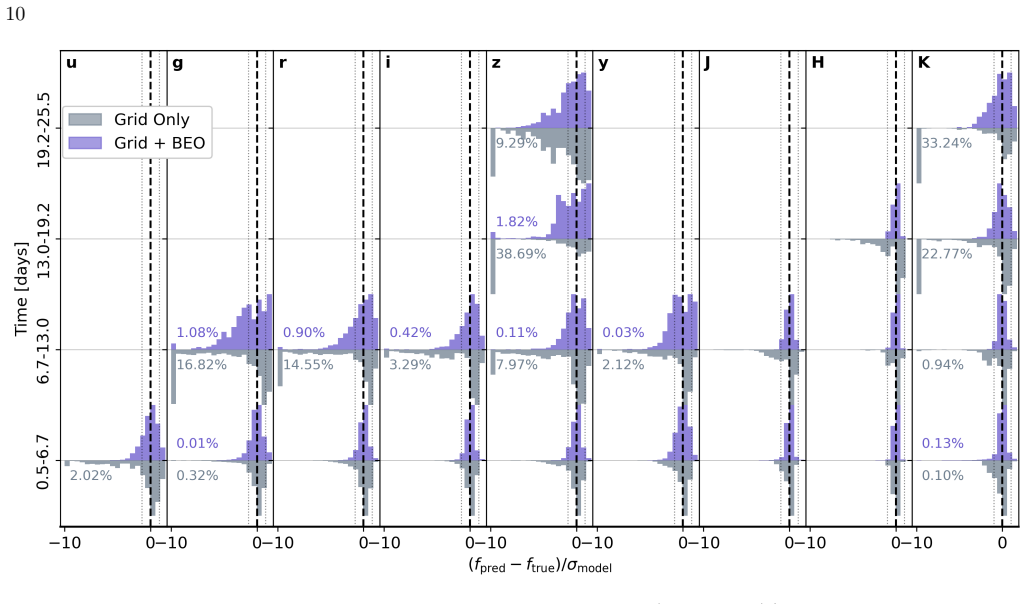


read the original abstract
With the next generation of both electromagnetic and gravitational wave observatories beginning to come online, rapid analysis methods for kilonova data are becoming increasingly important in astronomy. Traditional Bayesian parameter estimation using Markov chain Monte Carlo (MCMC) is time-consuming and relies on explicit likelihood approximations that can break down when modeling uncertainties are significant. We develop a simulation-based inference (SBI) framework for kilonova parameter estimation using density-estimation likelihood-free inference. The framework uses a Gaussian process emulator trained on $\sim 1300$ POSSIS simulations. We demonstrate that SBI provides a rapid alternative to MCMC that is robust to likelihood misspecification. The standard Gaussian likelihood approximation fails to capture the non-Gaussian, correlated structure of emulator uncertainty; SBI learns this structure directly from forward simulations. Simulation studies show that the SBI method accurately recovers injected parameters, while the MCMC suffers from systematic bias caused by likelihood misspecification. This problem persists when analyzing AT2017gfo, where a subset of the MCMC posteriors pile up at prior boundaries and the SBI posteriors do not. The SBI framework infers a total ejecta mass of $\sim 0.087 M_{\odot}$ dominated by lanthanide-poor ejecta and excludes toroidal and peanut ejecta geometries at the 99th percentile for both components. The SBI framework generates $\sim 2 \times 10^{4}$ posterior samples in seconds.
Editorial analysis
A structured set of objections, weighed in public.
Referee Report
Summary. The manuscript develops a simulation-based inference (SBI) framework for kilonova parameter estimation that trains a Gaussian process emulator on ~1300 POSSIS simulations and employs density-estimation likelihood-free inference. It claims that SBI provides a rapid alternative to MCMC, is robust to likelihood misspecification because it learns the non-Gaussian and correlated structure of emulator uncertainty directly from forward simulations, accurately recovers injected parameters in simulation studies (while MCMC exhibits systematic bias), and when applied to AT2017gfo yields a total ejecta mass of ~0.087 M⊙ dominated by lanthanide-poor material while excluding toroidal and peanut geometries at the 99th percentile.
Significance. If the results hold, the work would represent a useful contribution to rapid kilonova analysis methods needed for upcoming electromagnetic and gravitational-wave facilities. The explicit contrast between SBI and Gaussian-likelihood MCMC on both simulated and real data (AT2017gfo) is a concrete strength, as is the use of forward simulations to capture emulator uncertainty structure. The reported inference on ejecta mass and geometry exclusion provides a falsifiable prediction that can be tested with future observations.
major comments (1)
- [Abstract (simulation studies and emulator description)] The simulation studies inject parameters drawn from the same GP emulator that supplies the training data for the SBI density estimator. Because the studies therefore cannot expose biases arising from inaccuracies in the emulator's predictive mean or miscalibrated uncertainties (especially in sparsely sampled regions of parameter space), they do not independently validate the claim that SBI recovers parameters accurately when applied to real data. The abstract states that the emulator is trained on ~1300 simulations but does not report held-out validation metrics; this validation is load-bearing for the central robustness claim.
minor comments (1)
- The abstract could specify the precise form of the density estimator (e.g., normalizing flow architecture or neural posterior estimation variant) used within the SBI framework.
Simulated Author's Rebuttal
We thank the referee for their thoughtful and constructive review. The major comment raises a valid point about the scope of our simulation studies and the need for explicit emulator validation metrics. We address this below and will revise the manuscript accordingly.
read point-by-point responses
-
Referee: [Abstract (simulation studies and emulator description)] The simulation studies inject parameters drawn from the same GP emulator that supplies the training data for the SBI density estimator. Because the studies therefore cannot expose biases arising from inaccuracies in the emulator's predictive mean or miscalibrated uncertainties (especially in sparsely sampled regions of parameter space), they do not independently validate the claim that SBI recovers parameters accurately when applied to real data. The abstract states that the emulator is trained on ~1300 simulations but does not report held-out validation metrics; this validation is load-bearing for the central robustness claim.
Authors: We agree that the simulation studies, by design, treat the GP emulator as the forward model and therefore primarily demonstrate SBI's robustness to likelihood misspecification relative to Gaussian-likelihood MCMC under that model; they do not independently test for biases due to emulator inaccuracies on real observations. This was an intentional choice to isolate the impact of the Gaussian approximation. For the application to AT2017gfo, the differing posterior behavior between SBI and MCMC provides supporting evidence of robustness, but we acknowledge that held-out emulator validation metrics are necessary to strengthen the claim. In revision we will (i) add held-out validation metrics (e.g., predictive mean squared error and coverage on a withheld set of simulations) to the abstract and emulator section, and (ii) clarify the intended scope of the simulation studies in the text. revision: yes
Circularity Check
No significant circularity
full rationale
The paper's derivation relies on forward simulations from the external POSSIS code, a GP emulator trained on ~1300 runs, and density-estimation SBI that learns the emulator's uncertainty structure directly from those simulations. Simulation studies inject known parameters into the same forward model and compare recovery between SBI and MCMC; this is an independent consistency check rather than a reduction by construction. The application to AT2017gfo is a direct inference step with no self-definitional equations, fitted inputs renamed as predictions, or load-bearing self-citations that force the central claims. The method remains self-contained against external benchmarks.
Axiom & Free-Parameter Ledger
Forward citations
Cited by 1 Pith paper
-
Probabilistic Data-Driven Modelling of Astrophysical Transients: The Neural Process Family for Ultrafast and Class-Agnostic Light Curve Reconstruction with NightLANP
Attentive Neural Processes outperform Gaussian Processes and neural networks on light curve interpolation quality, feature recovery, calibration, and speed for 15 transient classes under realistic Rubin cadences.
Reference graph
Works this paper leans on
-
[1]
2026, JCAP, 2026(03), 081, doi: 10.1088/1475-7516/2026/03/081 Abbott, B
Abac, A., Abramo, R., Albanesi, S., et al. 2026, JCAP, 2026(03), 081, doi: 10.1088/1475-7516/2026/03/081 Abbott, B. P., Abbott, R., Abbott, T. D., et al. 2017a, PhRvL, 119, doi: 10.1103/PhysRevLett.119.161101 Abbott, B. P., Abbott, R., Abbott, T. D., et al. 2017b, ApJL, 848, L12, doi: 10.3847/2041-8213/aa91c9 Abbott, B. P., Abbott, R., Abbott, T. D., et a...
-
[2]
https://www.jmlr.org/papers/v3/auer02a.html Auer, P., Cesa-Bianchi, N., & Fischer, P. 2002, Machine Learning, 47, 235, doi: 10.1023/A:1013689704352 Banerjee, S., Tanaka, M., Kato, D., et al. 2022, ApJ, 934, 117, doi: 10.3847/1538-4357/ac7565 Banerjee, S., Tanaka, M., Kawaguchi, K., Kato, D., & Gaigalas, G. 2020, ApJ, 901, 29, doi: 10.3847/1538-4357/abae61...
-
[3]
Cosmic Explorer: The U.S. Contribution to Gravitational-Wave Astronomy beyond LIGO
http://jmlr.org/papers/v22/19-1028.html Pedersen, C., Font-Ribera, A., Rogers, K. K., et al. 2021, JCAP, 2021(05), 033, doi: 10.1088/1475-7516/2021/05/033 Peng, Y., Risti´ c, M., Kedia, A., et al. 2024, PhRvR, 6, 033078, doi: 10.1103/PhysRevResearch.6.033078 Pian, E., D’Avanzo, P., Benetti, S., et al. 2017, Nature, 551, 67, doi: 10.1038/nature24298 Pognan...
work page internal anchor Pith review Pith/arXiv arXiv doi:10.1088/1475-7516/2021/05/033 2021
discussion (0)
Sign in with ORCID, Apple, or X to comment. Anyone can read and Pith papers without signing in.