A Precise Measurement of the Fermi-LAT Galactic Center Excess Morphology and Spectrum
Pith reviewed 2026-06-30 15:47 UTC · model grok-4.3
The pith
The Galactic Center Excess follows a spherical generalized Navarro-Frenk-White profile with inner slope near 1.15, not stellar bulge shapes.
A machine-rendered reading of the paper's core claim, the machinery that carries it, and where it could break.
Core claim
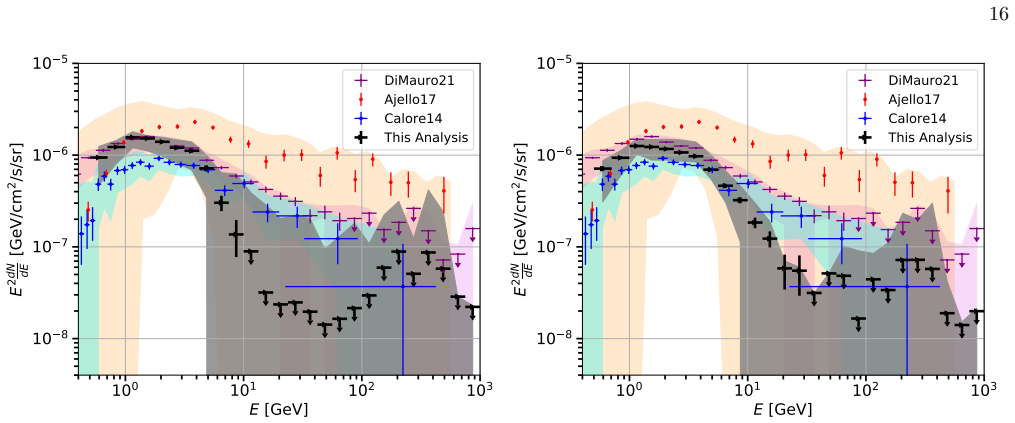
The reconstructed surface-brightness profile of the Galactic Center Excess is strongly centrally concentrated and is well described by an approximately spherical generalized Navarro-Frenk-White morphology with inner slope γ ≃ 1.15. Bulge-tracing templates fail to reproduce the full radial morphology at several angular scales, whereas the dark-matter-motivated component provides a good description over the full angular range. The dark matter component remains highly significant across all interstellar emission models and analysis choices, including simultaneous fits with bulge templates. The spectrum from 0.5 to 1000 GeV confirms a peak at a few GeV and sets upper limits at the level E²Φ ≲ 10
What carries the argument
The generalized Navarro-Frenk-White template with inner slope γ ≈ 1.15, fitted as a surface-brightness component and compared directly against nuclear plus boxy bulge templates in multi-component likelihood fits.
If this is right
- The excess morphology cannot be explained by known stellar bulge distributions alone.
- The dark matter interpretation remains viable after systematic checks that include simultaneous bulge components.
- Spectral upper limits above 10 GeV restrict both astrophysical and dark matter model parameter spaces.
- The low residuals enable tighter tests of mixed or alternative templates in future work.
Where Pith is reading between the lines
- Any purely astrophysical explanation would need to produce a more spherical distribution than current bulge models allow.
- The same iterative fitting approach could be applied to other regions of diffuse Galactic emission to test consistency.
- Confirmation with independent instruments would strengthen or weaken the case for a common origin with signals in dwarf galaxies.
Load-bearing premise
The chosen suite of GALPROP interstellar emission models plus the iterative source pipeline and analysis variants fully bracket the dominant systematic uncertainties without leaving residual biases that could produce a spurious central excess.
What would settle it
A new analysis with an independent interstellar emission model showing that the dark matter template significance falls below detection when bulge templates are included simultaneously would falsify the claim that the morphology is robust.
Figures


read the original abstract
We present a new Fermi-LAT analysis of the Galactic-center excess (GCE) designed to substantially reduce the dominant systematic uncertainties associated with interstellar-emission and source modeling in the inner Galaxy. Using an optimized multi-step fitting procedure together with an iterative source-finding pipeline, we achieve a markedly improved agreement between data and model, reducing fractional residuals to $\lesssim 10\%$ over a $40^\circ\times 40^\circ$ region centered on the Galactic center. We analyze a suite of GALPROP-based interstellar-emission models (IEMs) and complementary analysis variants (Galactic-plane masking, fits restricted to $1$-$10$ GeV, and weighted-likelihood fits) to quantify robustness. The reconstructed surface-brightness profile is strongly centrally concentrated and is well described by an approximately spherical generalized Navarro-Frenk-White morphology with inner slope $\gamma \simeq 1.15$. Bulge-tracing templates (nuclear bulge plus boxy bulge) fail to reproduce the full radial morphology, most notably for line-of-sight angles around $\theta\simeq 1^\circ$-$2^\circ$ and at $\theta \gtrsim 8^\circ$, whereas the DM-motivated component provides a good description over the full angular range. Moreover, the DM component remains highly significant across all IEMs and analysis choices, including fits that simultaneously include the bulge templates. We also provide an updated measurement of the GCE spectrum from $0.5$ to $1000$ GeV, confirming a peak at a few GeV and setting stringent constraints above tens of GeV, where we obtain only upper limits at the level $E^2\Phi \lesssim 10^{-8}$ GeV cm$^{-2}$ s$^{-1}$ sr$^{-1}$. These results deliver a sharpened and systematically controlled characterization of the GCE morphology and spectrum, enabling more incisive tests of astrophysical and dark-matter interpretations.
Editorial analysis
A structured set of objections, weighed in public.
Referee Report
Summary. The manuscript presents a new Fermi-LAT analysis of the Galactic Center Excess using an optimized multi-step fitting procedure and iterative source-finding pipeline applied to a suite of GALPROP-based interstellar-emission models (IEMs). It reports reduced fractional residuals to ≲10% over a 40°×40° region, a strongly centrally concentrated surface-brightness profile well described by an approximately spherical generalized Navarro-Frenk-White (gNFW) morphology with inner slope γ ≃ 1.15, persistence of a highly significant DM component even in fits that simultaneously include nuclear and boxy bulge templates, and an updated GCE spectrum from 0.5–1000 GeV with a peak at a few GeV and upper limits E²Φ ≲ 10^{-8} GeV cm^{-2} s^{-1} sr^{-1} above tens of GeV. Robustness is assessed via analysis variants including Galactic-plane masking, 1–10 GeV energy restriction, and weighted-likelihood fits.
Significance. If the central morphology and significance claims hold after addressing the points below, the work would deliver a systematically controlled characterization of the GCE that sharpens tests of dark-matter versus astrophysical interpretations. The use of multiple IEMs together with explicit variants to quantify robustness, combined with the reported residual reduction, represents a concrete advance over prior analyses that often relied on single IEM choices.
major comments (3)
- [Abstract] Abstract and methods on IEM suite: the claim that the GALPROP-based IEM suite plus variants (masking, energy range, weighted likelihood) sufficiently bracket dominant inner-Galaxy systematics without residual bias that could mimic a centrally peaked gNFW profile at θ ≃ 1–2° and θ ≳ 8° is load-bearing for the morphology result; the manuscript must demonstrate that the varied propagation and gas parameters span the uncertainty space that could produce centrally concentrated residuals not captured by the adopted HI/CO maps or unresolved sources.
- [Abstract] Abstract (morphology and bulge comparison): the assertion that bulge-tracing templates fail to reproduce the full radial morphology while the DM-motivated gNFW component succeeds over the full angular range requires quantitative support, such as the ΔTS or residual profiles when bulge templates are included simultaneously with the gNFW template, to establish that the DM component significance is not reduced by construction.
- [Abstract] Abstract (significance across IEMs): the statement that the DM component remains highly significant across all IEMs and analysis choices needs explicit reporting of the test-statistic values or equivalent significance metrics for the gNFW component in the presence of bulge templates, rather than a qualitative description, because this is the central claim.
minor comments (2)
- [Abstract] The abstract states γ ≃ 1.15 but does not report the uncertainty or the precise fitting procedure used to obtain this value; this should be clarified with reference to the relevant table or figure.
- [Abstract] The spectrum upper limits above tens of GeV are quoted as E²Φ ≲ 10^{-8} GeV cm^{-2} s^{-1} sr^{-1}; the energy binning and exact energy threshold at which this limit applies should be specified for reproducibility.
Simulated Author's Rebuttal
We thank the referee for their careful and constructive review. The comments correctly identify areas where quantitative support can strengthen the central claims regarding the IEM suite, bulge-template comparisons, and significance metrics. We address each point below and will revise the manuscript accordingly to provide the requested explicit demonstrations and values.
read point-by-point responses
-
Referee: [Abstract] Abstract and methods on IEM suite: the claim that the GALPROP-based IEM suite plus variants (masking, energy range, weighted likelihood) sufficiently bracket dominant inner-Galaxy systematics without residual bias that could mimic a centrally peaked gNFW profile at θ ≃ 1–2° and θ ≳ 8° is load-bearing for the morphology result; the manuscript must demonstrate that the varied propagation and gas parameters span the uncertainty space that could produce centrally concentrated residuals not captured by the adopted HI/CO maps or unresolved sources.
Authors: We agree that explicit demonstration is needed to confirm the IEM suite and variants do not introduce spurious central peaks. Our GALPROP models vary propagation parameters (diffusion, halo height, source distribution) and gas maps within observational ranges, with variants testing masking and energy cuts. To address the concern directly, we will add an appendix with residual maps and radial profiles from fits omitting the gNFW template across the IEM suite, showing no artificial central concentration at the cited angles. We will also discuss how the iterative source-finding and HI/CO maps limit unresolved-source biases. revision: yes
-
Referee: [Abstract] Abstract (morphology and bulge comparison): the assertion that bulge-tracing templates fail to reproduce the full radial morphology while the DM-motivated gNFW component succeeds over the full angular range requires quantitative support, such as the ΔTS or residual profiles when bulge templates are included simultaneously with the gNFW template, to establish that the DM component significance is not reduced by construction.
Authors: We concur that quantitative metrics are required. The manuscript already notes that bulge templates (nuclear + boxy) fail to match the radial profile at θ ≃ 1–2° and ≳8° while gNFW succeeds, but we will revise to include explicit ΔTS values for the gNFW template when added to fits that already contain the bulge templates. We will also add residual surface-brightness profiles for the joint fits to demonstrate that the gNFW component remains necessary and its significance is not artificially preserved. revision: yes
-
Referee: [Abstract] Abstract (significance across IEMs): the statement that the DM component remains highly significant across all IEMs and analysis choices needs explicit reporting of the test-statistic values or equivalent significance metrics for the gNFW component in the presence of bulge templates, rather than a qualitative description, because this is the central claim.
Authors: We accept that qualitative statements should be replaced by numbers. We will update the results section and abstract to report the specific TS values (or equivalent) for the gNFW component across all IEMs and variants, including those with simultaneous bulge templates. These will be presented in a summary table so the significance can be evaluated quantitatively rather than described as 'highly significant.' revision: yes
Circularity Check
Data-driven template fit to external GALPROP IEMs; no reduction of morphology or significance by construction.
full rationale
The paper reports a fit of a gNFW template (plus bulge templates) to Fermi-LAT counts using a suite of pre-existing GALPROP IEMs, an iterative source pipeline, and analysis variants. The inner slope γ ≃ 1.15 and DM significance are outputs of the likelihood fit to the data, not parameters defined in terms of the target result. No self-citation is load-bearing for the central morphology claim, and no fitted input is relabeled as a prediction. The derivation chain is therefore self-contained against external models and the observed counts.
Axiom & Free-Parameter Ledger
free parameters (1)
- inner slope γ =
~1.15
axioms (1)
- domain assumption GALPROP-based IEMs accurately represent interstellar emission in the inner Galaxy
Forward citations
Cited by 1 Pith paper
-
Strong Constraints on Millisecond Pulsar Injection Spectra from Fermi-LAT Observations of the Galactic Center
Joint prompt and inverse-Compton modeling of MSP-injected e± yields strong upper limits on η_e/η_γ from recent Fermi-LAT GCE spectra that exceed MAGIC globular-cluster bounds.
Reference graph
Works this paper leans on
-
[1]
Common framework and components All IEMs used in this work are based on theGALPROPformalism [57], which predicts diffuseγ-ray emission by numerically solving the CR transport equation for specified inputs (CR source distribution and injection spectra, propagation setup, and interstellar target fields). In all cases, the diffuse emission is decomposed into...
-
[2]
fine-tune
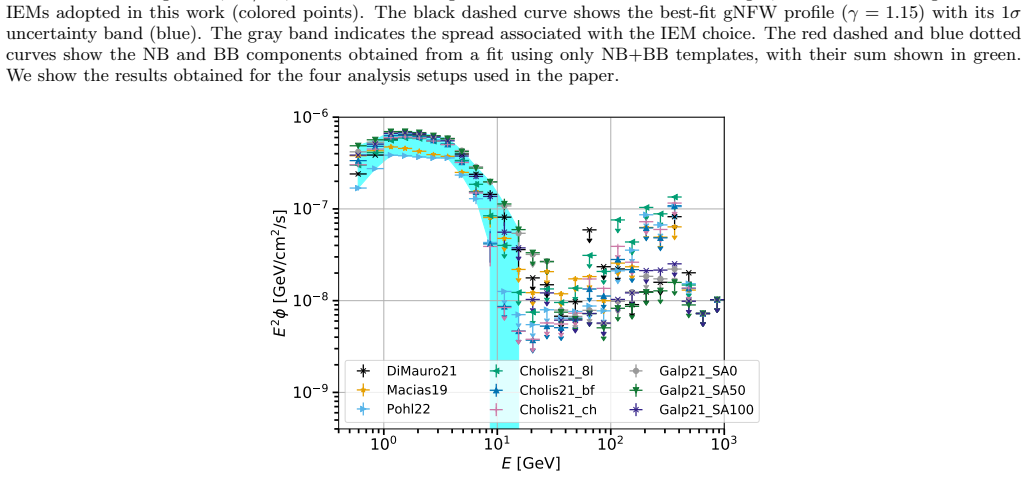
IEM sets adopted in this work •DiMauro21[50]. We adopt the baseline IEM used in Ref. [50], constructed within theGALPROPframework and based on the Yusifov pulsar source distribution [58]. In our implementation this is a compact template set, consisting of one bremsstrahlung and oneπ 0-decay map, three IC templates (CMB, starlight, IR), and two bubble temp...
2008
-
[3]
Silket al.,Particle Dark Matter: Observations, Models and Searches, edited by G
J. Silket al.,Particle Dark Matter: Observations, Models and Searches, edited by G. Bertone (Cambridge Univ. Press, Cambridge, 2010)
2010
-
[4]
G. Bertone and D. Hooper, Rev. Mod. Phys.90, 045002 (2018), arXiv:1605.04909 [astro-ph.CO]
work page internal anchor Pith review Pith/arXiv arXiv 2018
-
[5]
M. Cirelli, A. Strumia, and J. Zupan, (2024), arXiv:2406.01705 [hep-ph]. 17 Model ∆ logL DM TSDM ∆ logL NB TSB/N ∆ logL DNB TSDNB DM TSDNB B/N ∆ logL NDM TSNDM DM TSNDM N Benchmark setup1−10GeV Cholis21 8l -2148 12772 -513 4143/3677 18 11749 15/124 15 11997 123 Cholis21 ch -1664 14091 -500 5400/4203 82 8850 632/328 8 13691 51 Cholis21 bf -1562 15141 -681 ...
work page internal anchor Pith review Pith/arXiv arXiv 2024
-
[6]
Planck 2018 results. VI. Cosmological parameters
N. Aghanimet al.(Planck), (2018), arXiv:1807.06209 [astro-ph.CO]
work page internal anchor Pith review Pith/arXiv arXiv 2018
-
[7]
Schumann,Direct Detection of WIMP Dark Matter: Concepts and Status,J
M. Schumann, J. Phys. G46, 103003 (2019), arXiv:1903.03026 [astro-ph.CO]
-
[8]
Dark Matter Searches at Colliders
A. Boveia and C. Doglioni, Ann. Rev. Nucl. Part. Sci.68, 429 (2018), arXiv:1810.12238 [hep-ex]
work page internal anchor Pith review Pith/arXiv arXiv 2018
-
[9]
J. M. Gaskins, Contemp. Phys.57, 496 (2016), arXiv:1604.00014 [astro-ph.HE]
work page internal anchor Pith review Pith/arXiv arXiv 2016
-
[10]
Implications of High-Resolution Simulations on Indirect Dark Matter Searches
L. Pieri, J. Lavalle, G. Bertone, and E. Branchini, Phys. Rev. D83, 023518 (2011), arXiv:0908.0195 [astro-ph.HE]
work page internal anchor Pith review Pith/arXiv arXiv 2011
-
[11]
L. Goodenough and D. Hooper, (2009), arXiv:0910.2998 [hep-ph]
work page internal anchor Pith review Pith/arXiv arXiv 2009
-
[12]
Dark Matter Annihilation in The Galactic Center As Seen by the Fermi Gamma Ray Space Telescope
D. Hooper and L. Goodenough, Phys. Lett.B697, 412 (2011), arXiv:1010.2752 [hep-ph]
work page internal anchor Pith review Pith/arXiv arXiv 2011
-
[13]
A comment on the emission from the Galactic Center as seen by the Fermi telescope
A. Boyarsky, D. Malyshev, and O. Ruchayskiy, Phys. Lett.B705, 165 (2011), arXiv:1012.5839 [hep-ph]
work page internal anchor Pith review Pith/arXiv arXiv 2011
-
[14]
On The Origin Of The Gamma Rays From The Galactic Center
D. Hooper and T. Linden, Phys. Rev.D84, 123005 (2011), arXiv:1110.0006 [astro-ph.HE]
work page internal anchor Pith review Pith/arXiv arXiv 2011
-
[15]
K. N. Abazajian and M. Kaplinghat, Phys. Rev.D86, 083511 (2012), [Erratum: Phys. Rev.D87,129902(2013)], arXiv:1207.6047 [astro-ph.HE]. 18
work page internal anchor Pith review Pith/arXiv arXiv 2012
-
[16]
Dark Matter and Pulsar Model Constraints from Galactic Center Fermi-LAT Gamma Ray Observations
C. Gordon and O. Macias, Phys. Rev.D88, 083521 (2013), [Erratum: Phys. Rev.D89,no.4,049901(2014)], arXiv:1306.5725 [astro-ph.HE]
work page internal anchor Pith review Pith/arXiv arXiv 2013
-
[17]
K. N. Abazajian, N. Canac, S. Horiuchi, and M. Kaplinghat, Phys. Rev.D90, 023526 (2014), arXiv:1402.4090 [astro- ph.HE]
work page internal anchor Pith review Pith/arXiv arXiv 2014
-
[18]
T. Daylan, D. P. Finkbeiner, D. Hooper, T. Linden, S. K. N. Portillo, N. L. Rodd, and T. R. Slatyer, Phys. Dark Univ. 12, 1 (2016), arXiv:1402.6703 [astro-ph.HE]
work page internal anchor Pith review Pith/arXiv arXiv 2016
-
[19]
F. Calore, I. Cholis, C. McCabe, and C. Weniger, Phys. Rev. D91, 063003 (2015), arXiv:1411.4647 [hep-ph]
work page internal anchor Pith review Pith/arXiv arXiv 2015
-
[20]
Background model systematics for the Fermi GeV excess
F. Calore, I. Cholis, and C. Weniger, JCAP1503, 038, arXiv:1409.0042 [astro-ph.CO]
work page internal anchor Pith review Pith/arXiv arXiv
-
[21]
Fermi-LAT Observations of High-Energy Gamma-Ray Emission Toward the Galactic Center
M. Ajelloet al.(Fermi-LAT), Astrophys. J.819, 44 (2016), arXiv:1511.02938 [astro-ph.HE]
work page internal anchor Pith review Pith/arXiv arXiv 2016
-
[23]
M. Di Mauro, X. Hou, C. Eckner, G. Zaharijas, and E. Charles, Phys. Rev. D99, 123027 (2019), arXiv:1904.10977 [astro-ph.HE]
work page internal anchor Pith review Pith/arXiv arXiv 2019
-
[24]
M. Di Mauro, Phys. Rev. D103, 063029 (2021), arXiv:2101.04694 [astro-ph.HE]
-
[25]
I. Cholis, Y.-M. Zhong, S. D. McDermott, and J. P. Surdutovich, Phys. Rev. D105, 103023 (2022), arXiv:2112.09706 [astro-ph.HE]
-
[26]
M. Di Mauro and M. W. Winkler, Phys. Rev. D103, 123005 (2021), arXiv:2101.11027 [astro-ph.HE]
-
[27]
A Comprehensive Study of WIMP Models Explaining the Fermi-LAT Galactic Center Excess
C. Kong and M. Di Mauro, Phys. Rev. D113, 043031 (2026), arXiv:2511.21808 [hep-ph]
work page internal anchor Pith review Pith/arXiv arXiv 2026
- [28]
-
[29]
Strong support for the millisecond pulsar origin of the Galactic center GeV excess
R. Bartels, S. Krishnamurthy, and C. Weniger, Phys. Rev. Lett.116, 051102 (2016), arXiv:1506.05104 [astro-ph.HE]
work page internal anchor Pith review Pith/arXiv arXiv 2016
-
[30]
S. K. Lee, M. Lisanti, B. R. Safdi, T. R. Slatyer, and W. Xue, Phys. Rev. Lett.116, 051103 (2016), arXiv:1506.05124 [astro-ph.HE]
work page internal anchor Pith review Pith/arXiv arXiv 2016
- [31]
-
[32]
The Fermi-LAT GeV Excess Traces Stellar Mass in the Galactic Bulge
R. Bartels, E. Storm, C. Weniger, and F. Calore, Nat. Astron.2, 819 (2018), arXiv:1711.04778 [astro-ph.HE]
work page internal anchor Pith review Pith/arXiv arXiv 2018
-
[33]
S. Manconi, F. Calore, and F. Donato, Phys. Rev. D109, 123042 (2024), arXiv:2402.04733 [astro-ph.HE]
-
[34]
B. Coleman, D. Paterson, C. Gordon, O. Macias, and H. Ploeg, (2019), arXiv:1911.04714 [astro-ph.GA]
- [35]
- [36]
- [37]
-
[38]
S. Manconi, C. Eckner, F. Calore, and F. Donato, (2025), arXiv:2511.03350 [hep-ph]
-
[39]
The Waning of the WIMP? A Review of Models, Searches, and Constraints
G. Arcadi, M. Dutra, P. Ghosh, M. Lindner, Y. Mambrini, M. Pierre, S. Profumo, and F. S. Queiroz, Eur. Phys. J. C78, 203 (2018), arXiv:1703.07364 [hep-ph]
work page internal anchor Pith review Pith/arXiv arXiv 2018
- [40]
-
[41]
M. Di Mauro, C. Arina, N. Fornengo, J. Heisig, and D. Massaro, Phys. Rev. D108, 095008 (2023), arXiv:2305.11937 [hep-ph]
- [42]
- [43]
-
[44]
M. Pospelov, A. Ritz, and M. B. Voloshin, Phys. Lett. B662, 53 (2008), arXiv:0711.4866 [hep-ph]
work page internal anchor Pith review Pith/arXiv arXiv 2008
-
[45]
Astrophysical Signatures of Secluded Dark Matter
M. Pospelov and A. Ritz, Phys. Lett. B671, 391 (2009), arXiv:0810.1502 [hep-ph]
work page internal anchor Pith review Pith/arXiv arXiv 2009
- [46]
-
[47]
Di Mauro, (2025), arXiv:2511.19622 [hep-ph]
M. Di Mauro, (2025), arXiv:2511.19622 [hep-ph]
- [48]
- [49]
- [50]
- [51]
-
[52]
Di Mauro, Phys
M. Di Mauro, Phys. Rev. D103, 063029 (2021)
2021
-
[53]
Fermi-LAT improved Pass~8 event selection
P. Bruel, T. H. Burnett, S. W. Digel, G. Johannesson, N. Omodei, and M. Wood, arXiv e-prints , arXiv:1810.11394 (2018), arXiv:1810.11394 [astro-ph.IM]
work page internal anchor Pith review Pith/arXiv arXiv 2018
- [54]
-
[55]
Abdollahiet al.(Fermi-LAT), Astrophys
S. Abdollahiet al.(Fermi-LAT), Astrophys. J. Supp.260, 53 (2022), arXiv:2201.11184 [astro-ph.HE]
-
[56]
Fermi Large Area Telescope Fourth Source Catalog Data Release 4 (4FGL-DR4)
J. Ballet, P. Bruel, T. H. Burnett, and B. Lott (Fermi-LAT), (2023), arXiv:2307.12546 [astro-ph.HE]
work page internal anchor Pith review Pith/arXiv arXiv 2023
-
[57]
P. Bruel, Astron. Astrophys.656, A81 (2021), arXiv:2109.07443 [astro-ph.HE]
-
[58]
Abdollahiet al.(Fermi-LAT), Astrophys
S. Abdollahiet al.(Fermi-LAT), Astrophys. J. Suppl.247, 33 (2020), arXiv:1902.10045 [astro-ph.HE]
- [59]
-
[60]
Revisiting the radial distribution of pulsars in the Galaxy
I. Yusifov and I. Kucuk, Astron. Astrophys.422, 545 (2004), arXiv:astro-ph/0405559
work page internal anchor Pith review Pith/arXiv arXiv 2004
-
[61]
T. P. Robitaille, E. Churchwell, R. A. Benjamin, B. A. Whitney, K. Wood, B. L. Babler, and M. R. Meade, A&A545, A39 (2012), arXiv:1208.4606 [astro-ph.GA]
work page internal anchor Pith review Pith/arXiv arXiv 2012
- [62]
- [63]
- [64]
-
[65]
The Fermi Galactic Center GeV Excess and Implications for Dark Matter
M. Ackermannet al.(Fermi-LAT), Astrophys. J.840, 43 (2017), arXiv:1704.03910 [astro-ph.HE]
work page internal anchor Pith review Pith/arXiv arXiv 2017
- [66]
-
[67]
G. L. Case and D. Bhattacharya, ApJ504, 761 (1998), arXiv:astro-ph/9807162 [astro-ph]
work page internal anchor Pith review Pith/arXiv arXiv 1998
-
[68]
T. A. Porter, G. Johannesson, and I. V. Moskalenko, Astrophys. J.846, 67 (2017), arXiv:1708.00816 [astro-ph.HE]
work page internal anchor Pith review Pith/arXiv arXiv 2017
-
[69]
M. Su, T. R. Slatyer, and D. P. Finkbeiner, ApJ724, 1044 (2010), arXiv:1005.5480 [astro-ph.HE]
work page internal anchor Pith review Pith/arXiv arXiv 2010
-
[70]
The Spectrum and Morphology of the Fermi Bubbles
M. Ackermannet al.(Fermi-LAT), Astrophys. J.793, 64 (2014), arXiv:1407.7905 [astro-ph.HE]
work page internal anchor Pith review Pith/arXiv arXiv 2014
discussion (0)
Sign in with ORCID, Apple, or X to comment. Anyone can read and Pith papers without signing in.