Local diagnostics for strong-to-weak spontaneous symmetry breaking and non-equilibrium phase transitions
Pith reviewed 2026-06-29 11:19 UTC · model grok-4.3
The pith
A marginal fidelity correlator diagnoses strong-to-weak spontaneous symmetry breaking using only local tomography.
A machine-rendered reading of the paper's core claim, the machinery that carries it, and where it could break.
Core claim
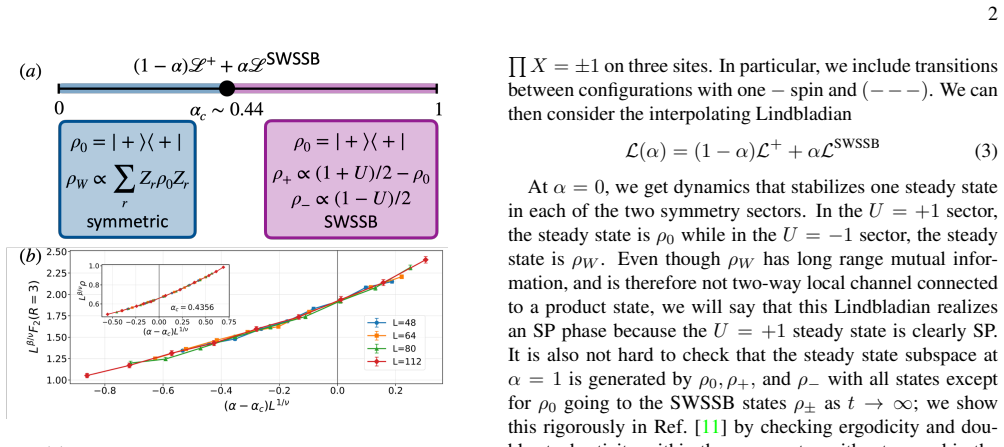
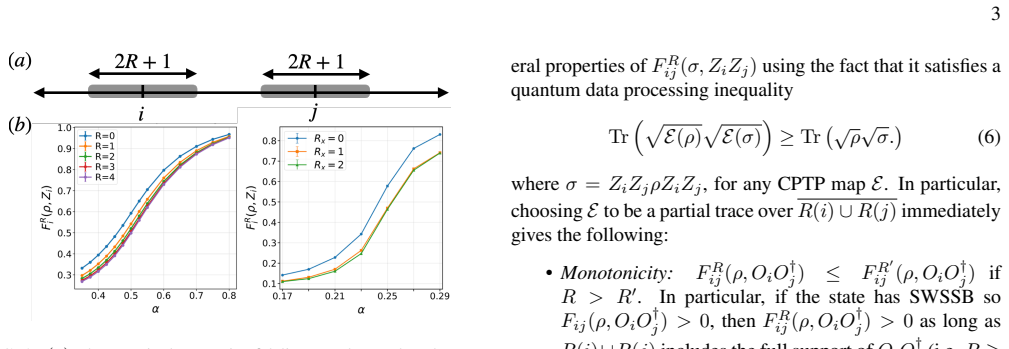
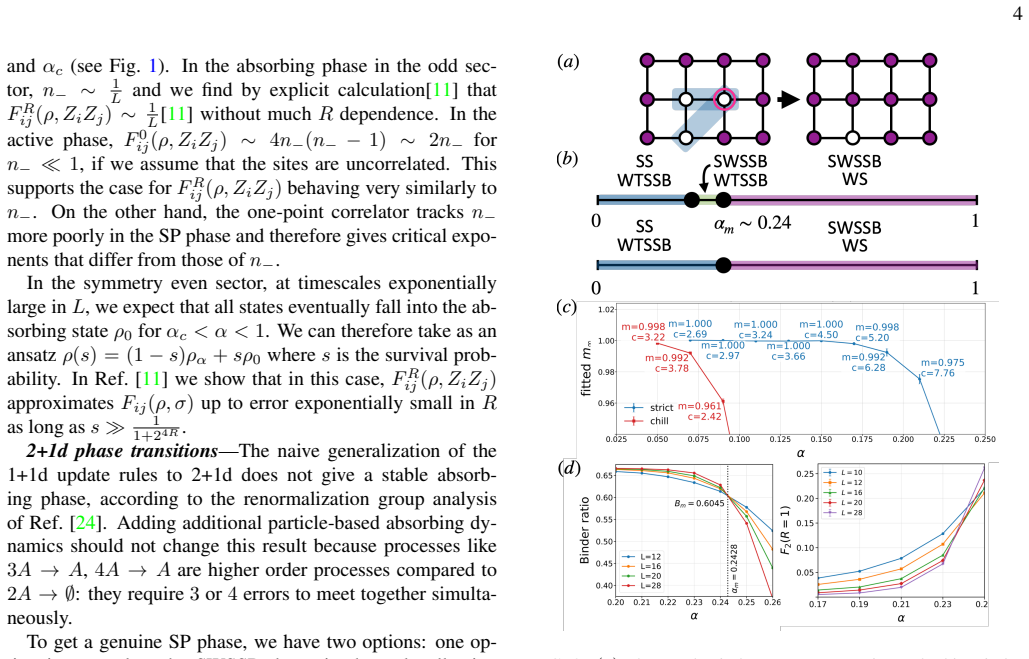
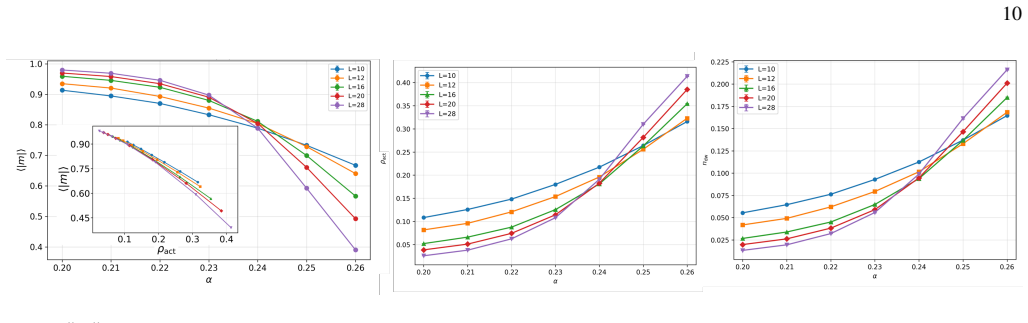
We construct strongly Z2-symmetric local Markov/Lindblad dynamics exhibiting transitions between strong-paramagnetic behavior and strong-to-weak spontaneous symmetry breaking. In 1+1d an absorbing-state construction gives a transition with scaling consistent with the parity-conserving branching-annihilating random-walk universality class. In 2+1d, a pair-flip variant of Toom's rule provides evidence for a stable strong-paramagnetic/weakly symmetry-broken regime and a transition into an active SWSSB regime. We also introduce a marginal fidelity correlator of radius R, a local proxy for the usual SWSSB fidelity order parameter requiring tomography only on O(R^d)-size regions, with error bounds
What carries the argument
The marginal fidelity correlator of radius R, which acts as a local proxy for the global fidelity order parameter in detecting strong-to-weak spontaneous symmetry breaking.
If this is right
- In 1+1 dimensions, the transition in the absorbing-state construction follows the scaling of the parity-conserving branching-annihilating random-walk universality class.
- In 2+1 dimensions, the pair-flip Toom's rule dynamics exhibits a stable regime of strong paramagnetism with weak symmetry breaking and a transition to an active SWSSB phase.
- The marginal fidelity provides a model-independent diagnostic for SWSSB in absorbing-state transitions where standard notions of defects or activity lack universality.
- The exponential error bound allows the marginal correlator to reliably approximate the global one for symmetry-projected Gibbs-like states satisfying local indistinguishability.
Where Pith is reading between the lines
- This approach could extend to other open quantum systems or measurement-induced transitions where symmetry breaking is weak.
- Experimental implementations in quantum simulators might use this to identify phases without full tomography, by measuring small patches.
- Further work could test the bound's tightness in states that are not exactly Gibbs-like.
- The 1D and 2D constructions suggest different dynamical universality classes for SWSSB transitions in open systems.
Load-bearing premise
That for the relevant states, the error between marginal and global fidelity correlators decays exponentially with the radius R due to local indistinguishability.
What would settle it
If numerical simulations of the 1D absorbing-state model show critical exponents inconsistent with the parity-conserving branching-annihilating random walk class, that would challenge the claimed universality of the transition.
Figures
read the original abstract
We construct strongly $\mathbb{Z}_2$-symmetric local Markov/Lindblad dynamics exhibiting transitions between strong-paramagnetic behavior and strong-to-weak spontaneous symmetry breaking. In 1+1d, an absorbing-state construction gives a transition with scaling consistent with the parity-conserving branching-annihilating random-walk universality class. In 2+1d, a pair-flip variant of Toom's rule provides evidence for a stable strong-paramagnetic/weakly symmetry-broken regime and a transition into an active SWSSB regime. We also introduce a marginal fidelity correlator of radius $R$, a local proxy for the usual SWSSB fidelity order parameter requiring tomography only on $\mathcal{O}(R^d)$-size regions. For broad classes of states, including symmetry-projected Gibbs-like states satisfying suitable local indistinguishability assumptions, we bound the error between the marginal and global fidelity correlators by terms decaying exponentially in $R$. These marginal fidelities provide a model-independent diagnostic of SWSSB in absorbing-state transitions, where microscopic notions of defects or activity are not universal.
Editorial analysis
A structured set of objections, weighed in public.
Referee Report
Summary. The manuscript constructs strongly Z_2-symmetric local Markov/Lindblad dynamics exhibiting transitions between strong-paramagnetic behavior and strong-to-weak spontaneous symmetry breaking (SWSSB). In 1+1d an absorbing-state construction yields a transition whose scaling is consistent with the parity-conserving branching-annihilating random-walk universality class. In 2+1d a pair-flip variant of Toom's rule supplies numerical evidence for a stable strong-paramagnetic/weakly symmetry-broken regime and a transition into an active SWSSB regime. The central technical contribution is the marginal fidelity correlator of radius R, a local proxy for the global SWSSB fidelity order parameter that requires tomography only on O(R^d)-sized regions; for symmetry-projected Gibbs-like states obeying local indistinguishability assumptions the error between marginal and global correlators is bounded by terms that decay exponentially in R. These diagnostics are applied to absorbing-state transitions where microscopic defect notions are non-universal.
Significance. If the constructions and the exponential error bound hold, the work supplies a model-independent, locally measurable diagnostic for SWSSB that is directly usable in numerical and experimental settings where global tomography is infeasible. The explicit Lindblad realizations in both 1+1d and 2+1d, together with the link to a known classical universality class, strengthen the physical relevance of strong-to-weak symmetry breaking in open quantum systems. The parameter-free character of the marginal-correlator bound (once the local-indistinguishability assumption is granted) is a notable strength.
major comments (2)
- [Section deriving the error bound] The exponential error bound between marginal and global fidelity correlators (stated for symmetry-projected states under local indistinguishability) is load-bearing for the claim that the marginal correlator is a reliable diagnostic; the manuscript should explicitly verify that the constructed Lindblad steady states satisfy the local-indistinguishability hypothesis used in the bound, or state the additional assumptions required.
- [1+1d construction and scaling analysis] In the 1+1d absorbing-state construction the claim of scaling consistency with the parity-conserving BARW class rests on numerical data; the manuscript should report the extracted exponents, system sizes, and fitting procedure so that the consistency can be assessed independently of finite-size effects.
minor comments (2)
- Notation for the marginal fidelity correlator should be introduced with an explicit equation (e.g., Eq. (X)) before it is used in the abstract and later sections.
- Figure captions for the 2+1d phase diagram should state the system sizes and boundary conditions employed in the pair-flip Toom-rule simulations.
Simulated Author's Rebuttal
We thank the referee for the positive assessment and recommendation for minor revision. We address the two major comments below.
read point-by-point responses
-
Referee: [Section deriving the error bound] The exponential error bound between marginal and global fidelity correlators (stated for symmetry-projected states under local indistinguishability) is load-bearing for the claim that the marginal correlator is a reliable diagnostic; the manuscript should explicitly verify that the constructed Lindblad steady states satisfy the local-indistinguishability hypothesis used in the bound, or state the additional assumptions required.
Authors: We agree that the local-indistinguishability assumption is central to applying the bound to the constructed dynamics. The manuscript derives the bound for symmetry-projected Gibbs-like states obeying this hypothesis, but does not yet contain an explicit check for the Lindblad steady states. In the revised version we will add a dedicated paragraph (or short subsection) that either verifies the hypothesis for the 1+1d and 2+1d steady states or states the additional assumptions under which the bound continues to hold. revision: yes
-
Referee: [1+1d construction and scaling analysis] In the 1+1d absorbing-state construction the claim of scaling consistency with the parity-conserving BARW class rests on numerical data; the manuscript should report the extracted exponents, system sizes, and fitting procedure so that the consistency can be assessed independently of finite-size effects.
Authors: We accept the request for greater transparency in the numerical analysis. The current manuscript presents data consistent with the parity-conserving BARW class but does not tabulate the extracted exponents, list the system sizes, or detail the fitting protocol. In the revised manuscript we will expand the relevant section (including a supplementary table or figure caption) to report these quantities and the fitting procedure, thereby allowing independent evaluation of finite-size effects. revision: yes
Circularity Check
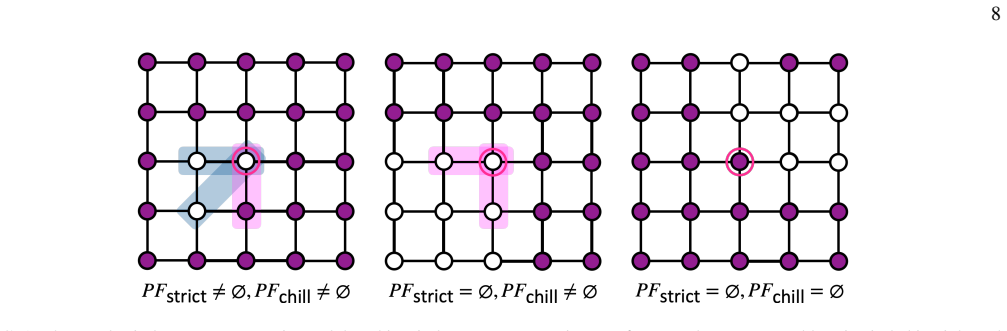
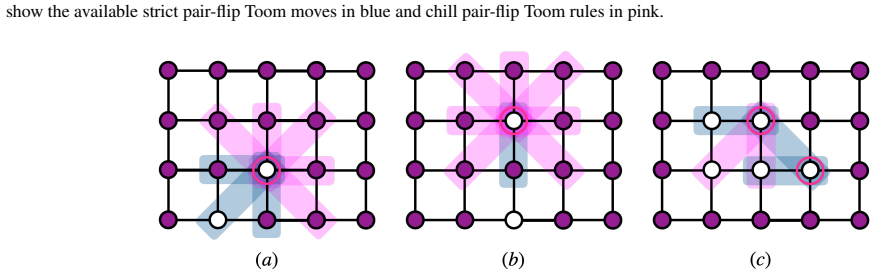
No significant circularity in derivation chain
full rationale
The paper explicitly constructs strongly Z2-symmetric Lindblad dynamics in 1+1d and 2+1d, introduces the marginal fidelity correlator as a new local proxy, and derives an error bound between marginal and global correlators under stated local indistinguishability assumptions for symmetry-projected states. These steps are presented as independent constructions and bounds rather than reductions to fitted parameters or self-referential definitions. No load-bearing self-citations, ansatzes smuggled via prior work, or predictions that reduce to inputs by construction are identifiable from the provided material. The scaling consistency with BARW and numerical evidence are supporting observations, not central derivations. The central claims remain self-contained against external benchmarks.
Axiom & Free-Parameter Ledger
axioms (2)
- domain assumption Strong Z2 symmetry of the local Markov/Lindblad generators
- domain assumption Local indistinguishability assumptions for symmetry-projected Gibbs-like states
invented entities (1)
-
marginal fidelity correlator of radius R
no independent evidence
Forward citations
Cited by 2 Pith papers
-
From Topological Order to Mixed-State Phases: A Ground-State Probe of Fractionalized Excitations
Reduced density matrices of 2D topological orders at entanglement cuts realize 1D mixed-state phases whose properties detect fractionalized excitations such as anyons and spinons.
-
Strong-to-Weak Spontaneous Symmetry Breaking
SW-SSB extends symmetry breaking to mixed states and serves as a unifying perspective connecting topological orders, emergent hydrodynamics, and information-theoretic characterizations of phases in open systems.
Reference graph
Works this paper leans on
-
[1]
Ma and C
R. Ma and C. Wang, Phys. Rev. X13, 031016 (2023)
2023
-
[2]
P. Sala, S. Gopalakrishnan, M. Oshikawa, and Y . You, Phys. Rev. B110, 155150 (2024)
2024
-
[3]
Ma, J.-H
R. Ma, J.-H. Zhang, Z. Bi, M. Cheng, and C. Wang, Phys. Rev. X15, 021062 (2025)
2025
-
[4]
Ma and A
R. Ma and A. Turzillo, PRX Quantum6, 010348 (2025)
2025
-
[5]
J. Y . Lee, Y .-Z. You, and C. Xu, Quantum9, 1607 (2025)
2025
-
[6]
D. Gu, Z. Wang, and Z. Wang, Phys. Rev. B112, 245123 (2025)
2025
-
[7]
Coser and D
A. Coser and D. P ´erez-Garc´ıa, Quantum3, 174 (2019)
2019
-
[8]
Sang and T
S. Sang and T. H. Hsieh, Phys. Rev. Lett.134, 070403 (2025)
2025
- [9]
-
[10]
L. A. Lessa, R. Ma, J.-H. Zhang, Z. Bi, M. Cheng, and C. Wang, PRX Quantum6, 010344 (2025)
2025
-
[11]
See supplemental materials for details
-
[12]
Bu ˇca and T
B. Bu ˇca and T. Prosen, New Journal of Physics14, 073007 (2012)
2012
-
[13]
Rakovszky, S
T. Rakovszky, S. Gopalakrishnan, and C. von Keyserlingk, Phys. Rev. X14, 041031 (2024)
2024
-
[14]
Strong-to-weak symmetry breaking phases in steady states of quantum operations,
N. Ziereis, S. Moudgalya, and M. Knap, arXiv preprint arXiv:2509.09669 (2025)
-
[15]
J. Shah, C. Fechisin, Y .-X. Wang, J. T. Iosue, J. D. Watson, Y .- Q. Wang, B. Ware, A. V . Gorshkov, and C.-J. Lin, Quantum9, 1912 (2025)
1912
-
[16]
J. Guo, O. Hart, C.-F. Chen, A. J. Friedman, and A. Lucas, Quantum9, 1612 (2025)
2025
-
[17]
Y . Liu, A. Ruiz-de Alarc´on, G. Styliaris, X.-Q. Sun, D. P ´erez- Garc´ıa, and J. I. Cirac, Phys. Rev. Res.8, 013210 (2026)
2026
-
[18]
Martinelli, inLectures on probability theory and statistics: Ecole d’et´e de probailit ´es de saint-flour xxvii-1997(Springer,
F. Martinelli, inLectures on probability theory and statistics: Ecole d’et´e de probailit ´es de saint-flour xxvii-1997(Springer,
1997
-
[19]
M. J. Kastoryano and F. G. Brandao, Communications in Math- ematical Physics344, 915 (2016)
2016
- [20]
-
[21]
Z. Ding, B. Li, and L. Lin, Communications in Mathematical Physics406, 67 (2025)
2025
-
[22]
Jensen, Phys
I. Jensen, Phys. Rev. E50, 3623 (1994)
1994
-
[23]
Grassberger, F
P. Grassberger, F. Krause, and T. von der Twer, Journal of Physics A: Mathematical and General17, L105 (1984)
1984
-
[24]
J. L. Cardy and U. C. T ¨auber, Journal of statistical physics90, 1 (1998)
1998
-
[25]
Hinrichsen, Advances in physics49, 815 (2000)
H. Hinrichsen, Advances in physics49, 815 (2000)
2000
-
[26]
´Odor, Rev
G. ´Odor, Rev. Mod. Phys.76, 663 (2004)
2004
-
[27]
A. L. Toom, Multicomponent random systems6, 549 (1980)
1980
-
[28]
Kholevo, Theoretical and Mathematical Physics13, 1071 (1972)
A. Kholevo, Theoretical and Mathematical Physics13, 1071 (1972)
1972
-
[29]
M. M. Wilde, in2018 IEEE International Symposium on Infor- mation Theory (ISIT)(IEEE, 2018) pp. 2331–2335
2018
-
[30]
Weinstein, Phys
Z. Weinstein, Phys. Rev. Lett.134, 150405 (2025)
2025
-
[31]
Z. Liu, L. Chen, Y . Zhang, S. Zhou, and P. Zhang, Communi- cations Physics8, 274 (2025)
2025
-
[32]
Binder, Reports on progress in physics50, 783 (1987)
K. Binder, Reports on progress in physics50, 783 (1987)
1987
-
[33]
L. A. Lessa, M. Cheng, and C. Wang, Phys. Rev. X15, 011069 (2025)
2025
-
[34]
Chatterjee and X.-G
A. Chatterjee and X.-G. Wen, Phys. Rev. B107, 155136 (2023)
2023
-
[35]
Zhang and M
C. Zhang and M. Levin, Phys. Rev. Lett.130, 026801 (2023)
2023
-
[36]
S. Sang, Y . Zou, and T. H. Hsieh, Phys. Rev. X14, 031044 (2024)
2024
-
[37]
Marcuzzi, M
M. Marcuzzi, M. Buchhold, S. Diehl, and I. Lesanovsky, Phys. Rev. Lett.116, 245701 (2016)
2016
- [38]
-
[39]
Wampler and N
M. Wampler and N. R. Cooper, Phys. Rev. Res.7, 033053 (2025)
2025
-
[40]
F. Divi, L. Lessa, and C. Wang,
-
[41]
R. Liu, J. Yi, and D. Else, . Supplemental Material: Local diagnostics for strong-to-weak spontaneous symmetry breaking and non-equilibrium phase transitions Carolyn Zhang 1 1Department of Physics, Harvard University, Cambridge, MA 02138, USA CONTENTS I. Review of strong/weak symmetries and phase classification 1 II. Properties of the marginal fidelity co...
-
[42]
Lower bound on fidelity correlator 5
-
[43]
Partially dead state 7 IV
Bounding the error of the marginal fidelity 6 E. Partially dead state 7 IV . Pair flip Toom dynamics 7 V . Steady states for 1+1d and 2+1d SWSSB dynamics 8 VI. Additional numerical results for the 2+1d model 9 VII. Estimate ofα c in the 1+1d phase transition 10 References 10 I. REVIEW OF STRONG/WEAK SYMMETRIES AND PHASE CLASSIFICA TION In this section we ...
-
[44]
We will first show that the true one-point fidelity (and therefore also the marginal fidelity) is lower bounded by anO(1)constant as long asβis finite andHis local
Lower bound on fidelity correlator We first considerτ= 1 Z e−βH and we will then add the symmetry sector projector. We will first show that the true one-point fidelity (and therefore also the marginal fidelity) is lower bounded by anO(1)constant as long asβis finite andHis local. The form of the lower bound is similar to the exact result in the classical ...
-
[45]
We define ρ=P +τ P+ +P −τ P− p± = Tr(P±ρ)ρ ± = P±ρP± p± (35) whereP ± = 1±U 2
Bounding the error of the marginal fidelity For states with exponential decay of CMI, including all classical Gibbs states, we can also bound the error between the true fidelity correlator and the marginal radiusRfidelity as long as we make an additional assumption of local indistinguishability. We define ρ=P +τ P+ +P −τ P− p± = Tr(P±ρ)ρ ± = P±ρP± p± (35)...
-
[46]
Pick a site at random
-
[47]
If it is not anti-aligned with both its north and east neighbors, do nothing. 8 FIG. 1. The purple circles represent+spins and the white circles represent−spins. We focus on the Toom unstable spin circled in pink, and show the available strict pair-flip Toom moves in blue and chill pair-flip Toom rules in pink. FIG. 2. We take the same coloring convention...
-
[48]
Toom unstable
If the site is anti-aligned with its north and east neighbors, it is “Toom unstable.” Compute the change in domain wall length from flipping the site together with each of its eight neighbors (including diagonal ones). This can be computed locally by looking at the 24 bonds around the target site and its eight neighbors
-
[49]
Collect the subset of these pair flipsP F strict that lower the total domain wall length and also the subsetP F chill that do not increase the domain wall length.P F strict ⊂P F chill
-
[50]
If the relevant subset of flips (P Fstrict orP F chill) is empty, do nothing
-
[51]
It is straightforward to find configurations for whichP F strict =∅: any isolated single minority spin or corner of a minority square with side length≥3is frozen
Otherwise, choose uniformly among the elements ofP F strict for strict pair-flip Toom orP Fchill for chill pair-flip Toom. It is straightforward to find configurations for whichP F strict =∅: any isolated single minority spin or corner of a minority square with side length≥3is frozen. We also show below a configuration whereP F chill =∅in Fig. 1. As menti...
-
[52]
Single−spins can move
-
[53]
Three−spins together can be reduced to one:(− − −)↔(−+ +),(+−+),(+ +−)
-
[54]
For every odd parity state, we can choose one−spin to be the seed and move other−spins to the seed to form a local(− − −) and then use (2) to remove two−spins
Pairs of−spins can move because we scramble(− −+),(−+−),(+− −). For every odd parity state, we can choose one−spin to be the seed and move other−spins to the seed to form a local(− − −) and then use (2) to remove two−spins. Repeating this procedure reduces any odd configuration to a single−spin, and since it can move anywhere by (1), the whole odd sector ...
-
[55]
Single−spins can move within a plaquette
-
[56]
A pair of−spins can be rearranged inside a plaquette
-
[57]
escape” probability and “collapse
One−spin can transition to three minus spins in a plaquette and vice versa It is clear thatρ 0 andρ − 0 are completely decoupled from the rest of the states and form their own class. In the odd sector, any configuration can be reduced to a single−spin, which can then be moved around by (1). Therefore, the odd sector is connected. In the even sector, outsi...
-
[58]
Fawzi and R
O. Fawzi and R. Renner, Communications in Mathematical Physics340, 575 (2015)
2015
-
[59]
Watrous,The theory of quantum information(Cambridge university press, 2018)
J. Watrous,The theory of quantum information(Cambridge university press, 2018)
2018
-
[60]
Petz, Reports on mathematical physics23, 57 (1986)
D. Petz, Reports on mathematical physics23, 57 (1986)
1986
-
[61]
M ¨uller-Lennert, F
M. M ¨uller-Lennert, F. Dupuis, O. Szehr, S. Fehr, and M. Tomamichel, Journal of Mathematical Physics54(2013)
2013
-
[62]
Van Erven and P
T. Van Erven and P. Harremos, IEEE Transactions on Information Theory60, 3797 (2014)
2014
discussion (0)
Sign in with ORCID, Apple, or X to comment. Anyone can read and Pith papers without signing in.