Fixed-Point Scaffolding in the Clef Programming Language
Pith reviewed 2026-06-28 11:27 UTC · model grok-4.3
The pith
A fixed-point combinator in the Clef compiler preserves dimensional, grade, escape and numeric structure from the program semantic graph during categorical lowering to MLIR.
A machine-rendered reading of the paper's core claim, the machinery that carries it, and where it could break.
Core claim
The compiler middle end performs lowering via a functor from the compilation poset to a target category subject to the compositionality equation; this functor is realized by a fixed-point combinator that preserves the dimensional, grade, escape, and numeric-representation structure of the program semantic graph, allowing the same primitive to supply continuing proof terms inside MLIR.
What carries the argument
The fixed-point combinator that preserves dimensional, grade, escape and numeric-representation structure from the program semantic graph while enabling a functor from the compilation poset to a target category obeying the compositionality equation.
If this is right
- Compact-closed negative and fractional types can be introduced while carrying the preserved structure through the same machinery.
- Proof terms generated by the fixed-point combinator continue to be exercised inside MLIR to verify integrity at each pipeline stage.
- The abstractions remain internal; developers obtain the guarantees without invoking category theory directly.
- The same foundation supports dimensional types, groupoid structure, and cellular sheaves as additional algebraic objects.
Where Pith is reading between the lines
- Similar fixed-point scaffolding could be tested in other MLIR-based compilers that already use dialects and attributes.
- The compositionality equation might be checked by constructing small example programs and inspecting whether structure is identical before and after each lowering pass.
- Extending the types could be validated by adding one new negative or fractional type and confirming that the fixed-point combinator still produces valid MLIR without structural drift.
Load-bearing premise
The fixed-point combinator preserves the dimensional, grade, escape, and numeric-representation structure from the program semantic graph.
What would settle it
A concrete lowering step in which one of the preserved attributes (dimension, grade, escape, or numeric representation) changes between the program semantic graph and the emitted MLIR dialect.
Figures

read the original abstract
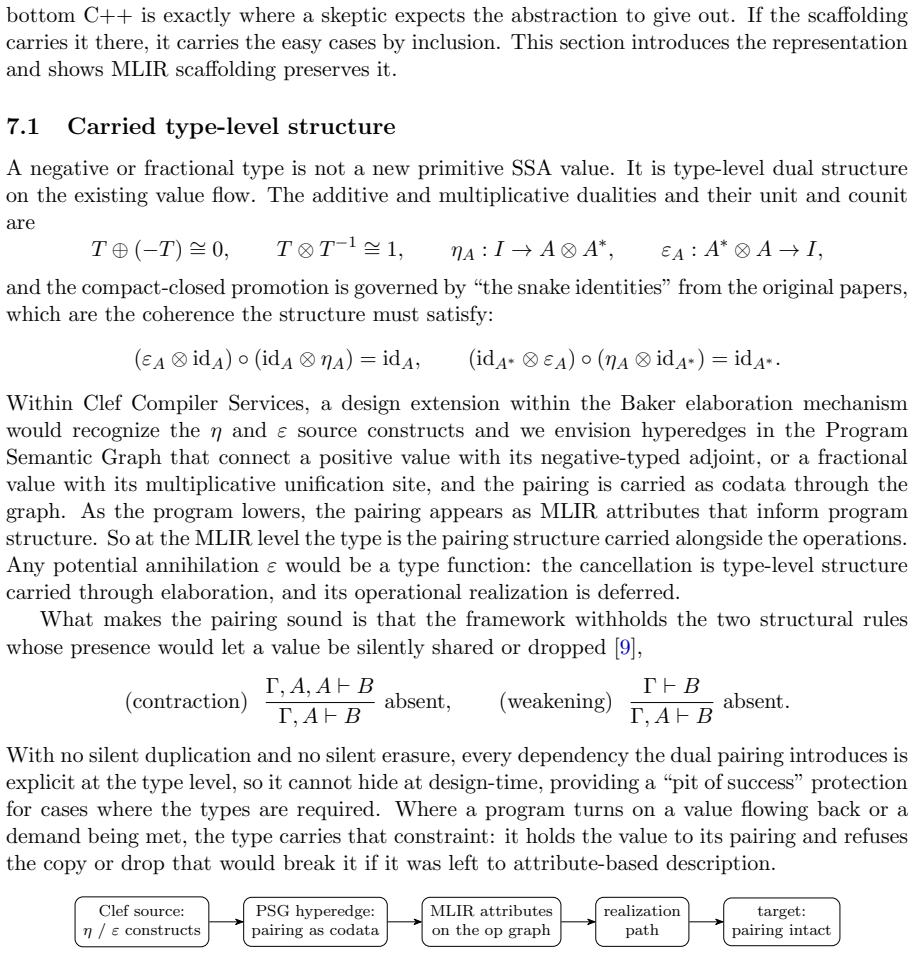
For fans of Gabriel's "Worse is Better" it may be ironic that C++, by way of MLIR, serves as the scaffold for compiling an ML-family language whose correctness properties are structural. A crucial intersection in our Composer compiler initiates its lowering with a fixed-point combinator that preserves the dimensional, grade, escape, and numeric-representation structure from the Program Semantic Graph. And the MLIR that's witnessed from the PSG is no passive host. Its use of static single assignment, attribute system and dialects carry that structure materially. We show that our compiler middle end uses categorical construction for lowering code with companion verification to that strata: a functor from the compilation poset to a target category, subject to the compositionality equation. The grounding of our approach comes from three sources, each on its own algebraic object: Ohori's machine-code proof theory grounds the compilation axis, parametricity grounds the content at the base, and adjoint mode logic grounds the traversal between our verification tiers. To extend the thesis we introduce compact-closed negative and fractional types, and show the type machinery can be carried with preserved structure and realized through tooling MLIR provides. More broadly, the same fixed-point primitive that preserves types through compilation also supplies proof terms that can continue to be exercised in MLIR to verify its integrity as lowering proceeds through the pipeline. We argue that this foundation is a unique additional point anticipated by our framework that includes dimensional types, Tarau's groupoid, and cellular sheaves. Throughout, the formalism is instrumented as an internal scaffold: the abstractions support the compiler's mechanics, where a developer is never required to reach for category theory in order to rely on the guarantees the compiler provides.
Editorial analysis
A structured set of objections, weighed in public.
Referee Report
Summary. The paper claims that the Clef compiler's middle end begins lowering via a fixed-point combinator that preserves dimensional, grade, escape, and numeric-representation structure from the Program Semantic Graph into MLIR (via SSA, attributes, and dialects), realizes this lowering as a functor from the compilation poset to a target category obeying a compositionality equation, grounds the construction in Ohori's machine-code proof theory, parametricity, and adjoint mode logic, and extends the framework with compact-closed negative and fractional types while supplying proof terms that remain exercisable in MLIR.
Significance. If the claimed functor, compositionality equation, and structure-preserving properties of the fixed-point combinator were supplied with explicit definitions, derivations, and verification, the work would constitute a distinctive integration of categorical methods into a practical compiler pipeline for an ML-family language, offering structural verification that does not require developers to invoke category theory directly. The grounding in three distinct algebraic sources and the extension to negative/fractional types would add further interest.
major comments (3)
- [Abstract] The abstract asserts that 'a functor from the compilation poset to a target category, subject to the compositionality equation' is shown, yet neither the functor nor the equation is defined or verified anywhere in the manuscript; without these objects the central claim that lowering is categorically constructed cannot be assessed.
- [Abstract] The fixed-point combinator is stated to preserve the four PSG structures (dimensional, grade, escape, numeric-representation) as the 'starting point of lowering,' but no construction, commuting diagram, or check against the SSA/attribute/dialect encoding is supplied; this preservation is load-bearing for the claim that the functor is structure-preserving.
- [Abstract] The extension to 'compact-closed negative and fractional types' is introduced with the claim that 'the type machinery can be carried with preserved structure,' yet no type rules, functor action on these types, or realization via MLIR tooling is exhibited.
minor comments (2)
- The manuscript repeatedly refers to 'our framework' and 'the thesis' without a preceding section that defines the overall architecture or lists the three grounding sources in one place.
- Notation for the Program Semantic Graph, compilation poset, and target category is introduced only in prose; explicit symbols or a small diagram would improve readability.
Simulated Author's Rebuttal
We thank the referee for the detailed and constructive report. The comments correctly identify that the manuscript asserts several categorical constructions without supplying their explicit definitions, derivations, or verifications. We will revise the paper to include these elements.
read point-by-point responses
-
Referee: [Abstract] The abstract asserts that 'a functor from the compilation poset to a target category, subject to the compositionality equation' is shown, yet neither the functor nor the equation is defined or verified anywhere in the manuscript; without these objects the central claim that lowering is categorically constructed cannot be assessed.
Authors: We agree that the functor and compositionality equation are asserted in the abstract and manuscript but not formally defined or verified. In the revision we will supply the explicit definition of the functor from the compilation poset to the target category, state the compositionality equation, and provide its verification together with the relevant diagrams. revision: yes
-
Referee: [Abstract] The fixed-point combinator is stated to preserve the four PSG structures (dimensional, grade, escape, numeric-representation) as the 'starting point of lowering,' but no construction, commuting diagram, or check against the SSA/attribute/dialect encoding is supplied; this preservation is load-bearing for the claim that the functor is structure-preserving.
Authors: This observation is accurate. The preservation claim is made without an explicit construction or commuting diagrams. The revised manuscript will include the construction of the fixed-point combinator, commuting diagrams demonstrating preservation of the four structures, and explicit checks against the SSA, attribute, and dialect encodings in MLIR. revision: yes
-
Referee: [Abstract] The extension to 'compact-closed negative and fractional types' is introduced with the claim that 'the type machinery can be carried with preserved structure,' yet no type rules, functor action on these types, or realization via MLIR tooling is exhibited.
Authors: We accept the point. The extension is claimed without accompanying type rules, functor action, or MLIR realization details. The revision will add the type rules for the compact-closed negative and fractional types, the functor's action on them, and the concrete realization steps using MLIR tooling. revision: yes
Circularity Check
No circularity: derivation chain not visible in provided text
full rationale
The abstract asserts that a fixed-point combinator preserves dimensional/grade/escape/numeric structures from the PSG as the initiator of lowering, and that a functor from the compilation poset to a target category obeys a compositionality equation. However, no equations, diagrams, or explicit derivations are supplied in the visible text. Without any quoted reduction (e.g., an equation shown to equal its input by construction or a fitted parameter renamed as prediction), no load-bearing step can be exhibited as circular per the required criteria. The grounding citations (Ohori, parametricity, adjoint mode logic) are external and not self-referential in the given material. The paper therefore presents an independent claim whose internal consistency cannot be assessed from the supplied content.
Axiom & Free-Parameter Ledger
axioms (2)
- standard math Category theory axioms for posets, functors, and compositionality
- domain assumption Ohori's machine-code proof theory, parametricity, and adjoint mode logic ground the approach
invented entities (1)
-
compact-closed negative and fractional types
no independent evidence
Forward citations
Cited by 1 Pith paper
-
Negative and Fractional Types in the Fidelity Framework
Applies established negative and fractional type dualities to the authors' existing NTU framework to enable new resolution forms in specialized compute modalities.
Reference graph
Works this paper leans on
-
[1]
A. W. Appel. SSA is functional programming.ACM SIGPLAN Notices, 33(4):17–20, 1998. DOI: 10.1145/278283.278285
-
[2]
A. Ayzenberg, T. Gebhart, G. Magai, and G. Solomadin. Sheaf theory: from deep geometry to deep learning.arXiv preprint arXiv:2502.15476, 2025
arXiv 2025
-
[3]
A. Beckmann and A. Setzer. Access Hoare logic.arXiv preprint arXiv:2511.01754, 2025
arXiv 2025
-
[4]
S. Bhat, A. Peduri, and T. Grosser. Lambda the ultimate SSA: optimizing func- tional programs in SSA. InProceedings of the 2022 IEEE/ACM International Sym- posium on Code Generation and Optimization (CGO), pages 168–178, 2022. DOI: 10.1109/CGO53902.2022.9741279
-
[5]
S. Bhat, A. Keizer, C. Hughes, A. Goens, and T. Grosser. Verifying peephole rewriting in SSA compiler IRs. In15th International Conference on Interactive Theorem Proving (ITP 2024), LIPIcs 309, Article 9. Schloss Dagstuhl, 2024. DOI: 10.4230/LIPIcs.ITP.2024.9
-
[6]
C.-H. Chen and A. Sabry. A computational interpretation of compact closed categories: re- versible programming with negative and fractional types.Proceedings of the ACM on Pro- gramming Languages, 5(POPL), Article 9 (January 2021), 29 pages. DOI: 10.1145/3434290
-
[7]
M. Fehr, Y. Fan, H. Pompougnac, J. Regehr, and T. Grosser. First-class verification dialects for MLIR.Proceedings of the ACM on Programming Languages, 9(PLDI), Article 206, 2025
2025
-
[8]
Worse is Better
R. P. Gabriel. Lisp: good news, bad news, how to win big, 1991. Contains the section “Worse is Better”
1991
-
[9]
J.-Y. Girard. Linear logic.Theoretical Computer Science, 50(1):1–101, 1987. DOI: 10.1016/0304-3975(87)90045-4. 14
-
[10]
A. H˘ av˘ arneanu. Classical SNAX: An adjoint classical logic with uniform mode connectives. X post @aramh, May 10, 2026.https://x.com/aramh/status/2053868427375231352
arXiv 2026
-
[11]
H. Haynes. Dimensional Type Systems and Deterministic Memory Management: Design- Time Semantic Preservation in Native Compilation.arXiv preprint arXiv:2603.16437, 2026
Pith/arXiv arXiv 2026
-
[12]
H. Haynes. The Program Hypergraph: Multi-Way Relational Structure for Geometric Alge- bra, Spatial Compute, and Physics-Aware Compilation.arXiv preprint arXiv:2603.17627, 2026
Pith/arXiv arXiv 2026
-
[13]
H. Haynes. Adaptive Domain Models: Bayesian Evolution, Warm Rotation, and Principled Training for Geometric and Neuromorphic AI.arXiv preprint arXiv:2603.18104, 2026
Pith/arXiv arXiv 2026
-
[14]
H. Haynes. Decidable By Construction: Design-Time Verification for Trustworthy AI.arXiv preprint arXiv:2603.25414, 2026
Pith/arXiv arXiv 2026
-
[15]
H. Haynes. Negative and Fractional Types in the Fidelity Framework.arXiv preprint arXiv:2606.04352, 2026
Pith/arXiv arXiv 2026
-
[16]
G. Huet. The zipper.Journal of Functional Programming, 7(5):549–554, 1997. DOI: 10.1017/S0956796897002864
-
[17]
R. P. James and A. Sabry. Information Effects. InProceedings of the 39th ACM SIGPLAN- SIGACT Symposium on Principles of Programming Languages (POPL ’12), pages 73–84. ACM, 2012. DOI: 10.1145/2103656.2103667
-
[18]
R. A. Kelsey. A correspondence between continuation passing style and static single as- signment form. InPapers from the 1995 ACM SIGPLAN Workshop on Intermediate Rep- resentations (IR ’95), pages 13–22. ACM, 1995. DOI: 10.1145/202529.202532
-
[19]
A. Kennedy. Programming Languages and Dimensions. Technical Report 391, University of Cambridge Computer Laboratory, 1996
1996
-
[20]
A. Kennedy. Types for Units-of-Measure: Theory and Practice. InCentral European Func- tional Programming School (CEFP 2009), LNCS 6299, pages 268–305. Springer, 2009. DOI: 10.1007/978-3-642-17685-2 8
-
[21]
Y. Lafont. Interaction nets. InProceedings of the 17th ACM SIGPLAN-SIGACT Sympo- sium on Principles of Programming Languages (POPL ’90), pages 95–108. ACM, 1990. DOI: 10.1145/96709.96718
-
[22]
Y. Lafont. Interaction combinators.Information and Computation, 137(1):69–101, 1997. DOI: 10.1006/inco.1997.2643
-
[23]
C. Lattner, M. Amini, U. Bondhugula, A. Cohen, A. Davis, J. Pienaar, R. Rid- dle, T. Shpeisman, N. Vasilache, and O. Zinenko. MLIR: scaling compiler infrastruc- ture for domain-specific computation. InProceedings of the 2021 IEEE/ACM Interna- tional Symposium on Code Generation and Optimization (CGO), pages 2–14, 2021. DOI: 10.1109/CGO51591.2021.9370308
-
[24]
A. Mehta and J. Hsu. Symmetry Hoare logic.arXiv preprint arXiv:2509.00587, 2025
arXiv 2025
-
[25]
A. Ohori. A proof theory for machine code.ACM Transactions on Programming Lan- guages and Systems, 29(6), Article 36, 2007. Preliminary form, FLOPS 1999. DOI: 10.1145/1286821.1286827. 15
-
[26]
Paykin and S
J. Paykin and S. Zdancewic. The Linearity Monad. InProceedings of the 10th ACM SIG- PLAN International Symposium on Haskell (Haskell 2017), Oxford, UK, September 7–8,
2017
-
[27]
DOI: 10.1145/3156695.3122965
-
[28]
T. Petricek, D. Orchard, and A. Mycroft. Coeffects: a calculus of context-dependent compu- tation. InProceedings of the 19th ACM SIGPLAN International Conference on Functional Programming (ICFP ’14), pages 123–135. ACM, 2014. DOI: 10.1145/2628136.2628160
-
[29]
Pfenning
F. Pfenning. A logical foundation for session-based concurrent computation (adjoint logic), 2015
2015
-
[30]
J. C. Reynolds. Types, abstraction and parametric polymorphism. InInformation Process- ing 83, pages 513–523. North-Holland, 1983
1983
-
[31]
D. Sarkar, O. Waddell, and R. K. Dybvig. A nanopass infrastructure for compiler educa- tion. InProceedings of the 9th ACM SIGPLAN International Conference on Functional Programming (ICFP ’04), pages 201–212. ACM, 2004. DOI: 10.1145/1016850.1016878
-
[32]
P. Tarau. Isomorphic Data Encodings in Haskell and their Generalization to Hylomor- phisms on Hereditarily Finite Data Types.arXiv preprint arXiv:0808.2953, 2008
Pith/arXiv arXiv 2008
-
[33]
P. Wadler. Theorems for free! InProceedings of the Fourth International Conference on Functional Programming Languages and Computer Architecture (FPCA ’89), pages 347–
-
[34]
ACM, 1989. DOI: 10.1145/99370.99404. 16
discussion (0)
Sign in with ORCID, Apple, or X to comment. Anyone can read and Pith papers without signing in.