Red noise and evolving signals: a complete frequentist approach to supermassive black hole binary searches with pulsar timing array
Pith reviewed 2026-06-27 21:15 UTC · model grok-4.3
The pith
A generalized likelihood ratio test enables reliable detection of evolving supermassive black hole binary signals in pulsar timing arrays that include red noise.
A machine-rendered reading of the paper's core claim, the machinery that carries it, and where it could break.
Core claim
The GLRT and T-statistic form a complete frequentist detection framework for isolated evolving SMBHBs in PTA data that simultaneously estimates signal and noise parameters, retains both Earth and pulsar terms, and reduces computational dimensionality via semi-analytical maximization over pulsar phases combined with particle swarm optimization to locate the global likelihood maximum.
What carries the argument
Generalized Likelihood Ratio Test (GLRT) and T-statistic using semi-analytical maximization over pulsar phase parameters followed by Particle Swarm Optimization over the remaining parameters.
If this is right
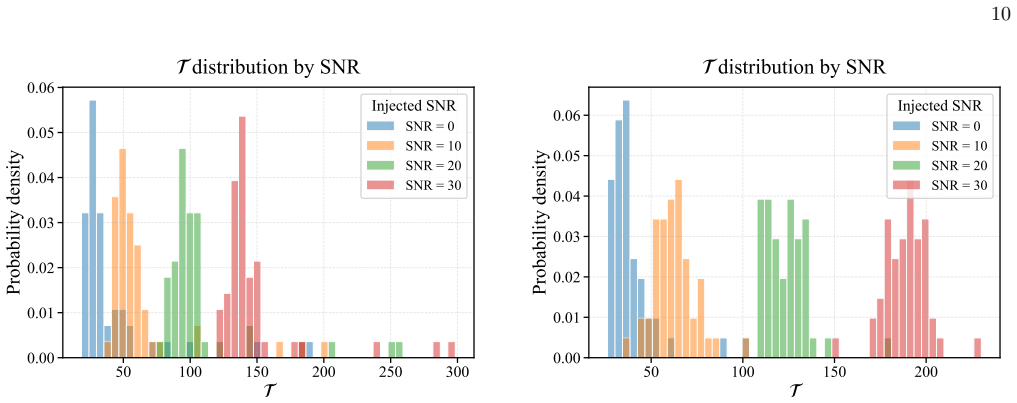
- The statistic achieves 100 percent detection probability at false-alarm probability 0.06 for an evolving SMBHB with chirp mass 10^9.2 solar masses and SNR 20 in a 30-pulsar timing array with 100 ns rms white noise and pulsar-specific red noise.
- The method incorporates both Earth and pulsar terms without forcing the circular analysis that biases earlier F-statistic approaches limited to non-evolving sources.
- Dimensionality of the fit scales with the number of pulsars yet remains computationally tractable through the semi-analytical reduction step.
- The framework directly models source evolution from gravitational-wave emission while estimating pulsar distances as unknown parameters.
Where Pith is reading between the lines
- Application to longer PTA data sets could allow population studies that include realistic orbital evolution rather than assuming fixed-frequency sources.
- The same dimensionality-reduction technique might extend to searches for other time-varying gravitational-wave sources in PTA data.
- Combining this frequentist statistic with Bayesian methods could provide cross-checks on detection significance when red noise properties are uncertain.
Load-bearing premise
The semi-analytical maximization of the likelihood over the pulsar phase parameters combined with Particle Swarm Optimization reliably locates the global maximum without missing superior solutions or introducing bias in the presence of red noise.
What would settle it
A set of Monte Carlo simulations on a 30-pulsar array with injected evolving SMBHB signals of chirp mass 10^9.2 solar masses, SNR 20, and realistic red noise in which the T-statistic fails to reach near-100 percent detection at a false-alarm probability of 0.06 would falsify the claimed performance.
Figures


read the original abstract
Searches for gravitational waves (GWs) from isolated supermassive black hole binaries (SMBHBs) in pulsar timing array (PTA) data require simultaneous estimation of signal and noise parameters, so the dimensionality of the fit scales with the number of observed pulsars. This computational difficulty is exacerbated when source evolution from GW emission is included, since retaining both Earth and pulsar terms introduces the unknown pulsar distances. Existing frequentist methods such as the $\mathcal{F}$-statistic, restricted so far to non-evolving sources, effectively, imply a circular analysis, which may lead to biased estimators. We present a Generalized Likelihood Ratio Test (GLRT) and the associated $\mathcal{T}$-statistic that overcomes the aforementioned limitations. The formulation of the GLRT extends earlier work in which the dimensionality of the fitting problem was drastically reduced by semi-analytical maximization of the likelihood over the pulsar phase parameters, followed by efficient global optimization over the remaining parameters using Particle Swarm Optimization. Our simulations demonstrate that for an evolving SMBHB signal with chirp mass $\mathcal{M}=10^{9.2}\,M_\odot$ and signal-to-noise ratio $20$, this detection statistic achieves a $100\%$ detection probability at a false-alarm probability of $0.06$ in a 30-pulsar timing array, which is characterized by a $100~\mathrm{ns}$ root-mean-square white noise residual and pulsar-specific red noise.
Editorial analysis
A structured set of objections, weighed in public.
Referee Report
Summary. The paper introduces a Generalized Likelihood Ratio Test (GLRT) and associated T-statistic for frequentist searches of evolving supermassive black hole binary (SMBHB) gravitational wave signals in pulsar timing array (PTA) data. It extends prior F-statistic work by using semi-analytical maximization of the likelihood over the 2N_pulsar phase parameters, followed by Particle Swarm Optimization (PSO) over the remaining parameters (including unknown pulsar distances), to avoid circularity and handle the increased dimensionality from source evolution. Simulations for a specific case (chirp mass 10^{9.2} M_odot, SNR 20) in a 30-pulsar array with 100 ns white noise plus pulsar-specific red noise report 100% detection probability at a false-alarm probability of 0.06.
Significance. If the optimization procedure is shown to reliably recover global likelihood maxima, the method would provide a computationally tractable frequentist framework for evolving SMBHB signals that addresses a key limitation of existing approaches. The dimensionality reduction via semi-analytical phase maximization is a clear technical strength, and the reported operating point (if robust) would be relevant for interpreting PTA data from arrays like NANOGrav or EPTA.
major comments (2)
- [Abstract] Abstract (simulation results paragraph): The headline performance (100% detection probability at FAP=0.06) is obtained by evaluating the GLRT/T-statistic at the numerically located maximum; however, no details are provided on the number of Monte Carlo realizations used to construct the empirical FAP distribution, the PSO convergence criteria, or any validation that single PSO runs recover the global maximum on the non-convex surface induced by red-noise covariance. This directly affects whether the reported detection probabilities are biased low.
- [Abstract] Abstract (method description): The claim that the semi-analytical maximization over pulsar phases combined with PSO 'overcomes the aforementioned limitations' of circular analysis requires explicit demonstration that the reduced-dimensional optimization does not introduce bias when pulsar distances are unknown and red noise is present; without such a test or derivation showing independence from fitted parameters, the independence from the F-statistic circularity cannot be confirmed.
Simulated Author's Rebuttal
We thank the referee for their thorough review and valuable comments on our manuscript. We address each major comment below and have made revisions to the manuscript to incorporate the suggested improvements.
read point-by-point responses
-
Referee: [Abstract] Abstract (simulation results paragraph): The headline performance (100% detection probability at FAP=0.06) is obtained by evaluating the GLRT/T-statistic at the numerically located maximum; however, no details are provided on the number of Monte Carlo realizations used to construct the empirical FAP distribution, the PSO convergence criteria, or any validation that single PSO runs recover the global maximum on the non-convex surface induced by red-noise covariance. This directly affects whether the reported detection probabilities are biased low.
Authors: We agree that these methodological details were omitted from the abstract and main text. In the revised manuscript, we will expand the methods and simulation sections to report the number of Monte Carlo realizations used to construct the empirical FAP distribution, the PSO convergence criteria, and validation results from multiple PSO runs with varied initializations to confirm reliable recovery of the global maximum. These additions will allow assessment of whether the reported detection probabilities are robust. revision: yes
-
Referee: [Abstract] Abstract (method description): The claim that the semi-analytical maximization over pulsar phases combined with PSO 'overcomes the aforementioned limitations' of circular analysis requires explicit demonstration that the reduced-dimensional optimization does not introduce bias when pulsar distances are unknown and red noise is present; without such a test or derivation showing independence from fitted parameters, the independence from the F-statistic circularity cannot be confirmed.
Authors: The semi-analytical maximization over the 2N_pulsar phase parameters is derived to be independent of the remaining parameters (including distances) by construction, as the likelihood is maximized analytically for any fixed values of the other parameters before PSO is applied. To explicitly demonstrate the absence of bias under unknown distances and red noise, the revised manuscript will include additional simulations comparing the full procedure against cases with fixed distances and against the non-evolving limit, confirming consistency and lack of introduced bias. revision: yes
Circularity Check
No significant circularity; performance claims rest on independent Monte Carlo simulations
full rationale
The paper defines a GLRT/T-statistic via semi-analytical maximization over pulsar phases plus PSO on remaining parameters, then reports empirical detection probabilities from separate Monte Carlo trials on synthetic PTA data with injected signals and red noise. These operating-point numbers are not obtained by fitting to the same data used for the statistic definition, nor do they reduce to a self-citation chain or ansatz smuggled from prior work. The reference to 'earlier work' is only for the maximization technique; the present results are self-contained against external simulation benchmarks. No load-bearing step equates a claimed prediction to its own inputs by construction.
Axiom & Free-Parameter Ledger
Reference graph
Works this paper leans on
-
[1]
were later adapted to PTAs, most notably as the Fe-statistic and theF p-statistic [24–26]. These statis- tics are attractive because they are easy to implement and, under fixed-noise assumptions, lead to simple ref- erence distributions for threshold setting [27]. However, this simplicity comes from approximations. The coherent Fe-statistic omits the puls...
Pith/arXiv arXiv 2026
-
[2]
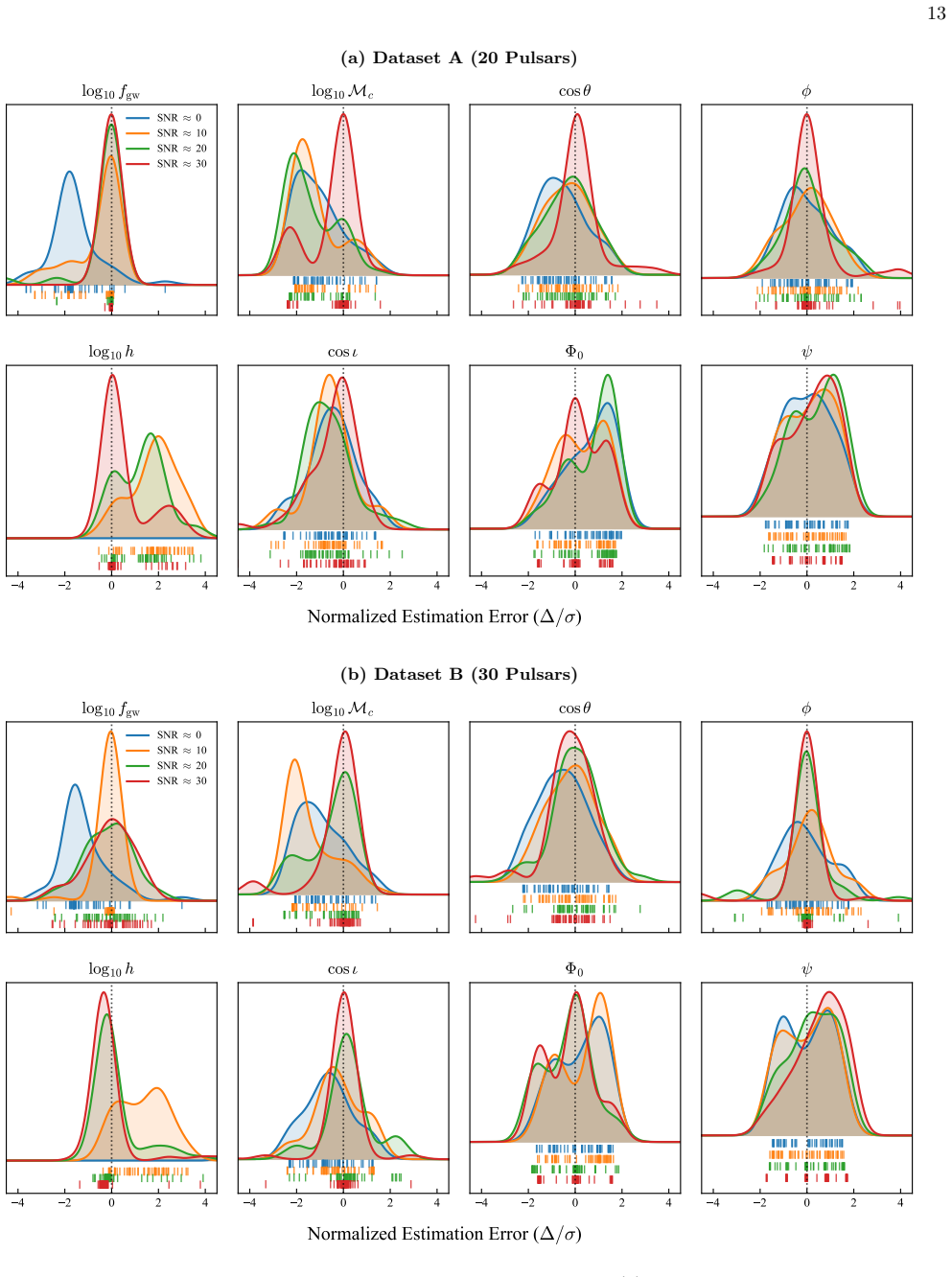
CGW Parameter Recovery We define the estimation error for a parameterλas ∆λ=λ best −λ true. To visualize the estimation accu- racy while accounting for scale variations across differ- ent signal strengths, Figure 6 displays the kernel den- sity estimates (KDE) of the normalized estimation errors (∆λ/σ∆λ) for both the 20-pulsar baseline (panel a) and the 3...
-
[3]
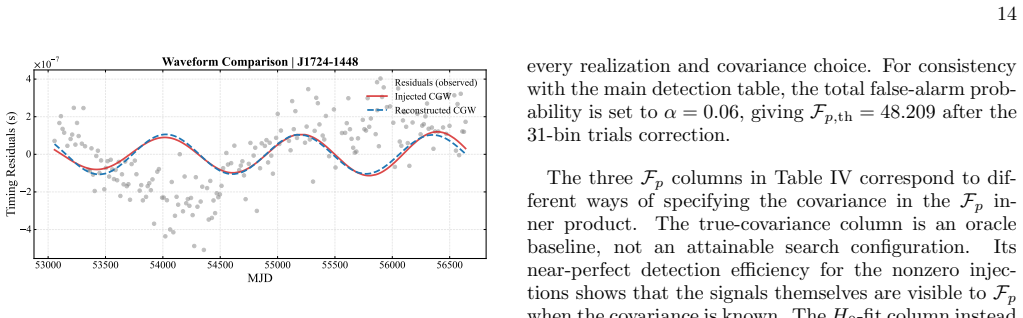
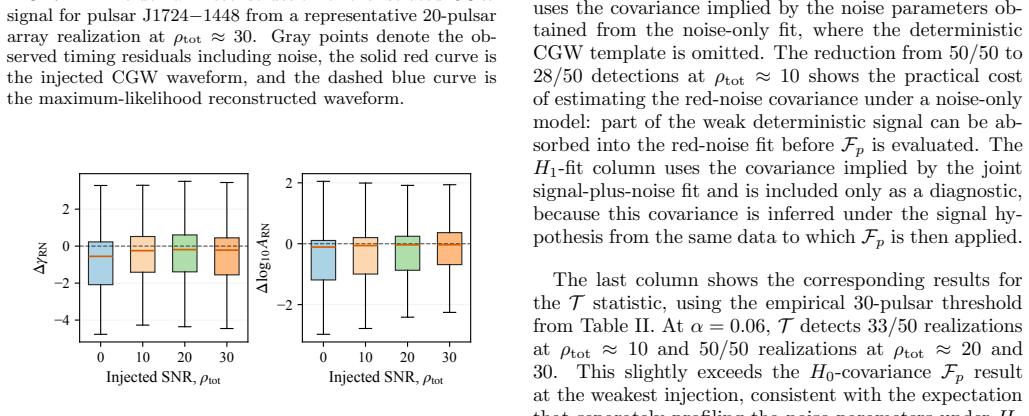
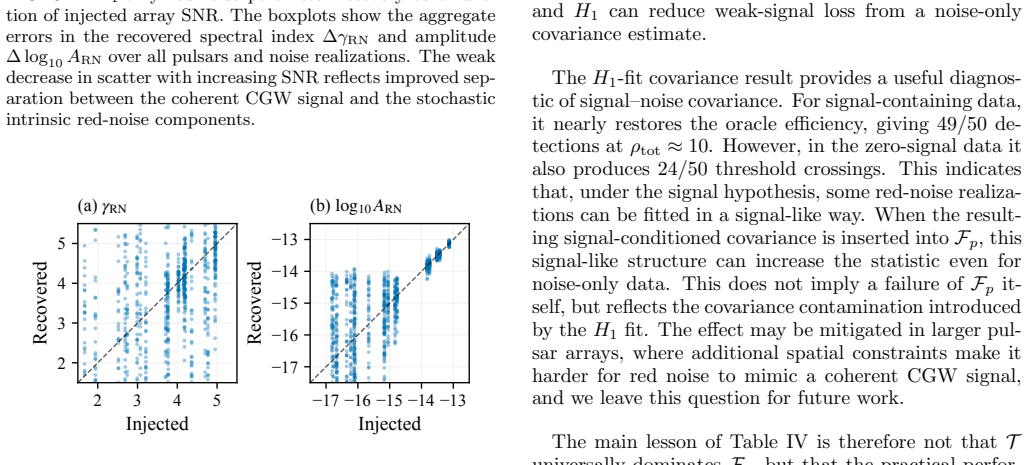
Red Noise Characterization A central motivation for the joint-search framework is to characterize the covariance between a deterministic continuous gravitational wave (CGW) signal and intrin- sic pulsar red noise within the same likelihood analysis. Even when red-noise and CGW parameters are sampled simultaneously in a Bayesian stage, a subsequent frequen...
-
[4]
TheH 1-fit covariance result provides a useful diagnos- tic of signal–noise covariance
This slightly exceeds theH 0-covarianceF p result at the weakest injection, consistent with the expectation that separately profiling the noise parameters underH 0 andH 1 can reduce weak-signal loss from a noise-only covariance estimate. TheH 1-fit covariance result provides a useful diagnos- tic of signal–noise covariance. For signal-containing data, it ...
2000
-
[5]
M. V. Sazhin, Soviet Astronomy22, 36 (1978)
1978
-
[6]
Detweiler, Astrophys
S. Detweiler, Astrophys. J.234, 1100 (1979)
1979
-
[7]
R. S. Foster and D. C. Backer, Astrophys. J.361, 300 (1990)
1990
-
[8]
Hobbset al., Class
G. Hobbset al., Class. Quantum Grav.27, 084013 (2010)
2010
-
[9]
Burke-Spolaoret al., Astron
S. Burke-Spolaoret al., Astron. Astrophys. Rev.27, 5 (2019)
2019
-
[10]
Agazieet al.(NANOGrav Collaboration), Astrophys
G. Agazieet al.(NANOGrav Collaboration), Astrophys. J. Lett.951, L8 (2023)
2023
-
[11]
Antoniadiset al.(EPTA Collaboration and InPTA Collaboration), Astron
J. Antoniadiset al.(EPTA Collaboration and InPTA Collaboration), Astron. Astrophys.678, A3 (2023)
2023
-
[12]
D. J. Reardonet al.(PPTA Collaboration), Astrophys. J. Lett.951, L6 (2023)
2023
-
[13]
Xuet al.(CPTA Collaboration), Res
H. Xuet al.(CPTA Collaboration), Res. Astron. Astro- phys.23, 075024 (2023)
2023
-
[14]
Tarafdaret al., Publ
P. Tarafdaret al., Publ. Astron. Soc. Aust.39, e053 (2022)
2022
-
[15]
R. W. Hellings and G. S. Downs, Astrophys. J.265, L39 (1983). 17
1983
-
[16]
Rajagopal and R
M. Rajagopal and R. W. Romani, Astrophys. J.446, 543 (1995)
1995
-
[17]
A. H. Jaffe and D. C. Backer, Astrophys. J.583, 616 (2003)
2003
-
[18]
Sesana, A
A. Sesana, A. Vecchio, and C. N. Colacino, Mon. Not. R. Astron. Soc.390, 192 (2008)
2008
-
[19]
L. Z. Kelley, L. Blecha, and L. Hernquist, Mon. Not. R. Astron. Soc.464, 3131 (2017)
2017
-
[20]
C. M. F. Mingarelli, K. Grover, T. Sidery, R. J. E. Smith, and A. Vecchio, Phys. Rev. Lett.109, 081104 (2012)
2012
-
[21]
Y. Wang, S. D. Mohanty, and Z. Cao, The Astrophys- ical Journal Letters907, L43 (2021), arXiv:2012.04261 [astro-ph.HE]
arXiv 2021
-
[22]
X. Tao, Y. Wang, and S. D. Mohanty, Phys. Rev. D111, 083030 (2025), arXiv:2412.07615 [astro-ph.HE]
arXiv 2025
-
[23]
V. Corbin and N. J. Cornish, arXiv e-prints (2010), arXiv:1008.1782 [astro-ph.GA]
Pith/arXiv arXiv 2010
-
[24]
K. J. Leeet al., Mon. Not. R. Astron. Soc.414, 3251 (2011)
2011
-
[25]
A. T. Delleret al., Astrophys. J. Lett.685, L67 (2008)
2008
-
[26]
J. P. W. Verbiestet al., Astrophys. J.755, 39 (2012)
2012
-
[27]
Jaranowski, A
P. Jaranowski, A. Kr´ olak, and B. F. Schutz, Phys. Rev. D58, 063001 (1998)
1998
-
[28]
Babak and A
S. Babak and A. Sesana, Phys. Rev. D85, 044034 (2012)
2012
-
[29]
J. A. Ellis, X. Siemens, and J. D. E. Creighton, Astro- phys. J.756, 175 (2012)
2012
-
[30]
Zhuet al., Mon
X. Zhuet al., Mon. Not. R. Astron. Soc.444, 3709 (2014)
2014
-
[31]
Arzoumanianet al., Astrophys
Z. Arzoumanianet al., Astrophys. J.794, 141 (2014)
2014
-
[32]
van Haasteren and M
R. van Haasteren and M. Vallisneri, Phys. Rev. D90, 104012 (2014)
2014
-
[33]
J. A. Elliset al., Enterprise: Enhanced numerical toolkit evaluator for robust pulsar inference supported by em- pirical data (2019), astrophysics Source Code Library, record ascl:1912.015
2019
-
[34]
S. J. Vigeland, K. Islo, S. R. Taylor, and X. Siemens, Phys. Rev. D98, 044003 (2018)
2018
-
[35]
Aggarwal,et al
NANOGrav Collaboration, K. Aggarwal,et al. (NANOGrav Collaboration), Astrophys. J.880, 116 (2019)
2019
-
[36]
Arzoumanianet al.(NANOGrav Collaboration), As- trophys
Z. Arzoumanianet al.(NANOGrav Collaboration), As- trophys. J. Lett.951, L50 (2023)
2023
-
[37]
B´ ecsy, N
B. B´ ecsy, N. J. Cornish, and L. Z. Kelley, Astrophys. J. 931, 95 (2022)
2022
-
[38]
S. C. Sardesai, G. E. Freedman, S. J. Vigeland, and C. A. Witt, Phys. Rev. D113, 084067 (2026)
2026
-
[39]
Kennedy and R
J. Kennedy and R. Eberhart, inProceedings of ICNN’95- International Conference on Neural Networks(1995) pp. 1942–1948
1995
-
[40]
Mohanty,Swarm intelligence methods for statistical regression(CRC Press, 2018)
S. Mohanty,Swarm intelligence methods for statistical regression(CRC Press, 2018)
2018
-
[41]
Lentati, P
L. Lentati, P. Alexander, M. P. Hobson, S. Taylor, J. Gair, S. T. Balan, and R. van Haasteren, Phys. Rev. D87, 104021 (2013)
2013
-
[42]
Y. Wang, S. D. Mohanty, and F. A. Jenet, Astrophys. J. 815, 125 (2015)
2015
-
[43]
Y. Wang and S. D. Mohanty, Phys. Rev. Lett.118, 151104 (2017), arXiv:1611.09440 [astro-ph.IM]
Pith/arXiv arXiv 2017
-
[44]
Y.-Q. Qian, S. D. Mohanty, and Y. Wang, Phys. Rev. D 106, 023016 (2022)
2022
-
[45]
Wang and S
Y. Wang and S. D. Mohanty, Phys. Rev. D81, 063002 (2010)
2010
-
[46]
T. S. Weerathunga and S. D. Mohanty, Phys. Rev. D95, 124030 (2017)
2017
-
[47]
Zhanget al., Phys
X.-H. Zhanget al., Phys. Rev. D104, 024023 (2021)
2021
-
[48]
Y. Fu, Y. Wang, and S. D. Mohanty, Phys. Rev. D111, 043026 (2025), arXiv:2407.10797 [astro-ph.IM]
arXiv 2025
-
[49]
S. M. Kay,Fundamentals of Statistical Signal Processing, Volume II: Detection Theory(Prentice Hall, 1998)
1998
-
[50]
Neyman and E
J. Neyman and E. S. Pearson, Philos. Trans. R. Soc. Lon- don A231, 289 (1933)
1933
-
[51]
S. R. Taylor, P. T. Baker, J. S. Hazboun, J. Simon, and S. J. Vigeland, enterprise extensions (2021), v2.4.3. Appendix A: Simulated Pulsar Parameters and Signal-to-Noise Ratios This appendix details the noise properties and signal contributions for the simulated PTAs. Table V lists the injected red noise parameters (log 10 ARN andγ RN), dis- tances (L I),...
2021
discussion (0)
Sign in with ORCID, Apple, or X to comment. Anyone can read and Pith papers without signing in.