Towards imaging Earth's large-scale structures by directional geoneutrino detection with Ocean Bottom Detector
Pith reviewed 2026-06-27 04:52 UTC · model grok-4.3
The pith
An ocean bottom detector can use directional geoneutrino signals to image enriched regions in Earth's deep mantle.
A machine-rendered reading of the paper's core claim, the machinery that carries it, and where it could break.
Core claim
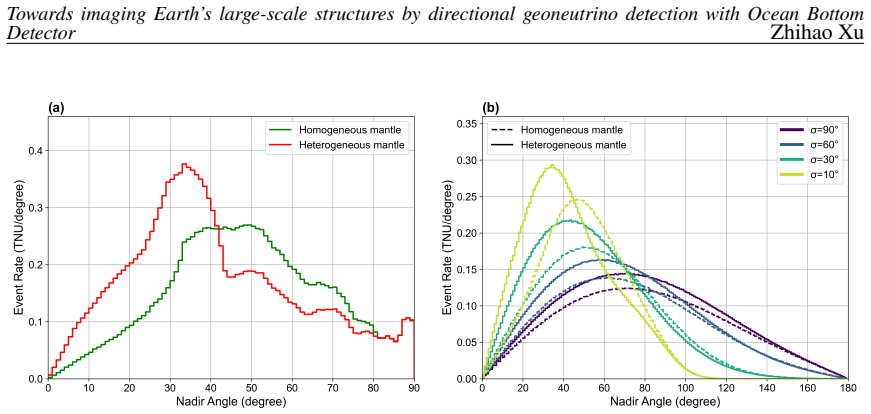
The central claim is that LLSVPs enriched in Th and U yield a distinct flux of geoneutrinos with distinctive angular patterns, making an oceanic site above the Pacific LLSVP a particularly favorable location for the Ocean Bottom Detector to achieve spatial resolution of mantle structures.
What carries the argument
The angular patterns in geoneutrino flux detected by a directional ocean-bottom liquid scintillator, which arise from the enrichment of LLSVPs in heat-producing elements.
If this is right
- The detector can distinguish homogeneous from heterogeneous mantle models.
- Constraints on the distribution of heat-producing elements within the Earth will improve.
- Site selection for detectors should incorporate geophysical and geochemical data.
- Overall understanding of Earth's internal heat budget will advance.
Where Pith is reading between the lines
- Other deep Earth structures with chemical enrichment could become detectable with similar methods.
- Integration with seismic tomography data might allow joint inversion for mantle composition.
- Scaling up the detector size could enable finer resolution of mantle features.
Load-bearing premise
LLSVPs must contain substantially more thorium and uranium than the average mantle for their geoneutrino signals to stand out angularly.
What would settle it
Failure to detect an angular excess of geoneutrinos pointing toward the Pacific LLSVP from the proposed ocean floor location would indicate that the enrichment assumption does not hold or the patterns are not observable.
Figures

read the original abstract
Geoneutrinos, electron antineutrinos produced by radioactive decays of heat-producing elements (HPEs) within the Earth, provide unique insights into Earth's interior and heat budget since their first detection in 2005 by KamLAND. Conventional geoneutrino detectors currently provide integrated global information and lack the capability to spatially resolve structures deep within the Earth. Here, we evaluate the ability of angular-sensitive geoneutrino detectors to distinguish between homogeneous and heterogeneous mantle models, focusing on Large Low Shear Velocity Provinces (LLSVPs). Our results show that LLSVPs enriched in Th and U yield a distinct flux of geoneutrinos with distinctive angular patterns. An oceanic site above the Pacific LLSVP is considered a particularly favorable detector location. The Ocean Bottom Detector (OBD) project aims to leverage this spatial resolving advantage by deploying a kiloton-scale liquid scintillator detector directly on the ocean floor, enabling unprecedented sensitivity for mantle geoneutrino detection. These findings demonstrate the critical role of combining geophysical and geochemical data to guide detector site selection, ultimately improving constraints on Earth's internal heat and the HPE distribution.
Editorial analysis
A structured set of objections, weighed in public.
Referee Report
Summary. The manuscript evaluates the potential of directional (angular-sensitive) geoneutrino detectors to distinguish homogeneous from heterogeneous mantle models, focusing on Large Low Shear Velocity Provinces (LLSVPs). It claims that LLSVPs enriched in Th and U produce a distinct geoneutrino flux with characteristic angular patterns, identifies an oceanic site above the Pacific LLSVP as particularly favorable, and argues that the proposed Ocean Bottom Detector (OBD) would enable spatially resolved constraints on heat-producing element (HPE) distribution beyond the integrated signals from existing detectors such as KamLAND.
Significance. If the forward-modeling results hold under the stated enrichment assumption, the work provides a concrete geophysical argument for site selection of future directional detectors and illustrates how angular information could help map deep-mantle HPE heterogeneity. The explicit linkage between geophysical structure (LLSVPs) and geochemical enrichment is a useful framing, though the result remains conditional on that enrichment.
major comments (2)
- [Abstract] Abstract and implied mantle-modeling sections: the reported angular distinction and the claim that an oceanic site above the Pacific LLSVP is 'particularly favorable' are stated to hold only for LLSVPs 'enriched in Th and U.' No sensitivity study or minimum enrichment factor is supplied to show how large the contrast must be before the angular pattern becomes detectable above background and statistical fluctuations; without this, the site-selection recommendation rests on an external premise whose violation removes the distinction.
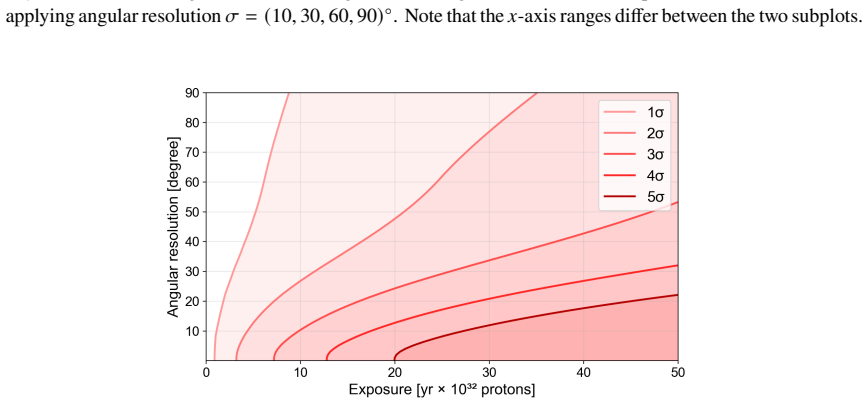
- [Abstract] The manuscript supplies no quantitative details on simulation methods, error estimates, or statistical significance of the angular patterns (e.g., flux contrast ratios, angular resolution, or exposure required). This prevents assessment of whether the claimed distinction is robust under realistic detector response and backgrounds.
minor comments (1)
- Notation for flux and angular bins should be defined explicitly on first use; the abstract refers to 'distinctive angular patterns' without indicating the angular binning or coordinate system employed.
Simulated Author's Rebuttal
We thank the referee for the constructive comments on our manuscript. We address each major comment below and indicate the revisions that will be incorporated.
read point-by-point responses
-
Referee: [Abstract] Abstract and implied mantle-modeling sections: the reported angular distinction and the claim that an oceanic site above the Pacific LLSVP is 'particularly favorable' are stated to hold only for LLSVPs 'enriched in Th and U.' No sensitivity study or minimum enrichment factor is supplied to show how large the contrast must be before the angular pattern becomes detectable above background and statistical fluctuations; without this, the site-selection recommendation rests on an external premise whose violation removes the distinction.
Authors: The angular distinction is presented under the assumption of Th/U-enriched LLSVPs, consistent with geochemical models linking these structures to HPE-enriched material. We agree that no sensitivity study on the minimum enrichment factor is included. In the revised manuscript we will add a sensitivity analysis varying the enrichment level to identify the threshold at which the angular pattern exceeds background and statistical fluctuations. revision: yes
-
Referee: [Abstract] The manuscript supplies no quantitative details on simulation methods, error estimates, or statistical significance of the angular patterns (e.g., flux contrast ratios, angular resolution, or exposure required). This prevents assessment of whether the claimed distinction is robust under realistic detector response and backgrounds.
Authors: The full manuscript describes the Monte Carlo simulation of directional geoneutrino fluxes and includes basic statistical uncertainties. However, explicit quantitative metrics such as flux contrast ratios, angular resolution, and required exposure are not presented in sufficient detail. We will expand these elements with numerical values and significance estimates in the revised manuscript. revision: yes
Circularity Check
No circularity; forward modeling rests on external enrichment premise
full rationale
The paper evaluates directional geoneutrino detection via forward modeling of fluxes from LLSVPs under an explicit input assumption of Th/U enrichment relative to surrounding mantle. No equations, fitted parameters, or self-citations are shown that reduce any output flux pattern or site advantage to a re-derivation of the enrichment itself or to prior author results by construction. The angular distinction is stated to vanish without the enrichment premise, confirming it functions as an independent external input rather than an internally forced result. This is the most common honest non-finding for modeling papers.
Axiom & Free-Parameter Ledger
Forward citations
Cited by 1 Pith paper
-
Deep-Ocean Application-Specific Neutrino Experiment: a white paper
The paper describes a conceptual mobile deep-ocean geoneutrino detector design intended to enable direct mantle measurements by reducing crustal background 50-100 times relative to land-based detectors.
Reference graph
Works this paper leans on
-
[1]
Layet al.,A post-perovskite lens and D” heat flux beneath the central Pacific,Science314 (2006) 1272-1276
T. Layet al.,A post-perovskite lens and D” heat flux beneath the central Pacific,Science314 (2006) 1272-1276
2006
-
[2]
E.J.GarneroandA.K.McNamara,StructureanddynamicsofEarth’slowermantle,Science 320(2008) 626-628
2008
-
[3]
A.K.McNamara,Areviewoflargelowshearvelocityprovincesandultralowvelocityzones, Tectonophysics760(2019) 199-220
2019
-
[4]
Arakiet al.(KamLAND Collaboration),Experimental investigation of geologically pro- duced antineutrinos with KamLAND,Nature436(2005) 499-503
T. Arakiet al.(KamLAND Collaboration),Experimental investigation of geologically pro- duced antineutrinos with KamLAND,Nature436(2005) 499-503
2005
-
[5]
Abeet al.(KamLAND Collaboration),Abundances of uranium and thorium elements in Earthestimatedbygeoneutrinospectroscopy,Geophys.Res.Lett.49(2022)e2022GL099566
S. Abeet al.(KamLAND Collaboration),Abundances of uranium and thorium elements in Earthestimatedbygeoneutrinospectroscopy,Geophys.Res.Lett.49(2022)e2022GL099566
2022
-
[6]
M.Agostinietal.(BorexinoCollaboration),ComprehensivegeoneutrinoanalysiswithBorex- ino,Phys. Rev. D101(2020) 012009
2020
-
[7]
Abreuet al.(SNO+ Collaboration),Measurement of Reactor Antineutrino Oscillation at SNO+,Phys
M. Abreuet al.(SNO+ Collaboration),Measurement of Reactor Antineutrino Oscillation at SNO+,Phys. Rev. Lett.135(2025) 121801
2025
-
[8]
A.Abuslemeetal.(JUNOCollaboration),Firstmeasurementofreactorneutrinooscillations at JUNO, [arXiv:2511.14593]
-
[9]
O.Šrámeketal.,GeophysicalandgeochemicalconstraintsongeoneutrinofluxesfromEarth’s mantle,Earth Planet. Sci. Lett.361(2013) 356-366
2013
-
[10]
Šrámeket al.,Revealing the Earth’s mantle from the tallest mountains using the Jinping Neutrino Experiment,Sci
O. Šrámeket al.,Revealing the Earth’s mantle from the tallest mountains using the Jinping Neutrino Experiment,Sci. Rep.6(2016) 33034
2016
-
[11]
Sakaiet al.,Study of Ocean Bottom Detector for observation of geo-neutrino from the mantle,J
T. Sakaiet al.,Study of Ocean Bottom Detector for observation of geo-neutrino from the mantle,J. Phys. Conf. Ser.2156(2022) 012144
2022
-
[12]
Watanabeet al.,Ocean Bottom Detector: frontier of technology for understanding the mantle by geoneutrinos,2023 IEEE Underwater Technology(2023)
H. Watanabeet al.,Ocean Bottom Detector: frontier of technology for understanding the mantle by geoneutrinos,2023 IEEE Underwater Technology(2023)
2023
-
[13]
C. G. Rothschildet al.,Antineutrino geophysics with liquid scintillator detectors,Geophys. Res. Lett.25(1998) 1083-1086
1998
-
[14]
K.A.Hochmuthetal.,ExploitingthedirectionalsensitivityoftheDoubleChoozneardetector, Phys. Rev. D76(2007) 073001. 6 Towards imaging Earth’s large-scale structures by directional geoneutrino detection with Ocean Bottom DetectorZhihao Xu
2007
-
[15]
M.Andriamiradoetal.(PROSPECTCollaboration),Reactorantineutrinodirectionalitymea- surement with the PROSPECT-I detector,Phys. Rev. D111(2025) 032014
2025
-
[16]
H. K. M. Tanaka and H. Watanabe,6Li-loaded directionally sensitive anti-neutrino detector for possible geo-neutrinographic imaging applications,Sci. Rep.4(2014) 4708
2014
-
[17]
Leytonet al.,Exploring the hidden interior of the Earth with directional neutrino mea- surements,Nat
M. Leytonet al.,Exploring the hidden interior of the Earth with directional neutrino mea- surements,Nat. Commun.8(2017) 15989
2017
-
[18]
M. J. Duvallet al.,Directional response of several geometries for reactor-neutrino detectors, Phys. Rev. Appl.22(2024) 054030
2024
-
[19]
Enomoto,Neutrino geophysics and observation of geo-neutrinos at KamLAND, Ph.D
S. Enomoto,Neutrino geophysics and observation of geo-neutrinos at KamLAND, Ph.D. Thesis, Tohoku University, (2005)
2005
-
[20]
Strumia and F
A. Strumia and F. Vissani,Precise quasielastic neutrino/nucleon cross-section,Phys. Lett. B 564(2013) 42-54
2013
-
[21]
Smirnov,Experimental aspects of geoneutrino detection: Status and perspectives,Prog
O. Smirnov,Experimental aspects of geoneutrino detection: Status and perspectives,Prog. Part. Nucl. Phys.109(2019) 103712
2019
-
[22]
A. M. Dziewonski and D. L. Anderson,Preliminary reference Earth model,Phys. Earth Planet. Inter.25(1981) 297-356
1981
-
[23]
W. F. McDonough and S.-s. Sun,The composition of the Earth,Chem. Geol.120(1995) 223-253
1995
-
[24]
Laskeet al.,CRUST1.0: An updated global model of Earth’s crust,Geophys
G. Laskeet al.,CRUST1.0: An updated global model of Earth’s crust,Geophys. Res. Abstr. 14(2012) 743
2012
-
[25]
G. E. Shephardet al.,On the consistency of seismically imaged lower mantle slabs,Sci. Rep. 7(2017) 10976
2017
-
[26]
Huanget al.,A reference Earth model for the heat-producing elements and associated geoneutrino flux,Geochem
Y. Huanget al.,A reference Earth model for the heat-producing elements and associated geoneutrino flux,Geochem. Geophys. Geosyst.14(2013) 2003-2029
2013
-
[27]
Geol.271(2010) 70-85
R.ArevaloJr.andW.F.McDonough,Chemicalvariationsandregionaldiversityobservedin MORB,Chem. Geol.271(2010) 70-85
2010
-
[28]
Fiorentiniet al.,KamLAND, terrestrial heat sources and neutrino oscillations,Phys
G. Fiorentiniet al.,KamLAND, terrestrial heat sources and neutrino oscillations,Phys. Lett. B558(2003) 15-21. 7
2003
discussion (0)
Sign in with ORCID, Apple, or X to comment. Anyone can read and Pith papers without signing in.