Deep-Ocean Application-Specific Neutrino Experiment: a white paper
Pith reviewed 2026-06-26 15:02 UTC · model grok-4.3
The pith
A mobile deep-ocean detector reduces crustal background 50 to 100 times to measure mantle geoneutrinos directly.
A machine-rendered reading of the paper's core claim, the machinery that carries it, and where it could break.
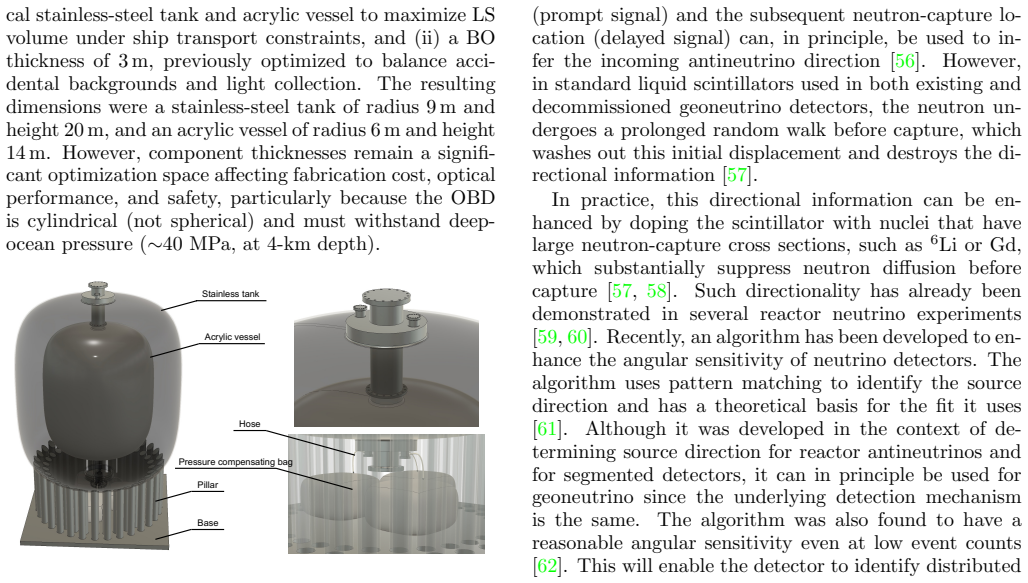
Core claim
The central claim is that a deep-ocean mobile detector, unlike any active or planned experiment, can achieve a 50-100 fold reduction in crustal background based on geoscientific studies, thereby enabling direct measurements of mantle geoneutrinos from the uranium and thorium decay chains. The detector's mobility further permits multiple stereoscopic projections to map spatial variations in mantle heat-producing elements, supporting multi-modal data on Earth's internal composition and structure.
What carries the argument
The deep-ocean mobile neutrino detector design, which relies on ocean placement for background suppression and detector mobility for spatial mapping of mantle signals.
If this is right
- Direct constraints on the Earth's total radiogenic heat production from mantle geoneutrino flux.
- Improved determination of the geochemical makeup of the mantle through uranium and thorium abundance measurements.
- Spatial maps of heat-producing element variations obtained from multiple detector positions.
- Multi-modal datasets combining neutrino data with other geophysical observations of Earth's interior.
- Hardware prototypes that can be adapted for related neutrino or ocean-based sensing tasks.
Where Pith is reading between the lines
- The same mobile platform could test background models by relocating between sites with known crustal differences.
- Data from the detector might be cross-checked against seismic or heat-flow measurements to refine models of Earth's heat budget.
- Repeated deployments could reveal time-dependent signals if mantle convection affects local neutrino production rates.
Load-bearing premise
That ocean placement together with detector mobility will deliver the stated 50-100 fold crustal background reduction, as attributed to prior geoscientific studies without new derivation in this document.
What would settle it
A background-rate measurement from an ocean prototype that shows less than a 10-fold reduction relative to a similarly sized continental detector.
Figures

read the original abstract
This white paper introduces the concept, prototype design, projected costs, and scientific goals of a mobile experiment for detecting geoneutrinos originating from uranium and thorium decay chains in the Earth's mantle. This will constrain the planet's radiogenic heat production and unearth its geochemical makeup. This design of a deep-ocean mobile neutrino experiment, which is not mirrored by any active or planned experiments, supports physics and geoscience's goal of multi-modal data on the Earth's internal composition and structure. Based on geoscientific studies, this design is expected to achieve a 50--100-fold reduction in crustal background compared to similarly sized continental detectors, thereby enabling direct measurements of mantle geoneutrinos. The multiple stereoscopic projections enabled by the detector's unique mobility can map spatial variations in heat-producing elements within the mantle. Beyond discussing the design, we report on our collaboration's most recent hardware developments in the active prototyping of this detector. We briefly highlight the potential multiuse and interdisciplinary nature of this detector.
Editorial analysis
A structured set of objections, weighed in public.
Referee Report
Summary. The manuscript is a white paper proposing a mobile deep-ocean neutrino detector (DOASNE) to measure mantle geoneutrinos from U and Th decay chains. It describes the conceptual design, mobility-enabled stereoscopic mapping, projected costs, scientific goals for constraining radiogenic heat production and mantle composition, and recent hardware prototyping efforts. The central claim is that ocean placement yields a 50--100-fold reduction in crustal geoneutrino background relative to same-size continental detectors, based on prior geoscientific studies, thereby enabling direct mantle measurements.
Significance. If the background-reduction projection holds, the concept would enable a qualitatively new class of geoneutrino observations by suppressing the dominant crustal signal that limits existing detectors, potentially delivering direct constraints on mantle heat-producing elements and spatial variations via detector mobility. The inclusion of active prototyping adds concrete engineering content to the proposal.
major comments (1)
- [Abstract] Abstract: the headline claim that the design 'is expected to achieve a 50--100-fold reduction in crustal background compared to similarly sized continental detectors' is attributed solely to 'geoscientific studies' with no citations, flux model, depth dependence, or calculation supplied in the manuscript to derive or justify the numerical factor from the proposed geometry, depth, or mobility.
minor comments (1)
- A short dedicated section or appendix summarizing the referenced geoscientific studies, the crustal flux model, and the mapping from detector parameters to the 50--100 factor would allow readers to assess the projection without external lookup.
Simulated Author's Rebuttal
We thank the referee for their detailed review and constructive suggestion. We agree that the abstract's headline claim requires explicit support and will revise accordingly.
read point-by-point responses
-
Referee: [Abstract] Abstract: the headline claim that the design 'is expected to achieve a 50--100-fold reduction in crustal background compared to similarly sized continental detectors' is attributed solely to 'geoscientific studies' with no citations, flux model, depth dependence, or calculation supplied in the manuscript to derive or justify the numerical factor from the proposed geometry, depth, or mobility.
Authors: We accept this criticism. The factor originates from published geoscientific flux models (e.g., crustal thickness maps and U/Th abundance distributions from Huang et al. and similar works) that predict the ocean floor at ~4 km depth sees a crustal contribution reduced by the absence of the thick continental crust above the detector. We will add the relevant citations to the abstract and main text, include a short paragraph summarizing the depth dependence and geometry, and reference the underlying flux calculations. No new calculation will be performed in this white-paper format, but the supporting literature will be made explicit. revision: yes
Circularity Check
No circularity; central background-reduction claim is attributed to external geoscientific studies with no internal derivation or self-referential reduction
full rationale
The paper is a white-paper proposal whose sole quantitative claim (50--100-fold crustal suppression) is explicitly stated to rest on unspecified prior geoscientific studies rather than any derivation, equation, fit, or self-citation chain internal to the document. No load-bearing steps match the enumerated circularity patterns: there are no self-definitional relations, no fitted inputs relabeled as predictions, no uniqueness theorems imported from the authors' prior work, and no ansatz smuggled via citation. The hardware-prototyping and mobility-mapping sections are independent of the background factor. The derivation chain is therefore self-contained against the paper's own content; the external attribution is a limitation of verifiability, not circularity.
Axiom & Free-Parameter Ledger
axioms (1)
- domain assumption Geoneutrinos from mantle U/Th decay can be isolated from other neutrino sources using the proposed detector design
Reference graph
Works this paper leans on
-
[1]
mantle only
showed that Kappa ( κ = 232Th/238U) in mantle- derived basalts, crustal rocks, and chondrites was approx- imately 3.5 ± 1.0, and Kappa P b (κP b), which is derived by calculating the 208∗ Pb/206∗ Pb value after subtraction of the Earth’s initial 208Pb/204Pb and 206Pb/204Pb val- ues and time integrating the contributions from the two decay chains. The valu...
2005
-
[2]
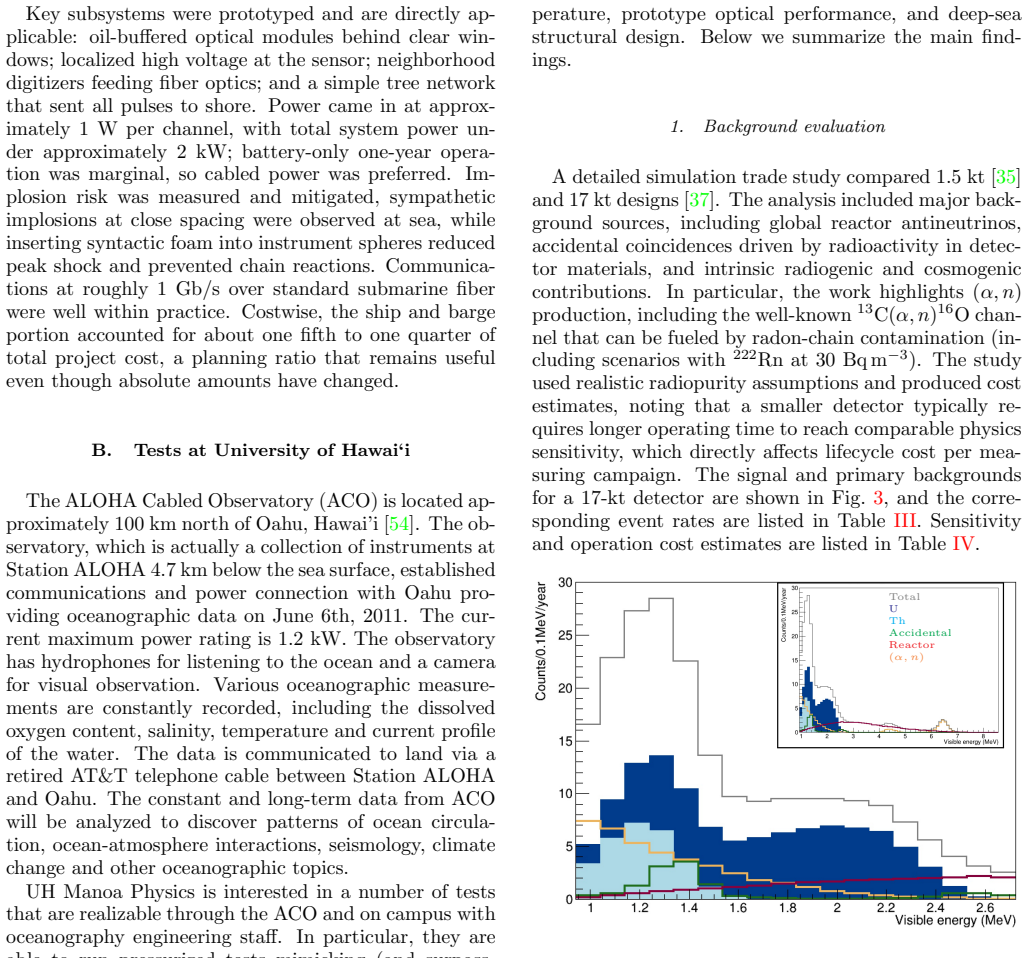
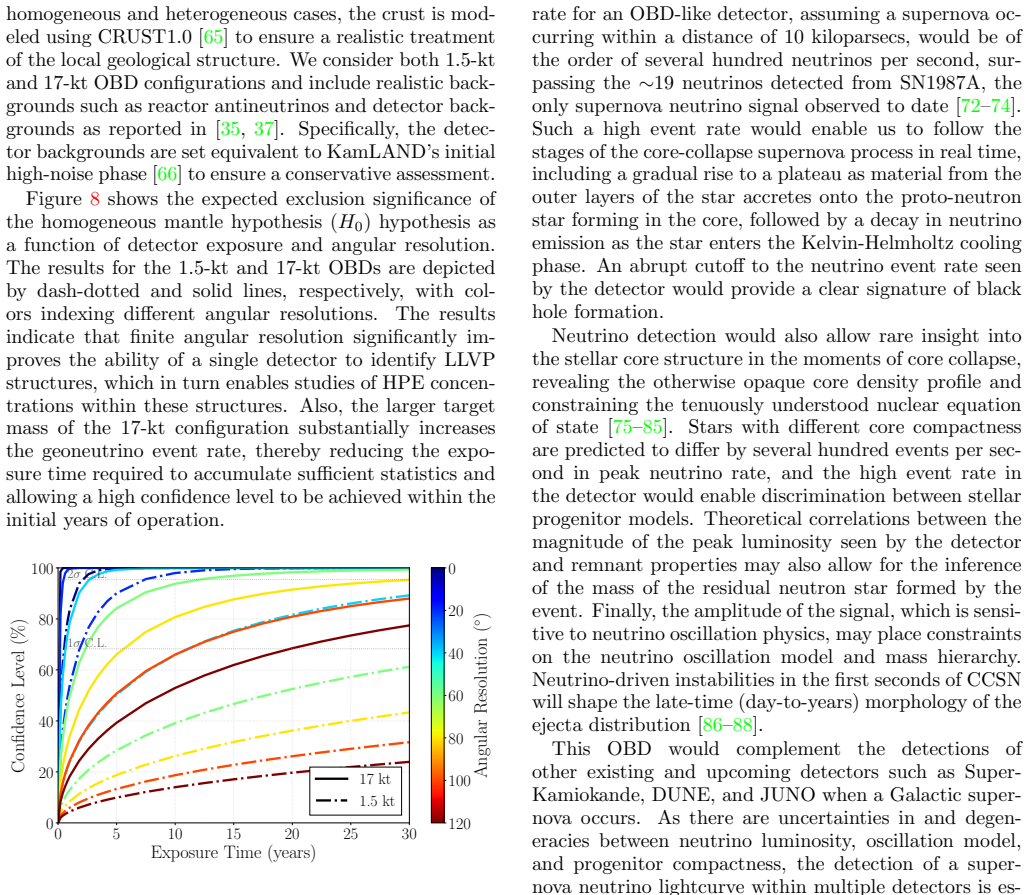
Background evaluation A detailed simulation trade study compared 1.5 kt [35] and 17 kt designs [37]. The analysis included major back- ground sources, including global reactor antineutrinos, accidental coincidences driven by radioactivity in detec- tor materials, and intrinsic radiogenic and cosmogenic contributions. In particular, the work highlights ( α...
-
[3]
The liquid scintillator consists of LAB (Linear Alkyl Benzene) and PPO (2,5-diphenyloxazole) as a fluor
Liquid scintillator performance at deep ocean temperature A dedicated low-temperature performance study was conducted for a laboratory-based liquid scintillator perti- nent to OBD [35]. The liquid scintillator consists of LAB (Linear Alkyl Benzene) and PPO (2,5-diphenyloxazole) as a fluor. The temperature of the liquid scintillator, con- tained within an ...
-
[4]
5) was used to determine its perfor- mance in a marine environment [38]
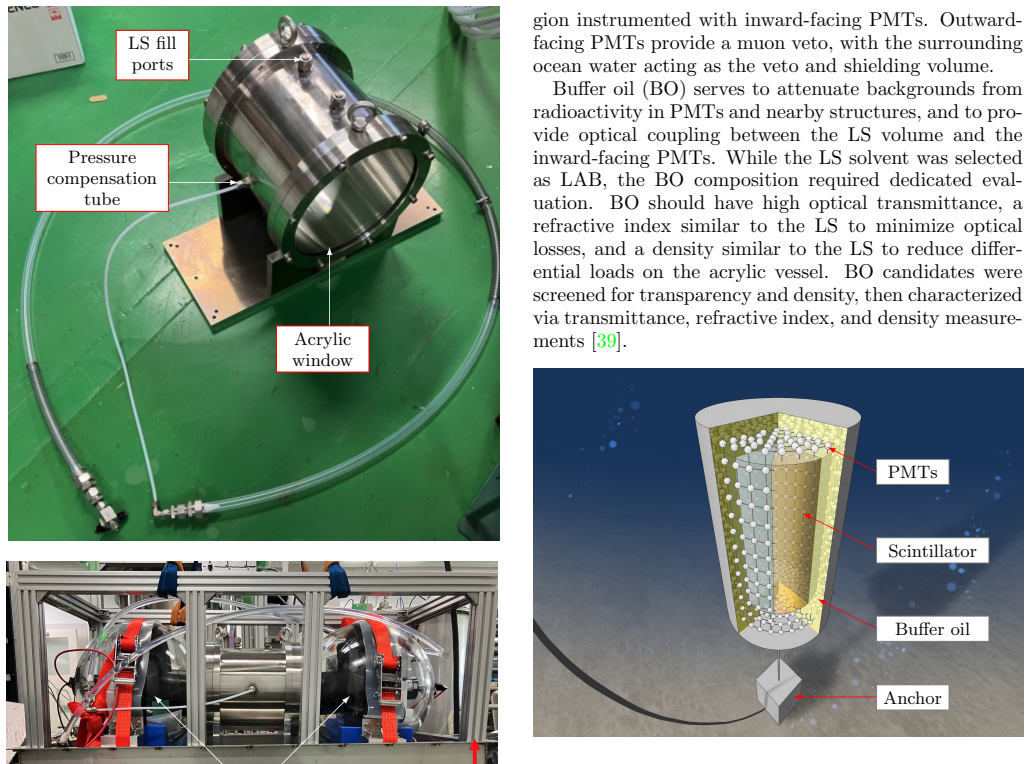
Optical performance of a prototype detector A prototype detector constructed by Tohoku Univer- sity (shown in Fig. 5) was used to determine its perfor- mance in a marine environment [38]. This prototype con- sisted of a cylindrical stainless steel vessel, with an outer radius of 14 cm, an inner radius of 13 cm, and a length of 20 cm, with acrylic windows ...
-
[5]
spectral shaping
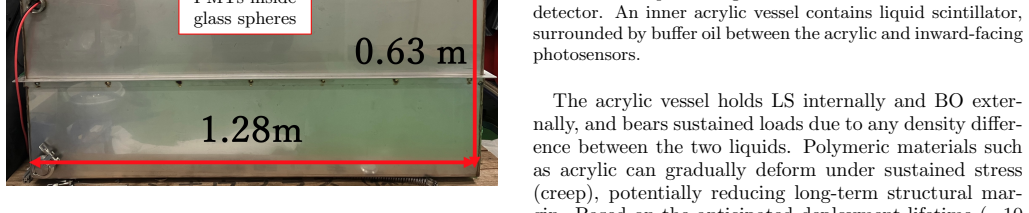
Structural design and selection of buffer oil and acrylic vessel A conventional detector concept is shown in Fig. 6. As in land-based liquid scintillator detectors (e.g., Kam- LAND, SNO+, JUNO), an inner acrylic vessel contains liquid scintillator (LS) and is surrounded by a buffer re- gion instrumented with inward-facing PMTs. Outward- facing PMTs provid...
-
[6]
W. F. McDonough, Geochim. Cosmochim. Acta 422, 9 (2026)
2026
-
[7]
R. A. Fischer and W. F. McDonough, in 1, Earth’s In- terior, Treatise on Geochemistry, Ariel Anbar and Do- minique Weis (series editor), edited by C. Chauvel (El- sevier, Oxford, 2025) third edition ed., pp. 18–71
2025
-
[8]
T. Lay, J. Hernlund, E. J. Garnero, and M. S. Thorne, Science 314, 1272 (2006)
2006
-
[9]
E. J. Garnero and A. K. McNamara, Science 320, 626 (2008)
2008
-
[10]
Driscoll and C
P. Driscoll and C. Davies, J. Geophys. Res. Solid Earth 128, e2022JB025355 (2023)
2023
-
[11]
Korenaga and C
J. Korenaga and C. Herzberg, Earth Planet. Sci. Lett. 683, 119958 (2026)
2026
-
[12]
Jaupart, S
C. Jaupart, S. Labrosse, F. Lucazeau, and J.-C. Mareschal, in Treatise on Geophysics (Second Edition), Vol. 7, edited by G. Schubert (Elsevier, Oxford, 2015) pp. 223–270
2015
-
[13]
W. F. McDonough, O. ˇSr´ amek, and S. A. Wipper- furth, Geochem. Geophys. Geosyst.21, e2019GC008865 (2020)
2020
-
[14]
R. L. Rudnick and S. Gao, in Treatise on Geochemistry (Second Edition), edited by H. D. Holland and K. K. Turekian (Elsevier, Oxford, 2014) pp. 1–51
2014
-
[15]
S. A. Wipperfurth, M. Guo, O. ˇSr´ amek, and W. F. Mc- Donough, Earth Planet. Sci. Lett. 498, 196 (2018)
2018
-
[16]
Blichert-Toft, B
J. Blichert-Toft, B. Zanda, D. S. Ebel, and F. Albar` ede, Earth Planet. Sci. Lett. 300, 152 (2010)
2010
-
[17]
Wang and S
Z. Wang and S. Chen, Chin. Phys. C 44, 033001 (2020)
2020
-
[18]
Arevalo, W
R. Arevalo, W. F. McDonough, and M. Luong, Earth Planet. Sci. Lett. 278, 361 (2009)
2009
-
[19]
Neutrino geo- science: review, survey, future prospects,
W. F. McDonough and H. Watanabe, “Neutrino geo- science: review, survey, future prospects,” in Core- Mantle Co-Evolution (American Geophysical Union (AGU), 2023) Chap. 1, pp. 1–16
2023
-
[20]
Javoy, E
M. Javoy, E. Kaminski, F. Guyot, D. Andrault, C. San- loup, M. Moreira, S. Labrosse, A. Jambon, P. Agrinier, A. Davaille, and C. Jaupart, Earth Planet. Sci. Lett. 293, 259 (2010)
2010
-
[21]
W. F. McDonough and S.-s. Sun, Chem. Geol. 120, 223 (1995)
1995
-
[22]
D. L. Turcotte and G. Schubert, Geodynamics (Cam- bridge university press, 2002)
2002
-
[23]
Aker et al
M. Aker et al. (KATRIN Collaboration), Nat. Phys. 18, 160 (2022)
2022
-
[24]
Strumia and F
A. Strumia and F. Vissani, Phys. Lett. B564, 42 (2003)
2003
-
[25]
Araki et al
T. Araki et al. (KamLAND Collaboration), Nature 436, 499 (2005)
2005
-
[26]
Mantovani, L
F. Mantovani, L. Carmignani, G. Fiorentini, and M. Lis- sia, Phys. Rev. D 69, 013001 (2004)
2004
-
[27]
Coltorti et al., Geochim
M. Coltorti et al., Geochim. Cosmochim. Acta 75, 2271 (2011)
2011
-
[28]
Huang, V
Y. Huang, V. Strati, F. Mantovani, S. B. Shirey, and W. F. McDonough, Geochem. Geophys. Geosyst. 15, 3925 (2014)
2014
-
[29]
Strati, M
V. Strati, M. Baldoncini, I. Callegari, F. Mantovani, W. F. McDonough, B. Ricci, and G. Xhixha, Prog. Earth Planet. Sci. 2, 5 (2015)
2015
-
[30]
Huang, V
Y. Huang, V. Chubakov, F. Mantovani, R. L. Rudnick, and W. F. McDonough, Geochem. Geophys. Geosyst. 14, 2003 (2013)
2003
-
[31]
S. A. Wipperfurth, O. ˇSr´ amek, and W. F. McDonough, J. Geophys. Res. Solid Earth 125, e2019JB018433 (2020)
2020
-
[32]
Bellini et al
G. Bellini et al. (Borexino Collaboration), Phys. Lett. B 687, 299 (2010)
2010
-
[33]
Abreu et al
M. Abreu et al. (SNO+ Collabortion), Phys. Rev. Lett. 135, 121801 (2025)
2025
-
[34]
Abusleme et al
A. Abusleme et al. (JUNO Collaboration), Nature 654, 343 (2026)
2026
-
[35]
Abe et al
S. Abe et al. (KamLAND Collaboration), Geophys. Res. Lett. 49, e2022GL099566 (2022)
2022
-
[36]
Batygov, Combined Study of Reactor and Terrestrial Antineutrinos with KamLAND, Ph.D
M. Batygov, Combined Study of Reactor and Terrestrial Antineutrinos with KamLAND, Ph.D. thesis, University of Tennessee, Knoxville, United States (2006)
2006
-
[37]
G. L. Fogli, E. Lisi, A. Palazzo, and A. M. Rotunno, Phys. Rev. D 82, 093006 (2010). 13
2010
-
[38]
Agostini et al
M. Agostini et al. (Borexino Collaboration), Phys. Rev. D 101, 012009 (2020)
2020
-
[39]
Adam et al
T. Adam et al. (JUNO Collaboration), Chin. Phys. C (in press)
-
[40]
T. Sakai, Development of detector components for low- temperature and high-pressure environment, and perfor- mance evaluation with simulation toward ocean bottom anti-neutrino detector OBD , Master’s thesis, Tohoku University, Sendai, Japan (2021), (in Japanese)
2021
-
[41]
Araki, Development of a Small Prototype Detec- tor for the Realization of the Ocean Bottom Detec- tor (OBD), Master’s thesis, Tohoku University, Sendai, Japan (2024), (in Japanese)
T. Araki, Development of a Small Prototype Detec- tor for the Realization of the Ocean Bottom Detec- tor (OBD), Master’s thesis, Tohoku University, Sendai, Japan (2024), (in Japanese)
2024
-
[42]
T. Ohno, Comprehensive Evaluation of Observation Sensitivity via Simulation Toward the Large-Scale Deep- Ocean Neutrino Detector OBD, Master’s thesis, Tohoku University, Sendai, Japan (2024), (in Japanese)
2024
-
[43]
S. Chauhan, Optical Performance of a Prototype De- tector and Preliminary Design Studies for Large-Scale Ocean-based Neutrino Detector, Master’s thesis, Tohoku University, Sendai, Japan (2025)
2025
-
[44]
Ono, Detector Structure Design for the Ocean Bot- tom Neutrino Detector (OBD) , Master’s thesis, Tohoku University, Sendai, Japan (2026), (in Japanese)
T. Ono, Detector Structure Design for the Ocean Bot- tom Neutrino Detector (OBD) , Master’s thesis, Tohoku University, Sendai, Japan (2026), (in Japanese)
2026
-
[45]
Sakai et al., J
T. Sakai et al., J. Phys. Conf. Ser. 2156, 012144 (2021)
2021
-
[46]
Watanabe et al., in 2023 IEEE Underwater Technol- ogy (UT) (IEEE, 2023) pp
H. Watanabe et al., in 2023 IEEE Underwater Technol- ogy (UT) (IEEE, 2023) pp. 1–5
2023
-
[47]
Z. Xu et al. (OBD Consortium), “Towards imaging Earth’s large-scale structures by directional geoneu- trino detection with Ocean Bottom Detector,” (2026), arXiv:2606.13273 [physics.geo-ph]
Pith/arXiv arXiv 2026
-
[48]
Geoneutrino observation with Kam- LAND,
N. Kawada, “Geoneutrino observation with Kam- LAND,” Talk at Neutrino Geoscience 2025, Kingston, Canada (2025)
2025
-
[49]
Abusleme et al
A. Abusleme et al. (JUNO Collaboration), Chin. Phys. C 50, 043001 (2026)
2026
-
[50]
Han, Y.-F
R. Han, Y.-F. Li, L. Zhan, W. F. McDonough, J. Cao, and L. Ludhova, Chin. Phys. C 40, 033003 (2016)
2016
-
[51]
J. G. Learned, S. T. Dye, and S. Pakvasa, in 12th In- ternational Workshop on Neutrinos Telescopes: Twenty Years after the Supernova 1987A Neutrino Bursts Dis- covery (2007) pp. 235–269, arXiv:0810.4975 [hep-ex]
Pith/arXiv arXiv 2007
-
[52]
ˇSr´ amek, B
O. ˇSr´ amek, B. Roskovec, S. A. Wipperfurth, Y. Xi, and W. F. McDonough, Sci. Rep. 6, 33034 (2016)
2016
-
[53]
W. D. Mooney, C. Barrera-Lopez, M. G. Su´ arez, and M. A. Castelblanco, Earth-Sci. Rev.243, 104493 (2023)
2023
-
[54]
White and E
W. White and E. Klein, in 4.13, Composition of the oceanic crust, Treatise on Geochemistry (Elsevier, Ox- ford, 2014) second edition ed., pp. 457–496
2014
-
[55]
ˇSr´ amek, W
O. ˇSr´ amek, W. F. McDonough, E. S. Kite, V. Leki´ c, S. T. Dye, and S. Zhong, Earth Planet. Sci. Lett. 361, 356 (2013)
2013
-
[56]
A. K. McNamara, Tectonophysics 760, 199 (2019)
2019
-
[57]
Q. Yuan, M. Li, S. J. Desch, B. Ko, H. Deng, E. J. Garnero, T. S. J. Gabriel, J. A. Kegerreis, Y. Miyazaki, V. Eke, and P. D. Asimow, Nature 623, 95 (2023)
2023
-
[58]
Mapping deep-mantle compositional heterogeneity using a directional geoneutrino detector,
Z. Xu, M. Hosoya, W. F. McDonough, T. Sakai, and H. Watanabe, “Mapping deep-mantle compositional heterogeneity using a directional geoneutrino detector,” (2026), arXiv:2606.15680 [physics.geo-ph]
arXiv 2026
-
[59]
B. M. Howe, F. K. Duennebier, and R. Lukas, inSeafloor Observatories: A new vision of the Earth from the Abyss (Springer, 2015) pp. 439–463
2015
-
[60]
Inoue, New J
K. Inoue, New J. Phys. 6, 147 (2004)
2004
-
[61]
Vogel and J
P. Vogel and J. F. Beacom, Phys. Rev. D 60, 053003 (1999)
1999
-
[62]
H. K. M. Tanaka and H. Watanabe, Sci. Rep. 4, 4708 (2014)
2014
-
[63]
J. H. Seo, Z. Atif, C. D. Shin, and K. K. Joo, Nucl. Instrum. Methods Phys. Res. A 969, 164001 (2020)
2020
-
[64]
K. A. Hochmuth, M. Lindner, and G. G. Raffelt, Phys. Rev. D 76, 073001 (2007)
2007
-
[65]
Andriamirado et al
M. Andriamirado et al. (PROSPECT Collaboration), Phys. Rev. D 111, 032014 (2025)
2025
-
[66]
J. G. Yepez, J. D. Seligman, M. A. A. Dornfest, B. C. Crow, J. G. Learned, and V. A. Li, AIP Adv.16, 025110 (2026)
2026
-
[67]
B. C. Crow, M. A. A. Dornfest, J. G. Learned, J. D. Seligman, N. S. Sibert, J. G. Yepez, and V. A. Li, “En- hancing angular sensitivity of segmented antineutrino detectors for reactor monitoring applications,” (2026), arXiv:2603.03561 [hep-ex]
arXiv 2026
-
[68]
Arevalo, Jr
R. Arevalo, Jr. and W. F. McDonough, Chem. Geol. 271, 70 (2010)
2010
-
[69]
Cowan, K
G. Cowan, K. Cranmer, E. Gross, and O. Vitells, Eur. Phys. J. C 71, 1554 (2011)
2011
-
[70]
Laske, G
G. Laske, G. Masters, Z. Ma, and M. Pasyanos, Geo- phys. Res. Abstr. 15, 2658 (2013)
2013
-
[71]
Gando et al
A. Gando et al. (KamLAND Collaboration), Phys. Rev. C 92, 055808 (2015)
2015
-
[72]
Burrows, T
A. Burrows, T. Wang, and D. Vartanyan, Astrophys. J. Lett. 964, L16 (2024)
2024
-
[73]
Janka, Annu
H.-T. Janka, Annu. Rev. Nucl. Part. Sci.75, 425 (2025)
2025
-
[74]
E. P. O’Connor and S. M. Couch, Astrophys. J. 865, 81 (2018)
2018
-
[75]
M¨ uller, H.-T
B. M¨ uller, H.-T. Janka, and A. Marek, Astrophys. J. 766, 43 (2013)
2013
-
[76]
Kuroda, K
T. Kuroda, K. Kotake, and T. Takiwaki, Astrophys. J. 755, 11 (2012)
2012
-
[77]
Hirata et al., Phys
K. Hirata et al., Phys. Rev. Lett. 58, 1490 (1987)
1987
-
[78]
Bionta et al., Phys
R. Bionta et al., Phys. Rev. Lett. 58, 1494 (1987)
1987
-
[79]
E. N. Alekseev, L. N. Alexeyeva, I. V. Krivosheina, and V. I. Volchenko, Phys. Lett. B 205, 209 (1988)
1988
-
[80]
L. Choi, A. Burrows, and D. Vartanyan, Phys. Rev. D 111, 123038 (2025)
2025
discussion (0)
Sign in with ORCID, Apple, or X to comment. Anyone can read and Pith papers without signing in.