Finsler structure of Busemann G-spaces
Pith reviewed 2026-06-27 05:41 UTC · model grok-4.3
The pith
Busemann G-spaces satisfying two comparison conditions admit a differentiable DC atlas with a continuous Finsler metric.
A machine-rendered reading of the paper's core claim, the machinery that carries it, and where it could break.
Core claim
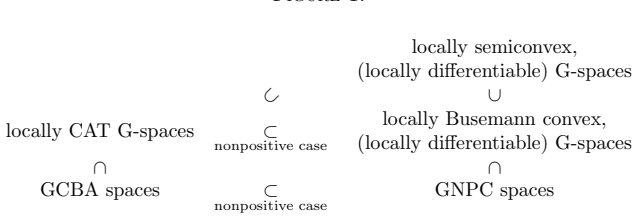
We provide two sufficient conditions for a Busemann G-space to admit a differentiable DC atlas with a continuous Finsler metric, from the viewpoint of comparison geometry. These results generalize previous work on G-spaces with Riemannian curvature bounds, namely the Alexandrov and CAT conditions, to the Finsler setting.
What carries the argument
The two sufficient conditions drawn from comparison geometry that generalize Alexandrov and CAT bounds, applied to Busemann G-spaces to produce the DC atlas and continuous Finsler metric.
If this is right
- The resulting Finsler metric is continuous with respect to the DC atlas.
- The atlas itself is differentiable of class DC.
- The same comparison viewpoint that worked for Riemannian G-spaces now works in the Finsler case.
- No a-priori smoothness of the metric is required beyond the stated comparison conditions.
Where Pith is reading between the lines
- The continuous Finsler metric might admit further regularity under stronger comparison assumptions in concrete examples.
- The method could extend to other geodesic metric spaces that satisfy analogous curvature comparisons.
- One could check whether the DC atlas allows local coordinate computations that recover classical Finsler identities.
Load-bearing premise
The Busemann G-space satisfies comparison-geometry conditions that generalize the Alexandrov and CAT curvature bounds sufficiently to guarantee the existence of the DC atlas and continuous Finsler metric.
What would settle it
A Busemann G-space that obeys one of the two comparison conditions yet fails to possess either a differentiable DC atlas or a continuous Finsler metric on that atlas.
Figures



read the original abstract
We provide two sufficient conditions for a Busemann G-space to admit a differentiable DC atlas with a continuous Finsler metric, from the viewpoint of comparison geometry. These results generalize previous work on G-spaces with Riemannian curvature bounds, namely the Alexandrov and CAT conditions, to the Finsler setting.
Editorial analysis
A structured set of objections, weighed in public.
Referee Report
Summary. The paper claims to provide two sufficient conditions, from the viewpoint of comparison geometry, under which a Busemann G-space admits a differentiable DC atlas carrying a continuous Finsler metric. These conditions are asserted to generalize prior results on G-spaces satisfying Alexandrov or CAT curvature bounds from the Riemannian to the Finsler setting.
Significance. If the stated conditions can be verified and the proofs hold, the results would extend comparison-geometry techniques to Finsler structures on Busemann G-spaces, broadening the range of spaces for which differentiable atlases and continuous Finsler metrics are known to exist under curvature-type controls.
major comments (1)
- [Abstract] Abstract: The manuscript asserts the existence of two specific sufficient conditions but neither states the conditions explicitly nor supplies any derivation, equation, or outline of the argument. Without these, the central claim cannot be assessed for correctness or for whether the comparison-geometry hypotheses are load-bearing.
Simulated Author's Rebuttal
We thank the referee for their comments. We address the single major comment below.
read point-by-point responses
-
Referee: [Abstract] Abstract: The manuscript asserts the existence of two specific sufficient conditions but neither states the conditions explicitly nor supplies any derivation, equation, or outline of the argument. Without these, the central claim cannot be assessed for correctness or for whether the comparison-geometry hypotheses are load-bearing.
Authors: We agree that the abstract does not explicitly name the two sufficient conditions. In the revised manuscript we will expand the abstract to state them clearly (the Finsler analogues of the Alexandrov and CAT curvature bounds). The full statements, derivations, and proofs appear in the body of the paper (Theorems 1.1 and 1.2 together with the comparison-geometry hypotheses in Sections 3 and 4). revision: yes
Circularity Check
No significant circularity; derivation self-contained
full rationale
The provided abstract and context describe a mathematical result supplying two sufficient comparison-geometry conditions on Busemann G-spaces that guarantee a differentiable DC atlas with continuous Finsler metric, generalizing Alexandrov/CAT Riemannian cases. No equations, fitted parameters, self-definitional steps, or load-bearing self-citations are visible in the given text. The central claim consists of new sufficient conditions whose validity is independent of the inputs by construction; the paper is self-contained against external benchmarks with no reduction of predictions to fitted quantities or renamed ansatzes.
Axiom & Free-Parameter Ledger
Forward citations
Cited by 1 Pith paper
-
Weak Quadruple Comparison and Structure Theory Beyond Alexandrov Geometry
Introduces the weak quadruple condition and proves that finite-dimensional S-concave Busemann concave spaces have constant integer dimension, satisfy MCP, are rectifiable, admit unique Banach tangent cones a.e., and c...
Reference graph
Works this paper leans on
-
[1]
A. D. Aleksandrov, V. N. Berestovski˘ ı, and I. G. Nikolaev. Generalized Rie- mannian spaces.Uspekhi Mat. Nauk41.3(249) (1986), 3–44, 240
1986
-
[2]
Alexander, V
S. Alexander, V. Kapovitch, and A. Petrunin.An invitation to Alexandrov geometry. SpringerBriefs in Mathematics. CAT(0) spaces. Springer, Cham, 2019
2019
-
[3]
Alexander, V
S. Alexander, V. Kapovitch, and A. Petrunin.Alexandrov geometry—foundations. Vol. 236. Graduate Studies in Mathematics. American Mathematical Society, Providence, RI, 2024
2024
-
[4]
Ambrosio and J
L. Ambrosio and J. Bertrand. DC calculus.Math. Z.288.3-4 (2018), 1037– 1080
2018
-
[5]
P. D. Andreev. Proof of the Busemann conjecture forG-spaces of nonpositive curvature.Algebra i Analiz26.2 (2014), 1–20. Translation inSt. Petersburg Math. J.26.2 (2015), 193–206
2014
-
[6]
P. D. Andreev. Normed space structure on a BusemannG-space of cone type. Mat. Zametki101.2 (2017), 169–180. Translation inMath. Notes101.1-2 (2017), 193–202
2017
-
[7]
P. Andreev. Foundations of singular Finsler geometry.Eur. J. Math.3.4 (2017), 767–787
2017
-
[8]
P. Andreev. Busemann’s problems onG-spaces.Herbert Busemann Selected works. I. Springer, Cham, 2018, 85–113
2018
-
[9]
V. N. Berestovski˘ ı. Introduction of a Riemannian structure in certain metric spaces.Sibirsk. Mat. ˇZ.16.4 (1975), 651–662, 883. Translation inSiberian Math. J.16.4 (1975), 499–507. 42 REFERENCES
1975
-
[10]
V. N. Berestovski˘ ı. On the problem of the finite dimensionality of a Busemann G-space.Sibirsk. Mat. ˇZ.18.1 (1977), 219–221, 240. Translation inSiberian Math. J.18.1 (1977), 159–161
1977
-
[11]
V. N. Berestovski˘ ı. Manifolds with an intrinsic metric with one-sided bounded curvature in the sense of A. D. Aleksandrov.Mat. Fiz. Anal. Geom.1.1 (1994), 41–59
1994
-
[12]
V. N. Berestovski˘ ı. Busemann spaces with upper-bounded Aleksandrov curva- ture.Algebra i Analiz14.5 (2002), 3–18. Translation inSt. Petersburg Math. J.14.5 (2003), 713–723
2002
-
[13]
V. N. Berestovski˘ ı, D. M. Halverson, and D. Repovˇ s. LocallyG-homogeneous BusemannG-spaces.Differential Geom. Appl.29.3 (2011), 299–318
2011
-
[14]
V. N. Berestovskij and I. G. Nikolaev. Multidimensional generalized Riemann- ian spaces.Geometry, IV.70. Encyclopaedia Math. Sci. Springer, Berlin, 1993, 165–243, 245–250
1993
-
[15]
M. R. Bridson and A. Haefliger.Metric spaces of non-positive curvature. Vol. 319. Grundlehren der mathematischen Wissenschaften [Fundamental Prin- ciples of Mathematical Sciences]. Springer-Verlag, Berlin, 1999
1999
-
[16]
M. Brown. The monotone union of openn-cells is an openn-cell.Proc. Amer. Math. Soc.12(1961), 812–814
1961
-
[17]
Burago, Y
D. Burago, Y. Burago, and S. Ivanov.A course in metric geometry. Vol. 33. Graduate Studies in Mathematics. American Mathematical Society, Provi- dence, RI, 2001
2001
-
[18]
Burago, M
Y. Burago, M. Gromov, and G. Perel’man. A. D. Aleksandrov spaces with curvatures bounded below.Uspekhi Mat. Nauk47.2(284) (1992), 3–51, 222. Translation inRussian Math. Surveys47.2 (1992), 1–58
1992
-
[19]
Busemann and B
H. Busemann and B. B. Phadke. Minkowskian geometry, convexity conditions and the parallel axiom.J. Geom.12.1 (1979), 17–33
1979
-
[20]
Busemann and B
H. Busemann and B. B. Phadke. Nonconvex spheres inG-spaces.J. Indian Math. Soc. (N.S.)44.1-4 (1980), 39–50
1980
-
[21]
Busemann.The geometry of geodesics
H. Busemann.The geometry of geodesics. Academic Press, Inc., New York, 1955
1955
-
[22]
Busemann.Recent synthetic differential geometry
H. Busemann.Recent synthetic differential geometry. Vol. Band 54. Ergeb- nisse der Mathematik und ihrer Grenzgebiete [Results in Mathematics and Related Areas]. Springer-Verlag, New York-Berlin, 1970
1970
-
[23]
Busemann and W
H. Busemann and W. Mayer. On the foundations of calculus of variations. Trans. Amer. Math. Soc.49(1941), 173–198
1941
-
[24]
Foertsch
T. Foertsch. Ball versus distance convexity of metric spaces.Beitr¨ age Algebra Geom.45.2 (2004), 481–500
2004
-
[25]
T. Fujioka. Geodesically complete Busemann spaces of nonpositive curvature. In preparation
-
[26]
T. Fujioka and S. Gu. Topological regularity of Busemann spaces of nonpos- itive curvature. Preprint. 2026. arXiv:2504.14455v3
Pith/arXiv arXiv 2026
-
[27]
Fujioka and K
T. Fujioka and K. Tashiro. Busemann and MCP. Preprint. 2026. arXiv:2602. 05740v2
2026
-
[28]
S. Gu. On small metric spheres and local cone structures of BusemannG- spaces.Houston J. Math.45.1 (2019), 285–291
2019
-
[29]
D. M. Halverson and D. Repovˇ s. The Bing-Borsuk and the Busemann con- jectures.Math. Commun.13.2 (2008), 163–184. REFERENCES 43
2008
-
[30]
B.-X. Han and L. Yin. On the structure of Busemann spaces with non- negative curvature I. Preprint. 2026. arXiv:2508.12348v3
Pith/arXiv arXiv 2026
-
[31]
Ivanov and A
S. Ivanov and A. Lytchak. Rigidity of Busemann convex Finsler metrics. Comment. Math. Helv.94.4 (2019), 855–868
2019
-
[32]
Jost.Nonpositive curvature: geometric and analytic aspects
J. Jost.Nonpositive curvature: geometric and analytic aspects. Lectures in Mathematics ETH Z¨ urich. Birkh¨ auser Verlag, Basel, 1997
1997
-
[33]
M. Kell. Sectional curvature-type conditions on metric spaces.J. Geom. Anal. 29.1 (2019), 616–655
2019
-
[34]
B. Krakus. Any 3-dimensionalG-space is a manifold.Bull. Acad. Polon. Sci. S´ er. Sci. Math. Astronom. Phys.16(1968), 737–740
1968
-
[35]
Krist´ aly and L
A. Krist´ aly and L. Kozma. Metric characterization of Berwald spaces of non- positive flag curvature.J. Geom. Phys.56.8 (2006), 1257–1270
2006
-
[36]
Krist´ aly, C
A. Krist´ aly, C. Varga, and L. Kozma. The dispersing of geodesics in Berwald spaces of non-positive flag curvature.Houston J. Math.30.2 (2004), 413–420
2004
-
[37]
A. Lytchak. Open map theorem for metric spaces.Algebra i Analiz17.3 (2005), 139–159. Translation inSt. Petersburg Math. J.17.3 (2006), 477– 491
2005
-
[38]
Lytchak and K
A. Lytchak and K. Nagano. Geodesically complete spaces with an upper cur- vature bound.Geom. Funct. Anal.29.1 (2019), 295–342
2019
-
[39]
Lytchak and K
A. Lytchak and K. Nagano. Topological regularity of spaces with an upper curvature bound.J. Eur. Math. Soc. (JEMS)24.1 (2022), 137–165
2022
-
[40]
Lytchak, K
A. Lytchak, K. Nagano, and S. Stadler. CAT(0) 4-manifolds are Euclidean. Geom. Topol.28.7 (2024), 3285–3308
2024
-
[41]
I. G. Nikolaev. Smoothness of the metric of spaces with bilaterally bounded curvature in the sense of A. D. Aleksandrov.Sibirsk. Mat. Zh.24.2 (1983), 114–132. Translation inSiberian Math. J.24.2 (1983), 247–263
1983
-
[42]
S.-i. Ohta. Uniform convexity and smoothness, and their applications in Finsler geometry.Math. Ann.343.3 (2009), 669–699
2009
-
[43]
Ohta.Comparison Finsler geometry
S.-i. Ohta.Comparison Finsler geometry. Springer Monographs in Mathemat- ics. Springer, Cham, 2021
2021
-
[44]
Otsu and H
Y. Otsu and H. Tanoue. The Riemannian structure of Alexandrov spaces with curvature bounded above. Preprint. 1999
1999
-
[45]
Y. Otsu. On manifolds of small excess.Amer. J. Math.115.6 (1993), 1229– 1280
1993
-
[46]
Y. Otsu. Almost everywhere existence of second differentiable structure of Alexandrov spaces. Preprint. 1995
1995
-
[47]
Y. Otsu. Differential geometric aspects of Alexandrov spaces.Comparison geometry (Berkeley, CA, 1993–94).30. Math. Sci. Res. Inst. Publ. Cambridge Univ. Press, Cambridge, 1997, 135–148
1993
-
[48]
Otsu and T
Y. Otsu and T. Shioya. The Riemannian structure of Alexandrov spaces.J. Differential Geom.39.3 (1994), 629–658
1994
-
[49]
Papadopoulos.Metric spaces, convexity and non-positive curvature
A. Papadopoulos.Metric spaces, convexity and non-positive curvature. Sec- ond. Vol. 6. IRMA Lectures in Mathematics and Theoretical Physics. Euro- pean Mathematical Society (EMS), Z¨ urich, 2014
2014
-
[50]
Perelman
G. Perelman. DC structure on Alexandrov space (preliminary version). Preprint available athttps://anton-petrunin.github.io/papers/. 1994. 44 REFERENCES
1994
-
[51]
A. V. Pogorelov. H. Busemann’sG-spaces with a Riemannian metric.Dokl. Akad. Nauk SSSR313.5 (1990), 1044–1046. Translation inSoviet Math. Dokl. 42(1991), no. 1, 129–132
1990
-
[52]
A. V. Pogorelov. RegularG-spaces of H. Busemann.Dokl. Akad. Nauk SSSR 314.1 (1990), 114–118. Translation inSoviet Math. Dokl.42(1991), no. 2, 356–359
1990
-
[53]
A. V. Pogorelov. Solution of a problem of H. Busemann.Dokl. Akad. Nauk SSSR314.4 (1990), 790–792. Translation in Soviet Math. Dokl. 42 (1991), no. 2, 547–549
1990
-
[54]
A. V. Pogorelov. Busemann regularG-spaces.Rev. Math. Math. Phys.10.4 (1998), 1–99
1998
-
[55]
Shen.Lectures on Finsler geometry
Z. Shen.Lectures on Finsler geometry. World Scientific Publishing Co., Sin- gapore, 2001
2001
-
[56]
Thurston
P. Thurston. 4-dimensional BusemannG-spaces are 4-manifolds.Differential Geom. Appl.6.3 (1996), 245–270. (T. Fujioka)Department of Applied Mathematics, Fukuoka University, Fukuoka 814- 0180, Japan Email address:tfujioka210@gmail.com (S. Gu)Department of Mathematics, Northeastern University, Shenyang, Liaoning, China, 110004 Email address:shijiegutop@gmail.com
1996
discussion (0)
Sign in with ORCID, Apple, or X to comment. Anyone can read and Pith papers without signing in.