Photoinduced enhancement of chemical shift sensitivity to local vibrations
Pith reviewed 2026-06-26 22:06 UTC · model grok-4.3
The pith
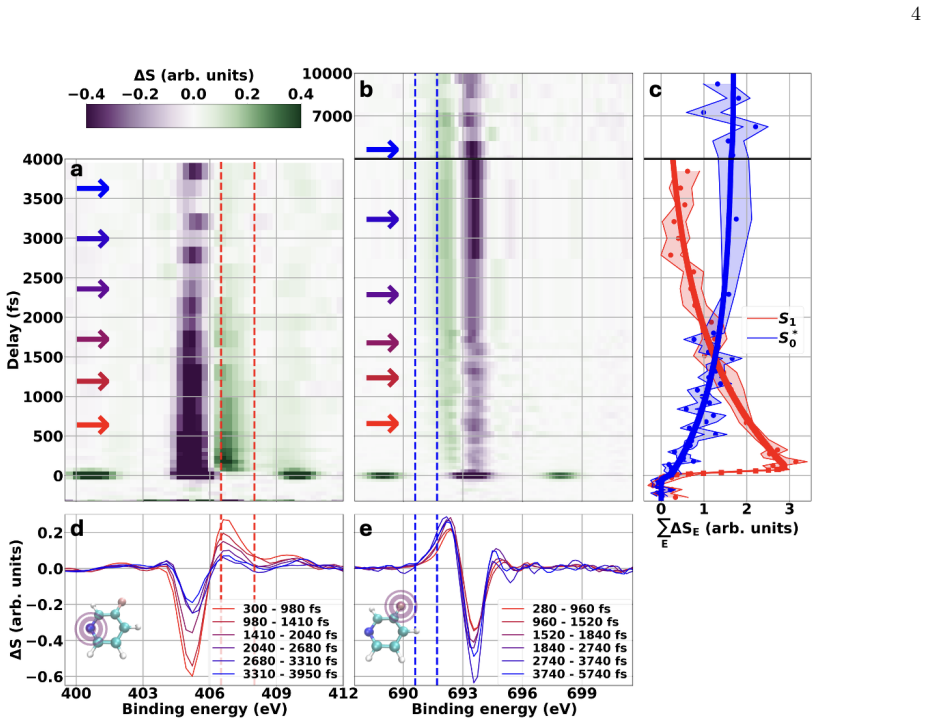
Photoexcitation to S1 shifts the nitrogen core-electron binding energy and increases its sensitivity to local vibrations in fluoropyridine.
A machine-rendered reading of the paper's core claim, the machinery that carries it, and where it could break.
Core claim
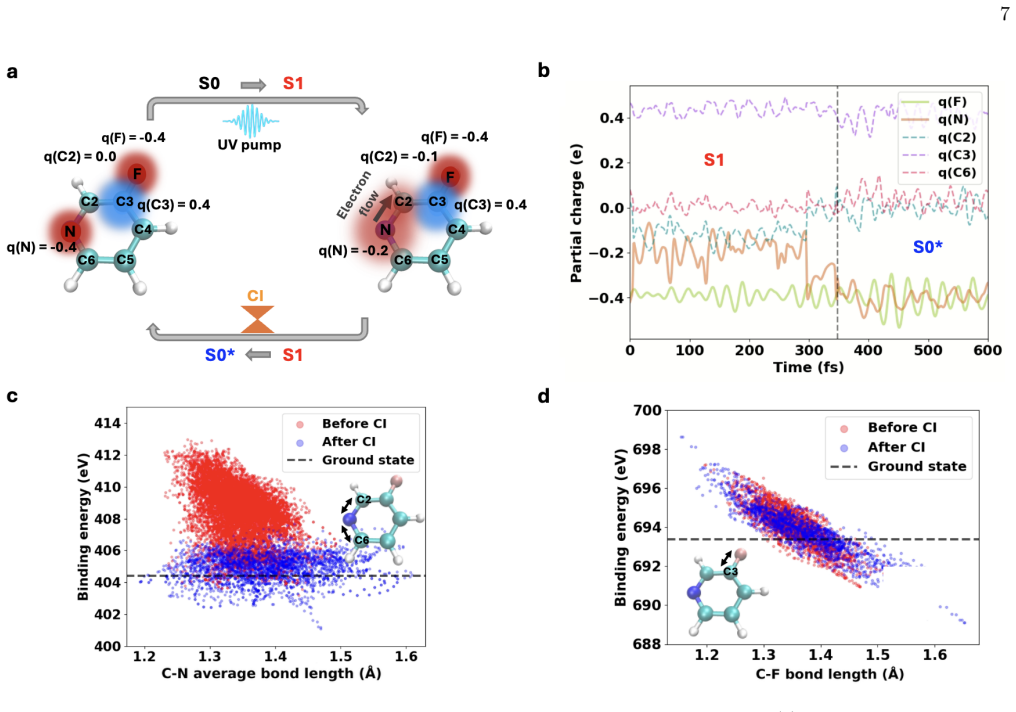
Excitation to the S1 state induces a measurable energy shift at the N site and significantly enhances its sensitivity to local vibrations within the ring. This behavior arises from a photoinduced redistribution of charge, which also increases the Coulomb interaction between the 1s electron at the N atom and the atomic partial charge at an adjacent C atom. The F site responds primarily to vibrational relaxation with minimal sensitivity to the electronic excited state.
What carries the argument
Photoinduced charge redistribution that enhances Coulomb interaction between the N 1s electron and adjacent C partial charge.
If this is right
- The nitrogen site serves as a probe that is more responsive to vibrations once the molecule is electronically excited.
- Different atomic sites can be used to separate electronic-state effects from vibrational effects in ultrafast processes.
- Charge redistribution upon excitation provides a mechanism to tune chemical-shift sensitivity at specific atoms.
- This approach can be applied to monitor relaxation pathways in other photoactive molecules.
Where Pith is reading between the lines
- Similar site-selective enhancements might appear in DNA bases, allowing direct observation of conical-intersection dynamics without ensemble averaging.
- Mapping the effect across a series of substituted pyridines could identify molecular features that maximize the vibration sensitivity increase.
- Combining the method with other spectroscopies might separate the contributions of geometry change and charge shift more cleanly.
Load-bearing premise
The measured chemical shifts at the N and F sites accurately reflect the local electronic and vibrational environment without dominant contributions from global geometry changes, solvent effects, or instrumental broadening during the relaxation through the conical intersection.
What would settle it
If calculations or further experiments showed that the enhanced vibration sensitivity at nitrogen persists even when the molecule is prevented from reaching the conical intersection or when charge redistribution is suppressed, the link between the excited-state charge shift and the sensitivity increase would be falsified.
Figures

read the original abstract
The advent of novel free-electron laser sources enabling time-resolved x-ray photoelectron spectroscopy (tr-XPS) provides a unique opportunity to monitor local chemical environments in real time by measuring sub-eV shifts in core-electron binding energies. These shifts reflect the interplay between electronic excitation and nuclear motion, an interplay that remains largely unexplored. In our combined theoretical and experimental study of fluoropyridine (C$_5$H$_4$FN), we investigate this link by monitoring the evolving chemical environment at the N and F atomic sites as the photoexcited $S_1$ state relaxes to the ground state via a conical intersection. We find that the F site responds primarily to vibrational relaxation, showing minimal sensitivity to the electronic excited state. In contrast, excitation to $S_1$ induces a measurable energy shift at the N site and significantly enhances its sensitivity to local vibrations within the ring. This behavior arises from a photoinduced redistribution of charge, which also increases the Coulomb interaction between the 1s electron at the N atom and the atomic partial charge at an adjacent C atom. This insight opens new avenues for exploring ultrafast dynamics and conical intersection pathways in more complex systems, from photostable DNA bases to light-harvesting materials.
Editorial analysis
A structured set of objections, weighed in public.
Referee Report
Summary. The manuscript reports a combined tr-XPS experiment and theory study on fluoropyridine, tracking core-level shifts at the N and F sites during S1 relaxation to S0 through a conical intersection. The central claim is that the N site exhibits both an excitation-induced energy shift and markedly enhanced sensitivity to local ring vibrations, arising from S1-driven charge redistribution that strengthens the 1s–adjacent-C Coulomb interaction; the F site response is attributed primarily to vibrational relaxation.
Significance. If the site-specific attribution holds, the work supplies a concrete illustration of how electronic excitation can selectively amplify vibrational sensitivity in core-level spectra, with direct relevance to mechanistic studies of conical intersections in photostable bases and light-harvesting systems.
major comments (1)
- [Theoretical methods / tr-XPS simulations] The attribution of the N-site enhancement specifically to charge redistribution (rather than nuclear displacements at the CI) is load-bearing for the central claim, yet the manuscript does not report a fixed-geometry decomposition that varies only the electronic state while holding nuclear coordinates fixed. Without this isolation of the Coulomb term, the proposed mechanism remains under-determined relative to geometry-driven contributions.
minor comments (2)
- [Abstract] Clarify the precise isomer (e.g., 2-fluoropyridine) and the definition of 'local vibrations within the ring' in the abstract and introduction.
- [Figures] Figure captions should explicitly state whether error bars include only statistical uncertainty or also systematic contributions from solvent and instrumental broadening.
Simulated Author's Rebuttal
We thank the referee for their constructive comment, which helps strengthen the mechanistic interpretation. We address the point below.
read point-by-point responses
-
Referee: [Theoretical methods / tr-XPS simulations] The attribution of the N-site enhancement specifically to charge redistribution (rather than nuclear displacements at the CI) is load-bearing for the central claim, yet the manuscript does not report a fixed-geometry decomposition that varies only the electronic state while holding nuclear coordinates fixed. Without this isolation of the Coulomb term, the proposed mechanism remains under-determined relative to geometry-driven contributions.
Authors: We agree that an explicit fixed-geometry decomposition is needed to isolate the electronic contribution. In the revised manuscript we have added calculations performed at the S0 Franck-Condon geometry, comparing the N 1s and F 1s binding energies and their vibrational sensitivities in the S0 and S1 electronic states while keeping all nuclear coordinates identical. These results show that the N-site shift and the enhanced sensitivity to ring modes are already present upon electronic excitation alone, confirming the dominant role of S1-driven charge redistribution. The new analysis is presented in Section 3.3 with supporting data in Figure 5. revision: yes
Circularity Check
No circularity in derivation chain
full rationale
The paper's central claims rest on direct experimental tr-XPS observations of chemical-shift evolution at N and F sites during S1 relaxation through a conical intersection, together with interpretive attribution to charge redistribution. No equations, fitting procedures, or self-citations are described that would reduce any reported 'prediction' or sensitivity enhancement to an input by construction. The derivation chain is therefore self-contained and externally falsifiable via the measurements themselves.
Axiom & Free-Parameter Ledger
Reference graph
Works this paper leans on
-
[1]
where the shifts of the binding energy of core electrons were linked to their local chemical environment. Today, this is a widespread tool for investigating surfaces and materials with atomic sensitivity [3–5]. In addition to chemical information, XPS can also reveal vibrational ∗ Corresponding author, daniel.rivas@xfel.eu † Corresponding author, antonio....
Pith/arXiv arXiv 2026
-
[2]
While these satellite states are not explored further here, we predict that such signals could be used to disentangle dynamics in more complex systems; see, for example, [28]
At both edges, we also observe significant changes in satellite features at larger binding energies (above 409 eV for N and above 695 eV for F). While these satellite states are not explored further here, we predict that such signals could be used to disentangle dynamics in more complex systems; see, for example, [28]. We now turn to see how this concept ...
-
[3]
The relative contribution ofS 1 to this signal is 23%. We note that while the integration windows could, in principle, be broadened, we deliberately restrict them to regions that remain predominantly sensitive to the ‘after-CI’ popu- lation without compromising the signal statistics. At higher binding energies, the ‘before-CI’ state contributes more stron...
-
[4]
andk= 27.0 eV/C at the N site [48]. These values remain essentially constant during the dynamics because the core orbitals are highly localized. ACKNOWLEDGMENTS The authors gratefully acknowledge the support teams at European XFEL and DESY for their assistance in conducting this experiment under proposal refer- ence 2862. A.M.G, P.E.A, L.P., D.M., and A.P...
-
[5]
D. Cremer and J. A. Pople. General definition of ring puckering coordinates. J. Am. Chem. Soc., 97 (6):1354–1358, March 1975. ISSN 0002-7863. doi: 10.1021/ja00839a011. URLhttps://doi.org/10.1021/ ja00839a011. Publisher: American Chemical Society
-
[6]
Electron Spectroscopy for Atoms, Molecules, and Condensed Matter
Kai Siegbahn. Electron Spectroscopy for Atoms, Molecules, and Condensed Matter. Science, 217(4555): 111–121, July 1982. ISSN 0036-8075, 1095-9203. doi:10.1126/science.217.4555.111. URLhttp://www. sciencemag.org/content/217/4555/111
-
[7]
C. S. Fadley. X-ray photoelectron spectroscopy: Progress and perspectives. Journal of Electron Spectroscopy and Related Phenomena, 178-179:2–32, May 2010. ISSN 0368-2048. doi:10.1016/j.elspec.2010.01.006. URL https://www.sciencedirect.com/science/article/ pii/S0368204810000095
-
[8]
Greczynski and L
G. Greczynski and L. Hultman. X-ray photo- electron spectroscopy: Towards reliable bind- ing energy referencing. Progress in Materials Science, 107:100591, January 2020. ISSN 0079-
2020
-
[9]
X-ray photoelectron spectroscopy: Towards reliable binding energy referencing,
doi:10.1016/j.pmatsci.2019.100591. URL https://www.sciencedirect.com/science/article/ pii/S0079642519300738
-
[10]
Binding energy referencing in X-ray photoelectron spectroscopy
Grzegorz Greczynski and Lars Hultman. Binding energy referencing in X-ray photoelectron spectroscopy. Nat Rev Mater, 10(1):62–78, January 2025. ISSN 2058-
2025
-
[11]
Binding energy referencing in X-ray photoelectron spectroscopy,
doi:10.1038/s41578-024-00743-5. URLhttps:// www.nature.com/articles/s41578-024-00743-5. Pub- lisher: Nature Publishing Group
-
[12]
U. Gelius. Recent progress in ESCA studies of gases. Journal of Electron Spectroscopy and Related Phenomena, 5(1):985–1057, January 1974. ISSN 0368-2048. doi:10.1016/0368-2048(74)85064-
-
[13]
URLhttps://www.sciencedirect.com/science/ article/pii/0368204874850644
-
[14]
Vibrational structure in inner shell photoionization of molecules
Uwe Hergenhahn. Vibrational structure in inner shell photoionization of molecules. J. Phys. B: At. Mol. Opt. Phys., 37(12):R89–R135, May 2004. ISSN 0953-4075. doi: 10.1088/0953-4075/37/12/R01. URLhttps://doi.org/ 10.1088/0953-4075/37/12/r01. Publisher: IOP Pub- lishing
-
[15]
Theory meets experiment for un- ravelling the C1s X-ray photoelectron spectra of pyri- dine, 2-fluoropyridine, and 2,6-difluoropyridine.J
Marco Mendolicchio, Alberto Baiardi, Giovanna Fron- zoni, Mauro Stener, Cesare Grazioli, Monica de Simone, and Vincenzo Barone. Theory meets experiment for un- ravelling the C1s X-ray photoelectron spectra of pyri- dine, 2-fluoropyridine, and 2,6-difluoropyridine.J. Chem. Phys., 151(12):124105, September 2019. ISSN 0021-
2019
-
[16]
URLhttps://doi.org/ 10.1063/1.5122310
doi:10.1063/1.5122310. URLhttps://doi.org/ 10.1063/1.5122310
-
[17]
Leitner, I
T. Leitner, I. Josefsson, T. Mazza, P. S. Miedema, H. Schr¨ oder, M. Beye, K. Kunnus, S. Schreck, S. D¨ usterer, A. F¨ ohlisch, M. Meyer, M. Odelius, and Ph. Wernet. Time-resolved electron spectroscopy for chem- ical analysis of photodissociation: Photoelectron spec- tra of Fe(CO)5, Fe(CO)4, and Fe(CO)3. The Journal of Chemical Physics, 149(4):044307, Jul...
2018
-
[18]
URLhttps://doi.org/ 10.1063/1.5035149
doi:10.1063/1.5035149. URLhttps://doi.org/ 10.1063/1.5035149
-
[19]
Felix Brauße, Gildas Goldsztejn, Kasra Amini, Rebecca Boll, Sadia Bari, C´ edric Bomme, Mark Brouard, Michael Burt, Barbara Cunha de Miranda, Stefan D¨ usterer, Ben- jamin Erk, Marie G´ el´ eoc, Romain Geneaux, Alexan- der S. Gentleman, Renaud Guillemin, Iyas Ismail, Per Johnsson, Lo¨ ıc Journel, Thomas Kierspel, Hansjochen K¨ ockert, Jochen K¨ upper, Pas...
-
[20]
Baumann, G¨ unter Brenner, Michael Burt, Philipp V
Felix Allum, Valerija Music, Ludger Inhester, Rebecca Boll, Benjamin Erk, Philipp Schmidt, Thomas M. Baumann, G¨ unter Brenner, Michael Burt, Philipp V. Demekhin, Simon D¨ orner, Arno Ehresmann, Andreas Galler, Patrik Grychtol, David Heathcote, Denis Kargin, Mats Larsson, Jason W. L. Lee, Zheng Li, Bastian Man- schwetus, Lutz Marder, Robert Mason, Michael...
2022
-
[21]
URLhttps:// www.nature.com/articles/s42004-022-00656-w
doi:10.1038/s42004-022-00656-w. URLhttps:// www.nature.com/articles/s42004-022-00656-w. Pub- lisher: Nature Publishing Group
-
[22]
Lane, Alberto Lut- man, Agostino Marinelli, Timothy J
Andre Al-Haddad, Sol` ene Oberli, Jes´ us Gonz´ alez- V´ azquez, Maximilian Bucher, Gilles Doumy, Phay Ho, Jacek Krzywinski, Thomas J. Lane, Alberto Lut- man, Agostino Marinelli, Timothy J. Maxwell, Ste- fan Moeller, Stephen T. Pratt, Dipanwita Ray, Ron Shepard, Stephen H. Southworth, ´Alvaro V´ azquez- Mayagoitia, Peter Walter, Linda Young, Antonio Pic´ ...
2022
-
[23]
URLhttps:// www.nature.com/articles/s41467-022-34670-2
doi:10.1038/s41467-022-34670-2. URLhttps:// www.nature.com/articles/s41467-022-34670-2. Pub- lisher: Nature Publishing Group
-
[24]
Bucksbaum, Michael Burt, James P
Ian Gabalski, Felix Allum, Issaka Seidu, Mathew Britton, G¨ unter Brenner, Hubertus Bromberger, Mark Brouard, Philip H. Bucksbaum, Michael Burt, James P. Cryan, Taran Driver, Nagitha Ekanayake, Benjamin Erk, Dik- sha Garg, Eva Gougoula, David Heathcote, Paul Hock- ett, David M. P. Holland, Andrew J. Howard, Sonu Kumar, Jason W. L. Lee, Siqi Li, Joseph McM...
-
[25]
D. Mayer, F. Lever, D. Picconi, J. Metje, S. Al- isauskas, F. Calegari, S. D¨ usterer, C. Ehlert, R. Feifel, M. Niebuhr, B. Manschwetus, M. Kuhlmann, T. Mazza, M. S. Robinson, R. J. Squibb, A. Trabattoni, M. Wall- ner, P. Saalfrank, T. J. A. Wolf, and M. G¨ uhr. Follow- ing excited-state chemical shifts in molecular ultrafast x-ray photoelectron spectrosc...
-
[26]
J. Christian Lennox, Daniel A. Kurtz, Tao Huang, and Jillian L. Dempsey. Excited-State Proton-Coupled Electron Transfer: Different Avenues for Promot- ing Proton/Electron Movement with Solar Photons. ACS Energy Lett., 2(5):1246–1256, May 2017. doi: 10.1021/acsenergylett.7b00063. URLhttps://doi.org/ 10.1021/acsenergylett.7b00063. Publisher: American Chemic...
-
[27]
Chi-Lin Chen, Yi-Ting Chen, Alexander P. Demchenko, and Pi-Tai Chou. Amino proton donors in excited- state intramolecular proton-transfer reactions. Nat Rev Chem, 2(7):131–143, July 2018. ISSN 2397-3358. doi: 10.1038/s41570-018-0020-z. URLhttps://www.nature. com/articles/s41570-018-0020-z. Publisher: Nature Publishing Group
-
[28]
Theory and Simulation of the Ultrafast Double- Bond Isomerization of Biological Chromophores
Samer Gozem, Hoi Ling Luk, Igor Schapiro, and Massimo Olivucci. Theory and Simulation of the Ultrafast Double- Bond Isomerization of Biological Chromophores. Chem. Rev., 117(22):13502–13565, November 2017. ISSN 0009-
2017
-
[29]
URLhttps: //doi.org/10.1021/acs.chemrev.7b00177
doi:10.1021/acs.chemrev.7b00177. URLhttps: //doi.org/10.1021/acs.chemrev.7b00177. Publisher: American Chemical Society
-
[30]
Ibele, Rebecca Boll, Carlo Cal- legari, Alexander Demidovich, Benjamin Erk, Raimund Feifel, Ruaridh Forbes, Michele Di Fraia, Luca Gian- nessi, Christopher S
Shashank Pathak, Lea M. Ibele, Rebecca Boll, Carlo Cal- legari, Alexander Demidovich, Benjamin Erk, Raimund Feifel, Ruaridh Forbes, Michele Di Fraia, Luca Gian- nessi, Christopher S. Hansen, David M. P. Holland, Re- becca A. Ingle, Robert Mason, Oksana Plekan, Kevin C. Prince, Arnaud Rouz´ ee, Richard J. Squibb, Jan Tross, Michael N. R. Ashfold, Basile F....
2020
-
[31]
URLhttps:// www.nature.com/articles/s41557-020-0507-3
doi:10.1038/s41557-020-0507-3. URLhttps:// www.nature.com/articles/s41557-020-0507-3. Pub- lisher: Nature Publishing Group
-
[32]
Intrinsic Lifetimes of the Excited State of DNA and RNA Bases
Hyuk Kang, Kang Taek Lee, Boyong Jung, Yeon Jae Ko, and Seong Keun Kim. Intrinsic Lifetimes of the Excited State of DNA and RNA Bases. J. Am. Chem. Soc., 124(44):12958–12959, November 2002. ISSN 0002-
2002
-
[33]
URLhttps://doi.org/ 10.1021/ja027627x
doi:10.1021/ja027627x. URLhttps://doi.org/ 10.1021/ja027627x. Publisher: American Chemical So- ciety
-
[34]
Yuan-Chung Cheng and Graham R. Fleming. Dy- namics of Light Harvesting in Photosynthesis. Annual Review of Physical Chemistry, 60(Volume 60, 2009): 241–262, May 2009. ISSN 0066-426X, 1545-1593. doi:10.1146/annurev.physchem.040808.090259. URL https://www.annualreviews.org/content/journals/ 10.1146/annurev.physchem.040808.090259. Publisher: Annual Reviews
-
[35]
Conical intersection dynamics of the primary photoisomerization event in vision , journal=
Dario Polli, Piero Alto` e, Oliver Weingart, Kate- lyn M. Spillane, Cristian Manzoni, Daniele Brida, Gaia Tomasello, Giorgio Orlandi, Philipp Kukura, Richard A. Mathies, Marco Garavelli, and Giulio Cerullo. Conical intersection dynamics of the primary pho- toisomerization event in vision. Nature, 467(7314): 440–443, September 2010. ISSN 0028-0836. doi: 10...
-
[36]
M. A. El-Sayed. Spin—Orbit Coupling and the Ra- diationless Processes in Nitrogen Heterocyclics. J. Chem. Phys., 38(12):2834–2838, June 1963. ISSN 0021-
1963
-
[37]
URLhttps://doi.org/ 10.1063/1.1733610
doi:10.1063/1.1733610. URLhttps://doi.org/ 10.1063/1.1733610
-
[38]
Ultrafast Photophysics of Transition Metal Complexes
Majed Chergui. Ultrafast Photophysics of Transition Metal Complexes. Acc. Chem. Res., 48(3):801–808, March 2015. ISSN 0001-4842. doi:10.1021/ar500358q. URLhttps://doi.org/10.1021/ar500358q. Publisher: American Chemical Society
-
[39]
Neville, Majed Chergui, Albert Stolow, and Michael S
Simon P. Neville, Majed Chergui, Albert Stolow, and Michael S. Schuurman. Ultrafast X-Ray Spectroscopy of Conical Intersections. Phys. Rev. Lett., 120(24):243001, June 2018. doi:10.1103/PhysRevLett.120.243001. URL https://link.aps.org/doi/10.1103/PhysRevLett. 120.243001. Publisher: American Physical Society
-
[40]
Ludger Inhester, Zheng Li, Xiaolei Zhu, Nikita Medvedev, and Thomas J. A. Wolf. Spectro- scopic Signature of Chemical Bond Dissociation Re- vealed by Calculated Core-Electron Spectra. J. Phys. Chem. Lett., 10(21):6536–6544, November 2019. doi: 10.1021/acs.jpclett.9b02370. URLhttps://doi.org/ 10.1021/acs.jpclett.9b02370. Publisher: American Chemical Society
-
[41]
Daniel E. Rivas, Lorenzo Paoloni, Rebecca Boll, Alberto De Fanis, Ana Mart´ ınez Guti´ errez, Tommaso Mazza, Sol` ene Oberli, Oliver Alexander, Andr´ e Al-Haddad, Thomas M. Baumann, Christoph Bostedt, Simon Dold, Gianluca Geloni, Markus Ilchen, Dooshaye Moonshi- ram, Daniel Rolles, Artem Rudenko, Philipp Schmidt, Svitozar Serkez, Sergey Usenko, ´Angel Mar...
-
[42]
Rivas, Marin Sapunar, Bj¨ orn Senfftleben, Sergey Usenko, Caterina Vozzi, Markus G¨ uhr, Kevin C
Davide Faccial` a, Matteo Bonanomi, Bruno Nunes Cabral Tenorio, Lorenzo Avaldi, Paola Bolognesi, Carlo Cal- legari, Marcello Coreno, Sonia Coriani, Piero De- cleva, Michele Devetta, Nadja Doslic, Alberto De Fa- nis, Michele Di Fraia, Fabiano Lever, Tommaso Mazza, Michael Meyer, Terry Mullins, Yevheniy Ovcharenko, Nitish Pal, Maria Novella Piancastelli, Ro...
-
[43]
Thompson, Matteo Bonanomi, Jacob Pedersen, Oksana Plekan, Nitish Pal, Cesare Grazioli, Kevin C
Henry J. Thompson, Matteo Bonanomi, Jacob Pedersen, Oksana Plekan, Nitish Pal, Cesare Grazioli, Kevin C. Prince, Bruno N. C. Tenorio, Michele Devetta, Da- vide Faccial` a, Caterina Vozzi, Paolo Piseri, Miltcho B. Danailov, Alexander Demidovich, Alexander D. Brynes, Alberto Simoncig, Marco Zangrando, Marcello Coreno, Raimund Feifel, Richard J. Squibb, Davi...
-
[44]
Jie Yang, Xiaolei Zhu, J. Pedro F. Nunes, Jimmy K. Yu, Robert M. Parrish, Thomas J. A. Wolf, Mar- tin Centurion, Markus G¨ uhr, Renkai Li, Yusong Liu, Bryan Moore, Mario Niebuhr, Suji Park, Xiaozhe Shen, Stephen Weathersby, Thomas Weinacht, Todd J. Mar- tinez, and Xijie Wang. Simultaneous observation of nuclear and electronic dynamics by ultrafast electro...
-
[45]
D. C´ eolin, J. M. Ablett, D. Prieur, T. Moreno, J. P. Ru- eff, T. Marchenko, L. Journel, R. Guillemin, B. Pilette, T. Marin, and M. Simon. Hard X-ray photoelectron spectroscopy on the GALAXIES beamline at the SOLEIL synchrotron. Journal of Electron Spectroscopy and Related Phenomena, 190:188–192, October 2013. ISSN 0368-2048. doi:10.1016/j.elspec.2013.01...
-
[46]
A. De Fanis, M. Ilchen, A. Achner, T. M. Baumann, R. Boll, J. Buck, C. Danilevsky, S. Esenov, B. Erk, P. Grychtol, G. Hartmann, J. Liu, T. Mazza, J. Monta˜ no, V. Music, Y. Ovcharenko, N. Rennhack, D. Rivas, D. Rolles, P. Schmidt, H. Sotoudi Namin, F. Scholz, J. Viefhaus, P. Walter, P. Zi´ o lkowski, H. Zhang, and M. Meyer. High-resolution electron time-o...
-
[47]
Niklas Helle, Tim Raeker, and Juergen Grotemeyer. Studies of the First Electronically Excited State of 3-Fluoropyridine and Its Ionic Structure by Means of REMPI, Two-Photon MATI, One-Photon VUV-MATI Spectroscopy and Franck–Condon Analysis. Phys. Chem. Chem. Phys., 24(4):2412–2423, January 2022. ISSN 1463-9084. doi:10.1039/D1CP04636E. URL https://pubs.rsc...
-
[48]
Excitation wavelength dependent S1-state decay dy- namics of 2-aminopyridine and 3-aminopyridine
Baihui Feng, Dongyuan Yang, Yanjun Min, Qinghua Gao, Benjie Fang, Guorong Wu, and Xueming Yang. Excitation wavelength dependent S1-state decay dy- namics of 2-aminopyridine and 3-aminopyridine. Phys. Chem. Chem. Phys., 25(26):17403–17409, July 2023. ISSN 1463-9084. doi:10.1039/D3CP01487H. URL https://pubs.rsc.org/en/content/articlelanding/ 2023/cp/d3cp014...
-
[49]
Gelius, P
U. Gelius, P. F. Hed´ en, J. Hedman, B. J. Lindberg, R. Manne, R. Nordberg, C. Nordling, and K. Sieg- bahn. Molecular Spectroscopy by Means of ESCA III.Carbon compounds. Phys. Scr., 2(1-2):70–80, July
-
[50]
doi:10.1088/0031-8949/2/1- 2/014
ISSN 1402-4896. doi:10.1088/0031-8949/2/1- 2/014. URLhttps://doi.org/10.1088/0031-8949/2/ 1-2/014. Publisher: IOP Publishing
-
[51]
U. Gelius. Binding Energies and Chemical Shifts in ESCA. Phys. Scr., 9(3):133–147, March 1974. ISSN 1402-
1974
-
[52]
URLhttps:// doi.org/10.1088/0031-8949/9/3/001
doi:10.1088/0031-8949/9/3/001. URLhttps:// doi.org/10.1088/0031-8949/9/3/001. Publisher: IOP Publishing
-
[53]
N. Gerasimova, D. La Civita, L. Samoylova, M. Van- noni, R. Villanueva, D. Hickin, R. Carley, R. Gort, B. E. Van Kuiken, P. Miedema, L. Le Guyarder, L. Mercadier, G. Mercurio, J. Schlappa, M. Teichman, A. Yaroslavt- sev, H. Sinn, and A. Scherz. The soft X-ray monochro- mator at the SASE3 beamline of the European XFEL: from design to operation. J. Synchrot...
-
[54]
John C. Tully. Molecular dynamics with electronic tran- sitions. The Journal of Chemical Physics, 93(2):1061– 1071, July 1990. ISSN 0021-9606, 1089-7690. doi: 10.1063/1.459170. URLhttp://scitation.aip.org/ content/aip/journal/jcp/93/2/10.1063/1.459170
-
[55]
Martin Richter, Philipp Marquetand, Jes´ us Gonz´ alez- V´ azquez, Ignacio Sola, and Leticia Gonz´ alez. SHARC: ab Initio Molecular Dynamics with Surface Hopping in the Adiabatic Representation Including Arbitrary Couplings. J. Chem. Theory Comput., 7(5):1253–1258, May 2011. ISSN 1549-9618. doi:10.1021/ct1007394. URLhttps: //doi.org/10.1021/ct1007394. Pub...
-
[56]
Toru Shiozaki, Werner Gy˝ orffy, Paolo Celani, and Hans- Joachim Werner. Communication: Extended multi-state complete active space second-order perturbation the- ory: Energy and nuclear gradients. J. Chem. Phys., 135(8):081106, August 2011. ISSN 0021-9606. doi: 10.1063/1.3633329. URLhttps://doi.org/10.1063/1. 3633329
-
[57]
BAGEL: Brilliantly Advanced General Electronic-structure Library
Toru Shiozaki. BAGEL: Brilliantly Advanced General Electronic-structure Library. WIREs Computational Molecular Science, 8(1):e1331, 2018. ISSN 1759-0884. doi:10.1002/wcms.1331. URLhttps://onlinelibrary. wiley.com/doi/abs/10.1002/wcms.1331
-
[58]
J. V. Ortiz. Dyson-orbital concepts for description of electrons in molecules. The Journal of Chemical Physics, 153(7):070902, August 2020. ISSN 0021-9606. doi: 10.1063/5.0016472. URLhttps://doi.org/10.1063/5. 0016472
-
[59]
Ignacio Fdez. Galv´ an, Morgane Vacher, Ali Alavi, Ce- lestino Angeli, Francesco Aquilante, Jochen Autschbach, Jie J. Bao, Sergey I. Bokarev, Nikolay A. Bogdanov, Re- becca K. Carlson, Liviu F. Chibotaru, Joel Creutzberg, Nike Dattani, Micka¨ el G. Delcey, Sijia S. Dong, An- dreas Dreuw, Leon Freitag, Luis Manuel Frutos, Laura Gagliardi, Fr´ ed´ eric Gend...
-
[60]
Borin, Liviu F
Francesco Aquilante, Jochen Autschbach, Alberto Ba- iardi, Stefano Battaglia, Veniamin A. Borin, Liviu F. Chibotaru, Irene Conti, Luca De Vico, Micka¨ el Del- cey, Ignacio Fdez. Galv´ an, Nicolas Ferr´ e, Leon Fre- itag, Marco Garavelli, Xuejun Gong, Stefan Knecht, Ernst D. Larsson, Roland Lindh, Marcus Lundberg, Per ˚Ake Malmqvist, Artur Nenov, Jesper No...
2020
-
[61]
URLhttps://doi.org/ 10.1063/5.0004835
doi:10.1063/5.0004835. URLhttps://doi.org/ 10.1063/5.0004835
-
[62]
VMD: Visual molecular dynamics
William Humphrey, Andrew Dalke, and Klaus Schul- ten. VMD: Visual molecular dynamics. Journal of Molecular Graphics, 14(1):33–38, February 1996. ISSN 0263-7855. doi:10.1016/0263-7855(96)00018-
-
[63]
URLhttps://www.sciencedirect.com/science/ article/pii/0263785596000185
-
[64]
Soumen Saha, Ram Kinkar Roy, and Paul W. Ayers. Are the Hirshfeld and Mulliken population analysis schemes consistent with chemical intuition? International Journal of Quantum Chemistry, 109(9):1790–1806,
-
[65]
ISSN 1097-461X. doi:10.1002/qua.21901. URLhttps://onlinelibrary.wiley.com/doi/abs/10. 1002/qua.21901
-
[66]
Tymofii Y. Nikolaienko, Leonid A. Bulavin, and Dmytro M. Hovorun. JANPA: An open source cross- platform implementation of the Natural Population Analysis on the Java platform. Computational and Theoretical Chemistry, 1050:15–22, December 2014. ISSN 2210-271X. doi:10.1016/j.comptc.2014.10.002. URLhttps://www.sciencedirect.com/science/ article/pii/S2210271X14004484
-
[67]
D. W. Davis, David A. Shirley, and T. Darrah Thomas. X-ray photoelectron spectroscopy of fluorinated ben- zenes. J. Am. Chem. Soc., 94(19):6565–6575, Septem- ber 1972. ISSN 0002-7863. doi:10.1021/ja00774a001. URLhttps://doi.org/10.1021/ja00774a001. Pub- lisher: American Chemical Society
-
[68]
R. S. Brown and A. Tse. N1s core binding energies for 2-, 3-, and 4-substituted pyridines determined by X- ray photoelectron spectroscopy. Correlations with the- oretical models, substituent parameters, and gas phase basicities. Can. J. Chem., 58(7):694–703, April 1980. ISSN 0008-4042. doi:10.1139/v80-106. URLhttps:// cdnsciencepub.com/doi/10.1139/v80-106...
discussion (0)
Sign in with ORCID, Apple, or X to comment. Anyone can read and Pith papers without signing in.