A Tentative Double Excess in the Gamma-Ray Spectrum of the Fermi Blazar 4FGL J0604.9-0000
Pith reviewed 2026-06-26 07:19 UTC · model grok-4.3
The pith
Fermi-LAT data show a tentative double excess in the gamma-ray spectrum of blazar 4FGL J0604.9-0000 at 1.5 GeV and 11 GeV.
A machine-rendered reading of the paper's core claim, the machinery that carries it, and where it could break.
Core claim
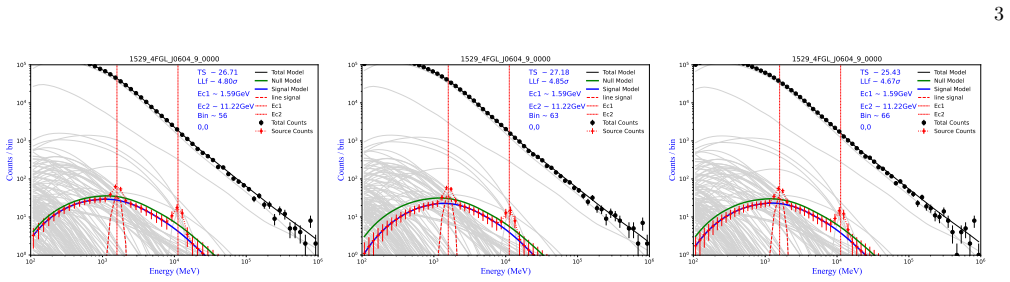
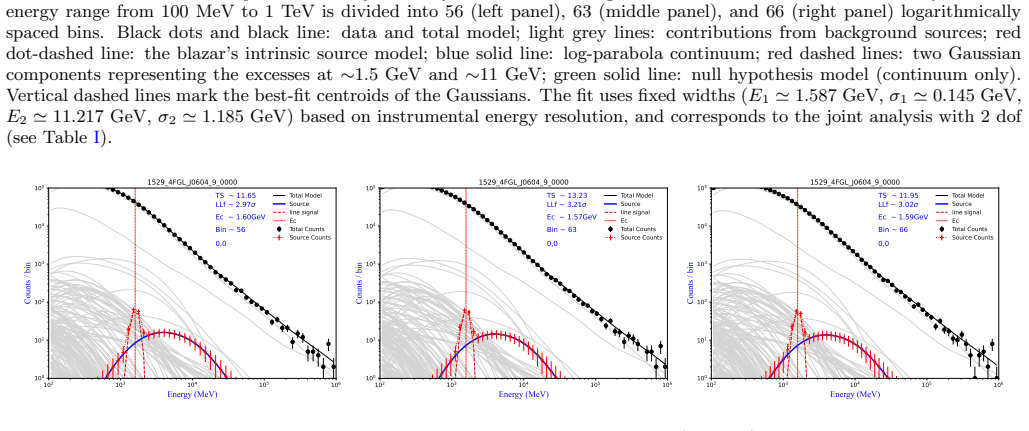
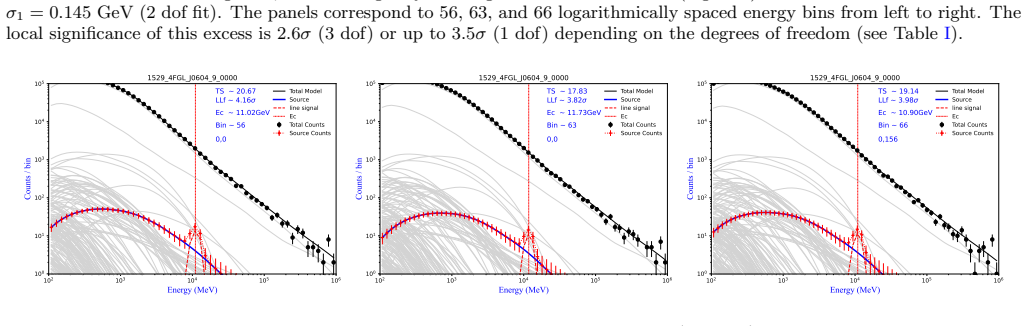
Based on 17.75 years of Fermi-LAT observations, we report a tentative double excess in the gamma-ray spectrum of the blazar 4FGL J0604.9-0000, with peak energies at approximately 1.5 GeV and 11 GeV. The two excesses are modeled as double Gaussian components. For the lower-energy excess, the best-fit centroid is E1 = 1.59 plus or minus 0.07 GeV with a width fixed to the instrumental resolution. For the higher-energy excess, the centroid is E2 = 11.15 plus or minus 0.61 GeV and the width is constrained to sigma2 = 1.185 GeV. The two features have local significances of 2.6 sigma and 3.7 sigma respectively. A joint likelihood analysis yields a combined test statistic of TS approximately 27, cor
What carries the argument
Double Gaussian components added to the spectral model, with centroids at 1.59 GeV and 11.15 GeV and widths fixed or constrained to match the Fermi-LAT energy resolution, to capture the excesses whose ratio of about 7 matches dark matter annihilation channels.
If this is right
- The energy ratio of roughly 1 to 7 is consistent with dark matter annihilation into two gamma-ray lines for a particle mass near 11 GeV.
- This source becomes a promising target for follow-up with next-generation gamma-ray telescopes.
- No other active galactic nucleus has been reported with a similar double-excess candidate.
- Standard astrophysical emission processes have difficulty accounting for the observed energy ratio.
Where Pith is reading between the lines
- If confirmed, the features would suggest searching other blazars for analogous line-like excesses at fixed energy ratios.
- Time-variability studies could test whether the excesses track the blazar's flaring behavior or remain steady like a dark matter signal.
- A non-detection in deeper exposures would tighten constraints on any dark matter interpretation without affecting the statistical claim itself.
Load-bearing premise
The observed excesses arise from real astrophysical or particle processes rather than unmodeled instrumental effects, background mismodeling, or random statistical fluctuations.
What would settle it
An independent observation with higher energy resolution that fails to detect excess flux at both 1.5 GeV and 11 GeV in the same source would falsify the reported features.
Figures
read the original abstract
Based on 17.75 years of Fermi-LAT observations, we report a tentative double excess in the gamma-ray spectrum of the blazar 4FGL J0604.9-0000, with peak energies at approximately 1.5 GeV and 11 GeV. The two excesses are modeled as double Gaussian components. For the lower-energy excess, the best-fit centroid is $E_1 = 1.59\pm0.07$ GeV with a width fixed to the instrumental resolution ($\sigma_1 = 0.145$ GeV). For the higher-energy excess, the centroid is $E_2 = 11.15\pm0.61$ GeV and the width is constrained to $\sigma_2 = 1.185$ GeV (about 10\% of the peak energy), which is comparable to the Fermi-LAT energy resolution at that energy. The two features have local significances of $2.6\sigma$ and $3.7\sigma$ (3 dof), respectively. A joint likelihood analysis yields a combined test statistic of TS $\simeq 27$, corresponding to a local significance of approximately $4.3\sigma$ (4 dof, without correction for trials and the look-elsewhere effect) or about $4.8\sigma$ (2 dof). To our knowledge, no other active galactic nucleus has been reported to show a similar double-excess candidate. The observed energy ratio of $\sim$1:7 is difficult to explain with standard astrophysical emission processes. However, the energies and their ratio are consistent with dark matter annihilation (e.g., $\chi\chi\to\gamma\gamma$ and $\chi\chi\to\gamma\gamma'$) for a particle mass near 11 GeV, making this source a promising target for follow-up observations with next-generation gamma-ray telescopes.
Editorial analysis
A structured set of objections, weighed in public.
Referee Report
Summary. The manuscript reports a tentative double excess in the gamma-ray spectrum of the blazar 4FGL J0604.9-0000 based on 17.75 years of Fermi-LAT data. The excesses are modeled as two Gaussian components with best-fit centroids E1 = 1.59 ± 0.07 GeV (width fixed to instrumental resolution σ1 = 0.145 GeV) and E2 = 11.15 ± 0.61 GeV (σ2 = 1.185 GeV), yielding local significances of 2.6σ and 3.7σ (3 dof each). A joint likelihood analysis gives TS ≃ 27 (~4.3σ local for 4 dof, without trials correction). The energy ratio ~1:7 is noted as difficult to explain astrophysically but consistent with ~11 GeV dark matter annihilation (χχ → γγ and χχ → γγ'). No other AGN has shown a similar feature.
Significance. If the excesses prove robust against background variations and trials factors, the result would be of moderate interest as the first reported double-excess candidate in an AGN and could motivate targeted follow-up with next-generation instruments. The modest local significances and explicit caveats already limit the strength of the claim; the DM interpretation adds little independent value given the post-hoc mass choice.
major comments (3)
- [Results section (spectral fitting and likelihood analysis)] Results section (spectral fitting and likelihood analysis): The combined TS ≃ 27 (4 dof) is presented as ~4.3σ local without any quantitative estimate of the trials factor or look-elsewhere effect arising from the energy scan and choice of Gaussian widths tied to resolution. This directly affects whether the joint significance supports even a tentative claim.
- [Discussion of dark matter interpretation] Discussion of dark matter interpretation: The particle mass is set near 11 GeV specifically to match the fitted E2 = 11.15 GeV centroid, so the stated consistency with χχ → γγ and χχ → γγ' channels reduces to a restatement of the spectral fit parameters rather than an independent test.
- [Methods and results on background modeling] Methods and results on background modeling: The analysis relies on the standard diffuse model plus nearby sources without reported tests of alternative background parametrizations, event-class selections, or effective-area variations at 1–10 GeV. Any residual energy-dependent mismatch could be absorbed by the floating Gaussian normalizations, inflating the reported TS values.
minor comments (2)
- The abstract and text should clarify that the width σ2 is constrained rather than freely fitted, and state the exact number of free parameters in the joint fit.
- Figure captions for the spectral plots should include the best-fit parameters and TS values directly on the panels for clarity.
Simulated Author's Rebuttal
We thank the referee for the constructive comments on our manuscript. We respond point-by-point to the major comments below.
read point-by-point responses
-
Referee: The combined TS ≃ 27 (4 dof) is presented as ~4.3σ local without any quantitative estimate of the trials factor or look-elsewhere effect arising from the energy scan and choice of Gaussian widths tied to resolution. This directly affects whether the joint significance supports even a tentative claim.
Authors: The manuscript already states that the reported significance is local and without trials correction. We agree a quantitative estimate of the look-elsewhere effect would be useful. In revision we will add a rough estimate based on the scanned energy range (0.1–100 GeV) and the number of independent resolution elements, while noting that a full Monte-Carlo evaluation lies beyond the scope of the present work. revision: partial
-
Referee: The particle mass is set near 11 GeV specifically to match the fitted E2 = 11.15 GeV centroid, so the stated consistency with χχ → γγ and χχ → γγ' channels reduces to a restatement of the spectral fit parameters rather than an independent test.
Authors: We acknowledge that the dark-matter mass is chosen to match the observed centroid and that the consistency is therefore not an independent test. We will revise the discussion to state explicitly that the DM scenario is offered only as a speculative possibility that matches the energy ratio, which is otherwise difficult to accommodate with standard astrophysical processes. revision: yes
-
Referee: The analysis relies on the standard diffuse model plus nearby sources without reported tests of alternative background parametrizations, event-class selections, or effective-area variations at 1–10 GeV. Any residual energy-dependent mismatch could be absorbed by the floating Gaussian normalizations, inflating the reported TS values.
Authors: The analysis follows the standard Fermi-LAT diffuse model and 4FGL catalog as is conventional. No significant residuals appear in the baseline fit. To address the concern we will add in revision explicit checks using an alternative diffuse model parametrization and the ULTRACLEAN event class to demonstrate that the reported excesses remain stable. revision: yes
Circularity Check
No circularity: observational fit and post-hoc consistency note are independent of each other
full rationale
The paper's core result is a data-driven spectral fit of two Gaussian components to Fermi-LAT counts, with significances obtained from likelihood ratios against a background model. The subsequent remark that the fitted energies 'are consistent with dark matter annihilation ... for a particle mass near 11 GeV' simply equates the observed centroid to the kinematic expectation m_χ = E_γγ; it does not derive the mass from first principles, rename a prediction, or rely on any self-citation chain. No equation or claim in the provided text reduces the reported TS or the excess detection to the DM interpretation by construction. The analysis therefore remains self-contained against external data.
Axiom & Free-Parameter Ledger
free parameters (3)
- E1 =
1.59 GeV
- E2 =
11.15 GeV
- Gaussian normalizations
axioms (2)
- standard math The test statistic TS follows a chi-squared distribution with degrees of freedom equal to the number of additional parameters for converting to significance.
- domain assumption Gaussian profiles with widths fixed or constrained to instrumental resolution accurately model any narrow spectral features.
invented entities (1)
-
Dark matter particle of mass near 11 GeV
no independent evidence
Reference graph
Works this paper leans on
-
[1]
have been performed toward the Galactic center [27– 30], dwarf spheroidal galaxies [31–35], and galaxy clus- ters [36–39], but no conclusive signal has been estab- lished, with the strongest upper limits now approaching the thermal relic cross section for low DM masses. Recently, the Galactic center has also exhibited a broad arXiv:2606.23488v1 [astro-ph....
Pith/arXiv arXiv 2026
-
[2]
C. M. Urry and P. Padovani, PASP107, 803 (1995), arXiv:astro-ph/9506063 [astro-ph]
Pith/arXiv arXiv 1995
-
[3]
R. Blandford, D. Meier, and A. Readhead, ARA&A57, 467 (2019), arXiv:1812.06025 [astro-ph.HE]
arXiv 2019
-
[4]
Maraschi, G
L. Maraschi, G. Ghisellini, and A. Celotti, ApJL397, L5 (1992)
1992
-
[5]
Sikora, M
M. Sikora, M. C. Begelman, and M. J. Rees, Astrophys. J.421, 153 (1994)
1994
-
[6]
Mannheim, A&A269, 67 (1993), arXiv:astro- ph/9302006 [astro-ph]
K. Mannheim, A&A269, 67 (1993), arXiv:astro- ph/9302006 [astro-ph]
arXiv 1993
-
[7]
A. M¨ ucke and R. J. Protheroe, Astroparticle Physics15, 121 (2001), arXiv:astro-ph/0004052 [astro-ph]
Pith/arXiv arXiv 2001
-
[8]
A. M¨ ucke, R. J. Protheroe, R. Engel, J. P. Rachen, and T. Stanev, Astroparticle Physics18, 593 (2003), arXiv:astro-ph/0206164 [astro-ph]
Pith/arXiv arXiv 2003
-
[9]
M. B¨ ottcher, A. Reimer, K. Sweeney, and A. Prakash, Astrophys. J.768, 54 (2013), arXiv:1304.0605 [astro- ph.HE]
Pith/arXiv arXiv 2013
-
[10]
B¨ ottcher, Galaxies7, 20 (2019), arXiv:1901.04178 [astro-ph.HE]
M. B¨ ottcher, Galaxies7, 20 (2019), arXiv:1901.04178 [astro-ph.HE]
Pith/arXiv arXiv 2019
-
[11]
T. Hovatta and E. Lindfors, New Astronomy Reviews87, 101541 (2019), arXiv:2003.06322 [astro-ph.HE]
arXiv 2019
-
[12]
W. B. Atwood, A. A. Abdo, M. Ackermann, W. Alt- house, B. Anderson, M. Axelsson, L. Baldini, J. Ballet, D. L. Band, G. Barbiellini, J. Bartelt, D. Bastieri, B. M. Baughman, K. Bechtol, D. B´ ed´ er` ede, F. Bellardi, R. Bel- lazzini, B. Berenji, G. F. Bignami, D. Bisello, E. Bissaldi, R. D. Blandford, E. D. Bloom, J. R. Bogart, E. Bona- mente, J. Bonnell,...
Pith/arXiv arXiv 2009
-
[13]
S. Abdollahi, F. Acero, M. Ackermann, M. Ajello, W. B. Atwood, M. Axelsson, L. Baldini, J. Ballet, G. Barbi- ellini, D. Bastieri, J. Becerra Gonzalez, R. Bellazzini, A. Berretta, E. Bissaldi, R. D. Blandford, E. D. Bloom, R. Bonino, E. Bottacini, T. J. Brandt, J. Bregeon, P. Bruel, R. Buehler, T. H. Burnett, S. Buson, R. A. Cameron, R. Caputo, P. A. Carav...
arXiv 2020
-
[14]
M. Ajello, R. Angioni, M. Axelsson, J. Ballet, G. Bar- biellini, D. Bastieri, J. Becerra Gonzalez, R. Bellazz- ini, E. Bissaldi, E. D. Bloom, R. Bonino, E. Bottacini, P. Bruel, S. Buson, F. Cafardo, R. A. Cameron, E. Cavaz- zuti, S. Chen, C. C. Cheung, S. Ciprini, D. Costantin, S. Cutini, F. D’Ammando, P. de la Torre Luque, R. de Menezes, F. de Palma, A. ...
arXiv 2020
-
[15]
J. Ballet, P. Bruel, T. H. Burnett, B. Lott, and The Fermi-LAT collaboration, arXiv e-prints , arXiv:2307.12546 (2023), arXiv:2307.12546 [astro- ph.HE]
Pith/arXiv arXiv 2023
-
[16]
J. Ballet, P. Bruel, T. H. Burnett, and B. Lott, arXiv e-prints , arXiv:2602.22148 (2026), arXiv:2602.22148 [astro-ph.HE]
Pith/arXiv arXiv 2026
-
[17]
A. A. Abdo, M. Ackermann, M. Ajello, W. B. At- wood, M. Axelsson, L. Baldini, J. Ballet, G. Barbi- ellini, D. Bastieri, M. Battelino, B. M. Baughman, K. Bechtol, R. Bellazzini, B. Berenji, R. D. Bland- ford, E. D. Bloom, E. Bonamente, A. W. Borgland, A. Bouvier, J. Bregeon, A. Brez, M. Brigida, P. Bruel, T. H. Burnett, G. A. Caliandro, R. A. Cameron, P. A...
Pith/arXiv arXiv 2009
-
[18]
F. Ait Benkhali, N. Chakraborty, and F. M. Rieger, A&A 623, A2 (2019), arXiv:1802.03103 [astro-ph.HE]
Pith/arXiv arXiv 2019
- [19]
-
[20]
V. S. Paliya, M. B¨ ottcher, K. Wani, P. N. N. Mo- hammed, C. S. Stalin, S. Sahayanathan, D. J. Saikia, and S. Muneer, ApJL991, L8 (2025), arXiv:2508.17659 [astro-ph.HE]
arXiv 2025
- [21]
-
[22]
J. Zhou, Z. Wang, F. Huang, and L. Chen, J. Cosmol- ogy Astropart. Phys.2021, 007 (2021), arXiv:2102.05833 [astro-ph.HE]
arXiv 2021
-
[23]
S.-J. Kang, Y. Yin, Y.-G. Zheng, and Q. Wu, arXiv e-prints , arXiv:2604.00579 (2026), arXiv:2604.00579 [astro-ph.HE]
arXiv 2026
-
[24]
L. Bergstr¨ om, P. Ullio, and J. H. Buckley, Astroparticle Physics9, 137 (1998), arXiv:astro-ph/9712318 [astro-ph]
Pith/arXiv arXiv 1998
-
[25]
T. Bringmann and C. Weniger, Physics of the Dark Uni- verse1, 194 (2012), arXiv:1208.5481 [hep-ph]
Pith/arXiv arXiv 2012
-
[26]
G. Bertone and D. Hooper, Reviews of Modern Physics 90, 045002 (2018), arXiv:1605.04909 [astro-ph.CO]
Pith/arXiv arXiv 2018
-
[27]
A. A. Abdo, M. Ackermann, M. Ajello, W. B. Atwood, L. Baldini, J. Ballet, G. Barbiellini, D. Bastieri, K. Bech- tol, R. Bellazzini, B. Berenji, E. D. Bloom, E. Bona- mente, A. W. Borgland, A. Bouvier, J. Bregeon, A. Brez, M. Brigida, P. Bruel, T. H. Burnett, S. Buson, G. A. Caliandro, R. A. Cameron, P. A. Caraveo, S. Carri- gan, J. M. Casandjian, C. Cecch...
Pith/arXiv arXiv 2010
-
[28]
C. Weniger, J. Cosmology Astropart. Phys.2012, 007 (2012), arXiv:1204.2797 [hep-ph]
Pith/arXiv arXiv 2012
-
[29]
M. Ackermann, M. Ajello, A. Albert, B. Anderson, W. B. Atwood, L. Baldini, G. Barbiellini, D. Bastieri, R. Bellazzini, E. Bissaldi, R. D. Blandford, E. D. Bloom, R. Bonino, E. Bottacini, T. J. Brandt, J. Bre- geon, P. Bruel, R. Buehler, S. Buson, G. A. Calian- dro, R. A. Cameron, R. Caputo, M. Caragiulo, P. A. Caraveo, C. Cecchi, E. Charles, A. Chekhtman,...
Pith/arXiv arXiv 2015
-
[30]
T. Daylan, D. P. Finkbeiner, D. Hooper, T. Linden, S. K. N. Portillo, N. L. Rodd, and T. R. Slatyer, Physics of the Dark Universe12, 1 (2016), arXiv:1402.6703 [astro-ph.HE]
Pith/arXiv arXiv 2016
-
[31]
M. Ackermann, M. Ajello, A. Albert, W. B. Atwood, L. Baldini, J. Ballet, G. Barbiellini, D. Bastieri, R. Bel- lazzini, E. Bissaldi, and et al., Astrophys. J.840, 43 (2017), arXiv:1704.03910 [astro-ph.HE]
Pith/arXiv arXiv 2017
-
[32]
M. Ackermann, A. Albert, B. Anderson, L. Baldini, J. Ballet, G. Barbiellini, D. Bastieri, K. Bechtol, R. Bel- lazzini, E. Bissaldi, and et al., Phys. Rev. D89, 042001 (2014), arXiv:1310.0828 [astro-ph.HE]
Pith/arXiv arXiv 2014
-
[33]
M. Ackermann, A. Albert, B. Anderson, W. B. At- wood, L. Baldini, G. Barbiellini, D. Bastieri, K. Bech- tol, R. Bellazzini, E. Bissaldi, R. D. Blandford, E. D. Bloom, R. Bonino, E. Bottacini, T. J. Brandt, J. Bre- geon, P. Bruel, R. Buehler, G. A. Caliandro, R. A. Cameron, R. Caputo, M. Caragiulo, P. A. Caraveo, C. Cecchi, E. Charles, A. Chekhtman, J. Chi...
Pith/arXiv arXiv 2015
-
[34]
A. Albert, B. Anderson, K. Bechtol, A. Drlica-Wagner, M. Meyer, M. S´ anchez-Conde, L. Strigari, M. Wood, T. M. C. Abbott, F. B. Abdalla, and et al., Astrophys. J.834, 110 (2017), arXiv:1611.03184 [astro-ph.HE]
Pith/arXiv arXiv 2017
-
[35]
H. Abdalla, F. Aharonian, F. Ait Benkhali, E. O. Ang¨ uner, M. Arakawa, C. Arcaro, C. Armand, M. Ar- rieta, M. Backes, M. Barnard, Y. Becherini, J. Becker Tjus, D. Berge, S. Bernhard, K. Bernl¨ ohr, R. Black- well, M. B¨ ottcher, C. Boisson, J. Bolmont, S. Bonnefoy, P. Bordas, J. Bregeon, F. Brun, P. Brun, M. Bryan, M. B¨ uchele, T. Bulik, T. Bylund, M. C...
Pith/arXiv arXiv 2018
-
[36]
S. Abdollahi, L. Baldini, R. Bellazzini, B. Berenji, E. Bissaldi, R. Bonino, P. Bruel, S. Buson, E. Charles, A. W. Chen, S. Ciprini, M. Crnogorcevic, A. Cuoco, F. D’Ammando, A. de Angelis, M. di Mauro, N. di Lalla, L. di Venere, A. Dom´ ınguez, S. J. Fegan, A. Fiori, P. Fusco, V. Gammaldi, F. Gargano, D. Gasparrini, F. Giacchino, N. Giglietto, M. Gilibert...
arXiv 2026
-
[37]
Y.-F. Liang, Z.-Q. Shen, X. Li, Y.-Z. Fan, X. Huang, S.- J. Lei, L. Feng, E.-W. Liang, and J. Chang, Phys. Rev. D93, 103525 (2016), arXiv:1602.06527 [astro-ph.HE]. 9
Pith/arXiv arXiv 2016
-
[38]
Z.-Q. Shen, Z.-Q. Xia, and Y.-Z. Fan, Astrophys. J.920, 1 (2021), arXiv:2108.00363 [astro-ph.HE]
arXiv 2021
-
[39]
Y.-Z. Fan, Z.-Q. Shen, Y.-F. Liang, X. Li, K.-K. Duan, Z.-Q. Xia, X.-Y. Huang, L. Feng, and Q. Yuan, arXiv e-prints , arXiv:2407.11737 (2024), arXiv:2407.11737 [astro-ph.HE]
Pith/arXiv arXiv 2024
-
[40]
S. Manna and S. Desai, Physics of the Dark Universe49, 101966 (2025), arXiv:2502.15235 [astro-ph.HE]
arXiv 2025
-
[41]
P. Gondolo and J. Silk, Phys. Rev. Lett.83, 1719 (1999), arXiv:astro-ph/9906391 [astro-ph]
Pith/arXiv arXiv 1999
-
[42]
P. Ullio, H. Zhao, and M. Kamionkowski, Phys. Rev. D 64, 043504 (2001), arXiv:astro-ph/0101481 [astro-ph]
Pith/arXiv arXiv 2001
-
[43]
D. Merritt, M. Milosavljevi´ c, L. Verde, and R. Jimenez, Phys. Rev. Lett.88, 191301 (2002), arXiv:astro- ph/0201376 [astro-ph]
arXiv 2002
-
[44]
J.-W. Wang, A. Granelli, and P. Ullio, Phys. Rev. Lett. 128, 221104 (2022), arXiv:2111.13644 [astro-ph.HE]
arXiv 2022
-
[45]
M. Cirelli, A. Strumia, and J. Zupan, arXiv e-prints , arXiv:2406.01705 (2024), arXiv:2406.01705 [hep-ph]
Pith/arXiv arXiv 2024
-
[46]
S. Abdollahi, F. Acero, L. Baldini, J. Ballet, D. Bastieri, R. Bellazzini, B. Berenji, A. Berretta, E. Bissaldi, R. D. Blandford, E. Bloom, R. Bonino, A. Brill, R. J. Britto, P. Bruel, T. H. Burnett, S. Buson, R. A. Cameron, R. Ca- puto, P. A. Caraveo, D. Castro, S. Chaty, C. C. Che- ung, G. Chiaro, N. Cibrario, S. Ciprini, J. Coronado- Bl´ azquez, M. Crn...
arXiv 2022
-
[47]
Keshet, arXiv e-prints , arXiv:2606.17044 (2026), arXiv:2606.17044 [astro-ph.HE]
U. Keshet, arXiv e-prints , arXiv:2606.17044 (2026), arXiv:2606.17044 [astro-ph.HE]
Pith/arXiv arXiv 2026
-
[48]
Y. Z. Fan, J. Chang, J. H. Guo, Q. Yuan, Y. M. Hu, X. Li, C. Yue, G. S. Huang, S. B. Liu, C. Q. Feng, Y. L. Zhang, Y. F. Wei, Z. Y. Sun, Y. H. Yu, J. Kong, C. X. Zhao, J. J. Zang, W. Jiang, X. Pan, J. J. Wei, S. Wang, K. K. Duan, Z. Q. Shen, Z. Q. Xia, Z. L. Xu, L. Feng, X. Y. Huang, Y. L. TSAI, J. J. Wei, H. D. Zeng, H. N. He, J. Li, R. Z. Yang, J. Z. Ya...
2022
-
[49]
B. S. Acharya, M. Actis, T. Aghajani, G. Agnetta, J. Aguilar, F. Aharonian, M. Ajello, A. Akhperjanian, M. Alcubierre, J. Aleksi´ c, R. Alfaro, E. Aliu, A. J. Al- lafort, D. Allan, I. Allekotte, E. Amato, J. Anderson, E. O. Ang¨ uner, L. A. Antonelli, P. Antoranz, A. Ara- vantinos, T. Arlen, T. Armstrong, H. Arnaldi, L. Arra- bito, K. Asano, T. Ashton, H....
2013
discussion (0)
Sign in with ORCID, Apple, or X to comment. Anyone can read and Pith papers without signing in.