Reachability and optimal-time certificates for quantum control
Pith reviewed 2026-06-25 23:35 UTC · model grok-4.3
The pith
A moment relaxation framework yields rigorous upper bounds on terminal fidelities and lower bounds on minimal control times for constrained quantum systems.
A machine-rendered reading of the paper's core claim, the machinery that carries it, and where it could break.
Core claim
We develop a framework for finite-time reachability and optimal-time certificates in constrained quantum control based on moment relaxations with implicitly time-dependent differential constraints. For fixed control horizons and control constraints, the method yields rigorous upper bounds on achievable terminal fidelities, lower bounds on the optimal control times required to reach them, and certificate gaps for benchmarking explicit control pulses.
What carries the argument
moment relaxations that incorporate the implicitly time-dependent differential constraints arising from the Schrödinger equation into a convergent hierarchy
If this is right
- Upper bounds on terminal fidelity become available for any fixed control horizon and constraint set.
- Lower bounds on the shortest time needed to reach a prescribed fidelity are obtained directly from the same hierarchy.
- Certificate gaps supply a rigorous metric for how close any given control pulse comes to the optimum.
- The method supplies hardware-aware quantum speed limits once the control constraints are specified.
- Structure exploitation in the moment hierarchy is required for the approach to remain scalable.
Where Pith is reading between the lines
- The same hierarchy could be applied to open quantum systems if the Lindblad terms can be encoded without destroying convergence.
- Bounds obtained for small qubit chains could serve as benchmarks for heuristic pulse-design algorithms on larger devices.
- The method naturally produces a sequence of successively tighter certificates whose convergence rate could be studied as a function of system size.
- Comparison of the derived time bounds with existing analytical quantum speed limits in integrable cases would test the tightness of the relaxation.
Load-bearing premise
The differential constraints from the Schrödinger equation can be placed inside a convergent moment hierarchy without introducing uncontrolled relaxation gaps that invalidate the fidelity or time bounds.
What would settle it
For a two-level system whose exact minimal control time to a target state is known analytically, the hierarchy returns a lower bound strictly larger than that known time or an upper fidelity bound below the fidelity that is provably achievable.
Figures



read the original abstract
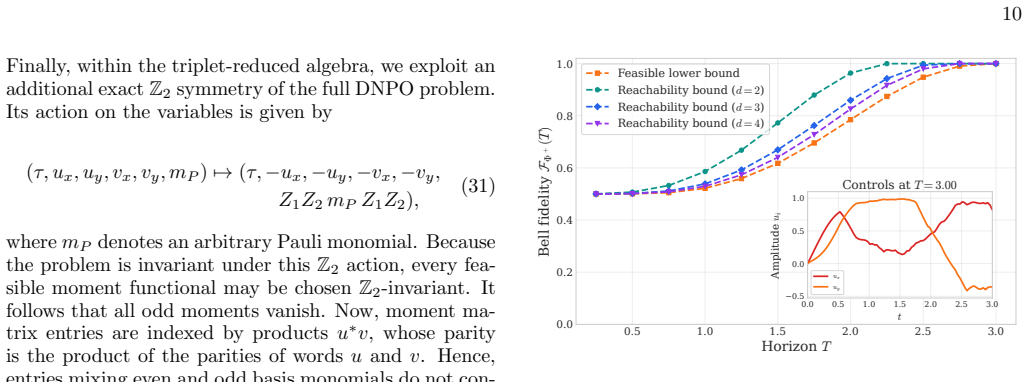
Finite-time control is central to quantum technologies, yet rigorous limits on reachable targets and optimal control times remain largely unknown. We develop a framework for finite-time reachability and optimal-time certificates in constrained quantum control based on moment relaxations with implicitly time-dependent differential constraints. For fixed control horizons and control constraints, the method yields rigorous upper bounds on achievable terminal fidelities, lower bounds on the optimal control times required to reach them, and certificate gaps for benchmarking explicit control pulses. We demonstrate the versatility of our framework in three use cases: entangled-state preparation in two and three qubits, one-qubit gate synthesis across different control geometries, and excitation transfer in an $N$-qubit $XX$ chain. Our work establishes differential moment hierarchies as a practical tool for certifying reachability limits and optimal control times in quantum control, providing hardware-aware quantum speed limits while highlighting structure exploitation as a key ingredient for scalable certification.
Editorial analysis
A structured set of objections, weighed in public.
Referee Report
Summary. The paper develops a framework for finite-time reachability and optimal-time certificates in constrained quantum control using moment relaxations that incorporate implicitly time-dependent differential constraints from the Schrödinger equation. For fixed control horizons and constraints, it claims to produce rigorous upper bounds on achievable terminal fidelities, lower bounds on optimal control times, and certificate gaps for benchmarking explicit pulses. The method is demonstrated on entangled-state preparation in 2- and 3-qubit systems, one-qubit gate synthesis under different control geometries, and excitation transfer in an N-qubit XX chain.
Significance. If the central claims hold, the work provides a practical, hardware-aware tool for certifying reachability limits and quantum speed limits via differential moment hierarchies, with explicit demonstrations across several qubit control problems. The emphasis on structure exploitation for scalability and the production of certificate gaps for benchmarking are notable strengths that could support reproducible validation of control protocols.
major comments (2)
- [§3] §3 (moment hierarchy construction): the incorporation of the time-dependent Schrödinger equation as an implicitly time-dependent differential constraint into the moment relaxation is central to the claimed rigorous bounds, yet no explicit statement or proof is given that the resulting hierarchy converges without introducing uncontrolled relaxation gaps that could invalidate the fidelity upper bounds or time lower bounds for the stated use cases.
- [§4.1–4.3] §4.1–4.3 (numerical demonstrations): the reported certificate gaps and bounds for the three use cases rely on finite-order truncations, but the manuscript provides no error analysis or convergence diagnostics showing that the observed gaps are not artifacts of the relaxation order or discretization; this directly affects whether the bounds can be treated as rigorous for benchmarking.
minor comments (2)
- [§3] Notation for the moment variables and the implicit time-dependence should be clarified with an explicit example in the first demonstration section to improve readability.
- [§4] Figure captions for the fidelity-vs-time plots should state the relaxation order used and whether the plotted curves are from the relaxation or from explicit pulse optimization.
Simulated Author's Rebuttal
We thank the referee for their careful reading and constructive comments. We address each major comment below.
read point-by-point responses
-
Referee: [§3] §3 (moment hierarchy construction): the incorporation of the time-dependent Schrödinger equation as an implicitly time-dependent differential constraint into the moment relaxation is central to the claimed rigorous bounds, yet no explicit statement or proof is given that the resulting hierarchy converges without introducing uncontrolled relaxation gaps that could invalidate the fidelity upper bounds or time lower bounds for the stated use cases.
Authors: The finite-order moment relaxations produce rigorous upper bounds on terminal fidelity (and lower bounds on time) because any feasible moment sequence is an outer approximation to the reachable set; infeasibility of the relaxation therefore certifies that no admissible control exists. Convergence of the hierarchy to the exact optimum is not required for these finite-order certificates to be valid. We acknowledge that the manuscript does not contain an explicit convergence theorem and will add a clarifying paragraph in §3 that (i) states the rigorous character of the finite-order bounds and (ii) outlines sufficient conditions (compact control set, analytic drift and control Hamiltonians) under which the hierarchy is expected to converge. revision: partial
-
Referee: [§4.1–4.3] §4.1–4.3 (numerical demonstrations): the reported certificate gaps and bounds for the three use cases rely on finite-order truncations, but the manuscript provides no error analysis or convergence diagnostics showing that the observed gaps are not artifacts of the relaxation order or discretization; this directly affects whether the bounds can be treated as rigorous for benchmarking.
Authors: We agree that explicit convergence diagnostics would strengthen the numerical sections. In the revised manuscript we will add supplementary figures (or tables) in §4 that track the certificate gap versus moment order for representative instances of each use case, confirming that the reported gaps have stabilized at the truncation orders employed. revision: yes
Circularity Check
No significant circularity identified
full rationale
The paper develops moment relaxations incorporating time-dependent differential constraints from the Schrödinger equation to produce upper bounds on terminal fidelities and lower bounds on optimal control times. No load-bearing step reduces by construction to a fitted parameter, self-citation chain, or renamed input; the central claims rest on the convergence properties of the hierarchy applied to the given control constraints, which are independent of the target bounds. The derivation is therefore self-contained against external benchmarks such as explicit pulse simulations and does not exhibit any of the enumerated circularity patterns.
Axiom & Free-Parameter Ledger
Reference graph
Works this paper leans on
-
[1]
Reachability and optimal-time certificates for quantum control
have been used to obtain global bounds for controlled polynomial dynamics and reachability [17–20]. However, these methods are commutative and therefore cannot encode the noncommutative nature of quantum evolu- tion. In quantum optimal control, global polynomial op- timization has recently been combined with polynomial approximations to mitigate the effec...
work page internal anchor Pith review Pith/arXiv arXiv 2026
-
[2]
In contrast to the state-preparation setting, this function is not naturally the expectation value of a single observ- able on the system Hilbert space
between the terminal propagatorU(T) and the tar- get gateU ⋆ as the figure of merit Fgate(T) = |Tr U † ⋆ U(T) |2 + 2 6 ,(35) such that the constraintF gate(T)≥ηrestricts the search space to timesTafter which fidelityηcan be attained. In contrast to the state-preparation setting, this function is not naturally the expectation value of a single observ- able...
2016
-
[3]
Gebhart, R
V. Gebhart, R. Santagati, A. A. Gentile, E. M. Gauger, D. Craig, N. Ares, L. Banchi, F. Marquardt, L. Pezz` e, and C. Bonato, Learning quantum systems, Nature Re- views Physics5, 141 (2023)
2023
-
[4]
D. D. Awschalom, H. Bernien, R. Hanson, W. D. Oliver, and J. Vuˇ ckovi´ c, Challenges and opportunities for quan- tum information hardware, Science390, 1004 (2025)
2025
-
[5]
Preskill, Quantum computing in the NISQ era and beyond, Quantum2, 79 (2018)
J. Preskill, Quantum computing in the NISQ era and beyond, Quantum2, 79 (2018)
2018
-
[6]
C. Brif, R. Chakrabarti, and H. Rabitz, Control of quan- tum phenomena: Past, present, and future, New Journal of Physics12, 075008 (2010)
2010
-
[7]
Dong and I
D. Dong and I. R. Petersen, Quantum control theory and applications: A survey, IET Control Theory & Applica- tions4, 2651 (2010)
2010
-
[8]
S. J. Glaser, U. Boscain, T. Calarco,et al., Training schr¨ odinger’s cat: quantum optimal control, The Euro- pean Physical Journal D69, 279 (2015)
2015
-
[9]
C. P. Koch, U. Boscain, T. Calarco,et al., Quantum optimal control in quantum technologies. strategic report on current status, visions and goals for research in europe, EPJ Quantum Technology9, 19 (2022)
2022
-
[10]
Altafini, Controllability of quantum mechanical sys- tems by root space decomposition of su(n), Journal of Mathematical Physics43, 2051 (2002)
C. Altafini, Controllability of quantum mechanical sys- tems by root space decomposition of su(n), Journal of Mathematical Physics43, 2051 (2002)
2051
-
[11]
Khaneja, T
N. Khaneja, T. Reiss, C. Kehlet, T. Schulte-Herbr¨ uggen, and S. J. Glaser, Optimal control of coupled spin dy- namics: Design of NMR pulse sequences by gradient as- cent algorithms, Journal of Magnetic Resonance172, 296 (2005)
2005
-
[12]
Yuan and N
H. Yuan and N. Khaneja, Time optimal control of cou- pled qubits under non-stationary interactions, Physical Review A72, 040301 (2005). 16
2005
-
[13]
Caneva, T
T. Caneva, T. Calarco, and S. Montangero, Chopped random-basis quantum optimization, Physical Review A 84, 022326 (2011)
2011
-
[14]
O. V. Morzhin and A. N. Pechen, Krotov method for op- timal control of closed quantum systems, Russian Math- ematical Surveys74, 851 (2019)
2019
-
[15]
X. Wang, M. Allegra, K. Jacobs, S. Lloyd, C. Lupo, and M. Mohseni, Quantum brachistochrone curves as geodesics: Obtaining accurate minimum-time protocols for the control of quantum systems, Physical Review Let- ters114, 170501 (2015)
2015
-
[16]
K. W. Moore and H. Rabitz, Exploring constrained quan- tum control landscapes, The Journal of Chemical Physics 137, 134113 (2012)
2012
-
[17]
A. N. Pechen and D. J. Tannor, Are there traps in quan- tum control landscapes?, Physical Review Letters106, 120402 (2011)
2011
-
[18]
J. B. Lasserre, Global optimization with polynomials and the problem of moments, SIAM Journal on Optimization 11, 796 (2001)
2001
-
[19]
Lasserre, D
J.-B. Lasserre, D. Henrion, C. Prieur, and E. Tr´ elat, Non- linear optimal control via occupation measures and lmi- relaxations, SIAM Journal on Control and Optimization 47, 1643 (2008)
2008
-
[20]
Henrion, M
D. Henrion, M. Korda, M. Kruˇ z´ ık, and R. R´ ıos-Zertuche, Occupation measure relaxations in variational problems: The role of convexity, SIAM Journal on Optimization34, 1708 (2024)
2024
-
[21]
Henrion and M
D. Henrion and M. Korda, Convex computation of the region of attraction of polynomial control systems, IEEE Transactions on Automatic Control59, 297 (2014)
2014
-
[22]
L. B. Gaggioli, D. Henrion, and M. Korda, Composition and tensor train structure in polynomial optimization (2026), arXiv:2604.17563
work page internal anchor Pith review Pith/arXiv arXiv 2026
-
[23]
D. I. Bondar, L. Balada Gaggioli, G. Korpas, J. Mare- cek, J. Vala, and K. Jacobs, Globally optimal control of quantum dynamics, Phys. Rev. Res.7, 043202 (2025)
2025
-
[24]
L. Balada Gaggioli, D. I. Bondar, J. Vala, R. Ovsian- nikov, and J. Marecek, Unitary gate synthesis via polynomial optimization, arXiv preprint (2025), arXiv:2508.01356 [quant-ph]
-
[25]
J. Marecek and J. Vala, Quantum optimal control via magnus expansion and non-commutative polynomial op- timization, arXiv preprint 10.48550/arXiv.2001.06464 (2020), arXiv:2001.06464 [quant-ph]
-
[26]
Pironio, M
S. Pironio, M. Navascu´ es, and A. Ac´ ın, Convergent re- laxations of polynomial optimization problems with non- commuting variables, SIAM Journal on Optimization20, 2157 (2010)
2010
-
[27]
Navascu´ es, S
M. Navascu´ es, S. Pironio, and A. Ac´ ın, A convergent hi- erarchy of semidefinite programs characterizing the set of quantum correlations, New Journal of Physics10, 073013 (2008)
2008
-
[28]
M. Ara´ ujo, A. J. P. Garner, and M. Navascues, Non- commutative optimization problems with differential constraints (2024), arXiv:2408.02572 [quant-ph]
-
[29]
Augier, Nicolas, Henrion, Didier, Korda, Milan, and Ma- gron, Victor, Symmetry reduction and recovery of tra- jectories of optimal control problems via measure relax- ations, ESAIM: COCV30, 63 (2024)
2024
-
[30]
I. Klep, V. Magron, and J. Povh, Sparse noncommu- tative polynomial optimization, Mathematical Program- ming193, 789–829 (2021)
2021
-
[31]
Wang and V
J. Wang and V. Magron, Exploiting term sparsity in non- commutative polynomial optimization, Computational Optimization and Applications80, 483 (2021)
2021
-
[32]
J. Wang, J. Surace, I. Fr´ erot, B. Legat, M.-O. Renou, V. Magron, and A. Ac´ ın, Certifying ground-state prop- erties of many-body systems, Physical Review X14, 031006 (2024)
2024
- [33]
-
[34]
Albertini and D
F. Albertini and D. D’Alessandro, Notions of control- lability for bilinear multilevel quantum systems, IEEE Transactions on Automatic Control48, 1399 (2003)
2003
-
[35]
Altafini, Controllability properties for finite dimen- sional quantum markovian master equations, Journal of Mathematical Physics44, 2357 (2003)
C. Altafini, Controllability properties for finite dimen- sional quantum markovian master equations, Journal of Mathematical Physics44, 2357 (2003)
2003
-
[36]
Albertini and D
F. Albertini and D. D’Alessandro, The lie algebra struc- ture and controllability of spin systems, Linear Algebra and its Applications350, 213 (2002)
2002
-
[37]
D. I. Bondar and A. N. Pechen, Uncomputability and complexity of quantum control, Scientific Reports10, 10.1038/s41598-019-56804-1 (2020)
-
[38]
C. A. Weidner, E. A. Reed, J. Monroe, B. Sheller, S. O’Neil, E. Maas, E. A. Jonckheere, F. C. Langbein, and S. Shermer, Robust quantum control in closed and open systems: Theory and practice, Automatica172, 111987 (2025)
2025
-
[39]
Dahleh, A
M. Dahleh, A. P. Peirce, and H. Rabitz, Optimal control of uncertain quantum systems, Physical Review A42, 1065 (1990)
1990
-
[40]
A. J. Goldschmidt, J. L. DuBois, S. L. Brunton, and J. N. Kutz, Model predictive control for robust quantum state preparation, Quantum6, 837 (2022)
2022
-
[41]
Lawrence, A
R. Lawrence, A. Wodecki, J. Aspman, L. Balada Gaggi- oli, and J. Mareˇ cek, Geometric quantum control and the random schr¨ odinger equation, Physical Review Research 8, 013150 (2026)
2026
-
[42]
S. E. Sklarz and D. J. Tannor, Loading a Bose-Einstein condensate onto an optical lattice: An application of op- timal control theory to the nonlinear Schr¨ odinger equa- tion, Physical Review A66, 053619 (2002)
2002
-
[43]
J. P. Palao and R. Kosloff, Quantum computing by an optimal control algorithm for unitary transformations, Physical Review Letters89, 188301 (2002)
2002
-
[44]
Jacobs, R
K. Jacobs, R. Wu, X. Wang, S. Ashhab, Q.-M. Chen, and H. Rabitz, Fast quantum communication in linear networks, EPL (Europhysics Letters)114, 40007 (2016)
2016
-
[45]
Navascu´ es, S
M. Navascu´ es, S. Pironio, and A. Ac´ ın, Bounding the set of quantum correlations, Phys. Rev. Lett.98, 010401 (2007)
2007
-
[46]
Z. Ji, A. Natarajan, T. Vidick, J. Wright, and H. Yuen, Mip*=re, Communications of the ACM64, 131 (2021)
2021
-
[47]
[46]https://github.com/nininaceur/ ReachabilityQuantumControl
MOSEK ApS,MOSEK Optimizer API for Julia 11.0.30 (2025). [46]https://github.com/nininaceur/ ReachabilityQuantumControl
2025
-
[48]
D. M. Greenberger, M. A. Horne, and A. Zeilinger, Going beyond bell’s theorem, inBell’s Theorem, Quantum The- ory and Conceptions of the Universe, Fundamental The- ories of Physics, Vol. 37, edited by M. Kafatos (Springer, Dordrecht, 1989) pp. 69–72. 17
1989
-
[49]
M. A. Nielsen, A simple formula for the average gate fi- delity of a quantum dynamical operation, Physics Letters A303, 249 (2002)
2002
-
[50]
E. H. Lieb and D. W. Robinson, The finite group velocity of quantum spin systems, Communications in Mathemat- ical Physics28, 251 (1972)
1972
-
[51]
Lieb-Robinson Bounds in Quantum Many-Body Physics
B. Nachtergaele and R. Sims, Lieb-robinson bounds in quantum many-body physics (2010), arXiv:1004.2086
work page internal anchor Pith review Pith/arXiv arXiv 2010
-
[52]
Claeys, J
M. Claeys, J. Daafouz, and D. Henrion, Modal occupa- tion measures and LMI relaxations for nonlinear switched systems control, Automatica64, 143 (2016)
2016
-
[53]
S. Marx, E. Pauwels, T. Weisser, D. Henrion, and J. B. Lasserre, Semi-algebraic approximation using christoffel– darboux kernel, Constructive Approximation54, 391 (2021)
2021
- [54]
- [55]
-
[56]
Cafuta, I
K. Cafuta, I. Klep, and J. Povh, Rational sums of her- mitian squares of free noncommutative polynomials, Ars Mathematica Contemporanea9, 243 (2015)
2015
discussion (0)
Sign in with ORCID, Apple, or X to comment. Anyone can read and Pith papers without signing in.