REVIEW 2 major objections 2 minor 1 cited by
Gravitational particle production at reheating onset alters ultra-relativistic freeze-out dynamics and expands viable dark matter parameter space.
Reviewed by Pith at T0; open to challenge. T0 means a machine referee read the full paper against a public rubric. the ladder, T0–T4 →
T0 review · grok-4.3
2026-06-25 22:54 UTC pith:YXJDGSG5
load-bearing objection Extends UFO to general reheating via arbitrary ξ and an initial gravitational radiation bath, which relaxes some mass bounds for n=2, but the quoted numbers rest on derivations not visible in the abstract. the 2 major comments →
Gravitational ultra-relativistic freeze-out during general reheating
The pith
A machine-rendered reading of the paper's core claim, the machinery that carries it, and where it could break.
Core claim
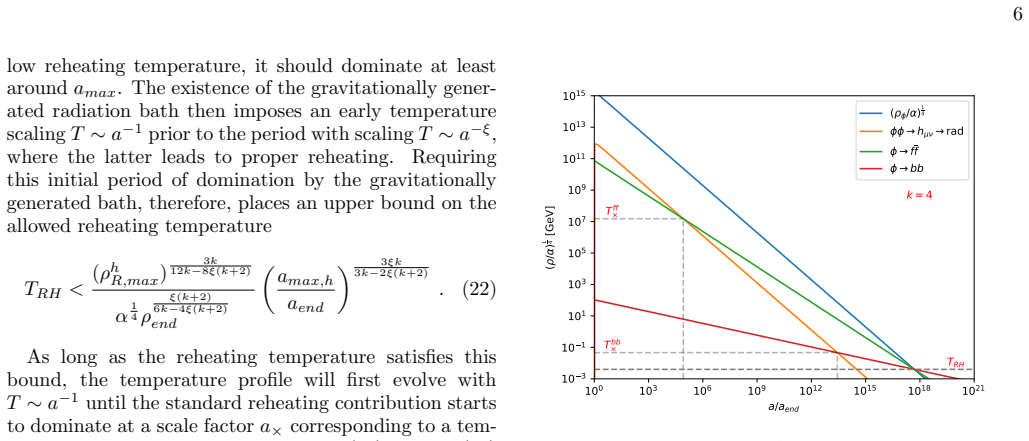
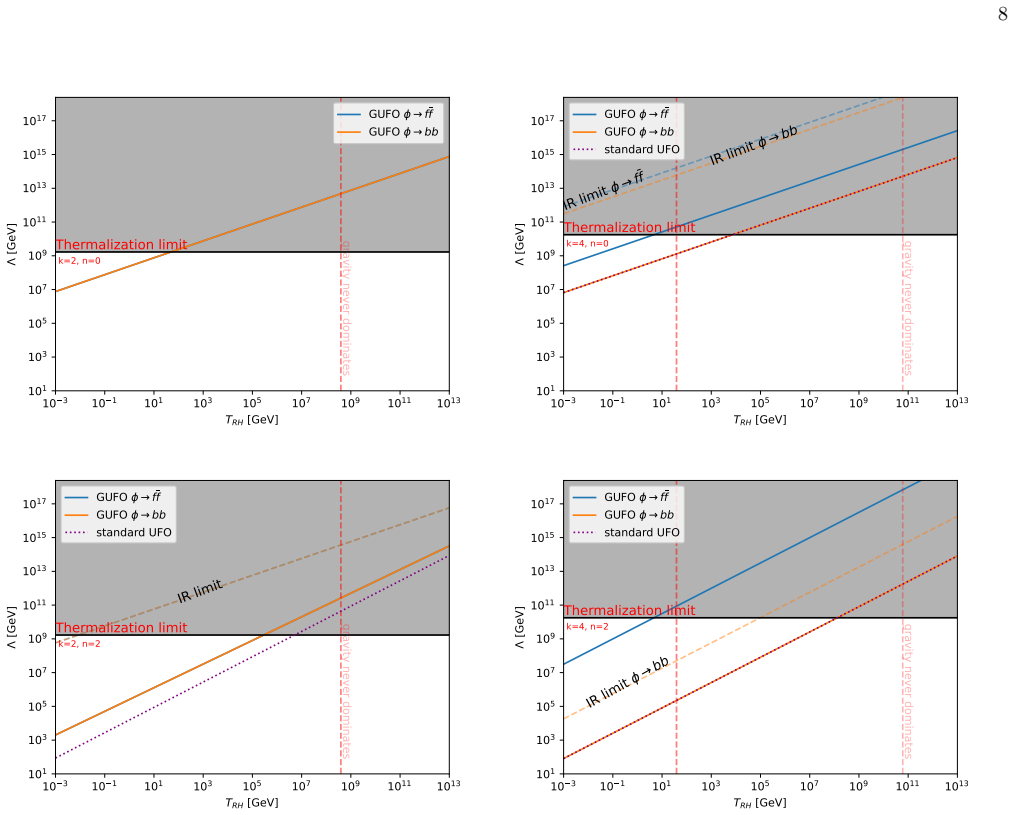
By treating the reheating temperature evolution as T ~ a^{-ξ} with constant ξ and including a non-negligible initial radiation abundance from gravitational production, the UFO dynamics shift such that the relic abundance calculation incorporates both the initial hot bath and subsequent temperature scaling. This GUFO mechanism relaxes thermalization constraints and allows higher dark matter masses in matter-like reheating (V ~ ϕ²) compared to the standard φ → f f-bar channel.
What carries the argument
The power-law temperature profile T ~ a^{-ξ} acting on the cross section ⟨σv⟩ ~ T^n / Λ^{n+2}, with an added early radiation bath from gravitational particle production that seeds the initial conditions for freeze-out.
Load-bearing premise
The temperature evolution during reheating can be parameterized as a power-law T ~ a^{-ξ} with constant ξ, and gravitational particle production at the onset of reheating sources a non-negligible initial radiation bath that alters the UFO dynamics.
What would settle it
An observation of dark matter with mass above 10^7 GeV produced via thermal freeze-out in a matter-like reheating scenario where the initial radiation bath is shown to be negligible would contradict the GUFO prediction for n=2.
If this is right
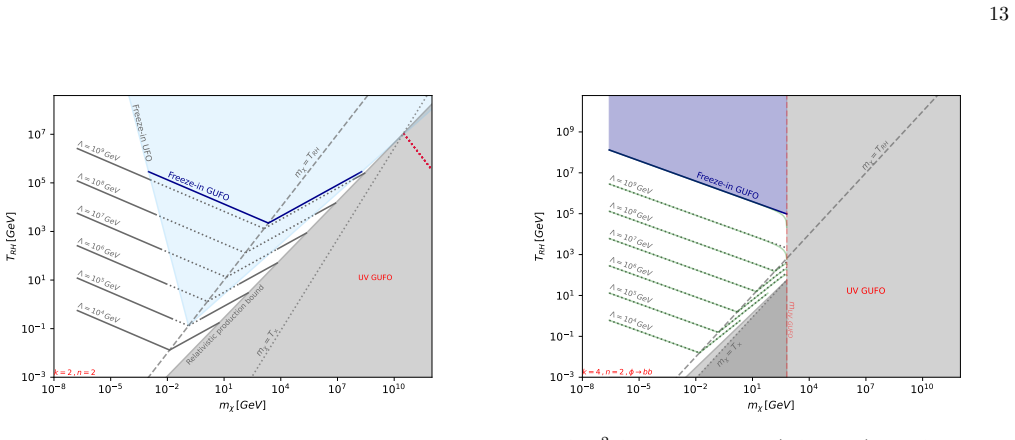
- Matter-like reheating accommodates dark matter masses up to 10^7 GeV for Λ ≲ 10^9 GeV because thermalization constraints weaken.
- Radiation-like reheating remains compatible with GUFO across channels only when gravitational processes supply the initial bath.
- Changes in the temperature scaling can flip the IR/UV character of the freeze-out and produce post-freeze-out freeze-in phases.
- The exact temperature profile must be tracked to obtain the correct relic abundance, unlike in standard WIMP calculations.
Where Pith is reading between the lines
- Similar gravitational seeding effects could modify freeze-out calculations in other non-standard cosmologies with power-law temperature evolution.
- The mechanism suggests that early-universe gravitational production may be necessary to reconcile high-mass dark matter candidates with observed relic density in a wider range of inflationary models.
- Extending the analysis to n ≠ 2 could identify additional regimes where the initial bath dominates the abundance calculation.
Editorial analysis
A structured set of objections, weighed in public.
Referee Report
Summary. The manuscript generalizes ultrarelativistic freeze-out (UFO) of dark matter to arbitrary reheating temperature profiles T ∼ a^{-ξ} and introduces GUFO by adding an initial radiation bath sourced by gravitational particle production at reheating onset. For a thermally averaged cross section ⟨σv⟩ ∼ T^n / Λ^{n+2}, it identifies UV and IR regimes, then specializes to n=2 to report that matter-like reheating (V ∼ ϕ²) accommodates DM masses up to 10^7 GeV for Λ ≲ 10^9 GeV while radiation-like reheating (V ∼ ϕ^4) is compatible with GUFO across channels only when gravitational processes are included.
Significance. If the central derivations hold, the work extends the UFO framework to generic reheating histories and relaxes thermalization constraints for heavier DM candidates. The explicit inclusion of gravitational production as a source of early radiation is a concrete modeling choice that yields falsifiable relic-abundance predictions; this is a strength worth crediting. The n=2 results could inform model-building in non-standard cosmologies provided the temperature-profile assumptions are verified.
major comments (2)
- [generalization section] § on generalization to T ∼ a^{-ξ} (preceding the n=2 specialization): the UV/IR regime classification for general n is load-bearing for the quoted mass bounds, yet the manuscript presents the relic-abundance expressions only after specializing to n=2 without showing the intermediate steps that connect the Boltzmann solution to the 10^7 GeV and 10^9 GeV thresholds.
- [GUFO section] GUFO section (following the initial-radiation discussion): the claim that radiation-like reheating is compatible with GUFO 'only if gravitational processes are taken into account' requires an explicit side-by-side comparison of the relic density with and without the gravitational-production term; without this, the 'only if' qualifier is not substantiated by the given temperature evolution.
minor comments (2)
- [Abstract] Abstract: the mapping V ∼ ϕ² → matter-like and V ∼ ϕ^4 → radiation-like reheating is stated without a brief reminder of the underlying equation-of-state relation, which would aid readers outside the immediate subfield.
- [Introduction or generalization paragraph] Notation: the constant ξ in T ∼ a^{-ξ} is introduced without an immediate statement of its range or its relation to the inflaton potential index, which could be clarified in the first paragraph of the generalization.
Simulated Author's Rebuttal
We thank the referee for the careful reading and constructive comments. We address each major comment below and will revise the manuscript to incorporate the requested clarifications.
read point-by-point responses
-
Referee: [generalization section] § on generalization to T ∼ a^{-ξ} (preceding the n=2 specialization): the UV/IR regime classification for general n is load-bearing for the quoted mass bounds, yet the manuscript presents the relic-abundance expressions only after specializing to n=2 without showing the intermediate steps that connect the Boltzmann solution to the 10^7 GeV and 10^9 GeV thresholds.
Authors: We agree that the intermediate steps should be shown explicitly. In the revised manuscript we will insert the general-n relic-abundance expressions (UV and IR regimes) immediately after the Boltzmann-equation solution for arbitrary ξ, before the n=2 specialization, and will derive how these expressions yield the quoted 10^7 GeV (matter-like) and 10^9 GeV (Λ) thresholds. revision: yes
-
Referee: [GUFO section] GUFO section (following the initial-radiation discussion): the claim that radiation-like reheating is compatible with GUFO 'only if gravitational processes are taken into account' requires an explicit side-by-side comparison of the relic density with and without the gravitational-production term; without this, the 'only if' qualifier is not substantiated by the given temperature evolution.
Authors: We accept the request for an explicit comparison. The revised manuscript will include a direct side-by-side evaluation (text or additional figure panel) of the relic density for radiation-like reheating with and without the gravitational-production term, thereby substantiating the 'only if' statement. revision: yes
Circularity Check
No significant circularity
full rationale
The derivation begins with an explicit generalization of UFO to arbitrary T ~ a^{-ξ} (constant ξ) plus an initial radiation component sourced by gravitational production at reheating onset. The relic abundance and the quoted mass reach (10^7 GeV for n=2, matter-like reheating) are obtained by solving the Boltzmann equation under these stated assumptions; the results are not fitted to the target outcome, nor do any load-bearing steps reduce by definition or self-citation to the inputs. The modeling choices are declared up front and the calculation proceeds from them without circular reduction.
Axiom & Free-Parameter Ledger
free parameters (2)
- n
- ξ
axioms (2)
- domain assumption Temperature during reheating follows T ~ a^{-ξ} for constant ξ
- domain assumption Gravitational particle production at reheating onset produces a non-negligible initial radiation abundance
read the original abstract
We investigate ultrarelativistic freeze-out (UFO) in the context of generic reheating scenarios. While the standard WIMP dark matter paradigm has been extensively studied, UFO has so far only been analyzed within the specific reheating channel $\phi \rightarrow f\bar{f}$. Unlike in the standard WIMP mechanism, where dark matter can only be diluted after freeze-out at $T_\mathrm{FO} \sim m_\chi/\mathcal{O}(10)$, UFO dark matter can undergo freeze-in like phases following the initial freeze-out, driven by the non-trivial temperature evolution. The exact temperature evolution then needs to be accounted for, as a change in the temperature scaling can modify the IR/UV nature of UFO, impacting the relic abundance. We first generalize UFO to an arbitrary temperature profile $T \sim a^{-\xi}$, making explicit the UV and IR regimes for a thermally averaged cross section $\langle \sigma v \rangle \sim T^n / \Lambda^{n+2}$. Then, as a concrete example, we consider the minimal scenario in which gravitational particle production at the onset of reheating sources an initial radiation abundance, and show that this early hot bath changes the UFO parameter space. We refer to this effect as GUFO. Specializing to $n = 2$, we find that matter-like reheating ($V \sim \phi^2$) accommodates dark matter masses up to $10^7~\mathrm{GeV}$ for $\Lambda \lesssim 10^9~\mathrm{GeV}$ as thermalization becomes less stringent, while radiation-like reheating ($V \sim \phi^4$) is compatible with GUFO across all reheating channels only if gravitational processes are taken into account.
Figures

Forward citations
Cited by 1 Pith paper
-
Seesaw reheating
Reheating temperature is controlled by the lifetime and relativistic-to-nonrelativistic transition of an intermediate seesaw scalar, not by the inflaton decay width, yielding simple analytical expressions for TRH.
Reference graph
Works this paper leans on
-
[1]
1Note that theµin this interaction differs from the one in the thermal-averaged cross section
In this case the temperature profile during reheating generally solves to [33] ρR = 2k k+ 8−6kl γϕ Hend ρl+1 end M4l P aend a 4 " a aend k+8−6kl k+2 −1 # (10) Note that throughout this work we will fix the reheating temperature and consider compatible values ofξcorre- sponding to the introduced models while parametrizing everything from the reheating poin...
2025
-
[2]
M. Cirelli, A. Strumia, and J. Zupan, (2024), arXiv:2406.01705 [hep-ph]
work page internal anchor Pith review Pith/arXiv arXiv 2024
-
[3]
The Waning of the WIMP: Endgame?
G. Arcadi, D. Cabo-Almeida, M. Dutra, P. Ghosh, M. Lindner, Y. Mambrini, J. P. Neto, M. Pierre, S. Pro- fumo, and F. S. Queiroz, Eur. Phys. J. C85, 152 (2025), arXiv:2403.15860 [hep-ph]
work page Pith review arXiv 2025
-
[4]
The Dawn of FIMP Dark Matter: A Review of Models and Constraints
N. Bernal, M. Heikinheimo, T. Tenkanen, K. Tuomi- nen, and V. Vaskonen, Int. J. Mod. Phys. A32, 1730023 (2017), arXiv:1706.07442 [hep-ph]
work page internal anchor Pith review Pith/arXiv arXiv 2017
-
[5]
E. G. M. Ferreira, Astron. Astrophys. Rev.29, 7 (2021), arXiv:2005.03254 [astro-ph.CO]
work page Pith review arXiv 2021
-
[6]
Primordial Black Holes as Dark Matter Candidates
B. Carr and F. Kuhnel, SciPost Phys. Lect. Notes48, 1 (2022), arXiv:2110.02821 [astro-ph.CO]
work page Pith review arXiv 2022
-
[7]
Planck 2018 results. VI. Cosmological parameters
N. Aghanim et al. (Planck), Astron. Astrophys.641, A6 (2020), [Erratum: Astron.Astrophys. 652, C4 (2021)], arXiv:1807.06209 [astro-ph.CO]
work page internal anchor Pith review Pith/arXiv arXiv 2020
-
[8]
First Dark Matter Search Results from the LUX-ZEPLIN (LZ) Experiment
J. Aalbers et al. (LZ), Phys. Rev. Lett.131, 041002 (2023), arXiv:2207.03764 [hep-ex]
work page internal anchor Pith review Pith/arXiv arXiv 2023
-
[9]
E. Aprile et al. (XENON), Phys. Rev. Lett.134, 161004 (2025), arXiv:2411.15289 [hep-ex]
-
[10]
E. Aprile et al. (XENON), Phys. Rev. Lett.131, 041003 (2023), arXiv:2303.14729 [hep-ex]
-
[11]
DARWIN: towards the ultimate dark matter detector
J. Aalbers et al. (DARWIN), JCAP11, 017 (2016), arXiv:1606.07001 [astro-ph.IM]
work page internal anchor Pith review Pith/arXiv arXiv 2016
-
[12]
A. McDaniel, M. Ajello, C. M. Karwin, M. Di Mauro, A. Drlica-Wagner, and M. A. S´ anchez-Conde, Phys. Rev. D109, 063024 (2024), arXiv:2311.04982 [astro-ph.HE]
work page Pith review arXiv 2024
-
[13]
J. M. Gaskins, Contemp. Phys.57, 496 (2016), arXiv:1604.00014 [astro-ph.HE]
work page internal anchor Pith review Pith/arXiv arXiv 2016
-
[14]
Gravitational portals in the early Universe
S. Clery, Y. Mambrini, K. A. Olive, and S. Verner, Phys. Rev. D105, 075005 (2022), arXiv:2112.15214 [hep-ph]
work page Pith review arXiv 2022
-
[15]
Gravitational Portals with Non-Minimal Couplings
S. Clery, Y. Mambrini, K. A. Olive, A. Shkerin, and S. Verner, Phys. Rev. D105, 095042 (2022), arXiv:2203.02004 [hep-ph]
work page Pith review arXiv 2022
-
[16]
Gravity as a Portal to Reheating, Leptogenesis and Dark Matter
B. Barman, S. Cl´ ery, R. T. Co, Y. Mambrini, and K. A. Olive, JHEP12, 072 (2022), arXiv:2210.05716 [hep-ph]
work page Pith review arXiv 2022
-
[17]
E. W. Kolb, A. J. Long, E. McDonough, and J. Wang, (2025), arXiv:2512.16976 [hep-ph]
work page internal anchor Pith review Pith/arXiv arXiv 2025
- [18]
-
[19]
E. W. Kolb and A. J. Long, Rev. Mod. Phys.96, 045005 (2024), arXiv:2312.09042 [astro-ph.CO]
work page Pith review arXiv 2024
-
[20]
F. Koutroulis, O. Lebedev, and S. Pokorski, JHEP04, 027 (2024), arXiv:2310.15906 [hep-ph]
-
[21]
D. Feiteira, F. Koutroulis, O. Lebedev, and S. Pokorski, JCAP03, 030 (2026), arXiv:2509.01673 [hep-ph]
-
[22]
S. Verner, Phys. Rev. D113, 123503 (2026), arXiv:2512.19041 [hep-ph]
-
[23]
N. Bernal and Y. Xu, JCAP12, 017 (2022), arXiv:2209.07546 [hep-ph]
-
[24]
G. B´ elanger, N. Bernal, and A. Pukhov, (2026), arXiv:2603.05590 [hep-ph]
- [25]
- [26]
- [27]
-
[28]
Freeze-in at stronger coupling
C. Cosme, F. Costa, and O. Lebedev, Phys. Rev. D109, 075038 (2024), arXiv:2306.13061 [hep-ph]
work page Pith review arXiv 2024
-
[29]
Warm dark matter from freeze-in at stronger coupling
D. Feiteira, O. Lebedev, and V. Oliveira, (2026), arXiv:2602.20242 [hep-ph]
work page internal anchor Pith review Pith/arXiv arXiv 2026
-
[30]
Higgs Portal Dark Matter Freeze-in at Stronger Coupling: Observational Benchmarks
G. Arcadi, F. Costa, A. Goudelis, and O. Lebedev, JHEP 07, 044 (2024), arXiv:2405.03760 [hep-ph]
work page Pith review arXiv 2024
- [31]
-
[32]
S. E. Henrich, Y. Mambrini, and K. A. Olive, (2026), arXiv:2605.03014 [hep-ph]
work page internal anchor Pith review Pith/arXiv arXiv 2026
-
[33]
Universality Class in Conformal Inflation
R. Kallosh and A. Linde, JCAP07, 002 (2013), arXiv:1306.5220 [hep-th]
work page internal anchor Pith review Pith/arXiv arXiv 2013
-
[34]
M. A. G. Garcia, K. Kaneta, Y. Mambrini, and K. A. Olive, JCAP04, 012 (2021), arXiv:2012.10756 [hep-ph]
work page Pith review arXiv 2021
-
[35]
Freeze-in and ultra-relativistic freeze-out during general reheating scenarios
K. Deka, (2026), arXiv:2606.17155 [hep-ph]
work page internal anchor Pith review Pith/arXiv arXiv 2026
-
[36]
S. S. Gershtein and Y. B. Zeldovich, JETP Lett.4, 120 (1966)
1966
-
[37]
Cowsik and J
R. Cowsik and J. McClelland, Phys. Rev. Lett.29, 669 (1972)
1972
-
[38]
A. S. Szalay and G. Marx, Acta Physica Acad. Sci. Hung. 35, 113 (1974)
1974
-
[39]
V. Irˇ siˇ cet al., Phys. Rev. D96, 023522 (2017), arXiv:1702.01764 [astro-ph.CO]
work page internal anchor Pith review Pith/arXiv arXiv 2017
- [40]
-
[41]
A. Chakraborty, D. Maity, and R. Mondal, (2026), arXiv:2603.04155 [hep-ph]
-
[42]
Linking the Gauge Hierarchy with Neutrino Masses and Dark Matter via Two-step Cosmological Selection
J.-L. Yang and F. F. Deppisch, (2026), arXiv:2605.28728 [hep-ph]
work page internal anchor Pith review Pith/arXiv arXiv 2026
-
[43]
O. Lebedev, A. P. Morais, V. Oliveira, and R. Pasechnik, JHEP04, 136 (2025), arXiv:2410.21874 [hep-ph]
- [44]
-
[45]
N. Koivunen, O. Lebedev, and M. Raidal, Eur. Phys. J. C84, 1234 (2024), arXiv:2403.15533 [hep-ph]
-
[46]
Temperature evolution in the Early Universe and freeze-in at stronger coupling
C. Cosme, F. Costa, and O. Lebedev, JCAP06, 031 (2024), arXiv:2402.04743 [hep-ph]
work page Pith review arXiv 2024
-
[47]
X. Bertou, O. Deligny, M. Gross, Y. Mambrini, and I.-E. Mellouki, (2026), arXiv:2606.12408 [hep-ph]
work page internal anchor Pith review Pith/arXiv arXiv 2026
- [48]
- [49]
-
[50]
A. Goudelis, A. Lessa, L. M. D. Ramos, and T. Reggio, (2026), arXiv:2606.19564 [hep-ph]
work page internal anchor Pith review Pith/arXiv arXiv 2026
-
[51]
M. A. G. Garcia, M. Gross, Y. Mambrini, K. A. Olive, M. Pierre, and J.-H. Yoon, JCAP12, 028 (2023), arXiv:2308.16231 [hep-ph]
work page Pith review arXiv 2023
- [52]
-
[53]
Y. Cado and M. Quir´ os, Phys. Rev. D106, 055018 (2022), arXiv:2201.06422 [hep-ph]
-
[54]
Higgs condensation as an unwanted curvaton
T. Kunimitsu and J. Yokoyama, Phys. Rev. D86, 083541 (2012), arXiv:1208.2316 [hep-ph]
work page internal anchor Pith review Pith/arXiv arXiv 2012
-
[55]
D. G. Figueroa, J. Garc´ ıa-Bellido, and F. Torrent´ ı, Phys. Rev. D93, 103521 (2016), arXiv:1602.03085 [astro- ph.CO]
work page internal anchor Pith review Pith/arXiv arXiv 2016
discussion (0)
Sign in with ORCID, Apple, or X to comment. Anyone can read and Pith papers without signing in.