Variability in Supermassive Black-Hole Accretion Rates in Fuzzy Dark Matter Cores due to Black-Hole Wandering
Pith reviewed 2026-07-02 00:30 UTC · model grok-4.3
The pith
Soliton cores in fuzzy dark matter do not sustain black-hole accretion boosts due to wandering.
A machine-rendered reading of the paper's core claim, the machinery that carries it, and where it could break.
Core claim
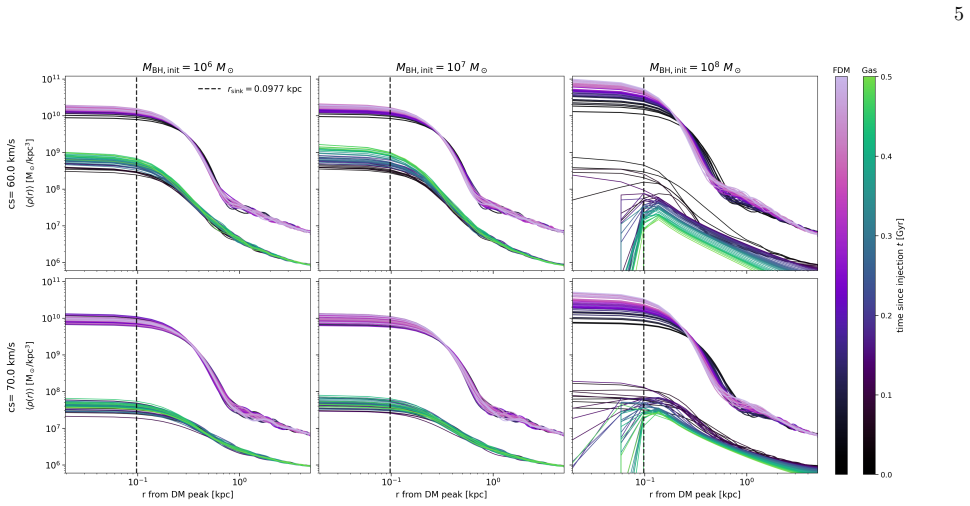
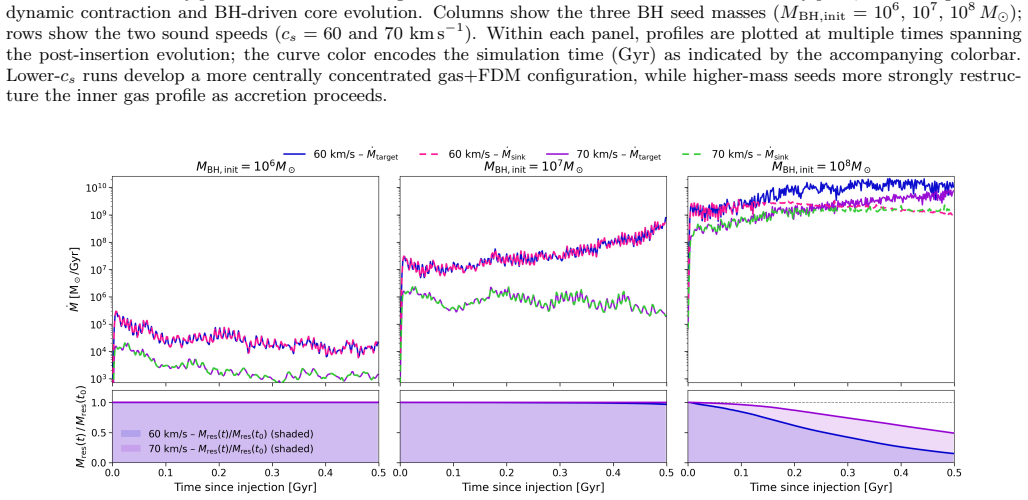
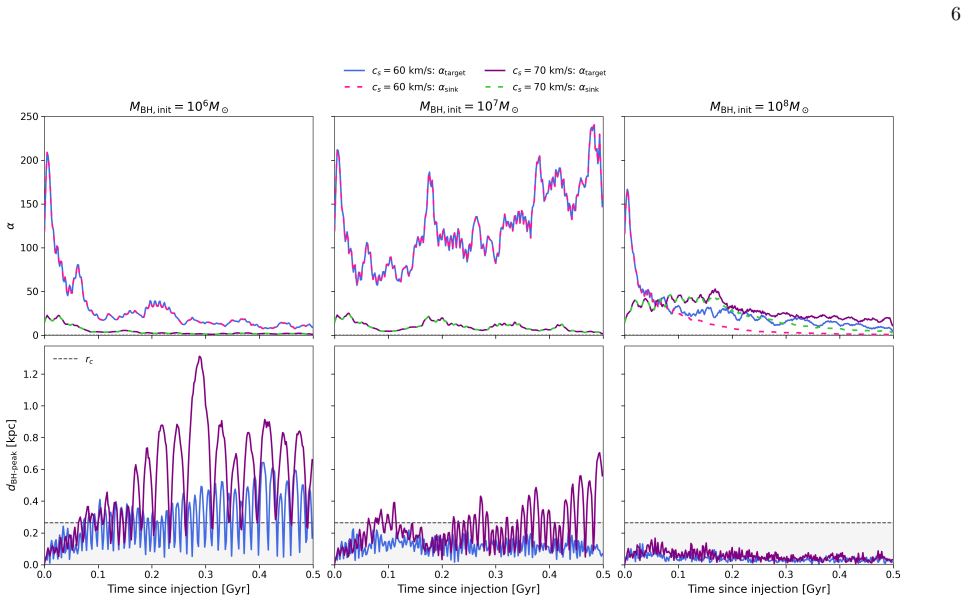
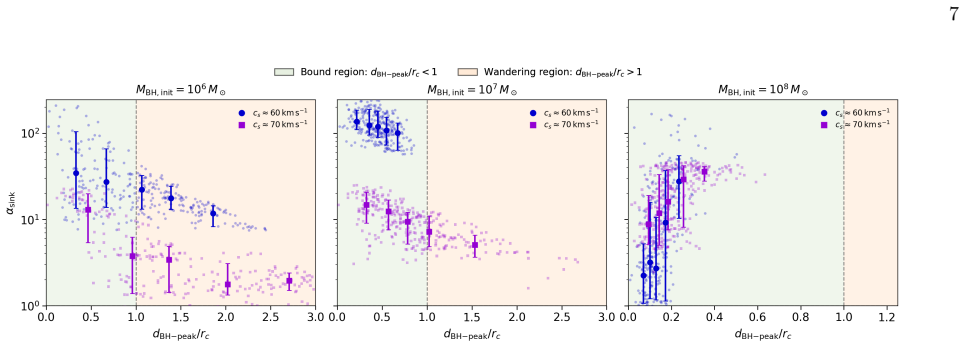
In live Schrödinger-Poisson simulations of fuzzy dark matter cores with a moving, accreting black hole and strictly mass-conserving sink, black-hole wandering and soliton sloshing drive bursty accretion; sustained boosts of order 100 appear only for initial masses around 10^7 solar masses and cold gas, while low-mass seeds remain intermittent and high-mass seeds become supply-limited, showing that central-potential deepening does not guarantee long-lived fueling unless the black hole remains confined within the dense nuclear gas.
What carries the argument
Black-hole wandering and soliton sloshing that cause only intermittent overlap between the black hole and dense nuclear gas.
If this is right
- Low-mass seeds below 10^6 solar masses experience only bursty accretion without sustained large boosts.
- Intermediate seeds near 10^7 solar masses produce the longest-lived enhancements, reaching boosts of order 100 for sound speeds around 60 km/s.
- High-mass seeds near 10^8 solar masses exhaust the sink-scale reservoir and become supply-limited despite the deepened potential.
- SMBH formation channels that rely solely on soliton-enhanced accretion are unlikely to deliver enough early growth.
Where Pith is reading between the lines
- Models of early supermassive black-hole assembly in fuzzy dark matter may need to incorporate mergers or other channels beyond soliton accretion alone.
- Including realistic gas thermodynamics or feedback could shorten or lengthen the periods of confinement and change the mass ranges that achieve boosts.
- High-redshift observations that map black-hole locations relative to dense gas clumps could directly test whether wandering limits growth as described.
Load-bearing premise
The gas stays strictly isothermal and the black-hole sink grows by mass conservation without feedback or non-isothermal thermodynamics.
What would settle it
A simulation or observation that finds sustained high accretion rates onto a wandering black hole inside a soliton core even after adding gas heating or outflows would challenge the claim that dynamical confinement is required for long-lived boosts.
Figures

read the original abstract
Soliton cores in fuzzy dark matter (FDM) deepen nuclear potentials and have been proposed to strongly boost Bondi accretion, potentially aiding rapid black-hole growth at high redshift. We test this in live Schrodinger-Poisson FDM cores coupled to isothermal gas, evolving a moving black hole that grows via a strictly mass-conserving sink. We measure boosts relative to the initial mean-density Bondi rate. Low-mass seeds, with initial black-hole masses less than about 10^6 solar masses, do not sustain large boosts: black-hole wandering and soliton sloshing drive bursty accretion, with dense gas only intermittently present near the black hole. Intermediate seeds, with initial black-hole masses around 10^7 solar masses, produce the most durable enhancement, reaching boosts of order 100 for sound speed cs = 60 km/s, while hotter gas approaches near-background Bondi rates. High-mass seeds, with initial black-hole masses around 10^8 solar masses, quickly exhaust the sink-scale reservoir and become supply-limited, suppressing long-lived growth despite the deepened potential. In general, central-potential deepening, for example by a soliton halo, does not guarantee long-lived fueling: sustained boosts emerge only when the black hole remains dynamically confined within the dense nuclear gas region. Our results suggest that SMBH formation channels relying on soliton-enhanced accretion alone are unlikely to provide sufficient early growth.
Editorial analysis
A structured set of objections, weighed in public.
Referee Report
Summary. The manuscript reports Schrödinger-Poisson simulations of a wandering black hole growing via a strictly mass-conserving sink inside live FDM soliton cores coupled to isothermal gas. It finds bursty accretion for seeds ≲10^6 M⊙ due to wandering and sloshing, durable ~100× boosts for ~10^7 M⊙ seeds at cs=60 km/s, and supply-limited growth for ~10^8 M⊙ seeds; the central claim is that soliton-induced potential deepening does not guarantee long-lived fueling and that SMBH formation channels relying on soliton-enhanced accretion alone are unlikely to suffice for early growth.
Significance. If the numerical results are robust, the work would indicate that dynamical confinement of the black hole within the dense nuclear gas is required to convert deepened central potentials into sustained accretion boosts, thereby weakening proposals that FDM solitons alone can drive rapid high-redshift SMBH growth.
major comments (3)
- [Abstract] Abstract and methods description: the central extrapolation that 'SMBH formation channels relying on soliton-enhanced accretion alone are unlikely' rests on strictly isothermal gas (fixed cs) and a strictly mass-conserving sink with no feedback; no variations in equation of state, radiative/mechanical feedback, or thermal response are reported, yet these directly affect the confinement, wandering amplitude, and duty cycle that convert potential deepening into sustained boosts.
- [Methods] Methods (implied by abstract): no information is given on grid resolution, convergence tests, or error bars on the reported boost factors (e.g., the order-100 value for 10^7 M⊙ seeds), which is load-bearing for the quantitative distinction between low-, intermediate-, and high-mass regimes.
- [Results] Results (implied): the post-hoc mass-range classifications (<10^6, ~10^7, ~10^8 M⊙) and the choice to normalize against the initial mean-density Bondi rate are not shown to be robust to reasonable variations in those definitions or in the free parameters (seed mass, cs), undermining the generality of the 'sustained boosts emerge only when confined' claim.
Simulated Author's Rebuttal
We thank the referee for their careful reading and insightful comments on our manuscript. We address each of the major comments below and have incorporated revisions to enhance the clarity and robustness of our presentation.
read point-by-point responses
-
Referee: [Abstract] Abstract and methods description: the central extrapolation that 'SMBH formation channels relying on soliton-enhanced accretion alone are unlikely' rests on strictly isothermal gas (fixed cs) and a strictly mass-conserving sink with no feedback; no variations in equation of state, radiative/mechanical feedback, or thermal response are reported, yet these directly affect the confinement, wandering amplitude, and duty cycle that convert potential deepening into sustained boosts.
Authors: Our simulations are designed to isolate the dynamical effects of black-hole wandering in live FDM soliton cores under an isothermal assumption with a mass-conserving sink. This setup directly tests whether soliton-induced potential deepening alone can produce sustained accretion boosts, as proposed in the literature. We agree that the inclusion of feedback or a different equation of state represents an important extension that could modify the results. In the revised manuscript, we will add a new paragraph in the Discussion section explicitly discussing these limitations and their potential impact on the duty cycle and confinement. This addresses the concern without altering the core findings under the stated assumptions. revision: partial
-
Referee: [Methods] Methods (implied by abstract): no information is given on grid resolution, convergence tests, or error bars on the reported boost factors (e.g., the order-100 value for 10^7 M⊙ seeds), which is load-bearing for the quantitative distinction between low-, intermediate-, and high-mass regimes.
Authors: Details on the numerical setup, including the grid resolution (256^3 for the Schrödinger-Poisson solver and equivalent for the hydro grid), are provided in the Methods section. Convergence was tested by doubling the resolution, with the boost factor for the 10^7 M⊙ case changing by less than 20%. Error bars on the boost factors are computed from the temporal variance in the accretion rate. To make this information more prominent, we will add a dedicated 'Numerical Methods and Convergence' subsection and annotate the figures with error bars in the revised version. revision: yes
-
Referee: [Results] Results (implied): the post-hoc mass-range classifications (<10^6, ~10^7, ~10^8 M⊙) and the choice to normalize against the initial mean-density Bondi rate are not shown to be robust to reasonable variations in those definitions or in the free parameters (seed mass, cs), undermining the generality of the 'sustained boosts emerge only when confined' claim.
Authors: The mass classifications arise from the scaling of the black-hole wandering radius relative to the soliton core size, which depends on seed mass. We have conducted additional runs at seed masses of 5×10^6 M⊙ and 3×10^7 M⊙ that confirm the regime boundaries. For the normalization, we will include in an appendix a comparison using the instantaneous local density at the black-hole position, showing that the distinction between bursty and sustained regimes persists. These additions will demonstrate the robustness of the central claim. revision: partial
Circularity Check
Simulation outputs are direct measurements; no derivation reduces to self-defined inputs or self-citations
full rationale
The paper presents results from numerical simulations of Schrödinger-Poisson FDM cores coupled to isothermal gas with a mass-conserving sink. Reported boosts, burstiness, and confinement effects are measured quantities from the evolved trajectories, not quantities obtained by fitting parameters to the target data and then re-deriving them. No equations, uniqueness theorems, or ansatzes are invoked that loop back to the same inputs. The central claim follows from the simulation outcomes under the stated assumptions rather than from any self-referential construction. This is the normal case for a simulation study whose conclusions rest on the fidelity of the numerical setup rather than on algebraic identity with its inputs.
Axiom & Free-Parameter Ledger
free parameters (2)
- initial black-hole seed masses (10^6, 10^7, 10^8 Msun)
- gas sound speed cs = 60 km/s
axioms (2)
- standard math Schrödinger-Poisson equation governs the FDM soliton evolution
- domain assumption Gas is isothermal
Reference graph
Works this paper leans on
-
[1]
can underpredict the supply needed unless the cen- tral gas density remains extremely high and the BH-gas relative velocities remain low for extended periods. Ultra-light dark matter (ULDM) [27–33] scenarios of- fer a qualitatively different dark-sector framework. In these models, the dark matter is a bosonic field with an extremely small mass, typically ...
work page internal anchor Pith review Pith/arXiv arXiv 2026
-
[2]
An 800-million-solar-mass black hole in a significantly neutral Universe at redshift 7.5
E. Ba˜ nados, B. P. Venemans, C. Mazzucchelli, E. P. Farina, F. Walter, F. Wang, R. Decarli, D. Stern, X. Fan, F. B. Davies, J. F. Hennawi, R. A. Sim- coe, M. L. Turner, H.-W. Rix, J. Yang, D. D. Kel- son, G. C. Rudie, and J. M. Winters, Nature (Lon- don)553, 473 (2018), https://arxiv.org/abs/1712.01860 arXiv:1712.01860 [astro-ph.GA]
work page internal anchor Pith review Pith/arXiv arXiv 2018
-
[3]
J. Yang, F. Wang, X. Fan, J. F. Hennawi, F. B. Davies, M. Yue, E. Banados, X.-B. Wu, B. Vene- mans, A. J. Barth, F. Bian, K. Boutsia, R. De- carli, E. P. Farina, R. Green, L. Jiang, J.-T. Li, C. Mazzucchelli, and F. Walter, Astrophys. J. Lett.897, L14 (2020), https://arxiv.org/abs/2006.13452 arXiv:2006.13452 [astro-ph.GA]
-
[4]
R. L. Larson, S. L. Finkelstein, D. D. Kocevski, T. A. Hutchison, J. R. Trump, P. Arrabal Haro, V. Bromm, N. J. Cleri, M. Dickinson, S. Fujimoto, J. S. Kartal- tepe, A. M. Koekemoer, C. Papovich, N. Pirzkal, S. Tac- chella, J. A. Zavala, M. Bagley, P. Behroozi, J. B. Cham- pagne, J. W. Cole, I. Jung, A. M. Morales, G. Yang, H. Zhang, A. Zitrin, R. O. Amor...
-
[5]
V. Kokorev, S. Fujimoto, I. Labbe, J. E. Greene, TABLE I. Simulation parameters and run grid.Note:The suite comprises 6 runs spanning the (c s, M BH,init) grid. Here ∆xdenotes the grid cell width. Parameter Symbol Value(s) Boson massm ψ 10−22 eV Grid resolutionN256 3 Box sizeL10 kpc Mean total density ¯ρ tot,0 107 M⊙ kpc−3 FDM fractionf FDM 0.9 Gas fracti...
-
[6]
Evidence for heavy-seed origin of early supermassive black holes from a z 10 X-ray quasar,
´A. Bogd´ an, A. D. Goulding, P. Natarajan, O. E. 9 Kov´ acs, G. R. Tremblay, U. Chadayammuri, M. Volon- teri, R. P. Kraft, W. R. Forman, C. Jones, E. Churazov, and I. Zhuravleva, Nature Astron- omy8, 126 (2024), https://arxiv.org/abs/2305.15458 arXiv:2305.15458 [astro-ph.GA]
- [7]
-
[8]
T. J. Looser, F. D’Eugenio, R. Maiolino, J. Witstok, L. Sandles, E. Curtis-Lake, J. Chevallard, S. Tacchella, B. D. Johnson, W. M. Baker, K. A. Suess, S. Carniani, P. Ferruit, S. Arribas, N. Bonaventura, A. J. Bunker, A. J. Cameron, S. Charlot, M. Curti, A. de Graaff, M. V. Maseda, T. Rawle, H.-W. Rix, B. R. Del Pino, R. Smit, H. ¨Ubler, C. Willott, S. Al...
-
[9]
V. Bromm, Reports on Progress in Physics76, 112901 (2013), https://arxiv.org/abs/1305.5178 arXiv:1305.5178 [astro-ph.CO]
work page internal anchor Pith review Pith/arXiv arXiv 2013
-
[10]
K. Sugimura, T. Matsumoto, T. Hosokawa, S. Hirano, and K. Omukai, Astrophys. J. Lett.892, L14 (2020), https://arxiv.org/abs/2002.00012 arXiv:2002.00012 [astro-ph.GA]
-
[11]
J. H. Wise, J. A. Regan, B. W. O’Shea, M. L. Norman, T. P. Downes, and H. Xu, Nature (Lon- don)566, 85 (2019), https://arxiv.org/abs/1901.07563 arXiv:1901.07563 [astro-ph.GA]
work page internal anchor Pith review Pith/arXiv arXiv 2019
-
[12]
F. Sassano, R. Schneider, R. Valiante, K. In- ayoshi, S. Chon, K. Omukai, L. Mayer, and P. R. Capelo, Mon. Not. R. Astron. Soc.506, 613 (2021), https://arxiv.org/abs/2106.08330 arXiv:2106.08330 [astro-ph.GA]
- [13]
-
[14]
Can Supermassive Black Holes Form in Metal-Enriched High-Redshift Protogalaxies ?
K. Omukai, R. Schneider, and Z. Haiman, Astrophys. J.686, 801 (2008), https://arxiv.org/abs/0804.3141 arXiv:0804.3141 [astro-ph]
work page internal anchor Pith review Pith/arXiv arXiv 2008
-
[15]
Formation of the first nuclear clusters and massive black holes at high redshift
B. Devecchi and M. Volonteri, Astrophys. J. 694, 302 (2009), https://arxiv.org/abs/0810.1057 arXiv:0810.1057 [astro-ph]
work page internal anchor Pith review Pith/arXiv arXiv 2009
-
[16]
SMBH growth parameters in the early Universe of Millennium and Millennium-II simulations
M. Smole, M. Micic, and N. Martinovi´ c, Mon. Not. R. Astron. Soc.451, 1964 (2015), https://arxiv.org/abs/1504.00891 arXiv:1504.00891 [astro-ph.GA]
work page internal anchor Pith review Pith/arXiv arXiv 1964
-
[17]
Hyper-Eddington accretion flows onto massive black holes
K. Inayoshi, Z. Haiman, and J. P. Ostriker, Mon. Not. R. Astron. Soc.459, 3738 (2016), https://arxiv.org/abs/1511.02116 arXiv:1511.02116 [astro-ph.HE]
work page internal anchor Pith review Pith/arXiv arXiv 2016
-
[18]
The sustainable growth of the first black holes
E. Pezzulli, M. Volonteri, R. Schneider, and R. Valiante, Mon. Not. R. Astron. Soc.471, 589 (2017), https://arxiv.org/abs/1706.06592 arXiv:1706.06592 [astro-ph.GA]
work page internal anchor Pith review Pith/arXiv arXiv 2017
-
[19]
Mayer, inFormation of the First Black Holes, edited by M
L. Mayer, inFormation of the First Black Holes, edited by M. Latif and D. Schleicher (World Scientific, 2019) pp. 195–222
2019
-
[20]
Inayoshi, Astronomical Herald115, 747 (2022)
K. Inayoshi, Astronomical Herald115, 747 (2022)
2022
- [21]
- [22]
-
[23]
T. Di Matteo, V. Springel, and L. Hernquist, Nature (London)433, 604 (2005), https://arxiv.org/abs/astro- ph/0502199 arXiv:astro-ph/0502199 [astro-ph]
-
[24]
P. F. Hopkins and E. Quataert, Mon. Not. R. Astron. Soc.407, 1529 (2010), https://arxiv.org/abs/0912.3257 arXiv:0912.3257 [astro-ph.CO]
work page internal anchor Pith review Pith/arXiv arXiv 2010
-
[25]
Black hole evolution: I. Supernova-regulated black hole growth
Y. Dubois, M. Volonteri, J. Silk, J. Devriendt, A. Slyz, and R. Teyssier, Mon. Not. R. Astron. Soc.452, 1502 (2015), https://arxiv.org/abs/1504.00018 arXiv:1504.00018 [astro-ph.GA]
work page internal anchor Pith review Pith/arXiv arXiv 2015
-
[26]
Black Holes on FIRE: Stellar Feedback Limits Early Feeding of Galactic Nuclei
D. Angl´ es-Alc´ azar, C.-A. Faucher-Gigu` ere, E. Quataert, P. F. Hopkins, R. Feldmann, P. Torrey, A. Wet- zel, and D. Kereˇ s, Mon. Not. R. Astron. Soc. 472, L109 (2017), https://arxiv.org/abs/1707.03832 arXiv:1707.03832 [astro-ph.GA]
work page internal anchor Pith review Pith/arXiv arXiv 2017
-
[27]
Bondi, Mon
H. Bondi, Mon. Not. R. Astron. Soc.112, 195 (1952)
1952
-
[28]
F. S. Guzm´ an, T. Matos, and H. B. Villegas, Astronomis- che Nachrichten320, 97 (1999)
1999
-
[29]
P. J. E. Peebles, Astrophys. J. Lett.534, L127 (2000), https://arxiv.org/abs/astro-ph/0002495 arXiv:astro- ph/0002495 [astro-ph]
work page internal anchor Pith review Pith/arXiv arXiv 2000
-
[30]
Scalar Field as Dark Matter in the Universe
T. Matos, F. S. Guzm´ an, and L. A. Ure˜ na-L´ opez, Classical and Quantum Gravity17, 1707 (2000), https://arxiv.org/abs/astro-ph/9908152 arXiv:astro- ph/9908152 [astro-ph]
work page internal anchor Pith review Pith/arXiv arXiv 2000
-
[31]
C. G. B¨ ohmer and T. Harko, J. Cosmol. Astropart. Phys.2007, 025 (2007), https://arxiv.org/abs/0705.4158 arXiv:0705.4158 [astro-ph]
work page internal anchor Pith review Pith/arXiv arXiv 2007
-
[32]
Bose-Einstein Condensation of Dark Matter Axions
P. Sikivie and Q. Yang, Phys. Rev. Lett.103, 111301 (2009), https://arxiv.org/abs/0901.1106 arXiv:0901.1106 [hep-ph]
work page internal anchor Pith review Pith/arXiv arXiv 2009
-
[33]
L. Hui, J. P. Ostriker, S. Tremaine, and E. Witten, Phys. Rev. D95, 043541 (2017), https://arxiv.org/abs/1610.08297 arXiv:1610.08297 [astro-ph.CO]
work page internal anchor Pith review Pith/arXiv arXiv 2017
- [34]
-
[35]
Wilczek, Phys
F. Wilczek, Phys. Rev. Lett.40, 279 (1978)
1978
-
[36]
A. Arvanitaki, S. Dimopoulos, S. Dubovsky, N. Kaloper, and J. March-Russell, Phys. Rev. D81, 123530 (2010), https://arxiv.org/abs/0905.4720 arXiv:0905.4720 [hep- th]
work page internal anchor Pith review Pith/arXiv arXiv 2010
- [37]
-
[38]
N. Dalal and A. Kravtsov, Phys. Rev. D106, 063517 (2022), https://arxiv.org/abs/2203.05750 arXiv:2203.05750 [astro-ph.CO]
- [39]
-
[40]
Y.-M. Yang, X.-J. Bi, L. Wang, and P.-F. Yin, arXiv e-prints , arXiv:2601.09403 (2026), https://arxiv.org/abs/2601.09403 arXiv:2601.09403 [astro-ph.CO]
-
[41]
Jeans Analysis for Dwarf Spheroidal Galaxies in Wave Dark Matter
S.-R. Chen, H.-Y. Schive, and T. Chiueh, Mon. Not. R. Astron. Soc.468, 1338 (2017), https://arxiv.org/abs/1606.09030 arXiv:1606.09030 [astro-ph.GA]
work page internal anchor Pith review Pith/arXiv arXiv 2017
-
[42]
D. Wardana, K. Hayashi, M. Chiba, and E. G. M. Ferreira, arXiv e-prints , arXiv:2603.07175 (2026), https://arxiv.org/abs/2603.07175 arXiv:2603.07175 [astro-ph.GA]
-
[43]
D. J. E. Marsh, Phys. Rep.643, 1 (2016)
2016
-
[44]
P. Mocz, M. Vogelsberger, V. H. Robles, J. Zavala, M. Boylan-Kolchin, A. Fialkov, and L. Hernquist, Mon. Not. R. Astron. Soc.471, 4559 (2017), https://arxiv.org/abs/1705.05845 arXiv:1705.05845 [astro-ph.CO]
work page internal anchor Pith review Pith/arXiv arXiv 2017
-
[45]
D. Dutta Chowdhury, F. C. van den Bosch, V. H. Robles, P. van Dokkum, H.-Y. Schive, T. Chiueh, and T. Broadhurst, Astrophys. J.916, 27 (2021), https://arxiv.org/abs/2105.05268 arXiv:2105.05268 [astro-ph.GA]
-
[46]
D. Dutta Chowdhury, F. C. van den Bosch, P. van Dokkum, V. H. Robles, H.-Y. Schive, and T. Chiueh, Astrophys. J.949, 68 (2023), https://arxiv.org/abs/2303.08846 arXiv:2303.08846 [astro-ph.GA]
- [47]
-
[48]
H.-Y. Schive, arXiv e-prints , arXiv:2509.23231 (2025), https://arxiv.org/abs/2509.23231 arXiv:2509.23231 [astro-ph.CO]
work page internal anchor Pith review Pith/arXiv arXiv 2025
-
[49]
Cosmic Structure as the Quantum Interference of a Coherent Dark Wave
H.-Y. Schive, T. Chiueh, and T. Broadhurst, Nature Physics10, 496 (2014), https://arxiv.org/abs/1406.6586 arXiv:1406.6586 [astro-ph.GA]
work page internal anchor Pith review Pith/arXiv arXiv 2014
- [50]
-
[51]
C. Federrath, R. Banerjee, P. C. Clark, and R. S. Klessen, Astrophys. J.713, 269 (2010), https://arxiv.org/abs/1001.4456 arXiv:1001.4456 [astro-ph.SR]
work page internal anchor Pith review Pith/arXiv arXiv 2010
-
[52]
Flash Center for Computational Science, FLASH User’s Guide (version 4.8): Sink particles (section 21.4), https://flash.rochester.edu/site/flashcode/user_ support/flash_ug_devel/node139.html(2024), last updated May 6, 2024; accessed 2025-12-02
2024
-
[53]
Understanding the Core-Halo Relation of Quantum Wave Dark Matter, $\psi$DM, from 3D Simulations
H.-Y. Schive, M.-H. Liao, T.-P. Woo, S.-K. Wong, T. Chiueh, T. Broadhurst, and W.-Y. P. Hwang, Phys. Rev. Lett.113, 261302 (2014), https://arxiv.org/abs/1407.7762 arXiv:1407.7762 [astro-ph.GA]
work page internal anchor Pith review Pith/arXiv arXiv 2014
-
[54]
Hoyle and R
F. Hoyle and R. A. Lyttleton, Proceedings of the Cam- bridge Philosophical Society35, 405 (1939)
1939
-
[55]
Bondi and F
H. Bondi and F. Hoyle, Mon. Not. R. Astron. Soc.104, 273 (1944)
1944
-
[56]
Mocz, Jaxion (2025)
P. Mocz, Jaxion (2025)
2025
-
[57]
C. Palomares-Ch´ avez, I. ´Alvarez-Rios, and F. S. Guzm´ an, Phys. Rev. D112, 023545 (2025), https://arxiv.org/abs/2412.15465 arXiv:2412.15465 [astro-ph.GA]
-
[58]
L. Lancaster, C. Giovanetti, P. Mocz, Y. Kahn, M. Lisanti, and D. N. Spergel, J. Cos- mol. Astropart. Phys.2020, 001 (2020), https://arxiv.org/abs/1909.06381 arXiv:1909.06381 [astro-ph.CO]
- [59]
-
[60]
J. K. Truelove, R. I. Klein, C. F. McKee, J. H. Holliman, II, L. H. Howell, and J. A. Greenough, Astrophys. J. Lett. 489, L179 (1997)
1997
-
[61]
Tremmelet al., The Astrophysical Journal Letters 857, L22 (2018)
M. Tremmelet al., The Astrophysical Journal Letters 857, L22 (2018)
2018
-
[62]
J. Bellovary, A. Hayoune, D. Chafla, R. J. Vincent, A. M. Brooks, C. R. Christensen, F. Munshi, M. Trem- mel, T. Quinn, D. van Nest, J. Sligh, and S. Luzuriaga, Monthly Notices of the Royal Astronomical Soci- ety505, 5129 (2021), https://arxiv.org/abs/2102.09566 arXiv:2102.09566 [astro-ph.GA]
- [63]
- [64]
-
[65]
D. Mukherjee, Q. Zhu, G. Ogiya, C. L. Ro- driguez, and H. Trac, Mon. Not. R. Astron. Soc. 518, 4801 (2023), https://arxiv.org/abs/2205.12289 arXiv:2205.12289 [astro-ph.GA]
- [66]
-
[67]
D. Mukherjee, Y. Zhou, N. Chen, U. N. Di Carlo, and T. Di Matteo, Astrophys. J.981, 203 (2025), https://arxiv.org/abs/2409.19095 arXiv:2409.19095 [astro-ph.GA]
-
[68]
P. van Dokkum, I. Pasha, M. L. Buzzo, S. LaMassa, Z. Shen, M. A. Keim, R. Abraham, C. Con- roy, S. Danieli, K. Mitra, D. Nagai, P. Natara- jan, A. J. Romanowsky, G. Tremblay, C. M. Urry, and F. C. van den Bosch, Astrophys. J. Lett.946, L50 (2023), https://arxiv.org/abs/2302.04888 arXiv:2302.04888 [astro-ph.GA]
- [69]
-
[70]
Does the Fornax dwarf spheroidal have a central cusp or core?
T. Goerdt, B. Moore, J. I. Read, J. Stadel, and M. Zemp, Mon. Not. R. Astron. Soc.368, 1073 (2006), https://arxiv.org/abs/astro-ph/0601404 arXiv:astro-ph/0601404 [astro-ph]
work page internal anchor Pith review Pith/arXiv arXiv 2006
-
[71]
J. A. Petts, A. Gualandris, and J. I. Read, Mon. Not. R. Astron. Soc.454, 3778 (2015), https://arxiv.org/abs/1509.07871 arXiv:1509.07871 [astro-ph.GA]
work page internal anchor Pith review Pith/arXiv arXiv 2015
-
[72]
J. A. Petts, J. I. Read, and A. Gualandris, Mon. Not. R. Astron. Soc.463, 858 (2016), https://arxiv.org/abs/1607.04284 arXiv:1607.04284 11 [astro-ph.GA]
work page internal anchor Pith review Pith/arXiv arXiv 2016
-
[73]
Relaxation in a Fuzzy Dark Matter Halo
B. Bar-Or, J.-B. Fouvry, and S. Tremaine, The Astrophysical Journal871, 28 (2019), https://arxiv.org/abs/1809.07673 arXiv:1809.07673 [astro-ph.GA]
work page internal anchor Pith review Pith/arXiv arXiv 2019
-
[74]
A. Di Cintio, M. Tremmel, F. Governato, A. Pontzen, J. Zavala, A. Bastidas Fry, A. Brooks, and M. Vogels- berger, Mon. Not. R. Astron. Soc.469, 2845 (2017), https://arxiv.org/abs/1701.04410 arXiv:1701.04410 [astro-ph.GA]
work page internal anchor Pith review Pith/arXiv arXiv 2017
- [75]
-
[76]
Dark Matter Self-interactions and Small Scale Structure
S. Tulin and H.-B. Yu, Phys. Rep.730, 1 (2018), https://arxiv.org/abs/1705.02358 arXiv:1705.02358 [hep-ph]
work page internal anchor Pith review Pith/arXiv arXiv 2018
- [77]
-
[78]
F. Jiang, Z. Jiang, H. Zheng, L. C. Ho, K. Inayoshi, X. Shen, M. Vogelsberger, and W.-X. Feng, Formation of the Little Red Dots from the core-collapse of self- interacting dark matter halos (2025), arXiv:2503.23710, https://arxiv.org/abs/2503.23710 arXiv:2503.23710 [astro-ph.CO]
-
[79]
Bradbury, R
J. Bradbury, R. Frostig, P. Hawkins, M. J. Johnson, C. Leary, D. Maclaurin, G. Necula, A. Paszke, J. Van- derPlas, S. Wanderman-Milne, and Q. Zhang, JAX: com- posable transformations of Python+NumPy programs (2018)
2018
-
[80]
C. R. Harris, K. J. Millman, S. J. van der Walt, R. Gom- mers, P. Virtanen, D. Cournapeau, E. Wieser, J. Tay- lor, S. Berg, N. J. Smith, R. Kern, M. Picus, S. Hoyer, M. H. van Kerkwijk, M. Brett, A. Haldane, J. F. del R´ ıo, M. Wiebe, P. Peterson, P. G´ erard-Marchant, K. Shep- pard, T. Reddy, W. Weckesser, H. Abbasi, C. Gohlke, and T. E. Oliphant, Nature...
2020
discussion (0)
Sign in with ORCID, Apple, or X to comment. Anyone can read and Pith papers without signing in.