Modularity in Multilayer Networks using Redundancy-based Resolution and Projection-based Inter-Layer Coupling
Pith reviewed 2026-05-25 13:59 UTC · model grok-4.3
The pith
A revised multilayer modularity sets its resolution and coupling factors from community structures and layer orderings rather than arbitrary choices.
A machine-rendered reading of the paper's core claim, the machinery that carries it, and where it could break.
Core claim
The proposed multilayer modularity revises the semantics of the resolution and inter-layer coupling factors using information from the within-layer and inter-layer structures of the multilayer communities, and is general enough to incorporate orderings of the network layers along with the constraints those orderings impose on layer coupling.
What carries the argument
The revised modularity function whose resolution and inter-layer coupling terms are defined directly from within-layer and inter-layer community structure, extended to accept layer orderings as constraints on coupling.
If this is right
- Experiments on synthetic and real-world multilayer networks can reveal the effects of different combinations of the resolution and inter-layer coupling functions.
- The formulation can be paired with existing state-of-the-art multilayer community detection methods.
- The work supplies a foundation for developing new optimization algorithms that exploit the revised modularity.
Where Pith is reading between the lines
- Because the parameters are now tied to observed community structure, the approach may reduce the sensitivity of detected communities to manual parameter tuning.
- The explicit handling of layer orderings could improve community detection accuracy on networks whose layers represent sequential time steps.
- The same structure-based definition of coupling might be adapted to other multilayer settings that contain natural orderings, such as hierarchical or spatial networks.
Load-bearing premise
The within-layer and inter-layer structures of the multilayer communities supply independent information that can be used to define the resolution and coupling functions without introducing circular dependence on the communities the modularity is meant to discover.
What would settle it
On synthetic multilayer networks with known ground-truth communities, if the new structure-derived resolution and coupling functions produce partitions whose agreement with the ground truth is no higher than partitions obtained with arbitrary parameter values, the central claim would be falsified.
Figures







read the original abstract
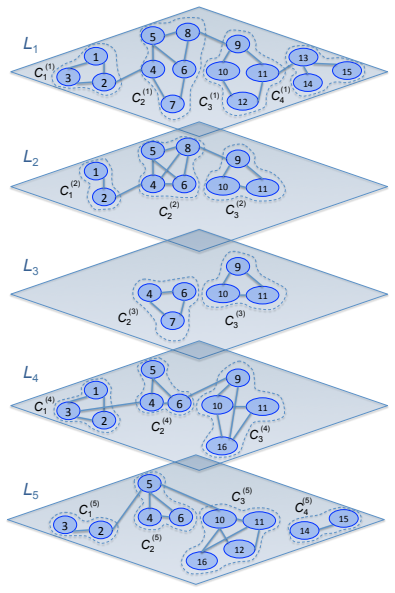
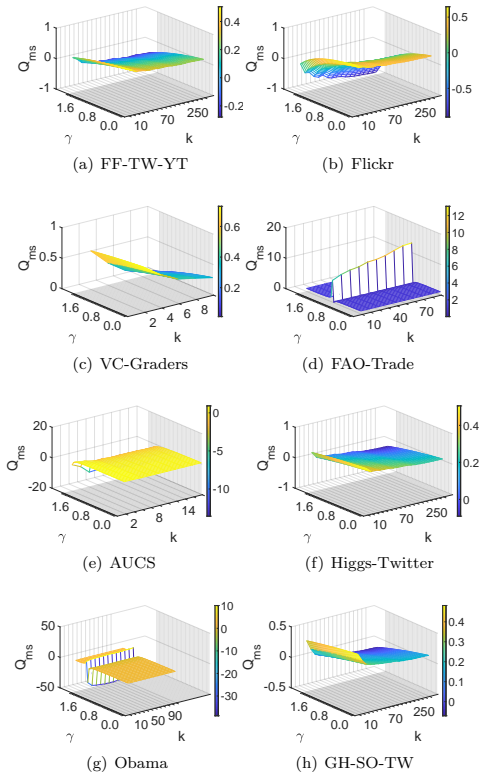
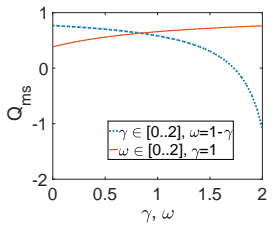
The generalized version of modularity for multilayer networks, a.k.a. multislice modularity, is characterized by two model parameters, namely resolution factor and inter-layer coupling factor. The former corresponds to a notion of layer-specific relevance, whereas the inter-layer coupling factor represents the strength of node connections across the network layers. Despite the potential of this approach, the setting of both parameters can be arbitrarily selected, without considering specific characteristics from the topology of the multilayer network as well as from an available community structure. Also, the multislice modularity is not designed to explicitly model order relations over the layers, which is of prior importance for dynamic networks. This paper aims to overcome the main limitations of the multislice modularity by introducing a new formulation of modularity for multilayer networks. We revise the role and semantics of both the resolution and inter-layer coupling factors based on information available from the within-layer and inter-layer structures of the multilayer communities. Also, our proposed multilayer modularity is general enough to consider orderings of network layers and their constraints on layer coupling. Experiments were carried out on synthetic and real-world multilayer networks using state-of-the-art approaches for multilayer community detection. The obtained results have shown the meaningfulness of the proposed modularity, revealing the effects of different combinations of the resolution and inter-layer coupling functions. This work also represents a starting point for the development of new optimization methods for community detection in multilayer networks.
Editorial analysis
A structured set of objections, weighed in public.
Referee Report
Summary. The paper proposes a new formulation of multilayer modularity that redefines the resolution factor (layer-specific relevance) and inter-layer coupling factor using information from within-layer and inter-layer structures of the multilayer communities, while also incorporating orderings over layers and their constraints on coupling. It claims this addresses arbitrary parameter selection in multislice modularity and demonstrates the approach via experiments on synthetic and real-world networks with state-of-the-art detection methods, showing effects of different resolution/coupling function combinations.
Significance. If the circularity concern is addressed, the work could provide a more topology-informed alternative to fixed-parameter multislice modularity, particularly for ordered layers such as dynamic networks. The experiments indicate that varying the proposed functions yields distinguishable outcomes, but the significance hinges on whether the parameter definitions supply independent information rather than fitting the communities they help discover.
major comments (3)
- [§3] §3 (Proposed Formulation): the resolution and inter-layer coupling factors are defined from the within-layer and inter-layer structures of the multilayer communities; because these communities are recovered by optimizing the very modularity that employs the factors, the construction is at risk of circular dependence unless an independent estimator, fixed functional form, or convergent iterative procedure is supplied and validated.
- [§4] §4 (Experiments): the reported results on synthetic and real networks compare combinations of the new functions but do not include a control that isolates whether the community-derived parameters improve detection over fixed or externally estimated values, leaving the central claim that the formulation is 'general enough' and 'meaningful' without direct support.
- [Abstract and §2] Abstract and §2: the claim that the new modularity 'explicitly model[s] order relations over the layers' is not accompanied by a derivation showing how the ordering constraints are enforced in the objective without reducing to the standard multislice form when the ordering is ignored.
minor comments (2)
- [§3] Notation for the new resolution and coupling functions is introduced without an explicit equation number or comparison table to the original multislice parameters, making it difficult to verify the claimed revision of semantics.
- [Abstract] The abstract states that experiments 'reveal the effects of different combinations,' but the manuscript does not report quantitative metrics (e.g., NMI, modularity values, or statistical significance) that would allow readers to assess the magnitude of those effects.
Simulated Author's Rebuttal
We thank the referee for the constructive and detailed comments. We address each major comment below and indicate where revisions will be made to the manuscript.
read point-by-point responses
-
Referee: §3 (Proposed Formulation): the resolution and inter-layer coupling factors are defined from the within-layer and inter-layer structures of the multilayer communities; because these communities are recovered by optimizing the very modularity that employs the factors, the construction is at risk of circular dependence unless an independent estimator, fixed functional form, or convergent iterative procedure is supplied and validated.
Authors: We acknowledge the validity of this concern about circular dependence. The manuscript defines the factors from community structure without specifying the initialization or convergence mechanism. In the revised version we will add an explicit iterative procedure to §3: initialize with fixed parameters from the standard multislice formulation, obtain communities, recompute the resolution and coupling factors from those communities, re-optimize, and iterate until the detected communities stabilize. We will also report convergence behavior and stability on the synthetic networks. revision: yes
-
Referee: §4 (Experiments): the reported results on synthetic and real networks compare combinations of the new functions but do not include a control that isolates whether the community-derived parameters improve detection over fixed or externally estimated values, leaving the central claim that the formulation is 'general enough' and 'meaningful' without direct support.
Authors: We agree that a control isolating the contribution of the community-derived parameters is missing. In the revision we will augment the experimental section with comparisons against (i) fixed parameter values drawn from the multislice literature and (ii) parameters estimated from layer topology independently of the detected communities. Performance will be quantified using NMI on synthetic data and modularity on real data to directly test whether the proposed factors yield distinguishable improvements. revision: yes
-
Referee: Abstract and §2: the claim that the new modularity 'explicitly model[s] order relations over the layers' is not accompanied by a derivation showing how the ordering constraints are enforced in the objective without reducing to the standard multislice form when the ordering is ignored.
Authors: The manuscript states that the formulation is general enough to incorporate layer orderings but does not supply the requested derivation. We will expand §2 with a mathematical derivation of the modified objective that shows how ordering constraints modulate the inter-layer coupling terms (e.g., distance-based weighting along an ordered sequence of layers). The derivation will also demonstrate that uniform coupling recovers the standard multislice objective when ordering information is omitted. revision: yes
Circularity Check
Resolution/coupling factors defined from community structures that modularity is optimized to discover
specific steps
-
self definitional
[Abstract]
"We revise the role and semantics of both the resolution and inter-layer coupling factors based on information available from the within-layer and inter-layer structures of the multilayer communities."
The factors are explicitly defined from the community structures, yet the modularity (which uses those factors) is the function optimized to identify the communities. This makes the parameters a function of the partition they help produce, with no independent topological summary or external estimator stated to ground them.
full rationale
The paper's central innovation revises the resolution and inter-layer coupling factors using within-layer and inter-layer structures of the multilayer communities. Because the modularity incorporating these factors is the objective being optimized to recover those communities, the construction reduces to a self-referential dependence unless an independent estimator or fixed non-community-dependent form is supplied. The abstract provides no such grounding and instead presents the revision as the solution to arbitrary parameter choice. This matches the self-definitional pattern exactly, with no equations or external benchmarks shown to break the loop. No self-citation load-bearing or other patterns are evidenced in the provided text.
Axiom & Free-Parameter Ledger
Lean theorems connected to this paper
-
IndisputableMonolith/Cost/FunctionalEquation.leanwashburn_uniqueness_aczel unclear?
unclearRelation between the paper passage and the cited Recognition theorem.
We revise the role and semantics of both the resolution and inter-layer coupling factors based on information available from the within-layer and inter-layer structures of the multilayer communities.
-
IndisputableMonolith/Foundation/RealityFromDistinction.leanreality_from_one_distinction unclear?
unclearRelation between the paper passage and the cited Recognition theorem.
γ(L,C)=2/(1+log₂(1+nrp(L,C)))
What do these tags mean?
- matches
- The paper's claim is directly supported by a theorem in the formal canon.
- supports
- The theorem supports part of the paper's argument, but the paper may add assumptions or extra steps.
- extends
- The paper goes beyond the formal theorem; the theorem is a base layer rather than the whole result.
- uses
- The paper appears to rely on the theorem as machinery.
- contradicts
- The paper's claim conflicts with a theorem or certificate in the canon.
- unclear
- Pith found a possible connection, but the passage is too broad, indirect, or ambiguous to say the theorem truly supports the claim.
Reference graph
Works this paper leans on
-
[1]
Revisiting Resolution and Inter-Layer Cou- pling Factors in Modularity for Multilayer Networks,
A. Amelio and A. Tagarelli, “Revisiting Resolution and Inter-Layer Cou- pling Factors in Modularity for Multilayer Networks,” inProc. IEEE/ACM ASONAM, 2017, pp. 266–273
work page 2017
-
[2]
Finding and evaluating community structure in networks,
M. E. J. Newman and M. Girvan, “Finding and evaluating community structure in networks,” Phys. Rev. E , vol. 69, no. 2, p. 026113, 2004
work page 2004
-
[3]
Fast algorithm for detecting community structure in networks,
M. E. J. Newman, “Fast algorithm for detecting community structure in networks,” Phys. Rev. E , vol. 69, 2004
work page 2004
-
[4]
U. Brandes, D. Delling, M. Gaertler, R. G¨ orke, M. Hoefer, Z. Nikoloski, and D. Wagner, “On modularity clustering,” IEEE Trans. Knowl. Data Eng., vol. 20, no. 2, pp. 172–188, 2008
work page 2008
-
[5]
Community detection via maximization of modularity and its variants,
M. Chen, K. Kuzmin, and B. K. Szymanski, “Community detection via maximization of modularity and its variants,” IEEE Trans. Comput. Social Syst., vol. 1, no. 1, pp. 46–65, 2014
work page 2014
-
[6]
Finding community struc- ture in very large networks,
A. Clauset, M. E. J. Newman, and C. Moore, “Finding community struc- ture in very large networks,” Phys. Rev. E , vol. 70, 2004
work page 2004
-
[7]
Modularity and community structure in networks,
M. E. J. Newman, “Modularity and community structure in networks,” Proc. Natl. Acad. Sci., pp. 8577–8582, 2005
work page 2005
-
[8]
A spectral clustering approach to finding com- munities in graph,
S. White and P. Smyth, “A spectral clustering approach to finding com- munities in graph,” in Proc. SDM, 2005
work page 2005
-
[9]
Statistical mechanics of community detec- tion,
J. Reichardt and S. Bornholdt, “Statistical mechanics of community detec- tion,” Phys. Rev. E , vol. 74, 2006
work page 2006
-
[10]
Community detection in complex networks using extremal optimization,
J. Duch and A. Arenas, “Community detection in complex networks using extremal optimization,” Phys. Rev. E , vol. 72, 2005
work page 2005
-
[11]
The structure and dy- namics of multilayer networks,
S. Boccaletti, G. Bianconi, R. Criado, C. I. del Genio, J. G.-G. nes, M. Ro- mance, I. S. na Nadal, Z. Wang, and M. Zanin, “The structure and dy- namics of multilayer networks,” Phys. Rep. , vol. 544, no. 1, pp. 1–122, 2014
work page 2014
-
[12]
M. E. Dickison, M. Magnani, and L. Rossi, Multilayer social networks . Cambridge University Press, 2016
work page 2016
-
[13]
M. Kivela, A. Arenas, M. Barthelemy, J. P. Gleeson, Y. Moreno, and M. A. Porter, “Multilayer networks,”J. Complex Netw., vol. 2, no. 3, pp. 203–271, 2014
work page 2014
-
[14]
L. G. A. Alves, G. Mangioni, F. A. Rodrigues, P. Panzarasa, and Y. Moreno, “Unfolding the complexity of the global value chain: Strength and entropy in the single-layer, multiplex, and multi-layer international trade networks,” Entropy, vol. 20, no. 12, 2018
work page 2018
-
[15]
Community structure in time-dependent, multiscale, and multiplex net- works,
P. J. Mucha, T. Richardson, K. Macon, M. A. Porter, and J.-P. Onnela, “Community structure in time-dependent, multiscale, and multiplex net- works,” Science, vol. 328, no. 5980, pp. 876–878, 2010
work page 2010
-
[16]
A classification for community discovery methods in complex networks,
M. Coscia, F. Giannotti, and D. Pedreschi, “A classification for community discovery methods in complex networks,” Stat. Anal. Data Min. , vol. 4, no. 5, pp. 512–546, 2011
work page 2011
-
[17]
Community detection in multiplex networks using locally adaptive random walks,
Z. Kuncheva and G. Montana, “Community detection in multiplex networks using locally adaptive random walks,” in Proc. IEEE/ACM ASONAM, 2015, pp. 1308–1315
work page 2015
-
[18]
Modularity in Complex Multilayer Networks with Multiple Aspects: A Static Perspective
H. Zhang, C. Wang, J. Lai, and P. S. Yu, “Modularity in Complex Multi- layer Networks with Multiple Aspects: A Static Perspective,” CoRR, vol. abs/1605.06190, 2016
work page internal anchor Pith review Pith/arXiv arXiv 2016
-
[19]
Ensemble-based community detec- tion in multilayer networks,
A. Tagarelli, A. Amelio, and F. Gullo, “Ensemble-based community detec- tion in multilayer networks,” Data Min. Knowl. Discov. , vol. 31, no. 5, pp. 1506–1543, 2017
work page 2017
-
[20]
Consensus Community De- tection in Multilayer Networks Using Parameter-Free Graph Pruning,
D. Mandaglio, A. Amelio, and A. Tagarelli, “Consensus Community De- tection in Multilayer Networks Using Parameter-Free Graph Pruning,” in Proc. PAKDD, 2018, pp. 193–205
work page 2018
-
[21]
Identifying the community structure of the food-trade international multi-network,
S. Torreggiani, G. Mangioni, M. J. Puma, and G. Fagiolo, “Identifying the community structure of the food-trade international multi-network,” Environ. Res. Lett., vol. 13, no. 5, p. 054026, 2018
work page 2018
-
[22]
Multilayer flows in molec- ular networks identify biological modules in the human proteome,
G. Mangioni, G. Jurman, and M. De Domenico, “Multilayer flows in molec- ular networks identify biological modules in the human proteome,” IEEE Trans. Netw. Sci. Eng. , 2018
work page 2018
-
[23]
The nested structural organization of the worldwide trade multi-layer network,
L. G. Alves, G. Mangioni, I. Cingolani, F. A. Rodrigues, P. Panzarasa, and Y. Moreno, “The nested structural organization of the worldwide trade multi-layer network,” Sci. Rep., vol. 9, no. 1, p. 2866, 2019
work page 2019
-
[24]
Resolution limit in community detec- tion,
S. Fortunato and M. Barthelemy, “Resolution limit in community detec- tion,” Proc. Natl. Acad. Sci., vol. 104, no. 36, 2007
work page 2007
-
[25]
Community detection in graphs,
S. Fortunato, “Community detection in graphs,” Phys. Rep., vol. 486, no. 3, pp. 75–174, 2010
work page 2010
-
[26]
L. Tang and H. Liu, Community Detection and Mining in Social Media, ser. Synthesis Lectures on Data Mining and Knowledge Discovery. Morgan & Claypool Publishers, 2010
work page 2010
-
[27]
Community detection in networks: A user guide,
S. Fortunato and D. Hric, “Community detection in networks: A user guide,” Phys. Rep., vol. 659, pp. 1–44, 2016
work page 2016
-
[28]
Community structure in directed networks,
E. A. Leicht and M. E. J. Newman, “Community structure in directed networks,” Phys. Rev. Lett., vol. 100, p. 118703, Mar 2008
work page 2008
-
[29]
Size reduction of com- plex networks preserving modularity,
A. Arenas, J. Duch, A. Fern´ andez, and S. G´ omez, “Size reduction of com- plex networks preserving modularity,” New J. Phys. , vol. 9, no. 6, p. 176, 2007
work page 2007
-
[30]
Analysis of weighted networks,
M. E. J. Newman, “Analysis of weighted networks,” Phys. Rev. E, vol. 70, p. 056131, Nov 2004
work page 2004
-
[31]
Limitation of multi-resolution methods in community detection,
J. Xiang and K. Hu, “Limitation of multi-resolution methods in community detection,” Physica A Stat. Mech. Appl. , vol. 391, no. 20, pp. 4995–5003, 2012
work page 2012
-
[32]
Seeding the kernels in graphs: toward multi-resolution community analysis,
J. Zhang, K. Zhang, X. ke Xu, C. K. Tse, and M. Small, “Seeding the kernels in graphs: toward multi-resolution community analysis,” New J. Phys., vol. 11, no. 11, p. 113003, 2009
work page 2009
-
[33]
Analysis of the structure of complex networks at different resolution levels,
A. Arenas, A. Fern´ andez, and S. G´ omez, “Analysis of the structure of complex networks at different resolution levels,” New J. Phys. , vol. 10, no. 5, p. 053039, 2008
work page 2008
-
[34]
Multi-resolution community detection based on generalized self- loop rescaling strategy,
J. Xiang, Y.-N. Tang, Y.-Y. Gao, Y. Zhang, K. Deng, X.-K. Xu, and K. Hu, “Multi-resolution community detection based on generalized self- loop rescaling strategy,”Physica A Stat. Mech. Appl., vol. 432, pp. 127–139, 2015
work page 2015
-
[35]
Analysis of community structure in networks of correlated data,
S. G´ omez, P. Jensen, and A. Arenas, “Analysis of community structure in networks of correlated data,” Phys. Rev. E , vol. 80, p. 016114, 2009
work page 2009
-
[36]
Community detection in networks with positive and negative links,
V. A. Traag and J. Bruggeman, “Community detection in networks with positive and negative links,” Phys. Rev. E , vol. 80, p. 036115, Sep 2009
work page 2009
-
[37]
Modularity and community detection in bipartite networks,
M. J. Barber, “Modularity and community detection in bipartite networks,” Phys. Rev. E , vol. 76, p. 066102, 2007
work page 2007
-
[38]
Community detection from bipartite net- works,
Y. Xu, L. Chen, and S. Zou, “Community detection from bipartite net- works,” in Proc. IEEE WISA, 2013, pp. 249–254
work page 2013
-
[39]
Module identification in bipartite and directed networks,
R. Guimer` a, M. Sales-Pardo, and L. A. N. Amaral, “Module identification in bipartite and directed networks,” Phys. Rev. E, vol. 76, p. 036102, 2007
work page 2007
-
[40]
Extending the definition of modularity to directed graphs with overlapping communities,
V. Nicosia, G. Mangioni, V. Carchiolo, and M. Malgeri, “Extending the definition of modularity to directed graphs with overlapping communities,” J. Stat. Mech. , vol. 2009, no. 03, p. P03024, 2009
work page 2009
-
[41]
Finding and character- izing communities in multidimensional networks,
M. Berlingerio, M. Coscia, and F. Giannotti, “Finding and character- izing communities in multidimensional networks,” in Proc. IEEE/ACM ASONAM, 2011, pp. 490–494
work page 2011
-
[42]
Community detection in multi-layer graphs: A survey,
J. Kim and J. Lee, “Community detection in multi-layer graphs: A survey,” SIGMOD Record, vol. 44, no. 3, pp. 37–48, 2015
work page 2015
-
[43]
Towards effective visual analytics on multiplex and multilayer networks,
L. Rossi and M. Magnani, “Towards effective visual analytics on multiplex and multilayer networks,” Chaos, Solitons & Fractals , vol. 72, pp. 68–76, 2015
work page 2015
-
[44]
Structural re- ducibility of multilayer networks,
M. De Domenico, V. Nicosia, A. Arenas, and V. Latora, “Structural re- ducibility of multilayer networks,” Nat. Commun., vol. 6, p. 6864, 2015
work page 2015
-
[45]
A Measurement-driven Analysis of Information Propagation in the Flickr Social Network,
M. Cha, A. Mislove, and K. P. Gummadi, “A Measurement-driven Analysis of Information Propagation in the Flickr Social Network,” in Proc. WWW, 2009, pp. 721–730
work page 2009
-
[46]
Linking accounts across social networks: the case of stackoverflow, github and twitter,
G. Silvestri, J. Yang, A. Bozzon, and A. Tagarelli, “Linking accounts across social networks: the case of stackoverflow, github and twitter,” in Proc. Work. on Knowl. Discov. on the Web , 2015, pp. 41–52
work page 2015
-
[47]
Characterizing interactions in online social networks during exceptional events,
E. Omodei, M. De Domenico, and A. Arenas, “Characterizing interactions in online social networks during exceptional events,” Frontiers in Physics, vol. 3, p. 59, 2015
work page 2015
-
[48]
Uncovering groups via heterogeneous in- teraction analysis,
L. Tang, X. Wang, and H. Liu, “Uncovering groups via heterogeneous in- teraction analysis,” in Proc. IEEE ICDM, 2009, pp. 503–512
work page 2009
-
[49]
Clustering network layers with the strata multilayer stochastic block model,
N. Stanley, S. Shai, D. Taylor, and P. J. Mucha, “Clustering network layers with the strata multilayer stochastic block model,” IEEE Trans. Netw. Sci. Eng., vol. 3, no. 2, pp. 95–105, April 2016
work page 2016
-
[50]
Latent heterogeneous multilayer community detection,
H. T. Ali, S. Liu, Y. Yilmaz, R. Couillet, I. Rajapakse, and A. O. Hero, “Latent heterogeneous multilayer community detection,” inProc. ICASSP, 2019. Appendix A Analytical derivation of lower and upper bounds Proof of Proposition 1 (Lower bound of Q). Let us assume that each of the ℓ layer graphs in GL has the form of a bipartite graph Ki(a,b ), with i = ...
work page 2019
discussion (0)
Sign in with ORCID, Apple, or X to comment. Anyone can read and Pith papers without signing in.