First Measurement of the Muon Neutrino Interaction Cross Section and Flux as a Function of Energy at the LHC with FASER
Pith reviewed 2026-05-23 08:32 UTC · model grok-4.3
The pith
Muon neutrino cross sections and fluxes measured differentially in six TeV energy bins at the LHC for the first time.
A machine-rendered reading of the paper's core claim, the machinery that carries it, and where it could break.
Core claim
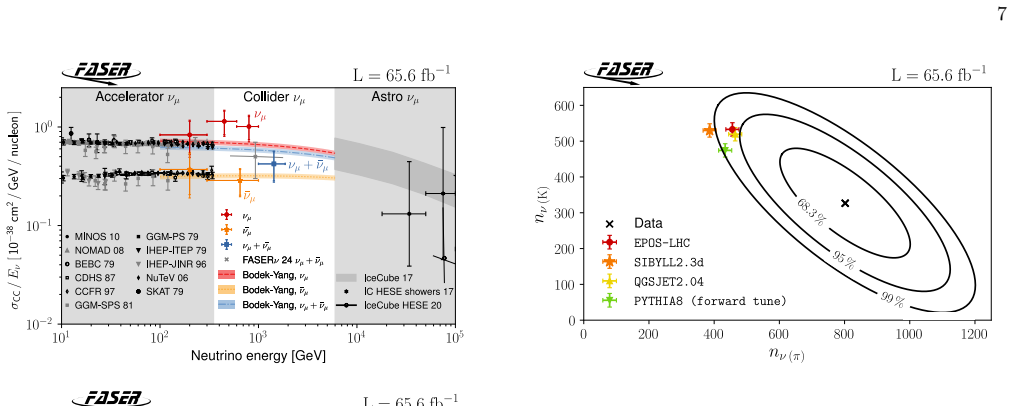
Using 65.6 fb^{-1} of data, 338.1 ± 21.0 muon neutrino events are observed after background subtraction. The events are unfolded into six bins of neutrino energy, enabling the first differential measurement of the neutrino-nucleon cross section and the muon neutrino flux in the TeV range, both consistent with Standard Model predictions.
What carries the argument
Unfolding observed events into a fiducial volume corresponding to the FASER detector's sensitive regions, then interpreting the binned data either as a cross-section measurement (using the expected flux) or as a flux measurement (using the predicted cross section).
Load-bearing premise
The background subtraction from other processes and the unfolding procedure to the fiducial volume are accurate enough that the 338 events yield reliable differential distributions in six energy bins.
What would settle it
A significant deviation between the measured distributions in any of the six energy bins and the Standard Model prediction, exceeding the reported uncertainties, would falsify the claim of alignment with the Standard Model.
Figures







read the original abstract
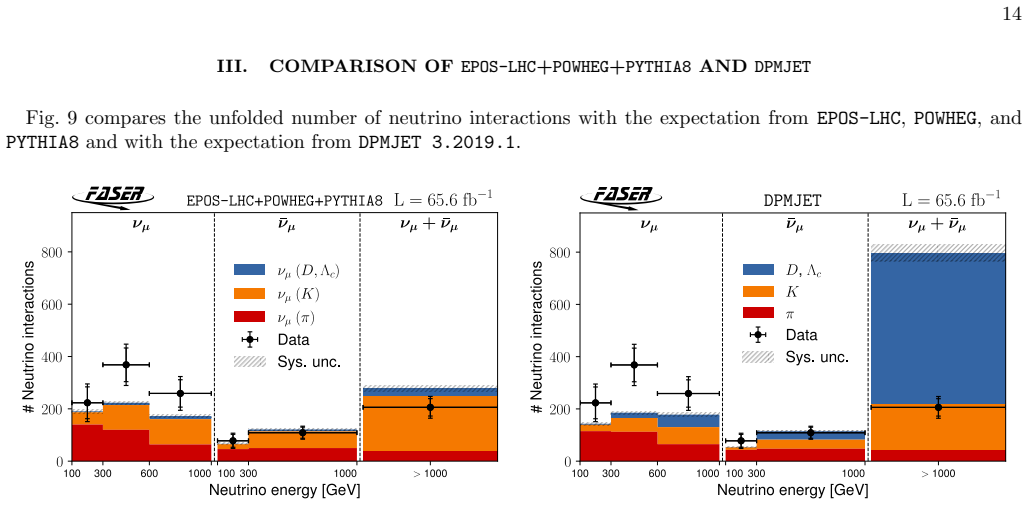
This letter presents the measurement of the energy-dependent neutrino-nucleon cross section in tungsten and the differential flux of muon neutrinos and anti-neutrinos. The analysis is performed using proton-proton collision data at a center-of-mass energy of $13.6 \, {\rm TeV}$ and corresponding to an integrated luminosity of $(65.6 \pm 1.4) \, \mathrm{fb^{-1}}$. Using the active electronic components of the FASER detector, $338.1 \pm 21.0$ charged current muon neutrino interaction events are identified, with backgrounds from other processes subtracted. We unfold the neutrino events into a fiducial volume corresponding to the sensitive regions of the FASER detector and interpret the results in two ways: We use the expected neutrino flux to measure the cross section, and we use the predicted cross section to measure the neutrino flux. Both results are presented in six bins of neutrino energy, achieving the first differential measurement in the TeV range. The observed distributions align with Standard Model predictions. Using this differential data, we extract the contributions of neutrinos from pion and kaon decays.
Editorial analysis
A structured set of objections, weighed in public.
Referee Report
Summary. The paper reports the first differential measurement of the muon neutrino-nucleon cross section in tungsten and the differential flux of muon neutrinos and antineutrinos at the LHC. Using 65.6 fb^{-1} of 13.6 TeV pp collision data collected with the FASER detector, 338.1 ± 21.0 charged-current muon neutrino events are identified after background subtraction. The events are unfolded into a fiducial volume and interpreted in two complementary ways (cross section using predicted flux; flux using predicted cross section), both presented in six neutrino-energy bins. The distributions agree with Standard Model expectations, and the data are used to extract the relative contributions from pion and kaon decays.
Significance. If the unfolding and background modeling hold, this constitutes the first TeV-scale differential neutrino cross-section and flux measurement at a collider. It supplies direct experimental input on high-energy neutrino interactions and forward production, which is valuable for validating Monte Carlo generators, constraining pion/kaon yields, and informing future forward-neutrino programs. The dual-interpretation approach and the extraction of decay-channel contributions are particular strengths.
major comments (2)
- [Unfolding procedure (results and methods sections)] The six-bin differential results (cross section and flux) rest on the unfolding step to the fiducial volume, yet the manuscript provides no migration matrix, regularization strength, condition number, or closure-test outcomes. Without these quantitative diagnostics it is impossible to assess migration, bias, or statistical stability across the six energy bins, which directly affects the reliability of both the cross-section and flux measurements.
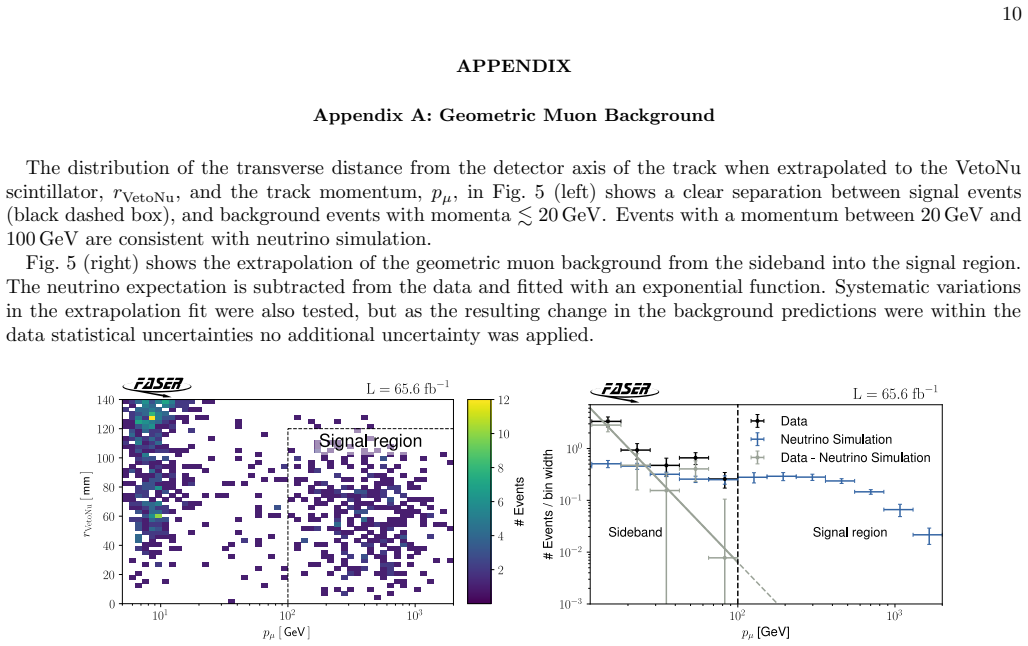
- [Background estimation and event selection] Background subtraction yields the quoted 338.1 ± 21.0 events, but no energy-dependent validation or sideband studies are shown that would demonstrate the background model does not introduce bin-to-bin distortions. Any residual energy-dependent bias would propagate directly into the unfolded spectra and the subsequent pion/kaon extraction.
minor comments (2)
- [Abstract] The abstract states the total event count and unfolding but does not quote the per-bin event yields or the size of the unfolding corrections; adding these numbers would improve transparency.
- [Results section] Notation for neutrino versus antineutrino fluxes and the precise definition of the fiducial volume should be stated explicitly in the text rather than only in figures.
Simulated Author's Rebuttal
We thank the referee for the positive assessment of the significance of this first differential TeV-scale neutrino measurement and for the constructive comments. We address each major comment below and will revise the manuscript accordingly to improve transparency.
read point-by-point responses
-
Referee: The six-bin differential results (cross section and flux) rest on the unfolding step to the fiducial volume, yet the manuscript provides no migration matrix, regularization strength, condition number, or closure-test outcomes. Without these quantitative diagnostics it is impossible to assess migration, bias, or statistical stability across the six energy bins, which directly affects the reliability of both the cross-section and flux measurements.
Authors: We agree that these quantitative diagnostics are important for assessing the unfolding. The current letter format limited the space available for such details. In the revised manuscript we will add the migration matrix (as a figure or table), state the regularization strength, report the condition number of the response matrix, and include closure-test results demonstrating stability and bias control across the six energy bins. revision: yes
-
Referee: Background subtraction yields the quoted 338.1 ± 21.0 events, but no energy-dependent validation or sideband studies are shown that would demonstrate the background model does not introduce bin-to-bin distortions. Any residual energy-dependent bias would propagate directly into the unfolded spectra and the subsequent pion/kaon extraction.
Authors: We acknowledge that energy-dependent validation strengthens confidence in the background model. The letter format constrained the presentation of such studies. In the revised version we will include energy-dependent sideband distributions and validation plots to demonstrate that the background subtraction does not introduce significant bin-to-bin distortions. revision: yes
Circularity Check
No significant circularity; direct data-driven measurement
full rationale
The paper identifies 338.1 ± 21.0 events in data, subtracts backgrounds, unfolds to a fiducial volume, and presents two alternative interpretations (cross section from expected flux, or flux from predicted cross section) in six energy bins. These use external model inputs only for one quantity while measuring the other; no equations or steps reduce the reported distributions to fitted parameters or self-citations by construction. The alignment with SM predictions is a comparison, not a derivation. The analysis is self-contained against external benchmarks.
Axiom & Free-Parameter Ledger
axioms (1)
- domain assumption Standard Model predictions for neutrino-nucleon cross sections and for the relative contributions of pion and kaon decays to the forward neutrino flux are sufficiently accurate to serve as reference for the measurement.
Forward citations
Cited by 4 Pith papers
-
TeV-scale neutrino cross-section measurement using upward through-going muons in Super-Kamiokande
Super-Kamiokande measures the flux-averaged muon neutrino and antineutrino charged-current cross section at 500-5000 GeV as (0.51 ± 0.11) × 10^{-38} cm² GeV^{-1}.
-
A novel phenomenological approach to total charm cross-section measurements at the LHC
A data-driven ddFONLL extrapolation method accounts for LHC-observed charm fragmentation non-universality to derive higher total charm cross sections from D0 fiducial measurements at 5 and 13 TeV, consistent with NNLO...
-
Towards foundation-style models for energy-frontier heterogeneous neutrino detectors via self-supervised pre-training
Self-supervised pre-training on multimodal neutrino detector simulations produces reusable representations that improve downstream classification, regression, and data efficiency over training from scratch.
-
Non-Standard Neutrino Interactions at a Muon Collider Neutrino Detector
A forward neutrino detector at a muon collider can exceed current and upcoming bounds on non-standard neutrino interactions by exploiting high neutrino flux, known flavor composition, and chirality.
Reference graph
Works this paper leans on
-
[1]
Detecting and Studying High-Energy Collider Neutrinos with FASER at the LHC,
FASER Collaboration, “Detecting and Studying High-Energy Collider Neutrinos with FASER at the LHC,”Eur. Phys. J. C 80 (01, 2020) 61, arXiv:1908.02310 [hep-ex]
-
[2]
The Forward Physics Facility at the High-Luminosity LHC,
J. L. Feng et al., “The Forward Physics Facility at the High-Luminosity LHC,” J. Phys. G 50 (2023) no. 3, 030501, arXiv:2203.05090 [hep-ex]
-
[3]
Particle Data Group Collaboration, “Review of Particle Physics,”Phys. Rev. D 110 (8, 2024) 030001
work page 2024
-
[5]
Neutrino and muon physics in the collider mode of future accelerators,
A. De Rujula and R. Ruckl, “Neutrino and muon physics in the collider mode of future accelerators,” in SSC Workshop: Superconducting Super Collider Fixed Target Physics, pp. 571–596. 5, 1984
work page 1984
-
[6]
First Direct Observation of Collider Neutrinos with FASER at the LHC,
FASER Collaboration, “First Direct Observation of Collider Neutrinos with FASER at the LHC,” Phys. Rev. Lett. 131 (2023) no. 3, 031801, arXiv:2303.14185 [hep-ex]
-
[7]
Observation of Collider Muon Neutrinos with the SND@LHC Experiment,
SND@LHC Collaboration, “Observation of Collider Muon Neutrinos with the SND@LHC Experiment,” Phys. Rev. Lett. 131 (2023) no. 3, 031802, arXiv:2305.09383 [hep-ex]
-
[8]
First Measurement of νe and νµ Interaction Cross Sections at the LHC with FASER’s Emulsion Detector,
FASER Collaboration, “First Measurement of νe and νµ Interaction Cross Sections at the LHC with FASER’s Emulsion Detector,”Phys. Rev. Lett. 133 (7, 2024) 021802, arXiv:2403.12520 [hep-ex]
-
[9]
The Dawn of Collider Neutrino Physics,
E. Worcester, “The Dawn of Collider Neutrino Physics,” APS Physics 16 (2023) 113
work page 2023
-
[10]
FASER Collaboration, “The FASER Detector,”J. Instrum. 19 (5, 2024) P05066, arXiv:2207.11427 [physics.ins-det]
-
[11]
The trigger and data acquisition system of the FASER experiment,
FASER Collaboration, “The trigger and data acquisition system of the FASER experiment,” JINST 16 (2021) no. 12, P12028, arXiv:2110.15186 [physics.ins-det]
-
[12]
The tracking detector of the FASER experiment,
FASER Collaboration, “The tracking detector of the FASER experiment,” Nucl. Instrum. Meth. A 1034 (2022) 166825, arXiv:2112.01116 [physics.ins-det]
-
[13]
The barrel modules of the ATLAS semiconductor tracker,
A. Abdesselam et al., “The barrel modules of the ATLAS semiconductor tracker,” Nucl. Instrum. Meth. A 568 (2006) 642–671
work page 2006
-
[14]
Luminosity determination in $pp$ collisions at $\sqrt{s}=13$ TeV using the ATLAS detector at the LHC
ATLAS Collaboration, “Luminosity determination in pp collisions at √s = 13 TeV using the ATLAS detector at the LHC,”Eur. Phys. J. C 83 (10, 2023) 982, arXiv:2212.09379 [hep-ex]
work page internal anchor Pith review arXiv 2023
-
[15]
Preliminary analysis of the luminosity calibration of the ATLAS 13.6 TeV data recorded in 2022,
ATLAS Collaboration, “Preliminary analysis of the luminosity calibration of the ATLAS 13.6 TeV data recorded in 2022,” tech. rep., CERN, Geneva, 2023. https://cds.cern.ch/record/2853525
-
[16]
Preliminary analysis of the luminosity calibration for the ATLAS 13.6 TeV data recorded in 2023,
ATLAS Collaboration, “Preliminary analysis of the luminosity calibration for the ATLAS 13.6 TeV data recorded in 2023,” tech. rep., CERN, Geneva, 2024. http://cds.cern.ch/record/2900949
-
[17]
Forward neutrino fluxes at the LHC,
F. Kling and L. J. Nevay, “Forward neutrino fluxes at the LHC,” Phys. Rev. D 104 (2021) no. 11, 113008, arXiv:2105.08270 [hep-ph]
-
[18]
Neutrino Rate Predictions for FASER,
FASER Collaboration, “Neutrino Rate Predictions for FASER,”Phys. Rev. D 110 (7, 2024) 012009, arXiv:2402.13318 [hep-ex]
-
[19]
EPOS LHC : test of collective hadronization with LHC data
T. Pierog et al., “EPOS LHC: Test of collective hadronization with data measured at the CERN Large Hadron Collider,” Phys. Rev. C92 (2015) 034906, arXiv:1306.0121 [hep-ph]
work page internal anchor Pith review Pith/arXiv arXiv 2015
-
[20]
A New Method for Combining NLO QCD with Shower Monte Carlo Algorithms
P. Nason, “A New method for combining NLO QCD with shower Monte Carlo algorithms,” JHEP 11 (2004) 040, arXiv:hep-ph/0409146
work page internal anchor Pith review Pith/arXiv arXiv 2004
-
[21]
Matching NLO QCD computations with Parton Shower simulations: the POWHEG method
S. Frixione et al., “Matching NLO QCD computations with Parton Shower simulations: the POWHEG method,” JHEP 11 (2007) 070, arXiv:0709.2092 [hep-ph]
work page internal anchor Pith review Pith/arXiv arXiv 2007
-
[22]
A general framework for implementing NLO calculations in shower Monte Carlo programs: the POWHEG BOX
S. Alioli et al., “A general framework for implementing NLO calculations in shower Monte Carlo programs: the POWHEG BOX,” JHEP 06 (2010) 043, arXiv:1002.2581 [hep-ph]
work page internal anchor Pith review Pith/arXiv arXiv 2010
-
[23]
A comprehensive guide to the physics and usage of PYTHIA 8.3
C. Bierlich et al., “A comprehensive guide to the physics and usage of PYTHIA 8.3,” SciPost Phys. Codeb. 2022 (2022) 8, arXiv:2203.11601 [hep-ph]
work page internal anchor Pith review Pith/arXiv arXiv 2022
-
[24]
Predictions for Neutrinos and New Physics from Forward Heavy Hadron Production at the LHC,
L. Buonocore et al., “Predictions for Neutrinos and New Physics from Forward Heavy Hadron Production at the LHC,”Eur. Phys. J. C, Particles and Fields 84 (4, 2024) 363, arXiv:2309.12793 [hep-ph]
-
[25]
The GENIE Neutrino Monte Carlo Generator
C. Andreopoulos et al., “The GENIE Neutrino Monte Carlo Generator,” Nucl. Instrum. Meth. A614 (2010) 87–104, arXiv:0905.2517 [hep-ph]
work page internal anchor Pith review Pith/arXiv arXiv 2010
-
[26]
The GENIE Neutrino Monte Carlo Generator: Physics and User Manual
C. Andreopoulos et al., “The GENIE Neutrino Monte Carlo Generator: Physics and User Manual,” arXiv:1510.05494 [hep-ph]
work page internal anchor Pith review Pith/arXiv arXiv
-
[27]
Neutrino-nucleon cross-section model tuning in GENIE v3,
GENIE Collaboration, “Neutrino-nucleon cross-section model tuning in GENIE v3,” Phys. Rev. D 104 (2021) no. 7, 072009, arXiv:2104.09179 [hep-ph]
-
[28]
GEANT4 Collaboration, “GEANT4–a simulation toolkit,” Nucl. Instrum. Meth. A 506 (2003) 250–303
work page 2003
-
[29]
The ATLAS Collaboration Software and Firmware
ATLAS Collaboration, “The ATLAS Collaboration Software and Firmware.” ATL-SOFT-PUB-2021-001,
work page 2021
- [30]
-
[31]
A Common Tracking Software Project,
X. Ai et al., “A Common Tracking Software Project,” Comput. Softw. Big Sci. 6 (2022) no. 1, 8, arXiv:2106.13593 [physics.ins-det]
-
[32]
H. Dembinski et al., “scikit-hep/iminuit,”. https://doi.org/10.5281/zenodo.3949207
-
[33]
Modeling Deep Inelastic Cross Sections in the Few GeV Region
A. Bodek et al., “Modeling deep inelastic cross-sections in the few GeV region,” Nucl. Phys. B Proc. Suppl. 112 (2002) 70–76, arXiv:hep-ex/0203009
work page internal anchor Pith review Pith/arXiv arXiv 2002
-
[34]
Improved low Q2 model for neutrino and electron nucleon cross sections in few GeV region
A. Bodek et al., “Improved low Q**2 model for neutrino and electron nucleon cross sections in few GeV region,” Nucl. Phys. B Proc. Suppl. 139 (2005) 113–118, arXiv:hep-ph/0411202
work page internal anchor Pith review Pith/arXiv arXiv 2005
-
[35]
A. Bodek et al., “Axial and Vector Structure Functions for Electron- and Neutrino- Nucleon Scattering Cross Sections at all Q2 using Effective Leading order Parton Distribution Functions,” arXiv:1011.6592 [hep-ph]
work page internal anchor Pith review Pith/arXiv arXiv
-
[36]
Neutrino Structure Functions from GeV to EeV Energies,
A. Candido et al., “Neutrino Structure Functions from GeV to EeV Energies,” JHEP 05 (2023) 149, arXiv:2302.08527 [hep-ph]
-
[37]
Neutrino cross sections: Interface of shallow- and deep-inelastic scattering for collider neutrinos,
Y. S. Jeong and M. H. Reno, “Neutrino cross sections: Interface of shallow- and deep-inelastic scattering for collider neutrinos,” Phys. Rev. D 108 (2023) no. 11, 9 113010, arXiv:2307.09241 [hep-ph]
-
[38]
Strategies and performance of the CMS silicon tracker alignment during LHC Run 2,
CMS Collaboration, “Strategies and performance of the CMS silicon tracker alignment during LHC Run 2,” Nucl. Instrum. Meth. A 1037 (2022) 166795, arXiv:2111.08757 [physics.ins-det]
-
[39]
Inclusive Interactions of High-Energy Neutrinos and anti-neutrinos in Iron,
J. G. H. de Groot et al., “Inclusive Interactions of High-Energy Neutrinos and anti-neutrinos in Iron,” Z. Phys. C 1 (1979) 143
work page 1979
-
[40]
D. C. Colley et al., “Cross-sections for Charged Current Neutrino and Anti-neutrino Interactions in the Energy Range 10-GeV to 50-GeV,” Z. Phys. C 2 (1979) 187
work page 1979
-
[41]
W. G. Seligman, A Next-to-Leading Order QCD Analysis of Neutrino - Iron Structure Functions at the Tevatron. PhD thesis, Nevis Labs, Columbia U., 1997
work page 1997
-
[42]
J. P. Berge et al., “Total Neutrino and Anti-neutrino Charged Current Cross-section Measurements in 100-GeV, 160-GeV and 200-GeV Narrow Band Beams,” Z. Phys. C 35 (1987) 443
work page 1987
-
[43]
Total Cross-section for Neutrino Charged Current Interactions at 3-GeV and 9-GeV,
Gargamelle Neutrino Propane, Aachen-Brussels-CERN-Ecole Poly-Orsay-Padua Collaboration, “Total Cross-section for Neutrino Charged Current Interactions at 3-GeV and 9-GeV,” Phys. Lett. B 84 (1979) 281–284
work page 1979
-
[44]
Gargamelle SPS Collaboration, “Total Cross-sections and Nucleon Structure Functions in the Gargamelle SPS Neutrino / Anti-neutrino Experiment,” Phys. Lett. B 104 (1981) 235–238
work page 1981
-
[45]
A. I. Mukhin et al., “Energy Dependence of Total Cross-sections for Neutrino and Anti-neutrino Interactions at Energies Below 35-GeV,” Sov. J. Nucl. Phys. 30 (1979) 528
work page 1979
-
[46]
V. B. Anikeev et al., “Total cross-section measurements for muon-neutrino, anti-muon-neutrino interactions in 3-GeV - 30-GeV energy range with IHEP-JINR neutrino detector,” Z. Phys. C 70 (1996) 39–46
work page 1996
-
[47]
MINOS Collaboration, “Neutrino and Antineutrino Inclusive Charged-current Cross Section Measurements with the MINOS Near Detector,” Phys. Rev. D 81 (2010) 072002, arXiv:0910.2201 [hep-ex]
work page internal anchor Pith review Pith/arXiv arXiv 2010
-
[48]
NOMAD Collaboration, “A Precise measurement of the muon neutrino-nucleon inclusive charged current cross-section off an isoscalar target in the energy range 2.5 < E(nu) < 40-GeV by NOMAD,” Phys. Lett. B 660 (2008) 19–25, arXiv:0711.1183 [hep-ex]
work page internal anchor Pith review Pith/arXiv arXiv 2008
-
[49]
Precise Measurement of Neutrino and Anti-neutrino Differential Cross Sections
NuTeV Collaboration, “Precise measurement of neutrino and anti-neutrino differential cross sections,” Phys. Rev. D 74 (2006) 012008, arXiv:hep-ex/0509010
work page internal anchor Pith review Pith/arXiv arXiv 2006
-
[50]
Measurement of the νµ-N total cross section at 2–30 GeV in a SKAT neutrino experiment,
D. Baranov et al., “Measurement of the νµ-N total cross section at 2–30 GeV in a SKAT neutrino experiment,” Phys. Lett. B 81 (1979) no. 2, 255–257
work page 1979
-
[51]
Measurement of the multi-TeV neutrino cross section with IceCube using Earth absorption
IceCube Collaboration, “Measurement of the multi-TeV neutrino cross section with IceCube using Earth absorption,” Nature 551 (2017) 596–600, arXiv:1711.08119 [hep-ex]
work page internal anchor Pith review Pith/arXiv arXiv 2017
-
[52]
Extracting the Energy-Dependent Neutrino-Nucleon Cross Section Above 10 TeV Using IceCube Showers
M. Bustamante and A. Connolly, “Extracting the Energy-Dependent Neutrino-Nucleon Cross Section above 10 TeV Using IceCube Showers,” Phys. Rev. Lett. 122 (2019) no. 4, 041101, arXiv:1711.11043 [astro-ph.HE]
work page internal anchor Pith review Pith/arXiv arXiv 2019
-
[53]
Measurement of the high-energy all-flavor neutrino-nucleon cross section with IceCube,
IceCube Collaboration, “Measurement of the high-energy all-flavor neutrino-nucleon cross section with IceCube,”Phys. Rev. D 104 (Jul, 2021) 022001, arXiv:2011.03560 [hep-ex]
-
[54]
Report on Tests and Measurements of Hadronic Interaction Properties with Air Showers
H. P. Dembinski et al., “Report on Tests and Measurements of Hadronic Interaction Properties with Air Showers,” EPJ Web of Conferences 210 (2019) 02004, arXiv:1902.08124 [astro-ph.HE]
work page internal anchor Pith review Pith/arXiv arXiv 2019
-
[55]
The Muon Puzzle in Cosmic-Ray Induced Air Showers and Its Connection to the Large Hadron Collider,
J. Albrecht et al., “The Muon Puzzle in Cosmic-Ray Induced Air Showers and Its Connection to the Large Hadron Collider,”Astrophysics and Space Science 367 (3, 2022) 27, arXiv:2105.06148 [astro-ph.HE]
-
[56]
L. A. Anchordoqui et al., “An Explanation of the Muon Puzzle of Ultrahigh-Energy Cosmic Rays and the Role of the Forward Physics Facility for Model Improvement,”Journal of High Energy Astrophysics 34 (6, 2022) 19–32, arXiv:2202.03095 [hep-ph]
-
[57]
Update on the Combined Analysis of Muon Measurements from Nine Air Shower Experiments,
EAS-MSU, IceCube, KASCADE-Grande, NEVOD-DECOR, Pierre Auger, SUGAR, Telescope Array, Yakutsk EAS Array Collaboration, D. Soldin, “Update on the Combined Analysis of Muon Measurements from Nine Air Shower Experiments,” PoS ICRC2021 (2021) 349, arXiv:2108.08341 [astro-ph.HE]
-
[58]
FASER Collaboration, “First Measurement of the Muon Neutrino Interaction Cross Section and Flux as a Function of Energy at the LHC with FASER.” HEPData (collection), 2025. https://doi.org/10.17182/hepdata.156838.v1
-
[59]
Hadronic interaction model Sibyll 2.3d and extensive air showers,
F. Riehn et al., “Hadronic interaction model Sibyll 2.3d and extensive air showers,” Phys. Rev. D 102 (2020) no. 6, 063002, arXiv:1912.03300 [hep-ph]
-
[60]
Monte Carlo treatment of hadronic interactions in enhanced Pomeron scheme: I. QGSJET-II model
S. Ostapchenko, “Monte Carlo treatment of hadronic interactions in enhanced Pomeron scheme: I. QGSJET-II model,” Phys. Rev. D83 (2011) 014018, arXiv:1010.1869 [hep-ph]
work page internal anchor Pith review Pith/arXiv arXiv 2011
-
[61]
Tuning pythia for forward physics experiments,
M. Fieg et al., “Tuning pythia for forward physics experiments,” Phys. Rev. D 109 (2024) no. 1, 016010, arXiv:2309.08604 [hep-ph]
-
[62]
Improving proton-induced one-nucleon removal in intranuclear cascade
D. Mancusi et al., “Improving the description of proton-induced one-nucleon removal in intranuclear-cascade models,” Phys. Rev. C 91 (2015) no. 3, 034602, arXiv:1411.4562 [nucl-th]
work page internal anchor Pith review Pith/arXiv arXiv 2015
-
[63]
New Standard Evaluated Neutron Cross Section Libraries for the GEANT4 Code and First Verification,
E. Mendoza et al., “New Standard Evaluated Neutron Cross Section Libraries for the GEANT4 Code and First Verification,” IEEE Transactions on Nuclear Science 61 (2014) 2357–2364
work page 2014
-
[64]
Update of the Evaluated Neutron Cross Section Libraries for the Geant4 Code,
E. Mendoza et al., “Update of the Evaluated Neutron Cross Section Libraries for the Geant4 Code,” tech. rep., International Atomic Energy Agency (IAEA), 2018
work page 2018
-
[65]
The Joint Evaluated Fission and Fusion Nuclear Data Library, JEFF-3.3,
A. J. M. Plompen et al., “The Joint Evaluated Fission and Fusion Nuclear Data Library, JEFF-3.3,” Eur. Phys. J. A 56 (2020) no. 7, 181
work page 2020
-
[66]
D. A. Brown et al., “ENDF/B-VIII.0: The 8th Major Release of the Nuclear Reaction Data Library with CIELO-project Cross Sections, New Standards and Thermal Scattering Data,” Nuclear Data Sheets 148 (2018) 1–142. 10 APPENDIX Appendix A: Geometric Muon Background The distribution of the transverse distance from the detector axis of the track when extrapolat...
work page 2018
discussion (0)
Sign in with ORCID, Apple, or X to comment. Anyone can read and Pith papers without signing in.