Exploring Cross-lingual Latent Transplantation: Mutual Opportunities and Open Challenges
Pith reviewed 2026-05-23 07:02 UTC · model grok-4.3
The pith
Cross-lingual latent transplantation improves multilingual capability and cultural adaptability in LLMs.
A machine-rendered reading of the paper's core claim, the machinery that carries it, and where it could break.
Core claim
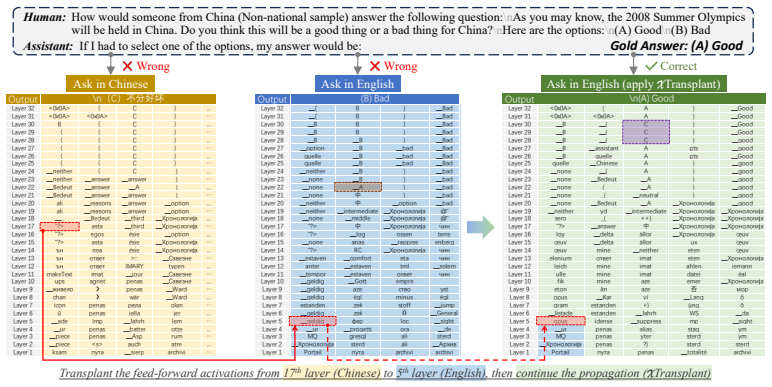
XTransplant is a probing framework that transplants latent activations across languages to harness complementary strengths of English and non-English resources. Empirical analysis shows this cross-lingual interaction has mutually beneficial effects on multilingual capability and cultural adaptability of LLMs, particularly for low-resource languages and cultures. Attention modules play a pivotal role in multilingual understanding, while feed-forward modules capture culture-specific knowledge. The work exposes considerable underutilization of current LLMs' multilingual potential.
What carries the argument
XTransplant framework that transplants latent activations across languages during inference.
If this is right
- XTransplant yields mutual improvements in multilingual capability for both high- and low-resource languages.
- XTransplant yields mutual improvements in cultural adaptability, especially for low-resource cultures.
- Attention modules support multilingual understanding.
- Feed-forward modules are more effective at capturing culture-specific knowledge.
- Current LLMs leave substantial internalized multilingual knowledge underutilized.
Where Pith is reading between the lines
- The same activation-transplant approach could be tested on tasks that cross other boundaries such as domain or modality.
- Stability results from the paper suggest XTransplant might be combined with existing alignment methods to reduce English-centric bias without full retraining.
- The exposed performance gap implies that inference-time interventions may be a cheaper route to multilingual gains than additional pre-training data collection.
Load-bearing premise
Observed performance changes result specifically from transplanting latent activations rather than from other uncontrolled factors in the experimental procedure.
What would settle it
A controlled run in which transplanting the same activations produces no performance change or produces degradation after matching all other experimental variables.
Figures



read the original abstract
Current large language models (LLMs) often exhibit imbalances in multilingual capabilities and cultural adaptability, largely attributed to their English-centric pre-training data. In this paper, we introduce and investigate cross-lingual latent transplantation (XTransplant), a probing framework which aims to further exploit the model's internalized multilingual knowledge during inference and examine its effects on the multilingual capability and cultural adaptability of LLMs. XTransplant framework enables models to harness the complementary strengths of both English and non-English resources by transplanting latent activations across languages. Through extensive analysis, we empirically demonstrate that XTransplant, a form of cross-lingual interaction, has mutually beneficial effects on the multilingual capability and cultural adaptability of LLMs, particularly for low-resource languages and cultures. We further reveal that attention modules play a pivotal role in supporting multilingual understanding, while feed-forward modules are more adept at capturing culture-specific knowledge. In addition, we conduct in-depth analysis of XTransplant's stability, effectiveness, and generalizability. By probing the upper bound performance of XTransplant, we expose the considerable underutilization of current LLMs' multilingual potential-a challenge that remains open. We hope our analysis offers a new lens for advancing cross-lingual interactions and better leveraging models' internalized multilingual knowledge.
Editorial analysis
A structured set of objections, weighed in public.
Referee Report
Summary. The manuscript introduces XTransplant, a probing framework that transplants latent activations across languages during inference in LLMs. It claims this cross-lingual interaction yields mutually beneficial effects on multilingual capability and cultural adaptability (especially for low-resource languages), identifies attention modules as key for multilingual understanding and FFN modules for culture-specific knowledge, analyzes stability/effectiveness/generalizability, and concludes that current LLMs underutilize their multilingual potential.
Significance. If the reported gains are causally due to transplantation and replicate under controls, the work would offer an inference-time method to exploit internalized multilingual knowledge without retraining, with the module-role findings and upper-bound analysis providing concrete directions for future cross-lingual interaction research.
major comments (1)
- [Experimental results and analysis] The central claim that XTransplant produces mutually beneficial effects requires isolating the contribution of cross-lingual activation transplantation from other factors (e.g., changes in activation statistics or inference dynamics). The experimental sections do not describe matched controls such as same-language transplantation, random activation swaps, or frozen-module baselines that would rule out these alternatives.
minor comments (1)
- [Introduction / Method] Notation for the transplanted activations and the precise definition of 'mutually beneficial' (e.g., symmetric improvement thresholds) should be formalized earlier to aid reproducibility.
Simulated Author's Rebuttal
We thank the referee for highlighting the importance of rigorous controls to support the central claims regarding XTransplant's effects. We address the major comment point-by-point below.
read point-by-point responses
-
Referee: [Experimental results and analysis] The central claim that XTransplant produces mutually beneficial effects requires isolating the contribution of cross-lingual activation transplantation from other factors (e.g., changes in activation statistics or inference dynamics). The experimental sections do not describe matched controls such as same-language transplantation, random activation swaps, or frozen-module baselines that would rule out these alternatives.
Authors: We agree that additional matched controls are needed to more convincingly isolate the contribution of cross-lingual transplantation. In the revised manuscript we will add (1) same-language transplantation baselines, (2) random activation swap controls, and (3) frozen-module ablations where feasible. These will be reported alongside the existing stability, effectiveness, and generalizability analyses to strengthen the causal interpretation of the mutual benefits. revision: yes
Circularity Check
No circularity; empirical claims rest on experimental measurements, not self-referential definitions or fitted inputs
full rationale
The paper introduces XTransplant as an empirical probing framework and reports observed performance changes on multilingual and cultural metrics. No equations, derivations, parameter-fitting steps, or self-citation chains appear in the abstract or described structure. Central claims are presented as outcomes of transplantation experiments rather than quantities defined in terms of the inputs themselves. No self-definitional, fitted-prediction, or ansatz-smuggling patterns are present. The work is self-contained against external benchmarks as an observational study.
Axiom & Free-Parameter Ledger
axioms (1)
- domain assumption LLMs internalize multilingual knowledge and cultural adaptability during pre-training that can be accessed and transferred via latent activations
Forward citations
Cited by 1 Pith paper
-
COMPASS: COntinual Multilingual PEFT with Adaptive Semantic Sampling
COMPASS uses semantic clustering on multilingual embeddings to select auxiliary data for PEFT adapters, outperforming linguistic-similarity baselines on multilingual benchmarks while supporting continual adaptation.
Reference graph
Works this paper leans on
-
[2]
M. Artetxe, S. Ruder, and D. Yogatama. On the cross-lingual transferability of monolingual representations. In D. Jurafsky, J. Chai, N. Schluter, and J. Tetreault, editors,Proceedings of the 58th Annual Meeting of the Association for Computational Linguistics, pages 4623–4637, Online, July 2020. Association for Computational Linguistics. doi: 10.18653/v1/...
-
[3]
URL https://aclanthology.org/2020.acl-main.421
work page 2020
-
[4]
S. Biderman, H. Schoelkopf, Q. G. Anthony, H. Bradley, K. O’Brien, E. Hallahan, M. A. Khan, S. Purohit, U. S. Prashanth, E. Raff, et al. Pythia: A suite for analyzing large language models across training and scaling. In International Conference on Machine Learning, pages 2397–2430. PMLR, 2023
work page 2023
- [5]
-
[6]
S. Cahyawijaya, H. Lovenia, T. Yu, W. Chung, and P. Fung. InstructAlign: High-and-low resource language alignment via continual crosslingual instruction tuning. In D. Wijaya, A. F. Aji, C. Vania, G. I. Winata, and A. Purwarianti, editors, Proceedings of the First Workshop in South East Asian Language Processing , pages 55–78, Nusa Dua, Bali, Indonesia, Nov
-
[7]
doi: 10.18653/v1/2023.sealp-1.5
Association for Computational Linguistics. doi: 10.18653/v1/2023.sealp-1.5. URL https://aclanthology.org/2023.sealp-1.5
-
[8]
P. Chen, S. Ji, N. Bogoychev, A. Kutuzov, B. Haddow, and K. Heafield. Monolingual or multilingual instruction tuning: Which makes a better alpaca. In Y . Graham and M. Purver, editors, Findings of the Association for Computational Linguistics: EACL 2024, pages 1347– 1356, St. Julian’s, Malta, Mar. 2024. Association for Computational Linguistics. URL https...
work page 2024
- [9]
-
[10]
A. Conneau and G. Lample. Cross-lingual language model pretraining. Advances in neural information processing systems, 32, 2019
work page 2019
-
[11]
A. Conneau, R. Rinott, G. Lample, A. Williams, S. R. Bowman, H. Schwenk, and V . Stoyanov. Xnli: Evaluating cross-lingual sentence representations. In Proceedings of the 2018 Confer- ence on Empirical Methods in Natural Language Processing. Association for Computational Linguistics, 2018
work page 2018
-
[12]
A. Conneau, K. Khandelwal, N. Goyal, V . Chaudhary, G. Wenzek, F. Guzmán, E. Grave, M. Ott, L. Zettlemoyer, and V . Stoyanov. Unsupervised cross-lingual representation learning at scale. In D. Jurafsky, J. Chai, N. Schluter, and J. Tetreault, editors,Proceedings of the 58th Annual Meeting of the Association for Computational Linguistics , pages 8440–8451,...
-
[13]
Unsupervised Cross-lingual Representation Learning at Scale , booktitle =
Association for Computational Linguistics. doi: 10.18653/v1/2020.acl-main.747. URL https://aclanthology.org/2020.acl-main.747
- [14]
-
[15]
BERT : Pre-training of Deep Bidirectional Transformers for Language Understanding
J. Devlin, M.-W. Chang, K. Lee, and K. Toutanova. BERT: Pre-training of deep bidirectional transformers for language understanding. In J. Burstein, C. Doran, and T. Solorio, editors, Proceedings of the 2019 Conference of the North American Chapter of the Association for Computational Linguistics: Human Language Technologies, Volume 1 (Long and Short Pa- p...
-
[16]
Q. Dong, L. Li, D. Dai, C. Zheng, Z. Wu, B. Chang, X. Sun, J. Xu, and Z. Sui. A survey for in-context learning. ArXiv preprint, abs/2301.00234, 2023. URL https://arxiv.org/abs/ 2301.00234
work page internal anchor Pith review Pith/arXiv arXiv 2023
-
[17]
Towards Measuring the Representation of Subjective Global Opinions in Language Models
E. Durmus, K. Nguyen, T. I. Liao, N. Schiefer, A. Askell, A. Bakhtin, C. Chen, Z. Hatfield- Dodds, D. Hernandez, N. Joseph, et al. Towards measuring the representation of subjective global opinions in language models. arXiv preprint arXiv:2306.16388, 2023
work page internal anchor Pith review Pith/arXiv arXiv 2023
- [18]
-
[19]
Chinese-mixtral-8x7b: An open-source mixture-of-experts llm
HIT-SCIR. Chinese-mixtral-8x7b: An open-source mixture-of-experts llm. https://github. com/HIT-SCIR/Chinese-Mixtral-8x7B , 2024
work page 2024
-
[20]
S. R. Indurthi, W. Zhou, S. Chollampatt, R. Agrawal, K. Song, L. Zhao, and C. Zhu. Improving multilingual instruction finetuning via linguistically natural and diverse datasets. In Y . Al- Onaizan, M. Bansal, and Y .-N. Chen, editors,Findings of the Association for Computational Linguistics: EMNLP 2024, pages 2306–2323, Miami, Florida, USA, Nov. 2024. Ass...
-
[22]
A. Q. Jiang, A. Sablayrolles, A. Mensch, C. Bamford, D. S. Chaplot, D. de las Casas, F. Bressand, G. Lengyel, G. Lample, L. Saulnier, L. R. Lavaud, M.-A. Lachaux, P. Stock, T. L. Scao, T. Lavril, T. Wang, T. Lacroix, and W. E. Sayed. Mistral 7b, 2023. URL https://arxiv.org/abs/ 2310.06825
work page internal anchor Pith review Pith/arXiv arXiv 2023
-
[23]
T. Kew, F. Schottmann, and R. Sennrich. Turning English-centric LLMs into polyglots: How much multilinguality is needed? In Y . Al-Onaizan, M. Bansal, and Y .-N. Chen, editors,Findings of the Association for Computational Linguistics: EMNLP 2024, pages 13097–13124, Miami, Florida, USA, Nov. 2024. Association for Computational Linguistics. doi: 10.18653/v1...
-
[24]
S. Khurana, N. Dawalatabad, A. Laurent, L. Vicente, P. Gimeno, V . Mingote, and J. Glass. Cross-lingual transfer learning for low-resource speech translation. In IEEE International Conference on Acoustics, Speech and Signal Processing (ICASSP), 2024
work page 2024
- [25]
- [26]
- [27]
- [28]
- [29]
- [30]
-
[31]
Y .-T. Lin and Y .-N. Chen. Taiwan llm: Bridging the linguistic divide with a culturally aligned language model. arXiv preprint arXiv:2311.17487, 2023
-
[32]
P. Liu, W. Yuan, J. Fu, Z. Jiang, H. Hayashi, and G. Neubig. Pre-train, prompt, and predict: A systematic survey of prompting methods in natural language processing. ACM Computing Surveys, 55(9):1–35, 2023
work page 2023
-
[33]
Crosslingual generalization through multitask finetuning
N. Muennighoff, T. Wang, L. Sutawika, A. Roberts, S. Biderman, T. L. Scao, M. S. Bari, S. Shen, Z.-X. Yong, H. Schoelkopf, et al. Crosslingual generalization through multitask finetuning. arXiv preprint arXiv:2211.01786, 2022
-
[34]
X.-P. Nguyen, W. Zhang, X. Li, M. Aljunied, Z. Hu, C. Shen, Y . K. Chia, X. Li, J. Wang, Q. Tan, L. Cheng, G. Chen, Y . Deng, S. Yang, C. Liu, H. Zhang, and L. Bing. SeaLLMs - large language models for Southeast Asia. In Y . Cao, Y . Feng, and D. Xiong, editors,Proceedings of the 62nd Annual Meeting of the Association for Computational Linguistics (Volume...
work page 2024
- [35]
- [36]
-
[37]
Yifan Li, Yifan Du, Kun Zhou, Jinpeng Wang, Xin Zhao, and Ji-Rong Wen
A. Ramezani and Y . Xu. Knowledge of cultural moral norms in large language models. In A. Rogers, J. Boyd-Graber, and N. Okazaki, editors, Proceedings of the 61st Annual Meeting of the Association for Computational Linguistics (Volume 1: Long Papers) , pages 428–446, Toronto, Canada, July 2023. Association for Computational Linguistics. doi: 10.18653/v1/2...
- [38]
-
[39]
A. S. Rao, A. Khandelwal, K. Tanmay, U. Agarwal, and M. Choudhury. Ethical reason- ing over moral alignment: A case and framework for in-context ethical policies in LLMs. In H. Bouamor, J. Pino, and K. Bali, editors, Findings of the Association for Compu- tational Linguistics: EMNLP 2023 , pages 13370–13388, Singapore, Dec. 2023. Associ- ation for Computa...
-
[40]
M. Reid and M. Artetxe. On the role of parallel data in cross-lingual transfer learning. arXiv preprint arXiv:2212.10173, 2022
-
[41]
T. L. Scao, A. Fan, C. Akiki, E. Pavlick, S. Ili ´c, D. Hesslow, R. Castagné, A. S. Luccioni, F. Yvon, M. Gallé, et al. Bloom: A 176b-parameter open-access multilingual language model. arXiv preprint arXiv:2211.05100, 2022
work page internal anchor Pith review Pith/arXiv arXiv 2022
- [42]
- [43]
-
[44]
S. Singh, F. Vargus, D. Dsouza, B. F. Karlsson, A. Mahendiran, W.-Y . Ko, H. Shandilya, J. Patel, D. Mataciunas, L. OMahony, M. Zhang, R. Hettiarachchi, J. Wilson, M. Machado, L. S. Moura, D. Krzemi´nski, H. Fadaei, I. Ergün, I. Okoh, A. Alaagib, O. Mudannayake, Z. Alyafeai, V . M. Chien, S. Ruder, S. Guthikonda, E. A. Alghamdi, S. Gehrmann, N. Muennighof...
work page 2024
- [45]
-
[46]
LLaMA: Open and Efficient Foundation Language Models
H. Touvron, T. Lavril, G. Izacard, X. Martinet, M.-A. Lachaux, T. Lacroix, B. Rozière, N. Goyal, E. Hambro, F. Azhar, et al. Llama: Open and efficient foundation language models. arXiv preprint arXiv:2302.13971, 2023
work page internal anchor Pith review Pith/arXiv arXiv 2023
-
[47]
W. Wang, W. Jiao, J. Huang, R. Dai, J.-t. Huang, Z. Tu, and M. Lyu. Not all countries celebrate thanksgiving: On the cultural dominance in large language models. In L.-W. Ku, A. Martins, and V . Srikumar, editors, Proceedings of the 62nd Annual Meeting of the Association for Computational Linguistics (Volume 1: Long Papers), pages 6349–6384, Bangkok, Thai...
work page 2024
-
[48]
Z. Wang, Z. C. Lipton, and Y . Tsvetkov. On negative interference in multilingual models: Findings and a meta-learning treatment. In B. Webber, T. Cohn, Y . He, and Y . Liu, editors, Proceedings of the 2020 Conference on Empirical Methods in Natural Language Processing (EMNLP), pages 4438–4450, Online, Nov. 2020. Association for Computational Linguis- tic...
-
[49]
J. Wei, Y . Tay, R. Bommasani, C. Raffel, B. Zoph, S. Borgeaud, D. Yogatama, M. Bosma, D. Zhou, D. Metzler, et al. Emergent abilities of large language models. ArXiv preprint, abs/2206.07682, 2022. URL https://arxiv.org/abs/2206.07682
work page internal anchor Pith review Pith/arXiv arXiv 2022
-
[50]
J. Wei, X. Wang, D. Schuurmans, M. Bosma, F. Xia, E. Chi, Q. V . Le, D. Zhou, et al. Chain-of- thought prompting elicits reasoning in large language models. Advances in Neural Information Processing Systems, 35:24824–24837, 2022
work page 2022
-
[51]
A. Yang, B. Yang, B. Hui, B. Zheng, B. Yu, C. Zhou, C. Li, C. Li, D. Liu, F. Huang, G. Dong, H. Wei, H. Lin, J. Tang, J. Wang, J. Yang, J. Tu, J. Zhang, J. Ma, J. Yang, J. Xu, J. Zhou, J. Bai, J. He, J. Lin, K. Dang, K. Lu, K. Chen, K. Yang, M. Li, M. Xue, N. Ni, P. Zhang, P. Wang, R. Peng, R. Men, R. Gao, R. Lin, S. Wang, S. Bai, S. Tan, T. Zhu, T. Li, T...
work page internal anchor Pith review Pith/arXiv arXiv 2024
- [52]
-
[53]
Y . Ye, X. Feng, X. Feng, W. Ma, L. Qin, D. Xu, Q. Yang, H. Liu, and B. Qin. GlobeSumm: A challenging benchmark towards unifying multi-lingual, cross-lingual and multi-document news summarization. In Y . Al-Onaizan, M. Bansal, and Y .-N. Chen, editors,Proceedings of the 2024 Conference on Empirical Methods in Natural Language Processing, pages 10803–10821...
work page 2024
-
[54]
OPT: Open Pre-trained Transformer Language Models
S. Zhang, S. Roller, N. Goyal, M. Artetxe, M. Chen, S. Chen, C. Dewan, M. Diab, X. Li, X. V . Lin, et al. Opt: Open pre-trained transformer language models.arXiv preprint arXiv:2205.01068, 2022
work page internal anchor Pith review Pith/arXiv arXiv 2022
-
[55]
W. X. Zhao, K. Zhou, J. Li, T. Tang, X. Wang, Y . Hou, Y . Min, B. Zhang, J. Zhang, Z. Dong, et al. A survey of large language models. ArXiv preprint, abs/2303.18223, 2023. URL https://arxiv.org/abs/2303.18223
work page internal anchor Pith review Pith/arXiv arXiv 2023
- [56]
-
[59]
URLhttps://aclanthology.org/2020.acl-main.421 .279 9 llama Datasets XNLI 30.1 33.2 30.5 XQuAD 33.5 31.3 31.9 Global OpinionQA 32.1 25.8 29.0 mistral Datasets XNLI 37.7 40.3 38.0 XQuAD 39.8 35.9 39.9 Global OpinionQA 68.3 66.4 66.5 qwen Datasets XNLI 55.2 55.2 54.4 XQuAD 47.3 44.2 45.5 Global OpinionQA 64.2 62.5 62.4 V anilla Self-Attention Feed-Forward Pe...
work page 2020
- [60]
-
[61]
M. Artetxe, S. Ruder, and D. Y ogatama. On the cross-lingual transferability of monolingual275 representations. In D. Jurafsky, J. Chai, N. Schluter, and J. Tetreault, editors, Proceedings of276 the 58th Annual Meeting of the Association for Computational Linguistics , pages 4623–4637,277 Online, July 2020. Association for Computational Linguistics. doi: ...
-
[62]
URL https://aclanthology.org/2020.acl-main.421 .279
work page 2020
-
[63]
S. Biderman, H. Schoelkopf, Q. G. Anthony, H. Bradley, K. O’Brien, E. Hallahan, M. A.280 Khan, S. Purohit, U. S. Prashanth, E. Raff, et al. Pythia: A suite for analyzing large language281 models across training and scaling. In International Conference on Machine Learning , pages282 2397–2430. PMLR, 2023.283
work page 2023
- [64]
-
[65]
S. Cahyawijaya, H. Lovenia, T. Y u, W. Chung, and P . Fung. InstructAlign: High-and-low287 resource language alignment via continual crosslingual instruction tuning. In D. Wijaya, A. F.288 10 1 2 3 4 5 6 7 8 9 10 11 12 13 14 15 16 17 18 19 20 21 22 23 24 25 26 27 28 29 30 31 32 10 0 10 20 30 Source Layer Accuracy Gains / Declines Average source layer resu...
discussion (0)
Sign in with ORCID, Apple, or X to comment. Anyone can read and Pith papers without signing in.