Quantum-gas microscopy and Talbot interferometry of the Bose-glass phase
Pith reviewed 2026-05-22 19:16 UTC · model grok-4.3
The pith
Quantum-gas microscopy and Talbot interferometry directly identify the Bose-glass phase through density fluctuations and reduced interference visibility.
A machine-rendered reading of the paper's core claim, the machinery that carries it, and where it could break.
Core claim
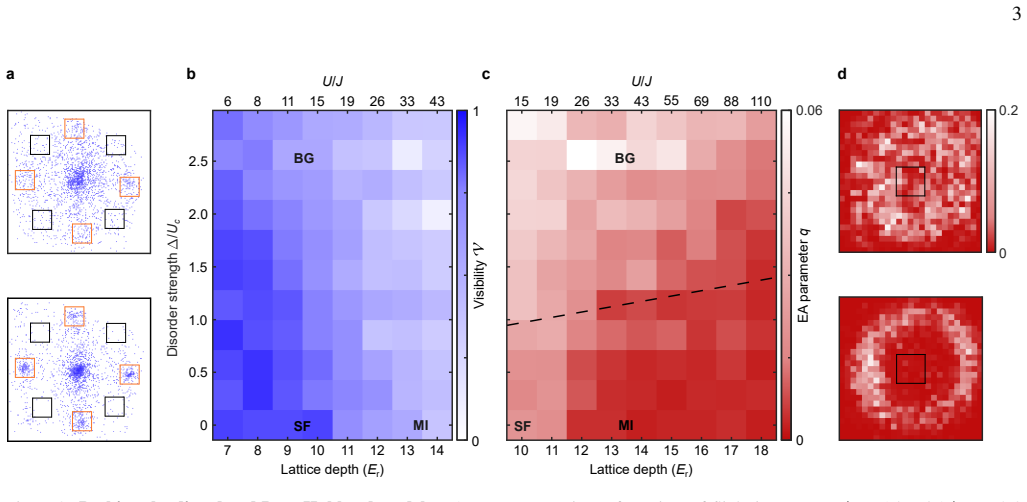
Using ultracold bosonic atoms in a two-dimensional lattice with site-resolved, reproducible disorder, the Bose-glass phase is identified through in-situ density distributions and particle-number fluctuations quantified via the Edwards-Anderson parameter, and through the visibility of interference patterns after time-of-flight, with signatures of non-ergodic dynamics observed when driving the system across the phase.
What carries the argument
Quantum-gas microscopy for single-atom-resolved in-situ detection combined with Talbot interferometry to assess coherence length via time-of-flight interference visibility.
If this is right
- The Edwards-Anderson parameter quantifies the particle-number fluctuations that mark the Bose-glass.
- Interference visibility after time-of-flight directly measures the reduced coherence length of the phase.
- Driving the system across the phase boundary produces observable non-ergodic dynamics.
- The methods open studies of disordered quantum systems both in and out of equilibrium.
Where Pith is reading between the lines
- The same imaging and interferometry approach could be extended to probe other disordered phases such as many-body localized states.
- Observations of non-ergodic behavior may help model the long-term stability of glass-like states in solid-state materials.
- Future experiments could test whether similar signatures appear when disorder strength or interaction parameters are varied continuously.
Load-bearing premise
The site-resolved reproducible disorder potential accurately realizes the theoretical Bose-glass phase of the disordered Bose-Hubbard model so measured fluctuations and visibility can be read as direct signatures.
What would settle it
If interference visibility stays high in the regime where the Edwards-Anderson parameter indicates the Bose-glass phase, or if ergodic dynamics continue when crossing the expected phase boundary, the identification of the phase would not hold.
Figures



read the original abstract
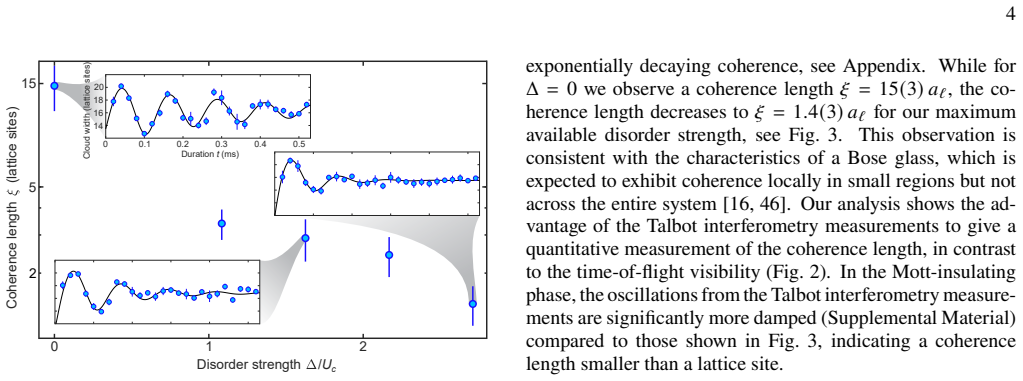
Disordered potentials fundamentally affect transport and coherence in quantum systems, giving rise to a Bose-glass phase in interacting bosonic systems -- an insulating yet compressible phase lacking long-range coherence. Directly measuring a reduced coherence length of the Bose glass has been an outstanding challenge. We address this by employing Talbot interferometry combined with single-atom-resolved detection in a quantum-gas microscope. Using ultracold bosonic atoms in a two-dimensional lattice with site-resolved, reproducible disorder, we identify the Bose-glass phase through in-situ density distributions and particle-number fluctuations, quantified via the Edwards-Anderson parameter, and through the visibility of interference patterns after time-of-flight. By driving the system across the Bose-glass phase, we further observe signatures of non-ergodic dynamics. Our studies provide a starting point to further explore disordered systems in and out of equilibrium, and are relevant for understanding the dynamics and stability of disordered and glass-like quantum states in solid-state systems.
Editorial analysis
A structured set of objections, weighed in public.
Referee Report
Summary. The manuscript reports an experimental realization of the Bose-glass phase in a two-dimensional optical lattice with ultracold bosonic atoms subject to site-resolved, reproducible disorder. Using quantum-gas microscopy, the authors measure in-situ density distributions and particle-number fluctuations, which they quantify via the Edwards-Anderson parameter. They combine this with Talbot interferometry to extract interference visibility after time-of-flight expansion, and they drive the system across the phase to observe signatures of non-ergodic dynamics. The central claim is that these multiple independent observables unambiguously identify the Bose-glass phase of the disordered Bose-Hubbard model.
Significance. If the phase identification holds, the work is significant because it provides direct, site-resolved access to both local fluctuations and reduced coherence length in the Bose-glass—an insulating yet compressible phase that has been difficult to characterize experimentally. The combination of single-atom microscopy with Talbot interferometry supplies new observables that complement conventional time-of-flight imaging, and the observation of non-ergodic dynamics adds an out-of-equilibrium dimension. These capabilities are relevant for exploring glass-like states in quantum many-body systems and for connections to solid-state disordered materials.
major comments (2)
- [Methods and Results sections describing parameter choice and phase identification] The manuscript does not contain an explicit mapping of the experimental lattice depth, interaction strength, filling, and disorder amplitude onto the phase diagram of the disordered Bose-Hubbard model. No comparison is made to critical disorder strengths obtained from quantum Monte Carlo or DMRG calculations at the relevant filling; without this, the observed density fluctuations and reduced Talbot visibility could correspond to a disordered superfluid, a finite-temperature crossover, or residual confinement effects rather than the Bose-glass lobe.
- [Section on in-situ measurements and Edwards-Anderson parameter] The Edwards-Anderson parameter is introduced to quantify particle-number fluctuations, but the text provides neither the precise operational definition used on the site-resolved data nor error bars or a direct comparison to theoretical thresholds expected for the Bose-glass phase. This weakens the claim that the fluctuations constitute an unambiguous signature independent of detection binning or imaging artifacts.
minor comments (2)
- [Abstract and Methods] The abstract states that the disorder is 'site-resolved' and 'reproducible,' yet the main text does not quantify the spatial correlation length of the disorder potential or its reproducibility across experimental runs; adding this information would strengthen the methods description.
- [Figures presenting Talbot interferometry data] Several figures showing interference patterns would benefit from explicit scale bars for the Talbot length and from a quantitative plot of visibility versus disorder strength with error bars.
Simulated Author's Rebuttal
We thank the referee for their careful reading of the manuscript and for the constructive comments. We appreciate the positive assessment of the work's significance. We address the two major comments point by point below. Where appropriate, we have revised the manuscript to provide the requested mappings, definitions, and comparisons.
read point-by-point responses
-
Referee: [Methods and Results sections describing parameter choice and phase identification] The manuscript does not contain an explicit mapping of the experimental lattice depth, interaction strength, filling, and disorder amplitude onto the phase diagram of the disordered Bose-Hubbard model. No comparison is made to critical disorder strengths obtained from quantum Monte Carlo or DMRG calculations at the relevant filling; without this, the observed density fluctuations and reduced Talbot visibility could correspond to a disordered superfluid, a finite-temperature crossover, or residual confinement effects rather than the Bose-glass lobe.
Authors: We agree that an explicit mapping to the phase diagram of the disordered Bose-Hubbard model strengthens the identification. In the revised manuscript we have added a dedicated paragraph in the Methods section that lists the experimental parameters (lattice depth V_0 = 8 E_r corresponding to J/h ≈ 2.3 Hz, interaction U/h ≈ 110 Hz, mean filling n ≈ 0.95, disorder strength Δ/h = 18 Hz) and places them on the phase diagram using existing quantum Monte Carlo results for the disordered Bose-Hubbard model at near-unit filling. These literature values indicate that the Bose-glass lobe is entered for Δ/J ≳ 6–8 at the relevant U/J. We further discuss experimental controls (box-trap homogeneity and temperature T < 0.1 J/k_B) that suppress finite-temperature crossovers and residual confinement effects, thereby supporting that the observed signatures arise from the Bose-glass rather than a disordered superfluid. revision: yes
-
Referee: [Section on in-situ measurements and Edwards-Anderson parameter] The Edwards-Anderson parameter is introduced to quantify particle-number fluctuations, but the text provides neither the precise operational definition used on the site-resolved data nor error bars or a direct comparison to theoretical thresholds expected for the Bose-glass phase. This weakens the claim that the fluctuations constitute an unambiguous signature independent of detection binning or imaging artifacts.
Authors: We thank the referee for noting this gap. The revised manuscript now states the operational definition explicitly: EA = (1/M) ∑_k=1^M (1/N_sites) ∑_i (n_i^{(k)} − n̄_i)^2, where the outer average runs over M independent disorder realizations and n̄_i is the disorder-averaged site density. We include error bars obtained from the standard error across the ensemble of realizations. In addition, we compare the measured EA values (≈ 0.22) to theoretical expectations from DMRG and QMC studies at comparable parameters, where EA remains finite (∼0.1–0.3) inside the Bose-glass lobe and vanishes in the superfluid. Robustness against binning and imaging artifacts is demonstrated by repeating the analysis for several bin sizes and by quoting the detection efficiency calibration. revision: yes
Circularity Check
No circularity: experimental signatures compared to external theory
full rationale
The paper reports direct experimental measurements of in-situ density distributions, particle-number fluctuations quantified by the Edwards-Anderson parameter, and Talbot interference visibility after time-of-flight in a quantum-gas microscope with engineered site-resolved disorder. These observables are interpreted as Bose-glass signatures by comparison against independent theoretical expectations for the disordered Bose-Hubbard model. No equations, fitted parameters, or self-citations reduce any claimed identification or non-ergodic dynamics to inputs by construction; the central claims rest on external benchmarks and reproducible disorder realization rather than self-referential definitions or renamings.
Axiom & Free-Parameter Ledger
axioms (1)
- domain assumption Standard assumptions of the disordered Bose-Hubbard model and ultracold-atom physics apply to the experimental system.
Forward citations
Cited by 3 Pith papers
-
Scale invariance of the polaron energy at the Mott-superfluid critical point
Polaron energy is scale-invariant at the Mott-superfluid quantum critical point, yielding an unexplained scaling exponent from finite-size scaling.
-
Scale invariance of the polaron energy at the Mott-superfluid critical point
Ground-state quantum Monte Carlo calculations demonstrate scale invariance of the polaron energy at the Mott-superfluid critical point in a lattice Bose gas and extract an unexplained scaling exponent.
-
Unsupervised Learning of Quantum Phase Transitions for Bose-Hubbard lattice systems
Diffusion maps identify quantum phase transitions in Bose-Hubbard systems, including symmetry-protected topological phases and ergodic vs. many-body localized regimes, without prior order parameters or handcrafted obs...
Reference graph
Works this paper leans on
-
[1]
Bose-Hubbard model with disorder The disordered Bose-Hubbard model is described by the Hamiltonian ˆ𝐻=−𝐽 ∑︁ ⟨𝑖, 𝑗⟩ ˆ𝑎† 𝑖 ˆ𝑎𝑗 + ∑︁ 𝑖 𝑈 2 ˆ𝑛𝑖 (ˆ𝑛𝑖 −1) + ∑︁ 𝑖 (𝜖𝑖 −𝜇)ˆ𝑛𝑖 + ∑︁ 𝑖 Δ𝑖 ˆ𝑛𝑖 , (1) where𝐽is the tunneling strength between neighboring lattice sites, ˆ𝑎† 𝑖 and ˆ𝑎𝑗 are the bosonic creation and annihilation oper- ators on neighboring sites𝑖and𝑗, respecti...
work page internal anchor Pith review Pith/arXiv arXiv 2026
-
[2]
Experimental details In our experiments [37], a cloud of ultracold 87Rb atoms is held in a single antinode of a vertical optical lattice (wavelength 𝜆=1064 nm and depth𝑉 𝑧 =25𝐸 r, where𝐸 r = ℏ 2/2𝑚𝜆2 is the recoil energy and𝑚is the mass of a 87Rb atom). After evaporative cooling, a superfluid of∼200 atoms is prepared in shallow horizontal lattices (𝑉 𝑥 =𝑉...
-
[3]
Time-of-flight visibility In the weakly interacting regime, the presence of disorder should result in a reduced coherence, which we initially mea- sure via the visibility after time-of-flight [41]. This allows us to map out the parameter space for different disorder strengths and lattice depths, within a reasonable experimental runtime. We later complemen...
-
[4]
Edwards-Anderson parameter The visibility is not a reliable observable for distinguishing the Mott insulator from the Bose glass, as both lack long-range phase coherence (rightmost columns of Fig. 2b). Therefore, we employ the Edwards-Anderson parameter,𝑞 𝑖, which uses the atom distribution of the in-situ images [35, 36], 𝑞𝑖 = ⟨ˆ𝑛𝑖⟩2 − ⟨ˆ𝑛𝑖⟩ 2 .(2) 3 BG V...
-
[5]
Talbot interferometry A distinct feature of the Bose glass is the absence of long- range phase coherence, while maintaining short-range coher- ence over a small number of sites. To measure the coherence length, we employ an interferometry technique based on the Talbot effect, following an earlier experimental demonstration [45]. It involves briefly switch...
-
[6]
Ergodicity, adiabaticity, and coherence In a finite-size system, a phase transition can be crossed without significant heating if both phases are ergodic. Signa- tures of non-ergodicity in the Bose-glass-to-superfluid transi- tion were recently observed using a quasicrystalline potential [32]. Here, we explore in a square lattice how the Mott- insulator-t...
-
[7]
Conclusion In summary, we identified the Bose-glass phase experi- mentally in both weakly and strongly interacting regimes in a two-dimensional square lattice with controllable and re- producible disorder potentials. Using Talbot interferometry across the superfluid-to-Bose-glass transition, we observed a change from long to short-range coherence. Additio...
work page 2020
-
[8]
L. Krusin-Elbaum, L. Civale, G. Blatter, A. Marwick, F. Holtzberg, and C. Feild, Bose-glass melting in YBaCuO crys- tals with correlated disorder, Phys. Rev. Lett.72, 1914 (1994)
work page 1914
-
[9]
L. Berthier and G. Biroli, Theoretical perspective on the glass transition and amorphous materials, Rev. Mod. Phys.83, 587 (2011)
work page 2011
- [10]
-
[11]
L. Sanchez-Palencia and M. Lewenstein, Disordered quantum gases under control, Nat. Phys.6, 87 (2010)
work page 2010
-
[12]
Shapiro, Cold atoms in the presence of disorder, J
B. Shapiro, Cold atoms in the presence of disorder, J. Phys. A: Math. Theor.45, 143001 (2012)
work page 2012
-
[13]
Pollet, A review of Monte Carlo simulations for the Bose– Hubbard model with diagonal disorder, C.R
L. Pollet, A review of Monte Carlo simulations for the Bose– Hubbard model with diagonal disorder, C.R. Phys.14, 712 (2013)
work page 2013
-
[14]
D. A. Abanin, E. Altman, I. Bloch, and M. Serbyn, Colloquium: Many-body localization, thermalization, and entanglement, Rev. Mod. Phys.91, 021001 (2019)
work page 2019
-
[15]
P. W. Anderson, Absence of diffusion in certain random lattices, Phys. Rev.109, 1492 (1958)
work page 1958
-
[16]
T. Schwartz, G. Bartal, S. Fishman, and M. Segev, Transport and Anderson localization in disordered two-dimensional photonic lattices, Nature446, 52 (2007)
work page 2007
- [17]
- [18]
-
[19]
M. Pasienski, D. McKay, M. White, and B. DeMarco, A disor- dered insulator in an optical lattice, Nat. Phys.6, 677 (2010)
work page 2010
-
[20]
S. S. Kondov, W. R. McGehee, J. J. Zirbel, and B. DeMarco, Three-dimensional Anderson localization of ultracold matter, Science334, 66 (2011)
work page 2011
-
[21]
F. Jendrzejewski, A. Bernard, K. Mueller, P. Cheinet, V. Josse, M. Piraud, L. Pezz ´e, L. Sanchez-Palencia, A. Aspect, and P. Bouyer, Three-dimensional localization of ultracold atoms in an optical disordered potential, Nat. Phys.8, 398 (2012)
work page 2012
-
[22]
D. H. White, T. A. Haase, D. J. Brown, M. D. Hoogerland, M. S. Najafabadi, J. L. Helm, C. Gies, D. Schumayer, and D. A. Hutchinson, Observation of two-dimensional Anderson locali- sation of ultracold atoms, Nat. Commun.11, 4942 (2020)
work page 2020
-
[23]
M. P. A. Fisher, P. B. Weichman, G. Grinstein, and D. S. Fisher, Boson localization and the superfluid-insulator transition, Phys. Rev. B40, 546 (1989)
work page 1989
- [24]
-
[25]
L. Fallani, J. E. Lye, V. Guarrera, C. Fort, and M. Inguscio, Ultracold atoms in a disordered crystal of light: Towards a Bose glass, Phys. Rev. Lett.98, 130404 (2007)
work page 2007
-
[26]
I. Aleiner, B. Altshuler, and G. Shlyapnikov, A finite- temperature phase transition for disordered weakly interacting bosons in one dimension, Nat. Phys.6, 900 (2010)
work page 2010
-
[27]
K. Binder and A. P. Young, Spin glasses: Experimental facts, theoretical concepts, and open questions, Rev. Mod. Phys.58, 801 (1986)
work page 1986
-
[28]
F. Lin, E. S. Sørensen, and D. Ceperley, Superfluid-insulator transition in the disordered two-dimensional Bose-Hubbard model, Phys. Rev. B.84, 094507 (2011)
work page 2011
-
[29]
S ¸. G. S¨oyler, M. Kiselev, N. V. Prokof’ev, and B. V. Svis- tunov, Phase diagram of the commensurate two-dimensional disordered Bose-Hubbard model, Phys. Rev. Lett.107, 185301 (2011)
work page 2011
-
[30]
P. B. Weichman, Dirty bosons: twenty years later, Mod. Phys. Lett. B22, 2623 (2008)
work page 2008
- [31]
-
[32]
G. Bertoli, V. P. Michal, B. L. Altshuler, and G. V. Shlyapnikov, Finite-temperature disordered bosons in two dimensions, Phys. Rev. Lett.121, 030403 (2018)
work page 2018
-
[33]
Z. Zhu, H. Yao, and L. Sanchez-Palencia, Thermodynamic phase diagram of two-dimensional bosons in a quasicrystal potential, Phys. Rev. Lett.130, 220402 (2023)
work page 2023
-
[34]
C. Meldgin, U. Ray, P. Russ, D. Chen, D. Ceperley, and B. De- Marco, Probing the Bose glass–superfluid transition using quan- tum quenches of disorder, Nat. Phys.12, 646 (2016)
work page 2016
- [35]
-
[36]
M. Schreiber, S. S. Hodgman, P. Bordia, H. P. L¨ uschen, M. H. Fischer, R. Vosk, E. Altman, U. Schneider, and I. Bloch, Ob- servation of many-body localization of interacting fermions in a quasirandom optical lattice, Science349, 842 (2015)
work page 2015
-
[37]
J. Choi, S. Hild, J. Zeiher, P. Schauß, A. Rubio-Abadal, T. Yef- sah, V. Khemani, D. A. Huse, I. Bloch, and C. Gross, Exploring the many-body localization transition in two dimensions, Sci- ence352, 1547 (2016)
work page 2016
-
[38]
M. Rispoli, A. Lukin, R. Schittko, S. Kim, M. E. Tai, J. L´eonard, and M. Greiner, Quantum critical behaviour at the many-body localization transition, Nature573, 385 (2019)
work page 2019
-
[39]
J.-C. Yu, S. Bhave, L. Reeve, B. Song, and U. Schneider, Observ- ing the two-dimensional Bose glass in an optical quasicrystal, Nature633, 338 (2024)
work page 2024
-
[40]
S. F. Edwards and P. W. Anderson, Theory of spin glasses, J. Phys. F5, 965 (1975)
work page 1975
-
[41]
S. Morrison, A. Kantian, A. J. Daley, H. G. Katzgraber, M. Lewenstein, H. P. B¨ uchler, and P. Zoller, Physical repli- cas and the Bose glass in cold atomic gases, New J. Phys.10, 073032 (2008)
work page 2008
-
[42]
S. J. Thomson, L. S. Walker, T. L. Harte, and G. D. Bruce, Measuring the Edwards-Anderson order parameter of the Bose glass: A quantum gas microscope approach, Phys. Rev. A94, 051601 (2016)
work page 2016
-
[43]
A. R. Abadal,Probing quantum thermalization and localization in Bose-Hubbard systems, Ph.D. thesis, Ludwig-Maximilians- Universit¨at M¨ unchen (2020)
work page 2020
-
[44]
A. Di Carli, C. Parsonage, A. La Rooij, L. Koehn, C. Ulm, C. W. Duncan, A. J. Daley, E. Haller, and S. Kuhr, Commensu- rate and incommensurate 1D interacting quantum systems, Nat. Commun.15, 474 (2024)
work page 2024
-
[45]
J. F. Sherson, C. Weitenberg, M. Endres, M. Cheneau, I. Bloch, and S. Kuhr, Single-atom-resolved fluorescence imaging of an atomic Mott insulator, Nature467, 68 (2010)
work page 2010
- [46]
-
[47]
M. Sbroscia, K. Viebahn, E. Carter, J.-C. Yu, A. Gaunt, and U. Schneider, Observing localization in a 2d quasicrystalline optical lattice, Phys. Rev. Lett.125, 200604 (2020)
work page 2020
-
[48]
W. S. Bakr, A. Peng, M. E. Tai, R. Ma, J. Simon, J. I. Gillen, S. F ¨olling, L. Pollet, and M. Greiner, Probing the Su- perfluid–to–Mott Insulator transition at the single-atom level, Science329, 547 (2010)
work page 2010
-
[49]
F. Gerbier, A. Widera, S. F ¨olling, O. Mandel, T. Gericke, and I. Bloch, Phase coherence of an atomic Mott insulator, Phys. Rev. Lett.95, 050404 (2005)
work page 2005
-
[50]
B. Capogrosso-Sansone, S ¸. G. S¨oyler, N. Prokof’ev, and B. Svis- tunov, Monte Carlo study of the two-dimensional Bose-Hubbard model, Phys. Rev. A77, 015602 (2008)
work page 2008
-
[51]
S. Pal, R. Bai, S. Bandyopadhyay, K. Suthar, and D. Angom, Enhancement of the Bose glass phase in the presence of an artificial gauge field, Phys. Rev. A99, 053610 (2019)
work page 2019
- [52]
-
[53]
V. Gurarie, L. Pollet, N. V. Prokof’ev, B. V. Svistunov, and M. Troyer, Phase diagram of the disordered Bose-Hubbard model, Phys. Rev. B80, 214519 (2009)
work page 2009
-
[54]
H. J. Manetsch, G. Nomura, E. Bataille, K. H. Leung, X. Lv, and M. Endres, A tweezer array with 6100 highly coherent atomic qubits, Arxiv 10.48550/arXiv.2403.12021 (2024)
work page internal anchor Pith review doi:10.48550/arxiv.2403.12021 2024
-
[55]
G. Malpuech, D. Solnyshkov, H. Ouerdane, M. Glazov, and I. Shelykh, Bose glass and superfluid phases of cavity polaritons, Phys. Rev. Lett.98, 206402 (2007)
work page 2007
-
[56]
R. Yu, L. Yin, N. S. Sullivan, J. Xia, C. Huan, A. Paduan-Filho, N. F. Oliveira Jr, S. Haas, A. Steppke, C. F. Miclea,et al., Bose glass and Mott glass of quasiparticles in a doped quantum magnet, Nature489, 379 (2012)
work page 2012
-
[57]
W. O. Tromp, T. Benschop, J.-F. Ge, I. Battisti, K. M. Bastiaans, D. Chatzopoulos, A. H. Vervloet, S. Smit, E. van Heumen, M. S. Golden,et al., Puddle formation and persistent gaps across the non-mean-field breakdown of superconductivity in overdoped (Pb, Bi)2Sr2CuO6+𝛿 , Nat. Mat.22, 703 (2023)
work page 2023
-
[58]
L. A. Gonz ´alez-Garc´ıa, S. F. Caballero-Ben´ıtez, and R. Paredes, Localisation of weakly interacting bosons in two dimensions: disorder vs lattice geometry effects, Sci. Rep.9, 11049 (2019)
work page 2019
-
[59]
X. Mao, J. Liu, J. Zhong, and R. A. R ¨omer, Disorder effects in the two-dimensional Lieb lattice and its extensions, Physica E 124, 114340 (2020)
work page 2020
-
[60]
J. Carrasquilla, F. Becca, A. Trombettoni, and M. Fabrizio, Characterization of the Bose-glass phase in low-dimensional lattices, Phys. Rev. B81, 195129 (2010)
work page 2010
-
[61]
Z. Ristivojevic, A. Petkovi ´c, P. Le Doussal, and T. Giamarchi, Superfluid/Bose-glass transition in one dimension, Phys. Rev. B 90, 125144 (2014)
work page 2014
-
[62]
J. L ´eonard, S. Kim, M. Rispoli, A. Lukin, R. Schittko, J. Kwan, E. Demler, D. Sels, and M. Greiner, Probing the onset of quan- tum avalanches in a many-body localized system, Nat. Phys.19, 481 (2023)
work page 2023
-
[63]
M. A. Tusch and D. E. Logan, Interplay between disorder and electron interactions in a𝑑=3 site-disordered Anderson- Hubbard model: A numerical mean-field study, Phys. Rev. B 48, 14843 (1993)
work page 1993
-
[64]
A. Sanpera, A. Kantian, L. Sanchez-Palencia, J. Zakrzewski, and M. Lewenstein, Atomic fermi-bose mixtures in inhomogeneous and random lattices: From Fermi Glass to Quantum Spin Glass and Quantum Percolation, Phys. Rev. Lett.93, 040401 (2004)
work page 2004
-
[65]
V. Ahufinger, L. Sanchez-Palencia, A. Kantian, A. Sanpera, and M. Lewenstein, Disordered ultracold atomic gases in optical lattices: A case study of Fermi-Bose mixtures, Phys. Rev. A72, 063616 (2005)
work page 2005
-
[66]
B. Paredes, C. Tejedor, and J. I. Cirac, Fermionic atoms in optical superlattices, Phys. Rev. A71, 063608 (2005)
work page 2005
-
[67]
A. Szab ´o and U. Schneider, Mixed spectra and partially extended states in a two-dimensional quasiperiodic model, Phys. Rev. B 101, 014205 (2020)
work page 2020
-
[68]
C. W. Duncan, Critical states and anomalous mobility edges in two-dimensional diagonal quasicrystals, Phys. Rev. B109, 014210 (2024)
work page 2024
-
[69]
Ticeaet al., Observation of disorder-induced superfluidity, arXiv:2512.21416 (2025)
N. Ticeaet al., Observation of disorder-induced superfluidity, arXiv:2512.21416 (2025)
-
[70]
The data used in this publication is openly avail- able at https://doi.org/10.15129/af5cd941-2496-4a50-a10e- 14df02036546
-
[71]
A. La Rooij, C. Ulm, E. Haller, and S. Kuhr, A comparative study of deconvolution techniques for quantum-gas microscope images, New J. Phys.25, 083036 (2023)
work page 2023
-
[72]
F. Alet, P. Dayal, A. Grzesik, A. Honecker, M. K ¨orner, A. L ¨auchli, S. R. Manmana, I. P. McCulloch, F. Michel, R. M. Noack,et al., The ALPS project: Open source software for strongly correlated systems, J. Phys. Soc. Jpn.74, 30 (2005)
work page 2005
-
[73]
A. F. Albuquerque, F. Alet, P. Corboz, P. Dayal, A. Feiguin, S. Fuchs, L. Gamper, E. Gull, S. G¨ urtler, A. Honecker,et al., The ALPS project release 1.3: Open-source software for strongly correlated systems, J. Magn. Magn. Mater.310, 1187 (2007)
work page 2007
- [74]
-
[75]
A. W. Sandvik, Stochastic series expansion method with operator-loop update, Phys. Rev. B59, R14157 (1999)
work page 1999
- [76]
-
[77]
F. Alet, S. Wessel, and M. Troyer, Generalized directed loop method for quantum Monte Carlo simulations, Phys. Rev. E71, 036706 (2005). 10 SUPPLEMENTAL MATERIALS
work page 2005
-
[78]
Calibration of disorder potential strength The disorder potential strength is calibrated by projecting a uniform square light potential onto a Mott insulator with unit occupation. We project this potential during the evaporation to a BEC and form the Mott insulator by increasing the horizontal lattices to𝑉 𝑥, 𝑦 =14𝐸 r. We increase the power of the light p...
-
[79]
2, we simulate the thermal state of the disordered Bose-Hubbard model (Eq
Quantum Monte-Carlo simulations To model the visibility measurements shown in Fig. 2, we simulate the thermal state of the disordered Bose-Hubbard model (Eq. 1) without harmonic confinement (𝜖 𝑖 =0) in the grand canonical ensemble at𝑇=0.1𝑈/𝑘 𝐵, using quantum Monte Carlo routines provided by the ALPS library [65–67]. We utilize the directed loop algorithm ...
-
[80]
S3, we show vertical cuts across the diagram pre- sented in Fig
Additional data: Edwards-Anderson parameter In Fig. S3, we show vertical cuts across the diagram pre- sented in Fig. 2c, including error bars. All of the measurements of the Edwards-Anderson parameter,𝑞 𝑖, presented in this pa- per use four different disorder patterns. To justify this choice, we measured𝑞 𝑖 for different numbers of disorder patterns. We f...
discussion (0)
Sign in with ORCID, Apple, or X to comment. Anyone can read and Pith papers without signing in.