Localized Fock Space Cages in Kinetically Constrained Models
Pith reviewed 2026-05-22 17:54 UTC · model grok-4.3
The pith
Destructive interference produces localized many-body eigenstates called Fock space cages in kinetically constrained quantum models.
A machine-rendered reading of the paper's core claim, the machinery that carries it, and where it could break.
Core claim
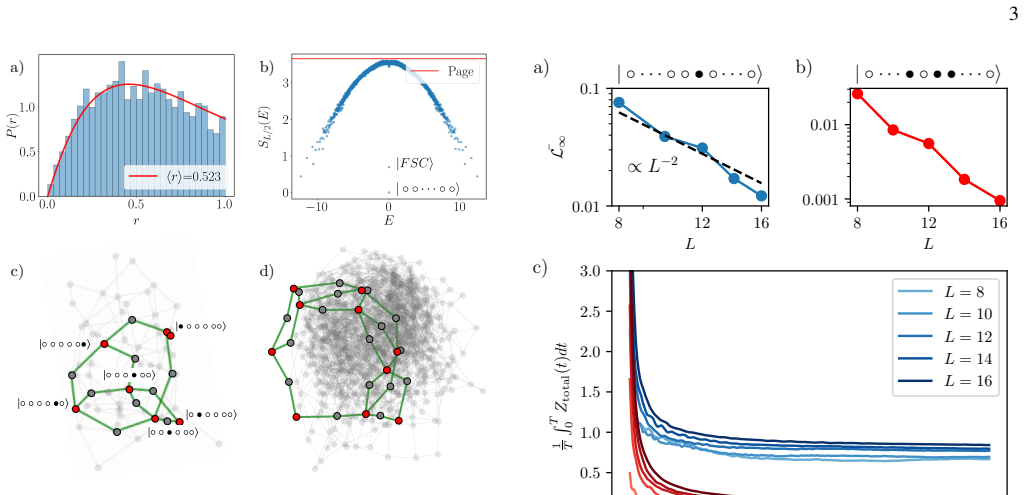
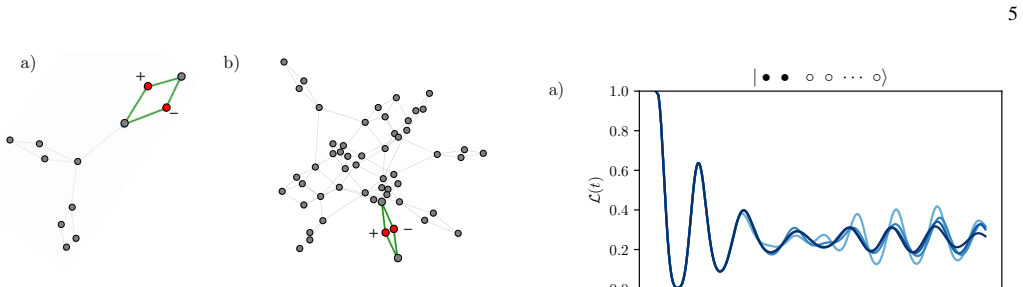
Drawing parallels with single-particle flat-band localization and Aharonov-Bohm cages, the authors identify conditions under which similar interference effects in the many-body domain produce Fock space cages (FSCs)-highly localized many-body eigenstates. By interpreting Fock space as a graph where nodes represent bitstring basis states and edges denote non-zero transition amplitudes of the Hamiltonian, they analyze different kinetically constrained models. The FSCs cause non-ergodic dynamics when the system is initialized within their support, highlighting a universal interference-driven localization mechanism in many-body systems.
What carries the argument
Fock space cages, highly localized eigenstates that emerge when destructive interference cancels all outgoing amplitudes on the graph whose nodes are bitstring states and whose edges are the Hamiltonian's non-zero matrix elements.
If this is right
- Initialization inside an FSC support produces dynamics that never reach the full Hilbert space.
- The same cage structures appear across multiple kinetically constrained Hamiltonians once the transition graph satisfies the cancellation condition.
- Non-ergodicity arises from geometry and interference alone, independent of conventional many-body localization ingredients.
Where Pith is reading between the lines
- Small-system exact diagonalization could map the precise loop conditions that generate cages and predict their size.
- Quantum simulators with tunable constraints might be used to engineer protected subspaces for information storage.
- The graph perspective could be applied to other constrained models to search for additional interference-based localized phases.
Load-bearing premise
The graph of allowed transitions in Fock space contains closed loops whose phases produce perfect cancellation, leaving eigenstates confined to a small subset of bitstrings.
What would settle it
Prepare the system in one of the bitstring states that belongs to a candidate cage and measure the long-time occupation of distant bitstrings; persistent confinement to the original small cluster would support the claim while rapid spreading would falsify it.
Figures




read the original abstract
We investigate a mechanism for non-ergodic behavior in many-body quantum systems arising from destructive interference, leading to localization in Fock space. Drawing parallels with single-particle flat-band localization and Aharonov-Bohm cages, we identify conditions under which similar interference effects in the many-body domain produce Fock space cages (FSCs)-highly localized many-body eigenstates. By interpreting Fock space as a graph where nodes represent bitstring basis states and edges denote non-zero transition amplitudes of the Hamiltonian, we analyze different kinetically constrained models. The FSCs cause non-ergodic dynamics when the system is initialized within their support, highlighting a universal interference-driven localization mechanism in many-body systems.
Editorial analysis
A structured set of objections, weighed in public.
Referee Report
Summary. The paper claims that destructive interference in the many-body Hamiltonian of kinetically constrained models produces highly localized many-body eigenstates, termed Fock space cages (FSCs), when Fock space is modeled as a graph of bitstring states connected by non-zero transition amplitudes. These FSCs are presented as analogs of single-particle Aharonov-Bohm cages and are argued to cause non-ergodic dynamics upon initialization within their support, offering a universal interference-driven mechanism for non-ergodicity.
Significance. If rigorously demonstrated with explicit Hamiltonians and verifiable cancellation conditions, the work would identify a disorder-free, interference-based route to many-body non-ergodicity that extends flat-band localization concepts to constrained quantum systems. The graph-theoretic framing of Fock space could provide a useful conceptual tool for analyzing localization in other kinetically constrained models.
major comments (2)
- [Abstract and parallels with flat-band localization] Abstract, paragraph on parallels with flat-band localization: the central claim that destructive interference produces highly localized FSCs requires that transition amplitudes satisfy closed-loop destructive interference for all paths with no leakage via virtual processes, yet the manuscript does not state the explicit symmetry or constraint on the couplings in the kinetically constrained Hamiltonians that would enforce exact cancellation. This condition is load-bearing for establishing that localization is exact rather than approximate and for validating the analogy.
- [Analysis of kinetically constrained models] Section analyzing different kinetically constrained models: without explicit derivations or numerical evidence showing the required phase/amplitude relations for the bitstring graph edges, it remains unclear whether the asserted FSCs are exact eigenstates or fragile to perturbations, undermining support for the non-ergodic dynamics claim.
minor comments (1)
- The notation for nodes and edges in the Fock space graph would benefit from an explicit small-scale example with labeled bitstrings and amplitudes in the main text for clarity.
Simulated Author's Rebuttal
We thank the referee for their careful reading of our manuscript and for the constructive comments, which have helped us improve the clarity and rigor of our presentation. We address each major comment point by point below.
read point-by-point responses
-
Referee: [Abstract and parallels with flat-band localization] Abstract, paragraph on parallels with flat-band localization: the central claim that destructive interference produces highly localized FSCs requires that transition amplitudes satisfy closed-loop destructive interference for all paths with no leakage via virtual processes, yet the manuscript does not state the explicit symmetry or constraint on the couplings in the kinetically constrained Hamiltonians that would enforce exact cancellation. This condition is load-bearing for establishing that localization is exact rather than approximate and for validating the analogy.
Authors: We agree that the manuscript would benefit from a more explicit statement of the symmetry and constraint conditions on the couplings. In the revised manuscript we have added a new paragraph immediately following the abstract's discussion of flat-band parallels that specifies the required phase relations (arising from the kinetic constraints) and the symmetry of the bitstring-graph edges that together guarantee exact closed-loop cancellation with no virtual leakage. This addition makes the load-bearing condition for exact localization explicit and strengthens the analogy. revision: yes
-
Referee: [Analysis of kinetically constrained models] Section analyzing different kinetically constrained models: without explicit derivations or numerical evidence showing the required phase/amplitude relations for the bitstring graph edges, it remains unclear whether the asserted FSCs are exact eigenstates or fragile to perturbations, undermining support for the non-ergodic dynamics claim.
Authors: We acknowledge the need for explicit derivations and supporting evidence. The revised manuscript now includes, in the section on kinetically constrained models, step-by-step derivations of the phase and amplitude relations for the relevant bitstring-graph edges in each model considered. We have also added numerical diagonalization results for small system sizes that confirm the FSCs remain exact eigenstates (within numerical precision) under the stated constraints and exhibit the expected non-ergodic dynamics when the system is initialized inside their support. These additions directly address the concern about fragility to perturbations. revision: yes
Circularity Check
No significant circularity; derivation relies on graph modeling and external analogy to single-particle localization.
full rationale
The paper models Fock space as a graph of bitstring states with Hamiltonian transitions as edges, then analyzes specific kinetically constrained models to identify conditions for destructive interference producing localized eigenstates (FSCs). This is presented as an extension of known single-particle Aharonov-Bohm cages and flat-band localization rather than a self-referential definition or fitted parameter renamed as prediction. No load-bearing self-citation, uniqueness theorem from authors, or ansatz smuggling is quoted or required for the central claim. The derivation remains self-contained against external benchmarks of interference-driven localization.
Axiom & Free-Parameter Ledger
axioms (2)
- domain assumption Fock space can be represented as a graph whose nodes are bitstring basis states and whose edges correspond to non-zero Hamiltonian transition amplitudes.
- domain assumption Destructive interference in the many-body setting produces highly localized eigenstates analogous to single-particle flat-band or Aharonov-Bohm cages.
invented entities (1)
-
Fock space cages (FSCs)
no independent evidence
Lean theorems connected to this paper
-
IndisputableMonolith/Foundation/RealityFromDistinction.leanreality_from_one_distinction unclear?
unclearRelation between the paper passage and the cited Recognition theorem.
By interpreting Fock space as a graph where nodes represent bitstring basis states and edges denote non-zero transition amplitudes of the Hamiltonian, we analyze different kinetically constrained models. The FSCs cause non-ergodic dynamics...
-
IndisputableMonolith/Foundation/AlexanderDuality.leanalexander_duality_circle_linking unclear?
unclearRelation between the paper passage and the cited Recognition theorem.
Hamiltonians with a chiral symmetry correspond to bipartite graphs... dim ker H ≥ ||A| - |B||
-
IndisputableMonolith/Cost/FunctionalEquation.leanwashburn_uniqueness_aczel unclear?
unclearRelation between the paper passage and the cited Recognition theorem.
destructive interference... Fock space cages (FSCs)
What do these tags mean?
- matches
- The paper's claim is directly supported by a theorem in the formal canon.
- supports
- The theorem supports part of the paper's argument, but the paper may add assumptions or extra steps.
- extends
- The paper goes beyond the formal theorem; the theorem is a base layer rather than the whole result.
- uses
- The paper appears to rely on the theorem as machinery.
- contradicts
- The paper's claim conflicts with a theorem or certificate in the canon.
- unclear
- Pith found a possible connection, but the passage is too broad, indirect, or ambiguous to say the theorem truly supports the claim.
Forward citations
Cited by 4 Pith papers
-
Floquet Many-Body Cages
Floquet circuits can be built to host many-body cages that carry topological features and π-quasienergy modes, producing time-crystalline spatiotemporal order in models such as the quantum hard disk.
-
Magnetic domains stabilized by symmetry-protected zero modes
Domain-wall magnetization persists indefinitely in coupled XX chains due to exponentially many chiral symmetry-protected zero modes, with a localization transition at critical interchain coupling.
-
Granovskii-Zhedanov Scars of XYZ Models: Modern Algebraic Perspectives and Realization in Higher Dimensional Lattices
Granovskii-Zhedanov scar states in XYZ models are described via spectrum-generating algebra with perturbative and optimized constructions, and lattice-independent versions exist only on specific uniform and non-unifor...
-
Algebraic structure of Fock-state lattices
Fock-state lattices are built from Lie-algebra generators, linking their structure and dynamics to phase-space geometry and revealing when integrable Hamiltonians lack such an algebraic origin.
Reference graph
Works this paper leans on
-
[1]
J. M. Deutsch, Phys. Rev. A 43, 2046 (1991)
work page 2046
- [2]
- [3]
-
[4]
From Quantum Chaos and Eigenstate Thermalization to Statistical Mechanics and Thermodynamics
L. D’Alessio, Y . Kafri, A. Polkovnikov, and M. Rigol, Ad- vances in Physics 65, 239 (2016), arXiv:1509.06411
work page internal anchor Pith review Pith/arXiv arXiv 2016
-
[5]
H. Kim, T. N. Ikeda, and D. A. Huse, Phys. Rev. E 90, 052105 (2014)
work page 2014
- [6]
- [7]
-
[8]
D. M. Basko, I. L. Aleiner, and B. L. Altshuler, Annals of Physics 321, 1126 (2006)
work page 2006
-
[10]
Advances in Measuring the Environmental and Social Impacts of Environmental Programs
E. Altman and R. V osk, Annual Review of Condensed Mat- ter Physics 6, 383 (2015), https: //doi.org/10.1146/annurev- conmatphys-031214-014701
-
[11]
M. Schreiber, S. S. Hodgman, P. Bordia, H. P. L¨uschen, M. H. Fischer, R. V osk, E. Altman, U. Schneider, and I. Bloch, Science 349, 842 (2015), http://science.sciencemag.org/content/349/6250/842.full.pdf
work page 2015
-
[12]
F. H. L. Essler and M. Fagotti, Journal of Statistical Mechanics: Theory and Experiment 2016, 064002 (2016)
work page 2016
-
[13]
D. A. Huse, R. Nandkishore, and V . Oganesyan, Phys. Rev. B 90, 174202 (2014)
work page 2014
- [14]
-
[15]
S. Moudgalya, S. Rachel, B. A. Bernevig, and N. Regnault, Phys. Rev. B 98, 235155 (2018)
work page 2018
-
[16]
S. Moudgalya, N. Regnault, and B. A. Bernevig, Phys. Rev. B 98, 235156 (2018)
work page 2018
- [17]
-
[18]
C. Turner, A. Michailidis, D. Abanin, M. Serbyn, and Z. Papic, Nature Physics 14 (2018), 10.1038/s41567-018-0137-5
-
[19]
C. J. Turner, A. A. Michailidis, D. A. Abanin, M. Serbyn, and Z. Papi´c, Phys. Rev. B 98, 155134 (2018)
work page 2018
-
[20]
S. Choi, C. J. Turner, H. Pichler, W. W. Ho, A. A. Michailidis, Z. Papi´c, M. Serbyn, M. D. Lukin, and D. A. Abanin, (2018), arXiv:1812.05561
work page internal anchor Pith review Pith/arXiv arXiv 2018
-
[21]
H. Bernien, S. Schwartz, A. Keesling, H. Levine, A. Om- ran, H. Pichler, S. Choi, A. Zibrov, M. Endres, M. Greiner, V . Vuletic, and M. Lukin, Nature 551 (2017), 10.1038 /na- ture24622
work page 2017
-
[22]
D. Bluvstein, A. Omran, H. Levine, A. Keesling, G. Semeghini, S. Ebadi, T. T. Wang, A. A. Michailidis, N. Maskara, W. W. Ho, S. Choi, M. Serbyn, M. Greiner, V . Vuleti´c, and M. D. Lukin, Science 371, 1355 (2021)
work page 2021
- [23]
-
[24]
Localization from Hilbert space shattering: From theory to physical realizations,
V . Khemani, M. Hermele, and R. Nandkishore, Phys. Rev. B 101, 174204 (2020), arXiv:1904.04815
-
[25]
S. Moudgalya, A. Prem, R. Nandkishore, N. Regnault, and B. A. Bernevig, arXiv (2019), arXiv:1910.14048 [cond- mat.stat-mech]
-
[26]
Mielke, Journal of Physics A: Mathematical and General 24, L73 (1991)
A. Mielke, Journal of Physics A: Mathematical and General 24, L73 (1991)
work page 1991
-
[27]
Tasaki, Physical Review Letters 69, 1608 (1992)
H. Tasaki, Physical Review Letters 69, 1608 (1992)
work page 1992
- [28]
- [29]
-
[30]
R. Mosseri, R. V ogeler, and J. Vidal, Physical Review B 106 (2022), 10.1103/physrevb.106.155120
-
[31]
M. Kang, S. Fang, L. Ye, H. C. Po, J. Denlinger, C. Jozwiak, A. Bostwick, E. Rotenberg, E. Kaxiras, J. G. Checkelsky, and R. Comin, Nature Communications 11, 4004 (2020)
work page 2020
-
[32]
J. P. Garrahan, R. L. Jack, V . Lecomte, E. Pitard, K. van Dui- jvendijk, and F. van Wijland, Journal of Physics A: Mathemat- ical and Theoretical 42, 075007 (2009)
work page 2009
-
[33]
N. Pancotti, G. Giudice, J. I. Cirac, J. P. Garrahan, and M. C. Ba ˜nuls, Physical Review X 10 (2020), 10.1103 /phys- revx.10.021051
work page 2020
-
[34]
Graph theory and tunable slow dynamics in quantum east hamiltoni- ans,
H. G. Menzler, M. C. Ba˜nuls, and F. Heidrich-Meisner, “Graph theory and tunable slow dynamics in quantum east hamiltoni- ans,” (2025), arXiv:2504.03458 [cond-mat.str-el]
-
[35]
Anomalous transport in the kinetically constrained quantum east-west model,
P. Brighi and M. Ljubotina, “Anomalous transport in the kinetically constrained quantum east-west model,” (2024), arXiv:2405.02102 [quant-ph]
- [36]
-
[37]
Buijsman, Physical Review B 106, 045104 (2022)
W. Buijsman, Physical Review B 106, 045104 (2022)
work page 2022
-
[38]
M. R. Garey and D. S. Johnson, Computers and Intractability: A Guide to the Theory of NP-Completeness (W. H. Freeman, San Francisco, CA, 1979)
work page 1979
-
[39]
R. G. Gallager, IRE Transactions on Information Theory 8, 21 (1962)
work page 1962
-
[40]
D. J. MacKay, Information Theory, Inference and Learning Al- gorithms (Cambridge University Press, Cambridge, UK, 2003)
work page 2003
-
[41]
Note that our East-West model di ffers from the one introduced in Ref. [35] in that it does not have aU(1) symmetry but instead involves spin flips as in the original East model
-
[42]
V . Oganesyan and D. A. Huse, Physical Review B 75 (2007), 10.1103/physrevb.75.155111
-
[43]
Y . Y . Atas, E. Bogomolny, O. Giraud, and G. Roux, Physical Review Letters 110 (2013), 10.1103/physrevlett.110.084101
-
[44]
D. N. Page, Physical Review Letters 71, 1291 (1993)
work page 1993
-
[45]
T.-L. Tan and Y .-P. Huang, arXiv preprint arXiv:2504.07780 (2025)
-
[46]
T. Ben-Ami, M. Heyl, and R. Moessner, arXiv preprint arXiv:2504.13086 (2025)
-
[47]
E. Nicolau, M. Ljubotina, and M. Serbyn, arXiv preprint arXiv:2504.17627 (2025), submitted on 24 Apr 2025
discussion (0)
Sign in with ORCID, Apple, or X to comment. Anyone can read and Pith papers without signing in.