CodeFlowBench: A Multi-turn, Iterative Benchmark for Complex Code Generation
Pith reviewed 2026-05-22 17:37 UTC · model grok-4.3
The pith
Large language models show sharp performance drops when generating code iteratively over multiple turns, worsening with greater dependency complexity.
A machine-rendered reading of the paper's core claim, the machinery that carries it, and where it could break.
Core claim
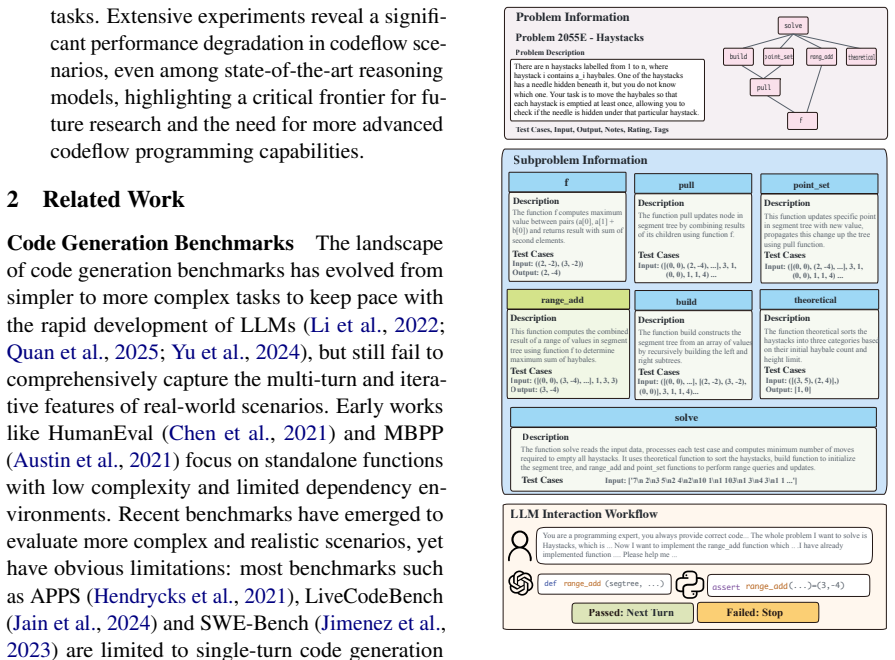
We formalize the iterative, multi-turn paradigm of code development as codeflow and introduce CodeFlowBench to evaluate LLMs' ability to implement new functionality by reusing existing functions over multiple turns. The benchmark comprises CodeFlowBench-Comp, a collection of over 5,000 competitive programming problems, and CodeFlowBench-Repo, sourced from GitHub repositories. A novel evaluation framework featuring a dual assessment protocol and structural metrics derived from dependency trees is presented. Extensive experiments reveal significant performance degradation in multi-turn codeflow scenarios and that model performance inversely correlates with dependency complexity.
What carries the argument
Codeflow, the iterative multi-turn process of implementing new functionality through reuse of existing functions, evaluated via dependency-tree structural metrics and a dual assessment protocol.
If this is right
- LLMs require stronger mechanisms for tracking and reusing prior code artifacts across successive interactions.
- Standard single-turn code generation benchmarks underestimate the difficulty of realistic development sequences.
- Structural metrics based on dependency trees expose failure modes that functional correctness alone misses.
- Progress on code generation will depend on addressing the inverse relationship between dependency complexity and model accuracy.
Where Pith is reading between the lines
- Teams using LLMs for coding assistance may achieve better results by deliberately limiting the depth of inter-function dependencies within any single task.
- Future model training could incorporate synthetic multi-turn dialogues that explicitly build and reference prior code structures.
- The benchmark framework could be extended to measure how well agents maintain consistency when humans intervene between turns.
Load-bearing premise
The chosen competitive programming problems and GitHub repositories, together with the dual assessment protocol and dependency-tree metrics, provide a faithful proxy for real-world iterative code development workflows.
What would settle it
Finding that current models maintain or improve their success rates when tested on real developer commit histories with comparable dependency-tree depths and turn counts would undermine the reported performance degradation.
Figures





read the original abstract
Modern software development demands code that is maintainable, testable, and scalable by organizing the implementation into modular components with iterative reuse of existing codes. We formalize this iterative, multi-turn paradigm as codeflow and introduce CodeFlowBench, the first benchmark designed to comprehensively evaluate LLMs' ability to perform codeflow - implementing new functionality by reusing existing functions over multiple turns. CodeFlowBench comprises two complementary components: CodeFlowBench-Comp, a core collection of 5,000+ competitive programming problems from Codeforces updated via an automated pipeline and CodeFlowBench-Repo, which is sourced from GitHub repositories to better reflect real-world scenarios. Furthermore, a novel evaluation framework featured dual assessment protocol and structural metrics derived from dependency trees is introduced. Extensive experiments reveal significant performance degradation in multi-turn codeflow scenarios. Furthermore, our in-depth analysis illustrates that model performance inversely correlates with dependency complexity. These findings not only highlight the critical challenges for supporting real-world workflows, but also establish CodeFlowBench as an essential tool for advancing code generation research.
Editorial analysis
A structured set of objections, weighed in public.
Referee Report
Summary. The paper introduces CodeFlowBench as the first benchmark for evaluating LLMs on 'codeflow'—iterative, multi-turn code generation that reuses existing functions to implement new functionality. It comprises CodeFlowBench-Comp (5,000+ competitive programming problems from Codeforces, updated via an automated pipeline) and CodeFlowBench-Repo (sourced from GitHub repositories). A dual assessment protocol and structural metrics derived from dependency trees are proposed. The manuscript reports that extensive experiments show significant performance degradation in multi-turn scenarios and that model performance inversely correlates with dependency complexity.
Significance. If the experimental results are substantiated with full methodological details, the benchmark would be a useful addition to code generation research by shifting evaluation toward realistic iterative workflows involving code reuse and maintainability. The dependency-tree metrics and dual assessment protocol offer a concrete way to quantify complexity and quality beyond single-turn pass rates.
major comments (1)
- [Abstract] Abstract: The central claims that 'extensive experiments reveal significant performance degradation in multi-turn codeflow scenarios' and that 'model performance inversely correlates with dependency complexity' are presented without any information on the models evaluated, baselines, number of turns, simulation of multi-turn interactions, dependency-tree construction, statistical tests, data splits, or controls for problem difficulty. This absence makes it impossible to assess whether the reported trends support the claims or arise from artifacts in problem selection.
minor comments (1)
- [Abstract] Abstract: The notation '5,000+' is imprecise; reporting an exact count or a clear range would improve reproducibility and clarity.
Simulated Author's Rebuttal
We thank the referee for their constructive feedback on the abstract. We address the major comment below and indicate where revisions will be made to strengthen the presentation of our claims.
read point-by-point responses
-
Referee: [Abstract] Abstract: The central claims that 'extensive experiments reveal significant performance degradation in multi-turn codeflow scenarios' and that 'model performance inversely correlates with dependency complexity' are presented without any information on the models evaluated, baselines, number of turns, simulation of multi-turn interactions, dependency-tree construction, statistical tests, data splits, or controls for problem difficulty. This absence makes it impossible to assess whether the reported trends support the claims or arise from artifacts in problem selection.
Authors: We acknowledge that the abstract, due to space constraints, presents the claims at a high level without enumerating methodological specifics. The full manuscript elaborates these elements in the Experiments and Evaluation sections, including the LLMs tested, comparison baselines, the iterative multi-turn protocol, construction of dependency trees from code structure, statistical analysis methods, train/test splits, and stratification by problem complexity. To make the abstract more self-contained while remaining concise, we will add a brief clause referencing the evaluation protocol and complexity controls. revision: partial
Circularity Check
No circularity: empirical benchmark with direct measurements
full rationale
This is an empirical benchmark paper that introduces CodeFlowBench (CodeFlowBench-Comp and CodeFlowBench-Repo) and reports experimental results on LLM performance. The abstract describes formalizing 'codeflow', collecting problems/repositories, applying a dual assessment protocol and dependency-tree metrics, then measuring degradation and inverse correlation with complexity. No derivation chain, equations, fitted parameters renamed as predictions, or self-citation load-bearing steps exist in the provided text. All central claims are direct observations on the new benchmark rather than reductions to inputs by construction, satisfying the self-contained empirical case with score 0.
Axiom & Free-Parameter Ledger
Lean theorems connected to this paper
-
IndisputableMonolith/Cost/FunctionalEquation.leanwashburn_uniqueness_aczel unclear?
unclearRelation between the paper passage and the cited Recognition theorem.
We parse the AST of the verified solution to extract and topologically sort function dependencies... define Average Pass Depth (APD) and Dependency Structure Complexity (DSC)
-
IndisputableMonolith/Foundation/AbsoluteFloorClosure.leanreality_from_one_distinction unclear?
unclearRelation between the paper passage and the cited Recognition theorem.
Extensive experiments reveal significant performance degradation in multi-turn codeflow scenarios... model performance inversely correlates with dependency complexity
What do these tags mean?
- matches
- The paper's claim is directly supported by a theorem in the formal canon.
- supports
- The theorem supports part of the paper's argument, but the paper may add assumptions or extra steps.
- extends
- The paper goes beyond the formal theorem; the theorem is a base layer rather than the whole result.
- uses
- The paper appears to rely on the theorem as machinery.
- contradicts
- The paper's claim conflicts with a theorem or certificate in the canon.
- unclear
- Pith found a possible connection, but the passage is too broad, indirect, or ambiguous to say the theorem truly supports the claim.
Forward citations
Cited by 4 Pith papers
-
On Time, Within Budget: Constraint-Driven Online Resource Allocation for Agentic Workflows
MCPP is a Monte Carlo simulation-based online planner that improves the probability of agentic workflows completing successfully under explicit budget and deadline constraints compared to baselines on CodeFlow and Pro...
-
On Time, Within Budget: Constraint-Driven Online Resource Allocation for Agentic Workflows
MCPP uses Monte Carlo simulations of workflow executions to dynamically allocate resources and replan, raising constrained completion probability over baselines on CodeFlow and ProofFlow.
-
Context Learning for Multi-Agent Discussion
M2CL trains per-agent context generators with a self-adaptive mechanism to maintain coherence and reduce output discrepancies in multi-LLM discussions, yielding 20-50% gains on reasoning, embodied, and mobile control tasks.
-
A-ProS: Towards Reliable Autonomous Programming Through Multi-Model Feedback
A-ProS uses a hybrid multi-model feedback framework with stateful refinement to improve success rates on competitive programming problems, achieving over 2x gains compared to baseline agent loops.
Reference graph
Works this paper leans on
-
[1]
Code reuse in practice: Benefiting or harm- ing technical debt.Journal of Systems and Software, 167:110618. Google. 2025. Gemini-3-flash system card. System card, Google. Aaron Grattafiori, Abhimanyu Dubey, Abhinav Jauhri, Abhinav Pandey, Abhishek Kadian, Ahmad Al- Dahle, Aiesha Letman, Akhil Mathur, Alan Schelten, Alex Vaughan, and 1 others. 2024. The ll...
work page internal anchor Pith review Pith/arXiv arXiv 2025
-
[2]
CRUXEval: A Benchmark for Code Reasoning, Understanding and Execution
Cruxeval: A benchmark for code reason- ing, understanding and execution.arXiv preprint arXiv:2401.03065. 9 Daya Guo, Dejian Yang, Haowei Zhang, Junxiao Song, Ruoyu Zhang, Runxin Xu, Qihao Zhu, Shi- rong Ma, Peiyi Wang, Xiao Bi, and 1 others. 2025. Deepseek-r1: Incentivizing reasoning capability in llms via reinforcement learning.arXiv preprint arXiv:2501....
work page internal anchor Pith review Pith/arXiv arXiv 2025
-
[3]
Measuring Coding Challenge Competence With APPS
Measuring coding challenge competence with apps.arXiv preprint arXiv:2105.09938. Dong Huang, Yuhao Qing, Weiyi Shang, Heming Cui, and Jie Zhang. 2024. Effibench: Benchmarking the efficiency of automatically generated code.Advances in Neural Information Processing Systems, 37:11506– 11544. Dong Huang, Jie M Zhang, Michael Luck, Qingwen Bu, Yuhao Qing, and ...
work page internal anchor Pith review Pith/arXiv arXiv 2024
-
[4]
Yuxiang Wei, Zhe Wang, Jiawei Liu, Yifeng Ding, and Lingming Zhang
Maintaincoder: Maintainable code genera- tion under dynamic requirements.arXiv preprint arXiv:2503.24260. Yuxiang Wei, Zhe Wang, Jiawei Liu, Yifeng Ding, and Lingming Zhang. 2023. Magicoder: Empowering code generation with oss-instruct.arXiv preprint arXiv:2312.02120. An Yang, Anfeng Li, Baosong Yang, Beichen Zhang, Binyuan Hui, Bo Zheng, Bowen Yu, Chang ...
-
[5]
Qwen3 technical report.arXiv preprint arXiv:2505.09388. John Yang, Akshara Prabhakar, Karthik Narasimhan, and Shunyu Yao. 2023. Intercode: Standardizing and 10 benchmarking interactive coding with execution feed- back.Advances in Neural Information Processing Systems, 36:23826–23854. Zhaojian Yu, Yilun Zhao, Arman Cohan, and Xiao- Ping Zhang. 2024. Humane...
work page internal anchor Pith review Pith/arXiv arXiv 2023
-
[6]
Clarity: Is the statement smoothly and understandably expressed, allowing a reader to grasp the task goal quickly?
-
[7]
Completeness: Does the description include all key elements needed to accomplish the subtask?
-
[8]
Accuracy: Is the description free of ambiguity or logical errors, and does it match the problem requirements and the provided code?
-
[9]
Feasibility: Can an engineer unambiguously determine and implement the required functionality—and pass functional tests—based solely on this description?
-
[10]
Please do not be overly strict
Professionalism: Does it use accurate, domain- appropriate terminology and a style fitting technical norms of coding tasks? Return your result **only** as a JSON dictionary with these five keys and values of 0 or 1. Please do not be overly strict. Assign a score of 1 to a criterion if it is even partially satisfied, allowing for minor imperfections. Only ...
-
[11]
21 (a) Distributions of overall-turns and overall-depth
Authenticity across Specialized Domains. 21 (a) Distributions of overall-turns and overall-depth. (b) The Correlations with Rating Levels. Figure 12: Statistics of the overall-turns and overall-depth metrics in CodeFlowBench-Comp. Subfigure (b) shows inflection points at turns = 1 and depth = 1. This is attributed to the fact that competition-level proble...
-
[12]
Alignment with Constructive Codeflow Paradigm. While many repository-level benchmarks focus onmaintenancetasks such as issue resolution or debugging within existing codebases, CodeFlow- Bench aims to evaluate the constructive aspect of software engineering, namely to build complex functionality from the ground up. DomainEval fo- cuses on function generati...
discussion (0)
Sign in with ORCID, Apple, or X to comment. Anyone can read and Pith papers without signing in.