An Ontology-Driven Graph RAG for Legal Norms: A Structural, Temporal, and Deterministic Approach
Pith reviewed 2026-05-22 17:49 UTC · model grok-4.3
The pith
An ontology-driven graph RAG distinguishes abstract legal works from versioned expressions to support deterministic temporal and causal queries.
A machine-rendered reading of the paper's core claim, the machinery that carries it, and where it could break.
Core claim
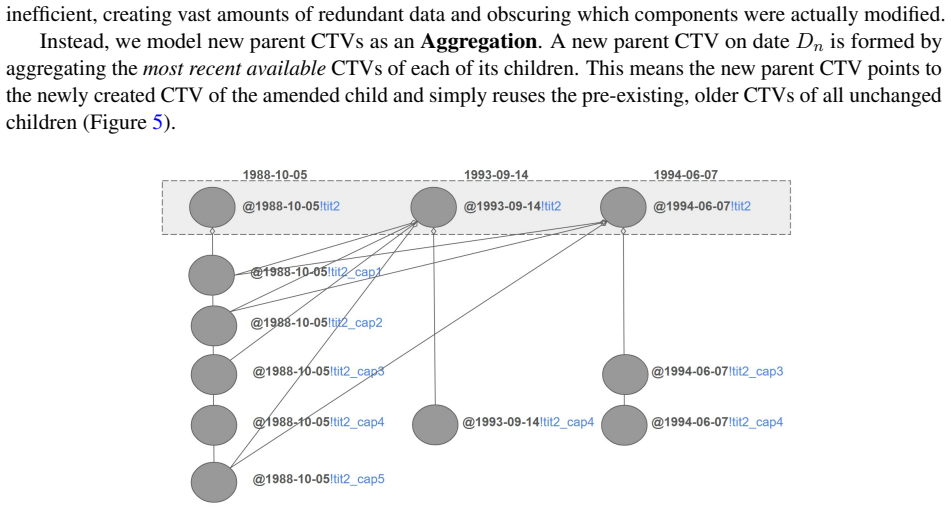
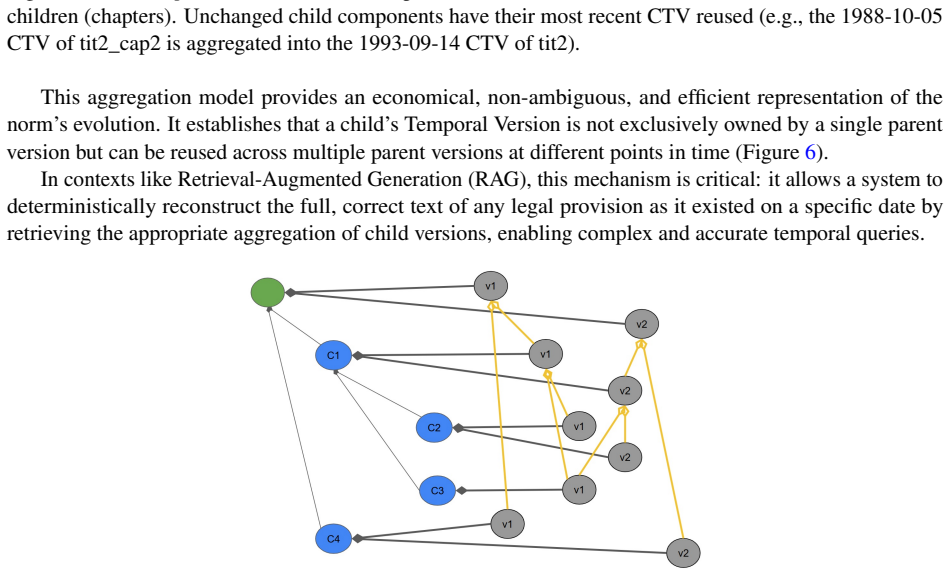
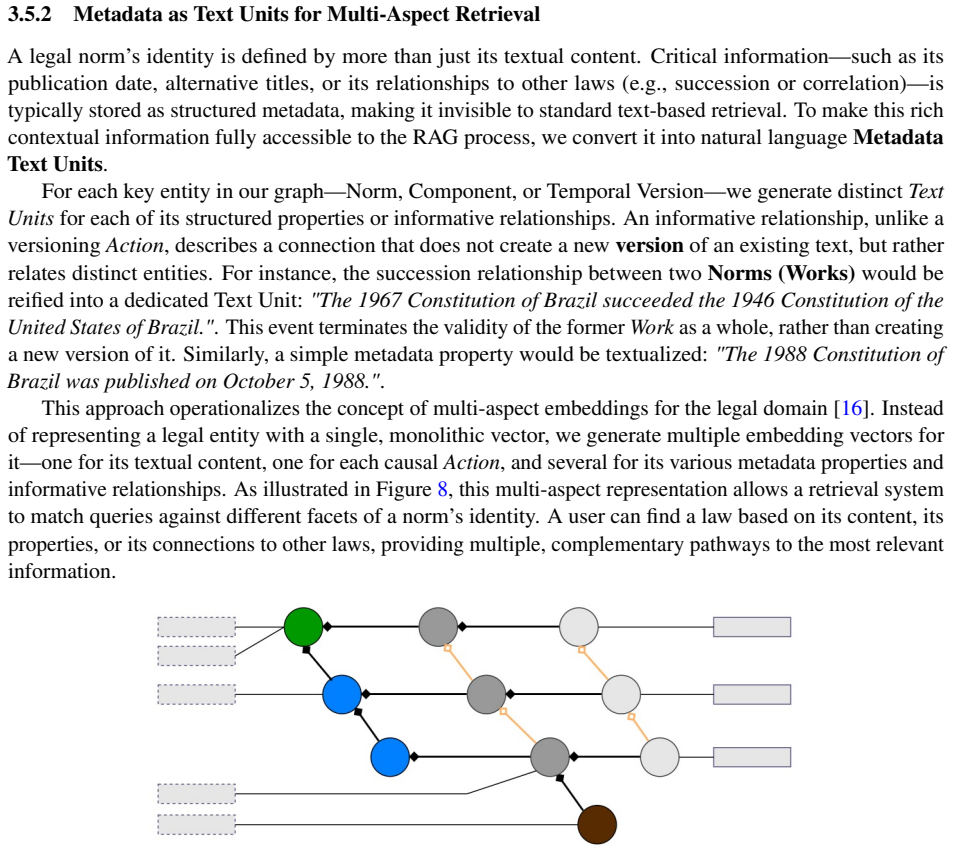
We ground our knowledge graph in a formal, LRMoo-inspired model that distinguishes abstract legal Works from their versioned Expressions. We model temporal states as efficient aggregations that reuse the versioned expressions (CTVs) of unchanged components, and we reify legislative events as first-class Action nodes to make causality explicit and queryable. This structured backbone enables a unified, planner-guided query strategy that applies explicit policies to deterministically resolve complex requests for point-in-time retrieval, hierarchical impact analysis, and auditable provenance reconstruction.
What carries the argument
The SAT-Graph RAG framework, which uses an LRMoo-inspired ontology to separate abstract Works from versioned Expressions, CTV aggregations for temporal states, and reified Action nodes to expose causality for deterministic query resolution.
Load-bearing premise
That explicitly modeling legal norms via an LRMoo-inspired distinction between abstract Works and versioned Expressions, combined with CTV aggregations and reified Action nodes, will produce deterministic, auditable resolutions for point-in-time and causal queries without introducing new modeling errors or query complexity.
What would settle it
Execute a point-in-time query on a specific article of the Brazilian Constitution at a date before and after a documented amendment, then verify whether the retrieved text matches only the historically valid versions with no later changes or omissions.
Figures





read the original abstract
Retrieval-Augmented Generation (RAG) systems in the legal domain face a critical challenge: standard, flat-text retrieval is blind to the hierarchical, diachronic, and causal structure of law, leading to anachronistic and unreliable answers. This paper introduces the Structure-Aware Temporal Graph RAG (SAT-Graph RAG), an ontology-driven framework designed to overcome these limitations by explicitly modeling the formal structure and diachronic nature of legal norms. We ground our knowledge graph in a formal, LRMoo-inspired model that distinguishes abstract legal Works from their versioned Expressions. We model temporal states as efficient aggregations that reuse the versioned expressions (CTVs) of unchanged components, and we reify legislative events as first-class Action nodes to make causality explicit and queryable. This structured backbone enables a unified, planner-guided query strategy that applies explicit policies to deterministically resolve complex requests for (i) point-in-time retrieval, (ii) hierarchical impact analysis, and (iii) auditable provenance reconstruction. Through a case study on the Brazilian Constitution, we demonstrate how this approach provides a verifiable, temporally-correct substrate for LLMs, enabling higher-order analytical capabilities while drastically reducing the risk of factual errors. The result is a practical framework for building more trustworthy and explainable legal AI systems.
Editorial analysis
A structured set of objections, weighed in public.
Referee Report
Summary. The paper introduces SAT-Graph RAG, an ontology-driven graph retrieval-augmented generation framework for legal norms. It grounds a knowledge graph in an LRMoo-inspired distinction between abstract legal Works and versioned Expressions, models temporal states via CTV aggregations of unchanged components, and reifies legislative events as Action nodes to capture causality. A unified planner-guided query strategy with explicit policies is proposed for point-in-time retrieval, hierarchical impact analysis, and provenance reconstruction. The central claim is that this structure provides a verifiable, temporally-correct substrate for LLMs that enables higher-order analysis while drastically reducing factual errors, as demonstrated in a case study on the Brazilian Constitution.
Significance. If the modeling and query policies prove robust, the approach could advance legal AI by supplying an auditable, diachronic graph substrate that mitigates anachronism and hallucination risks common in flat-text RAG. The explicit separation of Works/Expressions and reification of Actions offers a principled way to handle versioning and causality that standard vector retrieval lacks. However, the absence of quantitative evaluation in the provided description limits immediate impact assessment.
major comments (2)
- [Case study] Case study section: The Brazilian Constitution demonstration is presented only as a qualitative illustration of the framework and query policies. No accuracy metrics, error counts on temporal or causal queries, baseline comparisons (e.g., standard RAG or other graph methods), or error analysis are reported, leaving the claim of 'drastically reducing the risk of factual errors' unsupported by evidence.
- [Query strategy] Query strategy description: The planner-guided policies for resolving point-in-time, hierarchical, and provenance queries are described at a high level without formal specification of the resolution algorithms, conflict-handling rules, or complexity analysis. This makes it difficult to verify the determinism and auditability asserted in the abstract.
minor comments (1)
- [Abstract] The abstract and introduction use several acronyms (SAT-Graph RAG, CTV, LRMoo) without an initial glossary or expansion on first use.
Simulated Author's Rebuttal
We thank the referee for the constructive feedback. We address each major comment below and outline the revisions we will make to strengthen the manuscript.
read point-by-point responses
-
Referee: [Case study] Case study section: The Brazilian Constitution demonstration is presented only as a qualitative illustration of the framework and query policies. No accuracy metrics, error counts on temporal or causal queries, baseline comparisons (e.g., standard RAG or other graph methods), or error analysis are reported, leaving the claim of 'drastically reducing the risk of factual errors' unsupported by evidence.
Authors: We agree that the case study remains qualitative and does not yet supply quantitative metrics, error counts, or baseline comparisons, which leaves the stronger phrasing of the claim without direct empirical backing. In the revision we will add a dedicated error analysis subsection, report success rates on a set of temporal and causal queries, and include a brief comparison against standard vector RAG on the same query set. We will also moderate the wording of the claim to reflect the illustrative nature of the current demonstration while still highlighting the structural advantages. revision: yes
-
Referee: [Query strategy] Query strategy description: The planner-guided policies for resolving point-in-time, hierarchical, and provenance queries are described at a high level without formal specification of the resolution algorithms, conflict-handling rules, or complexity analysis. This makes it difficult to verify the determinism and auditability asserted in the abstract.
Authors: The manuscript presents the query strategy at the policy level to emphasize its unified, planner-guided character. To improve verifiability we will insert pseudocode for the core resolution procedures, explicit conflict-handling rules for overlapping temporal states, and a short complexity discussion. These additions will directly support the determinism and auditability claims without altering the overall approach. revision: yes
Circularity Check
No significant circularity; framework derives from independent ontology modeling
full rationale
The paper constructs SAT-Graph RAG from explicit modeling decisions: an LRMoo-inspired distinction between abstract Works and versioned Expressions, CTV aggregations for temporal states, and reified Action nodes for legislative events. These choices enable a planner-guided query strategy for point-in-time, hierarchical, and provenance queries, illustrated qualitatively via the Brazilian Constitution case study. No equations, fitted parameters, or self-referential definitions appear that would reduce any claimed prediction or result to the inputs by construction. The derivation chain relies on structural ontology application rather than self-citation chains or renamed empirical patterns, rendering it self-contained against external benchmarks.
Axiom & Free-Parameter Ledger
axioms (1)
- domain assumption LRMoo-inspired distinction between abstract legal Works and their versioned Expressions
invented entities (2)
-
CTVs (versioned expressions of unchanged components)
no independent evidence
-
Action nodes for legislative events
no independent evidence
Lean theorems connected to this paper
-
IndisputableMonolith/Foundation/AbsoluteFloorClosure.leanreality_from_one_distinction unclear?
unclearRelation between the paper passage and the cited Recognition theorem.
We ground our knowledge graph in a formal, LRMoo-inspired model that distinguishes abstract legal Works from their versioned Expressions... reify legislative events as first-class Action nodes
What do these tags mean?
- matches
- The paper's claim is directly supported by a theorem in the formal canon.
- supports
- The theorem supports part of the paper's argument, but the paper may add assumptions or extra steps.
- extends
- The paper goes beyond the formal theorem; the theorem is a base layer rather than the whole result.
- uses
- The paper appears to rely on the theorem as machinery.
- contradicts
- The paper's claim conflicts with a theorem or certificate in the canon.
- unclear
- Pith found a possible connection, but the passage is too broad, indirect, or ambiguous to say the theorem truly supports the claim.
Forward citations
Cited by 2 Pith papers
-
Controlling Authority Retrieval: A Missing Retrieval Objective for Authority-Governed Knowledge
CAR is a new retrieval objective that targets the currently active authority set rather than most-similar documents, with theorems on coverage conditions and evaluations showing two-stage methods outperform dense retr...
-
Deterministic Legal Agents: A Canonical Primitive API for Auditable Reasoning over Temporal Knowledge Graphs
The paper specifies the SAT-Graph API, a canonical primitive interface that enables auditable, deterministic reasoning over temporal knowledge graphs by isolating uncertainty to intent translation and narrative synthesis.
Reference graph
Works this paper leans on
-
[1]
Retrieval-augmented generation for knowledge-intensive NLP tasks
Lewis P, Perez E, Piktus A, Petroni F, Karpukhin V , Goyal N, et al. Retrieval-augmented generation for knowledge-intensive NLP tasks. In: Advances in Neural Information Processing Systems. vol. 33
-
[2]
De Martim H. Modeling the Diachronic Evolution of Legal Norms: An LRMoo-Based, Component- Level, Event-Centric Approach to Legal Knowledge Graphs; 2025. [preprint]. Accessed on: August 23,
work page 2025
- [3]
-
[4]
From Local to Global: A Graph RAG Approach to Query-Focused Summarization
Edge D, Trinh HT, Cheng N, Bradley J, Chao A, Mody A, et al.. From local to global: A graph RAG approach to query-focused summarization; 2024. [Preprint]. Accessed on: August 23, 2025. Available from:https://arxiv.org/abs/2404.16130
work page internal anchor Pith review Pith/arXiv arXiv 2024
-
[5]
LRMoo: Object-oriented definition and mapping from the IFLA Library Reference Model
IFLA LRMoo Working Group and CIDOC CRM Special Interest Group. LRMoo: Object-oriented definition and mapping from the IFLA Library Reference Model. IFLA; 2024. Version 1.0. 21
work page 2024
-
[6]
Pipitone N, Houir Alami G. LegalBench-RAG: A Benchmark for Retrieval-Augmented Generation in the Legal Domain; 2024. [preprint] arXiv:2408.10343
-
[7]
Finding the law: Enhancing statutory article retrieval via graph neural networks; 2023
Louis A, van Dijck G, Spanakis G. Finding the law: Enhancing statutory article retrieval via graph neural networks; 2023. [preprint] arXiv:2301.12847
-
[8]
Hei M, et al. A Heterogeneous Graph Based on Legal Documents and Legal Statute Hierarchy for Chinese Legal Case Retrieval. IEEE Access. 2024;12:93502-16
work page 2024
-
[9]
Ho J, Colby A, Fisher W. Incorporating Legal Structure in Retrieval-Augmented Generation: A Case Study on Copyright Fair Use; 2025. [preprint] arXiv:2505.02164
-
[10]
A survey on temporal knowledge graph: Representation learning and applications; 2024
Cai L, et al. A survey on temporal knowledge graph: Representation learning and applications; 2024. [preprint]
work page 2024
-
[11]
Modelling temporal data in knowledge graphs: a systematic review protocol
Hooshafza S, et al. Modelling temporal data in knowledge graphs: a systematic review protocol. HRB Open Research. 2022;4:101
work page 2022
-
[12]
Legislative XML: principles and technical tools; 2012
Palmirani M, Vitali F. Legislative XML: principles and technical tools; 2012
work page 2012
-
[13]
LegalHTML: a Representation Language for Legal Acts
Stellato A, et al. LegalHTML: a Representation Language for Legal Acts. ESWC 2023 (paper)
work page 2023
-
[14]
Available from: https://2023.eswc-conferences.org/wp-content/uploads/ 2023/05/paper_Stellato_2023_LegalHTML.pdf
work page 2023
-
[15]
A Temporal Knowledge Graph Generation Dataset Supervised Distantly by Large Language Models
Zhu J, et al. A Temporal Knowledge Graph Generation Dataset Supervised Distantly by Large Language Models. Scientific Data. 2025;12(1):734
work page 2025
-
[16]
Barron RC, et al. Bridging Legal Knowledge and AI: Retrieval-Augmented Generation with Vector Stores, Knowledge Graphs, and Hierarchical Non-negative Matrix Factorization; 2025. [preprint] arXiv:2502.20364
-
[17]
Moving in the time: An ontology for identifying legal resources
De Oliveira Lima JA, Palmirani M, Vitali F. Moving in the time: An ontology for identifying legal resources. In: Legal Knowledge and Information Systems. Berlin: Springer Berlin Heidelberg; 2008
work page 2008
-
[18]
Unsupervised Differentiable Multi-aspect Network Embedding
Park C, Yang C, Zhu Q, Kim D, Yu H, Han J. Unsupervised Differentiable Multi-aspect Network Embedding. In: Proceedings of the 26th ACM SIGKDD International Conference on Knowledge Discovery and Data Mining (KDD ’20); 2020. p. 1435-45
work page 2020
-
[19]
Explainable AI and law: An evidential survey
Richmond KM, et al. Explainable AI and law: An evidential survey. Digital Society. 2024;3(1):1. 22
work page 2024
discussion (0)
Sign in with ORCID, Apple, or X to comment. Anyone can read and Pith papers without signing in.