Design for a Digital Twin in Clinical Patient Care
Pith reviewed 2026-05-22 17:21 UTC · model grok-4.3
The pith
A digital twin design combines knowledge graphs and ensemble learning to mirror a patient's full clinical journey and support clinician decisions.
A machine-rendered reading of the paper's core claim, the machinery that carries it, and where it could break.
Core claim
The authors present a general and unspecialized Digital Twin design combining knowledge graphs and ensemble learning to reflect the entire patient's clinical journey and assist clinicians in their decision-making. Such a design is predictive, modular, evolving, informed, interpretable and explainable, thus opening broad clinical applications.
What carries the argument
The Digital Twin design that integrates knowledge graphs for representing structured patient knowledge with ensemble learning for predictive modeling to capture the full clinical journey.
Load-bearing premise
That a combination of knowledge graphs and ensemble learning can be engineered to remain predictive, modular, and explainable while fitting into established clinical workflows without requiring major changes to hospital data systems or doctor routines.
What would settle it
A hospital implementation where the system either fails to produce accurate or explainable predictions or requires substantial changes to existing data systems and doctor routines would disprove the design's core practicality.
Figures




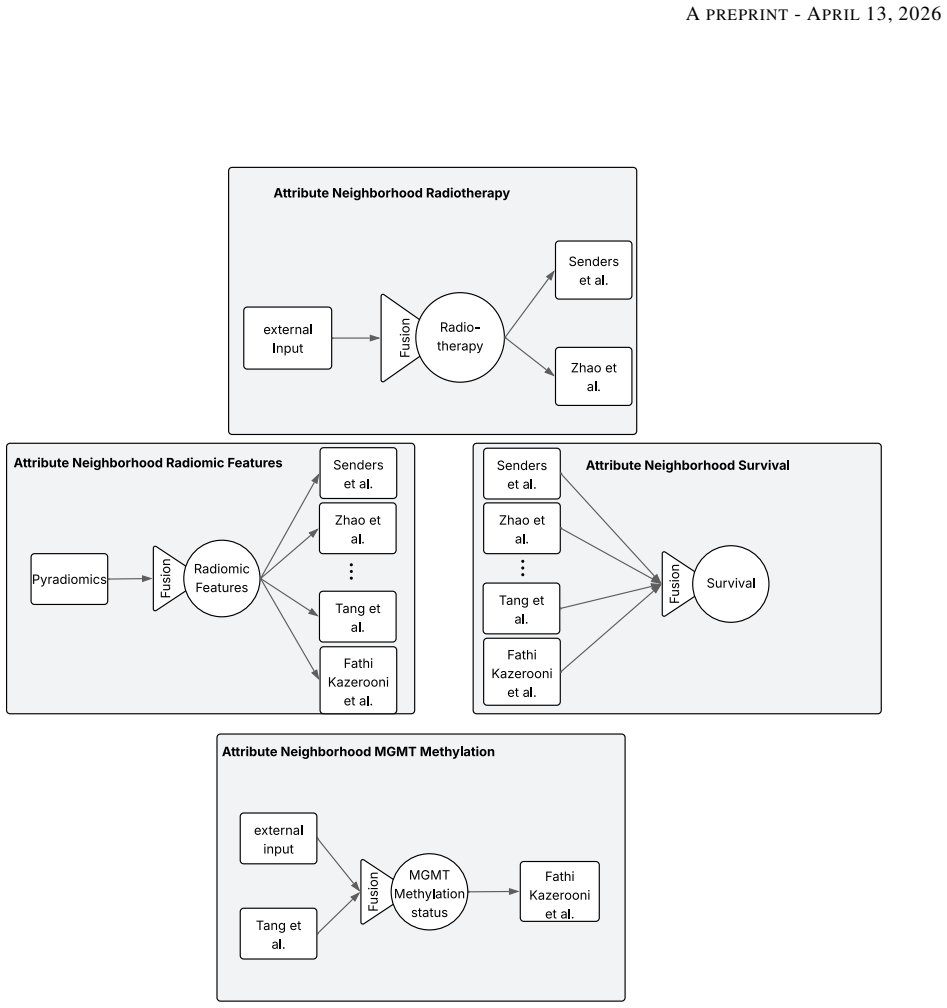
read the original abstract
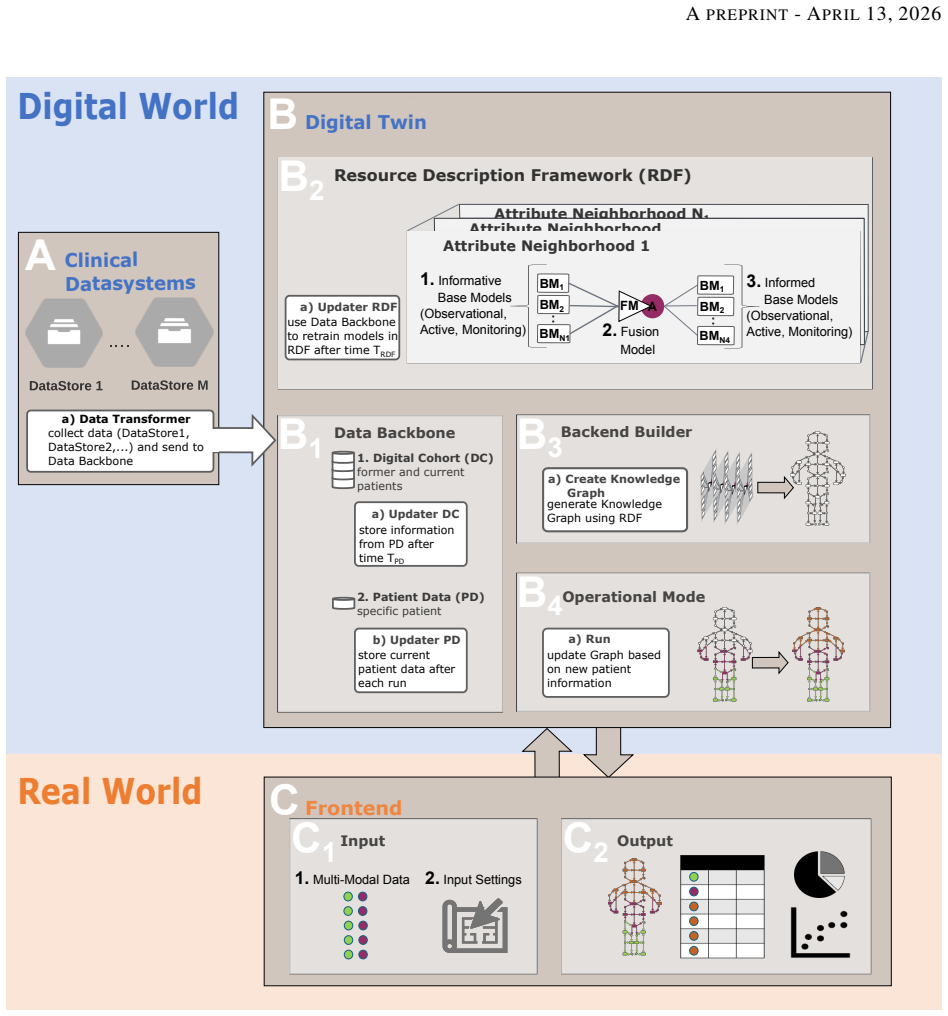
Digital Twins hold great potential to personalize clinical patient care, provided the concept is translated to meet specific requirements emerging from established clinical workflows. We present a general and unspecialized Digital Twin design combining knowledge graphs and ensemble learning to reflect the entire patient's clinical journey and assist clinicians in their decision-making. Such a design is predictive, modular, evolving, informed, interpretable and explainable, thus opening broad clinical applications.
Editorial analysis
A structured set of objections, weighed in public.
Referee Report
Summary. The paper proposes a general, unspecialized Digital Twin design for clinical patient care that integrates knowledge graphs with ensemble learning to model a patient's full clinical journey and support clinician decision-making. It asserts that this architecture is simultaneously predictive, modular, evolving, informed, interpretable, and explainable while integrating into existing clinical workflows with minimal disruption to hospital data systems or routines.
Significance. If the unspecified mechanisms for achieving the listed properties and seamless workflow integration can be supplied and validated, the design could offer a practical framework for applying digital twins in healthcare settings that prioritizes explainability and modularity over specialized implementations.
major comments (2)
- [Design Overview / Architecture] The central claim that the KG+ensemble design remains predictive, modular, evolving, informed, interpretable and explainable while requiring no major changes to hospital data systems or clinician routines is load-bearing yet unsupported. No data ingestion pipelines, real-time update protocols for the evolving component, or concrete EHR API interfaces are specified anywhere in the architecture description.
- [Component Integration] § on component integration: the manuscript lists the six properties as following from the combination of knowledge graphs and ensemble learning but provides neither mechanisms, pseudo-code, nor example workflows showing how these properties are simultaneously realized or preserved during clinical use.
minor comments (2)
- [Abstract / Introduction] The abstract and introduction would benefit from explicit citations to prior digital-twin and knowledge-graph work in clinical informatics to clarify the precise novelty of the proposed combination.
- [Properties Discussion] Terminology for 'informed' and 'evolving' is used without operational definitions or metrics that would allow a reader to evaluate whether a concrete implementation meets the criteria.
Simulated Author's Rebuttal
We thank the referee for their constructive comments on our manuscript describing a conceptual design for a Digital Twin in clinical patient care. We appreciate the emphasis on providing more concrete details to support the architecture's claims. We address each major comment below and indicate the revisions we plan to make.
read point-by-point responses
-
Referee: The central claim that the KG+ensemble design remains predictive, modular, evolving, informed, interpretable and explainable while requiring no major changes to hospital data systems or clinician routines is load-bearing yet unsupported. No data ingestion pipelines, real-time update protocols for the evolving component, or concrete EHR API interfaces are specified anywhere in the architecture description.
Authors: We acknowledge that our current presentation is at a conceptual level and does not include detailed specifications for data pipelines or API interfaces. This is because the manuscript focuses on a general, unspecialized design rather than a specific implementation. However, to address the referee's valid concern, we will revise the Design Overview / Architecture section to incorporate high-level descriptions of data ingestion pipelines, real-time update protocols for the evolving knowledge graph, and example EHR API integration approaches. These will be described in a manner consistent with the general nature of the design, demonstrating feasibility of integration with minimal disruption to existing workflows. We believe this addition will better substantiate the central claims. revision: yes
-
Referee: § on component integration: the manuscript lists the six properties as following from the combination of knowledge graphs and ensemble learning but provides neither mechanisms, pseudo-code, nor example workflows showing how these properties are simultaneously realized or preserved during clinical use.
Authors: We agree that the manuscript would benefit from more explicit mechanisms and examples for how the six properties are realized through the KG and ensemble learning integration. In the revised version, we will expand the component integration section to include example workflows illustrating clinical use cases, mechanisms for maintaining each property (e.g., how modularity allows independent updates to the graph without affecting ensemble predictions), and pseudo-code for key processes such as updating the twin with new patient data while preserving interpretability and explainability. This will show how the properties are simultaneously achieved and preserved. revision: yes
Circularity Check
No circularity: conceptual design proposal with no derivations or self-referential reductions
full rationale
The manuscript is a high-level architectural proposal for a Digital Twin that combines knowledge graphs and ensemble learning to support clinical decision-making. It asserts properties such as being predictive, modular, evolving, informed, interpretable and explainable without presenting equations, fitted parameters, derivation chains, or any mathematical steps that could reduce to their own inputs. No self-citations are invoked to justify uniqueness theorems or load-bearing premises, and the central claim is the design itself rather than a prediction derived from prior fitted results. The proposal remains self-contained as a descriptive framework for clinical workflows and does not exhibit any of the enumerated circularity patterns.
Axiom & Free-Parameter Ledger
axioms (1)
- domain assumption Clinical workflows can accommodate an external modular system that evolves with new patient data without disrupting existing processes.
Lean theorems connected to this paper
-
IndisputableMonolith/Cost/FunctionalEquation.leanwashburn_uniqueness_aczel unclear?
unclearRelation between the paper passage and the cited Recognition theorem.
bipartite knowledge graph... fusion models... ensemble learning strategies... provenance chain P
-
IndisputableMonolith/Foundation/RealityFromDistinction.leanreality_from_one_distinction unclear?
unclearRelation between the paper passage and the cited Recognition theorem.
modular, evolving, informed, interpretable... three phases of clinical patient journey
What do these tags mean?
- matches
- The paper's claim is directly supported by a theorem in the formal canon.
- supports
- The theorem supports part of the paper's argument, but the paper may add assumptions or extra steps.
- extends
- The paper goes beyond the formal theorem; the theorem is a base layer rather than the whole result.
- uses
- The paper appears to rely on the theorem as machinery.
- contradicts
- The paper's claim conflicts with a theorem or certificate in the canon.
- unclear
- Pith found a possible connection, but the passage is too broad, indirect, or ambiguous to say the theorem truly supports the claim.
Reference graph
Works this paper leans on
-
[1]
Eric J. Topol. High-performance medicine: The con- vergence of human and artificial intelligence.Nature Medicine, 25(1):44–56, January 2019
work page 2019
-
[2]
Digital twins for health: a scoping re- view.npj Digital Medicine, 7(1):1–11, 2024
Evangelia Katsoulakis, Qi Wang, Huanmei Wu, Leili Shahriyari, Richard Fletcher, Jinwei Liu, Luke Achenie, Hongfang Liu, Pamela Jackson, Ying Xiao, Tanveer Syeda-Mahmood, Richard Tuli, and Jun Deng. Digital twins for health: a scoping re- view.npj Digital Medicine, 7(1):1–11, 2024. Pub- lisher: Nature Publishing Group
work page 2024
-
[3]
Sarah J. MacEachern and Nils D. Forkert. Ma- chine learning for precision medicine.Genome, 64(4):416–425, April 2021
work page 2021
-
[4]
Maged N. Kamel Boulos and Peng Zhang. Digi- tal Twins: From Personalised Medicine to Precision Public Health.Journal of Personalized Medicine, 11(8):745, August 2021
work page 2021
-
[5]
Tianze Sun, Xiwang He, and Zhonghai Li. Dig- ital twin in healthcare: Recent updates and chal- lenges.DIGITAL HEALTH, 9:20552076221149651, January 2023
work page 2023
-
[6]
Oishee Mazumder, Dibyendu Roy, Sakyajit Bhat- tacharya, Aniruddha Sinha, and Arpan Pal. Syn- thetic PPG generation from haemodynamic model with baroreflex autoregulation: A Digital twin of cardiovascular system. In2019 41st Annual In- ternational Conference of the IEEE Engineering in Medicine and Biology Society (EMBC), pages 5024– 5029, July 2019
work page 2019
-
[7]
Tina Hernandez-Boussard, Paul Macklin, Emily J. Greenspan, Amy L. Gryshuk, Eric Stahlberg, Tan- veer Syeda-Mahmood, and Ilya Shmulevich. Digi- tal twins for predictive oncology will be a paradigm shift for precision cancer care.Nature Medicine, 27(12):2065–2066, December 2021
work page 2065
-
[9]
Envisioning the future of person- alized medicine: Role and realities of digital twins
Alexandre Vall ´ee. Envisioning the future of person- alized medicine: Role and realities of digital twins. Journal of Medical Internet Research, 26:e50204, May 2024
work page 2024
-
[10]
Digital Twins for Multiple Sclerosis.Frontiers in Immunology, 12, 2021
Isabel V oigt, Hernan Inojosa, Anja Dillenseger, Rocco Haase, Katja Akg ¨un, and Tjalf Ziemssen. Digital Twins for Multiple Sclerosis.Frontiers in Immunology, 12, 2021
work page 2021
-
[11]
Rocha, Jordan Rozum, Riccardo Sbarbati, and Francesco Zambelli
Manlio De Domenico, Luca Allegri, Guido Cal- darelli, Valeria d’Andrea, Barbara Di Camillo, Luis M. Rocha, Jordan Rozum, Riccardo Sbarbati, and Francesco Zambelli. Challenges and opportu- nities for digital twins in precision medicine from a complex systems perspective.npj Digital Medicine, 8(1):1–11, 2025. Publisher: Nature Publishing Group
work page 2025
-
[12]
Jan Gaebel, Johannes Keller, Daniel Schneider, Adrian Lindenmeyer, Thomas Neumuth, and Stefan Franke. The Digital Twin: Modular Model-Based Approach to Personalized Medicine.Current Di- rections in Biomedical Engineering, 7(2):223–226, October 2021
work page 2021
-
[13]
Nora Grieb, Lukas Schmierer, Hyeon Ung Kim, Sarah Strobel, Christian Schulz, Tim Meschke, Anne Sophie Kubasch, Annamaria Brioli, Uwe Platzbecker, Thomas Neumuth, Maximilian Merz, and Alexander Oeser. A digital twin model for evidence-based clinical decision support in multiple myeloma treatment.Frontiers in Digital Health, 5, December 2023
work page 2023
-
[14]
Phyllis M Thangaraj, Sean H Benson, Evange- los K Oikonomou, Folkert W Asselbergs, and Ro- han Khera. Cardiovascular care with digital twin technology in the era of generative artificial intelli- gence.European Heart Journal, 45(45):4808–4821, December 2024
work page 2024
-
[15]
Hendrik van der Valk, Hendrik Haße, Frederik M¨oller, MIchael Arbter, Jan\ Luca Henning, and Boris Otto. A taxonomy of digital twins. InAM- CIS 2020 Proceedings, 4, 2020
work page 2020
-
[18]
Koen Bruynseels, Filippo Santoni de Sio, and Jeroen van den Hoven. Digital Twins in Health Care: Ethical Implications of an Emerging Engineering Paradigm.Frontiers in Genetics, 9:31, 2018
work page 2018
-
[19]
Eugen Octav Popa. The use of digital twins in healthcare: Socio-ethical benefits and socio-ethical risks.Life Sciences, Society and Policy, 17(1):6–6, July 2021
work page 2021
-
[20]
Larry Goldenberg, Nir, and Septimiu E
S. Larry Goldenberg, Nir, and Septimiu E. Salcud- ean. A new era: Artificial intelligence and machine 9 APREPRINT- APRIL13, 2026 learning in prostate cancer.Nature Reviews Urology, 16(7):391–403, July 2019
work page 2026
-
[21]
Haffner, Wilbert Zwart, Martine P
Michael C. Haffner, Wilbert Zwart, Martine P. Roudier, Lawrence D. True, William G. Nelson, Jonathan I. Epstein, Angelo M. De Marzo, Peter S. Nelson, and Srinivasan Yegnasubramanian. Ge- nomic and phenotypic heterogeneity in prostate can- cer.Nature Reviews Urology, 18(2):79–92, 2021. Publisher: Nature Publishing Group. 10 SUPPLEMENT- DESIGN FOR ADIGITALT...
work page 2021
-
[22]
and Kelly et al. [22]. DT requirements R1 Holistic representation of the patient journey R1.1 Operate in observational phase R1.2 Operate in active phase R1.3 Operate in monitoring phase R1.4 Enable the prediction of the time evolution of parameters R2 Facilitate a bi-directional communication R3 Responds and operates upon data entries (real- time) Data h...
work page 2026
-
[23]
What if the pa- tient’s age is 10 years older?
as they have been developing a hub- and-spoke mod- ular design for their simulation-based medical DT. They presented a simulation solver that could alternatively be used instead of the Fusion method and orchestrates the execution of individual submodules in the biological pro- cess. R1.4: Time Evolution of Parameters -A model task that can occur within th...
work page 2026
-
[24]
Schwartz, Kevin Wildenhaus, Amy Bucher, and Brigid Byrd
Steven M. Schwartz, Kevin Wildenhaus, Amy Bucher, and Brigid Byrd. Digital Twins and the Emerging Science of Self: Implications for Digital Health Experience Design and “Small” Data.Fron- tiers in Computer Science, 2, 2020
work page 2020
-
[25]
Christopher J. Kelly. Key challenges for deliver- ing clinical impact with artificial intelligence.BMC Medicine, 17(1):1–9, October 2019
work page 2019
-
[26]
Michael G. Kapteyn, Jacob V . R. Pretorius, and Karen E. Willcox. A probabilistic graphical model foundation for enabling predictive digital twins at scale.Nature Computational Science, 1(5):337–347, May 2021
work page 2021
-
[27]
Franklin, Nan Luo, and Yang Cao
Sun Sun, Erik Stenberg, Lars Lindholm, Klas-G ¨oran Sal´en, Karl A. Franklin, Nan Luo, and Yang Cao. Prediction of quality-adjusted life years (QALYs) after bariatric surgery using regularized linear re- gression models: results from a Swedish nationwide quality register.Obesity Surgery, 33(8):2452–2462, August 2023
work page 2023
-
[28]
Claudio Capelli, Emilie Sauvage, Giuliano Giusti, Giorgia M. Bosi, Hopewell Ntsinjana, Mario Carmi- nati, Graham Derrick, Jan Marek, Sachin Kham- badkone, Andrew M. Taylor, and Silvia Schievano. Patient-specific simulations for planning treatment in congenital heart disease.Interface Focus, 8(1):20170021, February 2018
work page 2018
-
[29]
Smith, Minsun Kim, Clay Holdsworth, Jay Liao, and Mark H
Wade P. Smith, Minsun Kim, Clay Holdsworth, Jay Liao, and Mark H. Phillips. Personalized treatment planning with a model of radiation therapy outcomes for use in multiobjective optimization of IMRT plans for prostate cancer.Radiation Oncology, 11(1):38, December 2016
work page 2016
-
[30]
Thanveer Shaik, Xiaohui Tao, Niall Higgins, Lin Li, Raj Gururajan, Xujuan Zhou, and U. Rajendra Acharya. Remote patient monitoring using artificial intelligence: Current state, applications, and chal- lenges.WIREs Data Mining and Knowledge Dis- covery, 13(2):e1485, 2023
work page 2023
-
[31]
Katharine E. Henry, David N. Hager, Peter J. Pronovost, and Suchi Saria. A targeted real-time early warning score (trewscore) for septic shock. Science Translational Medicine, 7(299):299ra122– 299ra122, 2015
work page 2015
-
[32]
Jing Xia, Su Pan, Min Zhu, Guolong Cai, Molei Yan, Qun Su, Jing Yan, and Gangmin Ning. A long short-term memory ensemble approach for improv- ing the outcome prediction in intensive care unit. 2019(1):8152713, 2019
work page 2019
-
[33]
Marcus Eng Hock Ong, Christina Hui Lee Ng, Ken Goh, Nan Liu, Zhi Xiong Koh, Nur Shahi- dah, Tong Tong Zhang, Stephanie Fook-Chong, and Zhiping Lin. Prediction of cardiac arrest in critically ill patients presenting to the emergency department using a machine learning score incorporating heart rate variability compared with the modified early warning score...
work page 2012
-
[34]
Campbell, Elspeth Raymond, Michael E
Jared M. Campbell, Elspeth Raymond, Michael E. O’Callaghan, Andrew D. Vincent, Kerri R. Beck- mann, David Roder, Sue Evans, John McNeil, Jeremy Millar, John Zalcberg, Martin Borg, and Kim L. Moretti. Optimum Tools for Predicting Clin- ical Outcomes in Prostate Cancer Patients Undergo- ing Radical Prostatectomy: A Systematic Review of Prognostic Accuracy a...
work page 2017
-
[35]
Patel, Nada Sbihi, Gokul Ramasamy, Bhavika K
Hasna El Haji, Amine Souadka, Bhavik N. Patel, Nada Sbihi, Gokul Ramasamy, Bhavika K. Patel, Mounir Ghogho, and Imon Banerjee. Evolution of Breast Cancer Recurrence Risk Prediction: A Sys- tematic Review of Statistical and Machine Learning- Based Models.JCO clinical cancer informatics, 7:e2300049, August 2023
work page 2023
-
[36]
Farah Shamout, Tingting Zhu, and David A. Clifton. Machine learning for clinical outcome prediction. IEEE Reviews in Biomedical Engineering, 14:116– 126, 2021
work page 2021
-
[37]
J. Masison, J. Beezley, Y . Mei, Hal Ribeiro, A. C. Knapp, L. Sordo Vieira, B. Adhikari, Y . Scindia, M. Grauer, B. Helba, W. Schroeder, B. Mehrad, and R. Laubenbacher. A modular computa- tional framework for medical digital twins.Pro- ceedings of the National Academy of Sciences, 118(20):e2024287118, May 2021
work page 2021
-
[38]
Zitao Liu and Milos Hauskrecht. Clinical time series prediction: Toward a hierarchical dynamical sys- tem framework.Artificial Intelligence in Medicine, 65(1):5–18, September 2015
work page 2015
-
[39]
Zitao Liu and Milos Hauskrecht. A Personal- ized Predictive Framework for Multivariate Clinical Time Series via Adaptive Model Selection. InPro- ceedings of the 2017 ACM on Conference on Infor- mation and Knowledge Management, pages 1169– 1177, Singapore Singapore, November 2017. ACM
work page 2017
-
[40]
Geoffrey Chase, Jean-Charles Preiser, Jennifer L
J. Geoffrey Chase, Jean-Charles Preiser, Jennifer L. Dickson, Antoine Pironet, Yeong Shiong Chiew, Christopher G. Pretty, Geoffrey M. Shaw, Bal- azs Benyo, Knut Moeller, Soroush Safaei, Merryn Tawhai, Peter Hunter, and Thomas Desaive. Next- generation, personalised, model-based critical care medicine: a state-of-the art review of in silico virtual patient...
work page 2018
-
[41]
A Digital Twin Platform for Diagnostics and Rehabilitation of Multiple Sclerosis
Dessislava Petrova-Antonova, Ivaylo Spasov, Iva Krasteva, Ilina Manova, and Sylvia Ilieva. A Digital Twin Platform for Diagnostics and Rehabilitation of Multiple Sclerosis. In Osvaldo Gervasi, Beniamino Murgante, Sanjay Misra, Chiara Garau, Ivan Bleˇci´c, David Taniar, Bernady O. Apduhan, Ana Maria A.C. 25 APREPRINT- APRIL13, 2026 Rocha, Eufemia Tarantino...
work page 2026
-
[42]
Yifeng Li, Fang-Xiang Wu, and Alioune Ngom. A review on machine learning principles for multi- view biological data integration.Briefings in Bioin- formatics, 19(2):325–340, March 2018
work page 2018
-
[43]
Brandl, Anna-Katharina Nitschke, Fabian Egersd¨orfer, and Matthias Weidem ¨uller
Carlos A. Brandl, Anna-Katharina Nitschke, Fabian Egersd¨orfer, and Matthias Weidem ¨uller. A person- alized and evidence-based clinical decision support system using ensemble learning. In2025 47th An- nual International Conference of the IEEE Engi- neering in Medicine & Biology Society (EMBC),
- [44]
-
[45]
Seniha Esen Yuksel, Joseph N. Wilson, and Paul D. Gader. Twenty Years of Mixture of Experts.IEEE Transactions on Neural Networks and Learning Sys- tems, 23(8):1177–1193, August 2012
work page 2012
-
[46]
Haykin.Neural Networks: A Comprehen- sive Foundation
Simon S. Haykin.Neural Networks: A Comprehen- sive Foundation. Prentice Hall, Upper Saddle River, N.J, 2nd ed edition, 1999
work page 1999
-
[47]
Jorge Corral-Acero, Francesca Margara, Ma- ciej Marciniak, Cristobal Rodero, Filip Loncaric, Yingjing Feng, Andrew Gilbert, Joao F Fernandes, Hassaan A Bukhari, Ali Wajdan, Manuel Villegas Martinez, Mariana Sousa Santos, Mehrdad Shamo- hammdi, Hongxing Luo, Philip Westphal, Paul Lee- son, Paolo DiAchille, Viatcheslav Gurev, Manuel Mayr, Liesbet Geris, Pra...
work page 2020
-
[48]
Ian A. Scott. Machine Learning and Evidence-Based Medicine.Annals of Internal Medicine, 169(1):44, July 2018
work page 2018
-
[49]
Ahmad A. Abujaber, Abdulqadir J. Nashwan, and Adam Fadlalla. Harnessing machine learning to sup- port evidence-based medicine: A pragmatic recon- ciliation framework.Intelligence-Based Medicine, 6:100048, 2022
work page 2022
-
[50]
Alejandro Barredo Arrieta, Natalia D ´ıaz-Rodr´ıguez, Javier Del Ser, Adrien Bennetot, Siham Tabik, Al- berto Barbado, Salvador Garcia, Sergio Gil-Lopez, Daniel Molina, Richard Benjamins, Raja Chatila, and Francisco Herrera. Explainable artificial intel- ligence (XAI): Concepts, taxonomies, opportunities and challenges toward responsible AI. 58:82–115
-
[51]
Interpretable Mixture of Experts for Structured Data, June 2022
Aya Abdelsalam Ismail, Sercan ¨O Arik, Jinsung Yoon, Ankur Taly, Soheil Feizi, and Tomas Pfis- ter. Interpretable Mixture of Experts for Structured Data, June 2022
work page 2022
- [52]
-
[53]
A Unified Ap- proach to Interpreting Model Predictions
Scott M Lundberg and Su-In Lee. A Unified Ap- proach to Interpreting Model Predictions. InAd- vances in Neural Information Processing Systems, volume 30. Curran Associates, Inc., 2017
work page 2017
- [54]
-
[55]
Derek J Van Booven, Manish Kuchakulla, Raghav Pai, Fabio S Frech, Reshna Ramasahayam, Pritika Reddy, Madhumita Parmar, Ranjith Ramasamy, and Himanshu Arora. A Systematic Review of Artificial Intelligence in Prostate Cancer.Research and Re- ports in Urology, 13:31–39, January 2021
work page 2021
-
[56]
Amir Torab-Miandoab, Taha Samad-Soltani, Ah- madreza Jodati, and Peyman Rezaei-Hachesu. In- teroperability of heterogeneous health information systems: a systematic literature review.BMC Med- ical Informatics and Decision Making, 23(1), Jan- uary 2023
work page 2023
-
[57]
Guodong Jing, Pengyi Xing, Zhihui Li, Xiaolu Ma, Haidi Lu, Chengwei Shao, Yong Lu, Jianping Lu, and Fu Shen. Prediction of clinically significant prostate cancer with a multimodal MRI-based ra- diomics nomogram. 12. Publisher: Frontiers
-
[58]
Jan Philipp Radtke, Manuel Wiesenfarth, Claudia Kesch, Martin T. Freitag, Celine D. Alt, Kamil Celik, Florian Distler, Wilfried Roth, Kathrin Wieczorek, Christian Stock, Stefan Duensing, Matthias C. Roethke, Dogu Teber, Heinz- Peter Schlemmer, Markus Hohenfellner, David Bonekamp, and Boris A. Hadaschik. Combined clinical parameters and multiparametric mag...
-
[59]
Donna P. Ankerst, Johanna Straubinger, Katha- rina Selig, Lourdes Guerrios, Amanda De Hoedt, Javier Hernandez, Michael A. Liss, Robin J. Leach, Stephen J. Freedland, Michael W. Kattan, Robert Nam, Alexander Haese, Francesco Mon- torsi, Stephen A. Boorjian, Matthew R. Cooperberg, Cedric Poyet, Emily Vertosick, and Andrew J. Vick- ers. A Contemporary Prosta...
work page 2018
-
[60]
Roya Poursaeed, Mohsen Mohammadzadeh, and Ali Asghar Safaei. Survival prediction of glioblas- toma patients using machine learning and deep learning: a systematic review. 24(1):1581
-
[61]
Michael Weller, Martin van den Bent, Matthias Preusser, Emilie Le Rhun, J ¨org C. Tonn, Giuseppe Minniti, Martin Bendszus, Carmen Balana, Olivier Chinot, Linda Dirven, Pim French, Monika E. Hegi, 26 APREPRINT- APRIL13, 2026 Asgeir S. Jakola, Michael Platten, Patrick Roth, Roberta Rud `a, Susan Short, Marion Smits, Martin J. B. Taphoorn, Andreas von Deimli...
work page 2026
-
[62]
Hao Chen, Yang Liu, Xiaoying Pan, Qing Yang, Yongqian Qiang, and X Sharon Qi. A subregion- based survival prediction framework for GBM via multi-sequence MRI space optimization and clustering-based feature bundling and construction. 68(12):125005. Publisher: IOP Publishing
-
[63]
Anahita Fathi Kazerooni, Sanjay Saxena, Erik Toorens, Danni Tu, Vishnu Bashyam, Hamed Ak- bari, Elizabeth Mamourian, Chiharu Sako, Costas Koumenis, Ioannis Verginadis, Ragini Verma, Rus- sell T. Shinohara, Arati S. Desai, Robert A. Lustig, Steven Brem, Suyash Mohan, Stephen J. Bagley, Tapan Ganguly, Donald M. O’Rourke, Spyridon Bakas, MacLean P. Nasrallah...
-
[64]
Spatial hetero- geneity of edema region uncovers survival-relevant habitat of glioblastoma
Yang Yang, Yu Han, Shijie Zhao, Gang Xiao, Lei Guo, Xin Zhang, and Guangbin Cui. Spatial hetero- geneity of edema region uncovers survival-relevant habitat of glioblastoma. 154:110423
-
[65]
Zhenyu Tang, Yuyun Xu, Lei Jin, Abudumijiti Aibaidula, Junfeng Lu, Zhicheng Jiao, Jinsong Wu, Han Zhang, and Dinggang Shen. Deep learning of imaging phenotype and genotype for predict- ing overall survival time of glioblastoma patients. 39(6):2100–2109
-
[66]
Senders, Patrick Staples, Alireza Mehrtash, David J
Joeky T. Senders, Patrick Staples, Alireza Mehrtash, David J. Cote, Martin J. B. Taphoorn, David A. Reardon, William B. Gormley, Timothy R. Smith, Marike L. Broekman, and Omar Arnaout. An online calculator for the prediction of survival in glioblas- toma patients using classical statistics and machine learning. 86(2):E184
-
[67]
Rachel Zhao, Jonathan Zeng, Kimberly DeVries, Ryan Proulx, and Andra Valentina Krauze. Optimiz- ing management of the elderly patient with glioblas- toma: Survival prediction online tool based on BC cancer registry real-world data. 4(1):vdac052. 27
discussion (0)
Sign in with ORCID, Apple, or X to comment. Anyone can read and Pith papers without signing in.