The first radio view of a type Ibn supernova in SN 2023fyq: Understanding the mass-loss history in the last decade before the explosion
Pith reviewed 2026-05-18 17:37 UTC · model grok-4.3
The pith
Radio observations of SN 2023fyq detect dense circumstellar material ejected 0.7 to 3 years before explosion.
A machine-rendered reading of the paper's core claim, the machinery that carries it, and where it could break.
Core claim
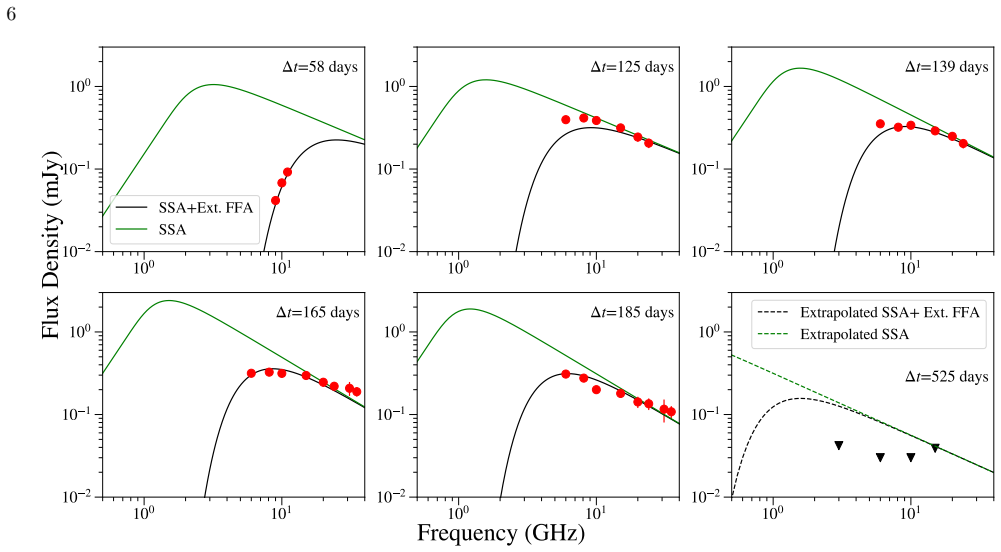
The radio light curve of SN 2023fyq is produced by synchrotron emission from the supernova shock interacting with a circumstellar shell of density about 10 to the minus 18 grams per cubic centimeter at 10 to the 16 centimeters. This corresponds to a mass-loss rate of 4 times 10 to the minus 3 solar masses per year for a 1700 km/s wind between 0.7 and 3 years before explosion. Non-detections at later times and in X-rays require lower density beyond 2 times 10 to the 16 centimeters, consistent with a shell-like structure whose properties align with merger-driven mass loss.
What carries the argument
Synchrotron radiation attenuated by free-free absorption in a wind or shell-like circumstellar medium whose density is fitted to the radio light curve.
If this is right
- Mass loss at the inferred rate occurred in the same 0.7-to-3-year window as the pre-explosion optical outbursts.
- The circumstellar material forms a shell extending from roughly 4 times 10 to the 15 to 2 times 10 to the 16 centimeters rather than extending indefinitely as a steady wind.
- The shell density and extent are roughly consistent with numerical predictions for a binary merger progenitor.
- Similar radio monitoring of additional Type Ibn events can map the radial extent and total mass of their helium-rich envelopes.
Where Pith is reading between the lines
- If the shell is merger ejecta, then the same progenitor channel may operate in other stripped-envelope supernovae that show brief pre-explosion activity.
- Multi-frequency radio campaigns starting within weeks of explosion could resolve whether the inner boundary of the shell is sharply defined or smoothed by earlier winds.
- X-ray and radio non-detections together already limit any ongoing wind beyond the shell; continued monitoring would tighten the upper bound on residual mass loss.
Load-bearing premise
The observed radio light curve arises from a spherically symmetric circumstellar medium whose density can be described by a steady wind or finite shell, with the wind speed measured in optical spectra applying at radio-emitting radii.
What would settle it
A radio detection at 525 days or later with flux above the reported upper limits would require either higher density at large radii or a different absorption mechanism, falsifying the finite shell interpretation.
Figures




read the original abstract
Supernovae that interact with hydrogen-poor, helium-rich circumstellar material (CSM), known as Type Ibn supernovae (SNe Ibn), present a unique opportunity to probe mass-loss processes in massive stars. In this work, we report the first radio detection of a SN Ibn, SN 2023fyq, and characterize the mass-loss history of its stellar progenitor using the radio and X-ray observations obtained over 18 months post-explosion. We find that the radio emission from 58--185 days is best modeled by synchrotron radiation attenuated by free-free absorption from a CSM of density $\sim$ $10^{-18}$ g/$\rm{cm^{3}}$ ($\sim 10^{6} \mathrm{\rho_{ISM}}$) at a radius of $10^{16}$ cm, corresponding to a mass-loss rate of $\sim$ $4 \times 10^{-3} \ \mathrm{M_{\odot} \ yr^{-1}}$ (for a wind velocity of 1700 km/s from optical spectroscopy) from 0.7 to 3 years before the explosion. This timescale is consistent with the time frame over which pre-explosion optical outbursts were observed. However, our late-time observations at 525 days post-explosion yield non-detections, and the 3$\sigma$ upper limits (along with an X-ray non-detection) allow us to infer lower-density CSM at $2\times 10^{16}$ cm with $\rm{\dot{M}}$ $< 2.5\times 10^{-3} \ \mathrm{M_{\odot} \ yr^{-1}}$. These results suggest a shell-like CSM from at most $4 \times 10^{15}$ to $2 \times 10^{16}$ cm ($\sim 10^{5} R_{\rm{\odot}}$) with an elevated CSM density (0.004 $\mathrm{M_{\odot} \ yr^{-1}}$) that is roughly consistent with predictions from a merger model for this object. Future radio observations of a larger sample of SNe Ibn will provide key details on the extent and density of their helium-rich CSM.
Editorial analysis
A structured set of objections, weighed in public.
Referee Report
Summary. The manuscript reports the first radio detection of the Type Ibn supernova SN 2023fyq. Radio observations from 58 to 185 days post-explosion are modeled as synchrotron emission attenuated by free-free absorption in a CSM with density ~10^{-18} g cm^{-3} at a radius of 10^{16} cm. This yields a mass-loss rate of ~4 x 10^{-3} M_sun yr^{-1} (assuming v_wind = 1700 km/s from optical spectra) over 0.7-3 years pre-explosion. Late-time non-detections at 525 days, combined with an X-ray non-detection, imply lower CSM density at ~2 x 10^{16} cm with Mdot < 2.5 x 10^{-3} M_sun yr^{-1}, suggesting a shell-like structure consistent with a merger origin.
Significance. If the modeling is robust, this provides the first radio-derived constraints on the mass-loss history of a SN Ibn progenitor in the years before explosion. The inferred dense, shell-like CSM and elevated mass-loss rate offer quantitative support for merger-driven scenarios and demonstrate the diagnostic power of radio observations for probing pre-explosion outbursts in helium-rich environments.
major comments (2)
- [Radio modeling and mass-loss derivation (abstract and associated sections)] The conversion of fitted CSM density to mass-loss rate uses Mdot = 4 pi r^2 rho v_wind with v_wind = 1700 km/s taken from optical spectroscopy. For the shell-like CSM structure proposed in the paper (from a merger or outburst), the ejection velocity at radio radii (~10^{16} cm) could be substantially lower, which would scale the inferred Mdot proportionally and weaken the claimed consistency with merger models. This assumption is load-bearing for the quantitative central claim and the interpretation of late-time upper limits.
- [Late-time observations and upper-limit analysis] The 3 sigma upper limits from the 525-day non-detection are used to infer a density drop and Mdot < 2.5 x 10^{-3} M_sun yr^{-1} at 2 x 10^{16} cm. The manuscript should explicitly detail the statistical procedure for these limits, including how uncertainties in synchrotron parameters, free-free absorption, and possible deviations from spherical symmetry are propagated.
minor comments (2)
- [Abstract] The abstract and text use slightly inconsistent notation for density units (g/cm^3 vs g cm^{-3}); standardize for clarity.
- [Observations section] Add a brief description of the radio data reduction, calibration, and any systematic checks performed, to support reproducibility of the light-curve points used in the fit.
Simulated Author's Rebuttal
We thank the referee for their careful reading and constructive comments, which have prompted us to clarify key aspects of our analysis. Below we respond point by point to the major comments. We have revised the manuscript to incorporate additional discussion and methodological details where appropriate.
read point-by-point responses
-
Referee: [Radio modeling and mass-loss derivation (abstract and associated sections)] The conversion of fitted CSM density to mass-loss rate uses Mdot = 4 pi r^2 rho v_wind with v_wind = 1700 km/s taken from optical spectroscopy. For the shell-like CSM structure proposed in the paper (from a merger or outburst), the ejection velocity at radio radii (~10^{16} cm) could be substantially lower, which would scale the inferred Mdot proportionally and weaken the claimed consistency with merger models. This assumption is load-bearing for the quantitative central claim and the interpretation of late-time upper limits.
Authors: The 1700 km/s value is taken directly from the narrow-line velocities measured in the optical spectra, which trace the kinematics of the CSM at the radii where the supernova shock is interacting. For a discrete shell ejected during a pre-explosion outburst, this velocity corresponds to the shell's expansion speed, and the radio-emitting region at ~10^{16} cm is consistent with the time since ejection when this speed is adopted. We acknowledge that a lower ejection velocity would proportionally reduce the derived Mdot and shift the inferred ejection epoch earlier. In the revised manuscript we add an explicit paragraph discussing the velocity uncertainty, the range of plausible values consistent with both optical data and merger models, and the resulting factor-of-a-few uncertainty on Mdot. The central conclusion of a dense, shell-like CSM remains unchanged, but the quantitative comparison to merger predictions is now presented with this caveat. revision: partial
-
Referee: [Late-time observations and upper-limit analysis] The 3 sigma upper limits from the 525-day non-detection are used to infer a density drop and Mdot < 2.5 x 10^{-3} M_sun yr^{-1} at 2 x 10^{16} cm. The manuscript should explicitly detail the statistical procedure for these limits, including how uncertainties in synchrotron parameters, free-free absorption, and possible deviations from spherical symmetry are propagated.
Authors: We agree that the statistical basis for the late-time upper limits should be stated more explicitly. In the revised manuscript we expand the relevant methods and results section to describe: (i) the 3σ flux upper-limit calculation from the non-detection, (ii) the forward-modeling approach used to convert this limit into a CSM density constraint while marginalizing over the synchrotron spectral index and normalization within their posterior ranges, and (iii) the treatment of free-free absorption optical depth. We also add a short paragraph noting that deviations from spherical symmetry would primarily affect the absolute normalization rather than the relative density drop between the early and late epochs. The combined radio and X-ray non-detections still robustly indicate a lower-density region beyond ~2×10^{16} cm. revision: yes
Circularity Check
No circularity: mass-loss rate uses independent optical velocity
full rationale
The paper fits CSM density from synchrotron plus free-free absorption modeling of the radio light curve at 58-185 days, then computes mass-loss rate via the standard relation Mdot = 4 pi r^2 rho v_wind using v_wind = 1700 km/s measured independently from optical spectra. This is a direct application of an external measurement rather than a self-definition, fitted parameter renamed as prediction, or self-citation chain. Late-time upper limits are interpreted as a density drop without reducing to the same inputs by construction. The central claim remains independent of its own fitted values and does not invoke author-specific uniqueness theorems or smuggled ansatzes.
Axiom & Free-Parameter Ledger
free parameters (2)
- CSM density at 10^16 cm =
~10^{-18} g cm^{-3}
- Mass-loss rate =
~4 x 10^{-3} M_sun yr^{-1}
axioms (2)
- domain assumption Radio emission arises from synchrotron radiation produced by electrons accelerated at the supernova shock front.
- domain assumption Free-free absorption is the dominant mechanism attenuating the radio emission at early times.
Lean theorems connected to this paper
-
IndisputableMonolith/Cost/FunctionalEquationwashburn_uniqueness_aczel unclear?
unclearRelation between the paper passage and the cited Recognition theorem.
radio emission ... best modeled by synchrotron radiation attenuated by free-free absorption from a CSM of density ~10^{-18} g cm^{-3} ... mass-loss rate of ~4 x 10^{-3} M_sun yr^{-1} (for v_wind = 1700 km/s)
What do these tags mean?
- matches
- The paper's claim is directly supported by a theorem in the formal canon.
- supports
- The theorem supports part of the paper's argument, but the paper may add assumptions or extra steps.
- extends
- The paper goes beyond the formal theorem; the theorem is a base layer rather than the whole result.
- uses
- The paper appears to rely on the theorem as machinery.
- contradicts
- The paper's claim conflicts with a theorem or certificate in the canon.
- unclear
- Pith found a possible connection, but the passage is too broad, indirect, or ambiguous to say the theorem truly supports the claim.
Reference graph
Works this paper leans on
-
[1]
Arnaud, K. A. 1996, in Astronomical Society of the Pacific Conference Series, Vol. 101, Astronomical Data Analysis Software and Systems V, ed. G. H. Jacoby & J. Barnes, 17 Astropy Collaboration, Robitaille, T. P., Tollerud, E. J., et al. 2013, A&A, 558, A33, doi: 10.1051/0004-6361/201322068 14 T able 2.The radio dataset obtained of SN 2023fyq. Telescope D...
-
[2]
2025, ApJ, 983, 101, doi: 10.3847/1538-4357/adc00a
Baer-Way, R., Chandra, P., Modjaz, M., et al. 2025, ApJ, 983, 101, doi: 10.3847/1538-4357/adc00a
-
[3]
Bietenholz, M. F., Bartel, N., Argo, M., et al. 2021, ApJ, 908, 75, doi: 10.3847/1538-4357/abccd9
-
[4]
2015, MNRAS, 450, 246, doi: 10.1093/mnras/stv566
Bilinski, C., Smith, N., Li, W., et al. 2015, MNRAS, 450, 246, doi: 10.1093/mnras/stv566
-
[5]
J., Sollerman, J., Irani, I., et al
Brennan, S. J., Sollerman, J., Irani, I., et al. 2024, A&A, 684, L18, doi: 10.1051/0004-6361/202449350
-
[6]
Brethauer, D., Margutti, R., Milisavljevic, D., et al. 2022, ApJ, 939, 105, doi: 10.3847/1538-4357/ac8b14
-
[7]
2018, SSRv, 214, 27, doi: 10.1007/s11214-017-0461-6
Chandra, P. 2018, SSRv, 214, 27, doi: 10.1007/s11214-017-0461-6
-
[8]
A., Chugai, N., Milisavljevic, D., & Fransson, C
Chandra, P., Chevalier, R. A., Chugai, N., Milisavljevic, D., & Fransson, C. 2020, ApJ, 902, 55, doi: 10.3847/1538-4357/abb460
-
[9]
Chevalier, R. A. 1982, ApJ, 259, 302, doi: 10.1086/160167 —. 1998, ApJ, 499, 810, doi: 10.1086/305676
-
[11]
1986, ARA&A, 24, 329, doi: 10.1146/annurev.aa.24.090186.001553
Chiosi, C., & Maeder, A. 1986, ARA&A, 24, 329, doi: 10.1146/annurev.aa.24.090186.001553
-
[12]
2024, ApJ, 977, 254, doi: 10.3847/1538-4357/ad8de6
Dong, Y., Tsuna, D., Valenti, S., et al. 2024, ApJ, 977, 254, doi: 10.3847/1538-4357/ad8de6
-
[13]
Dwarkadas, V. V. 2025, Universe, 11, 161, doi: 10.3390/universe11050161
-
[14]
2016, MNRAS, 463, 3894, doi: 10.1093/mnras/stw2253
Elias-Rosa, N., Pastorello, A., Benetti, S., et al. 2016, MNRAS, 463, 3894, doi: 10.1093/mnras/stw2253
-
[15]
J., Smith, N., Ganeshalingam, M., et al
Foley, R. J., Smith, N., Ganeshalingam, M., et al. 2007, ApJL, 657, L105, doi: 10.1086/513145
-
[16]
Foreman-Mackey, D., Hogg, D. W., Lang, D., & Goodman, J. 2013, PASP, 125, 306, doi: 10.1086/670067
-
[17]
Fransson, C., Lundqvist, P., & Chevalier, R. A. 1996, ApJ, 461, 993, doi: 10.1086/177119
-
[18]
Fruscione, A., McDowell, J. C., Allen, G. E., et al. 2006, in Society of Photo-Optical Instrumentation Engineers (SPIE) Conference Series, Vol. 6270, Observatory Operations: Strategies, Processes, and Systems, ed. D. R. Silva & R. E. Doxsey, 62701V, doi: 10.1117/12.671760
-
[19]
Gagliano, A., Berger, E., Villar, V. A., et al. 2025, ApJ, 978, 110, doi: 10.3847/1538-4357/ad9748 Gaia Collaboration, Vallenari, A., Brown, A. G. A., et al. 2023, A&A, 674, A1, doi: 10.1051/0004-6361/202243940
-
[21]
2020, ApJ, 889, 170, doi: 10.3847/1538-4357/ab6328
Gangopadhyay, A., Misra, K., Hiramatsu, D., et al. 2020, ApJ, 889, 170, doi: 10.3847/1538-4357/ab6328
-
[22]
Gediman, B., Miller, J. M., Zoghbi, A., et al. 2024, ApJ, 966, 57, doi: 10.3847/1538-4357/ad2fa3
-
[23]
2004, ApJ, 611, 1005, doi: 10.1086/422091
Gehrels, N., Chincarini, G., Giommi, P., et al. 2004, ApJ, 611, 1005, doi: 10.1086/422091
-
[24]
2024, ApJ, 976, 10, doi: 10.3847/1538-4357/ad7c4c
Gupta, S., Caprioli, D., & Spitkovsky, A. 2024, ApJ, 976, 10, doi: 10.3847/1538-4357/ad7c4c G¨ uver, T., &¨Ozel, F. 2009, MNRAS, 400, 2050, doi: 10.1111/j.1365-2966.2009.15598.x
-
[25]
Ho, A. Y. Q., Perley, D. A., Gal-Yam, A., et al. 2023, ApJ, 949, 120, doi: 10.3847/1538-4357/acc533
-
[26]
Hosseinzadeh, G., Arcavi, I., Valenti, S., et al. 2017, ApJ, 836, 158, doi: 10.3847/1538-4357/836/2/158
-
[27]
2008, ApJL, 674, L85, doi: 10.1086/529373 Jacobson-Gal´ an, W
Immler, S., Modjaz, M., Landsman, W., et al. 2008, ApJL, 674, L85, doi: 10.1086/529373 Jacobson-Gal´ an, W. V., Dessart, L., Jones, D. O., et al. 2022, ApJ, 924, 15, doi: 10.3847/1538-4357/ac3f3a Jacobson-Gal´ an, W. V., Dessart, L., Davis, K. W., et al. 2024, ApJ, 970, 189, doi: 10.3847/1538-4357/ad4a2a
-
[28]
Kale, R., & Ishwara-Chandra, C. H. 2021, Experimental Astronomy, 51, 95, doi: 10.1007/s10686-020-09677-6
-
[29]
Khakpash, S., Bianco, F. B., Modjaz, M., et al. 2024, ApJS, 275, 37, doi: 10.3847/1538-4365/ad7eaa
-
[30]
C., Karamehmetoglu, E., Sollerman, J., et al
Kool, E. C., Karamehmetoglu, E., Sollerman, J., et al. 2021, A&A, 652, A136, doi: 10.1051/0004-6361/202039137
-
[31]
2012, ARA&A, 50, 107, doi: 10.1146/annurev-astro-081811-125534
Langer, N. 2012, ARA&A, 50, 107, doi: 10.1146/annurev-astro-081811-125534
-
[32]
1991, ApJ, 380, 575, doi: 10.1086/170615
Lundqvist, P., & Fransson, C. 1991, ApJ, 380, 575, doi: 10.1086/170615
-
[33]
Maeda, K., & Moriya, T. J. 2022, ApJ, 927, 25, doi: 10.3847/1538-4357/ac4672
-
[34]
Maeda, K., Nozawa, T., Sahu, D. K., et al. 2013, ApJ, 776, 5, doi: 10.1088/0004-637X/776/1/5
-
[35]
2017, ApJ, 835, 140, doi: 10.3847/1538-4357/835/2/140
Margutti, R., Kamble, A., Milisavljevic, D., et al. 2017, ApJ, 835, 140, doi: 10.3847/1538-4357/835/2/140
-
[36]
Matheson, T., Filippenko, A. V., Chornock, R., Leonard, D. C., & Li, W. 2000, AJ, 119, 2303, doi: 10.1086/301352
-
[37]
2007, in Astronomical Society of the Pacific Conference Series, Vol
Golap, K. 2007, in Astronomical Society of the Pacific Conference Series, Vol. 376, Astronomical Data Analysis Software and Systems XVI, ed. R. A. Shaw, F. Hill, & D. J. Bell, 127
work page 2007
-
[38]
Modjaz, M., Guti´ errez, C. P., & Arcavi, I. 2019, Nature Astronomy, 3, 717, doi: 10.1038/s41550-019-0856-2
-
[39]
Moriya, T. J., & Maeda, K. 2016, ApJ, 824, 100, doi: 10.3847/0004-637X/824/2/100 16 Nasa High Energy Astrophysics Science Archive Research Center (Heasarc). 2014, HEAsoft: Unified Release of FTOOLS and XANADU, Astrophysics Source Code Library, record ascl:1408.004
-
[40]
J., Margutti, R., Wiston, E., et al
Nayana, A. J., Margutti, R., Wiston, E., et al. 2025, ApJ, 985, 51, doi: 10.3847/1538-4357/adc2fb
-
[41]
Ofek, E. O., Sullivan, M., Cenko, S. B., et al. 2013, Nature, 494, 65, doi: 10.1038/nature11877
-
[42]
Ofek, E. O., Sullivan, M., Shaviv, N. J., et al. 2014, ApJ, 789, 104, doi: 10.1088/0004-637X/789/2/104
-
[43]
Pacholczyk, A. G. 1970, Radio astrophysics. Nonthermal processes in galactic and extragalactic sources
work page 1970
-
[44]
2015, PhRvL, 114, 085003, doi: 10.1103/PhysRevLett.114.085003
Park, J., Caprioli, D., & Spitkovsky, A. 2015, Phys. Rev. Lett., 114, 085003, doi: 10.1103/PhysRevLett.114.085003
-
[45]
Pastorello, A., Mattila, S., Zampieri, L., et al. 2008, MNRAS, 389, 113, doi: 10.1111/j.1365-2966.2008.13602.x
-
[46]
Pastorello, A., Botticella, M. T., Trundle, C., et al. 2010, MNRAS, 408, 181, doi: 10.1111/j.1365-2966.2010.17142.x
-
[47]
2013, ApJ, 767, 1, doi: 10.1088/0004-637X/767/1/1
Pastorello, A., Cappellaro, E., Inserra, C., et al. 2013, ApJ, 767, 1, doi: 10.1088/0004-637X/767/1/1
-
[48]
Pastorello, A., Wang, X. F., Ciabattari, F., et al. 2016, MNRAS, 456, 853, doi: 10.1093/mnras/stv2634
-
[49]
Pellegrino, C., Howell, D. A., Vink´ o, J., et al. 2022, ApJ, 926, 125, doi: 10.3847/1538-4357/ac3e63
-
[50]
2024, ApJ, 977, 2, doi: 10.3847/1538-4357/ad8bc5
Pellegrino, C., Modjaz, M., Takei, Y., et al. 2024, ApJ, 977, 2, doi: 10.3847/1538-4357/ad8bc5
-
[51]
A., Fremling, C., Sollerman, J., et al
Perley, D. A., Fremling, C., Sollerman, J., et al. 2020, ApJ, 904, 35, doi: 10.3847/1538-4357/abbd98
-
[52]
Puls, J., Vink, J. S., & Najarro, F. 2008, A&A Rv, 16, 209, doi: 10.1007/s00159-008-0015-8
-
[53]
2020, A&A, 640, A56, doi: 10.1051/0004-6361/202037710
Renzo, M., Farmer, R., Justham, S., et al. 2020, A&A, 640, A56, doi: 10.1051/0004-6361/202037710
-
[54]
Rybicki, G. B., & Lightman, A. P. 1979, Radiative processes in astrophysics
work page 1979
-
[55]
Sanders, N. E., Soderberg, A. M., Foley, R. J., et al. 2013, ApJ, 769, 39, doi: 10.1088/0004-637X/769/1/39
-
[56]
Sargent, A. J., Fischer, T. C., Johnson, M. C., et al. 2024, ApJ, 961, 230, doi: 10.3847/1538-4357/ad11d4 Schrøder, S. L., MacLeod, M., Loeb, A., Vigna-G´ omez, A., & Mandel, I. 2020, ApJ, 892, 13, doi: 10.3847/1538-4357/ab7014
-
[57]
Shivvers, I., Zheng, W., Van Dyk, S. D., et al. 2017, MNRAS, 471, 4381, doi: 10.1093/mnras/stx1885
-
[58]
2014, ARA&A, 52, 487, doi: 10.1146/annurev-astro-081913-040025
Smith, N. 2014, ARA&A, 52, 487, doi: 10.1146/annurev-astro-081913-040025
-
[59]
2017, in Handbook of Supernovae, ed
Smith, N. 2017, Interacting Supernovae: Types IIn and Ibn (Springer International Publishing), 403–429, doi: 10.1007/978-3-319-21846-5 38
-
[60]
Smith, N., Foley, R. J., & Filippenko, A. V. 2008, ApJ, 680, 568, doi: 10.1086/587860
-
[61]
Smith, N., Silverman, J. M., Chornock, R., et al. 2009, ApJ, 695, 1334, doi: 10.1088/0004-637X/695/2/1334
-
[62]
2006, The Astronomer’s Telegram, 917, 1
Soderberg, A. 2006, The Astronomer’s Telegram, 917, 1
work page 2006
-
[63]
Frail, D. A. 2006, ApJ, 651, 1005, doi: 10.1086/507571
-
[64]
Strotjohann, N. L., Ofek, E. O., Gal-Yam, A., et al. 2021, ApJ, 907, 99, doi: 10.3847/1538-4357/abd032
-
[65]
2008, ApJ, 687, 1208, doi: 10.1086/591782
Tominaga, N., Limongi, M., Suzuki, T., et al. 2008, ApJ, 687, 1208, doi: 10.1086/591782
-
[66]
2025, arXiv e-prints, arXiv:2508.21116, doi: 10.48550/arXiv.2508.21116
Tsuna, D., Fuller, J., & Lu, W. 2025, arXiv e-prints, arXiv:2508.21116, doi: 10.48550/arXiv.2508.21116
-
[67]
Tsuna, D., Wu, S. C., Fuller, J., Dong, Y., & Piro, A. L. 2024, The Open Journal of Astrophysics, 7, 82, doi: 10.33232/001c.123897
-
[68]
Weiler, K. W., Panagia, N., Montes, M. J., & Sramek, R. A. 2002, ARA&A, 40, 387, doi: 10.1146/annurev.astro.40.060401.093744
-
[69]
Weiler, K. W., Sramek, R. A., Panagia, N., van der Hulst, J. M., & Salvati, M. 1986, ApJ, 301, 790, doi: 10.1086/163944
-
[70]
Woosley, S. E. 2017, ApJ, 836, 244, doi: 10.3847/1538-4357/836/2/244
-
[71]
Woosley, S. E., Langer, N., & Weaver, T. A. 1993, ApJ, 411, 823, doi: 10.1086/172886
-
[72]
Wu, S. C., & Fuller, J. 2022, ApJL, 940, L27, doi: 10.3847/2041-8213/ac9b3d
-
[73]
Wu, S. C., & Tsuna, D. 2025, arXiv e-prints, arXiv:2507.19613, doi: 10.48550/arXiv.2507.19613
discussion (0)
Sign in with ORCID, Apple, or X to comment. Anyone can read and Pith papers without signing in.