Constraining Gas Mass Fractions in Galaxy Groups and Clusters with the First CHIME/FRB Outrigger
Pith reviewed 2026-05-18 17:41 UTC · model grok-4.3
The pith
Fast radio bursts passing through galaxy groups and clusters constrain their gas mass fractions by matching dispersion measures to halo models.
A machine-rendered reading of the paper's core claim, the machinery that carries it, and where it could break.
Core claim
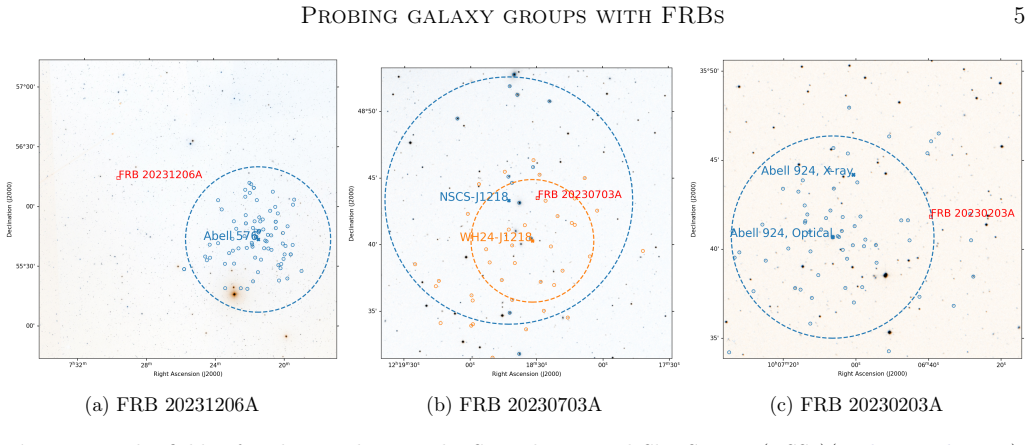
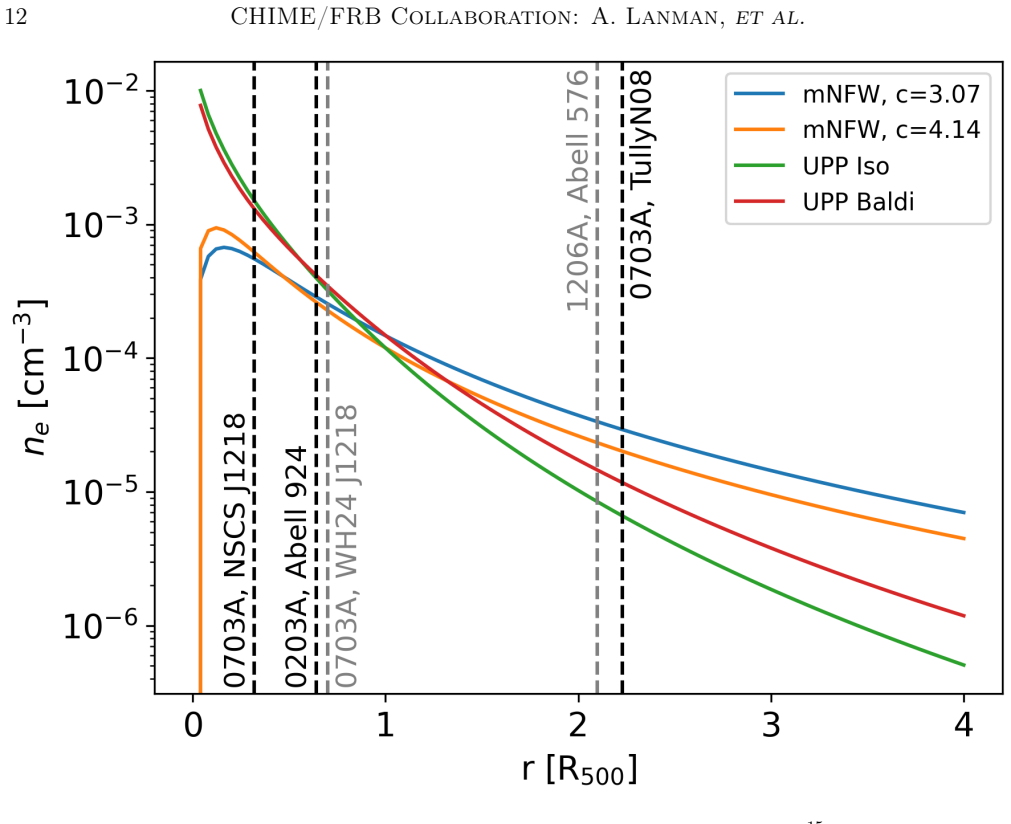
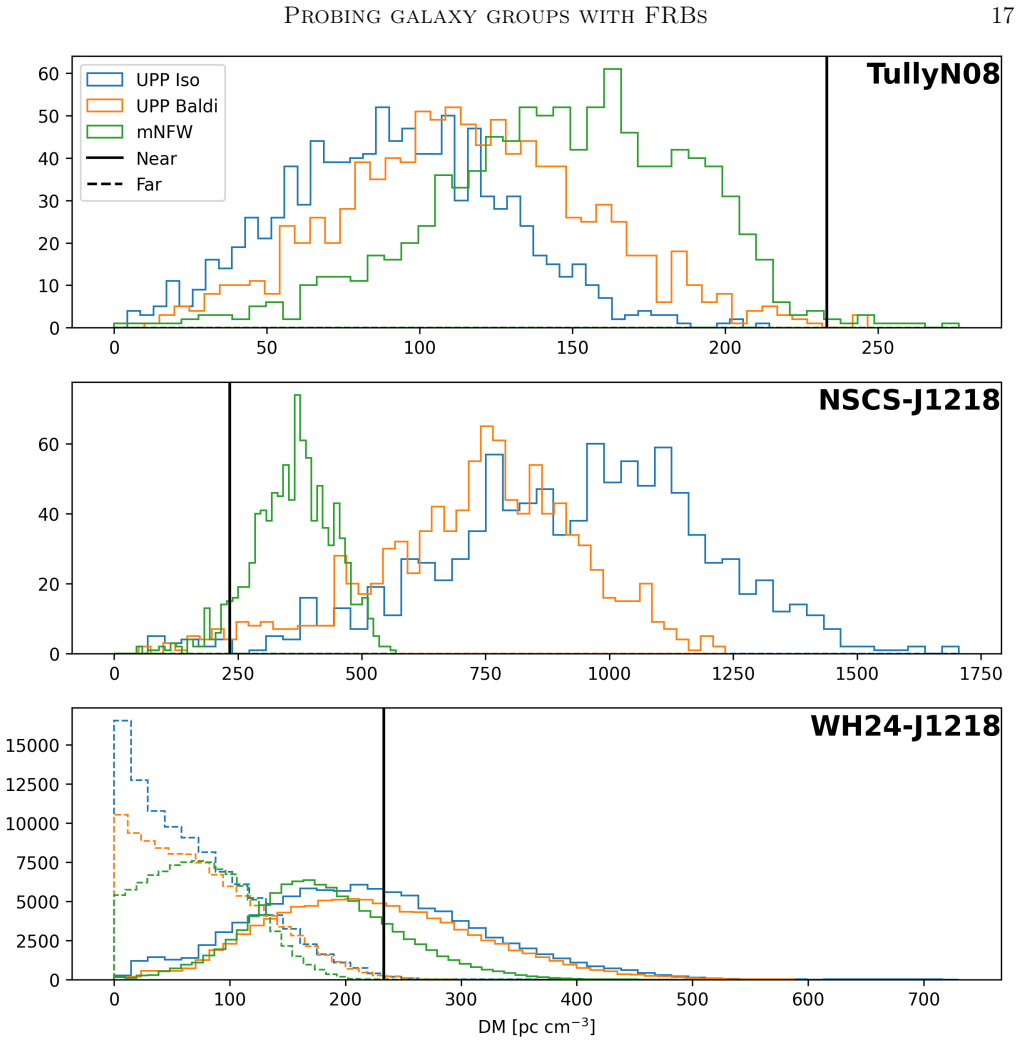
Three fast radio bursts from the first CHIME/FRB Outrigger sample have host galaxies within or behind galaxy clusters and groups. The contribution to their dispersion measures from the intragroup or intracluster medium is calculated by integrating various halo density profiles, with uncertainties from halo mass and host distance included. For the higher mass systems, these predicted DM values align with the remaining extragalactic DM. In the case of FRB 20230703A intersecting multiple groups with a low total DM, this comparison yields constraints on the gas mass fraction f_g as a function of radius, which agree with recent eROSITA findings at R_500 while showing mild tension at R_200 with X-
What carries the argument
Dispersion measure from fast radio bursts, integrated along the line of sight through halo density profiles, to constrain gas mass fraction f_g(R).
Load-bearing premise
Halo mass estimates and the line-of-sight distances to the host galaxies must be known with sufficient precision that their uncertainties do not dominate the dispersion measure budget.
What would settle it
A new FRB with accurately determined host redshift and associated halo mass whose measured dispersion measure falls well outside the predicted range from the gas fraction models would falsify the current constraints.
Figures




read the original abstract
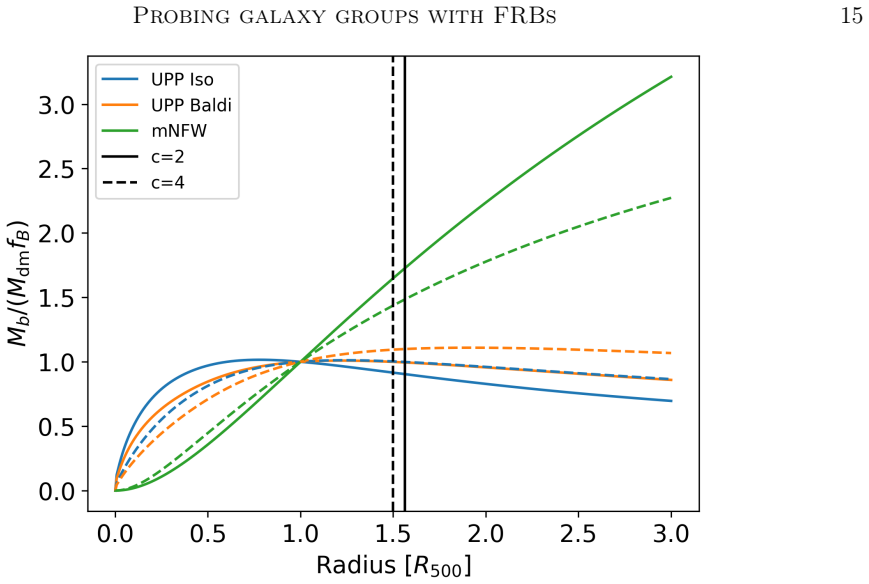
In recent years, localized fast radio bursts (FRBs) have emerged as a powerful tool to study the structure of the baryonic matter in the universe. Their dispersion measures (DMs) scale linearly with electron density independent of gas temperature, making them particularly well suited to studying the intragroup medium (IGrM), where traditional probes such as X-ray emission and the SZ effect are weak. Evidence suggests that the gas in group mass halos ($M_{500}$ ~ $10^{13}$ -- $10^{14}$ M$_\odot$) is strongly affected by galactic feedback, causing deviations from cluster scaling relations. Three FRBs from the first CHIME/FRB Outrigger sample come from host galaxies found within or behind galaxy clusters and groups. We estimate the DM contribution of each ICM/IGrM by integrating different halo density profiles, accounting for uncertainties in halo mass and the host galaxy line of sight distance. For the more massive halos, predicted cluster DMs agree with the extragalactic DM budget. One burst, FRB 20230703A, intersects three groups yet has a low extragalactic DM. By comparing model predictions with the measured DM, we constrain the gas mass fraction $f_g(R)$ in these halos. Comparing with published $M$--$f_g$ relations, we find consistency with recent eROSITA results at $R_{500}$ and mild tension at $R_{200}$ and with earlier X-ray--based relations. As CHIME/FRB Outriggers build a large catalog of localized FRBs, many additional sightlines through groups and clusters will be obtained. These will enable systematic tests of intragroup and intracluster gas properties and sharpen constraints on the distribution of baryons in massive halos.
Editorial analysis
A structured set of objections, weighed in public.
Referee Report
Summary. The manuscript uses localized FRBs from the CHIME/FRB Outrigger sample to probe the intragroup/intracluster medium. Focusing on FRB 20230703A, whose sightline intersects three groups, the authors integrate halo density profiles (normalized by gas mass fraction f_g) to predict the dispersion measure contribution, incorporating uncertainties in halo mass and line-of-sight host distance. They then compare the modeled DM to the observed extragalactic DM to derive constraints on f_g(R) at R_500 and R_200, finding consistency with recent eROSITA M–f_g relations at R_500 and mild tension at R_200 (as well as with earlier X-ray relations). The work positions FRBs as a complementary probe for lower-mass halos where feedback effects are prominent and anticipates larger samples for systematic tests.
Significance. If the modeling and uncertainty propagation are robust, the result provides an independent, temperature-insensitive constraint on baryonic content in group-scale halos, where X-ray and SZ signals are weak. This is a genuine strength: the approach is falsifiable with future localized FRBs and directly tests deviations from self-similar scaling due to feedback. The explicit use of multiple density profiles and external mass priors is noted as a transparent choice.
major comments (1)
- [Section describing FRB 20230703A modeling and f_g derivation] The central claim (constraining f_g(R) and reporting consistency/tension with eROSITA) rests on the DM comparison for FRB 20230703A. Because predicted DM scales linearly with f_g × M_halo and the path length through the halo depends on the precise impact parameter and host distance, the manuscript must demonstrate that the full 0.2–0.5 dex uncertainties on published M_500/M_200 and the line-of-sight geometry are propagated into the allowed f_g interval (e.g., via Monte Carlo sampling of the posterior). If these are treated only as fixed values or partial ranges, the reported mild tension at R_200 cannot be distinguished from the null case of an uninformative constraint.
minor comments (2)
- [Abstract and methods] The abstract states that uncertainties in halo mass and host distance are accounted for, but a short methods paragraph or appendix table listing the adopted priors, integration limits, and density-profile variants (e.g., NFW vs. beta-model) would improve reproducibility.
- [Results section on FRB 20230703A] Figure or table presenting the DM budget breakdown (host, IGM, halo contributions) for FRB 20230703A would help readers assess whether the group DM is the dominant term or whether other components could absorb the tension.
Simulated Author's Rebuttal
We thank the referee for their careful reading of the manuscript and for the constructive feedback. We address the major comment in detail below, clarifying our approach to uncertainty propagation while agreeing to improve the presentation in revision.
read point-by-point responses
-
Referee: [Section describing FRB 20230703A modeling and f_g derivation] The central claim (constraining f_g(R) and reporting consistency/tension with eROSITA) rests on the DM comparison for FRB 20230703A. Because predicted DM scales linearly with f_g × M_halo and the path length through the halo depends on the precise impact parameter and host distance, the manuscript must demonstrate that the full 0.2–0.5 dex uncertainties on published M_500/M_200 and the line-of-sight geometry are propagated into the allowed f_g interval (e.g., via Monte Carlo sampling of the posterior). If these are treated only as fixed values or partial ranges, the reported mild tension at R_200 cannot be distinguished from the null case of an uninformative constraint.
Authors: We thank the referee for this important clarification request. The manuscript does propagate the full uncertainties on halo mass (0.2–0.5 dex) and line-of-sight geometry when deriving the f_g constraints. We sample M_500 and M_200 from the published posterior distributions (or uniform ranges spanning the quoted uncertainties when posteriors are unavailable), and we vary the impact parameter and host distance within the geometric bounds allowed by the observed host redshift and the group/cluster positions. These samples are used to compute a distribution of predicted DM contributions for each trial value of f_g; the resulting DM distribution is then compared to the measured extragalactic DM to obtain the posterior on f_g at R_500 and R_200. The reported mild tension at R_200 persists after this marginalization: even when halo masses are drawn from the upper end of their uncertainty ranges, the median predicted DM still exceeds the observed value for f_g values that match the eROSITA relation at R_500. To make this procedure fully transparent, we will expand the methods section with an explicit description of the Monte Carlo sampling, report the number of samples used, and add a supplementary figure showing example DM distributions before and after marginalization. revision: partial
Circularity Check
No significant circularity; constraints derived from independent FRB DM data and external profiles
full rationale
The paper's central derivation integrates literature halo density profiles (normalized by gas mass fraction f_g and halo mass M_halo) along the line of sight to predict DM contributions, then compares these predictions to the observed extragalactic DM for FRB 20230703A and other events while propagating uncertainties in M_halo and host distance. The resulting allowed f_g(R) intervals at R_500 and R_200 are checked against published external M--f_g relations from eROSITA and X-ray studies. No quoted step equates a model prediction to its own fitted input by construction, invokes a self-citation as the sole justification for a uniqueness claim, or renames an internal fit as an independent result. The chain remains self-contained because the DM measurement and external density profiles supply independent inputs that are not redefined in terms of the output f_g constraints.
Axiom & Free-Parameter Ledger
axioms (2)
- domain assumption Standard halo density profiles (e.g., NFW or beta-model) accurately describe the intragroup and intracluster gas distribution for DM integration.
- domain assumption Halo masses and host-galaxy line-of-sight distances can be estimated with uncertainties that do not overwhelm the extragalactic DM signal.
Forward citations
Cited by 3 Pith papers
-
The limits of feedback from active galactic nuclei
AGN feedback creates a mass-independent entropy ceiling that allows outflows to escape halos only below M_200m = 10^13.7 M_sun, explaining depleted gas in groups versus near-cosmic fractions in clusters.
-
Great Walls of Cosmic Baryons in the Northern Sky
FRB dispersion measures reveal a large-scale excess of ionized gas in the northern sky spatially aligned with the Ursa Major supercluster.
-
Probing Primordial Black Holes with upcoming Radio Telescopes: a case study for LOFAR2.0, FAST Core Array and BINGO
LOFAR2.0, FAST Core Array and BINGO can constrain the PBH dark matter fraction f_PBH below 0.16-0.39 for masses above 10^{-2} to 10 solar masses via FRB lensing statistics.
Reference graph
Works this paper leans on
-
[1]
- [1] #1 = = ^ ^ ^ .\!\!^ d .\!\!^ h .\!\!^ m .\!\!^ s .\!\!^ @mss
thebibliography [1] 20pt to REFERENCES 6pt =0pt 10pt plus 3pt =0pt =0pt =1pt plus 1pt =0pt =0pt -12pt =13pt plus 1pt =20pt =13pt plus 1pt \@M =10000 =-1.0em =0pt =0pt 0pt =0pt =1.0em @enumiv\@empty 10000 10000 `\.\@m \@noitemerr \@latex@warning Empty `thebibliography' environment \@ifnextchar \@reference \@latexerr Missing key on reference command Each re...
-
[2]
Abdullah , M. H., Wilson , G., & Klypin , A. 2018, , 861, 22, 10.3847/1538-4357/aac5db
-
[3]
Abdullah , M. H., Wilson , G., Klypin , A., et al. 2020, , 246, 2, 10.3847/1538-4365/ab536e
-
[4]
Abell , G. O., Corwin , Jr., H. G., & Olowin , R. P. 1989, , 70, 1, 10.1086/191333
-
[5]
Aggarwal , K., Budav \'a ri , T., Deller , A. T., et al. 2021, , 911, 95, 10.3847/1538-4357/abe8d2
-
[6]
Allen , S. W., Evrard , A. E., & Mantz , A. B. 2011, , 49, 409, 10.1146/annurev-astro-081710-102514
-
[7]
doi:10.1093/mnras/stae1954 , eprint =
Anderson , C. S., McClure-Griffiths , N. M., Rudnick , L., et al. 2024, , 533, 4068, 10.1093/mnras/stae1954
-
[8]
Arnaud , M., Pratt , G. W., Piffaretti , R., et al. 2010, , 517, A92, 10.1051/0004-6361/200913416
-
[9]
Astropy Collaboration , Robitaille , T. P., Tollerud , E. J., et al. 2013, , 558, A33, 10.1051/0004-6361/201322068
-
[10]
Astropy Collaboration , Price-Whelan , A. M., Sip o cz , B. M., et al. 2018, , 156, 123, 10.3847/1538-3881/aabc4f
-
[11]
Astropy Collaboration , Price-Whelan , A. M., Lim , P. L., et al. 2022, , 935, 167, 10.3847/1538-4357/ac7c74
work page internal anchor Pith review doi:10.3847/1538-4357/ac7c74 2022
-
[12]
2014, , 349, 415, 10.1007/s10509-013-1630-z
Babyk , I., & Vavilova , I. 2014, , 349, 415, 10.1007/s10509-013-1630-z
-
[13]
2012, , 545, A41, 10.1051/0004-6361/201219555
Baldi , A., Ettori , S., Molendi , S., & Gastaldello , F. 2012, , 545, A41, 10.1051/0004-6361/201219555
-
[14]
Baptista , J., Prochaska , J. X., Mannings , A. G., et al. 2024, , 965, 57, 10.3847/1538-4357/ad2705
-
[15]
2024, Physics of the Dark Universe, 45, 101526, 10.1016/j.dark.2024.101526
Barbosa , D., von Marttens , R., Gonzalez , J., & Alcaniz , J. 2024, Physics of the Dark Universe, 45, 101526, 10.1016/j.dark.2024.101526
-
[16]
Beck , R., & Gaensler , B. M. 2004, , 48, 1289, 10.1016/j.newar.2004.09.013
-
[17]
Borthakur , S., Yun , M. S., & Verdes-Montenegro , L. 2010, , 710, 385, 10.1088/0004-637X/710/1/385
-
[18]
Statistical Properties of X-ray Clusters: Analytic and Numerical Comparisons
Bryan , G. L., & Norman , M. L. 1998, , 495, 80, 10.1086/305262
work page internal anchor Pith review doi:10.1086/305262 1998
-
[19]
2025, arXiv e-prints, arXiv:2502.11217, 10.48550/arXiv.2502.11217
CHIME/FRB Collaboration , Amiri , M., Amouyal , D., et al. 2025, arXiv e-prints, arXiv:2502.11217, 10.48550/arXiv.2502.11217
-
[20]
2025, Nature Astronomy, 9, 1226, doi: 10.1038/s41550-025-02566-y 31
Connor , L., Ravi , V., Sharma , K., et al. 2025, Nature Astronomy, 10.1038/s41550-025-02566-y
-
[21]
NE2001.I. A New Model for the Galactic Distribution of Free Electrons and its Fluctuations
Cordes , J. M., & Lazio , T. J. W. 2002, arXiv e-prints, astro, 10.48550/arXiv.astro-ph/0207156
work page internal anchor Pith review Pith/arXiv arXiv doi:10.48550/arxiv.astro-ph/0207156 2002
-
[22]
2023, , 676, A127, 10.1051/0004-6361/202245308
Damsted , S., Finoguenov , A., Clerc , N., et al. 2023, , 676, A127, 10.1051/0004-6361/202245308
-
[23]
Dey , A., Schlegel , D. J., Lang , D., et al. 2019, , 157, 168, 10.3847/1538-3881/ab089d
-
[24]
Dupke , R. A., Mirabal , N., Bregman , J. N., & Evrard , A. E. 2007, , 668, 781, 10.1086/520708
-
[25]
Eckert , D., Gaspari , M., Gastaldello , F., Le Brun , A. M. C., & O'Sullivan , E. 2021, Universe, 7, 142, 10.3390/universe7050142
-
[26]
2024, , 683, A205, 10.1051/0004-6361/202348038
Epinat , B., Contini , T., Mercier , W., et al. 2024, , 683, A205, 10.1051/0004-6361/202348038
-
[27]
2009, , 501, 61, 10.1051/0004-6361/200810878
Ettori , S., Morandi , A., Tozzi , P., et al. 2009, , 501, 61, 10.1051/0004-6361/200810878
-
[28]
Evrard , A. E., Metzler , C. A., & Navarro , J. F. 1996, , 469, 494, 10.1086/177798
-
[29]
Faber , J. T., Ravi , V., Ocker , S. K., et al. 2024, arXiv e-prints, arXiv:2405.14182, 10.48550/arXiv.2405.14182
-
[30]
Ferreira , M., Holanda , R. F. L., Gonzalez , J. E., Cola c o , L. R., & Nunes , R. C. 2024, European Physical Journal C, 84, 1120, 10.1140/epjc/s10052-024-13468-0
-
[31]
Survey, catalog, and cosmology of the X-ray luminosity function
Finoguenov , A., Rykoff , E., Clerc , N., et al. 2020, , 638, A114, 10.1051/0004-6361/201937283
-
[32]
Flewelling , H. A., Magnier , E. A., Chambers , K. C., et al. 2020, , 251, 7, 10.3847/1538-4365/abb82d
-
[33]
Fukugita , M., Hogan , C. J., & Peebles , P. J. E. 1998, , 503, 518, 10.1086/306025
-
[34]
Ginsburg , A., Sip o cz , B. M., Brasseur , C. E., et al. 2019, , 157, 98, 10.3847/1538-3881/aafc33
-
[35]
1998, , 505, 74, 10.1086/306157
Girardi , M., Giuricin , G., Mardirossian , F., Mezzetti , M., & Boschin , W. 1998, , 505, 74, 10.1086/306157
-
[36]
Groener , A. M., Goldberg , D. M., & Sereno , M. 2016, , 455, 892, 10.1093/mnras/stv2341
-
[37]
Hou , A., Parker , L. C., Harris , W. E., & Wilman , D. J. 2009, , 702, 1199, 10.1088/0004-637X/702/2/1199
-
[38]
Hu , W., & Kravtsov , A. V. 2003, , 584, 702, 10.1086/345846
-
[39]
Huang , Y., Lee , K.-G., Libeskind , N. I., et al. 2025, , 538, 2785, 10.1093/mnras/staf417
-
[40]
Hussaini , M., Connor , L., Konietzka , R. M., et al. 2025, arXiv e-prints, arXiv:2506.04186, 10.48550/arXiv.2506.04186
-
[41]
arXiv: 2208.00819 [astro-ph.CO]
James , C. W., Ghosh , E. M., Prochaska , J. X., et al. 2022, , 516, 4862, 10.1093/mnras/stac2524
-
[42]
1986, , 222, 323, 10.1093/mnras/222.2.323
Kaiser , N. 1986, , 222, 323, 10.1093/mnras/222.2.323
-
[43]
Khrykin , I. S., Sorini , D., Lee , K.-G., & Dav \'e , R. 2024 a , , 529, 537, 10.1093/mnras/stae525
-
[44]
Khrykin , I. S., Ata , M., Lee , K.-G., et al. 2024 b , , 973, 151, 10.3847/1538-4357/ad6567
-
[45]
S., Staveley-Smith, L., Westmeier, T., et al
Koribalski , B. S., Staveley-Smith , L., Westmeier , T., et al. 2020, , 365, 118, 10.1007/s10509-020-03831-4
-
[46]
Kravtsov , A. V., & Borgani , S. 2012, , 50, 353, 10.1146/annurev-astro-081811-125502
-
[47]
M., Doggett , J., McLean , B., et al
Lasker , B. M., Doggett , J., McLean , B., et al. 1996, in Astronomical Society of the Pacific Conference Series, Vol. 101, Astronomical Data Analysis Software and Systems V, ed. G. H. Jacoby & J. Barnes , 88
work page 1996
-
[48]
Le Brun , A. M. C., McCarthy , I. G., & Melin , J.-B. 2015, , 451, 3868, 10.1093/mnras/stv1172
-
[49]
2008, , 486, 359, 10.1051/0004-6361:200809538
Leccardi , A., & Molendi , S. 2008, , 486, 359, 10.1051/0004-6361:200809538
-
[50]
Lee , K.-G., Ata , M., Khrykin , I. S., et al. 2022, , 928, 9, 10.3847/1538-4357/ac4f62
-
[51]
Lee , K.-G., Khrykin , I. S., Simha , S., et al. 2023, , 954, L7, 10.3847/2041-8213/acefb5
-
[52]
Lopes , P. A. A., de Carvalho , R. R., Gal , R. R., et al. 2004, , 128, 1017, 10.1086/423038
-
[53]
Lopes , P. A. A., de Carvalho , R. R., Kohl-Moreira , J. L., & Jones , C. 2009, , 392, 135, 10.1111/j.1365-2966.2008.13962.x
-
[54]
Lovisari , L., Reiprich , T. H., & Schellenberger , G. 2015, , 573, A118, 10.1051/0004-6361/201423954
-
[55]
Lyskova , N., Churazov , E., Khabibullin , I. I., et al. 2023, , 525, 898, 10.1093/mnras/stad2305
-
[56]
Macquart , J. P., Prochaska , J. X., McQuinn , M., et al. 2020, , 581, 391, 10.1038/s41586-020-2300-2
-
[57]
Mantz , A. B., Morris , R. G., Allen , S. W., et al. 2022, , 510, 131, 10.1093/mnras/stab3390
-
[58]
2025, , 694, A207, 10.1051/0004-6361/202452028
Marini , I., Popesso , P., Dolag , K., et al. 2025, , 694, A207, 10.1051/0004-6361/202452028
-
[59]
Mathews , W. G., & Prochaska , J. X. 2017, , 846, L24, 10.3847/2041-8213/aa8861
-
[60]
Galactic star formation and accretion histories from matching galaxies to dark matter haloes
Moster , B. P., Naab , T., & White , S. D. M. 2013, , 428, 3121, 10.1093/mnras/sts261
-
[61]
G., Power , C., & Robotham , A
Murray , S. G., Power , C., & Robotham , A. S. G. 2013, Astronomy and Computing, 3, 23, 10.1016/j.ascom.2013.11.001
-
[62]
Navarro , J. F., Frenk , C. S., & White , S. D. M. 1997, , 490, 493, 10.1086/304888
-
[63]
Nielsen , N. M., Kacprzak , G. G., Pointon , S. K., Churchill , C. W., & Murphy , M. T. 2018, , 869, 153, 10.3847/1538-4357/aaedbd
-
[64]
2000, A&AS, 143, 23, doi: 10.1051/aas:2000169
Ochsenbein , F., Bauer , P., & Marcout , J. 2000, , 143, 23, 10.1051/aas:2000169
-
[65]
1997, , 2, 309, 10.1016/S1384-1076(97)00021-3
Pen , U.-L. 1997, , 2, 309, 10.1016/S1384-1076(97)00021-3
-
[66]
Pisano , D. J., Wakker , B. P., Wilcots , E. M., & Fabian , D. 2004, , 127, 199, 10.1086/380217
-
[67]
Planck Collaboration , Ade , P. A. R., Aghanim , N., et al. 2013, , 550, A131, 10.1051/0004-6361/201220040
-
[68]
---. 2016, , 594, A27, 10.1051/0004-6361/201525823
-
[69]
Planck Collaboration , Aghanim , N., Akrami , Y., et al. 2020, , 641, A6, 10.1051/0004-6361/201833910
-
[70]
2005, A&A, 433, 431, doi: 10.1051/0004-6361:20041915
Popesso , P., Biviano , A., B \"o hringer , H., Romaniello , M., & Voges , W. 2005, , 433, 431, 10.1051/0004-6361:20041915
-
[71]
2024 a , arXiv e-prints, arXiv:2411.16555
Popesso , P., Biviano , A., Marini , I., et al. 2024, arXiv e-prints, arXiv:2411.16555, 10.48550/arXiv.2411.16555
-
[72]
W., Arnaud , M., Piffaretti , R., et al
Pratt , G. W., Arnaud , M., Piffaretti , R., et al. 2010, , 511, A85, 10.1051/0004-6361/200913309
-
[73]
Prochaska , J. X., & Zheng , Y. 2019, , 485, 648, 10.1093/mnras/stz261
-
[74]
2019, , 486, 4001, 10.1093/mnras/stz1103
Ragagnin , A., Dolag , K., Moscardini , L., Biviano , A., & D'Onofrio , M. 2019, , 486, 4001, 10.1093/mnras/stz1103
-
[75]
Rines , K., Geller , M. J., Diaferio , A., Mohr , J. J., & Wegner , G. A. 2000, , 120, 2338, 10.1086/316811
-
[76]
Rykoff , E. S., Rozo , E., Busha , M. T., et al. 2014, , 785, 104, 10.1088/0004-637X/785/2/104
-
[77]
Rykoff , E. S., Rozo , E., Hollowood , D., et al. 2016, , 224, 1, 10.3847/0067-0049/224/1/1
-
[78]
A., Bravo-Alfaro , H., Pointecouteau , E., & Andernach , H
Santiago-Bautista , I., Caretta , C. A., Bravo-Alfaro , H., Pointecouteau , E., & Andernach , H. 2020, , 637, A31, 10.1051/0004-6361/201936397
-
[79]
1996, , 48, L119, 10.1093/pasj/48.6.L119
Sasaki , S. 1996, , 48, L119, 10.1093/pasj/48.6.L119
-
[80]
2023, , 671, A57, 10.1051/0004-6361/202245138
Seppi , R., Comparat , J., Nandra , K., et al. 2023, , 671, A57, 10.1051/0004-6361/202245138
discussion (0)
Sign in with ORCID, Apple, or X to comment. Anyone can read and Pith papers without signing in.