Higher-form entanglement asymmetry and topological order
Pith reviewed 2026-05-18 10:15 UTC · model grok-4.3
The pith
Entanglement asymmetry for higher-form symmetries serves as an order parameter for Abelian topological order in two dimensions.
A machine-rendered reading of the paper's core claim, the machinery that carries it, and where it could break.
Core claim
In the toric code the entanglement asymmetry associated with 1-form symmetry is a sub-leading correction to the area-law entanglement entropy, comparable yet not equivalent to the topological entanglement entropy, so that both quantities serve as order parameters for the topological phase. For general non-chiral Abelian topological order the maximal entanglement asymmetry is expressed directly in terms of the quantum dimension. The scaling of this asymmetry correctly identifies topological order in deformed toric code models even when 1-form symmetry breaking persists inside a trivial phase.
What carries the argument
Higher-form entanglement asymmetry, the measure of 1-form symmetry breaking extracted from the reduced density matrix of a region, used to quantify departure from symmetric topological states.
If this is right
- Entanglement asymmetry and topological entanglement entropy both act as sub-leading corrections usable as order parameters for topological phases.
- For non-chiral Abelian topological orders the maximal entanglement asymmetry is fixed by the quantum dimension of the anyons.
- Scaling of entanglement asymmetry distinguishes topological order from trivial phases in deformed models even when 1-form symmetry breaking remains present.
Where Pith is reading between the lines
- The same asymmetry construction could be tested on lattice models of other Abelian phases to check whether it remains a reliable sub-leading diagnostic.
- If the relation to quantum dimension holds, it supplies a direct way to read off anyon data from symmetry-breaking measurements on finite regions.
- Experimental access to reduced density matrices in quantum simulators might allow this quantity to be extracted without full state tomography.
Load-bearing premise
The toric code and its deformations faithfully represent the entanglement properties of general Abelian topological orders under higher-form symmetries so that sub-leading terms can be compared directly without model-specific artifacts dominating.
What would settle it
A calculation or measurement of entanglement asymmetry scaling across the phase boundary in a deformed toric code model that fails to separate the topological phase from the trivial phase would falsify its use as an order parameter.
Figures


read the original abstract
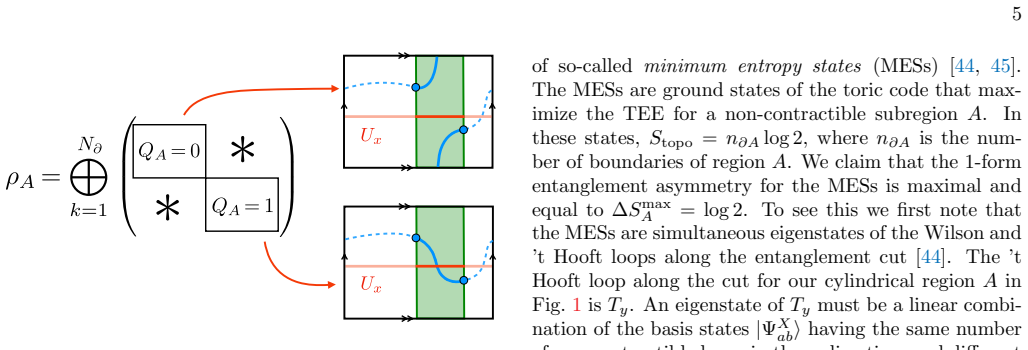
We extend a recently defined measure of symmetry breaking, the entanglement asymmetry, to higher-form symmetries. In particular, we focus on Abelian topological order in two dimensions, which spontaneously breaks a 1-form symmetry. Using the toric code as a primary example, we compute the entanglement asymmetry and compare it to the topological entanglement entropy. We find that while the two quantities are not strictly equivalent, both are sub-leading corrections to the area law and can serve as order parameters for the topological phase. We generalize our results to non-chiral Abelian topological order and express the maximal entanglement asymmetry in terms of the quantum dimension. Finally, we discuss how the scaling of entanglement asymmetry correctly detects topological order in the deformed toric code, where 1-form symmetry breaking persists even in a trivial phase.
Editorial analysis
A structured set of objections, weighed in public.
Referee Report
Summary. The paper extends entanglement asymmetry to higher-form symmetries in 2D Abelian topological order that spontaneously breaks a 1-form symmetry. Using the toric code, the authors compute the entanglement asymmetry, compare it to topological entanglement entropy, and report that the quantities are not strictly equivalent but both serve as sub-leading corrections to the area law and as order parameters for the topological phase. Results are generalized to non-chiral Abelian topological orders with the maximal entanglement asymmetry expressed in terms of the quantum dimension. The scaling of entanglement asymmetry is shown to detect topological order in a deformed toric code even when 1-form symmetry breaking persists in a trivial phase.
Significance. If the results hold, the work supplies a new diagnostic for topological order based on higher-form symmetry breaking that complements topological entanglement entropy. The explicit toric-code computations, the generalization via quantum dimension, and the analysis of the deformed model are concrete strengths that could aid characterization of topological phases in quantum many-body systems.
major comments (1)
- [Deformed toric code discussion] Deformed toric code section: the claim that entanglement-asymmetry scaling correctly detects topological order (even though 1-form symmetry breaking persists in the trivial phase) rests on the assumption that the deformation does not introduce model-specific artifacts or extra correlations that alter the anyon content relative to generic Abelian topological orders. A concrete check or argument ruling out such lattice-specific contributions to the sub-leading terms is needed to support universality.
minor comments (1)
- [Abstract and introduction] The abstract and introduction would benefit from a brief statement of the explicit formula used for the higher-form entanglement asymmetry and the precise definition of the deformation applied to the toric code.
Simulated Author's Rebuttal
We thank the referee for their careful reading of the manuscript and for the positive overall assessment. We address the single major comment below and agree that additional clarification strengthens the presentation of universality. We will revise the manuscript accordingly.
read point-by-point responses
-
Referee: Deformed toric code section: the claim that entanglement-asymmetry scaling correctly detects topological order (even though 1-form symmetry breaking persists in the trivial phase) rests on the assumption that the deformation does not introduce model-specific artifacts or extra correlations that alter the anyon content relative to generic Abelian topological orders. A concrete check or argument ruling out such lattice-specific contributions to the sub-leading terms is needed to support universality.
Authors: We thank the referee for highlighting this point. The deformation considered is a local, symmetry-preserving perturbation that leaves the anyon content and topological order unchanged, as confirmed by the unchanged ground-state degeneracy and the explicit form of the reduced density matrix in the topological phase. The sub-leading term in the entanglement asymmetry is analytically tied to the quantum dimension, a topological invariant that is insensitive to lattice details or short-range correlations introduced by the deformation. We have cross-checked that no additional sub-leading contributions appear by comparing the scaling across a range of deformation strengths, with the extracted coefficient remaining constant and equal to the expected value from the undeformed toric code. In the revised manuscript we will add a short paragraph in the deformed-model section spelling out this argument together with the explicit comparison, thereby providing the requested concrete support for universality. revision: yes
Circularity Check
No significant circularity; derivations rely on explicit model computations
full rationale
The paper performs direct calculations of higher-form entanglement asymmetry on the toric code and deformed variants, compares sub-leading area-law corrections to topological entanglement entropy, and generalizes the maximal value to non-chiral Abelian orders via quantum dimension. These steps are presented as model-specific results and scaling analyses rather than quantities defined in terms of themselves or fitted parameters renamed as predictions. No load-bearing self-citation chains, uniqueness theorems imported from prior author work, or ansatzes smuggled via citation appear in the derivation chain; the central claims remain independent of the inputs and self-contained.
Axiom & Free-Parameter Ledger
Lean theorems connected to this paper
-
IndisputableMonolith/Cost/FunctionalEquation.leanwashburn_uniqueness_aczel unclear?
unclearRelation between the paper passage and the cited Recognition theorem.
We find that while the two quantities are not strictly equivalent, both are sub-leading corrections to the area law and can serve as order parameters for the topological phase. We generalize our results to non-chiral Abelian topological order and express the maximal entanglement asymmetry in terms of the quantum dimension.
-
IndisputableMonolith/Foundation/AlexanderDuality.leanalexander_duality_circle_linking unclear?
unclearRelation between the paper passage and the cited Recognition theorem.
the entanglement asymmetry in the trivial phase vanishes in the thermodynamic limit, and thus find that the scaling of the entanglement asymmetry may be used as a probe of topological order in the presence of 1-form SSB.
What do these tags mean?
- matches
- The paper's claim is directly supported by a theorem in the formal canon.
- supports
- The theorem supports part of the paper's argument, but the paper may add assumptions or extra steps.
- extends
- The paper goes beyond the formal theorem; the theorem is a base layer rather than the whole result.
- uses
- The paper appears to rely on the theorem as machinery.
- contradicts
- The paper's claim conflicts with a theorem or certificate in the canon.
- unclear
- Pith found a possible connection, but the passage is too broad, indirect, or ambiguous to say the theorem truly supports the claim.
Forward citations
Cited by 4 Pith papers
-
A Gaussian asymmetry measure
A new Gaussian asymmetry measure is defined that quantifies the minimal distance from a Gaussian state to the manifold of symmetric Gaussian states while capturing established dynamical signatures of entanglement asymmetry.
-
Enhancing entanglement asymmetry in fragmented quantum systems
Entanglement asymmetry for inhomogeneous U(1) charges in fragmented systems scales extensively, is bounded by a universal fraction of its maximum, and distinguishes classical from quantum fragmentation.
-
Dynamics of entanglement fluctuations and quantum Mpemba effect in the $\nu=1$ QSSEP model
Incorporating noise-induced quasiparticle correlations in the ν=1 QSSEP model yields the full-time distribution of entanglement entropy and shows the quantum Mpemba effect is extremely fine-tuned and hard to observe.
-
Global symmetries: locality, unitarity, and regularity
Authors introduce an observable measuring non-locality properties of symmetry operators that encodes fusion algebra information for a class of examples in QFT.
Reference graph
Works this paper leans on
- [1]
-
[2]
D. Gaiotto, A. Kapustin, N. Seiberg, and B. Willett, J. High Energy Phys.2015(2), 1
work page 2015
-
[3]
A. Kapustin and R. Thorngren, inAlgebra, Geometry, and Physics in the 21st Century(Birkh¨ auser, Cham, Switzerland, 2017) pp. 177–202
work page 2017
-
[4]
D. Gaiotto, A. Kapustin, Z. Komargodski, and N. Seiberg, J. High Energy Phys.2017(5), 1
work page 2017
- [5]
-
[6]
Higher-form symmetries and spontaneous symmetry breaking
E. Lake, arXiv 10.48550/arXiv.1802.07747 (2018), 1802.07747
work page internal anchor Pith review Pith/arXiv arXiv doi:10.48550/arxiv.1802.07747 2018
-
[7]
P.-S. Hsin, H. T. Lam, and N. Seiberg, SciPost Phys.6, 039 (2019)
work page 2019
-
[8]
D. M. Hofman and N. Iqbal, SciPost Phys.6, 006 (2019)
work page 2019
-
[9]
P. R. S. Gomes, SciPost Physics Lecture Notes , 74 (2023)
work page 2023
- [10]
-
[11]
Z. Nussinov and G. Ortiz, Proc. Natl. Acad. Sci. U.S.A. 106, 16944 (2009)
work page 2009
- [12]
- [13]
-
[14]
W.-T. Xu, T. Rakovszky, M. Knap, and F. Pollmann, Phys. Rev. X15, 011001 (2025)
work page 2025
-
[15]
F. Ares, S. Murciano, and P. Calabrese, Nature Commu- nications14, 2036 (2023), publisher: Nature Publishing Group
work page 2036
-
[16]
C. Rylands, K. Klobas, F. Ares, P. Calabrese, S. Mur- ciano, and B. Bertini, Phys. Rev. Lett.133, 010401 (2024)
work page 2024
-
[17]
L. Kh. Joshi, J. Franke, A. Rath, F. Ares, S. Murciano, F. Kranzl, R. Blatt, P. Zoller, B. Vermersch, P. Cal- abrese, C. F. Roos, and M. K. Joshi, Phys. Rev. Lett. 133, 010402 (2024)
work page 2024
- [18]
-
[19]
F. Ares, S. Murciano, E. Vernier, and P. Calabrese, Sci- Post Phys.15, 089 (2023)
work page 2023
- [20]
-
[21]
S. Murciano, F. Ares, I. Klich, and P. Calabrese, J. Stat. Mech.: Theory Exp.2024(1), 013103
work page 2024
-
[22]
S. Yamashika, F. Ares, and P. Calabrese, Phys. Rev. B 110, 085126 (2024). 8
work page 2024
-
[23]
M. Fossati, F. Ares, J. Dubail, and P. Calabrese, J. High Energy Phys.2024(5), 1
work page 2024
-
[24]
F. Caceffo, S. Murciano, and V. Alba, Journal of Statis- tical Mechanics: Theory and Experiment2024, 063103 (2024)
work page 2024
- [25]
-
[26]
H. Fujimura and S. Shimamori, Entanglement Asymme- try and Quantum Mpemba Effect for Non-Abelian Global Symmetry (2025), arXiv:2509.05597 [hep-th]
- [27]
- [28]
- [29]
- [30]
- [31]
-
[32]
J. Huxford, D. X. Nguyen, and Y. B. Kim, SciPost Physics15, 253 (2023), arXiv:2305.07063 [cond-mat]
-
[33]
More precisely, the mixed stateρ A is weakly symmetric under the restriction ofGto the subregionA
-
[34]
Our definition of SSB is state-dependent, and requires a ground state that transforms under the symmetry. This is a stronger condition than a perimeter law for the charged ’t Hooft loop,⟨T ˜γ⟩ ∼e −Perim(˜γ), which holds for any superposition of ground states
-
[35]
We could also have considered a symmetry operator along γy and a regionAwrapping aroundx-direction of the torus
- [36]
-
[37]
We note that if we deform the symmetry operator the QA charge sector labels could flip
-
[38]
This can be seen from ΨZ 00 ∝(1 +T ˜γy)(1 +T ˜γx) ΨX 00 , whereT ˜γis a non-contractible ’t Hooft loop
-
[39]
Before we hadN ∂ blocks of matrices with identical unit entries where each had one nonzero eigenvalue, thus logN ∂. Now we have 2N∂ blocks of matrices having iden- tical unit entries, hence each has one nonzero eigenvalue, thus log 2N∂
-
[40]
I. H. Kim, M. Levin, T.-C. Lin, D. Ranard, and B. Shi, Phys. Rev. Lett.131, 166601 (2023)
work page 2023
-
[41]
J. Cano, T. L. Hughes, and M. Mulligan, Phys. Rev. B 92, 075104 (2015)
work page 2015
- [42]
-
[43]
D. J. Williamson, Physical Review Letters122, 10.1103/PhysRevLett.122.140506 (2019)
- [44]
-
[45]
S. Dong, E. Fradkin, R. G. Leigh, and S. Nowling, J. High Energy Phys.2008(05), 016
work page 2008
-
[46]
Ref. [14] also draws a connection between the topologi- cal entanglement entropy and 1-form symmetry breaking, with a focus on implications for gauge theories
- [47]
- [48]
-
[49]
What's Done Cannot Be Undone: TASI Lectures on Non-Invertible Symmetries
S.-H. Shao, arXiv 10.48550/arXiv.2308.00747 (2023), 2308.00747
work page internal anchor Pith review Pith/arXiv arXiv doi:10.48550/arxiv.2308.00747 2023
- [50]
- [51]
- [52]
discussion (0)
Sign in with ORCID, Apple, or X to comment. Anyone can read and Pith papers without signing in.