Generalized Distributions of Host Dispersion Measures in the Fast Radio Burst Cosmology
Pith reviewed 2026-05-18 07:51 UTC · model grok-4.3
The pith
Generalizing the distribution of host galaxy dispersion measures allows fast radio bursts to produce a Hubble constant consistent with CMB and supernova results without narrow priors on feedback.
A machine-rendered reading of the paper's core claim, the machinery that carries it, and where it could break.
Core claim
By replacing the fixed distribution of DM_host with a generalized form that includes free location parameter ℓ and scale parameter e^μ, the analysis of 125 localized FRBs produces Hubble constant values consistent with Planck 2018 and SH0ES across the considered models. These generalized models are strongly preferred over the version with a narrow prior on F according to Bayesian evidence and information criteria, without needing to alter the IGM distribution parameter σ_Δ.
What carries the argument
Generalized probability distribution for DM_host with free location ℓ and scale e^μ, which flexibly models host galaxy contributions to dispersion measures and enables consistent extraction of H0.
If this is right
- H0 derived from FRBs aligns with Planck 2018 and SH0ES values for all tested models.
- The intergalactic baryon fraction f_IGM no longer approaches its upper bound of 1.
- Generalized host models are strongly preferred by Bayesian evidence and Akaike/Bayesian information criteria.
- FRBs become usable as an independent H0 probe without artificially tight priors on the feedback parameter F.
Where Pith is reading between the lines
- Future increases in the number of localized FRBs could tighten constraints on the host distribution parameters themselves.
- The same generalization technique might apply to other line-of-sight probes that separate host and intergalactic contributions.
- This result points to the need for more detailed modeling of galaxy-to-galaxy variation in dispersion measures when using transient sources for cosmology.
Load-bearing premise
The chosen generalized functional form for the DM_host distribution with free location and scale parameters correctly captures the true host contributions across the FRB sample without systematic bias.
What would settle it
A larger sample of localized FRBs where the generalized DM_host models still produce an H0 value inconsistent with both Planck and SH0ES would falsify the claim that this generalization resolves the tension.
Figures




read the original abstract
Fast radio bursts (FRBs) can provide a measure of the Hubble constant $H_0$ that is independent of the constraints set by the cosmic microwave background (CMB) and the type Ia supernovae (SNIa), thereby arbitrating the Hubble tension. In the literature, the methodology proposed by Macquart et al. has been widely used, in which the contributions to the dispersion measure (DM) from the intergalactic medium (IGM, $\rm DM_{IGM}$) and the host galaxy ($\rm DM_{host}$) are described by probability distribution functions. Within the Macquart et al. methodology, it has been found that the parameter $F$, which quantifies the strength of the baryon feedback in galaxies, must be bound by an artificially narrow prior to result in a Hubble constant $H_0$ that is consistent with the ones derived from the CMB and SNIa studies. A recent study using ${\cal O}(100)$ localized FRBs found that this also causes the fraction of baryon mass in the IGM, $f_{\rm IGM}$, to approach its upper bound of 1. In the present work, using 125 localized FRBs, we find an unusually low $H_0$ when using a model with a loose prior on $F$. This model is in fact strongly preferred to the model with the narrow prior when considering the Bayesian evidence and the Akaike and Bayesian information criteria. Instead of modifying $\sigma_\Delta=Fz^{-0.5}$ in the distribution of $\rm DM_{IGM}$, we explore an alternative method of resolving the tension by generalizing the distribution of $\rm DM_{host}$ with varying location and scale parameters $\ell$ and $e^\mu$, respectively. We find that $H_0$ can be well consistent with the ones of Planck 2018 and SH0ES for all the models considered in this work, while these generalized models are all strongly preferred to the model with a narrow prior on $F$. Our findings indicate that more realistic distributions of $\rm DM_{host}$ could be the key to using FRBs as an independent measure of $H_0$.
Editorial analysis
A structured set of objections, weighed in public.
Referee Report
Summary. The paper analyzes 125 localized fast radio bursts to infer H0 by generalizing the DM_host probability distribution with free location ℓ and scale e^μ parameters. It reports that these generalized models yield H0 values consistent with Planck 2018 and SH0ES, are strongly preferred over narrow-prior-on-F models by Bayesian evidence, AIC, and BIC, and that more realistic DM_host modeling may be key to using FRBs as an independent H0 probe without artificial constraints on the IGM feedback parameter F.
Significance. If the central claim holds, the work offers a path to FRB-based H0 measurements that avoid the narrow F prior and resulting f_IGM boundary issues noted in prior studies. The explicit model comparison via evidence and information criteria, together with the focus on host-galaxy dispersion modeling, strengthens the case for FRBs as a cosmological tool independent of CMB and SNIa.
major comments (3)
- [Methods / Data sample] The manuscript states that generalized models are preferred by Bayesian evidence, AIC, and BIC and produce consistent H0, yet the data-selection criteria for the 125 events, the precise likelihood implementation, and any posterior predictive checks are not detailed. This prevents verification that the reported preference is not driven by unmodeled selection effects or redshift-dependent biases absorbed into ℓ and e^μ.
- [Model description and Results] While the Macquart IGM model (including F-dependent scatter) is held fixed and only the host term is generalized, the two extra parameters (ℓ, e^μ) can in principle compensate for residual IGM inhomogeneity or selection systematics. With O(100) events and no reported comparison to hydrodynamical simulations or the subset of FRBs with direct host-galaxy DM estimates, it is unclear whether the improvement reflects genuine host physics.
- [Discussion / H0 inference] The claim that H0 remains consistent with Planck and SH0ES across all generalized models is central, but the quantitative robustness depends on whether the chosen functional form for the generalized DM_host distribution introduces systematic bias at the redshifts of the sample. A direct test against the narrow-F model on the same likelihood would clarify if the evidence gain is proportionate to the added flexibility.
minor comments (2)
- [Model section] Notation for the generalized parameters (ℓ and e^μ) should be introduced with explicit functional forms in the text rather than only in equations, to improve readability for readers unfamiliar with the host DM parameterization.
- [Figures] Figure captions and axis labels for the posterior distributions or evidence comparisons could be expanded to include the exact model names and prior choices for direct comparison.
Simulated Author's Rebuttal
We thank the referee for their constructive and detailed comments, which have helped us improve the clarity and robustness of the manuscript. We address each major comment below and indicate the revisions made.
read point-by-point responses
-
Referee: [Methods / Data sample] The manuscript states that generalized models are preferred by Bayesian evidence, AIC, and BIC and produce consistent H0, yet the data-selection criteria for the 125 events, the precise likelihood implementation, and any posterior predictive checks are not detailed. This prevents verification that the reported preference is not driven by unmodeled selection effects or redshift-dependent biases absorbed into ℓ and e^μ.
Authors: We agree that additional methodological details are required for full reproducibility and verification. In the revised manuscript we have expanded the Methods section with a clear description of the data-selection criteria applied to assemble the sample of 125 localized FRBs, the explicit form of the likelihood function used for the Bayesian inference, and the results of posterior predictive checks. These checks show that the model reproduces the observed DM distribution without obvious residual trends that could be absorbed into the host-galaxy parameters. revision: yes
-
Referee: [Model description and Results] While the Macquart IGM model (including F-dependent scatter) is held fixed and only the host term is generalized, the two extra parameters (ℓ, e^μ) can in principle compensate for residual IGM inhomogeneity or selection systematics. With O(100) events and no reported comparison to hydrodynamical simulations or the subset of FRBs with direct host-galaxy DM estimates, it is unclear whether the improvement reflects genuine host physics.
Authors: We acknowledge that the extra parameters could in principle absorb some IGM or selection effects. Nevertheless, the best-fit values of ℓ and e^μ produce DM_host distributions that are consistent with independent observational constraints on host-galaxy contributions. In the revision we have added a discussion comparing the inferred distributions to results from hydrodynamical simulations in the literature and to the limited subset of FRBs with direct host DM measurements. A dedicated new simulation campaign tailored to our exact sample lies beyond the scope of the present work. revision: partial
-
Referee: [Discussion / H0 inference] The claim that H0 remains consistent with Planck and SH0ES across all generalized models is central, but the quantitative robustness depends on whether the chosen functional form for the generalized DM_host distribution introduces systematic bias at the redshifts of the sample. A direct test against the narrow-F model on the same likelihood would clarify if the evidence gain is proportionate to the added flexibility.
Authors: We have performed the suggested direct comparison by re-fitting the narrow-F model and all generalized models on identical data and likelihood implementations. The revised manuscript now includes these results, which confirm that H0 remains consistent with Planck 2018 and SH0ES while the generalized models are strongly preferred by Bayesian evidence, AIC, and BIC. We also verified that residuals show no systematic redshift-dependent trends attributable to the functional form of the host distribution. revision: yes
Circularity Check
No significant circularity; derivation fits data against external benchmarks
full rationale
The paper fits a two-parameter generalization (location ℓ and scale e^μ) of the DM_host distribution to 125 localized FRB events while holding the Macquart IGM model fixed, then infers H0 and compares it to independent Planck 2018 and SH0ES values. Model preference is assessed via Bayesian evidence, AIC, and BIC on the data likelihood. No equation or step reduces the reported H0 consistency or model preference to a quantity defined solely by the fitted host parameters or to a self-citation chain; the central result remains an empirical fit to external observations rather than a definitional or self-referential tautology.
Axiom & Free-Parameter Ledger
free parameters (2)
- ℓ
- e^μ
axioms (1)
- domain assumption Dispersion measure contributions from IGM and host follow the probability distributions assumed in the Macquart framework
Forward citations
Cited by 2 Pith papers
-
Constraints on the baryon density from fast radio bursts using a non-parametric reconstruction of the Hubble parameter
FRB dispersion measures combined with non-parametric H(z) reconstruction yield Ω_b h² = 0.02236 ± 0.00090, agreeing with BBN and Planck CMB to within 0.05%.
-
Probing Primordial Black Holes with upcoming Radio Telescopes: a case study for LOFAR2.0, FAST Core Array and BINGO
LOFAR2.0, FAST Core Array and BINGO can constrain the PBH dark matter fraction f_PBH below 0.16-0.39 for masses above 10^{-2} to 10 solar masses via FRB lensing statistics.
Reference graph
Works this paper leans on
-
[1]
3 σhost 40 100eµ 2 6F 2 6 F 40 100 eµ
-
[2]
4 σhost 45 55 65 75 H0 = 45.74+2
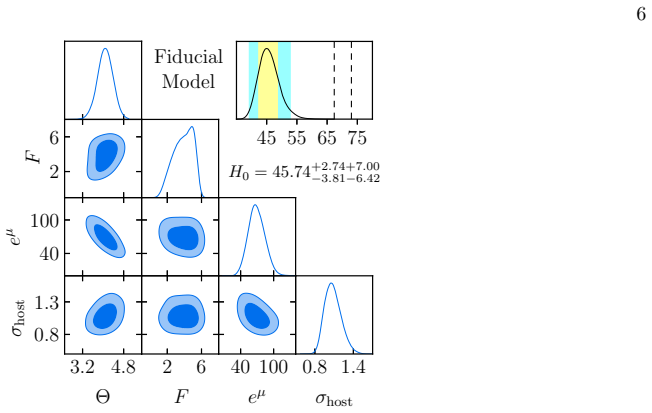
8 1 . 4 σhost 45 55 65 75 H0 = 45.74+2. 74+7. 00 − 3. 81− 6. 42 Fiducial Model FIG. 1: The 1 σ and 2 σ contours for all the free parameters of the fiducial model. Th e top-right panel is the marginalized probability distribution of the Hubble const ant H0 derived from Θ in Eq. (4) by using fIGM = 0. 83 and Ω bh2 = 0 . 02237. The mean and 1 σ , 2 σ interval...
work page 2018
- [3]
-
[4]
8 1 . 3 σhost 55 65 75 H0 = 63.29+2. 81+7. 29 − 3. 77− 6. 60 NarrowF Model FIG. 2: The same as in Fig. 1, but for the narrow priors used by M acquart et al. [32]. See Sec. II for details. strength of evidence is indicated by the empirical ranges of |ln B | summarized in Table II [97, 98] (see also e.g. [99]). Note that one can compute the Bayesian evidenc...
work page 1945
-
[5]
2 σ host 200 300 DME, t 45 85eµ 150 250 ℓ1 2 6F 2 6 F 150 250 ℓ1 45 85 eµ 200 300 DME, t
-
[6]
6 1 . 2 σ host 60 70 80 H0 = 70. 09+5. 95+15. 34 − 8. 01− 13. 61 Loc2s0 Model FIG. 3: The same as in Fig. 1, but for the Loc2s0 model. See Sec. III for details. Notice that one can do this easily by defining derived parameters in th e MCMC codes e.g. Cobaya or CosmoMC with GetDist. We also present the derived H0 in the top-right panel of Fig. 1. It is easy...
work page 2018
-
[7]
9 σ host 40 80 eµ 380 480 DME, t2 200 250 DME, t1 360 490 ℓ2 150 200 ℓ1 1 5 F 1 5 F 150 200 ℓ1 360 490 ℓ2 200 250 DME, t1 380 480 DME, t2 40 80 eµ
-
[8]
9 σ host 70 80 90 100 110 H0 = 89
5 0 . 9 σ host 70 80 90 100 110 H0 = 89 . 33+7. 89+17. 97 − 9. 72− 16. 80 Loc3s0 Model FIG. 4: The same as in Fig. 1, but for the Loc3s0 model. See Sec. III for details. It is natural to see which model is better. We compute ln B, ∆AIC and ∆BIC of the NarrowF model relative to the fiducial model, and find ln B = − 6. 6841 , ∆AIC = 13 . 4264 , ∆BIC = 13 . 42...
work page 2018
-
[9]
0 σ host 50 350eµ 200 450 DME, t 120 330 ℓ1 − 250 50 ℓ0 2 6F 2 6 F − 250 50 ℓ0 120 330 ℓ1 200 450 DME, t 50 350 eµ
-
[10]
2 1 . 0 σ host 60 70 80 90 H0 = 69 . 57+6. 49+15. 65 − 8. 31− 14. 42 Loc2s Model FIG. 5: The same as in Fig. 1, but for the Loc2s model. See Sec. I II for details. where ℓ and eµ (both in uints of pc cm − 3) play the roles of location and scale parameters, respectively. In the fiducial methodology proposed by Macquart et al. [32], a zero location parameter...
work page 2018
-
[11]
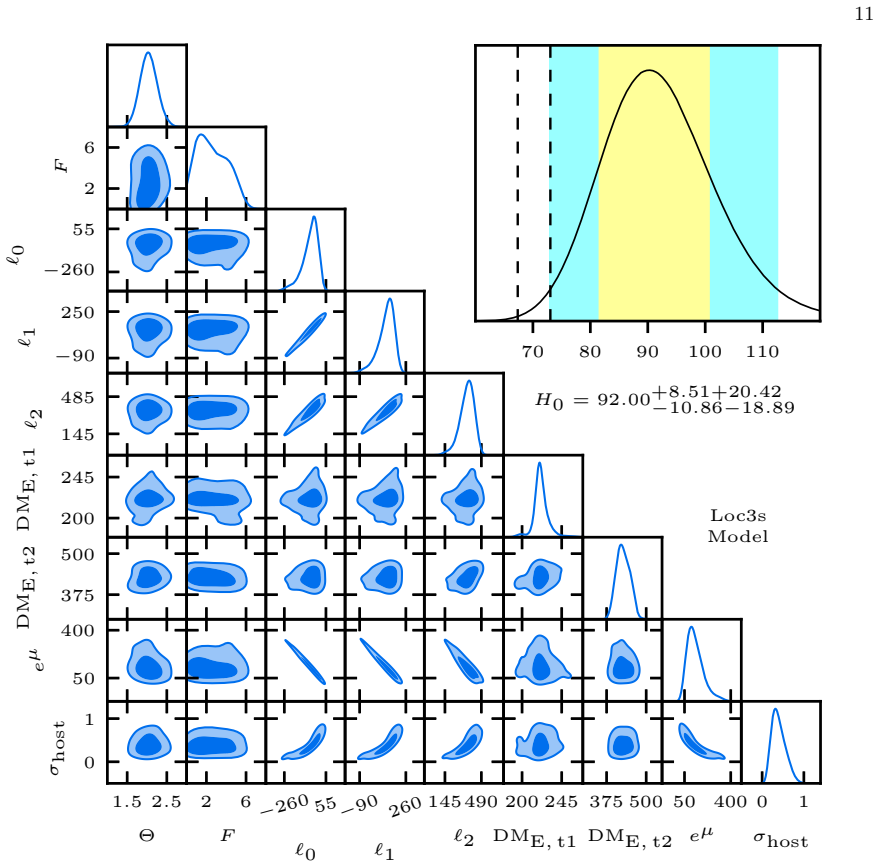
5 2 . 5 Θ 0 1 σ host 50 400 eµ 375 500 DME, t2 200 245 DME, t1 145 485 ℓ 2 − 90 250 ℓ 1 − 260 55 ℓ 0 2 6 F 2 6 F − 260 55 ℓ 0 − 90 260 ℓ 1 145 490 ℓ 2 200 245 DME, t1 375 500 DME, t2 50 400 eµ 0 1 σ host 70 80 90 100 110 H0 = 92 . 00+8. 51+20. 42 − 10. 86− 18. 89 Loc3s Model FIG. 6: The same as in Fig. 1, but for the Loc3s model. See Sec. I II for details...
work page 1997
-
[12]
0 2 . 8 Θ 1 2 σ host 15 55eµ 95 105 ℓ1 − 390 − 370 ℓ0 2 6F 2 6 F − 390− 370 ℓ0 95 105 ℓ1 15 55 eµ 1 2 σ host 70 80 90 H0 = 78. 36+5. 87+14. 75 − 8. 09− 13. 27 Loclin Model FIG. 7: The same as in Fig. 1, but for the Loclin model. See Sec. III for details. As mentioned above, we adopt Ω bh2 = 0. 02237 from the Planck 2018 result [4] and fIGM = 0 . 83 [14–23...
work page 2018
-
[13]
6 σ host 190 250 DME, t 180 320 µ 1 30 70 µ 0 2 5F 2 5 F 30 70 µ 0 180 320 µ 1 190 250 DME, t
-
[14]
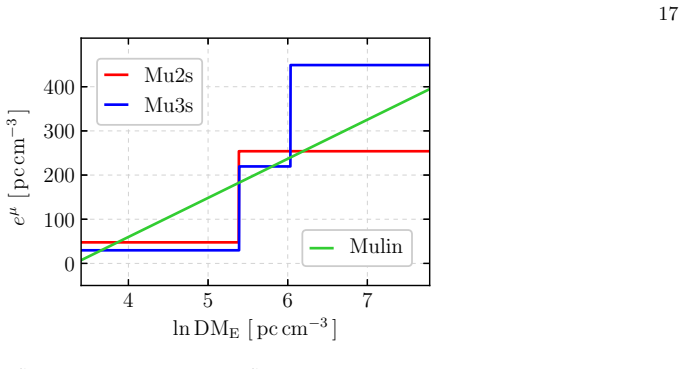
4 0 . 6 σ host 60 70 80 H0 = 67. 68+5. 77+15. 23 − 8. 38− 13. 46 Mu2s Model FIG. 9: The same as in Fig. 1, but for the Mu2s model. See Sec. IV for details. We also present the results in Fig. 5. It is easy to see that H0 is consistent with the ones of Planck 2018 and SH0ES well within 1 σ region. We compute ln B, ∆AIC and ∆BIC of the Loc2s model relative ...
work page 2018
-
[15]
24 σ host 380 445 DME, t2 216 223 DME, t1 395 496 µ 2 190 250 µ 1 23 37 µ 0 2 6 F 2 6 F 23 37 µ 0 190 250 µ 1 390 496 µ 2 216 223 DME, t1 380 445 DME, t2
-
[16]
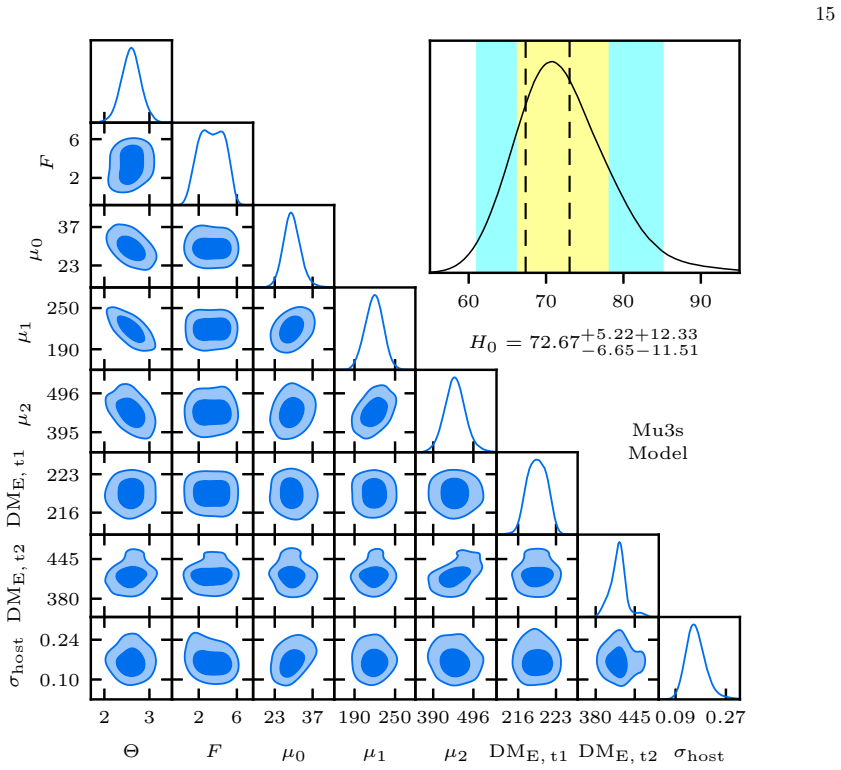
09 0 . 27 σ host 60 70 80 90 H0 = 72 . 67+5. 22+12. 33 − 6. 65− 11. 51 Mu3s Model FIG. 10: The same as in Fig. 1, but for the Mu3s model. See Sec. I V for details. and the derived parameters DME, t2 = 427. 1464+20. 9173 − 23. 1121 , H0 = 91. 9963+8. 5124 − 10. 8584 (1σ ) +20. 4240 − 18. 8946 (2σ ) +32. 3452 − 21. 0885 (3σ ) km / s/ Mpc . (42) We also pres...
work page 2018
-
[17]
5 σ host 75 100 µ 1 − 350 − 250 µ 0 1 6F 1 6 F − 350− 250 µ 0 75 100 µ 1
-
[18]
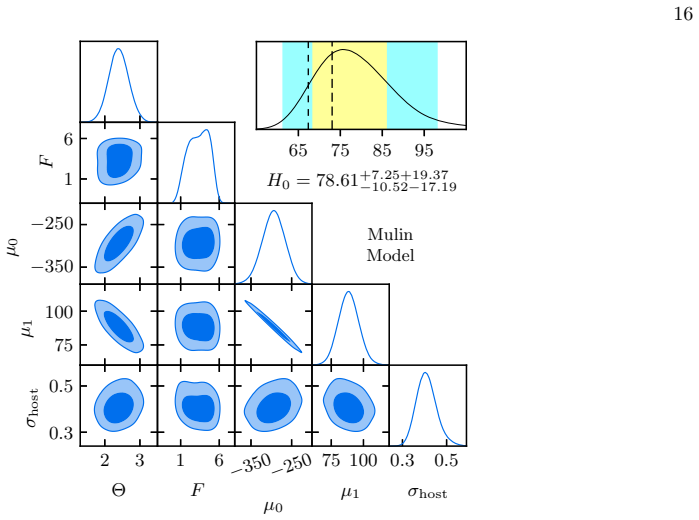
3 0 . 5 σ host 65 75 85 95 H0 = 78 . 61+7. 25+19. 37 − 10. 52− 17. 19 Mulin Model FIG. 11: The same as in Fig. 1, but for the Mulin model. See Sec. IV for details. more reasonable to consider ℓ’s Taylor expansion with respect to ln DM E up to first order, namely ℓ = ℓ0 + ℓ1 ln DME . (44) We label this model as Loclin. We consider the following uniform prio...
work page 1961
-
[19]
E. Di Valentino et al. , Phys. Dark Univ. 49, 101965 (2025) [arXiv:2504.01669]
work page internal anchor Pith review Pith/arXiv arXiv 2025
-
[20]
E. Abdalla et al. , JHEAp 34, 49 (2022) [arXiv:2203.06142]
work page internal anchor Pith review Pith/arXiv arXiv 2022
-
[21]
R. G. Cai, L. Li and S. J. Wang, Acta Phys. Sin. 72, no.23, 239801 (2023)
work page 2023
-
[22]
Planck 2018 results. VI. Cosmological parameters
N. Aghanim et al. , Astron. Astrophys. 641, A6 (2020) [arXiv:1807.06209]
work page internal anchor Pith review Pith/arXiv arXiv 2020
-
[23]
A. G. Riess et al. , Astrophys. J. Lett. 934, no.1, L7 (2022) [arXiv:2112.04510]
work page internal anchor Pith review Pith/arXiv arXiv 2022
-
[24]
https: / / www.nature.com/collections/rswtktxcln
-
[25]
D. R. Lorimer, Nat. Astron. 2, 860 (2018) [arXiv:1811.00195]
work page internal anchor Pith review Pith/arXiv arXiv 2018
-
[26]
E. F. Keane, Nat. Astron. 2, 865 (2018) [arXiv:1811.00899]
work page internal anchor Pith review Pith/arXiv arXiv 2018
-
[27]
E. Petroff, J. W. T. Hessels and D. R. Lorimer, Astron. Astr ophys. Rev. 30, 2 (2022) [arXiv:2107.10113]
- [28]
-
[29]
Zhang, Nature 587, 45 (2020) [arXiv:2011.03500]
B. Zhang, Nature 587, 45 (2020) [arXiv:2011.03500]
- [30]
-
[31]
L. Nicastro et al. , Universe 7, no.3, 76 (2021) [arXiv:2103.07786]
-
[32]
Cosmological implications of Fast Radio Burst / Gamma-Ray Burst Associations
W. Deng and B. Zhang, Astrophys. J. 783, L35 (2014) [arXiv:1401.0059]
work page internal anchor Pith review Pith/arXiv arXiv 2014
-
[33]
Y. P. Yang and B. Zhang, Astrophys. J. 830, no. 2, L31 (2016) [arXiv:1608.08154]
work page internal anchor Pith review Pith/arXiv arXiv 2016
-
[34]
H. Gao, Z. Li and B. Zhang, Astrophys. J. 788, 189 (2014) [arXiv:1402.2498]
work page internal anchor Pith review Pith/arXiv arXiv 2014
-
[35]
B. Zhou, X. Li, T. Wang, Y. Z. Fan and D. M. Wei, Phys. Rev. D 89, 107303 (2014) [arXiv:1401.2927]
work page internal anchor Pith review Pith/arXiv arXiv 2014
- [36]
- [37]
- [38]
- [39]
- [40]
- [41]
- [42]
- [43]
- [44]
- [45]
-
[46]
Locating the "missing" baryons with extragalactic dispersion measure estimates
M. McQuinn, Astrophys. J. 780, L33 (2014) [arXiv:1309.4451]
work page internal anchor Pith review Pith/arXiv arXiv 2014
-
[47]
K. Ioka, Astrophys. J. 598, L79 (2003) [astro-ph/0309200]
work page internal anchor Pith review Pith/arXiv arXiv 2003
-
[48]
S. Inoue, Mon. Not. Roy. Astron. Soc. 348, 999 (2004) [astro-ph/0309364]
work page internal anchor Pith review Pith/arXiv arXiv 2004
-
[49]
Fast Radio Bursts and cosmological tests
M. Jaroszynski, Mon. Not. Roy. Astron. Soc. 484, no. 2, 1637 (2019) [arXiv:1812.11936]
work page internal anchor Pith review Pith/arXiv arXiv 2019
- [50]
- [51]
- [52]
- [53]
- [54]
- [55]
-
[56]
J. Baptista et al. , Astrophys. J. 965, no.1, 57 (2024) [arXiv:2305.07022]
- [57]
-
[58]
J. M. Cordes and T. J. W. Lazio, astro-ph/0207156
work page internal anchor Pith review Pith/arXiv arXiv
-
[59]
J. M. Cordes and T. J. W. Lazio, astro-ph/0301598
work page internal anchor Pith review Pith/arXiv arXiv
-
[60]
S. Yamasaki and T. Totani, Astrophys. J. 888, no.2, 105 (2020) [arXiv:1909.00849]
-
[61]
https: / / pypi.org/project/pygedm and https: / / pygedm.readthedocs.io
- [62]
-
[63]
https: / / docs.scipy.org/doc/scipy/reference/generated/scipy.stats.lognorm.html
-
[64]
https: / / github.com/FRBs/FRB
- [65]
- [66]
-
[67]
Cobaya: Code for Bayesian Analysis of hierarchical physical models
J. Torrado and A. Lewis, JCAP 2105, 057 (2021) [arXiv:2005.05290]
work page internal anchor Pith review Pith/arXiv arXiv 2021
-
[68]
https: / / cobaya.readthedocs.org
-
[69]
GetDist: a Python package for analysing Monte Carlo samples
A. Lewis, arXiv:1910.13970 [astro-ph.IM]
work page internal anchor Pith review Pith/arXiv arXiv 1910
-
[70]
https: / / getdist.readthedocs.io
- [71]
-
[72]
L. Connor et al. , Nature Astron. 9, no.8, 1226 (2025) [arXiv:2409.16952]
- [73]
- [74]
-
[75]
K. Sharma et al. , Nature 635, no.8037, 61 (2024) [arXiv:2409.16964]. 22
-
[76]
V. Ravi et al. , Astrophys. J. Lett. 949, no.1, L3 (2023) [arXiv:2211.09049]
- [77]
-
[78]
S. Bhandari et al. , Astrophys. J. 948, no.1, 67 (2023) [arXiv:2211.16790]
-
[79]
M. Bhardwaj et al. , Astrophys. J. Lett. 971, no.2, L51 (2024) [arXiv:2310.10018]
- [80]
discussion (0)
Sign in with ORCID, Apple, or X to comment. Anyone can read and Pith papers without signing in.