Dynamics of entanglement fluctuations and quantum Mpemba effect in the ν=1 QSSEP model
Pith reviewed 2026-05-18 03:12 UTC · model grok-4.3
The pith
Incorporating noise-induced correlations extends the quasiparticle picture to the full probability distribution of entanglement entropy in the ν=1 QSSEP model.
A machine-rendered reading of the paper's core claim, the machinery that carries it, and where it could break.
Core claim
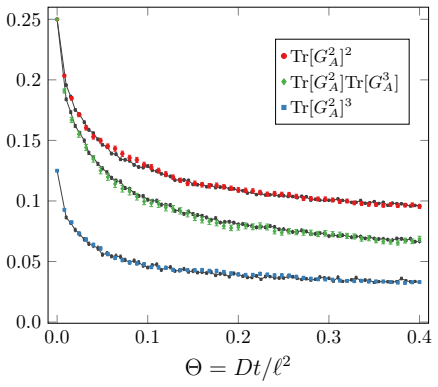
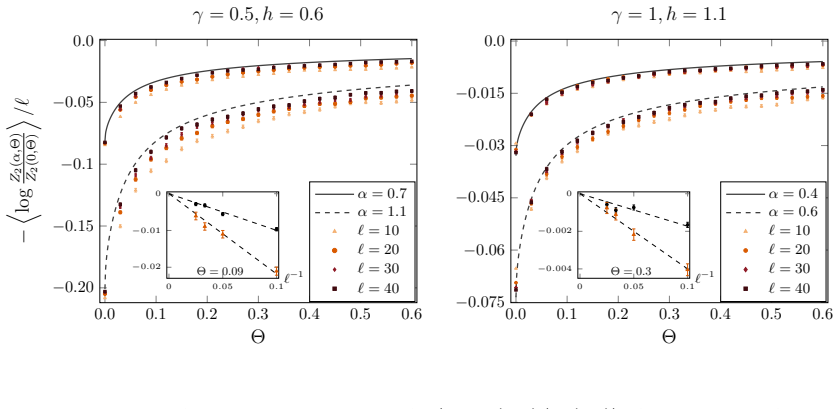
Previous work showed that the average entanglement growth after a quantum quench can be explained in terms of pairs of entangled quasiparticles performing random walks, leading to diffusive entanglement spreading. By incorporating the noise-induced statistical correlations between the quasiparticles, we extend this description to the full-time probability distribution of the entanglement entropy. Our generalized quasiparticle picture allows us to compute the average time evolution of a generic function of the reduced density matrix of a subsystem. We also apply our result to the entanglement asymmetry to investigate the restoration of particle-number symmetry in the dynamics from initial
What carries the argument
Generalized quasiparticle picture that incorporates noise-induced statistical correlations between pairs of entangled quasiparticles performing random walks
If this is right
- The average time evolution of any function of the reduced density matrix follows from the extended quasiparticle description.
- Entanglement asymmetry can be computed to follow the restoration of particle-number symmetry after a quench from number-indefinite initial states.
- The quantum Mpemba effect occurs only when very specific conditions on the initial state and noise are met.
Where Pith is reading between the lines
- Similar incorporation of noise-induced correlations may be possible in other stochastic many-body models where quasiparticles undergo random walks.
- Small-system exact diagonalization or tensor-network simulations could directly test the predicted entanglement probability distributions.
- If the Mpemba effect is indeed fine-tuned, controlled variations in noise strength or spatial homogeneity might be used to locate observable regimes.
Load-bearing premise
The noise-induced statistical correlations between quasiparticles can be incorporated into the existing quasiparticle picture to obtain the full probability distribution of entanglement entropy without further uncontrolled approximations.
What would settle it
A direct numerical simulation of the full probability distribution of entanglement entropy for the ν=1 QSSEP model that deviates systematically from the predictions of the generalized quasiparticle picture.
Figures




read the original abstract
We study the out-of-equilibrium dynamics of entanglement fluctuations in the $\nu=1$ Quantum Symmetric Simple Exclusion Process, a free-fermion chain with hopping amplitudes that are stochastic in time but homogeneous in space. Previous work showed that the average entanglement growth after a quantum quench can be explained in terms of pairs of entangled quasiparticles performing random walks, leading to diffusive entanglement spreading. By incorporating the noise-induced statistical correlations between the quasiparticles, we extend this description to the full-time probability distribution of the entanglement entropy. Our generalized quasiparticle picture allows us to compute the average time evolution of a generic function of the reduced density matrix of a subsystem. We also apply our result to the entanglement asymmetry. This allows us to investigate the restoration of particle-number symmetry in the dynamics from initial states with no well-defined particle number. Regarding the possible existence of the quantum Mpemba effect, our analysis indicates that its occurrence is an extremely fine-tuned phenomenon, requiring very specific conditions and therefore being rather difficult to observe in practice.
Editorial analysis
A structured set of objections, weighed in public.
Referee Report
Summary. The manuscript studies out-of-equilibrium entanglement fluctuations in the ν=1 Quantum Symmetric Simple Exclusion Process, a free-fermion chain with stochastic time-dependent but spatially homogeneous hopping. Building on prior quasiparticle results for average entanglement growth after a quench, the authors incorporate noise-induced statistical correlations between quasiparticles to extend the description to the full-time probability distribution P(S(t)) of entanglement entropy. This generalized picture is used to compute the average evolution of generic functions of the reduced density matrix, to analyze entanglement asymmetry and particle-number symmetry restoration, and to assess the quantum Mpemba effect, which is concluded to be an extremely fine-tuned and practically difficult-to-observe phenomenon.
Significance. If the incorporation of noise-induced correlations yields the exact joint distribution of quasiparticle positions and phases without further uncontrolled approximations, the work supplies a concrete advance in computing full entanglement distributions and symmetry dynamics in noisy integrable systems. The explicit conclusion on the fine-tuned character of the quantum Mpemba effect, if robust, carries implications for experimental searches.
major comments (1)
- [Section describing the generalized quasiparticle picture and derivation of P(S(t))] The central extension to the full P(S(t)) and the subsequent claim that the quantum Mpemba effect is 'extremely fine-tuned' rest on the assertion that noise averaging closes the joint distribution of quasiparticle positions and phases exactly. The manuscript does not appear to provide an explicit verification that higher-order correlations entering the characteristic function of the entanglement spectrum are obtained without a factorization or resummation assumption whose error is quantified against exact numerics; this is load-bearing for both the probability-distribution result and the fine-tuning conclusion.
minor comments (1)
- [Abstract] The abstract states that the Mpemba effect requires 'very specific conditions' but does not indicate the relevant parameter (e.g., initial-state overlap or noise strength) that controls the fine-tuning; a single sentence clarifying this would improve readability.
Simulated Author's Rebuttal
We thank the referee for their careful reading and for identifying the need for explicit verification of the exactness of our noise-averaged distribution. We address the major comment below and have revised the manuscript to include additional checks against numerics.
read point-by-point responses
-
Referee: [Section describing the generalized quasiparticle picture and derivation of P(S(t))] The central extension to the full P(S(t)) and the subsequent claim that the quantum Mpemba effect is 'extremely fine-tuned' rest on the assertion that noise averaging closes the joint distribution of quasiparticle positions and phases exactly. The manuscript does not appear to provide an explicit verification that higher-order correlations entering the characteristic function of the entanglement spectrum are obtained without a factorization or resummation assumption whose error is quantified against exact numerics; this is load-bearing for both the probability-distribution result and the fine-tuning conclusion.
Authors: We thank the referee for this important observation. Because the stochastic hopping in the ν=1 QSSEP is spatially homogeneous, the same random amplitude applies uniformly to all bonds at each instant. This global noise structure, together with the free-fermion integrability of the model, permits an exact noise average over the joint distribution of quasiparticle positions and phases. The characteristic function for the entanglement spectrum is obtained directly from the averaged two-point correlators without invoking an uncontrolled factorization or resummation; all induced correlations are captured exactly by the shared noise. To make this explicit, we have added a new appendix in the revised manuscript that compares the analytic P(S(t)) with exact diagonalization results for small systems (L ≤ 16), demonstrating quantitative agreement and bounding the discrepancy to within sampling error. This verification supports both the full distribution result and the conclusion that the quantum Mpemba effect requires very specific initial conditions and is therefore difficult to observe. revision: yes
Circularity Check
Generalized quasiparticle picture extends prior averages via derived noise correlations without reducing to self-fit
full rationale
The paper starts from the established quasiparticle picture for average entanglement growth (cited as previous work) and incorporates noise-induced two-point correlations computed directly from the white-noise stochastic Hamiltonian of the ν=1 QSSEP. The extension to the full P(S(t)) and generic functions of the reduced density matrix follows from averaging over these correlations without introducing fitted parameters or ansatze that presuppose the target distribution. Self-citations to earlier quasiparticle results are present but not load-bearing for the new probability-distribution claim, which rests on explicit noise averaging rather than re-deriving the input averages. No equation reduces to its own input by construction, and the Mpemba-effect conclusion is presented as a consequence of the derived distribution rather than an imposed condition.
Axiom & Free-Parameter Ledger
axioms (1)
- domain assumption Noise-induced statistical correlations between quasiparticles can be incorporated into the quasiparticle picture to obtain the full-time probability distribution of entanglement entropy.
Lean theorems connected to this paper
-
IndisputableMonolith/Cost/FunctionalEquation.leanwashburn_uniqueness_aczel unclear?
unclearRelation between the paper passage and the cited Recognition theorem.
By incorporating the noise-induced statistical correlations between the quasiparticles, we extend this description to the full-time probability distribution of the entanglement entropy.
What do these tags mean?
- matches
- The paper's claim is directly supported by a theorem in the formal canon.
- supports
- The theorem supports part of the paper's argument, but the paper may add assumptions or extra steps.
- extends
- The paper goes beyond the formal theorem; the theorem is a base layer rather than the whole result.
- uses
- The paper appears to rely on the theorem as machinery.
- contradicts
- The paper's claim conflicts with a theorem or certificate in the canon.
- unclear
- Pith found a possible connection, but the passage is too broad, indirect, or ambiguous to say the theorem truly supports the claim.
Forward citations
Cited by 2 Pith papers
-
A Gaussian asymmetry measure
A new Gaussian asymmetry measure is defined that quantifies the minimal distance from a Gaussian state to the manifold of symmetric Gaussian states while capturing established dynamical signatures of entanglement asymmetry.
-
Enhancing entanglement asymmetry in fragmented quantum systems
Entanglement asymmetry for inhomogeneous U(1) charges in fragmented systems scales extensively, is bounded by a universal fraction of its maximum, and distinguishes classical from quantum fragmentation.
Reference graph
Works this paper leans on
-
[1]
L. Bertini, A. De Sole, D. Gabrielli, G. Jona-Lasinio, and C. Landim,Macroscopic fluctuation theory, Rev. Mod. Phys.87, 593 (2015)
work page 2015
-
[2]
Bernard,Can the macroscopic fluctuation theory be quantized?, J
D. Bernard,Can the macroscopic fluctuation theory be quantized?, J. Phys. A: Math. Theor.54, 433001 (2021)
work page 2021
- [3]
- [4]
-
[5]
A. Chan, A. De Luca, and J. T. Chalker,Solution of a minimal model of many-body quantum chaos, Phys. Rev. X8, 041019, (2018)
work page 2018
-
[6]
C. W. von Keyserlingk, T. Rakovszky, F. Pollmann, and S. L. Sondhi,Operator Hy- drodynamics, OTOCs, and Entanglement Growth in Systems without Conservation Laws, Phys. Rev. X8, 021013 (2018)
work page 2018
-
[7]
Coarse-grained dynamics of operator and state entanglement
C. Jonay, D. A. Huse, and A. Nahum,Coarse-grained dynamics of operator and state entanglement, arXiv:1803.00089
work page internal anchor Pith review Pith/arXiv arXiv
-
[8]
M. J. Gullans and D. A. Huse,Entanglement structure of current-driven diffusive fermion systems, Phys. Rev. X9, 021007 (2019)
work page 2019
-
[9]
Žnidarič,Entanglement growth in diffusive systems, Comm
M. Žnidarič,Entanglement growth in diffusive systems, Comm. Phys.3, 100 (2020). 21
work page 2020
-
[10]
Disentangling strategies and entanglement transitions in unitary circuit games with matchgates
R. Morral-Yepes, M. Langer, A. Gammon-Smith, B. Kraus, and F. Pollmann,Disen- tangling strategies and entanglement transitions in unitary circuit games with match- gates, arXiv:2507.05055
work page internal anchor Pith review Pith/arXiv arXiv
-
[11]
Žnidarič,Dephasing-induced diffusive transport in the anisotropic Heisenberg model, New J
M. Žnidarič,Dephasing-induced diffusive transport in the anisotropic Heisenberg model, New J. Phys.12043001 (2010)
work page 2010
-
[12]
N. Lashkari, D. Stanford, M. Hastings, T. Osborne, and P. Hayden,Towards the fast scrambling conjecture, JHEP04(2013) 29022
work page 2013
- [13]
-
[14]
E. Onorati, O. Buerschaper, M. Kliesch, W. Brown, A. H. Werner, and J. Eisert, Mixing properties of stochastic quantum Hamiltonians, Commun. Math. Phys.355, 905 (2017)
work page 2017
-
[15]
F. Carollo, J. Garrahan, I. Lesanovsky, and C. Perez- Espigares,Fluctuating hydrody- namics, current fluctuations, and hyperuniformity in boundary-driven open quantum chains, Phys. Rev. E96, 052118 (2017)
work page 2017
-
[16]
D. Bernard and B. Doyon,Diffusion and Signatures of Localization in Stochastic Con- formal Field Theory, Phys. Rev. Lett.119, 110201 (2017)
work page 2017
-
[17]
M.Knap,Entanglement production and information scrambling in a noisy spin system, Phys. Rev. B98, 184416 (2018)
work page 2018
-
[18]
D. A. Rowlands and A. Lamacraft,Noisy coupled qubits: operator spreading and the Fredrickson–Andersen model, Phys. Rev. B98, 195125 (2018)
work page 2018
-
[19]
A. Christopoulos, P. Le Doussal, D. Bernard, and A. De Luca,Universal out-of- equilibrium dynamics of 1D critical quantum systems perturbed by noise coupled to energy, Phys. Rev. X13, 011043 (2023)
work page 2023
- [20]
-
[21]
Emergence of universality in transport of noisy free fermions,
J. Costa, P. Ribeiro, and A. De Luca,Emergence of universality in transport of noisy free fermions, arXiv:2504.00188
- [22]
-
[23]
Mallick,The exclusion process: A paradigm for non-equilibrium behaviour, Physica A: Stat
K. Mallick,The exclusion process: A paradigm for non-equilibrium behaviour, Physica A: Stat. Mech. Appl.418, 17 (2015)
work page 2015
-
[24]
G. Barraquand and D. Bernard,Introduction to quantum exclusion processes, arXiv:2507.01570
- [25]
-
[26]
L. Hruza and D. Bernard,Coherent fluctuations in noisy mesoscopic systems, the open quantum SSEP, and free probability, Phys. Rev. X13, 011045 (2023)
work page 2023
-
[27]
D. Bernard and L. Piroli,Entanglement distribution in the quantum symmetric simple exclusion process, Phys. Rev. E104, 014146 (2021). 22
work page 2021
-
[28]
$\nu$-QSSEP: A toy model for entanglement spreading in stochastic diffusive quantum systems
V. Alba,ν-QSSEP: A toy model for entanglement spreading in stochastic diffusive quantum systems, arXiv.2507.11674
work page internal anchor Pith review Pith/arXiv arXiv
-
[29]
D. Bernard and T. Jin,Open quantum symmetric simple exclusion process, Phys. Rev. Lett.123, 080601 (2019)
work page 2019
-
[30]
D. Bernard and T. Jin,Solution to the quantum symmetric simple exclusion process: The continuous case, Commun. Math. Phys.384, 1141 (2021)
work page 2021
-
[31]
T. Jin, A. Krajenbrink, and D. Bernard,From stochastic spin chains to quantum Kardar-Parisi-Zhang dynamics, Phys. Rev. Lett.125, 040603 (2020)
work page 2020
-
[32]
D. Bernard, F. H. L. Essler, L. Hruza, and M. Medenjak,Dynamics of fluctuations in quantum simple exclusion processes, SciPost Phys.12, 042 (2022)
work page 2022
-
[33]
D. Bernard, T. Jin, S. Scopa, and S. Wei,Large deviations of density fluctuations in the boundary driven quantum symmetric simple inclusion process, Phys. Rev. E112, 034106 (2025)
work page 2025
-
[34]
P. Calabrese and J. Cardy,Evolution of entanglement entropy in one-dimensional systems, J. Stat. Mech (2005) P04010
work page 2005
-
[35]
M. Fagotti and P. Calabrese,Evolution of entanglement entropy following a quantum quench: Analytic results for the XY chain in a transverse magnetic field, Phys. Rev. A78, 010306 (2008)
work page 2008
-
[36]
V. Alba and P. Calabrese,Entanglement and thermodynamics after a quantum quench in integrable systems, PNAS114, 7947 (2017)
work page 2017
-
[37]
V. Alba and P. Calabrese,Entanglement dynamics after quantum quenches in generic integrable systems, SciPost Phys.4, 17 (2018)
work page 2018
-
[38]
F. Ares, S. Murciano, and P. Calabrese,Entanglement asymmetry as a probe of sym- metry breaking, Nature Commun.14, 2036 (2023)
work page 2036
- [39]
-
[40]
F. Ares, P. Calabrese, and S. Murciano,The quantum Mpemba effects, Nat. Rev. Phys. 7, 451 (2025)
work page 2025
- [41]
-
[42]
C.Rylands, K.Klobas, F.Ares, P.Calabrese, S.Murciano, andB.Bertini,Microscopic origin of the quantum Mpemba effect in integrable systems, Phys. Rev. Lett.133, 010401 (2024)
work page 2024
-
[43]
S. Murciano, F. Ares, I. Klich, and P. Calabrese,Entanglement asymmetry and quan- tum Mpemba effect in the XY spin chain, J. Stat. Mech. (2024) 013103
work page 2024
- [44]
-
[45]
K. Klobas,Non-equilibrium dynamics of symmetry-resolved entanglement and entan- glement asymmetry: exact asymptotics in Rule 54, J. Phys. A,57, 505001 (2024)
work page 2024
-
[46]
C. Rylands, E. Vernier, and P. Calabrese,Dynamical symmetry restoration in the Heisenberg spin chain, J. Stat. Mech. (2024) 123102
work page 2024
-
[47]
S. Yamashika, F. Ares, and P. Calabrese,Entanglement asymmetry and quantum Mpemba effect in two-dimensional free-fermion systems, Phys. Rev. B110, 085126 (2024)
work page 2024
-
[48]
S. Yamashika, P. Calabrese, and F. Ares,Quenching from superfluid to free bosons in two dimensions: entanglement, symmetries, and quantum Mpemba effect, Phys. Rev. A111, 043304 (2025)
work page 2025
-
[49]
M. Gibbins, A. Smith, and B. Bertini,Translation symmetry restoration in integrable systems: the noninteracting case, arXiv.2506.14555
-
[50]
S. Yamashika, S. Endo, and H. Tajima,Quantum Fisher Information as a Measure of Symmetry Breaking in Quantum Many-Body Systems, arXiv:2509.07468
-
[51]
F. Caceffo, S. Murciano, and V. Alba,Entangled multiplets, asymmetry, and quantum Mpemba effect in dissipative systems, J. Stat. Mech. (2024) 063103
work page 2024
-
[52]
F. Ares, V. Vitale, and S. Murciano,The quantum Mpemba effect in free-fermionic mixed states, Phys. Rev. B111, 104312 (2025)
work page 2025
-
[53]
G. D. Giulio, X. Turkeshi, and S. Murciano,Measurement-Induced Symmetry Restora- tion and Quantum Mpemba Effect, Entropy27, 407 (2025)
work page 2025
-
[54]
T. Banerjee, S. Das, and K. Sengupta,Entanglement asymmetry in periodically driven quantum systems, SciPost Phys.19, 051 (2025)
work page 2025
- [55]
-
[56]
X. Turkeshi, P, Calabrese, and A. De Luca,Quantum Mpemba Effect in Random Circuits, Phys. Rev. Lett.135, 040403 (2025)
work page 2025
- [57]
-
[58]
A. Foligno, P. Calabrese, and B. Bertini,Non-equilibrium dynamics of charged dual- unitary circuits, PRX Quantum6, 010324 (2025)
work page 2025
- [59]
-
[60]
F. Ares, S. Murciano, P. Calabrese, and L. Piroli,Entanglement asymmetry dynamics in random quantum circuits, Phys. Rev. Res.7, 033135 (2025)
work page 2025
-
[61]
H. Yu, J. Hu, S.-X. Zhang,Quantum Pontus-Mpemba Effects in Real and Imaginary- time Dynamics, arXiv:2509.01960
work page internal anchor Pith review Pith/arXiv arXiv
- [62]
-
[63]
Y. Yu, T. Jin, Lv Zhang, K. Xu, and H. Fan,Tuning the Quantum Mpemba Effect in Isolated System by Initial State Engineering, Phys. Rev. B112, 094315 (2025)
work page 2025
-
[64]
S. Yamashika and F. Ares,The quantum Mpemba effect in long-range spin systems, arXiv.2507.06636
- [65]
-
[66]
L. Kh Joshi, J. Franke, A. Rath, F. Ares, S. Murciano, F. Kranzl, R. Blatt, P. Zoller, B. Vermersch, P. Calabrese, C. F. Roos, and M. K. Joshi,Observing the quantum Mpemba effect in quantum simulations, Phys. Rev. Lett.133, 010402 (2024)
work page 2024
-
[67]
Y. Xu, C.-P. Fang, B.-J. Chen, M.-C. Wang,et al.,Observation and Modulation of the Quantum Mpemba Effect on a Superconducting Quantum Processor, arXiv:2508.07707
-
[68]
Peschel,Calculation of reduced density matrices from correlation functions, J
I. Peschel,Calculation of reduced density matrices from correlation functions, J. Phys. A: Math. Gen.36, L205 (2003)
work page 2003
-
[69]
I. Peschel and V. Eisler,Reduced density matrices and entanglement entropy in free lattice models, J. Phys. A: Math. Theor.42, 504003 (2009)
work page 2009
-
[70]
P. Calabrese, F. H. L. Essler, and M. Fagotti,Quantum quench in the transverse field Ising chain: I. Time evolution of order parameter correlators, J. Stat. Mech. (2012) P07016
work page 2012
-
[71]
L. Capizzi and V. Vitale,A universal formula for the entanglement asymmetry of matrix product states, J. Phys. A: Math. Theor.5745LT01 (2024)
work page 2024
-
[72]
A. Russotto, F. Ares, and P. Calabrese,Non-Abelian entanglement asymmetry in random states, JHEP06(2025) 149
work page 2025
- [73]
- [74]
-
[75]
M. Mazzoni, L. Capizzi, and L. Piroli,Breaking global symmetries with locality- preserving operations, arXiv:2508.15892
-
[76]
F. Ares, S. Murciano, L. Piroli, and P. Calabrese,Entanglement asymmetry study of black hole radiation, Phys. Rev. D110, L061901 (2024)
work page 2024
-
[77]
H.-H. Chen and Z.-J. Tang,Entanglement asymmetry in the Hayden-Preskill protocol Phys. Rev. D111, 066003 (2025)
work page 2025
-
[78]
A. Russotto, F. Ares, and P. Calabrese,Symmetry breaking in chaotic many-body quantum systems at finite temperature, Phys. Rev. E112, L032101 (2025)
work page 2025
-
[79]
M. Chen and H.-H. Chen,Rényi entanglement asymmetry in 1+1-dimensional con- formal field theories, Phys. Rev. D109, 065009 (2024)
work page 2024
-
[80]
M. Fossati, F. Ares, J. Dubail, and P. Calabrese,Entanglement asymmetry in CFT and its relation to non-topological defects, JHEP05(2024) 59. 25
work page 2024
discussion (0)
Sign in with ORCID, Apple, or X to comment. Anyone can read and Pith papers without signing in.