Metallicity Gradients in Modern Cosmological Simulations II: The Role of Bursty Versus Smooth Feedback at High-Redshift
Pith reviewed 2026-05-18 02:44 UTC · model grok-4.3
The pith
Galaxies with bursty stellar feedback develop flatter metallicity gradients than those with smooth feedback at high redshifts.
A machine-rendered reading of the paper's core claim, the machinery that carries it, and where it could break.
Core claim
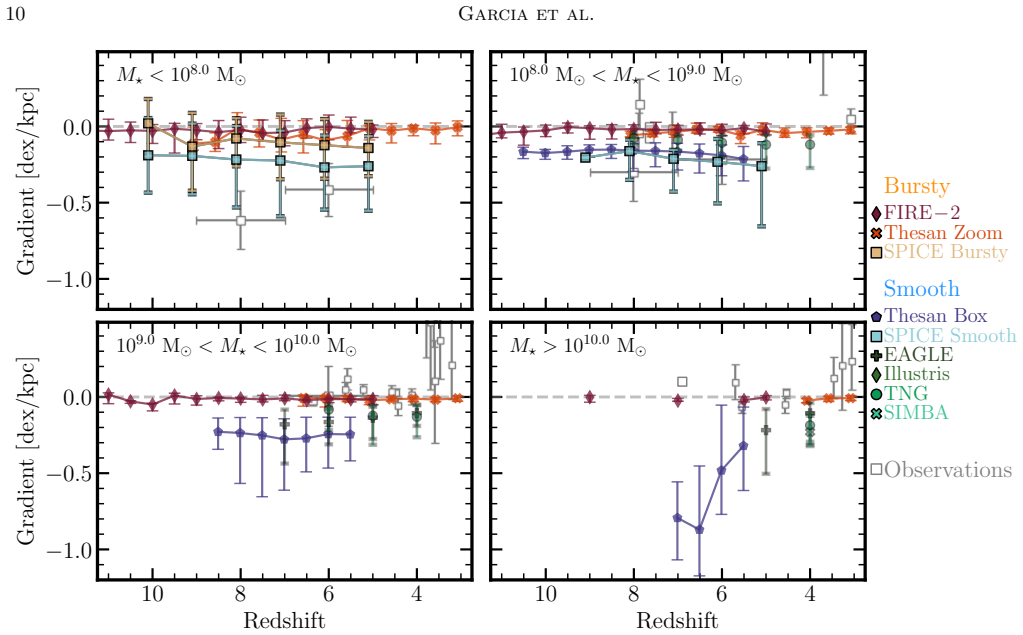
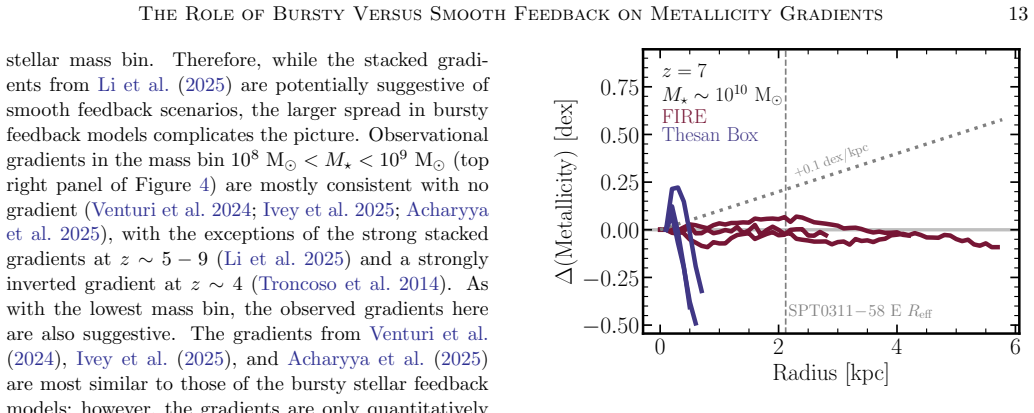
Across the FIRE-2, SPICE Bursty, Thesan Zoom, SPICE Smooth, and Thesan Box suites, galaxies with bursty feedback develop gas-phase metallicity gradients that are flatter by factors of approximately 2-10 than those produced under smooth feedback, with the difference most pronounced for galaxies above 10^9 solar masses. Bursty feedback injects sufficient turbulence to redistribute metals radially and suppress strong negative gradients, while smooth feedback permits less mixing and therefore preserves steeper gradients.
What carries the argument
The contrast between bursty (time-variable) and smooth (steady) stellar feedback and the turbulence each mode generates for radial metal redistribution.
If this is right
- Bursty feedback supplies enough turbulence to prevent strong negative metallicity gradients from forming.
- Smooth feedback does not enable efficient radial metal redistribution and therefore maintains steeper gradients.
- High-resolution gas-phase metallicity observations at high redshift can serve as a discriminator between qualitatively different feedback implementations.
- The majority of existing high-redshift gradient measurements are consistent with a bursty feedback picture, though a minority are not.
Where Pith is reading between the lines
- If bursty feedback is required to match observed gradients, then simulations that enforce smooth feedback may systematically under-predict metal mixing in the interstellar medium of early galaxies.
- Future observations with instruments capable of resolving gradients inside individual high-redshift galaxies could test whether the bursty-smooth distinction persists across a wider mass range.
- The same turbulence that flattens metallicity gradients may also influence other observable properties such as the spatial distribution of young stars or the kinematics of outflows.
Load-bearing premise
Differences in metallicity gradients arise mainly from the bursty versus smooth character of the feedback rather than from other differences in resolution, subgrid physics, or initial conditions across the simulation suites.
What would settle it
A set of high-redshift galaxies above 10^9 solar masses with steep observed metallicity gradients that also show clear signatures of bursty star-formation histories would directly contradict the reported trend.
Figures



read the original abstract
The distribution of gas-phase metals within galaxies encodes the impact of stellar feedback on galactic evolution. At high-redshift, when galaxies are rapidly assembling, feedback-driven outflows and turbulence can strongly reshape radial metallicity gradients. In this work, we use the FIRE-2, SPICE, Thesan and Thesan Zoom cosmological simulations -- spanning a range of stellar feedback from bursty (time-variable) to smooth (steady) -- to investigate how these feedback modes shape gas-phase metallicity gradients at $3<z\lesssim11$. Across all models, we find that galaxies with bursty feedback (FIRE-2, SPICE Bursty, and Thesan Zoom) develop systematically flatter (factors of $\sim2-10$) metallicity gradients than those with smooth feedback (SPICE Smooth and Thesan Box), particularly at stellar masses $M_\star > 10^{9}~{\rm M_\odot}$. These results demonstrate that bursty stellar feedback provides sufficient turbulence to prevent strong negative gradients from forming, while smooth stellar feedback does not generically allow for efficient radial redistribution of metals thereby keeping gradients steep. Finally, we compare with recent observations, finding that the majority -- but, notably, not all -- of the observed gradients may favor a bursty stellar feedback scenario. In all, these results highlight the utility of high-resolution observations of gas-phase metallicity at high-redshift as a key discriminator of these qualitatively different feedback types.
Editorial analysis
A structured set of objections, weighed in public.
Referee Report
Summary. The paper uses cosmological simulations from the FIRE-2, SPICE, and Thesan suites to examine gas-phase metallicity gradients at 3 < z ≲ 11. It claims that runs with bursty (time-variable) stellar feedback produce systematically flatter gradients than runs with smooth (steady) feedback by factors of ∼2–10, especially above M⋆ = 10^9 M⊙, because bursty feedback supplies enough turbulence to redistribute metals while smooth feedback does not. The abstract also notes a partial match to recent observations and concludes that high-redshift gradient measurements can discriminate between these feedback regimes.
Significance. If the attribution to feedback time-variability survives controls for resolution and sub-grid differences, the result would supply a concrete, observationally testable signature of bursty versus smooth feedback during the epoch of rapid galaxy assembly. This would strengthen the use of metallicity gradients as a diagnostic in galaxy-formation theory.
major comments (1)
- [Abstract] Abstract: the central claim attributes the factor ∼2–10 flattening exclusively to the bursty versus smooth character of stellar feedback, yet the abstract supplies no information on gradient measurement methods, sample selection, or any corrections for the known differences in numerical resolution, metal-diffusion implementations, star-formation sub-grid models, and cosmological initial conditions that exist across the FIRE-2, SPICE, and Thesan suites. Because the compared runs differ simultaneously in multiple non-feedback aspects, the reported difference cannot yet be isolated to feedback variability.
minor comments (1)
- [Abstract] Abstract: the statement that “the majority—but, notably, not all—of the observed gradients may favor a bursty stellar feedback scenario” is left without reference to the specific observational datasets or quantitative comparison metrics used.
Simulated Author's Rebuttal
We thank the referee for their constructive comments and for recognizing the potential significance of our results. We address the major comment below.
read point-by-point responses
-
Referee: [Abstract] Abstract: the central claim attributes the factor ∼2–10 flattening exclusively to the bursty versus smooth character of stellar feedback, yet the abstract supplies no information on gradient measurement methods, sample selection, or any corrections for the known differences in numerical resolution, metal-diffusion implementations, star-formation sub-grid models, and cosmological initial conditions that exist across the FIRE-2, SPICE, and Thesan suites. Because the compared runs differ simultaneously in multiple non-feedback aspects, the reported difference cannot yet be isolated to feedback variability.
Authors: We agree that the abstract, as a concise summary, does not detail measurement methods or explicitly discuss cross-suite differences in resolution and sub-grid physics. The main text provides these details, including how gradients are measured and the sample selection. To address the concern, we will revise the abstract to briefly describe the gradient measurement approach and to note that the comparison spans independent suites with both bursty and smooth feedback variants (e.g., SPICE Bursty vs. SPICE Smooth; Thesan Zoom vs. Thesan Box). We maintain that the systematic trend across these implementations supports attribution to feedback time-variability rather than other differences, but we will add language acknowledging the multi-faceted nature of the suite comparisons. revision: yes
Circularity Check
No circularity: direct comparison of independent simulation outputs
full rationale
The paper reports a comparative result across distinct simulation suites (FIRE-2, SPICE variants, Thesan Box/Zoom) that are pre-classified by their feedback character (bursty vs. smooth). The claimed factor of ~2-10 difference in metallicity gradients at M⋆ > 10^9 M⊙ is presented as an observed outcome of running those external codes, not as a quantity fitted, redefined, or derived from within the present analysis. No equations, ansatzes, or self-citations appear in the available text that would reduce the reported gradients to the input classification by construction. The study is therefore self-contained against external benchmarks and receives a score of 0.
Axiom & Free-Parameter Ledger
axioms (1)
- domain assumption Differences in metallicity gradients between simulation suites are attributable to the bursty versus smooth feedback implementation rather than other code-specific choices.
Lean theorems connected to this paper
-
IndisputableMonolith/Foundation/RealityFromDistinction.leanreality_from_one_distinction unclear?
unclearRelation between the paper passage and the cited Recognition theorem.
Across all models, we find that galaxies with bursty feedback (FIRE-2, SPICE Bursty, and Thesan Zoom) develop systematically flatter (factors of ∼2−10) metallicity gradients than those with smooth feedback (SPICE Smooth and Thesan Box)
-
IndisputableMonolith/Cost/FunctionalEquation.leanwashburn_uniqueness_aczel unclear?
unclearRelation between the paper passage and the cited Recognition theorem.
bursty stellar feedback provides sufficient turbulence to prevent strong negative gradients from forming, while smooth stellar feedback does not generically allow for efficient radial redistribution of metals
What do these tags mean?
- matches
- The paper's claim is directly supported by a theorem in the formal canon.
- supports
- The theorem supports part of the paper's argument, but the paper may add assumptions or extra steps.
- extends
- The paper goes beyond the formal theorem; the theorem is a base layer rather than the whole result.
- uses
- The paper appears to rely on the theorem as machinery.
- contradicts
- The paper's claim conflicts with a theorem or certificate in the canon.
- unclear
- Pith found a possible connection, but the passage is too broad, indirect, or ambiguous to say the theorem truly supports the claim.
Forward citations
Cited by 1 Pith paper
-
The DREAMS Project: Disentangling the Impact of Halo-to-Halo Variance and Baryonic Feedback on Milky Way Dark Matter Density Profiles
Milky Way-mass dark matter density profiles in IllustrisTNG are largely insensitive to astrophysics and cosmology variations, dominated by halo-to-halo variance instead.
Reference graph
Works this paper leans on
-
[1]
Acharyya, A., Krumholz, M. R., Federrath, C., et al. 2020, MNRAS, 495, 3819, doi: 10.1093/mnras/staa1100
-
[2]
Acharyya, A., Peeples, M. S., Tumlinson, J., et al. 2024, arXiv e-prints, arXiv:2404.06613, doi: 10.48550/arXiv.2404.06613
-
[3]
Acharyya, A., Watson, P. J., Vulcani, B., et al. 2025, arXiv e-prints, arXiv:2508.05335, doi: 10.48550/arXiv.2508.05335
-
[4]
Galactic Centre region, longitudes 345 to 6
Agertz, O., Teyssier, R., & Moore, B. 2011, MNRAS, 410, 1391, doi: 10.1111/j.1365-2966.2010.17530.x Angl´ es-Alc´ azar, D., Faucher-Gigu` ere, C.-A., Kereˇ s, D., et al. 2017, MNRAS, 470, 4698, doi: 10.1093/mnras/stx1517
-
[5]
2024, A&A, 688, A146, doi: 10.1051/0004-6361/202348824
Arribas, S., Perna, M., Rodr´ ıguez Del Pino, B., et al. 2024, A&A, 688, A146, doi: 10.1051/0004-6361/202348824
-
[6]
2024, MNRAS, 532, L14, doi: 10.1093/mnrasl/slae036
Bassini, L., Feldmann, R., Gensior, J., et al. 2024, MNRAS, 532, L14, doi: 10.1093/mnrasl/slae036
-
[7]
2017, MNRAS, 469, 151, doi: 10.1093/mnras/stx789
Belfiore, F., Maiolino, R., Tremonti, C., et al. 2017, MNRAS, 469, 151, doi: 10.1093/mnras/stx789
-
[8]
Bellardini, M. A., Wetzel, A., Loebman, S. R., et al. 2021, MNRAS, 505, 4586, doi: 10.1093/mnras/stab1606
-
[9]
Bhagwat, A., Costa, T., Ciardi, B., Pakmor, R., & Garaldi, E. 2024, MNRAS, 531, 3406, doi: 10.1093/mnras/stae1125
-
[10]
Quinn, T. 2012, MNRAS, 424, 1275, doi: 10.1111/j.1365-2966.2012.21306.x
-
[11]
Burger, J. D., Springel, V., Ostriker, E. C., et al. 2025, MNRAS, doi: 10.1093/mnras/staf1720
-
[12]
2018, MNRAS, 478, 4293, doi: 10.1093/mnras/sty1343
Carton, D., Brinchmann, J., Contini, T., et al. 2018, MNRAS, 478, 4293, doi: 10.1093/mnras/sty1343
-
[13]
2016, MNRAS, 457, 2605, doi: 10.1093/mnras/stw064
Ceverino, D., S´ anchez Almeida, J., Mu˜ noz Tu˜ n´ on, C., et al. 2016, MNRAS, 457, 2605, doi: 10.1093/mnras/stw064
-
[14]
2003, PASP, 115, 763, doi: 10.1086/376392
Chabrier, G. 2003, PASP, 115, 763, doi: 10.1086/376392
work page internal anchor Pith review doi:10.1086/376392 2003
-
[15]
K., Kereˇ s, D., Wetzel, A., et al
Chan, T. K., Kereˇ s, D., Wetzel, A., et al. 2018, MNRAS, 478, 906, doi: 10.1093/mnras/sty1153
-
[16]
Best, P. N. 2025, ApJL, 978, L42, doi: 10.3847/2041-8213/ad9a4d
-
[17]
Crain, R. A., & van de Voort, F. 2023, ARA&A, 61, 473, doi: 10.1146/annurev-astro-041923-043618
-
[18]
2010, Nature, 467, 811, doi: 10.1038/nature09451
Cresci, G., Mannucci, F., Maiolino, R., et al. 2010, Nature, 467, 811, doi: 10.1038/nature09451
-
[19]
2020, MNRAS, 492, 821, doi: 10.1093/mnras/stz3379
Curti, M., Maiolino, R., Cirasuolo, M., et al. 2020, MNRAS, 492, 821, doi: 10.1093/mnras/stz3379
-
[20]
M., Ward-Thompson, D., & Andr \'e , P.\ 2005, , 360, 4, 1506
Dale, J. E., Bonnell, I. A., Clarke, C. J., & Bate, M. R. 2005, MNRAS, 358, 291, doi: 10.1111/j.1365-2966.2005.08806.x
-
[21]
L., Tacchella, S., \”Ubler, H., et al
Danhaive, A. L., Tacchella, S.,\”Ubler, H., et al. 2025, arXiv e-prints, arXiv:2503.21863, doi: 10.48550/arXiv.2503.21863 Dav´ e, R., Angl´ es-Alc´ azar, D., Narayanan, D., et al. 2019, MNRAS, 486, 2827, doi: 10.1093/mnras/stz937
-
[22]
Doherty, C. L., Gil-Pons, P., Lau, H. H. B., Lattanzio, J. C., & Siess, L. 2014, MNRAS, 437, 195, doi: 10.1093/mnras/stt1877
-
[23]
2016, ApJ, 820, 131, doi: 10.3847/0004-637X/820/2/131
El-Badry, K., Wetzel, A., Geha, M., et al. 2016, ApJ, 820, 131, doi: 10.3847/0004-637X/820/2/131
-
[24]
2018a, MNRAS, 473, 1930, doi: 10.1093/mnras/stx2482
El-Badry, K., Quataert, E., Wetzel, A., et al. 2018, MNRAS, 473, 1930, doi: 10.1093/mnras/stx2482
-
[25]
Escala, I., Wetzel, A., Kirby, E. N., et al. 2018, MNRAS, 474, 2194, doi: 10.1093/mnras/stx2858
-
[26]
Evans, Neal J., I., Dunham, M. M., Jørgensen, J. K., et al. 2009, ApJS, 181, 321, doi: 10.1088/0067-0049/181/2/321
-
[27]
Federrath, C., & Klessen, R. S. 2012, ApJ, 761, 156, doi: 10.1088/0004-637X/761/2/156
-
[28]
2023, MNRAS, 522, 3831, doi: 10.1093/mnras/stad1205
Feldmann, R., Quataert, E., Faucher-Gigu` ere, C.-A., et al. 2023, MNRAS, 522, 3831, doi: 10.1093/mnras/stad1205
-
[29]
Ferrero, I., Navarro, J. F., Abadi, M. G., et al. 2017, MNRAS, 464, 4736, doi: 10.1093/mnras/stw2691
-
[30]
Fishlock, C. K., Karakas, A. I., Lugaro, M., & Yong, D. 2014, ApJ, 797, 44, doi: 10.1088/0004-637X/797/1/44 Forouhar Moreno, V. J., Helly, J., McGibbon, R., et al. 2025, MNRAS, doi: 10.1093/mnras/staf1478 F¨ orster Schreiber, N. M., Renzini, A., Mancini, C., et al. 2018, ApJS, 238, 21, doi: 10.3847/1538-4365/aadd49
- [31]
- [32]
-
[33]
1994, ApJL, 430, L105, doi: 10.1086/187449
Friedli, D., Benz, W., & Kennicutt, R. 1994, ApJL, 430, L105, doi: 10.1086/187449
-
[34]
Fujimoto, S., Faisst, A. L., Tsujita, A., et al. 2025, arXiv e-prints, arXiv:2510.16116. https://arxiv.org/abs/2510.16116
-
[35]
Garaldi, E., Kannan, R., Smith, A., et al. 2022, MNRAS, 512, 4909, doi: 10.1093/mnras/stac257 —. 2024, MNRAS, 530, 3765, doi: 10.1093/mnras/stae839
-
[36]
Garcia, A. M., Torrey, P., Hemler, Z. S., et al. 2023, MNRAS, 519, 4716, doi: 10.1093/mnras/stac3749
-
[37]
M., Torrey, P., Grasha, K., et al
Garcia, A. M., Torrey, P., Grasha, K., et al. 2024a, MNRAS, 529, 3342, doi: 10.1093/mnras/stae737
-
[38]
M., Torrey, P., Ellison, S., et al
Garcia, A. M., Torrey, P., Ellison, S., et al. 2024b, MNRAS, 531, 1398, doi: 10.1093/mnras/stae1252
-
[39]
Garcia, A. M., Torrey, P., Ellison, S. L., et al. 2025a, MNRAS, 536, 119, doi: 10.1093/mnras/stae2587
-
[40]
M., Torrey, P., Bhagwat, A., et al
Garcia, A. M., Torrey, P., Bhagwat, A., et al. 2025b, ApJ, 989, 147, doi: 10.3847/1538-4357/adea51 18Garcia et al
-
[41]
Garrison-Kimmel, S., Wetzel, A., Bullock, J. S., et al. 2017, MNRAS, 471, 1709, doi: 10.1093/mnras/stx1710
-
[42]
Garrison-Kimmel, S., Hopkins, P. F., Wetzel, A., et al. 2019, MNRAS, 487, 1380, doi: 10.1093/mnras/stz1317
-
[43]
, archivePrefix = "arXiv", eprint =
Genel, S., Vogelsberger, M., Springel, V., et al. 2014, MNRAS, 445, 175, doi: 10.1093/mnras/stu1654
-
[44]
Gibson, B. K., Pilkington, K., Brook, C. B., Stinson, G. S., & Bailin, J. 2013, A&A, 554, A47, doi: 10.1051/0004-6361/201321239
-
[45]
L., Wetzel, A., Bailin, J., & Orr, M
Graf, R. L., Wetzel, A., Bailin, J., & Orr, M. E. 2024, arXiv e-prints, arXiv:2410.21377, doi: 10.48550/arXiv.2410.21377
-
[46]
Grasha, K., Chen, Q. H., Battisti, A. J., et al. 2022, ApJ, 929, 118, doi: 10.3847/1538-4357/ac5ab2
-
[47]
2020, MNRAS, 498, 1939, doi: 10.1093/mnras/staa2382
Grossi, M., Garc´ ıa-Benito, R., Cortesi, A., et al. 2020, MNRAS, 498, 1939, doi: 10.1093/mnras/staa2382
-
[48]
Hemler, Z. S., Torrey, P., Qi, J., et al. 2021, MNRAS, 506, 3024, doi: 10.1093/mnras/stab1803
-
[49]
2011, ApJL, 743, L29, doi: 10.1088/2041-8205/743/2/L29
Hennebelle, P., & Chabrier, G. 2011, ApJL, 743, L29, doi: 10.1088/2041-8205/743/2/L29
-
[50]
Hopkins, P. F. 2015, MNRAS, 450, 53, doi: 10.1093/mnras/stv195 —. 2017, MNRAS, 466, 3387, doi: 10.1093/mnras/stw3306
-
[51]
Hopkins, P. F., Kereˇ s, D., O˜ norbe, J., et al. 2014, MNRAS, 445, 581, doi: 10.1093/mnras/stu1738
-
[52]
FIRE-2 Simulations: Physics versus Numerics in Galaxy Formation
Hopkins, P. F., Wetzel, A., Kereˇ s, D., et al. 2018, MNRAS, 480, 800, doi: 10.1093/mnras/sty1690
work page internal anchor Pith review doi:10.1093/mnras/sty1690 2018
-
[53]
Ivey, L. R., Scholtz, J., Danhaive, A. L., et al. 2025, arXiv e-prints, arXiv:2507.14936, doi: 10.48550/arXiv.2507.14936
-
[54]
1999, ApJS, 125, 439, doi: 10.1086/313278
Iwamoto, K., Brachwitz, F., Nomoto, K., et al. 1999, ApJS, 125, 439, doi: 10.1086/313278
-
[55]
Monthly Notices of the Royal Astronomical Society , author =
Izzard, R. G., Tout, C. A., Karakas, A. I., & Pols, O. R. 2004, MNRAS, 350, 407, doi: 10.1111/j.1365-2966.2004.07446.x
-
[56]
Jijina, J., & Adams, F. C. 1996, ApJ, 462, 874, doi: 10.1086/177201
-
[57]
Jones, T., Ellis, R. S., Richard, J., & Jullo, E. 2013, ApJ, 765, 48, doi: 10.1088/0004-637X/765/1/48
-
[58]
Jones, T., Wang, X., Schmidt, K. B., et al. 2015, AJ, 149, 107, doi: 10.1088/0004-6256/149/3/107
-
[59]
2025, ApJL, 978, L39, doi: 10.3847/2041-8213/ada150
Ju, M., Wang, X., Jones, T., et al. 2025, ApJL, 978, L39, doi: 10.3847/2041-8213/ada150
-
[60]
Kannan, R., Garaldi, E., Smith, A., et al. 2022, MNRAS, 511, 4005, doi: 10.1093/mnras/stab3710
-
[61]
Kannan, R., Marinacci, F., Simpson, C. M., Glover, S. C. O., & Hernquist, L. 2020, MNRAS, 491, 2088, doi: 10.1093/mnras/stz3078
-
[62]
2019, MNRAS, 485, 117, doi: 10.1093/mnras/stz287
Kannan, R., Vogelsberger, M., Marinacci, F., et al. 2019, MNRAS, 485, 117, doi: 10.1093/mnras/stz287
-
[63]
2025, arXiv e-prints, arXiv:2502.20437
Kannan, R., Puchwein, E., Smith, A., et al. 2025, arXiv e-prints, arXiv:2502.20437, doi: 10.48550/arXiv.2502.20437
-
[64]
Karakas, A. I. 2010, MNRAS, 403, 1413, doi: 10.1111/j.1365-2966.2009.16198.x
-
[65]
Kennicutt, Jr., R. C. 1998, ARA&A, 36, 189, doi: 10.1146/annurev.astro.36.1.189
work page internal anchor Pith review doi:10.1146/annurev.astro.36.1.189 1998
-
[66]
Kewley, L. J., Nicholls, D. C., & Sutherland, R. S. 2019, ARA&A, 57, 511, doi: 10.1146/annurev-astro-081817-051832
-
[67]
Knollmann, S. R., & Knebe, A. 2009, ApJS, 182, 608, doi: 10.1088/0067-0049/182/2/608
-
[68]
2006, ApJ, 653, 1145, doi: 10.1086/508914
Ohkubo, T. 2006, ApJ, 653, 1145, doi: 10.1086/508914
-
[69]
2020, MNRAS, 492, 1385, doi: 10.1093/mnras/stz3495
Kretschmer, M., & Teyssier, R. 2020, MNRAS, 492, 1385, doi: 10.1093/mnras/stz3495
-
[70]
Kroupa, P. 2002, Science, 295, 82, doi: 10.1126/science.1067524
-
[71]
Lazar, A., Bullock, J. S., Boylan-Kolchin, M., et al. 2020, MNRAS, 497, 2393, doi: 10.1093/mnras/staa2101
-
[72]
Leethochawalit, N., Jones, T. A., Ellis, R. S., et al. 2016, ApJ, 820, 84, doi: 10.3847/0004-637X/820/2/84
-
[73]
2014, ApJS, 212, 14, doi: 10.1088/0067-0049/212/1/14
Leitherer, C., Ekstr¨ om, S., Meynet, G., et al. 2014, ApJS, 212, 14, doi: 10.1088/0067-0049/212/1/14
-
[74]
Leitherer, C., Schaerer, D., Goldader, J. D., et al. 1999, ApJS, 123, 3, doi: 10.1086/313233
-
[75]
2022, ApJL, 929, L8, doi: 10.3847/2041-8213/ac626f
Li, Z., Wang, X., Cai, Z., et al. 2022, ApJL, 929, L8, doi: 10.3847/2041-8213/ac626f
-
[76]
2025c, arXiv e-prints, arXiv:2506.12129, doi: 10.48550/arXiv.2506.12129
Li, Z., Cai, Z., Wang, X., et al. 2025, arXiv e-prints, arXiv:2506.12129, doi: 10.48550/arXiv.2506.12129
-
[77]
J., D’Eugenio, F., Maiolino, R., et al
Looser, T. J., D’Eugenio, F., Maiolino, R., et al. 2024, Nature, 629, 53, doi: 10.1038/s41586-024-07227-0
-
[78]
Lopez, L. A., Krumholz, M. R., Bolatto, A. D., Prochaska, J. X., & Ramirez-Ruiz, E. 2011, ApJ, 731, 91, doi: 10.1088/0004-637X/731/2/91
-
[79]
Ma, X., Hopkins, P. F., Feldmann, R., et al. 2017, MNRAS, 466, 4780, doi: 10.1093/mnras/stx034
-
[80]
2020, MNRAS, 498, 2001, doi: 10.1093/mnras/staa2404
Ma, X., Quataert, E., Wetzel, A., et al. 2020, MNRAS, 498, 2001, doi: 10.1093/mnras/staa2404
discussion (0)
Sign in with ORCID, Apple, or X to comment. Anyone can read and Pith papers without signing in.