Recognition: 1 theorem link
· Lean TheoremCygnus X-3: A variable petaelectronvolt gamma-ray source
Pith reviewed 2026-05-16 21:23 UTC · model grok-4.3
The pith
Cygnus X-3 emits variable gamma rays reaching petaelectronvolt energies
A machine-rendered reading of the paper's core claim, the machinery that carries it, and where it could break.
Core claim
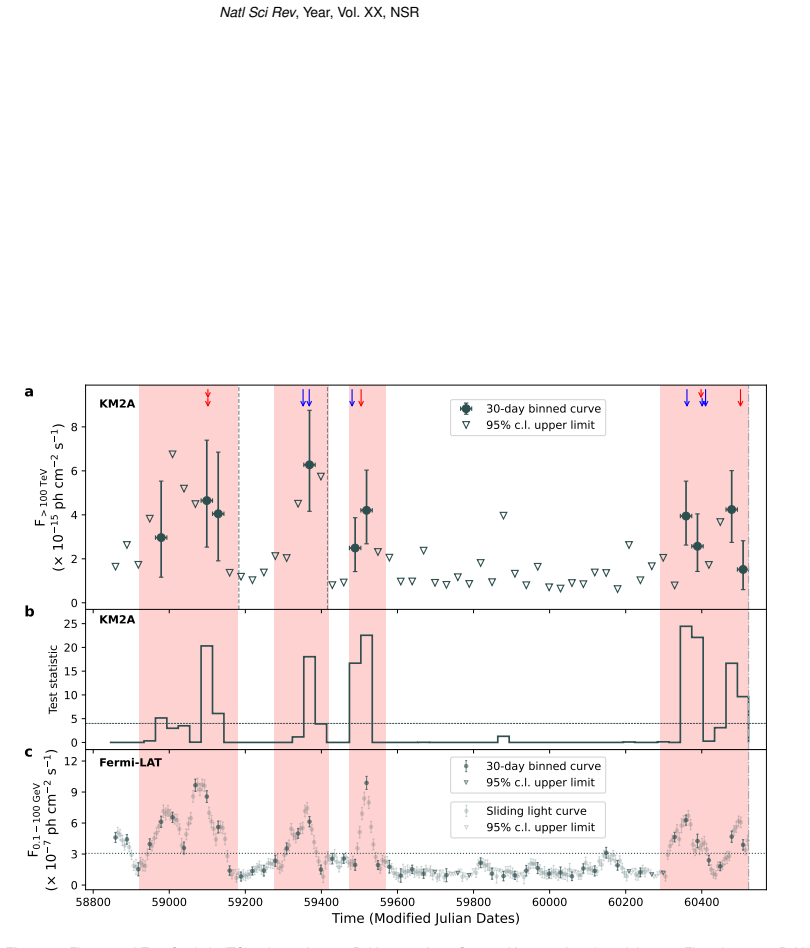
We report the discovery of variable γ-rays up to petaelectronvolt from Cygnus X-3. The γ-ray signal was detected with a statistical significance of approximately 10 σ by LHAASO. Its intrinsic spectral energy distribution extending from 0.06 to 3.7 PeV shows a pronounced rise toward 1 PeV after accounting for absorption by the cosmic microwave background radiation. Variability on month-long timescales at 8.6 σ coincides with a high state of the GeV gamma-ray flux detected by the Fermi-LAT. This, together with a 3.2σ evidence for orbital modulation, suggests that the PeV γ-rays originate within, or in close proximity to, the binary system itself. The observed energy spectrum and temporal mod
What carries the argument
Photomeson processes in the innermost region of the relativistic jet, where protons are accelerated to tens of PeV energies
Load-bearing premise
The assumption that the 8.6-sigma monthly variability coinciding with Fermi-LAT GeV flux and the 3.2-sigma orbital modulation together prove the PeV emission originates inside or immediately adjacent to the binary rather than in a more distant region of the jet or surrounding medium.
What would settle it
Detection of steady PeV emission from Cygnus X-3 that shows no correlation with the GeV flux variations or the orbital phase would falsify the claim of a production site inside or near the binary.
Figures


read the original abstract
We report the discovery of variable $\gamma$-rays up to petaelectronvolt from Cygnus X-3, an iconic X-ray binary. The $\gamma$-ray signal was detected with a statistical significance of approximately 10 $\sigma$ by the Large High Altitude Air Shower Observatory (LHAASO). Its intrinsic spectral energy distribution (SED), extending from 0.06 to 3.7 PeV, shows a pronounced rise toward 1 PeV after accounting for absorption by the cosmic microwave background radiation. We find variability on month-long timescales at a significance of $8.6 \sigma$, coinciding with a high state of the GeV gamma-ray flux detected by the Fermi-LAT. This,together with a 3.2$\sigma$ evidence for orbital modulation, suggests that the PeV $\gamma$-rays originate within, or in close proximity to, the binary system itself. The observed energy spectrum and temporal modulation can be naturally explained by $\gamma$-ray production through photomeson processes in the innermost region of the relativistic jet, where protons need to be accelerated to tens of PeV energies.
Editorial analysis
A structured set of objections, weighed in public.
Referee Report
Summary. The paper reports the discovery of variable gamma-ray emission from the X-ray binary Cygnus X-3 extending to petaelectronvolt energies, detected at ~10σ significance with LHAASO. The intrinsic SED rises toward 1 PeV after CMB absorption correction. Monthly variability is found at 8.6σ significance, coinciding with Fermi-LAT GeV high states, together with 3.2σ evidence for orbital modulation. The authors interpret the spectrum and timing as photomeson production in the innermost relativistic jet, requiring proton acceleration to tens of PeV.
Significance. If the binary association and photomeson origin hold, this would be the first confirmed PeV gamma-ray source in an X-ray binary, with implications for extreme hadronic acceleration in compact-object jets and the origin of galactic cosmic rays above the knee. The detection and monthly variability analyses use established LHAASO methods and benefit from direct cross-checks with Fermi-LAT, strengthening the observational foundation.
major comments (2)
- [Abstract / Temporal variability analysis] Abstract and temporal analysis section: The claim that the PeV emission originates 'within, or in close proximity to, the binary system' rests substantially on the reported 3.2σ orbital modulation. This significance is marginal by VHE astronomy standards for periodicity claims; the manuscript must explicitly report trials factors (phase binning choices, period search range, and look-elsewhere corrections) to demonstrate that the modulation is not overstated.
- [Abstract / Discussion] Abstract and spectral interpretation: The photomeson scenario is presented as a natural explanation based on the SED shape and temporal modulation, but no quantitative model fits, predicted spectra, or comparisons to alternative sites (e.g., extended jet or surrounding medium) are shown. This leaves the exclusion of more distant production regions on weaker footing.
minor comments (2)
- [Abstract] Abstract: Typo in 'This,together' should read 'This, together'.
- [Methods / Results] The manuscript should clarify the exact energy range and binning used for the 10σ detection and 8.6σ variability to allow direct reproducibility.
Simulated Author's Rebuttal
Thank you for the referee's positive summary and recommendation for major revision. We have carefully considered the comments and revised the manuscript to strengthen the statistical reporting and the discussion of the emission scenario.
read point-by-point responses
-
Referee: [Abstract / Temporal variability analysis] Abstract and temporal analysis section: The claim that the PeV emission originates 'within, or in close proximity to, the binary system' rests substantially on the reported 3.2σ orbital modulation. This significance is marginal by VHE astronomy standards for periodicity claims; the manuscript must explicitly report trials factors (phase binning choices, period search range, and look-elsewhere corrections) to demonstrate that the modulation is not overstated.
Authors: We agree that the 3.2σ orbital modulation significance is marginal and requires full transparency in the statistical procedure. In the revised manuscript, we will add explicit details on the trials factors in the temporal analysis section: the search used 20 phase bins over the known 4.8-hour orbital period, a narrow period range of ±0.005 days around the ephemeris to account for timing uncertainties, and a look-elsewhere correction yielding a post-trials significance of 3.2σ. This will clarify that the modulation is not overstated and supports the proximity to the binary system. revision: yes
-
Referee: [Abstract / Discussion] Abstract and spectral interpretation: The photomeson scenario is presented as a natural explanation based on the SED shape and temporal modulation, but no quantitative model fits, predicted spectra, or comparisons to alternative sites (e.g., extended jet or surrounding medium) are shown. This leaves the exclusion of more distant production regions on weaker footing.
Authors: We acknowledge that quantitative support would strengthen the photomeson interpretation. In the revised discussion, we will include a simple one-zone photomeson model showing the expected gamma-ray spectrum from protons at 10-100 PeV interacting with the companion star's photon field, reproducing the observed SED rise toward 1 PeV after CMB absorption. We will also compare to alternatives, noting that the detected monthly variability at 8.6σ significance strongly disfavors steady production in the extended jet or surrounding medium, as those regions would not produce such rapid changes. revision: yes
Circularity Check
No significant circularity in observational discovery claims
full rationale
The paper reports direct LHAASO detection of PeV gamma-rays from Cygnus X-3, including ~10σ significance, 8.6σ monthly variability correlated with Fermi-LAT GeV data, 3.2σ orbital modulation evidence, and the intrinsic SED shape. These are statistical measurements from independent observations, not mathematical derivations that reduce by construction to fitted parameters or self-referential inputs. The photomeson jet interpretation is presented as a natural physical explanation for the observed spectrum and modulation, without any equations or ansatzes that loop back to the same data. No self-citation chains, uniqueness theorems, or renamed empirical patterns serve as load-bearing steps for the core result. The analysis is self-contained against external benchmarks (Fermi-LAT cross-checks) and does not exhibit any of the enumerated circularity patterns.
Axiom & Free-Parameter Ledger
axioms (2)
- standard math Standard cosmic microwave background pair-production absorption model for gamma-ray propagation
- domain assumption Photomeson production cross sections and pion decay kinematics from particle physics
Lean theorems connected to this paper
-
IndisputableMonolith/Foundation/RealityFromDistinction.leanreality_from_one_distinction unclear?
unclearRelation between the paper passage and the cited Recognition theorem.
The observed energy spectrum and temporal modulation can be naturally explained by γ-ray production through photomeson processes in the innermost region of the relativistic jet, where protons need to be accelerated to tens of PeV energies.
What do these tags mean?
- matches
- The paper's claim is directly supported by a theorem in the formal canon.
- supports
- The theorem supports part of the paper's argument, but the paper may add assumptions or extra steps.
- extends
- The paper goes beyond the formal theorem; the theorem is a base layer rather than the whole result.
- uses
- The paper appears to rely on the theorem as machinery.
- contradicts
- The paper's claim conflicts with a theorem or certificate in the canon.
- unclear
- Pith found a possible connection, but the passage is too broad, indirect, or ambiguous to say the theorem truly supports the claim.
Forward citations
Cited by 2 Pith papers
-
Multi-TeV $\gamma$-ray candidates from GRB 221009A: a downturn in the intrinsic $\gamma$-ray spectrum, an echo of the prompt emission phase, and intergalactic electromagnetic cascades
GRB 221009A exhibits a TeV spectral downturn explained by neutron-induced synchrotron photons as a prompt emission echo, while intergalactic cascades are suppressed for typical filament magnetic fields above 1 nG.
-
Constraining the PeV gamma-ray emission zone of Cygnus X-3 with contemporaneous GeV timing and spectral observations
The GeV emission zone in Cygnus X-3 is too large and magnetized too weakly to accelerate protons to PeV energies, so the PeV gamma rays must originate from a more compact inner region with rapid magnetic field dissipation.
Reference graph
Works this paper leans on
-
[1]
Giacconi R, Gorenstein P , Gursky Het al.An X-Ray Survey of the Cygnus Region.ApJL1967;148: L119
-
[2]
van Kerkwijk MH, Charles PA, Geballe TRet al.Infrared helium emission lines from Cygnus X-3 suggesting a Wolf- Rayet star companion.Natur1992;355: 703–705
-
[3]
Becklin EE, Neugebauer G, Hawkins FJet al.Infrared and X-ray Variability of Cyg X-3.Natur1973;245: 302–304
-
[4]
The X-ray ephemeris of Cygnus X-3.A&A1989;214: 203–208
van der Klis M and Bonnet-Bidaud JM. The X-ray ephemeris of Cygnus X-3.A&A1989;214: 203–208
-
[5]
Tavani M, Bulgarelli A, Piano Get al.Extreme particle ac- celeration in the microquasar CygnusX-3.Natur2009;462: 620–623
-
[6]
Modulated High-Energy Gamma-Ray Emission from the Microquasar Cygnus X-3.Sci2009;326: 1512
Fermi LAT Collaboration, Abdo AA, Ackermann Met al. Modulated High-Energy Gamma-Ray Emission from the Microquasar Cygnus X-3.Sci2009;326: 1512
-
[7]
Szostek A, Zdziarski AA and McCollough ML. A classifi- cation of the X-ray and radio states of Cyg X-3 and their long-term correlations.MNRAS2008;388: 1001–1010
-
[8]
Tudose V, Miller-Jones JCA, Fender RPet al.Probing the behaviour of the X-ray binary Cygnus X-3 with very long baseline radio interferometry.MNRAS2010;401: 890– 900
-
[9]
Koljonen KII, Hannikainen DC, McCollough MLet al.The hardness-intensity diagram of Cygnus X-3: revisiting the radio/X-ray states.MNRAS2010;406: 307–319
-
[10]
Mioduszewski AJ, Rupen MP , Hjellming RMet al.A One- sided Highly Relativistic Jet from Cygnus X-3.Astrophys. J. 2001;553: 766–775
work page 2001
-
[11]
Development of a two-sided relativistic jet in Cygnus X-3.Astron
Mart ´ı J, Paredes JM and Peracaula M. Development of a two-sided relativistic jet in Cygnus X-3.Astron. & Astro- phys.2001;375: 476–484
work page 2001
-
[12]
Miller-Jones JCA, Blundell KM, Rupen MPet al.Time- sequenced Multi-Radio Frequency Observations of Cygnus X-3 in Flare.ApJ2004;600: 368–389
-
[13]
Veledina A, Muleri F , Poutanen Jet al.Cygnus X-3 revealed as a Galactic ultraluminous X-ray source by IXPE.Nature Astronomy2024;8: 1031–1046
-
[14]
Y ang J, Garc´ıa F , del Palacio Set al.The innermost jet in the hidden ultra-luminous X-ray source Cygnus X-3.MN- RAS2023;526: L1–L7
-
[15]
An Astronomical Puzzle Called Cygnus X-3
Hjellming RM. An Astronomical Puzzle Called Cygnus X-3. Science1973;182: 1089–1095
-
[16]
Galactic Superaccret- ing X-Ray Binaries as Super-PeVatron Accelerators.ApJL 2025;989:L25
Wang J, Reville B and Aharonian FA. Galactic Superaccret- ing X-Ray Binaries as Super-PeVatron Accelerators.ApJL 2025;989:L25
work page 2025
-
[17]
Cygnus X-3, a critical review.Physics Reports1988;170: 325–404
Bonnet-Bidaud JM and Chardin G. Cygnus X-3, a critical review.Physics Reports1988;170: 325–404
-
[18]
Abeysekara AU, Albert A, Alfaro Ret al.Very-high-energy particle acceleration powered by the jets of the micro- quasar SS 433.Nature2018;562: 82–85
-
[19]
H E S S Collaboration, Aharonian F , Ait Benkhali Fet al. Acceleration and transport of relativistic electrons in the jets of the microquasar SS 433.Science2024;383: 402–406
-
[21]
Alfaro R, Alvarez C, Arteaga-Vel´azquez JCet al.Ultra-high- energy gamma-ray bubble around microquasar V4641 Sgr. Nature2024;634: 557–560
-
[22]
Design of the LHAASO detectors.Radia- tion Detection T echnology and Methods2018;2: 7
Huihai He FtLC. Design of the LHAASO detectors.Radia- tion Detection T echnology and Methods2018;2: 7
-
[24]
Aharonian F , An Q, Axikeguet al.Observation of the Crab Nebula with LHAASO-KM2A - a performance study.Chi- nese Physics C2021;45:025002
-
[25]
On the Distances to the X- Ray Binaries Cygnus X-3 and GRS 1915+105.ApJ2023; 959:85
Reid MJ and Miller-Jones JCA. On the Distances to the X- Ray Binaries Cygnus X-3 and GRS 1915+105.ApJ2023; 959:85. Page 8 of 35 Natl Sci Rev, Y ear, Vol. XX, NSR
work page 1915
-
[26]
Radiation fields and application to high-energy astrophysics.MNRAS2017;470: 2539– 2558
Popescu CC, Y ang R, Tuffs RJet al.A radiation transfer model for the Milky Way: I. Radiation fields and application to high-energy astrophysics.MNRAS2017;470: 2539– 2558
-
[27]
Zdziarski AA, Malyshev D, Dubus Get al.A comprehensive study of high-energy gamma-ray and radio emission from Cyg X-3.MNRAS2018;479: 4399–4415
-
[28]
Antokhin II, Cherepashchuk AM, Antokhina EAet al.Near- IR and X-Ray Variability of Cyg X-3: Evidence for a Com- pact IR Source and Complex Wind Structures.Astrophys. J.2022;926: 123
work page 2022
-
[29]
Aharonian FA.Very high energy cosmic gamma radiation : a crucial window on the extreme Universe, (WORLD SCI- ENTIFIC2004)
-
[30]
The relativistic jet of Cygnus X-3 in gamma-rays.MNRAS2010;404: L55–L59
Dubus G, Cerutti B and Henri G. The relativistic jet of Cygnus X-3 in gamma-rays.MNRAS2010;404: L55–L59
-
[31]
Zdziarski AA, Sikora M, Dubus Get al.The gamma-ray emitting region of the jet in Cyg X-3.MNRAS2012;421: 2956–2968
-
[32]
Kelner SR and Aharonian FA. Energy spectra of gamma rays, electrons, and neutrinos produced at interactions of relativistic protons with low energy radiation.PhRvD2008; 78:034013. Page 9 of 35 Natl Sci Rev, Y ear, Vol. XX, NSR Zhen Cao1,2,3 , F. Aharonian3,4,5,6 , Y .X. Bai1,3, Y .W. Bao7, D. Bastieri8, X.J. Bi1,2,3 , Y .J. Bi1,3, W. Bian7, A.V . Bukevich...
work page 2024
-
[33]
Giacconi, R., Gorenstein, P., Gursky, H. & Waters, J. R. An X-Ray Survey of the Cygnus Region. ApJL 148, L119 (1967)
work page 1967
-
[34]
van Kerkwijk, M. H. et al. Infrared helium emission lines from Cygnus X-3 suggesting a Wolf-Rayet star companion. Natur 355, 703–705 (1992)
work page 1992
-
[35]
Becklin, E. E. et al. Infrared and X-ray Variability of Cyg X-3. Natur 245, 302–304 (1973)
work page 1973
-
[36]
van der Klis, M. & Bonnet-Bidaud, J. M. The X-ray ephemeris of Cygnus X-3. A&A 214, 203–208 (1989)
work page 1989
-
[37]
Tavani, M. et al. Extreme particle acceleration in the microquasar CygnusX-3. Natur 462, 620–623 (2009). 0910.5344
work page internal anchor Pith review Pith/arXiv arXiv 2009
-
[38]
Modulated High-Energy Gamma-Ray Emission from the Microquasar Cygnus X-3
Fermi LAT Collaboration et al. Modulated High-Energy Gamma-Ray Emission from the Microquasar Cygnus X-3. Sci 326, 1512 (2009)
work page 2009
-
[39]
Szostek, A., Zdziarski, A. A. & McCollough, M. L. A classification of the X-ray and radio states of Cyg X-3 and their long-term correlations. MNRAS 388, 1001–1010 (2008). 0803.2217
work page internal anchor Pith review Pith/arXiv arXiv 2008
-
[40]
Tudose, V. et al. Probing the behaviour of the X-ray binary Cygnus X-3 with very long baseline radio interferometry. MNRAS 401, 890–900 (2010). 0909.2790
work page internal anchor Pith review Pith/arXiv arXiv 2010
-
[41]
Koljonen, K. I. I., Hannikainen, D. C., McCollough, M. L., Pooley, G. G. & Trushkin, S. A. The hardness-intensity diagram of Cygnus X-3: revisiting the radio/X-ray states.MNRAS 406, 307–319 (2010). 1003.4351
work page internal anchor Pith review Pith/arXiv arXiv 2010
-
[42]
A One-sided, Highly Relativistic Jet from Cygnus X-3
Mioduszewski, A. J., Rupen, M. P., Hjellming, R. M., Pooley, G. G. & Waltman, E. B. A One- sided Highly Relativistic Jet from Cygnus X-3. 553, 766–775 (2001). astro-ph/0102018
work page internal anchor Pith review Pith/arXiv arXiv 2001
-
[43]
Mart ´ı, J., Paredes, J. M. & Peracaula, M. Development of a two-sided relativistic jet in Cygnus X-3. 375, 476–484 (2001)
work page 2001
-
[44]
Miller-Jones, J. C. A. et al. Time-sequenced Multi-Radio Frequency Observations of Cygnus X-3 in Flare. ApJ 600, 368–389 (2004). astro-ph/0311277. 32
work page internal anchor Pith review Pith/arXiv arXiv 2004
- [45]
- [46]
-
[47]
Hjellming, R. M. An Astronomical Puzzle Called Cygnus X-3. Science 182, 1089–1095 (1973)
work page 1973
-
[48]
Wang, J., Reville, B. & Aharonian, F. A. Galactic Superaccreting X-Ray Binaries as Super- PeVatron Accelerators. ApJL 989, L25 (2025). 2507.21048
-
[49]
Bonnet-Bidaud, J. M. & Chardin, G. Cygnus X-3, a critical review. 170, 325–404 (1988)
work page 1988
-
[50]
Very high energy particle acceleration powered by the jets of the microquasar SS 433
Abeysekara, A. U., Albert, A., Alfaro, R. & et al. Very-high-energy particle acceleration powered by the jets of the microquasar SS 433. Nature 562, 82–85 (2018). 1810.01892
work page internal anchor Pith review Pith/arXiv arXiv 2018
- [51]
-
[52]
Ultrahigh-Energy Gamma-ray Emission Associated with Black Hole- Jet Systems
LHAASO Collaboration. Ultrahigh-Energy Gamma-ray Emission Associated with Black Hole- Jet Systems. arXiv e-prints arXiv:2410.08988 (2024). 2410.08988
- [53]
-
[54]
Huihai He, F. t. L. C. Design of the LHAASO detectors. Radiation Detection Technology and Methods 2, 7 (2018). URL https://doi.org/10.1007/s41605-018-0037-3
-
[55]
Optimization of performance of the KM2A full array using the Crab Nebula
LHAASO collaboration. Optimization of performance of the KM2A full array using the Crab Nebula. arXiv e-prints arXiv:2401.01038 (2024). 2401.01038
-
[56]
Aharonian, F. et al. Observation of the Crab Nebula with LHAASO-KM2A - a performance study. Chinese Physics C 45, 025002 (2021). 33
work page 2021
- [57]
-
[58]
Popescu, C. C. et al. A radiation transfer model for the Milky Way: I. Radiation fields and application to high-energy astrophysics. MNRAS 470, 2539–2558 (2017). 1705.06652
work page internal anchor Pith review Pith/arXiv arXiv 2017
-
[59]
Zdziarski, A. A. et al. A comprehensive study of high-energy gamma-ray and radio emission from Cyg X-3. MNRAS 479, 4399–4415 (2018). 1804.07460
work page internal anchor Pith review Pith/arXiv arXiv 2018
-
[60]
Antokhin, I. I., Cherepashchuk, A. M., Antokhina, E. A. & Tatarnikov, A. M. Near-IR and X- Ray Variability of Cyg X-3: Evidence for a Compact IR Source and Complex Wind Structures. Astrophys. J. 926, 123 (2022). 2112.04805
-
[61]
Aharonian, F. A. Very high energy cosmic gamma radiation : a crucial window on the extreme Universe (WORLD SCIENTIFIC, 2004)
work page 2004
-
[62]
The relativistic jet of Cygnus X-3 in gamma rays
Dubus, G., Cerutti, B. & Henri, G. The relativistic jet of Cygnus X-3 in gamma-rays. MNRAS 404, L55–L59 (2010). 1002.3888
work page internal anchor Pith review Pith/arXiv arXiv 2010
-
[63]
Zdziarski, A. A. et al. The gamma-ray emitting region of the jet in Cyg X-3. MNRAS 421, 2956–2968 (2012). 1111.0878
work page internal anchor Pith review Pith/arXiv arXiv 2012
-
[64]
Kelner, S. R. & Aharonian, F. A. Energy spectra of gamma rays, electrons, and neutrinos produced at interactions of relativistic protons with low energy radiation. PhRvD 78, 034013 (2008). 0803.0688
work page internal anchor Pith review Pith/arXiv arXiv 2008
-
[65]
An ultrahigh-energy𝛾-ray bubble powered by a super PeVatron.Science Bulletin 69, 449–457 (2024)
Lhaaso Collaboration. An ultrahigh-energy𝛾-ray bubble powered by a super PeVatron.Science Bulletin 69, 449–457 (2024). 2310.10100
-
[66]
Fermi Large Area Telescope Fourth Source Catalog Data Release 4 (4FGL-DR4)
Ballet, J., Bruel, P., Burnett, T. H., Lott, B. & The Fermi-LAT collaboration. Fermi Large Area Telescope Fourth Source Catalog Data Release 4 (4FGL-DR4). arXiv e-prints arXiv:2307.12546 (2023). 2307.12546
work page internal anchor Pith review Pith/arXiv arXiv 2023
- [67]
-
[68]
Aharonian, F. et al. Limits on an Energy Dependence of the Speed of Light from a Flare of the Active Galaxy PKS 2155-304. 101, 170402 (2008). 0810.3475
work page internal anchor Pith review Pith/arXiv arXiv 2008
- [69]
-
[70]
Bhargava, Y. et al. A Precise Measurement of the Orbital Period Parameters of Cygnus X-3. ApJ 849, 141 (2017). 1709.07441
work page internal anchor Pith review Pith/arXiv arXiv 2017
-
[71]
Alexander, T. Is AGN Variability Correlated with Other AGN Properties? ZDCF Analysis of Small Samples of Sparse Light Curves. In Maoz, D., Sternberg, A. & Leibowitz, E. M. (eds.) Astronomical Time Series, vol. 218 of Astrophysics and Space Science Library , 163 (1997)
work page 1997
- [72]
-
[73]
High-energy electromagnetic conversion processes in intense magnetic fields
ERBER, T. High-energy electromagnetic conversion processes in intense magnetic fields. Rev. Mod. Phys. 38, 626–659 (1966). URL https://link.aps.org/doi/10.1103/ RevModPhys.38.626
work page 1966
-
[74]
Mart ´ı, J., Paredes, J. M. & Peracaula, M. Development of a two-sided relativistic jet in Cygnus X-3. A&A 375, 476–484 (2001)
work page 2001
-
[75]
The effects of the stellar wind and orbital motion on the jets of high-mass microquasars
Bosch-Ramon, V. & Barkov, M. V. The effects of the stellar wind and orbital motion on the jets of high-mass microquasars. A&A 590, A119 (2016). 1604.06360
work page internal anchor Pith review Pith/arXiv arXiv 2016
-
[76]
L ´opez-Miralles, J., Perucho, M., Mart ´ı, J. M., Migliari, S. & Bosch-Ramon, V. 3D RMHD simulations of jet-wind interactions in high-mass X-ray binaries. A&A 661, A117 (2022). 2202.11119
-
[77]
Feng, H., Tao, L., Kaaret, P. & Gris´e, F. Nature of the Soft ULX in NGC 247: Super-Eddington Outflow and Transition between the Supersoft and Soft Ultraluminous Regimes.ApJ 831, 117 (2016). 1608.07212
work page internal anchor Pith review Pith/arXiv arXiv 2016
-
[78]
King, A., Lasota, J.-P. & Middleton, M. Ultraluminous X-ray sources. NewAR 96, 101672 (2023). 2302.10605. 35
-
[79]
Matsuoka, M. et al. The MAXI Mission on the ISS: Science and Instruments for Monitoring All-Sky X-Ray Images. 61, 999 (2009). 0906.0631. 36
work page internal anchor Pith review Pith/arXiv arXiv 2009
discussion (0)
Sign in with ORCID, Apple, or X to comment. Anyone can read and Pith papers without signing in.