The impact of waveform systematics and Gaussian noise on the interpretation of GW231123
Pith reviewed 2026-05-16 14:28 UTC · model grok-4.3
The pith
The high mass and high spin magnitudes of GW231123 inferred by NRSur7dq4 remain stable under waveform systematics and Gaussian noise.
A machine-rendered reading of the paper's core claim, the machinery that carries it, and where it could break.
Core claim
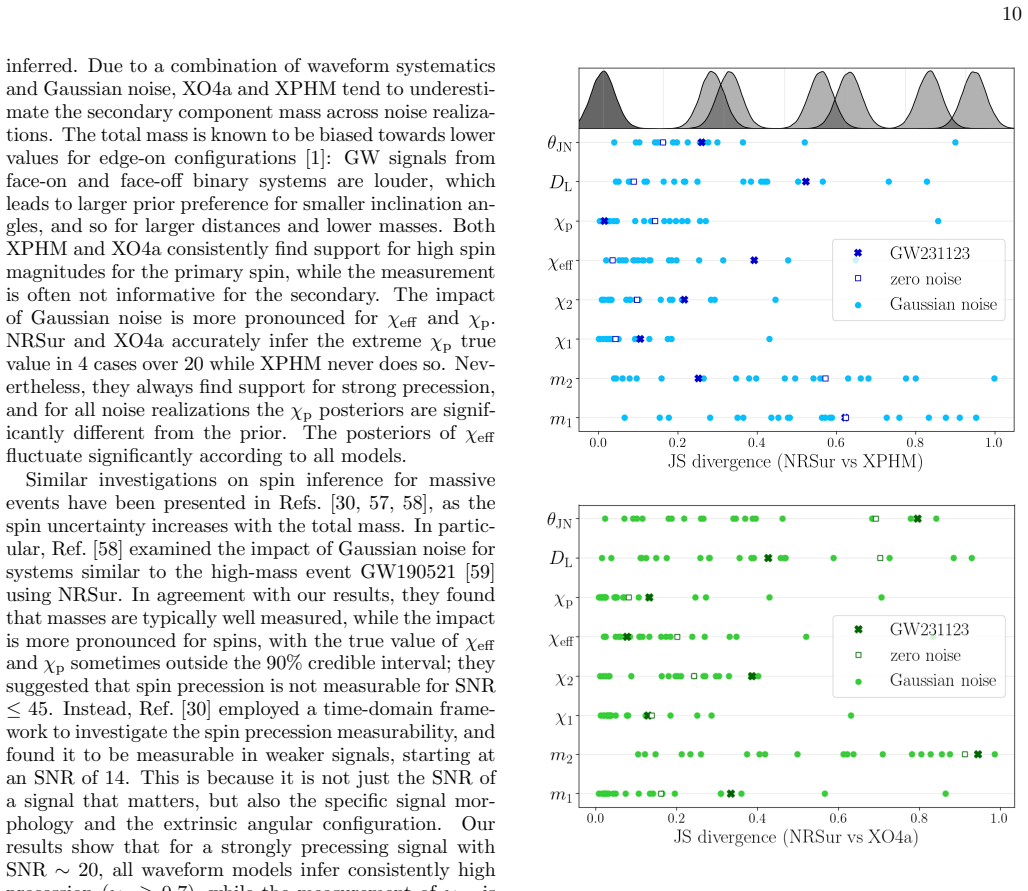
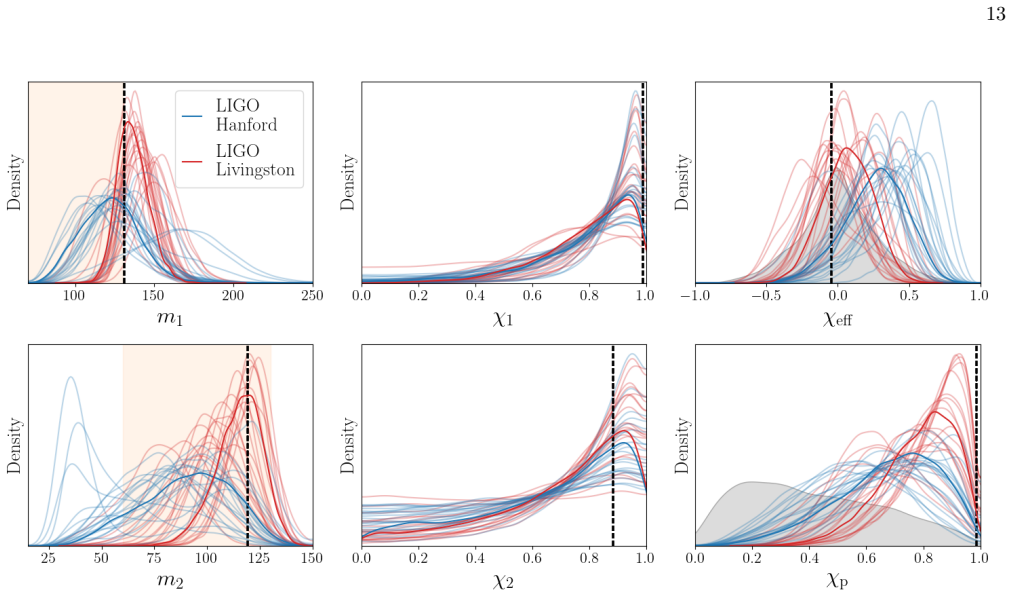
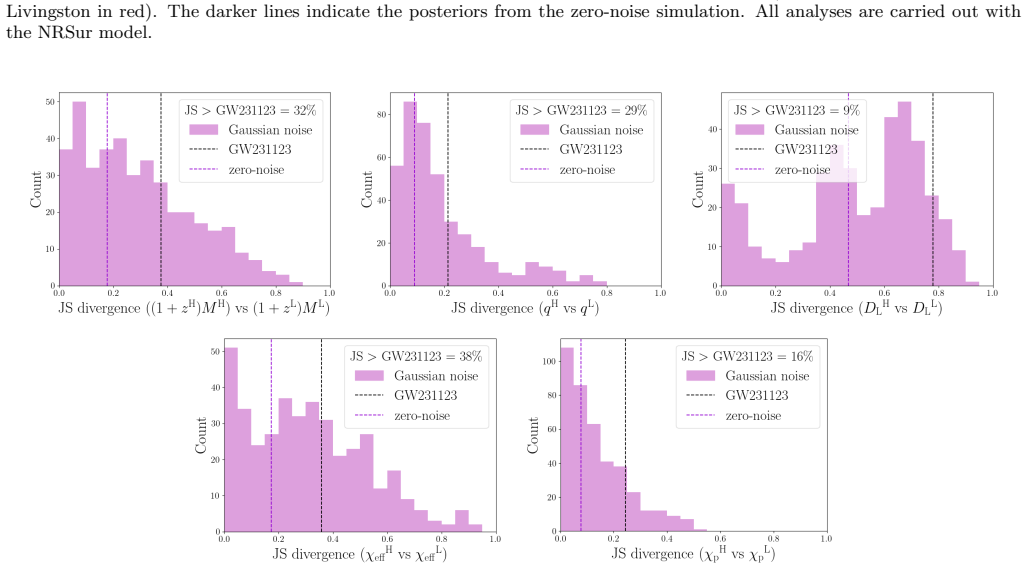
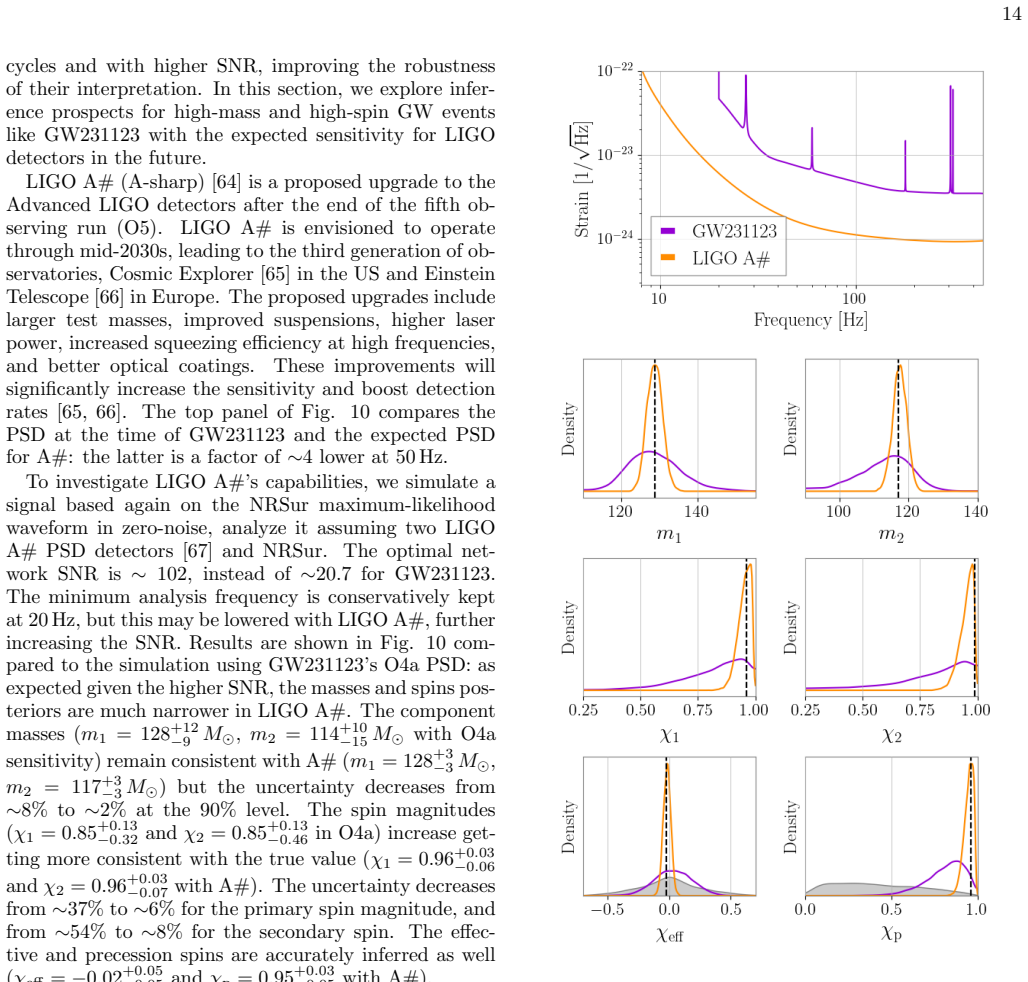
Simulations using the NRSur7dq4 maximum-likelihood waveform for GW231123 closely recover the model systematics observed in the real signal. When different Gaussian noise realizations are added, the recovered parameters consistently support large masses, high spin magnitudes with median chi_1 at least 0.7, and high spin precession with median chi_p at least 0.68. The effective spin chi_eff varies more across realizations. Differences between the two detectors are not statistically significant, establishing that the headline properties are robust.
What carries the argument
Injection of the NRSur7dq4 maximum-likelihood waveform into simulated data with and without Gaussian noise realizations, followed by parameter recovery and comparison to the real GW231123 posteriors.
If this is right
- The high masses and spins of GW231123 can be used with greater for astrophysical conclusions about black-hole formation channels.
- Events with few observed cycles can still yield reliable parameters when analyzed with NRSur7dq4 provided the same injection tests are performed.
- The effective spin chi_eff is the parameter most sensitive to noise, so interpretations relying on it require extra caution.
- Single-detector analyses of similar short signals do not introduce additional bias beyond what is already captured by the combined data.
- Systematic differences between waveform models can be diagnosed and bounded by reproducing them on noise-free injections of the maximum-likelihood waveform.
Where Pith is reading between the lines
- If NRSur7dq4 is faithful, GW231123 is a genuine population outlier whose formation mechanism must accommodate both high mass and high spin.
- The same injection-based robustness test could be applied routinely to other high-mass, short-duration events to validate their parameters.
- The observed fluctuations in chi_eff suggest that spin-aligned quantities may need tighter priors or additional waveform models in future analyses of precessing systems.
- Extending the test to include non-Gaussian noise artifacts would further strengthen or qualify the robustness claim for real detector data.
Load-bearing premise
The NRSur7dq4 surrogate model must accurately represent the true waveform produced by this binary system, and the detector noise must consist only of stationary Gaussian noise with no unmodeled systematics.
What would settle it
A new noise realization or a different waveform model that produces posteriors for the simulated signal whose high-mass and high-spin support differs significantly from the real-event posteriors would falsify the robustness result.
Figures




read the original abstract
GW231123 is an exceptional gravitational-wave event consistent with the merger of two massive, highly-spinning black holes. Reliable inference of the source properties is crucial for accurate interpretation of its astrophysical implications. However, characterization of GW231123 is challenging: only few signal cycles are observed and different signal models result in systematically different parameters. We investigate whether the interpretation of GW231123 is robust against model systematics and Gaussian detector noise. We show that the model systematics observed in GW231123 can be reproduced for a simulated signal based on the numerical-relativity surrogate model NRSur7dq4. Simulating data using the maximum-likelihood NRSur7dq4 waveform for GW231123 and no noise realization, we closely recover the systematics observed for the real signal. We then explore how the headline properties of GW231123 are impacted by Gaussian detector noise. Using the NRSur7dq4 maximum-likelihood waveform and different noise realizations, we consistently find support for large masses, high spin magnitudes (median $\chi_1\geq 0.7$), and high spin precession (median $\chi_\mathrm{p}\geq 0.68$). The spin in the direction of the angular momentum ($\chi_\mathrm{eff}$) fluctuates more. Finally, again comparing to simulated signals, we show that any differences in the GW231123 inference based on each separate detector are not statistically significant. These results show that the properties of GW231123, and most importantly the high mass and high spin magnitudes inferred by NRSur7dq4, are robust.
Editorial analysis
A structured set of objections, weighed in public.
Referee Report
Summary. The paper investigates the robustness of parameter inference for the gravitational-wave event GW231123 using the NRSur7dq4 numerical-relativity surrogate model. By injecting the maximum-likelihood NRSur7dq4 waveform into simulated data (first with no noise to reproduce model-to-model systematics, then with multiple independent Gaussian noise realizations drawn from detector PSDs), the authors show that the high masses, median χ1 ≥ 0.7, and median χp ≥ 0.68 remain stable. They further demonstrate that per-detector differences are not statistically significant, concluding that the headline properties inferred by NRSur7dq4 are robust against the tested systematics and noise.
Significance. If the results hold, the work strengthens in the astrophysical interpretation of GW231123 as a merger of two massive, highly spinning black holes. The controlled injection tests directly address the observed model-to-model discrepancies and the impact of Gaussian noise, providing a clear, falsifiable check on the stability of the NRSur7dq4 posteriors. This is particularly valuable for an event with few observed cycles where parameter inference is sensitive to waveform modeling choices.
minor comments (2)
- [§3.2] §3.2: the text states that noise realizations are drawn from the detector PSDs but does not specify whether the same random seeds or independent draws are used across the NRSur7dq4 recovery runs; adding this detail would improve reproducibility.
- [Figure 4] Figure 4: the caption should explicitly note the number of noise realizations shown and whether the plotted credible intervals are 90% or 68% to avoid ambiguity when comparing to the real-event posteriors.
Simulated Author's Rebuttal
We thank the referee for their positive assessment of our manuscript and for recommending acceptance. The referee's summary correctly reflects our central result that the high-mass, high-spin inferences for GW231123 obtained with NRSur7dq4 remain stable under the controlled injection tests we performed.
Circularity Check
No significant circularity in the derivation chain
full rationale
The paper conducts standard Bayesian inference on real GW231123 data using the external NRSur7dq4 surrogate model, then performs controlled robustness tests by injecting the maximum-likelihood NRSur7dq4 waveform into zero-noise data and multiple independent Gaussian noise realizations drawn from detector PSDs. Parameter recovery in these simulations directly tests pipeline stability and reproduces observed systematics without reducing any claim to a fitted input renamed as prediction, self-definition, or load-bearing self-citation. The headline result—that high mass and spin inferences remain stable—follows from consistency across independent external simulations and is self-contained against numerical-relativity benchmarks.
Axiom & Free-Parameter Ledger
axioms (2)
- domain assumption Detector noise is Gaussian and stationary
- domain assumption NRSur7dq4 accurately models the waveform for this system
Forward citations
Cited by 6 Pith papers
-
Investigating the formation channel of GW231123: Population III stars or hierarchical mergers?
GW231123 most likely formed through hierarchical mergers of black holes in metal-poor globular clusters, with isolated binary channels failing to match the observed merger redshift and masses.
-
Ringdown Analysis of GW250114 with Orthonormal Modes
Orthonormal QNM analysis of GW250114 raises the significance of the first overtone of the ℓ=m=2 mode from 82.5% to 99.9% and detects no significant deviation from Kerr predictions.
-
Agnostically decoding gravitational wave model deficiencies in GWTC-3
No evidence for a mass-scale dependent model deficiency is found in the highest-SNR GWTC-3 events.
-
Investigating the formation channel of GW231123: Population III stars or hierarchical mergers?
Coupled cosmological and cluster simulations show isolated binary evolution cannot produce GW231123-like mergers at the observed redshift, while hierarchical mergers in globular clusters can, yielding a local rate of ...
-
Mitigating Systematic Errors in Parameter Estimation of Binary Black Hole Mergers in O1-O3 LIGO-Virgo Data
Parametric models incorporating waveform phase and amplitude uncertainties mitigate systematic errors in gravitational wave parameter estimation, producing consistent results across models and raw/deglitched data for ...
-
Mitigating Systematic Errors in Parameter Estimation of Binary Black Hole Mergers in O1-O3 LIGO-Virgo Data
Reanalysis of flagged LVK events with waveform uncertainty models produces consistent spin and precession inferences across raw/deglitched data and multiple waveform approximants.
Reference graph
Works this paper leans on
-
[1]
A. G. Abac et al. (LIGO Scientific, VIRGO, KAGRA), Arxiv (2025), arXiv:2507.08219 [astro-ph.HE]
work page internal anchor Pith review Pith/arXiv arXiv 2025
-
[2]
J. Aasi et al. (LIGO Scientific), Class. Quant. Grav. 32, 074001 (2015), arXiv:1411.4547 [gr-qc]
work page internal anchor Pith review Pith/arXiv arXiv 2015
-
[3]
A. G. Abac et al. (LIGO Scientific, VIRGO, KA- GRA), arXiv preprint arXiv:2508.18080 (2025), arXiv:2508.18080 [gr-qc]
work page internal anchor Pith review Pith/arXiv arXiv 2025
-
[4]
A. Abac, I. Abouelfettouh, F. Acernese, K. Ackley, S. Ad- hicary, D. Adhikari, N. Adhikari, R. Adhikari, V. Adkins, S. Afroz, et al., arXiv preprint arXiv:2508.18081 (2025)
work page Pith review arXiv 2025
-
[5]
A. Abac, I. Abouelfettouh, F. Acernese, K. Ackley, C. Adamcewicz, S. Adhicary, D. Adhikari, N. Ad- hikari, R. Adhikari, V. Adkins, et al. , arXiv preprint arXiv:2508.18082 (2025)
work page internal anchor Pith review Pith/arXiv arXiv 2025
- [6]
- [7]
- [8]
-
[9]
K. Belczynski et al. , Astron. Astrophys. 636, A104 (2020), arXiv:1706.07053 [astro-ph.HE]
-
[10]
Y. Qin, T. Fragos, G. Meynet, J. Andrews, M. Sørensen, and H. F. Song, Astron. Astrophys. 616, A28 (2018), arXiv:1802.05738 [astro-ph.SR]
work page internal anchor Pith review Pith/arXiv arXiv 2018
-
[11]
J. Fuller and L. Ma, Astrophys. J. Lett. 881, L1 (2019), arXiv:1907.03714 [astro-ph.SR]
-
[12]
L. A. C. van Son, S. E. de Mink, F. S. Broekgaarden, M. Renzo, S. Justham, E. Laplace, J. Moran-Fraile, D. D. Hendriks, and R. Farmer, Astrophys. J. 897, 100 (2020), 17 Parameter LIGO Hanford LIGO Livingston Both source-frame primary mass ( M⊙) 114 +34 −25 135+21 −16 128+16 −16 source-frame secondary mass ( M⊙) 76 +71 −25 114+43 −22 108+16 −20 source-fram...
-
[13]
D. Gerosa and M. Fishbach, Nature Astron. 5, 749 (2021), arXiv:2105.03439 [astro-ph.HE]
-
[14]
V. Delfavero, S. Ray, H. Cook, K. Nathaniel, B. McK- ernan, K. Ford, J. Postiglione, E. McPike, and R. O’Shaughnessy, arXiv preprint arXiv:2508.13412 (2025)
-
[15]
2025, arXiv e-prints, arXiv:2509.10609
L. Paiella, C. Ugolini, M. Spera, M. Branchesi, and M. A. Sedda, arXiv preprint arXiv:2509.10609 (2025)
-
[16]
L. Passenger, S. Banagiri, E. Thrane, P. D. Lasky, A. Borchers, M. Fishbach, and C. S. Ye, arXiv preprint arXiv:2510.14363 (2025)
-
[17]
O. Gottlieb, B. D. Metzger, D. Issa, S. E. Li, M. Renzo, and M. Isi, arXiv preprint arXiv:2508.15887 (2025)
- [18]
- [19]
-
[20]
GW231123: A Possible Primordial Black Hole Origin
V. De Luca, G. Franciolini, and A. Riotto, arXiv preprint arXiv:2508.09965 (2025)
work page internal anchor Pith review Pith/arXiv arXiv 2025
- [21]
-
[22]
S. Liu, L. Wang, A. Tanikawa, W. Wu, and M. S. Fujii, The Astrophysical Journal Letters 993, L30 (2025)
work page 2025
-
[23]
GW231123 Formation from Population III Stars: Isolated Binary Evolution
A. Tanikawa, S. Liu, W. Wu, M. S. Fujii, and L. Wang, arXiv preprint arXiv:2508.01135 (2025)
work page internal anchor Pith review Pith/arXiv arXiv 2025
- [24]
-
[25]
F. Kıro˘ glu, K. Kremer, and F. A. Rasio, arXiv preprint arXiv:2509.05415 (2025)
-
[26]
I. Cuceu, M. A. Bizouard, N. Christensen, and M. Sakel- lariadou, Phys. Rev. D (2025), 10.1103/zd8m-tzxd
-
[27]
M. Fishbach, W. M. Farr, and D. E. Holz, Astrophys. J. Lett. 891, L31 (2020), arXiv:1911.05882 [astro-ph.HE]
-
[28]
Mandel, The Astrophysical Journal996, L4 (2026), arXiv:2509.05885 [astro-ph.HE]
I. Mandel, ArXiv (2025), arXiv:2509.05885 [astro- ph.HE]
- [29]
- [30]
-
[31]
Surrogate models for precessing binary black hole simulations with unequal masses
V. Varma, S. E. Field, M. A. Scheel, J. Blackman, D. Gerosa, L. C. Stein, L. E. Kidder, and H. P. Pfeiffer, Phys. Rev. Research. 1, 033015 (2019), arXiv:1905.09300 [gr-qc]
work page internal anchor Pith review Pith/arXiv arXiv 2019
-
[32]
M. Colleoni, F. A. R. Vidal, C. Garc´ ıa-Quir´ os, S. Ak¸ cay, and S. Bera, Phys. Rev. D 111, 104019 (2025), arXiv:2412.16721 [gr-qc]
- [33]
-
[34]
H. Estell´ es, M. Colleoni, C. Garc´ ıa-Quir´ os, S. Husa, D. Keitel, M. Mateu-Lucena, M. d. L. Planas, and A. Ramos-Buades, Phys. Rev. D 105, 084040 (2022), arXiv:2105.05872 [gr-qc]
-
[35]
A. Ramos-Buades, A. Buonanno, H. Estell´ es, M. Khalil, D. P. Mihaylov, S. Ossokine, L. Pompili, and M. Shiferaw, Phys. Rev. D 108, 124037 (2023), arXiv:2303.18046 [gr-qc]
- [36]
-
[37]
A. Jan, S. Nicolella, D. Shoemaker, and R. O’Shaughnessy, ArXiv (2025), arXiv:2512.20060 [gr-qc]
work page internal anchor Pith review Pith/arXiv arXiv 2025
- [38]
- [39]
-
[40]
Q. Hu, H. Narola, J. Heynen, M. Wright, J. Veitch, J. Janquart, and C. Van Den Broeck, arXiv (2025), arXiv:2512.17550 [gr-qc]
work page internal anchor Pith review arXiv 2025
- [41]
- [42]
-
[43]
C. Cutler and M. Vallisneri, Phys. Rev. D 76, 104018 (2007), arXiv:0707.2982 [gr-qc]
work page internal anchor Pith review Pith/arXiv arXiv 2007
-
[44]
M. Vallisneri, Phys. Rev. D 77, 042001 (2008), arXiv:gr- qc/0703086. 18
- [45]
-
[46]
M. Branchesi, M. Maggiore, D. Alonso, C. Badger, B. Banerjee, F. Beirnaert, E. Belgacem, S. Bhagwat, G. Boileau, S. Borhanian, et al. , Journal of Cosmology and Astroparticle Physics 2023, 068 (2023)
work page 2023
-
[47]
Model Waveform Accuracy Standards for Gravitational Wave Data Analysis
L. Lindblom, B. J. Owen, and D. A. Brown, Phys. Rev. D 78, 124020 (2008), arXiv:0809.3844 [gr-qc]
work page internal anchor Pith review Pith/arXiv arXiv 2008
-
[48]
Miller, Physical Review D—Particles, Fields, Gravi- tation, and Cosmology 71, 104016 (2005)
M. Miller, Physical Review D—Particles, Fields, Gravi- tation, and Cosmology 71, 104016 (2005)
work page 2005
-
[49]
Gw231123: a binary black hole merger with total mass 190-265 m⊙ — data release,
LIGO Scientific, Virgo, and KAGRA Collaboration, “Gw231123: a binary black hole merger with total mass 190-265 m⊙ — data release,” (2025)
work page 2025
-
[50]
T. B. Littenberg and N. J. Cornish, Phys. Rev. D 91, 084034 (2015), arXiv:1410.3852 [gr-qc]
work page internal anchor Pith review Pith/arXiv arXiv 2015
-
[51]
Mitigation of the instrumental noise transient in gravitational-wave data surrounding GW170817
C. Pankow et al. , Phys. Rev. D 98, 084016 (2018), arXiv:1808.03619 [gr-qc]
work page internal anchor Pith review Pith/arXiv arXiv 2018
-
[52]
Exploring short gamma-ray bursts as gravitational-wave standard sirens
S. Nissanke, D. E. Holz, S. A. Hughes, N. Dalal, and J. L. Sievers, Astrophys. J. 725, 496 (2010), arXiv:0904.1017 [astro-ph.CO]
work page internal anchor Pith review Pith/arXiv arXiv 2010
-
[53]
Bilby: A user-friendly Bayesian inference library for gravitational-wave astronomy
G. Ashton et al. , Astrophys. J. Suppl. 241, 27 (2019), arXiv:1811.02042 [astro-ph.IM]
work page internal anchor Pith review Pith/arXiv arXiv 2019
-
[54]
I. M. Romero-Shaw et al. , Mon. Not. Roy. Astron. Soc. 499, 3295 (2020), arXiv:2006.00714 [astro-ph.IM]
work page internal anchor Pith review arXiv 2020
-
[55]
Talbot et al., arXiv preprint arXiv:2508.11091 (2025)
C. Talbot et al., arXiv preprint arXiv:2508.11091 (2025)
- [56]
-
[57]
S. Biscoveanu, M. Isi, V. Varma, and S. Vitale, Phys. Rev. D 104, 103018 (2021), arXiv:2106.06492 [gr-qc]
- [58]
-
[59]
R. Abbott et al. (LIGO Scientific, Virgo), Phys. Rev. Lett. 125, 101102 (2020), arXiv:2009.01075 [gr-qc]
-
[60]
J. D. Romano and N. J. Cornish, Living Rev. Rel. 20, 2 (2017), arXiv:1608.06889 [gr-qc]
work page internal anchor Pith review Pith/arXiv arXiv 2017
- [61]
-
[62]
C. Hoy, S. Ak¸ cay, J. Mac Uilliam, and J. E. Thompson, Nature Astronomy , 1 (2025)
work page 2025
- [63]
-
[64]
P. Fritschel, K. Kuns, J. Driggers, A. Effler, B. Lantz, D. Ottaway, S. Ballmer, K. Dooley, R. Adhikari, M. Evans, et al., LIGO Document 2200287, 6 (2022)
work page 2022
-
[65]
A Horizon Study for Cosmic Explorer: Science, Observatories, and Community
M. Evans et al., ArXiv (2021), arXiv:2109.09882 [astro- ph.IM]
work page internal anchor Pith review Pith/arXiv arXiv 2021
-
[66]
Science Case for the Einstein Telescope
M. Maggiore et al. (ET), JCAP 03, 050 (2020), arXiv:1912.02622 [astro-ph.CO]
work page internal anchor Pith review Pith/arXiv arXiv 2020
- [67]
discussion (0)
Sign in with ORCID, Apple, or X to comment. Anyone can read and Pith papers without signing in.