Recognition: unknown
Mitigating Systematic Errors in Parameter Estimation of Binary Black Hole Mergers in O1-O3 LIGO-Virgo Data
Pith reviewed 2026-05-09 20:27 UTC · model grok-4.3
The pith
Parametric models with broad priors on waveform phase and amplitude uncertainties reduce systematic errors in binary black hole merger parameter estimates from LIGO-Virgo data.
A machine-rendered reading of the paper's core claim, the machinery that carries it, and where it could break.
Core claim
Applying parametric uncertainty models for waveform phase and amplitude, together with broad priors on the uncertainty coefficients, effectively mitigates systematic errors in parameter estimation of binary black hole mergers. The same framework brings results from different waveform approximants into agreement and renders inferences insensitive to the presence or removal of nearby glitches in the detector data.
What carries the argument
Parametric uncertainty models that add free parameters to the phase and amplitude of the gravitational-wave waveform, used with deliberately wide priors in a data-driven reanalysis.
If this is right
- Results from different waveform models become statistically consistent for the examined events.
- Systematic errors arising from glitches near the signal or from deglitching procedures are reduced.
- For GW191109_010717 the inference of anti-aligned spins remains but is now the same for raw and deglitched files and for three waveform models.
- For GW200129_065458 a consistent non-zero precession parameter χ_p ≈ 0.6 is recovered across IMRPhenomXPHM, IMRPhenomXO4a and NRSur7dq4.
Where Pith is reading between the lines
- The approach could be applied routinely to future events to produce more stable catalogs for population inference.
- If the extra parameters remain well constrained rather than drifting to their prior boundaries, the method may distinguish genuine astrophysical features from analysis artifacts.
- Extending the same parametric freedom to additional waveform features such as higher modes or eccentricity could address further classes of systematics.
Load-bearing premise
The parametric uncertainty models, when supplied with sufficiently broad priors, can absorb unknown systematic errors including data artifacts without creating new biases or overfitting the data.
What would settle it
Re-running the analysis on the same events with the same models and priors but still obtaining large, statistically significant differences between waveform families or between raw and deglitched data would falsify the claim.
Figures




read the original abstract
Systematic errors in the parameter estimation (PE) of gravitational wave (GW) mergers can arise from various sources, including waveform systematics, noise mischaracterization, data analysis artifacts, and other unknown factors. In this study, we analyze selected events from the first three observing runs of the LIGO-Virgo-KAGRA (LVK) collaboration. We choose events that have been flagged in various studies as potentially affected by systematic errors. Here, we reanalyze these events using a couple of parametric models developed in previous work that incorporate uncertainties in both the phase and amplitude of the GW waveform. In this data-driven approach, we apply sufficiently broad priors on the uncertainty parameters to account for potential systematic errors. Our findings show that the proposed method effectively reduces systematic errors, even those arising from data artifacts, such as glitches occurring near a signal and the deglitching process in GW frame files. Similarly, inconsistent results from different waveform models become much more consistent in our framework. One noteworthy event we examine is GW191109\_010717, which is particularly interesting due to its anti-aligned spin properties. We report that, within our framework, the event still exhibits anti-aligned spin characteristics, but the inference results become consistent across raw and deglitched frame files, as well as across the waveform models used for this event (IMRPhenomXPHM, IMRPhenomXO4a, and NRSur7dq4). A similar trend is observed for the event GW200129\_065458, which previously yielded a high, but inconsistent precession parameter among different waveform models. In contrast, we observe a non-zero and consistent value of $\chi_{p}=0.60^{+0.31}_{-0.33}, 0.58^{+0.30}_{-0.29}$ and $0.56^{+0.31}_{-0.28}$ for the IMRPhenomXPHM, IMRPhenomXO4a, and NRSur7dq4 waveform models, respectively.
Editorial analysis
A structured set of objections, weighed in public.
Referee Report
Summary. The paper claims that incorporating parametric models of phase and amplitude uncertainties (developed in prior work) with sufficiently broad priors into gravitational-wave parameter estimation can mitigate systematic errors arising from waveform models, glitches, and deglitching artifacts. Reanalysis of selected O1-O3 events, notably GW191109_010717 and GW200129_065458, is reported to yield consistent posteriors across IMRPhenomXPHM, IMRPhenomXO4a, and NRSur7dq4, with a stable non-zero precession parameter χ_p ≈ 0.58 for the latter event even when comparing raw versus deglitched frames.
Significance. If the central claim holds, the approach would offer a practical, data-driven route to more robust inference for events affected by data artifacts or model discrepancies, strengthening astrophysical conclusions drawn from LVK catalogs.
major comments (3)
- [Abstract] Abstract: the claim that the method 'effectively reduces systematic errors' rests solely on reported posterior consistency across models and data versions; no quantitative metrics of bias reduction (e.g., mean shifts relative to injections), credible-interval coverage, or posterior-predictive checks on residuals are provided to distinguish true bias mitigation from simple marginalization that inflates uncertainties.
- [Results for GW200129_065458] Analysis of GW200129_065458: the quoted χ_p intervals (0.60^{+0.31}_{-0.33}, 0.58^{+0.30}_{-0.29}, 0.56^{+0.31}_{-0.28}) are presented as evidence of consistency, yet without injection-recovery tests or comparison of recovered means against known injected values, it remains possible that the broad priors on the uncertainty parameters absorb mismatches without correcting the underlying bias in masses, spins, or precession.
- [Methods] Methods: the manuscript invokes 'sufficiently broad priors' on the phase/amplitude uncertainty parameters but supplies neither the explicit prior ranges nor convergence diagnostics (e.g., Gelman-Rubin statistics or effective sample sizes) for the sampling runs that produced the quoted posteriors.
minor comments (2)
- [Abstract] Abstract: the event identifier is written GW191109_010717; verify consistency with the standard LVK catalog naming (GW191109_010717).
- [Throughout] Throughout: explicitly restate the functional forms of the phase and amplitude uncertainty models (including any free parameters) and cite the prior reference papers at first use to improve readability for readers unfamiliar with that work.
Simulated Author's Rebuttal
We thank the referee for the constructive feedback on our manuscript. The comments highlight important aspects of how we present evidence for systematic error mitigation. We address each major comment point by point below, clarifying our approach for real-data events and making revisions to improve transparency.
read point-by-point responses
-
Referee: [Abstract] Abstract: the claim that the method 'effectively reduces systematic errors' rests solely on reported posterior consistency across models and data versions; no quantitative metrics of bias reduction (e.g., mean shifts relative to injections), credible-interval coverage, or posterior-predictive checks on residuals are provided to distinguish true bias mitigation from simple marginalization that inflates uncertainties.
Authors: We agree that quantitative metrics such as injection-recovery tests or explicit coverage checks would strengthen the claim. However, because the analysis concerns real O1-O3 events with unknown true parameters, direct bias quantification via injections is not possible without additional assumptions or simulations that lie outside the scope of this reanalysis. We have revised the abstract and added a dedicated limitations paragraph in the discussion to explicitly state that consistency across waveform models and raw/deglitched frames is presented as a practical, data-driven indicator rather than a formal bias-reduction proof. We also note that the method's goal is to produce mutually consistent posteriors where previous analyses did not. revision: partial
-
Referee: [Results for GW200129_065458] Analysis of GW200129_065458: the quoted χ_p intervals (0.60^{+0.31}_{-0.33}, 0.58^{+0.30}_{-0.29}, 0.56^{+0.31}_{-0.28}) are presented as evidence of consistency, yet without injection-recovery tests or comparison of recovered means against known injected values, it remains possible that the broad priors on the uncertainty parameters absorb mismatches without correcting the underlying bias in masses, spins, or precession.
Authors: The overlapping χ_p intervals are shown to illustrate that the parametric uncertainty model yields stable precession inferences where the three waveform models previously disagreed. We accept that this does not constitute a direct demonstration of bias correction in the absence of injections. In the revised results section we have added explicit language clarifying that the broad priors on the uncertainty parameters are intended to marginalize over model discrepancies, producing consistent credible regions; we also state that full validation against known injections remains a valuable direction for future work on simulated data. revision: partial
-
Referee: [Methods] Methods: the manuscript invokes 'sufficiently broad priors' on the phase/amplitude uncertainty parameters but supplies neither the explicit prior ranges nor convergence diagnostics (e.g., Gelman-Rubin statistics or effective sample sizes) for the sampling runs that produced the quoted posteriors.
Authors: We thank the referee for identifying this omission. The revised Methods section now provides the explicit prior ranges used for the phase and amplitude uncertainty parameters (uniform distributions over intervals taken from our earlier development papers) together with the Gelman-Rubin statistics (all < 1.01) and minimum effective sample sizes (> 1000) for the reported chains. These diagnostics confirm that the quoted posteriors are well converged. revision: yes
Circularity Check
No circularity: empirical reanalysis using prior parametric models yields consistency as data-driven outcome
full rationale
The paper applies parametric phase/amplitude uncertainty models from previous work to selected LVK events, using broad priors on the uncertainty coefficients. It then reports that the resulting posteriors for parameters such as χ_p become consistent across waveform approximants (IMRPhenomXPHM, IMRPhenomXO4a, NRSur7dq4) and between raw vs. deglitched frames. This consistency is an observed numerical result of the Bayesian sampling on the actual strain data; no equation or claim reduces a 'prediction' to a fitted input by construction, and the load-bearing step (broad priors absorbing mismatches) is an explicit modeling choice whose validity is tested by the reported consistency rather than assumed via self-definition or self-citation loop. The derivation chain is therefore self-contained against the external benchmark of the public GW data.
Axiom & Free-Parameter Ledger
free parameters (1)
- phase and amplitude uncertainty parameters
axioms (1)
- domain assumption The parametric models from previous work can represent unknown waveform and data systematics when given wide priors.
Reference graph
Works this paper leans on
-
[1]
The mismatch study (Figures 2 and 3) indicate that this event shows the minimal intrinsic difference across different waveform models
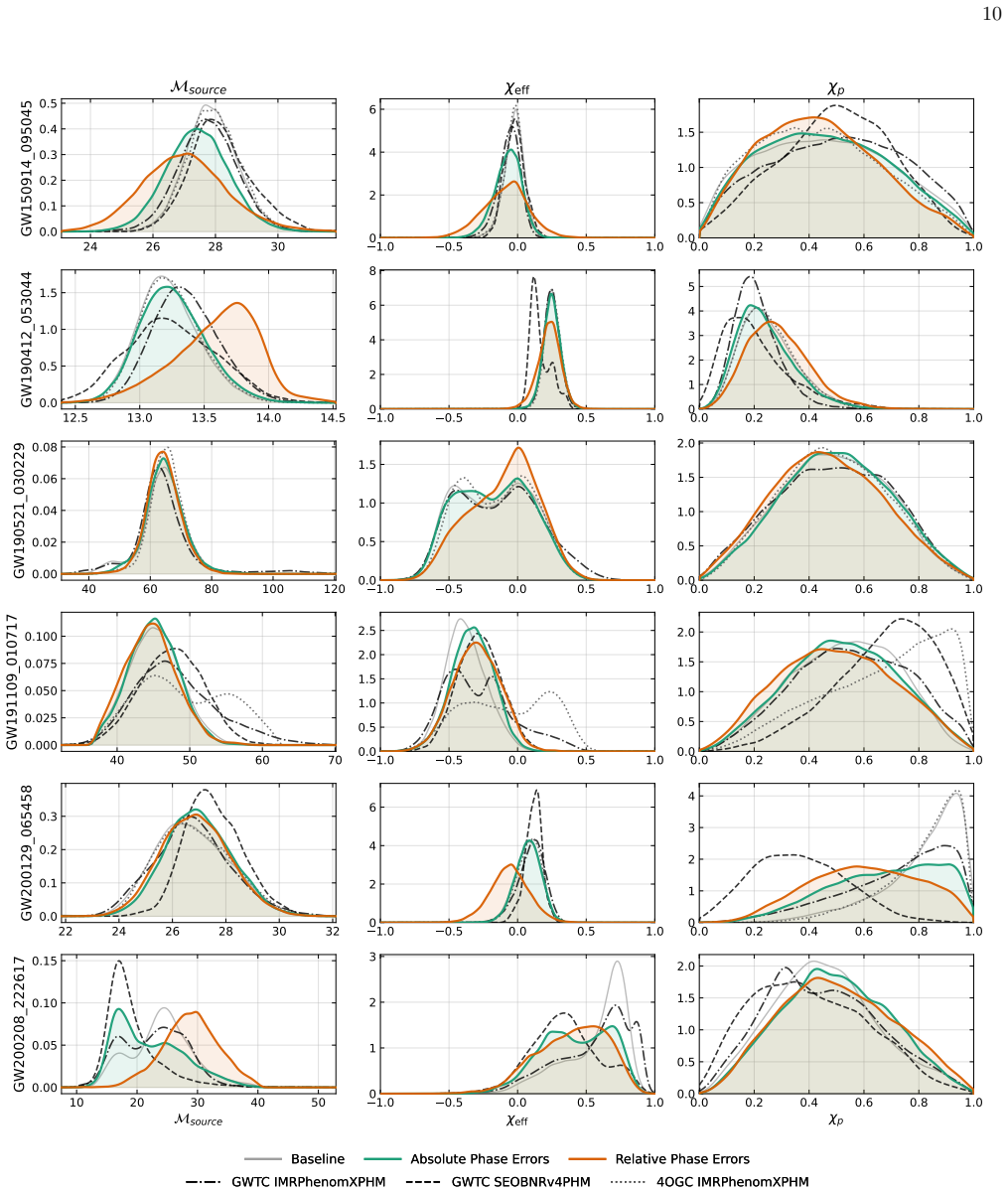
GW150914 095045 Even though the GW150914 095045 runs did not show any signs of systematic errors across studies, we still use it as an example of how the framework behaves when no significant systematic errors are present. The mismatch study (Figures 2 and 3) indicate that this event shows the minimal intrinsic difference across different waveform models....
-
[2]
In GWTC-2.1 analy- sis, the reported values of the effective spin parame- ter areχeff = 0.25+0.10 −0.10 (IMRPhenomXPHM) and 0.14+0.17 −0.07 (SEOBNRv4PHM)
GW190412 065458 The event GW190412 065458 is one of the events with an asymmetric mass ratio and a positive effec- tive spin parameterχ eff [95]. In GWTC-2.1 analy- sis, the reported values of the effective spin parame- ter areχeff = 0.25+0.10 −0.10 (IMRPhenomXPHM) and 0.14+0.17 −0.07 (SEOBNRv4PHM). The 4OGC analysis recoveredχ eff = 0.25+0.10 −0.09 (IMRP...
-
[3]
The final mass of the remanent black hole is an intermediate mass black hole (IMBH) [99]
GW190521 065458 The event GW190521 065458 [98] is a high mass sig- nal where the significant probability distribution of the primary black hole mass lies in the mass gap produced by the pair-instability supernova process. The final mass of the remanent black hole is an intermediate mass black hole (IMBH) [99]. This event could have formed through various ...
-
[4]
However, this event was affected by a scattered light glitch that occurred very close to the signal in the LIGO Livingston detec- tor
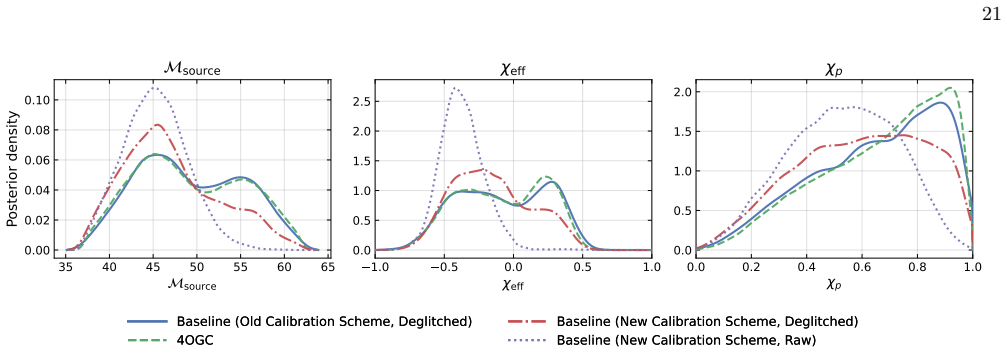
GW191109 010717 The event GW191109 010717 is particularly significant because it exhibits anti-aligned spin properties, which may hint at a dynamical origin [101]. However, this event was affected by a scattered light glitch that occurred very close to the signal in the LIGO Livingston detec- tor. In the GWTC-3 analysis, both waveform models, SEOBNRv4PHMa...
-
[5]
These observations are consistent among baseline runs and RPE parametrization runs. In a previous study [29], the authors noted that the negative effective spin mea- surement is attributed to the segment of the LIGO Liv- ingston data between 30 and 40 Hz, or 0.1-0.004 seconds before the merger, which coincides with the excess glitch power. In figure 7, we...
-
[6]
GW200129 065458 GW200129 065458 is another interesting event that may have originated through a dynamical formation channel, especially considering its reported high pre- 13 35 40 45 50 55 60 65 0.0 0.1Deglitched Baseline Runs 35 40 45 50 55 60 65 0.0 0.1 WF-Error Runs 35 40 45 50 55 60 65 source 0.0 0.1Raw 35 40 45 50 55 60 65 source 0.0 0.1 1.0 0.5 0.0 ...
-
[7]
GW200208 222617 GW200208 222617 is a comparatively low SNR (net- work SNR∼8) event that shows multimodal mass pos- 15 0.1 0.0 0.1 0.2 rel H1 20.0 24.5 30.0 36.7 45.0 55.1 67.5 82.7 101.2 124.0 Frequency [Hz] 0.1 0.0 0.1 0.2 rel L1 GW191109 (Single detector PE runs) Deglitched Raw Prior FIG. 8. The figure shows the 1D marginalized posterior samples of the ...
2000
-
[8]
A. G. Abacet al.(LIGO Scientific, VIRGO, KAGRA), (2025), arXiv:2508.18082 [gr-qc]
work page internal anchor Pith review arXiv 2025
-
[9]
GWTC-3: Compact Binary Coalescences Observed by LIGO and Virgo During the Second Part of the Third Observing Run,
The LIGO Scientific Collaboration, The Virgo Collab- oration, The KAGRA Collaboration,et al., “GWTC-3: Compact Binary Coalescences Observed by LIGO and Virgo During the Second Part of the Third Observing Run,” (2021)
2021
- [10]
- [11]
- [12]
-
[13]
A. G. Abacet al.(LIGO Scientific, VIRGO, KAGRA), (2025), arXiv:2508.18083 [astro-ph.HE]
work page internal anchor Pith review Pith/arXiv arXiv 2025
- [14]
- [15]
-
[16]
Tests of General Relativity with GWTC-3
R. Abbottet al.(LIGO Scientific, VIRGO, KAGRA), (2021), arXiv:2112.06861 [gr-qc]
work page internal anchor Pith review arXiv 2021
- [17]
- [18]
- [19]
-
[20]
B. P. Abbottet al.(LIGO Scientific, Virgo), Phys. Rev. Lett.121, 161101 (2018), arXiv:1805.11581 [gr-qc]
work page Pith review arXiv 2018
- [21]
-
[22]
R. Abbottet al.(LIGO Scientific, Virgo, KAGRA), Astrophys. J.949, 76 (2023), arXiv:2111.03604 [astro- 22 ph.CO]
- [23]
- [24]
-
[25]
Abbottet al.(LIGO Scientific, KAGRA, VIRGO), Astrophys
R. Abbottet al.(LIGO Scientific, KAGRA, VIRGO), Astrophys. J.970, 191 (2024), arXiv:2304.08393 [gr-qc]
- [26]
- [27]
- [28]
-
[29]
A. Samajdar and T. Dietrich, Phys. Rev. D98, 124030 (2018), arXiv:1810.03936 [gr-qc]
-
[30]
A. Samajdar and T. Dietrich, Phys. Rev. D100, 024046 (2019), arXiv:1905.03118 [gr-qc]
- [31]
- [32]
- [33]
-
[34]
S. Hourihane and K. Chatziioannou, Phys. Rev. D112, 084006 (2025), arXiv:2506.21869 [gr-qc]
- [35]
- [36]
-
[37]
S. Hourihane, K. Chatziioannou, M. Wijngaarden, D. Davis, T. Littenberg, and N. Cornish, Phys. Rev. D 106, 042006 (2022), arXiv:2205.13580 [gr-qc]
- [38]
- [39]
- [40]
-
[41]
C. Plunkett, S. Hourihane, and K. Chatziioannou, Phys. Rev. D106, 104021 (2022), arXiv:2208.02291 [gr- qc]
-
[42]
S. Bini, K. Kr´ ol, K. Chatziioannou, and M. Isi, (2026), arXiv:2601.09678 [gr-qc]
work page internal anchor Pith review Pith/arXiv arXiv 2026
- [43]
- [44]
-
[45]
K. Chatziioannou, N. Cornish, A. Klein, and N. Yunes, Astrophys. J. Lett.798, L17 (2015), arXiv:1402.3581 [gr-qc]
-
[46]
M. P¨ urrer, M. Hannam, and F. Ohme, Phys. Rev. D 93, 084042 (2016), arXiv:1512.04955 [gr-qc]
-
[47]
J. Calder´ on Bustillo, S. Husa, A. M. Sintes, and M. P¨ urrer, Phys. Rev. D93, 084019 (2016), arXiv:1511.02060 [gr-qc]
- [48]
-
[49]
D98,084028(2018),arXiv:1803.10701 [gr-qc]
R. Cotesta, A. Buonanno, A. Boh´ e, A. Taracchini, I. Hinder, and S. Ossokine, Phys. Rev. D98, 084028 (2018), arXiv:1803.10701 [gr-qc]
-
[50]
C. Kalaghatgi, M. Hannam, and V. Raymond, Phys. Rev. D101, 103004 (2020), arXiv:1909.10010 [gr-qc]
-
[51]
G. Pratten, P. Schmidt, R. Buscicchio, and L. M. Thomas, Phys. Rev. Res.2, 043096 (2020), arXiv:2006.16153 [gr-qc]
-
[52]
C. Garc´ ıa-Quir´ os, M. Colleoni, S. Husa, H. Estell´ es, G. Pratten, A. Ramos-Buades, M. Mateu-Lucena, and R. Jaume, Phys. Rev. D102, 064002 (2020), arXiv:2001.10914 [gr-qc]
- [53]
- [54]
-
[55]
A. Buikemaet al.(aLIGO), Phys. Rev. D102, 062003 (2020), arXiv:2008.01301 [astro-ph.IM]
-
[56]
J. Aasiet al.(LIGO Scientific), Class. Quant. Grav.32, 074001 (2015), arXiv:1411.4547 [gr-qc]
work page internal anchor Pith review arXiv 2015
- [57]
-
[58]
L. Lindblom, B. J. Owen, and D. A. Brown, Phys. Rev. D78, 124020 (2008), arXiv:0809.3844 [gr-qc]
-
[59]
M. P¨ urrer and C.-J. Haster, Phys. Rev. Res.2, 023151 (2020), arXiv:1912.10055 [gr-qc]
- [60]
- [61]
-
[62]
L. Pompili, A. Buonanno, and M. P¨ urrer, Phys. Rev. D112, 044062 (2025), arXiv:2410.16859 [gr-qc]
-
[63]
S. Mezzasoma, C.-J. Haster, and N. Yunes, (2026), arXiv:2603.15765 [gr-qc]
- [64]
-
[65]
R. Abbottet al.(KAGRA, VIRGO, LIGO Scientific), Phys. Rev. X13, 041039 (2023), arXiv:2111.03606 [gr- qc]
work page internal anchor Pith review arXiv 2023
-
[66]
G. Ashton and S. Khan, Phys. Rev. D101, 064037 (2020), arXiv:1910.09138 [gr-qc]
- [67]
-
[68]
G. Ashton and T. Dietrich, Nature Astron.6, 961 (2022), arXiv:2111.09214 [gr-qc]
- [69]
-
[70]
A. Puecher, A. Samajdar, G. Ashton, C. Van Den Broeck, and T. Dietrich, Phys. Rev. D109, 023019 (2024), arXiv:2310.03555 [gr-qc]
-
[71]
Samajdar and T
A. Samajdar and T. Dietrich, Phys. Rev. D98, 124030 (2018)
2018
-
[72]
Samajdar and T
A. Samajdar and T. Dietrich, Phys. Rev. D100, 024046 23 (2019)
2019
- [73]
-
[74]
R. Bachhar, M. P¨ urrer, and S. R. Green, (2024), arXiv:2410.17168 [gr-qc]
-
[75]
S. Mezzasoma, C.-J. Haster, C. B. Owen, N. J. Cor- nish, and N. Yunes, Phys. Rev. D112, 044057 (2025), arXiv:2503.23304 [gr-qc]
-
[76]
Kumar, S
Divyajyoti, S. Kumar, S. Tibrewal, I. M. Romero-Shaw, and C. K. Mishra, Phys. Rev. D109, 043037 (2024)
2024
- [77]
-
[78]
A. Ramos-Buades, S. Husa, G. Pratten, H. Estell´ es, C. Garc´ ıa-Quir´ os, M. Mateu-Lucena, M. Colleoni, and R. Jaume, Phys. Rev. D101, 083015 (2020), arXiv:1909.11011 [gr-qc]
- [79]
-
[80]
P. Narayan, N. K. Johnson-McDaniel, and A. Gupta, Phys. Rev. D108, 064003 (2023), arXiv:2306.04068 [gr- qc]
discussion (0)
Sign in with ORCID, Apple, or X to comment. Anyone can read and Pith papers without signing in.