Self-Organizing Railway Traffic Management
Pith reviewed 2026-05-16 14:20 UTC · model grok-4.3
The pith
Trains self-organize traffic management by identifying neighbors, forming hypotheses, checking compatibility, and reaching consensus to produce executable plans that reduce delays more than centralized algorithms.
A machine-rendered reading of the paper's core claim, the machinery that carries it, and where it could break.
Core claim
The central claim is that a modular self-organization process—trains identifying neighbors, formulating traffic management hypotheses, checking their compatibility, and selecting the best compatible set through consensus—produces a directly applicable traffic plan that outperforms a state-of-the-art centralized algorithm, specifically by defining and exploiting an instance decomposition of the overall traffic-management problem.
What carries the argument
The modular self-organization process of neighbor identification, hypothesis formulation, compatibility checking, and consensus mechanism that merges selected hypotheses into a single executable traffic plan.
If this is right
- Self-organization reduces delay propagation more effectively than centralized decision-making on the tested network segment.
- The performance edge arises from the explicit decomposition of the global problem into compatible local instances that trains can resolve without global oversight.
- The final merged plan can be applied directly by the trains without further central intervention.
- The advantage is demonstrated in closed-loop microscopic simulation that models realistic train dynamics and communication timing.
Where Pith is reading between the lines
- If train-to-train communication proves reliable at scale, the approach could lower the infrastructure cost of maintaining a always-available central control center.
- The decomposition technique might allow the method to handle larger or more densely perturbed networks than a single centralized solver can process in time.
- Real deployment would require testing whether the consensus step remains stable when trains move at different speeds and when some proposed hypotheses become invalid mid-negotiation.
Load-bearing premise
Trains can reliably identify their current neighbors, formulate and exchange hypotheses, and reach consensus in real time without communication failures or excessive latency under actual railway conditions.
What would settle it
A controlled simulation run in which neighbor detection or consensus messages are delayed or corrupted and the resulting self-organized plan produces longer total delays than the centralized algorithm on the same perturbation instances.
Figures


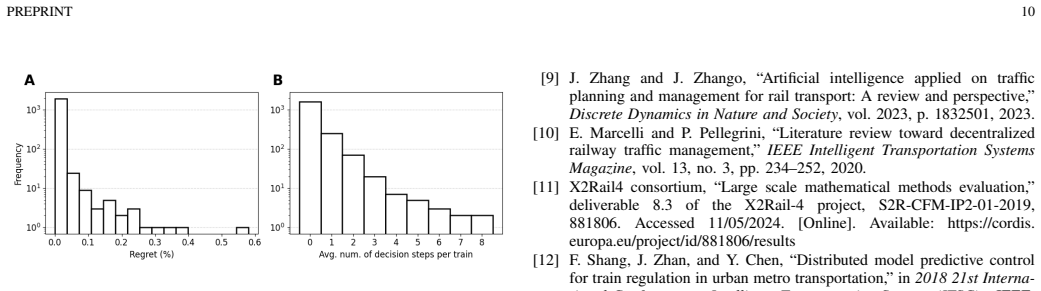
read the original abstract
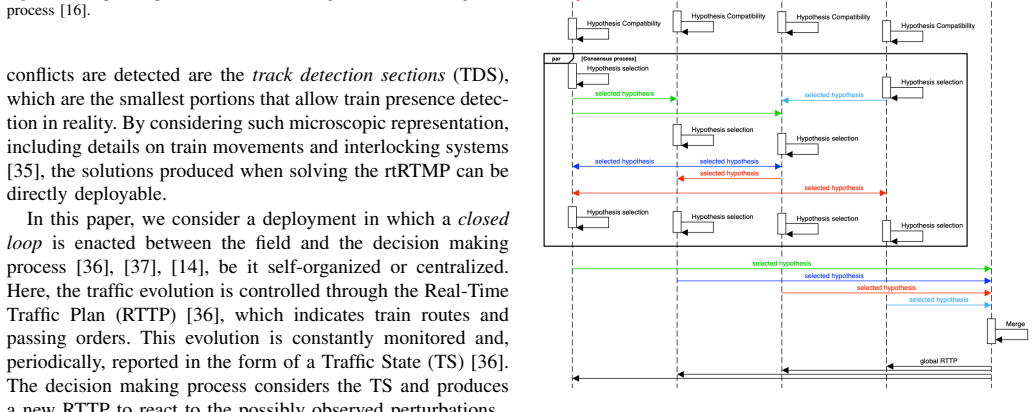
Improving traffic management in case of perturbation is one of the main challenges in today's railway research. The great majority of the existing literature proposes approaches to make centralized decisions to minimize delay propagation. In this paper, we propose a new paradigm to the same aim: we design and implement a modular process to allow trains to self-organize. This process consists in having trains identifying their neighbors, formulating traffic management hypotheses, checking their compatibility and selecting the best ones through a consensus mechanism. Finally, these hypotheses are merged into a directly applicable traffic plan. In a thorough experimental analysis on a portion of the Italian network, we compare the results of self-organization with those of a state-of-the-art centralized approach. In particular, we make this comparison mimicking a realistic deployment thanks to a closed-loop framework including a microscopic railway simulator. The results indicate that self-organization achieves better results than the centralized algorithm, specifically thanks to the definition and exploitation of the instance decomposition allowed by the proposed approach.
Editorial analysis
A structured set of objections, weighed in public.
Referee Report
Summary. The paper proposes a decentralized self-organizing approach to railway traffic management under perturbations. Trains identify neighbors, formulate traffic hypotheses, check compatibility, reach consensus via a mechanism, and merge results into an executable plan. On a portion of the Italian network, a closed-loop microscopic simulator comparison shows the self-organizing method outperforming a state-of-the-art centralized algorithm, with the gain attributed to explicit instance decomposition.
Significance. If the performance advantage holds under realistic communication constraints, the work offers a scalable alternative to centralized control that could improve resilience in disrupted railway networks. The closed-loop evaluation framework is a positive step toward deployment realism, though the absence of communication modeling limits immediate applicability.
major comments (2)
- [Experimental analysis / closed-loop framework] The experimental comparison (described in the abstract and experimental analysis) attributes the performance gain to instance decomposition and real-time consensus, yet the closed-loop simulator provides no explicit model, latency bounds, packet-loss rates, or failure modes for neighbor identification and hypothesis exchange. This assumption is load-bearing for the central claim that self-organization works under realistic conditions.
- [Experimental analysis] No sensitivity analysis or ablation is reported on communication parameters (bandwidth, latency, or consensus timeout), so it is unclear whether the measured advantage over the centralized baseline survives when these constraints are introduced at levels typical of railway radio systems.
minor comments (1)
- [Abstract] The abstract states that self-organization 'achieves better results' but supplies no numerical deltas, confidence intervals, or number of perturbation scenarios; these should be added to the abstract and results summary for immediate assessment.
Simulated Author's Rebuttal
We thank the referee for the detailed and constructive comments. We agree that incorporating communication constraints is essential for strengthening the claims about realistic deployment. Below we address each major comment point by point.
read point-by-point responses
-
Referee: [Experimental analysis / closed-loop framework] The experimental comparison (described in the abstract and experimental analysis) attributes the performance gain to instance decomposition and real-time consensus, yet the closed-loop simulator provides no explicit model, latency bounds, packet-loss rates, or failure modes for neighbor identification and hypothesis exchange. This assumption is load-bearing for the central claim that self-organization works under realistic conditions.
Authors: We acknowledge that our closed-loop framework models the train dynamics and perturbation scenarios but assumes perfect communication for the self-organization process, including instantaneous neighbor identification and hypothesis exchange. This allows us to focus on the benefits of decentralized decision-making and instance decomposition. However, we recognize that this is a limitation for claiming full realism. In the revised manuscript, we will add a discussion of communication assumptions and include initial experiments with modeled delays and losses to test robustness. revision: yes
-
Referee: [Experimental analysis] No sensitivity analysis or ablation is reported on communication parameters (bandwidth, latency, or consensus timeout), so it is unclear whether the measured advantage over the centralized baseline survives when these constraints are introduced at levels typical of railway radio systems.
Authors: The original experiments did not include sensitivity analysis on communication parameters as the primary goal was to compare the self-organizing approach against centralized control under ideal conditions to highlight the potential of the method. We agree that this analysis is necessary. We will perform and report an ablation study varying latency, bandwidth, and consensus timeout using realistic railway communication parameters (such as those from GSM-R systems) in the revised paper. revision: yes
Circularity Check
No circularity: central claim rests on direct empirical comparison in closed-loop simulation
full rationale
The paper presents a modular self-organization process (neighbor identification, hypothesis formulation, compatibility check, consensus) and validates it via experimental comparison against a state-of-the-art centralized algorithm on a portion of the Italian network using a microscopic simulator. No equations, fitted parameters, or derivations are described that reduce by construction to the inputs. The claimed advantage from instance decomposition is presented as an empirical outcome, not a definitional or self-citation reduction. No load-bearing self-citations or ansatzes are evident in the provided text.
Axiom & Free-Parameter Ledger
axioms (2)
- domain assumption Trains can accurately and timely identify their current neighbors
- domain assumption Local hypotheses can be formulated and checked for compatibility without global knowledge
Reference graph
Works this paper leans on
-
[1]
S2R, “Shift2rail,” 2015, accessed November 5th, 2024. [Online]. Available: https://rail-research.europa.eu/about-shift2rail/
work page 2015
-
[2]
ERJU, “Europe’s rail,” 2024, accessed November 5th, 2024. [Online]. Available: https://rail-research.europa.eu/
work page 2024
-
[3]
A review of online dynamic models and algorithms for railway traffic management,
F. Corman and L. Meng, “A review of online dynamic models and algorithms for railway traffic management,”IEEE Transactions on Intelligent Transportation Systems, vol. 16, no. 3, pp. 1274–1284, 2015
work page 2015
-
[4]
An overview of recovery models and algorithms for real-time railway rescheduling,
V . Cacchiani, D. Huisman, M. Kidd, L. Kroon, P. Toth, L. Veelenturf, and J. Wagenaar, “An overview of recovery models and algorithms for real-time railway rescheduling,”Transportation Research Part B: Methodological, vol. 63, pp. 15 – 37, 2014
work page 2014
-
[5]
A survey on problem models and solu- tion approaches to rescheduling in railway networks,
W. Fang, S. Yang, and X. Yao, “A survey on problem models and solu- tion approaches to rescheduling in railway networks,”IEEE Transactions on Intelligent Transportation Systems, vol. 16, no. 6, pp. 2997–3016, 2015
work page 2015
-
[6]
L. Lamorgese, C. Mannino, D. Pacciarelli, and J. T ¨ornquist Krasemann, Train Dispatching. Cham: Springer International Publishing, 2018, pp. 265–283
work page 2018
-
[7]
A scalable reinforcement learning algorithm for schedul- ing railway lines,
H. Khadilkar, “A scalable reinforcement learning algorithm for schedul- ing railway lines,”IEEE Transactions on Intelligent Transportation Systems, vol. 20, no. 2, pp. 727–736, 2019
work page 2019
-
[8]
Distributed approximate dynamic control for trafc management of busy railway networks,
T. Ghasempour, G. Nicholson, D. Kirkwood, T. Fujiyama, and B. Hey- decker, “Distributed approximate dynamic control for trafc management of busy railway networks,”IEEE Transactions on Intelligent Transporta- tion Systems, vol. 21, no. 9, pp. 3788–3798, 2020
work page 2020
-
[9]
J. Zhang and J. Zhango, “Artificial intelligence applied on traffic planning and management for rail transport: A review and perspective,” Discrete Dynamics in Nature and Society, vol. 2023, p. 1832501, 2023
work page 2023
-
[10]
Literature review toward decentralized railway traffic management,
E. Marcelli and P. Pellegrini, “Literature review toward decentralized railway traffic management,”IEEE Intelligent Transportation Systems Magazine, vol. 13, no. 3, pp. 234–252, 2020
work page 2020
-
[11]
Large scale mathematical methods evaluation,
X2Rail4 consortium, “Large scale mathematical methods evaluation,” deliverable 8.3 of the X2Rail-4 project, S2R-CFM-IP2-01-2019, 881806. Accessed 11/05/2024. [Online]. Available: https://cordis. europa.eu/project/id/881806/results
work page 2019
-
[12]
Distributed model predictive control for train regulation in urban metro transportation,
F. Shang, J. Zhan, and Y . Chen, “Distributed model predictive control for train regulation in urban metro transportation,” in2018 21st Interna- tional Conference on Intelligent Transportation Systems (ITSC). IEEE, 2018, pp. 1592–1597
work page 2018
-
[13]
C. Yong, M. Ullrich, and L. Jiajian, “Decentralized, autonomous train dispatching using swarm intelligence in railway operations and control,” in7th International Conference on Railway Operations Modelling and Analysis - RailLille2017. IAROR, 2017, pp. 521–540
work page 2017
-
[14]
Towards a conflict prevention strategy applicable for real-time railway traffic management,
S. Van Thielen, F. Corman, and P. Vansteenwegen, “Towards a conflict prevention strategy applicable for real-time railway traffic management,” Journal of Rail Transport Planning & Management, vol. 11, p. 100139, 2019
work page 2019
-
[15]
Self-organized rail traffic for the evolution of decentralized mobility,
SORTEDMOBILITY , “Self-organized rail traffic for the evolution of decentralized mobility,” 2021, accessed October 20th, 2022. [Online]. Available: https://www.sortedmobility.eu/
work page 2021
-
[16]
To- wards self-organizing railway traffic management: concept and frame- work,
L. D’Amato, F. Naldini, V . Tibaldo, V . Trianni, and P. Pellegrini, “To- wards self-organizing railway traffic management: concept and frame- work,”Journal of Rail Transport Planning and Management, vol. 29, p. 100427, 2020
work page 2020
-
[17]
P. Pellegrini, G. Marli `ere, R. Pesenti, and J. Rodriguez, “RECIFE- MILP: an effective MILP-based heuristic for the real-time railway traffic management problem,”Intelligent Transportation Systems, IEEE Transactions on, vol. 16, no. 5, pp. 2609–2619, 2015
work page 2015
-
[18]
Self-organized structures in a super- organism: do ants “behave
C. Detrain and J.-L. Deneubourg, “Self-organized structures in a super- organism: do ants “behave” like molecules?”Physics of Life Reviews, vol. 3, no. 3, pp. 162 – 187, 2006
work page 2006
-
[19]
Stop Signals Provide Cross Inhibition in Collective Decision-Making by Honeybee Swarms,
T. D. Seeley, P. K. Visscher, T. Schlegel, P. M. Hogan, N. R. Franks, and J. A. R. Marshall, “Stop Signals Provide Cross Inhibition in Collective Decision-Making by Honeybee Swarms,”Science, vol. 335, no. 6064, pp. 108 – 111, 2012
work page 2012
-
[20]
Swarm Robotics: Past, Present, and Future,
M. Dorigo, G. Theraulaz, and V . Trianni, “Swarm Robotics: Past, Present, and Future,”Proceedings of the IEEE, vol. 109, no. 7, pp. 1152–1165, 2021
work page 2021
-
[21]
Y . Liu, J. Gui, and N. Xiong, “Cognitive network architecture systems to provide intelligent services: An intelligent self-organization approach with a game-based incentive mechanism,”IEEE Systems, Man, and Cybernetics Magazine, vol. 9, no. 1, pp. 25–36, 2023
work page 2023
-
[22]
D. Arellanes, “Self-organizing software models for the internet of things: Complex software structures that emerge without a central controller,” IEEE Systems, Man, and Cybernetics Magazine, vol. 7, no. 3, pp. 4–9, 2021
work page 2021
-
[23]
Individual rules for trail pattern formation in argentine ants (linepithema humile),
A. Perna, B. Granovskiy, S. Garnier, S. C. Nicolis, M. Lab ´edan, G. Theraulaz, V . Fourcassi´e, and D. J. T. Sumpter, “Individual rules for trail pattern formation in argentine ants (linepithema humile),”PLOS Computational Biology, vol. 8, no. 7, pp. 1–12, 2012
work page 2012
-
[24]
Self-organized traffic via priority rules in leaf-cutting ants,
D. Str ¨ombom and A. Dussutour, “Self-organized traffic via priority rules in leaf-cutting ants,”PLOS Computational Biology, vol. 14, no. 10, pp. 1–13, 2018
work page 2018
-
[25]
Traffic instabilities in self-organized pedestrian crowds,
M. Moussa ¨ıd, E. G. Guillot, M. Moreau, J. Fehrenbach, O. Chabiron, S. Lemercier, J. Pettr ´e, C. Appert-Rolland, P. Degond, and G. Ther- aulaz, “Traffic instabilities in self-organized pedestrian crowds,”PLOS Computational Biology, vol. 8, no. 3, pp. 1–10, 2012
work page 2012
-
[26]
Mutual an- ticipation can contribute to self-organization in human crowds,
H. Murakami, C. Feliciani, Y . Nishiyama, and K. Nishinari, “Mutual an- ticipation can contribute to self-organization in human crowds,”Science Advances, vol. 7, no. 12, p. eabe7758, 2021
work page 2021
-
[27]
D. Helbing, S. L ¨ammer, and J.-P. Lebacque,Self-Organized Control of Irregular or Perturbed Network Traffic. Boston, MA: Springer US, 2005, pp. 239–274
work page 2005
-
[28]
Gershenson,Self-Organizing Urban Transportation Systems
C. Gershenson,Self-Organizing Urban Transportation Systems. Berlin, Heidelberg: Springer Berlin Heidelberg, 2012, pp. 269–279
work page 2012
-
[29]
Agent-based frame- work for self-organization of collective and autonomous shuttle fleets,
A. Bucchiarone, M. De Sanctis, and N. Bencomo, “Agent-based frame- work for self-organization of collective and autonomous shuttle fleets,” IEEE Transactions on Intelligent Transportation Systems, vol. 22, no. 6, pp. 3631–3643, 2021
work page 2021
-
[30]
Towards self-organizing lo- gistics in transportation: a literature review and typology,
B. Gerrits, W. van Heeswijk, and M. Mes, “Towards self-organizing lo- gistics in transportation: a literature review and typology,”International PREPRINT 11 Transactions in Operational Research, vol. 31, no. 3, pp. 1309–1374, 2024
work page 2024
-
[31]
Efficient self-organization of informal public transport networks,
K. M. Mittal, M. Timme, and M. Schr ¨oder, “Efficient self-organization of informal public transport networks,”Nature Communications, vol. 15, no. 1, p. 4910, 2024
work page 2024
-
[32]
C. Gershenson and D. Helbing, “When slower is faster,”Complexity, vol. 21, no. 2, pp. 9–15, 2015
work page 2015
-
[33]
A review of real-time railway and metro rescheduling models using learning algorithms,
M. Jusup, A. Trivella, and F. Corman, “A review of real-time railway and metro rescheduling models using learning algorithms,” in21st Swiss Transport Research Conference (STRC 2021), 2021, p. 27 p
work page 2021
-
[34]
Flatland-RL: Multi- agent reinforcement learning on trains,
S. Mohanty, E. Nygren, F. Laurent, M. Schneider, C. Scheller, N. Bhattacharya, J. Watson, A. Egli, C. Eichenberger, C. Baumberger, G. Vienken, I. Sturm, G. Sartoretti, and G. Spigler, “Flatland-RL: Multi- agent reinforcement learning on trains,” 2020
work page 2020
-
[35]
Pachl,Railway Operation and Control
J. Pachl,Railway Operation and Control. VTD Rail Publishing, 2002
work page 2002
-
[36]
E. Quaglietta, P. Pellegrini, R. Goverde, T. Albrecht, B. Jaekel, G. Marli `ere, J. Rodriguez, T. Dollevoet, B. Ambrogio, D. Carcasole, M. Giaroli, and G. Nicholson, “The ON-TIME real-time railway traffic management framework: A proof-of-concept using a scalable standard- ised data communication architecture,”Transportation Research Part C: Emerging Techn...
work page 2016
-
[37]
Closing the loop in real-time railway control: Framework design and impacts on operations,
F. Corman and E. Quaglietta, “Closing the loop in real-time railway control: Framework design and impacts on operations,”Transportation Research Part C: Emerging Technologies, vol. 54, pp. 15–39, 2015
work page 2015
-
[38]
Decentralised multi-agent coordination for real-time railway traffic management,
L. D’Amato, P. Pellegrini, and V . Trianni, “Decentralised multi-agent coordination for real-time railway traffic management,”arXiv preprint arXiv:2502.08324, 2025
-
[39]
Railroad simulation using OpenTrack,
A. Nash and D. Huerlimann, “Railroad simulation using OpenTrack,” inComputers in Railways IX, C. Brebbia, J. Allan, G. Sciutto, and S. Scone, Eds. WIT Press, Southampton, United Kingdom, 2004, pp. 45–54
work page 2004
-
[40]
Simulation- optimization interface format,
COSYS-ESTAS Universit ´e Gustave Eiffel, “Simulation- optimization interface format,” 2024, accessed November 5th,
work page 2024
-
[41]
Available: http://recife.univ-eiffel.fr/sharedData/ SimulationOptimization interface format/
[Online]. Available: http://recife.univ-eiffel.fr/sharedData/ SimulationOptimization interface format/
-
[42]
Assessment of self-organizing railway operations and recommendations,
SORTEDMOBILITY consortium, “Assessment of self-organizing railway operations and recommendations,” deliverable 5.2 of the SORTEDMOBILITY project, grant agreement N 875022. Accessed 11/05/2024. [Online]. Available: https://www.sortedmobility. eu/fileadmin/contributeurs/SORTEDMOBILITY/Files/WP5/D52 AssessmentOfSelf-OrganizingRailwayOperationsAndRecommendati...
work page 2024
discussion (0)
Sign in with ORCID, Apple, or X to comment. Anyone can read and Pith papers without signing in.