Recognition: no theorem link
Toys that listen, talk, and play: Understanding Children's Sensemaking and Interactions with AI Toys
Pith reviewed 2026-05-13 19:17 UTC · model grok-4.3
The pith
Children profile AI toys as social beings but interaction breakdowns lead to adversarial play.
A machine-rendered reading of the paper's core claim, the machinery that carries it, and where it could break.
Core claim
Children approached the AI toys with curiosity and profiled them as social beings capable of ongoing connection, but frequent interaction breakdowns and mismatches between apparent intelligence and toy-like form disrupted play expectations and produced adversarial play. The authors conclude with implications and design provocations for more transparent, developmentally appropriate, and responsible encounters.
What carries the argument
Participatory design sessions in which children shift between play, experimentation, and reflection with AI toys, exposing how social profiling collides with capability mismatches to generate adversarial responses.
If this is right
- Designers should build clearer signals of toy limitations so children can adjust expectations before breakdowns occur.
- Toys need mechanisms that preserve play flow even when responses fail to match prior interactions or simulated emotions.
- Developmentally appropriate transparency features can reduce the shift from curiosity to adversarial play.
- Responsible AI toy design requires explicit attention to how children form and revise mental models of agency and relationship.
Where Pith is reading between the lines
- Widespread adversarial play with AI toys could alter how children distinguish between responsive objects and people in other contexts.
- Short sessions may understate long-term effects on children's play habits if breakdowns persist across repeated use.
- The pattern suggests a need to test whether simple explanations of AI capabilities before play reduce adversarial shifts.
Load-bearing premise
Observations from eight children in two sessions can stand in for how broader groups of children will interact with AI toys.
What would settle it
A larger study in which children ages 6-11 interact with similar AI toys yet show no increase in adversarial play despite the same breakdowns and form-intelligence mismatches.
Figures





read the original abstract
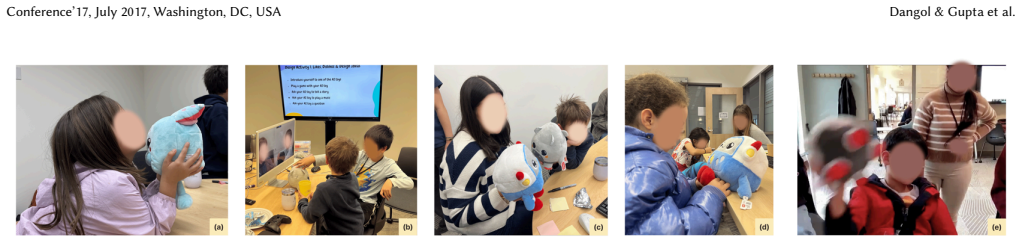
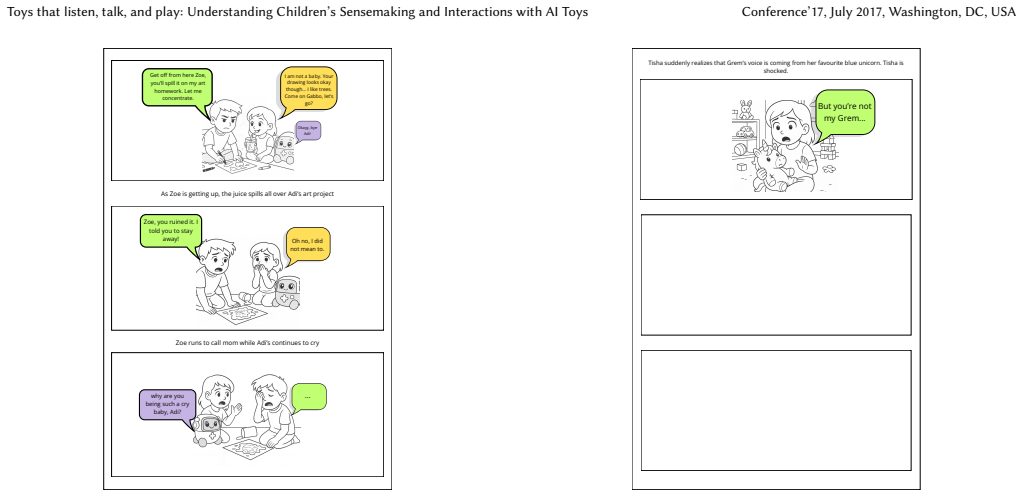
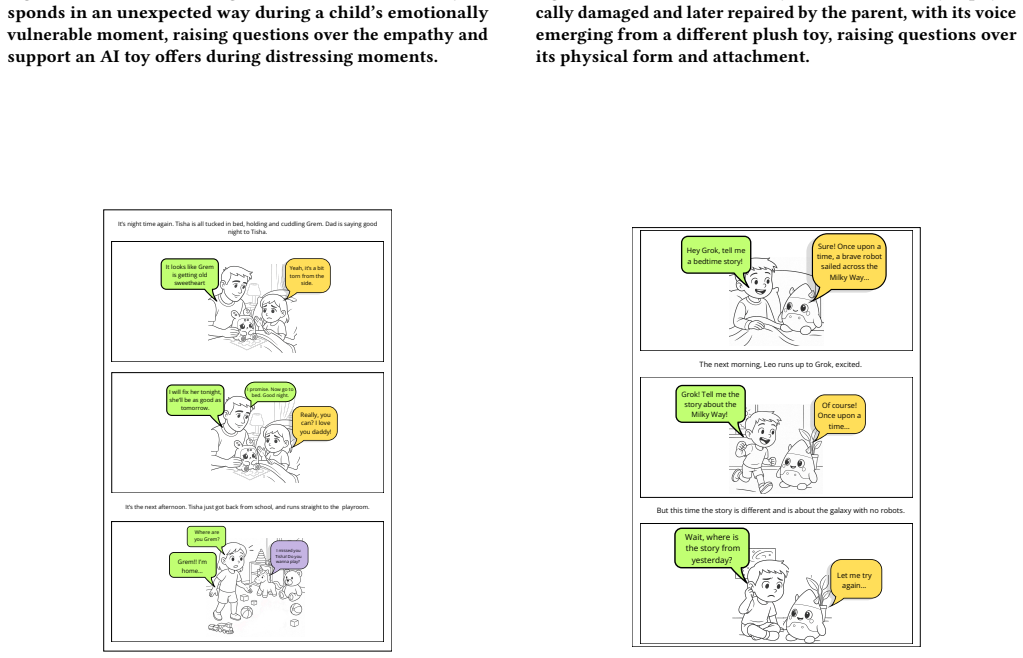
Generative AI (genAI) is increasingly being integrated into children's everyday lives, not only through screens but also through so-called "screen-free" AI toys. These toys can simulate emotions, personalize responses, and recall prior interactions, creating the illusion of an ongoing social connection. Such capabilities raise important questions about how children understand boundaries, agency, and relationships when interacting with AI toys. To investigate this, we conducted two participatory design sessions with eight children ages 6-11 where they engaged with three different AI toys, shifting between play, experimentation, and reflection. Our findings reveal that children approached AI toys with genuine curiosity, profiling them as social beings. However, frequent interaction breakdowns and mismatches between apparent intelligence and toy-like form disrupted expectations around play and led to adversarial play. We conclude with implications and design provocations to navigate children's encounters with AI toys in more transparent, developmentally appropriate, and responsible ways.
Editorial analysis
A structured set of objections, weighed in public.
Referee Report
Summary. The manuscript reports findings from two participatory design sessions with eight children (ages 6-11) who interacted with three AI toys. It claims that children approached the toys with genuine curiosity and profiled them as social beings, but that interaction breakdowns and mismatches between apparent intelligence and toy-like form disrupted play expectations and prompted adversarial play. The authors draw implications and design provocations for more transparent, developmentally appropriate AI toys.
Significance. If the observations hold, the work contributes exploratory qualitative evidence on children's sensemaking with generative-AI toys, a timely topic in HCI. The participatory sessions provide direct child perspectives that can usefully inform design guidelines for child-AI interaction, particularly around managing expectations and breakdowns.
major comments (2)
- [Methods] Methods: The description of how raw session data were analyzed to produce the reported themes (curiosity, social profiling, adversarial play) lacks detail on the coding process, inter-observer agreement, or validation steps. This under-specification is load-bearing for the reliability of the central empirical claims.
- [Findings] Findings: Concrete session excerpts or behavioral examples that directly illustrate how interaction breakdowns and form-intelligence mismatches produced adversarial play are needed; without them the causal link between observed behaviors and the claimed sensemaking patterns remains under-supported.
minor comments (2)
- [Abstract] Abstract: A one-sentence note on the qualitative analysis approach would help readers assess the strength of the reported patterns.
- [Discussion] Discussion: The design provocations would be stronger if each were explicitly tied to a specific observation or quote from the sessions rather than stated at a general level.
Simulated Author's Rebuttal
Thank you for the constructive feedback on our manuscript. We have carefully considered the referee's comments and revised the paper to address the concerns regarding methods and findings. Below, we provide point-by-point responses.
read point-by-point responses
-
Referee: [Methods] Methods: The description of how raw session data were analyzed to produce the reported themes (curiosity, social profiling, adversarial play) lacks detail on the coding process, inter-observer agreement, or validation steps. This under-specification is load-bearing for the reliability of the central empirical claims.
Authors: We agree that additional detail on the analysis process would strengthen the manuscript. In the revised version, we have expanded the Methods section to describe the thematic analysis approach in more detail, including how the two researchers iteratively coded the session videos and transcripts, developed the themes through discussion, and validated them against the raw data. While we did not compute formal inter-rater reliability metrics due to the small sample and exploratory nature of the participatory design sessions, we have added information on the collaborative validation steps taken. revision: yes
-
Referee: [Findings] Findings: Concrete session excerpts or behavioral examples that directly illustrate how interaction breakdowns and form-intelligence mismatches produced adversarial play are needed; without them the causal link between observed behaviors and the claimed sensemaking patterns remains under-supported.
Authors: We thank the referee for this suggestion. We have incorporated specific excerpts from the participatory design sessions and detailed behavioral observations into the Findings section. These examples now explicitly link the interaction breakdowns and mismatches to the emergence of adversarial play, providing stronger support for our interpretations of children's sensemaking. revision: yes
Circularity Check
No circularity: empirical qualitative observations from participatory sessions
full rationale
The paper reports findings from two participatory design sessions with eight children, describing observed behaviors such as curiosity, social profiling, interaction breakdowns, and adversarial play. These are presented as direct interpretations of session data with no mathematical derivations, fitted parameters, predictions, equations, or self-citation chains invoked to justify core claims. The analysis relies on qualitative sensemaking from the sessions themselves rather than reducing any result to prior inputs by construction. This is a standard empirical HCI study with no load-bearing self-referential steps.
Axiom & Free-Parameter Ledger
Reference graph
Works this paper leans on
-
[1]
2025.Google Rolls Out Gemini for Home AI Assistant in the US
Aminu Abdullahi. 2025.Google Rolls Out Gemini for Home AI Assistant in the US. TechRepublic. https://www.techrepublic.com/article/news-google-gemini- home/
work page 2025
-
[2]
Valentina Andries and Judy Robertson. 2023. Alexa doesn’t have that many feelings: Children’s understanding of AI through interactions with smart speakers in their homes.Computers and Education: Artificial Intelligence5 (2023), 100176
work page 2023
-
[3]
Erin Beneteau, Ashley Boone, Yuxing Wu, Julie A Kientz, Jason Yip, and Alexis Hiniker. 2020. Parenting with Alexa: exploring the introduction of smart speakers on family dynamics. InProceedings of the 2020 CHI conference on human factors in computing systems. 1–13
work page 2020
-
[4]
Erin Beneteau, Olivia K Richards, Mingrui Zhang, Julie A Kientz, Jason Yip, and Alexis Hiniker. 2019. Communication breakdowns between families and Alexa. InProceedings of the 2019 CHI conference on human factors in computing systems. 1–13
work page 2019
-
[5]
Melanie Birks, Ysanne Chapman, and Karen Francis. 2008. Memoing in qualitative research: Probing data and processes.Journal of research in nursing13, 1 (2008), 68–75
work page 2008
-
[6]
2009.Play: How it shapes the brain, opens the imagination, and invigorates the soul
Stuart Brown and Christopher Vaughan. 2009.Play: How it shapes the brain, opens the imagination, and invigorates the soul. Penguin
work page 2009
-
[7]
Jerome S Bruner. 1972. Nature and uses of immaturity.American psychologist27, 8 (1972), 687
work page 1972
-
[8]
Gaile S Cannella. 1993. Learning through social interaction: Shared cognitive experience, negotiation strategies, and joint concept construction for young children.Early Childhood Research Quarterly8, 4 (1993), 427–444
work page 1993
-
[9]
Nancy Carlsson-Paige. 1990. Who’s calling the shots?: How to respond effectively to children’s fascination with war play and war toys.(No Title)(1990)
work page 1990
-
[10]
2025.About a Quarter of US Teens Have Used ChatGPT for Schoolwork, Double the Share in 2023
Pew Research Center. 2025.About a Quarter of US Teens Have Used ChatGPT for Schoolwork, Double the Share in 2023. https://www.pewresearch.org/short- reads/2025/01/15/about-a-quarter-of-us-teens-have-used-chatgpt-for- schoolwork-double-the-share-in-2023/
work page 2025
-
[11]
Liuqing Chen, Shuhong Xiao, Yunnong Chen, Yaxuan Song, Ruoyu Wu, and Lingyun Sun. 2024. ChatScratch: an AI-Augmented System Toward Autonomous Visual Programming Learning for Children Aged 6-12. InProceedings of the 2024 CHI Conference on Human Factors in Computing Systems(Honolulu, HI, USA) (CHI ’24). Association for Computing Machinery, New York, NY, USA...
-
[12]
Ruishi Chen, Victor R Lee, and Monica G Lee. 2025. A cross-sectional look at teacher reactions, worries, and professional development needs related to generative AI in an urban school district.Education and Information Technologies (2025), 1–38
work page 2025
-
[13]
Yi Cheng, Kate Yen, Yeqi Chen, Sijin Chen, and Alexis Hiniker. 2018. Why doesn’t it work? Voice-driven interfaces and young children’s communication repair strategies. InProceedings of the 17th ACM conference on interaction design and children. 337–348
work page 2018
-
[14]
James F Christie and EP Johnsen. 1983. The role of play in social-intellectual development.Review of Educational Research53, 1 (1983), 93–115
work page 1983
-
[15]
Common Sense Media. 2026.AI Toys. Common Sense Media. https://www. commonsensemedia.org/ai-ratings/ai-toys
work page 2026
-
[16]
R. J. Cross and Rory Erlich. 2025. AI Comes to Playtime: Artificial companions, real risks. https://pirg.org/edfund/wp-content/uploads/2025/12/AI-Comes-to- Playtime-Artifical-companions-real-risks.pdf
work page 2025
-
[17]
Flannery Hope Currin, Cassidy Kilcoin, Kerry Peterman, Kyle Rector, and Juan Pablo Hourcade. 2024. Opportunities and challenges in using tangible, teleoperated voice agents in kid-driven moments in play among families with neurodivergent children.Proceedings of the ACM on human-computer interaction 8, CSCW1 (2024), 1–25
work page 2024
-
[18]
Aayushi Dangol. 2025. Beyond Users: Supporting Children in Interpreting, Resisting, and Collaborating with AI. InProceedings of the 24th Interaction Design and Children. 1180–1184
work page 2025
-
[19]
Aayushi Dangol, Yun Huang, Srirangaraj Setlur, Adele Smolansky, Hariharan Subramonyam, Hyewon Suh, Jinjun Xiong, and Julie A Kientz. 2024. AI-driven support for people with speech & language difficulties. InExtended Abstracts of the CHI Conference on Human Factors in Computing Systems. 1–4
work page 2024
-
[20]
Bowers, Antonio Vigil, Jason Yip, Julie A
Aayushi Dangol, Smriti Kotiyal, Robert Wolfe, Alex J. Bowers, Antonio Vigil, Jason Yip, Julie A. Kientz, Suleman Shahid, Tom Yeh, Vincent Cho, and Katie Davis
-
[21]
Relief or displacement? How teachers are negotiating generative AI’s role in their professional practice. InProceedings of the 2026 CHI Conference on Human Factors in Computing Systems (CHI ’26)(Barcelona, Spain)(CHI ’26). Association for Computing Machinery, New York, NY, USA. doi:10.1145/3772318.3791904
-
[22]
Aayushi Dangol, Aaleyah Lewis, Hyewon Suh, Xuesi Hong, Hedda Meadan, James Fogarty, and Julie A Kientz. 2025. “I Want to Think Like an SLP”: A Design Exploration of AI-Supported Home Practice in Speech Therapy. InProceedings of the 2025 CHI Conference on Human Factors in Computing Systems. 1–21
work page 2025
-
[23]
Kientz, Jason Yip, and Caroline Pitt
Aayushi Dangol, Michele Newman, Robert Wolfe, Jin Ha Lee, Julie A. Kientz, Jason Yip, and Caroline Pitt. 2024. Mediating Culture: Cultivating Socio-cultural Understanding of AI in Children through Participatory Design. InProceedings of the 2024 ACM Designing Interactive Systems Conference(Copenhagen, Denmark) (DIS ’24). Association for Computing Machinery...
-
[24]
Aayushi Dangol, Robert Wolfe, Daeun Yoo, Arya Thiruvillakkat, Ben Chick- adel, and Julie A Kientz. 2025. If anybody finds out you are in BIG TROUBLE”: Toys that listen, talk, and play: Understanding Children’s Sensemaking and Interactions with AI Toys Conference’17, July 2017, Washington, DC, USA Understanding Children’s Hopes, Fears, and Evaluations of G...
work page 2025
-
[25]
Aayushi Dangol, Robert Wolfe, Runhua Zhao, JaeWon Kim, Trushaa Ramanan, Katie Davis, and Julie A. Kientz. 2025. Children’s Mental Models of AI Reasoning: Implications for AI Literacy Education. InProceedings of the Interaction Design and Children Conference (IDC ’25). Association for Computing Machinery, Reykjavik, Iceland, 18. doi:10.1145/3713043.3728856
-
[26]
Aayushi Dangol, Runhua Zhao, Robert Wolfe, Trushaa Ramanan, Julie A Kientz, and Jason Yip. 2025. “AI just keeps guessing”: Using ARC Puzzles to Help Children Identify Reasoning Errors in Generative AI. InProceedings of the 24th Interaction Design and Children. 444–464
work page 2025
-
[27]
Hey Google is it ok if I eat you?
Stefania Druga, Randi Williams, Cynthia Breazeal, and Mitchel Resnick. 2017. " Hey Google is it ok if I eat you?" Initial explorations in child-agent interaction. InProceedings of the 2017 conference on interaction design and children. 595–600
work page 2017
-
[28]
Allison Druin. 1999. Cooperative inquiry: developing new technologies for children with children. InProceedings of the SIGCHI Conference on Human Factors in Computing Systems(Pittsburgh, Pennsylvania, USA)(CHI ’99). Association for Computing Machinery, New York, NY, USA, 592–599. doi:10.1145/302979.303166
-
[29]
Allison DRUIN. 2002. The role of children in the design of new technology. Behaviour & information technology21, 1 (2002), 1–25
work page 2002
-
[30]
Gary A Fine. 1988. Good children and dirty play.Play & Culture(1988)
work page 1988
-
[31]
Radhika Garg and Subhasree Sengupta. 2020. He is just like me: a study of the long-term use of smart speakers by parents and children.Proceedings of the ACM on Interactive, Mobile, Wearable and Ubiquitous Technologies4, 1 (2020), 1–24
work page 2020
-
[32]
Josie Gleave and Issy Cole-Hamilton. 2012. A literature review on the effects of a lack of play on children’s lives.England: Play England(2012)
work page 2012
-
[33]
Peter Gray. 2017. What exactly is play, and why is it such a powerful vehicle for learning?Topics in Language Disorders37, 3 (2017), 217–228
work page 2017
-
[34]
Phyllis Greenacre. 1959. Play in relation to creative imagination.The psychoana- lytic study of the child14, 1 (1959), 61–80
work page 1959
-
[35]
Karl Groos, Elizabeth L Baldwin, and J Baldwin. 1898. The psychology of animal play. (1898)
-
[36]
Xinwei Guan, Dengkai Chen, and Suihuai Yu. 2025. AI-Driven Design of Emotion- ally Supportive Toys for Child Development: An Iterative Process. InProceedings of the 2025 International Conference on Artificial Intelligence and Educational Systems. 160–168
work page 2025
-
[37]
Ariel Han and Zhenyao Cai. 2023. Design implications of generative AI systems for visual storytelling for young learners. InProceedings of the 22nd Annual ACM Interaction Design and Children Conference. 470–474
work page 2023
-
[38]
Alexis Hiniker, Sharon S Heung, Sungsoo Hong, and Julie A Kientz. 2018. Coco’s videos: an empirical investigation of video-player design features and children’s media use. InProceedings of the 2018 CHI conference on human factors in computing systems. 1–13
work page 2018
-
[39]
Jessica Hoffmann and Sandra Russ. 2012. Pretend play, creativity, and emotion regulation in children.Psychology of aesthetics, creativity, and the arts6, 2 (2012), 175
work page 2012
-
[40]
Layne Jackson Hubbard, Yifan Chen, Eliana Colunga, Pilyoung Kim, and Tom Yeh. 2021. Child-robot interaction to integrate reflective storytelling into creative play. InProceedings of the 13th Conference on Creativity and Cognition. 1–8
work page 2021
-
[41]
Eva Johansson and Anette Emilson. 2016. Conflicts and resistance: Potentials for democracy learning in preschool.International Journal of Early Years Education 24, 1 (2016), 19–35
work page 2016
-
[42]
Ken Kahn and Niall Winters. 2021. Constructionism and AI: A history and possible futures.British Journal of Educational Technology52, 3 (2021), 1130–1142
work page 2021
-
[43]
Sarika Kewalramani, Ioanna Palaiologou, Maria Dardanou, Kelly-Ann Allen, and Sivanes Phillipson. 2021. Using robotic toys in early childhood education to support children’s social and emotional competencies.Australasian Journal of Early Childhood46, 4 (2021), 355–369
work page 2021
-
[44]
Eric Klopfer, Justin Reich, Hal Abelson, and Cynthia Breazeal. 2024. Generative AI and K-12 Education: An MIT Perspective.An MIT Exploration of Generative AI(mar 27 2024). https://mit-genai.pubpub.org/pub/4k9msp17
work page 2024
-
[45]
Josephine Lau, Benjamin Zimmerman, and Florian Schaub. 2018. Alexa, are you listening? Privacy perceptions, concerns and privacy-seeking behaviors with smart speakers.Proceedings of the ACM on human-computer interaction2, CSCW (2018), 1–31
work page 2018
-
[46]
Zhixin Li, Trisha Thomas, Chi-Lin Yu, and Ying Xu. 2024. " I Said Knight, Not Night!": Children’s Communication Breakdowns and Repairs with AI Versus Human Partners. InProceedings of the 23rd Annual ACM Interaction Design and Children Conference. 781–788
work page 2024
-
[47]
Irene Lopatovska, Katrina Rink, Ian Knight, Kieran Raines, Kevin Cosenza, Harriet Williams, Perachya Sorsche, David Hirsch, Qi Li, and Adrianna Martinez. 2019. Talk to me: Exploring user interactions with the Amazon Alexa.Journal of Librarianship and Information Science51, 4 (2019), 984–997
work page 2019
-
[48]
Ben Mardell, Daniel Wilson, Jen Ryan, Katie Ertel, Mara Krechevsky, and Megina Baker. 2016. Towards a pedagogy of play.Cambridge, MA: Harvard Graduate School of Education(2016)
work page 2016
-
[49]
Lina Mavrina, Jessica Szczuka, Clara Strathmann, Lisa Michelle Bohnenkamp, Nicole Krämer, and Stefan Kopp. 2022. “Alexa, you’re really stupid”: A longitudi- nal field study on communication breakdowns between family members and a voice assistant.Frontiers in Computer Science4 (2022), 791704
work page 2022
-
[50]
Nora McDonald, Sarita Schoenebeck, and Andrea Forte. 2019. Reliability and Inter-rater Reliability in Qualitative Research: Norms and Guidelines for CSCW and HCI Practice.Proc. ACM Hum.-Comput. Interact.3, CSCW, Article 72 (Nov. 2019), 23 pages. doi:10.1145/3359174
-
[51]
Common Sense Media. 2025.New Report Shows Students Are Em- bracing Artificial Intelligence Despite Lack of Parent A wareness. https: //www.commonsensemedia.org/press-releases/new-report-shows-students- are-embracing-artificial-intelligence-despite-lack-of-parent-awareness-and Accessed: 2025-01-26
work page 2025
-
[52]
Punya Mishra and Matthew J. Koehler. 2006. Technological pedagogical content knowledge: A framework for teacher knowledge.Teachers College Record108, 6 (2006), 1017–1054
work page 2006
-
[53]
Neema Moraveji, Jason Li, Jiarong Ding, Patrick O’Kelley, and Suze Woolf. 2007. Comicboarding: using comics as proxies for participatory design with children. InProceedings of the SIGCHI conference on Human factors in computing systems. 1371–1374
work page 2007
-
[54]
Terran Mott, Alexandra Bejarano, and Tom Williams. 2022. Robot co-design can help us engage child stakeholders in ethical reflection. In2022 17th ACM/IEEE International Conference on Human-Robot Interaction (HRI). IEEE, 14–23
work page 2022
-
[55]
Keziah Naggita, Elsa Athiley, Beza Desta, and Sarah Sebo. 2022. Parental Re- sponses to Aggressive Child Behavior towards Robots, Smart Speakers, and Tablets. In2022 31st IEEE International Conference on Robot and Human Interactive Communication (RO-MAN). IEEE, 337–344
work page 2022
-
[56]
I want it to talk like Darth Vader
Michele Newman, Kaiwen Sun, Ilena B Dalla Gasperina, Grace Y Shin, Matthew Kyle Pedraja, Ritesh Kanchi, Maia B Song, Rannie Li, Jin Ha Lee, and Jason Yip. 2024. " I want it to talk like Darth Vader": Helping Children Con- struct Creative Self-Efficacy with Generative AI. InProceedings of the 2024 CHI Conference on Human Factors in Computing Systems. 1–18
work page 2024
-
[57]
Tatsuya Nomura, Takayuki Uratani, Takayuki Kanda, Kazutaka Matsumoto, Hi- royuki Kidokoro, Yoshitaka Suehiro, and Sachie Yamada. 2015. Why do children abuse robots?. InProceedings of the tenth annual ACM/IEEE international confer- ence on human-robot interaction extended abstracts. 63–64
work page 2015
-
[58]
Mohammad Obaid, Gökçe Elif Baykal, Güncel Kırlangıc, Tilbe Göksun, and Asım Evren Yantaç. 2024. Collective co-design activities with children for design- ing classroom robots. InProceedings of the 4th African Human Computer Interac- tion Conference(East London, South Africa)(AfriCHI ’23). Association for Com- puting Machinery, New York, NY, USA, 229–237. ...
-
[59]
Alexa, let me ask you something different
Cansu Oranç and Azzurra Ruggeri. 2021. “Alexa, let me ask you something different” Children’s adaptive information search with voice assistants.Human Behavior and Emerging Technologies3, 4 (2021), 595–605
work page 2021
-
[60]
Anne Ottenbreit-Leftwich, Krista Glazewski, Minji Jeon, Katie Jantaraweragul, Cindy E Hmelo-Silver, Adam Scribner, Seung Lee, Bradford Mott, and James Lester. 2023. Lessons learned for AI education with elementary students and teachers.International Journal of Artificial Intelligence in Education33, 2 (2023), 267–289
work page 2023
-
[61]
Jean Piaget. 1962. The stages of the intellectual development of the child.Bulletin of the Menninger clinic26, 3 (1962), 120
work page 1962
-
[62]
Amanda Purington, Jessie G Taft, Shruti Sannon, Natalya N Bazarova, and Samuel Hardman Taylor. 2017. " Alexa is my new BFF" social roles, user satis- faction, and personification of the Amazon Echo. InProceedings of the 2017 CHI conference extended abstracts on human factors in computing systems. 2853–2859
work page 2017
-
[63]
Mitchel Resnick. 2024. Generative AI and creative learning: Concerns, opportu- nities, and choices. (2024)
work page 2024
-
[64]
Olivia K Richards and Tiffany Veinot. 2025. I don’t want to watch grown-up stuff’: Children’s and Parents’ Perspectives and Recommendations for Health-Centered Digital Media Design. InProceedings of the 2025 CHI Conference on Human Factors in Computing Systems. 1–18
work page 2025
-
[65]
Richard Rogers. 2018. Coding and writing analytic memos on qualitative data: A review of Johnny Saldaña’s the coding manual for qualitative researchers.The Qualitative Report23, 4 (2018), 889–892
work page 2018
-
[66]
Carolyn U Shantz and Willard W Hartup. 1992. Conflict and development: An introduction.Conflict in child and adolescent development(1992), 1–11
work page 1992
-
[67]
Jaemarie Solyst, Amy Ogan, and Jessica Hammer. 2023. Intergenerational Games to Learn About AI and Ethics. InProceedings of the 54th ACM Tech- nical Symposium on Computer Science Education V. 2(Toronto ON, Canada) (SIGCSE 2023). Association for Computing Machinery, New York, NY, USA, 1273. doi:10.1145/3545947.3573256
-
[68]
Clara Strathmann, Aike C Horstmann, Jessica M Szczuka, and Nicole C Krämer
-
[69]
Alexa, shut up!–A 2.5-year study on negatively connotated communication behaviour towards voice assistants in the family home.Behaviour & Information Technology(2025), 1–19
work page 2025
-
[70]
Clara Strathmann, Jessica Szczuka, and Nicole Krämer. 2020. She talks to me as if she were alive: Assessing the social reactions and perceptions of children toward voice assistants and their appraisal of the appropriateness of these reactions. In Conference’17, July 2017, Washington, DC, USA Dangol & Gupta et al. Proceedings of the 20th ACM international ...
work page 2020
-
[71]
Lev S Vygotsky. 1967. Play and its role in the mental development of the child. Soviet psychology5, 3 (1967), 6–18
work page 1967
-
[72]
2025.Toys are talking back thanks to AI, but are they safe around kids?Los Angeles Times
Queenie Wong. 2025.Toys are talking back thanks to AI, but are they safe around kids?Los Angeles Times. https://www.latimes.com/business/story/2025-12- 24/toys-are-talking-back-thanks-to-ai-but-are-they-safe-around-kids
work page 2025
-
[73]
It Would Be Cool to Get Stampeded by Dinosaurs
Julia Woodward, Feben Alemu, Natalia E. López Adames, Lisa Anthony, Jason C. Yip, and Jaime Ruiz. 2022. “It Would Be Cool to Get Stampeded by Dinosaurs”: Analyzing Children’s Conceptual Model of AR Headsets Through Co-Design. In Proceedings of the 2022 CHI Conference on Human Factors in Computing Systems. 1–13
work page 2022
-
[74]
Julia Woodward, Zari McFadden, Nicole Shiver, Amir Ben-Hayon, Jason C Yip, and Lisa Anthony. 2018. Using co-design to examine how children conceptualize intelligent interfaces. InProceedings of the 2018 CHI conference on human factors in computing systems. 1–14
work page 2018
-
[75]
Robert K Yin. 2013. Validity and generalization in future case study evaluations. Evaluation19, 3 (2013), 321–332
work page 2013
-
[76]
Jason C Yip, Kung Jin Lee, and Jin Ha Lee. 2020. Design partnerships for par- ticipatory librarianship: A conceptual model for understanding librarians co designing with digital youth.Journal of the Association for Information Science and Technology71, 10 (2020), 1242–1256. https://doi.org/10.1002/asi.24320
-
[77]
Jason C Yip, Kiley Sobel, Caroline Pitt, Kung Jin Lee, Sijin Chen, Kari Nasu, and Laura R Pina. 2017. Examining adult-child interactions in intergenerational participatory design. InProceedings of the 2017 CHI conference on human factors in computing systems. Association for Computing Machinery, New York, New York, 5742–5754. https://doi.org/10.1145/30254...
-
[78]
Chao Zhang, Cheng Yao, Jianhui Liu, Zili Zhou, Weilin Zhang, Lijuan Liu, Fang- tian Ying, Yijun Zhao, and Guanyun Wang. 2021. StoryDrawer: A Co-Creative Agent Supporting Children’s Storytelling through Collaborative Drawing. In Extended Abstracts of the 2021 CHI Conference on Human Factors in Computing Systems. 1–6. Appendix A That’s mean butwoohoo that’s...
work page 2021
discussion (0)
Sign in with ORCID, Apple, or X to comment. Anyone can read and Pith papers without signing in.