Partially deterministic sampling for compressed sensing with denoising guarantees
Pith reviewed 2026-05-10 18:46 UTC · model grok-4.3
The pith
An optimized Bernoulli selector mixes deterministic and random row sampling from unitary matrices to improve compressed sensing recovery and add denoising guarantees.
A machine-rendered reading of the paper's core claim, the machinery that carries it, and where it could break.
Core claim
When sampling vectors are restricted to the rows of a unitary matrix, an optimized Bernoulli selector can be derived that designates some rows for deterministic inclusion and others for random selection. This partially deterministic scheme yields improved sample-complexity bounds relative to prior work and supplies novel denoising guarantees while maintaining the restricted-isometry and incoherence properties required for stable recovery.
What carries the argument
Optimized Bernoulli selector that assigns deterministic inclusion probabilities to rows of a unitary matrix while preserving the restricted isometry property.
If this is right
- Fewer total samples are required to achieve the same recovery accuracy for sparse or generative image priors.
- Denoising guarantees hold for the reconstructed signal even when the measurements contain additive noise.
- The scheme outperforms both independent with-replacement and fixed-size without-replacement random sampling in practice.
- The same selector construction applies to any unitary matrix whose rows exhibit varying importance for the signal class of interest.
Where Pith is reading between the lines
- The method may be adapted to non-unitary sensing matrices by first applying a suitable orthogonalization step.
- Similar deterministic-random hybrids could be tested in other linear inverse problems such as phase retrieval or tomography.
- The approach suggests a practical workflow in which a short pilot scan identifies crucial rows before the main acquisition.
Load-bearing premise
Certain rows can be identified as crucial and included deterministically without destroying the incoherence or restricted-isometry conditions needed for recovery.
What would settle it
A numerical test in which forcing the deterministically chosen rows into the sampling set produces worse reconstruction error or violates the derived sample-complexity bound compared with pure random selection.
Figures


read the original abstract
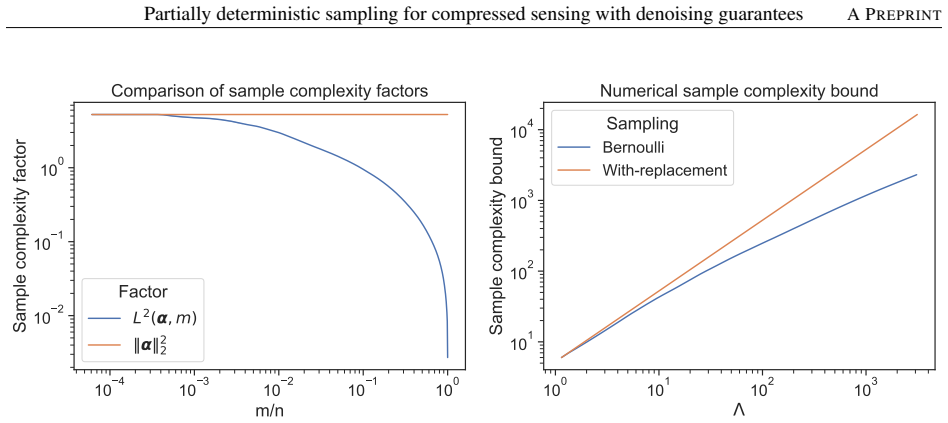
We study compressed sensing when the sampling vectors are chosen from the rows of a unitary matrix. In the literature, these sampling vectors are typically chosen randomly; the use of randomness has enabled major empirical and theoretical advances in the field. However, in practice there are often certain crucial sampling vectors, in which case practitioners will depart from the theory and sample such rows deterministically. In this work, we derive an optimized sampling scheme for Bernoulli selectors which naturally combines random and deterministic selection of rows, thus rigorously deciding which rows should be sampled deterministically. This sampling scheme provides measurable improvements in image compressed sensing for both generative and sparse priors when compared to with-replacement and without-replacement sampling schemes, as we show with theoretical results and numerical experiments. Additionally, our theoretical guarantees feature improved sample complexity bounds compared to previous works, and novel denoising guarantees in this setting.
Editorial analysis
A structured set of objections, weighed in public.
Referee Report
Summary. The paper proposes an optimized partially deterministic sampling scheme for compressed sensing, where rows of a unitary matrix are selected via Bernoulli selectors: a subset of 'crucial' rows is included deterministically (probability 1) while the remainder is chosen randomly. It claims this yields improved sample-complexity bounds over fully random with- and without-replacement schemes, novel denoising guarantees, and measurable empirical gains in image reconstruction tasks under both generative and sparse priors.
Significance. If the central claims hold, the work bridges a common practical-theoretical gap in compressed sensing by providing a rigorous justification for deterministic row inclusion within a probabilistic framework. The combination of theoretical bounds with numerical validation on image data for multiple priors is a clear strength, as are the novel denoising guarantees. This could inform more efficient sampling designs in applications such as MRI, provided the perturbation analysis is completed.
major comments (1)
- [Theoretical analysis (main theorem and supporting lemmas on the composite sampling operator)] The improved sample-complexity and denoising guarantees rest on the mixed operator preserving RIP/incoherence concentration properties comparable to the fully random case. No explicit uniform bound (independent of the particular choice of deterministic rows) is derived on the additive perturbation to the relevant concentration inequalities or coherence parameter induced by the fixed rows; this is load-bearing for the central claim that the scheme improves upon standard Bernoulli sampling.
minor comments (2)
- [Abstract and §1] Clarify in the abstract and introduction the precise quantitative improvement in sample complexity (e.g., the factor by which m is reduced) and the form of the new denoising bound.
- [Numerical experiments] In the experimental section, report the criterion used to identify 'crucial' rows, include error bars or multiple trials, and add direct comparison tables against the baseline schemes.
Simulated Author's Rebuttal
We thank the referee for the careful and constructive review. We appreciate the recognition of the work's potential to bridge practical sampling choices with theoretical guarantees in compressed sensing, as well as the value placed on the empirical validation across priors. We address the single major comment below and commit to a revision that strengthens the theoretical analysis.
read point-by-point responses
-
Referee: The improved sample-complexity and denoising guarantees rest on the mixed operator preserving RIP/incoherence concentration properties comparable to the fully random case. No explicit uniform bound (independent of the particular choice of deterministic rows) is derived on the additive perturbation to the relevant concentration inequalities or coherence parameter induced by the fixed rows; this is load-bearing for the central claim that the scheme improves upon standard Bernoulli sampling.
Authors: We thank the referee for identifying this important clarification needed in the theoretical development. The current proofs bound the deviation of the composite (partially deterministic) operator from the fully random case by controlling the contribution of the fixed rows through their cardinality, but we agree that an explicit, uniform bound on the resulting additive perturbation—independent of the specific identity of the chosen deterministic rows—would make the comparison to standard Bernoulli sampling fully rigorous and self-contained. In the revised manuscript we will add a new supporting lemma (to be placed before the main theorem) that derives such a uniform bound: for any fixed set of at most k deterministic rows with k = o(m), the perturbation to the relevant concentration inequalities and coherence parameter is at most O((k log n)/m) with high probability, which vanishes under the sample-complexity regime of the main theorem. This lemma will be invoked directly in the proof of the improved RIP and denoising guarantees, thereby explicitly establishing the claimed improvement over fully random sampling. The numerical experiments already illustrate the practical benefit; the added lemma will close the identified gap. revision: yes
Circularity Check
No circularity: optimized Bernoulli scheme derived independently with external theoretical support
full rationale
The paper derives its partially deterministic sampling scheme for unitary-matrix rows via optimization of Bernoulli selectors, yielding improved sample-complexity bounds and denoising guarantees. These are presented as first-principles results compared against with-replacement and without-replacement baselines, validated by both theory and numerical experiments on image data. No quoted equations or steps reduce a prediction to a fitted input, self-citation chain, or definitional tautology; the deterministic-row choice is justified by the optimization itself rather than by renaming or smuggling prior ansatzes. The central claims remain externally falsifiable via the stated RIP/incoherence analysis and experiments.
Axiom & Free-Parameter Ledger
axioms (1)
- domain assumption Rows of the unitary matrix satisfy sufficient incoherence or RIP when a subset is chosen via the proposed Bernoulli rule.
Reference graph
Works this paper leans on
-
[1]
[Adcock et al.(2024)Adcock, Cardenas, and Dexter] B. Adcock, J. M. Cardenas, and N. Dexter. A Unified Frame- work for Learning with Nonlinear Model Classes from Arbitrary Linear Samples. InProceedings of the 41st International Conference on Machine Learning, pages 169–202. PMLR, July
work page 2024
-
[2]
Axler.Linear Algebra Done Right
[Axler(2024)] S. Axler.Linear Algebra Done Right. Undergraduate Texts in Mathematics. Springer International Publishing, Cham,
work page 2024
-
[3]
ISBN 978-3-031-41025-3 978-3-031-41026-0. doi: 10.1007/978-3-031-41026-0. [Berk et al.(2022)Berk, Brugiapaglia, Joshi, Plan, Scott, and Yilmaz] A. Berk, S. Brugiapaglia, B. Joshi, Y . Plan, M. Scott, and ¨O. Yilmaz. A Coherence Parameter Characterizing Generative Compressed Sensing With Fourier Measurements.IEEE Journal on Selected Areas in Information Th...
-
[4]
doi: 10.1109/JSAIT.2022.3220196. 18 Partially deterministic sampling for compressed sensing with denoising guaranteesA PREPRINT [Berk et al.(2023)Berk, Brugiapaglia, Plan, Scott, Sheng, and Yilmaz] A. Berk, S. Brugiapaglia, Y . Plan, M. Scott, X. Sheng, and O. Yilmaz. Model-adapted Fourier sampling for generative compressed sensing. InNeurIPS 2023 Worksho...
- [5]
-
[6]
ISSN 1557-9654. doi: 10.1109/TIT.2016.2524628. [Candes and Romberg(2007)] E. Candes and J. Romberg. Sparsity and Incoherence in Compressive Sampling.In- verse Problems, 23(3):969–985, June
-
[7]
doi: 10.1088/0266-5611/23/3/008
ISSN 0266-5611, 1361-6420. doi: 10.1088/0266-5611/23/3/008. [Cardenas et al.(2023)Cardenas, Adcock, and Dexter] J. M. Cardenas, B. Adcock, and N. Dexter. CS4ML: A general framework for active learning with arbitrary data based on Christoffel functions.Advances in Neural Information Processing Systems, 36:19990–20037, Dec
-
[8]
[Chauffert et al.(2014)Chauffert, Ciuciu, Kahn, and Weiss] N. Chauffert, P. Ciuciu, J. Kahn, and P. Weiss. Variable Density Sampling with Continuous Trajectories.SIAM J. Img. Sci., 7(4):1962–1992, Jan
work page 2014
-
[9]
[Hoppe et al.(2023)Hoppe, Krahmer, Verdun, Menzel, and Rauhut] F
doi: 10.1137/ 130946642. [Hoppe et al.(2023)Hoppe, Krahmer, Verdun, Menzel, and Rauhut] F. Hoppe, F. Krahmer, C. M. Verdun, M. I. Men- zel, and H. Rauhut. Sampling Strategies for Compressive Imaging Under Statistical Noise. In2023 Inter- national Conference on Sampling Theory and Applications (SampTA), 2023 International Conference on Sam- pling Theory an...
work page 2023
-
[10]
Modulation Spaces and the Curse of Dimensionality,
doi: 10.1109/SampTA59647.2023.10301372. [Krahmer and Ward(2014)] F. Krahmer and R. Ward. Stable and Robust Sampling Strategies for Compressive Imaging.IEEE Trans. on Image Process., 23(2):612–622, Feb
-
[11]
ISSN 1057-7149, 1941-0042. doi: 10.1109/TIP.2013.2288004. [Liu and Nocedal(1989)] D. C. Liu and J. Nocedal. On the limited memory BFGS method for large scale optimization. Mathematical Programming, 45(1):503–528, Aug
-
[12]
On the limited memory BFGS method for large scale optimization
ISSN 1436-4646. doi: 10.1007/BF01589116. [Liu et al.(2015)Liu, Luo, Wang, and Tang] Z. Liu, P. Luo, X. Wang, and X. Tang. Deep Learning Face Attributes in the Wild. InProceedings of the 2015 IEEE International Conference on Computer Vision (ICCV), ICCV ’15, pages 3730–3738, USA, Dec
-
[13]
PoseNet: A convolutional network for real-time 6-dof camera relocalization,
IEEE Computer Society. ISBN 978-1-4673-8391-2. doi: 10.1109/ICCV . 2015.425. [Lustig et al.(2007)Lustig, Donoho, and Pauly] M. Lustig, D. Donoho, and J. M. Pauly. Sparse MRI: The application of compressed sensing for rapid MR imaging.Magn Reson Med, 58(6):1182–1195, Dec
-
[14]
ISSN 0740-3194. doi: 10.1002/mrm.21391. [Nilsback and Zisserman(2008)] M.-E. Nilsback and A. Zisserman. Automated Flower Classification over a Large Number of Classes. In2008 Sixth Indian Conference on Computer Vision, Graphics & Image Processing, pages 722–729, Dec
-
[15]
Norelli, A., Fumero, M., Maiorca, V ., Moschella, L., Rodola, E., and Locatello, F
doi: 10.1109/ICVGIP.2008.47. [Plan et al.(2025)Plan, Scott, Sheng, and Yilmaz] Y . Plan, M. S. Scott, X. Sheng, and O. Yilmaz. Denoising guaran- tees for optimized sampling schemes in compressed sensing, Apr
-
[16]
[Polak et al.(2015)Polak, Duarte, and Goeckel] A. C. Polak, M. F. Duarte, and D. L. Goeckel. Performance Bounds for Grouped Incoherent Measurements in Compressive Sensing.IEEE Trans. Signal Process., 63(11):2877– 2887, June
work page 2015
-
[17]
ISSN 1053-587X, 1941-0476. doi: 10.1109/TSP.2015.2412912. [Puy et al.(2011)Puy, Vandergheynst, and Wiaux] G. Puy, P. Vandergheynst, and Y . Wiaux. On Variable Density Com- pressive Sampling.IEEE Signal Process. Lett., 18(10):595–598, Oct
-
[18]
ISSN 1070-9908, 1558-2361. doi: 10.1109/LSP.2011.2163712. [Rudelson and Vershynin(2008)] M. Rudelson and R. Vershynin. On sparse reconstruction from Fourier and Gaussian measurements.Comm. Pure Appl. Math., 61(8):1025–1045, Aug
-
[19]
ISSN 00103640, 10970312. doi: 10.1002/cpa.20227. A Equivalence of duplicate-rejection sampling and sequential renormalized sampling Proposition A.1(Equivalence of two without-replacement implementations).LetF={f 1, . . . , fn}and letp= (p1, . . . , pn)satisfyp j ≥0and Pn j=1 pj =
discussion (0)
Sign in with ORCID, Apple, or X to comment. Anyone can read and Pith papers without signing in.