The Weaponization of Computer Vision: Tracing Military-Surveillance Ties through Conference Sponsorship
Pith reviewed 2026-05-10 18:18 UTC · model grok-4.3
The pith
Computer vision conferences receive sponsorship from companies with direct military or surveillance ties in 44 percent of cases.
A machine-rendered reading of the paper's core claim, the machinery that carries it, and where it could break.
Core claim
By collecting data on companies sponsoring computer vision conferences and checking their activities, we find that 44 percent have direct connections with military or surveillance applications. Conference sponsorship serves as strong evidence of investment in the field and provides a privileged position for shaping its trajectory, showing that computer vision is being used in technologies that inflict harm despite the field's neutral self-image.
What carries the argument
Conference sponsorship, which functions as evidence of a company's investment in computer vision and a means to shape its trajectory, applied to trace military-surveillance ties by examining each sponsor's documented activities.
If this is right
- Computer vision research is intertwined with applications in warfare and surveillance rather than remaining a neutral technical domain.
- Sponsorship data offers a concrete method for identifying pathways of technological weaponization.
- Companies involved in military or surveillance work hold positions to steer the direction of computer vision research.
- The approach has practical limits, including incomplete information on all connections and the need for careful classification of ties.
Where Pith is reading between the lines
- The same sponsorship-tracing method could be applied to other areas of AI to identify similar patterns of dual-use development.
- Increased public scrutiny of conference funding sources could prompt researchers to weigh potential influences on their work.
- The findings connect to wider questions about how academic fields handle funding from entities engaged in sensitive applications.
Load-bearing premise
That sponsorship reliably signals strong investment and influence in the field and that the classified ties accurately reflect direct military or surveillance involvement.
What would settle it
An independent review of the same sponsors that finds substantially fewer than 44 percent with direct military or surveillance activities would undermine the reported percentage and the tracing method.
Figures


read the original abstract
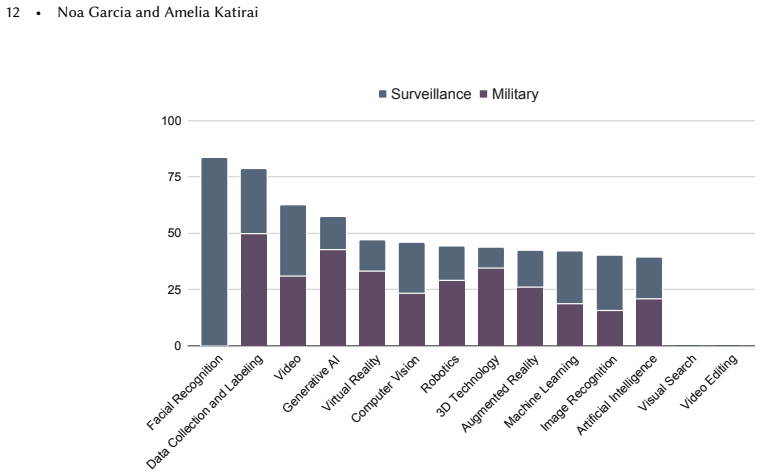
Computer vision, a core domain of artificial intelligence (AI), is the field that enables the computational analysis, understanding, and generation of visual data. Despite being historically rooted in military funding and increasingly deployed in warfare, the field tends to position itself as a neutral, purely technical endeavor, failing to engage in discussions about its dual-use applications. Yet it has been reported that computer vision systems are being systematically weaponized to assist in technologies that inflict harm, such as surveillance or warfare. Expanding on these concerns, we study the extent to which computer vision research is being used in the military and surveillance domains. We do so by collecting a dataset of tech companies with financial ties to the field's central research exchange platform: conferences. Conference sponsorship, we argue, not only serves as strong evidence of a company's investment in the field but also provides a privileged position for shaping its trajectory. By investigating sponsors' activities, we reveal that 44% of them have a direct connection with military or surveillance applications. We extend our analysis through two case studies in which we discuss the opportunities and limitations of sponsorship as a means for uncovering technological weaponization.
Editorial analysis
A structured set of objections, weighed in public.
Referee Report
Summary. The paper collects data on sponsors of major computer vision conferences and classifies their activities to argue that 44% have direct connections to military or surveillance applications. It positions conference sponsorship as evidence of investment and trajectory-shaping influence, then presents two case studies examining opportunities and limitations of this approach for tracing weaponization.
Significance. If the sponsor classification holds under transparent criteria, the work supplies an empirical count linking industry funding to dual-use domains in computer vision, adding to AI ethics literature on military-surveillance ties. The sponsorship-proxy method offers a replicable lens for other subfields, though its strength rests on the robustness of the 44% result and the case-study framing.
major comments (2)
- [Methods / Data Collection] The criteria and decision rules for labeling a sponsor as having a 'direct connection with military or surveillance applications' (including handling of dual-use products, subsidiaries, and thresholds) are not specified in the methods or data-collection section. This directly determines the 44% headline figure and must be documented with examples or a coding protocol to allow validation.
- [Results] No inter-coder agreement, sensitivity checks, or validation of the classification is reported, leaving the quantitative claim vulnerable to systematic bias in tie identification. This is load-bearing because the paper treats the resulting 44% as evidence of weaponization trends.
minor comments (3)
- [Abstract / Introduction] The abstract and introduction could more explicitly state the total number of sponsors analyzed and the time window of conferences covered to contextualize the 44% statistic.
- [Results] Figure or table presenting the sponsor breakdown by category (military, surveillance, dual-use, none) would improve readability of the main result.
- [Case Studies] The case studies would benefit from clearer linkage back to specific sponsors in the dataset rather than general discussion.
Simulated Author's Rebuttal
We thank the referee for their constructive comments, which help improve the transparency and robustness of our analysis on sponsor ties in computer vision conferences. We address each major point below and have revised the manuscript to incorporate additional methodological details.
read point-by-point responses
-
Referee: [Methods / Data Collection] The criteria and decision rules for labeling a sponsor as having a 'direct connection with military or surveillance applications' (including handling of dual-use products, subsidiaries, and thresholds) are not specified in the methods or data-collection section. This directly determines the 44% headline figure and must be documented with examples or a coding protocol to allow validation.
Authors: We agree that the original manuscript lacked sufficient detail on the classification criteria. In the revised version, we have added a new subsection in Methods that explicitly defines the decision rules: a sponsor receives a 'direct connection' label if it has documented military contracts, produces surveillance-specific hardware/software (e.g., facial recognition for law enforcement), or maintains subsidiaries with such activities, with a minimum revenue threshold of 5% from relevant divisions. Dual-use products are classified only when evidence shows active deployment in military or surveillance contexts rather than potential alone. We include a coding protocol table and three concrete sponsor examples (e.g., a company with both commercial imaging and defense contracts) to enable replication and validation. revision: yes
-
Referee: [Results] No inter-coder agreement, sensitivity checks, or validation of the classification is reported, leaving the quantitative claim vulnerable to systematic bias in tie identification. This is load-bearing because the paper treats the resulting 44% as evidence of weaponization trends.
Authors: We acknowledge that reliability metrics were not originally reported. The classification was performed by the lead authors using the now-documented protocol. In revision, we have added a sensitivity analysis that varies the 'direct connection' threshold (e.g., requiring explicit contracts versus any surveillance product line) and reports that the core 44% figure varies between 39% and 49% across reasonable alternatives, supporting stability. We also describe the single-coder process and potential bias sources. Full multi-coder agreement statistics cannot be retroactively computed from the existing data without re-labeling by independent coders, which we note as a limitation and plan to address in follow-up work. revision: partial
Circularity Check
No circularity; empirical count from external data with no self-referential reduction
full rationale
The paper conducts an empirical investigation by collecting sponsor data from conferences and classifying their activities for military/surveillance ties, yielding the 44% figure as a direct count. No equations, derivations, fitted parameters, or self-citations are present that reduce any claim to its own inputs by construction. The analysis relies on external company records rather than internal definitions or predictions, making it self-contained against the specified circularity patterns.
Axiom & Free-Parameter Ledger
axioms (1)
- domain assumption Conference sponsorship indicates a company's investment in the field and privileged position for shaping its trajectory
Lean theorems connected to this paper
-
IndisputableMonolith/Foundation/RealityFromDistinction.leanreality_from_one_distinction unclear?
unclearRelation between the paper passage and the cited Recognition theorem.
By investigating sponsors' activities, we reveal that 44% of them have a direct connection with military or surveillance applications... We collect a dataset of tech companies with financial ties to the field's central research exchange platform: conferences.
-
IndisputableMonolith/Cost/FunctionalEquation.leanwashburn_uniqueness_aczel unclear?
unclearRelation between the paper passage and the cited Recognition theorem.
We develop an annotation framework for categorizing corporation’s involvement in the weaponization of computer vision, which classifies whether a sponsor is related to military or surveillance applications.
-
IndisputableMonolith/Foundation/AlexanderDuality.leanalexander_duality_circle_linking unclear?
unclearRelation between the paper passage and the cited Recognition theorem.
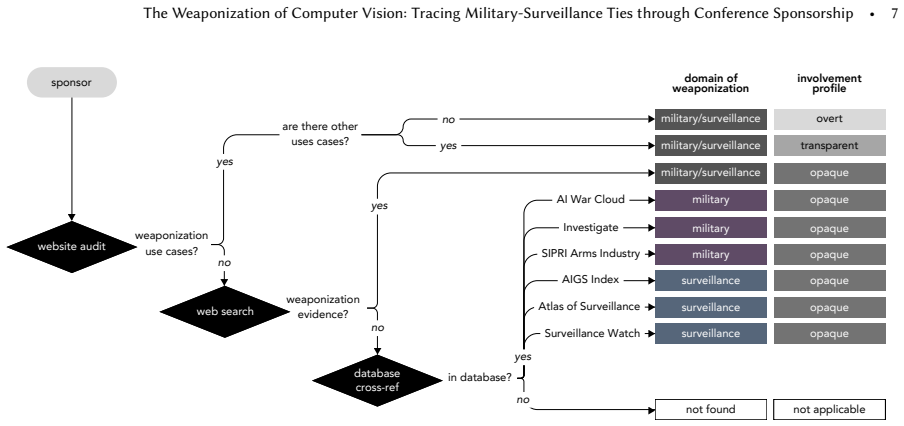
The CVWeap dataset... four-part methodology: (1) compile list of 469 companies... (2) enrich with metadata... (3) annotate domain of weaponization... (4) assign involvement profile.
What do these tags mean?
- matches
- The paper's claim is directly supported by a theorem in the formal canon.
- supports
- The theorem supports part of the paper's argument, but the paper may add assumptions or extra steps.
- extends
- The paper goes beyond the formal theorem; the theorem is a base layer rather than the whole result.
- uses
- The paper appears to rely on the theorem as machinery.
- contradicts
- The paper's claim conflicts with a theorem or certificate in the canon.
- unclear
- Pith found a possible connection, but the passage is too broad, indirect, or ambiguous to say the theorem truly supports the claim.
Reference graph
Works this paper leans on
-
[1]
2024 CVPR Program Committee. 2024. CVPR 2024 Breaks Paper and Attendance Records; AI Art Award and Demo Winners Announced . https://cvpr.thecvf.com/Conferences/2024/News/Wrap_Release [Accessed: March 2026]
work page 2024
-
[2]
Yuval Abraham. 2024. ‘Lavender’: The AI machine directing Israel’s bombing spree in Gaza. https://www.972mag.com/lavender-ai- israeli-army-gaza/ [Accessed: April 2025]
work page 2024
-
[3]
AFSC. 2025. Investigate: Action/Research for Palestinian Rights. https://investigate.info/ [Accessed: October 2025]
work page 2025
-
[4]
2024.Resisting Borders and Technologies of Violence
Mizue Aizeki, Matt Mamoudi, Coline Schupfer, and Ruha Benjamin. 2024.Resisting Borders and Technologies of Violence. Haymarket Books
work page 2024
-
[5]
Amnesty International. 2023. Israel and Occupied Palestinian Territories: Automated Apartheid: How facial recognition fragments, segregates and controls Palestinians in the OPT. https://www.amnesty.org/en/documents/mde15/6701/2023/en/ [Accessed: April 2025]
work page 2023
-
[6]
Mark Andrejevic and Neil Selwyn. 2022.Facial recognition. John Wiley & Sons
work page 2022
-
[7]
2012.Routledge handbook of surveillance studies
Kirstie Ball, Kevin Haggerty, and David Lyon. 2012.Routledge handbook of surveillance studies. Routledge
work page 2012
-
[8]
2019.Race after technology: Abolitionist tools for the new Jim code
Ruha Benjamin. 2019.Race after technology: Abolitionist tools for the new Jim code. John Wiley & Sons. The Weaponization of Computer Vision: Tracing Military-Surveillance Ties through Conference Sponsorship•15
work page 2019
-
[9]
Daniel Boffey. 2025. Killing machines: how Russia and Ukraine’s race to perfect deadly pilotless drones could harm us all. https: //www.theguardian.com/world/2025/jun/25/ukraine-russia-autonomous-drones-ai [Accessed: August 2025]
work page 2025
-
[10]
2018.The eye of war: Military perception from the telescope to the drone
Antoine Bousquet. 2018.The eye of war: Military perception from the telescope to the drone. U of Minnesota Press
work page 2018
-
[11]
Antoine Bousquet. 2024. Becoming (Im) Perceptible: From Scopic Regimes to the Martial Gaze.Drone Aesthetics(2024), 32
work page 2024
-
[12]
Tom Brown, Benjamin Mann, Nick Ryder, Melanie Subbiah, Jared D Kaplan, Prafulla Dhariwal, Arvind Neelakantan, Pranav Shyam, Girish Sastry, Amanda Askell, et al. 2020. Language models are few-shot learners.Advances in Neural Information Processing Systems33 (2020), 1877–1901
work page 2020
-
[13]
Joy Buolamwini and Timnit Gebru. 2018. Gender shades: Intersectional accuracy disparities in commercial gender classification. In Conference on Fairness, Accountability and Transparency
work page 2018
-
[14]
Hongtao Chen, Baojiang Zhong, and Kai-Kuang Ma. 2024. A Robust Airport Detection Method Based on Environment-Insensitive Saliency Analysis. InPacific Rim International Conference on Artificial Intelligence
work page 2024
-
[15]
Sarah Ciston. 2025. AI War Cloud. https://aiwar.cloud/ [Accessed: October 2025]
work page 2025
-
[16]
2021.The atlas of AI: Power, politics, and the planetary costs of artificial intelligence
Kate Crawford. 2021.The atlas of AI: Power, politics, and the planetary costs of artificial intelligence. Yale University Press
work page 2021
-
[17]
2023.The birth of computer vision
James E Dobson. 2023.The birth of computer vision. U of Minnesota Press
work page 2023
-
[18]
Mark Everingham, Luc Van Gool, Christopher KI Williams, John Winn, and Andrew Zisserman. 2010. The pascal visual object classes (VOC) challenge.International Journal of Computer Vision88, 2 (2010), 303–338
work page 2010
-
[19]
Lee Fang. 2018. Leaked Emails Show Google Expected Lucrative Military Drone AI Work to Grow Exponentially. https://theintercept. com/2018/05/31/google-leaked-emails-drone-ai-pentagon-lucrative/ [Accessed: April 2025]
work page 2018
-
[20]
2019.The global expansion of AI surveillance
Steven Feldstein. 2019.The global expansion of AI surveillance. Vol. 17. Carnegie Endowment for International Peace Washington, DC
work page 2019
-
[21]
Janja Filipi, Vladan Stojnić, Mario Muštra, Ross N Gillanders, Vedran Jovanović, Slavica Gajić, Graham A Turnbull, Zdenka Babić, Nikola Kezić, and Vladimir Risojević. 2022. Honeybee-based biohybrid system for landmine detection.Science of the total environment803 (2022), 150041
work page 2022
-
[22]
Christian Fuchs. 2010. How Can Surveillance Be Defined? Remarks on Theoretical Foundations.The Internet & Surveillance-Research paper series(2010)
work page 2010
-
[23]
Timnit Gebru and Remi Denton. 2024. Beyond fairness in computer vision: A holistic approach to mitigating harms and fostering community-rooted computer vision research.Foundations and Trends®in Computer Graphics and Vision16, 3 (2024), 215–321
work page 2024
-
[24]
Google Scholar. 2025. Top Publications Computer Vision & Pattern Recognition. https://scholar.google.com/citations?view_op=top_ venues&hl=en&vq=eng_computervisionpatternrecognition [Accessed: August 2025]
work page 2025
-
[25]
2023.Your Face Belongs to Us: A Tale of AI, a Secretive Startup, and the End of Privacy
Kashmir Hill. 2023.Your Face Belongs to Us: A Tale of AI, a Secretive Startup, and the End of Privacy. Random House
work page 2023
-
[26]
Lucie-Aimée Kaffee, Arnav Arora, Zeerak Talat, and Isabelle Augenstein. 2023. Thorny Roses: Investigating the Dual Use Dilemma in Natural Language Processing. InFindings of the Association for Computational Linguistics: EMNLP 2023. 13977–13998
work page 2023
-
[27]
Pratyusha Ria Kalluri, William Agnew, Myra Cheng, Kentrell Owens, Luca Soldaini, and Abeba Birhane. 2025. Computer-vision research powers surveillance technology.Nature(2025)
work page 2025
-
[28]
2020.Artificial whiteness: Politics and ideology in artificial intelligence
Yarden Katz. 2020.Artificial whiteness: Politics and ideology in artificial intelligence. Columbia University Press
work page 2020
-
[29]
Yann LeCun, Léon Bottou, Yoshua Bengio, and Patrick Haffner. 2002. Gradient-based learning applied to document recognition.Proc. IEEE86, 11 (2002), 2278–2324
work page 2002
-
[30]
Junnan Li, Dongxu Li, Silvio Savarese, and Steven Hoi. 2023. Blip-2: Bootstrapping language-image pre-training with frozen image encoders and large language models. InInternational Conference on Machine Learning
work page 2023
-
[31]
Geert Litjens, Thijs Kooi, Babak Ehteshami Bejnordi, Arnaud Arindra Adiyoso Setio, Francesco Ciompi, Mohsen Ghafoorian, Jeroen Awm Van Der Laak, Bram Van Ginneken, and Clara I Sánchez. 2017. A survey on deep learning in medical image analysis.Medical image analysis42 (2017), 60–88
work page 2017
-
[32]
Haotian Liu, Chunyuan Li, Qingyang Wu, and Yong Jae Lee. 2023. Visual instruction tuning.Advances in Neural Information Processing Systems(2023)
work page 2023
-
[33]
2024.The Palestine Laboratory: How Israel Exports the Technology of Occupation Around the World
Antony Loewenstein. 2024.The Palestine Laboratory: How Israel Exports the Technology of Occupation Around the World. Pan Macmillan
work page 2024
-
[34]
Dave Maass, Beryl Lipton, and Jesse Cabrera. 2025. Atlas of Surveillance. https://www.atlasofsurveillance.org/ [Accessed: October 2025]
work page 2025
-
[35]
Herwin W Meerveld, RHA Lindelauf, Eric O Postma, and M Postma. 2023. The irresponsibility of not using AI in the military.Ethics and Information Technology25, 1 (2023), 14
work page 2023
-
[36]
David C Mowery. 2010. Military R&D and innovation. InHandbook of the Economics of Innovation. Vol. 2. Elsevier, 1219–1256
work page 2010
-
[37]
Office of the High Commissioner for Human Rights (OHCHR). 2022. Israeli settlements in the Occupied Palestinian Territory, including East Jerusalem, and in the occupied Syrian Golan. https://www.ohchr.org/sites/default/files/documents/hrbodies/hrcouncil/sessions- regular/session59/advance-version/a-hrc-59-23-aev.pdf
work page 2022
- [38]
-
[39]
European Parliament and the Council of the European Union. 2024. Regulation (EU) 2024/1689 of the European Parliament and of the Council of 13 June 2024 laying down harmonised rules on artificial intelligence and amending certain Union legislative acts. https://eur-lex.europa.eu/eli/reg/2024/1689. Official Journal of the European Union, L 168, 12 July 2024
work page 2024
-
[40]
Frank Pasquale. 2020.New laws of robotics. Harvard University Press
work page 2020
-
[41]
Alec Radford, Jong Wook Kim, Chris Hallacy, Aditya Ramesh, Gabriel Goh, Sandhini Agarwal, Girish Sastry, Amanda Askell, Pamela Mishkin, Jack Clark, et al. 2021. Learning transferable visual models from natural language supervision. InInternational Conference on Machine Learning
work page 2021
-
[42]
Sam A Reynolds, Sara Beery, Neil Burgess, Mark Burgman, Stuart HM Butchart, Steven J Cooke, David Coomes, Finn Danielsen, Enrico Di Minin, América Paz Durán, et al . 2025. The potential for AI to revolutionize conservation: a horizon scan.Trends in ecology & evolution40, 2 (2025), 191–207
work page 2025
-
[43]
Michael Richardson. 2022. Military Virtues and the Limits of ’Ethics’ in AI Research.Economies of Virtue(2022), 123
work page 2022
-
[44]
Juan-Pablo Rivera, Gabriel Mukobi, Anka Reuel, Max Lamparth, Chandler Smith, and Jacquelyn Schneider. 2024. Escalation risks from language models in military and diplomatic decision-making. InProceedings of the ACM Conference on Fairness, Accountability, and Transparency
work page 2024
-
[45]
Gerard Salton and Christopher Buckley. 1988. Term-weighting approaches in automatic text retrieval.Information processing & management24, 5 (1988), 513–523
work page 1988
-
[46]
Florian Schroff, Dmitry Kalenichenko, and James Philbin. 2015. Facenet: A unified embedding for face recognition and clustering. In Proceedings of the IEEE Conference on Computer Vision and Pattern Recognition
work page 2015
-
[47]
Badman, Shayne Longpre, and Kanaka Rajan
Riley Simmons-Edler, Ryan P. Badman, Shayne Longpre, and Kanaka Rajan. 2024. Position: AI-powered autonomous weapons risk geopolitical instability and threaten AI research. InInternational Conference on Machine Learning
work page 2024
-
[48]
SIPRI. 2024. SIPRI Arms Industry Database. https://www.sipri.org/databases/armsindustry [Accessed: October 2025]
work page 2024
-
[49]
Lucy Suchman, Karolina Follis, and Jutta Weber. 2017. Tracking and targeting: Sociotechnologies of (in) security. 983–1002 pages
work page 2017
-
[50]
Surveillance Watch. 2025. Surveillance Watch: They Know Who You Are. https://aiwar.cloud/ [Accessed: October 2025]
work page 2025
-
[51]
Yaniv Taigman, Ming Yang, Marc’Aurelio Ranzato, and Lior Wolf. 2014. Deepface: Closing the gap to human-level performance in face verification. InProceedings of the IEEE Conference on Computer Vision and Pattern Recognition
work page 2014
-
[52]
The World Bank. 2024. GDP (current US$). https://data.worldbank.org/indicator/NY.GDP.MKTP.CD Data retrieved from World Bank Open Data
work page 2024
-
[53]
2025.Landmine Monitor Report 2025: Toward a Mine-free World
International Campaign to Ban Landmines. 2025.Landmine Monitor Report 2025: Toward a Mine-free World. Geneva: ICBL-CMC, December 2025
work page 2025
-
[54]
Sian Troath. 2023. The Political Economy of Australian Militarism: On the Emergent Military–Industrial–Academic Complex.Journal of Global Security Studies(2023)
work page 2023
-
[55]
Department of Defense, Deputy Secretary of Defense
U.S. Department of Defense, Deputy Secretary of Defense. 2017. Establishment of an Algorithmic Warfare Cross-Functional Team (Project Maven). https://www.govexec.com/media/gbc/docs/pdfs_edit/establishment_of_the_awcft_project_maven.pdf. Memorandum, Deputy Secretary of Defense, Washington, DC
work page 2017
-
[56]
Emanuele Vivoli, Lorenzo Capineri, and Marco Bertini. 2025. HoloMine: A Synthetic Dataset for Buried Landmines Recognition using Microwave Holographic Imaging.IEEE Journal of Selected Topics in Applied Earth Observations and Remote Sensing(2025)
work page 2025
- [57]
-
[58]
2018.War and the Politics of Ethics
Maja Zehfuss. 2018.War and the Politics of Ethics. Oxford University Press
work page 2018
discussion (0)
Sign in with ORCID, Apple, or X to comment. Anyone can read and Pith papers without signing in.