Evolving Many Worlds: Towards Open-Ended Discovery in Petri Dish NCA via Population-Based Training
Pith reviewed 2026-05-10 15:14 UTC · model grok-4.3
The pith
Evolving populations of neural cellular automata with novelty and diversity rewards generates persistent lifelike patterns at the edge of chaos.
A machine-rendered reading of the paper's core claim, the machinery that carries it, and where it could break.
Core claim
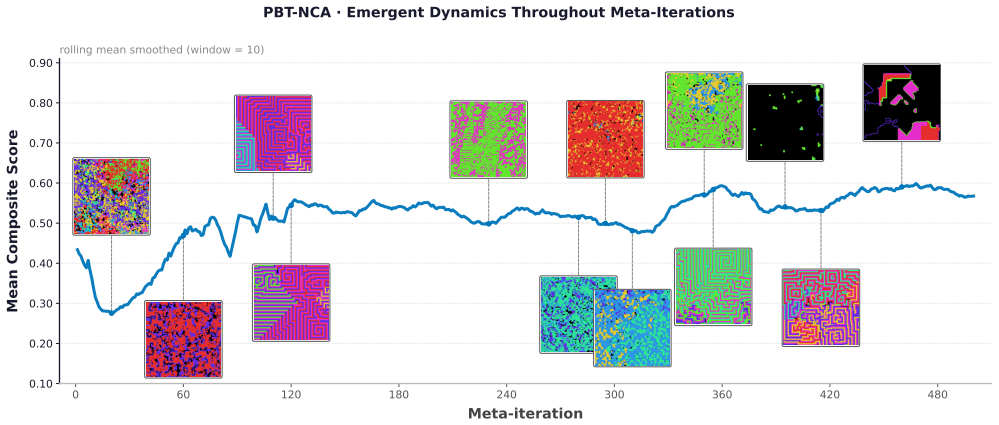
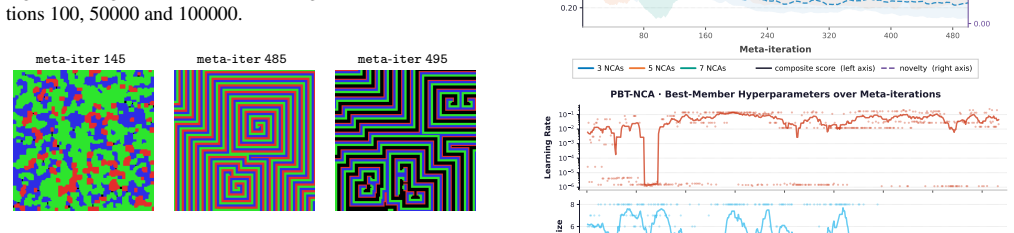
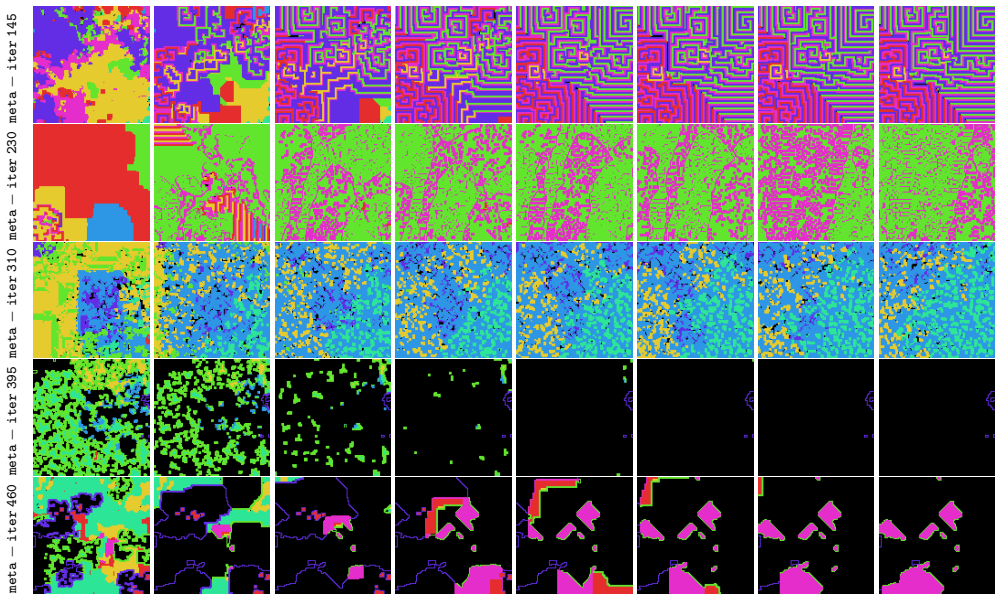
PBT-NCA evolves a population of PD-NCAs subject to a composite objective that rewards both historical behavioral novelty and contemporary visual diversity. By actively penalizing monocultures and dead states, the method drives the substrate to spontaneously generate emergent lifelike phenomena over extended horizons. These include highly regular coordinated periodic waves, spore-like scattering in which homogeneous groups eject cell-like clusters to colonize distant territories, and fluid shape-shifting macro-structures that migrate while maintaining stable outer boundaries enclosing highly active interiors. The system sustains effective complexity that is neither globally ordered nor random
What carries the argument
PBT-NCA, the population-based training algorithm applied to Petri Dish Neural Cellular Automata that uses a composite fitness function combining historical novelty, visual diversity, and penalties against uniform or extinct states to drive open-ended self-organization.
If this is right
- The substrate autonomously discovers diverse morphological survival and self-organization strategies.
- Coordinated periodic waves, spore-like scattering for colonization, and migrating shape-shifting structures emerge and persist.
- Effective complexity is sustained in a state neither globally ordered nor globally random.
- Multiple distinct behaviors coexist without one dominating the entire population.
Where Pith is reading between the lines
- Similar evolutionary pressures could be tested on other differentiable multi-agent systems to check if open-endedness generalizes beyond this substrate.
- The observed morphological strategies might serve as concrete targets for measuring progress toward open-ended artificial life.
- Varying the relative weights of novelty versus diversity in the objective could reveal thresholds needed to keep dynamics at the edge of chaos.
Load-bearing premise
That a composite objective rewarding historical behavioral novelty and contemporary visual diversity, together with active penalization of monocultures and dead states, will reliably sustain effective complexity without the evolutionary process discovering loopholes that produce superficially diverse but ultimately uninteresting or unstable dynamics.
What would settle it
Long-term runs of PBT-NCA that show whether populations maintain high behavioral and visual diversity with ongoing lifelike dynamics or instead converge to repetitive frozen patterns, unstructured noise, or extinction despite the penalties.
Figures






read the original abstract
The generation of sustained, open-ended complexity from local interactions remains a fundamental challenge in artificial life. Differentiable multi-agent systems, such as Petri Dish Neural Cellular Automata (PD-NCA), exhibit rich self-organization driven purely by spatial competition; however, they are highly sensitive to hyperparameters and frequently collapse into uninteresting patterns and dynamics, such as frozen equilibria or structureless noise. In this paper, we introduce PBT-NCA, a meta-evolutionary algorithm that evolves a population of PD-NCAs subject to a composite objective that rewards both historical behavioral novelty and contemporary visual diversity. Driven by this continuous evolutionary pressure, PBT-NCA spontaneously generates a plethora of emergent lifelike phenomena over extended horizons-a hallmark of true open-endedness. Strikingly, the substrate autonomously discovers diverse morphological survival and self-organization strategies. We observe highly regular, coordinated periodic waves; spore-like scattering where homogeneous groups eject cell-like clusters to colonize distant territories; and fluid, shape-shifting macro-structures that migrate across the substrate, maintaining stable outer boundaries that enclose highly active interiors. By actively penalizing monocultures and dead states, PBT-NCA sustains a state of effective complexity that is neither globally ordered nor globally random, operating persistently at the "edge of chaos".
Editorial analysis
A structured set of objections, weighed in public.
Referee Report
Summary. The manuscript presents PBT-NCA, a meta-evolutionary algorithm that evolves populations of Petri Dish Neural Cellular Automata (PD-NCA) using a composite objective rewarding historical behavioral novelty and contemporary visual diversity, along with penalties for monocultures and dead states. It reports that this leads to the autonomous discovery of diverse emergent phenomena including regular periodic waves, spore-like scattering for colonization, and fluid migrating macro-structures, which are presented as evidence of open-ended complexity sustained at the edge of chaos.
Significance. If the reported phenomena can be quantitatively validated, the work would be significant for the field of artificial life and evolutionary computation. It offers a practical method to overcome the hyperparameter sensitivity and collapse issues in PD-NCA by leveraging population-based training, potentially enabling more robust open-ended evolutionary systems. The empirical demonstration of self-discovered survival strategies adds to the literature on emergent complexity from local rules.
major comments (2)
- [Results] The central claims of open-ended discovery and persistent lifelike phenomena (e.g., waves, scattering, migrating structures) are supported only by qualitative observations and example images. No quantitative metrics, statistical tests, ablation studies, or controls (such as diversity measures over generations or comparisons to non-PBT baselines) are reported, which is necessary to distinguish sustained open-endedness from transient diversity.
- [Methods] The exact definition and implementation of the composite objective, including how historical behavioral novelty is measured and archived, the weights for each component, and the precise penalization of monocultures and dead states, are not provided in sufficient detail. This omission is load-bearing because it prevents assessment of whether the evolutionary process could exploit loopholes to produce superficially diverse but uninteresting dynamics.
minor comments (1)
- [Abstract] The abstract refers to 'extended horizons' without specifying the simulation timescales or number of evolutionary generations involved in the observations.
Simulated Author's Rebuttal
We thank the referee for their constructive feedback and for acknowledging the potential significance of PBT-NCA for open-ended evolution. We address each major comment point by point below and have revised the manuscript to strengthen the presentation of results and methods.
read point-by-point responses
-
Referee: [Results] The central claims of open-ended discovery and persistent lifelike phenomena (e.g., waves, scattering, migrating structures) are supported only by qualitative observations and example images. No quantitative metrics, statistical tests, ablation studies, or controls (such as diversity measures over generations or comparisons to non-PBT baselines) are reported, which is necessary to distinguish sustained open-endedness from transient diversity.
Authors: We agree that quantitative support strengthens claims of sustained open-endedness. The original manuscript prioritized qualitative demonstration of autonomously discovered strategies (periodic waves, spore scattering, migrating macro-structures) as direct evidence of open-ended discovery from local rules. In the revised version we have added quantitative metrics: time-series plots of population-level behavioral diversity and novelty scores across generations, direct comparisons to non-PBT PD-NCA baselines showing faster collapse to low-complexity states, ablation studies removing individual objective components, and statistical summaries (means and variance) of persistence metrics over 10 independent runs. These additions appear in a new Results subsection and supplementary figures. revision: yes
-
Referee: [Methods] The exact definition and implementation of the composite objective, including how historical behavioral novelty is measured and archived, the weights for each component, and the precise penalization of monocultures and dead states, are not provided in sufficient detail. This omission is load-bearing because it prevents assessment of whether the evolutionary process could exploit loopholes to produce superficially diverse but uninteresting dynamics.
Authors: We have expanded the Methods section with the requested implementation details. The revised text now includes the precise formulation of the composite objective (weighted sum of historical novelty via a fixed-size archive of behavior embeddings, contemporary visual diversity via average pairwise latent-space distances, and explicit penalties for monoculture homogeneity and dead-state quiescence), the exact weights used, the archiving mechanism (periodic sampling and embedding of population states), and pseudocode for the full PBT-NCA loop. These clarifications allow direct evaluation of potential loopholes and ensure reproducibility. revision: yes
Circularity Check
No significant circularity: empirical outcomes of defined evolutionary pressure
full rationale
The paper introduces PBT-NCA as a meta-evolutionary algorithm whose composite objective explicitly rewards behavioral novelty, visual diversity, and penalizes monocultures/dead states. All reported phenomena (periodic waves, spore-like scattering, shape-shifting structures) are presented as observed empirical results of running this system over extended horizons, not as quantities derived by construction from the objective or from prior self-citations. No equations, uniqueness theorems, or fitted-parameter predictions appear in the abstract or described approach that would reduce the central claim to its inputs. The derivation chain is therefore self-contained as an experimental demonstration rather than a deductive or definitional loop.
Axiom & Free-Parameter Ledger
free parameters (1)
- weights in composite novelty-diversity objective
axioms (1)
- domain assumption Penalizing monocultures and dead states combined with novelty rewards will sustain persistent complexity at the edge of chaos
Reference graph
Works this paper leans on
-
[1]
Andrychowicz, M., Denil, M., Colmenarejo, S. G., Hoffman, M. W., Pfau, D., Schaul, T., Shillingford, B., and de Freitas, N. (2016). Learning to learn by gradient descent by gradient descent. In Proceedings of the 30th International Conference on Neural In- formation Processing Systems, NeurIPS’16, page 3988–3996, Red Hook, NY , USA. Curran Associates Inc....
work page 2016
-
[2]
MIT Press One Rogers Street, Cambridge, MA 02142-1209, USA journals-info . . . . Baym, M., Lieberman, T. D., Kelsic, E. D., Chait, R., Gross, R., Yelin, I., and Kishony, R. (2016). Spatiotemporal microbial evolution on antibiotic landscapes.Science, 353(6304):1147–
work page 2016
-
[3]
Bedau, M. A. (1996). Measurement of evolutionary activity, teleol- ogy, and life. Berto, F. and Tagliabue, J. (2012). Cellular automata.Stanford Encyclopedia of Philosophy. Bruce, J., Dennis, M., Edwards, A., Parker-Holder, J., Shi, Y ., Hughes, E., Lai, M., Mavalankar, A., Steigerwald, R., Apps, C., et al. (2024). Genie: Generative interactive environmen...
-
[4]
Chan, B. W.-C. (2020). Lenia and expanded universe.Artificial Life, ALIFE 2020: The 2020 Conference on Artificial Life:221–
work page 2020
-
[5]
Chan, B. W.-C. (2023). Towards large-scale simulations of open- ended evolution in continuous cellular automata. InProceed- ings of the Companion Conference on Genetic and Evolution- ary Computation, GECCO ’23 Companion, page 127–130, New York, NY , USA. Association for Computing Machinery. Chen, T., Chen, X., Chen, W., Wang, Z., Heaton, H., Liu, J., and ...
-
[6]
Wang, R., Lehman, J., Clune, J., and Stanley, K. O. (2019). Paired open-ended trailblazer (poet): Evolvable evolutionary chal- lenges and their solutions through a generative environment model. InProceedings of the Genetic and Evolutionary Com- putation Conference, pages 142–151. White, C., Safari, M., Sukthanker, R. S., Ru, B., Elsken, T., Zela, A., Dey,...
discussion (0)
Sign in with ORCID, Apple, or X to comment. Anyone can read and Pith papers without signing in.