REVIEW 2 major objections 2 minor 106 references
Investigating the Effects of Different Levels of User Control in an Interactive Educational Recommender System
T0 review · 2 major / 2 minor · reviewed 2026-05-09 · grok-4.3
Pith's one-line read Enabling users to build and refine their profiles in an educational recommender system is sufficient to promote positive perceptions of control, transparency, trust, satisfaction, and quality.
desk verdict Profile control alone drives most of the perception gains here, but one-shot self-reports after a scripted task limit how much we can trust the real-world claims. read the letter →
The pith
A machine-rendered reading of the paper's core claim, the machinery that carries it, and where it could break.
The reading
What carries the argument
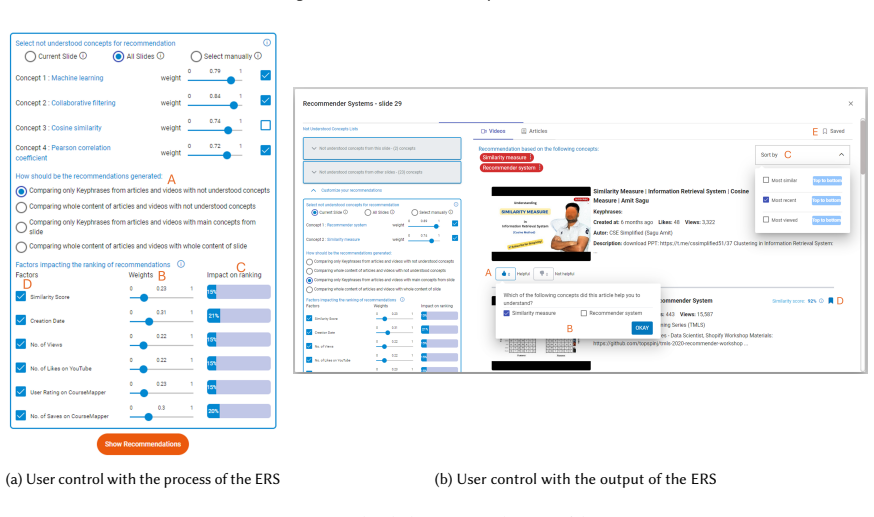
The staged control options over input (user profile construction), process (recommendation algorithm), and output (displayed recommendations).
What would settle it
A follow-up study that finds no difference in actual engagement or satisfaction between users limited to profile control and users given full control over multiple weeks of real course activity would undermine the claim that input control alone is sufficient.
Extended reading notes
Core claim
The work shows that in an interactive educational recommender system, allowing users to build and refine their profiles is sufficient to generate positive perceptions of the recommendation goals, while providing additional control over the algorithm and recommendations mainly reinforces those impressions. Perceived control is the only goal significantly affected by the different levels of control, and input control produces the strongest effect on it. The levels of control influence transparency, trust, satisfaction, and perceived quality in distinct yet interconnected patterns, and user control in general positively shapes these perceptions to varying degrees.
Load-bearing premise
Self-reported perceptions collected in a short-term between-subjects experiment reflect the real effects of control levels during extended everyday use across different educational platforms.
Editorial extensions
If this is right
- Input control alone promotes positive perceptions of the educational recommender system.
- Additional process and output controls mainly reinforce existing positive impressions rather than creating substantial new effects.
- Perceived control is the only recommendation goal significantly affected by control levels, with input control exerting the strongest influence.
- Different control levels affect transparency, trust, satisfaction, and perceived quality in distinct but interconnected ways.
- User control overall positively shapes transparency, trust, satisfaction, and perceived quality, though to varying extents.
Reading between the lines
- Interface designers could prioritize simple profile-editing features over complex algorithm controls to achieve most perception benefits.
- The observed perception gains might support higher completion rates in online courses if profile control reduces the time users spend searching for suitable materials.
- Similar control patterns could be tested in non-educational recommender systems to check whether input control remains the dominant stage.
- Longer deployments might reveal whether the reinforced impressions translate into sustained use or measurable learning improvements.
Signed reviews
Editorial analysis
A structured set of objections, weighed in public.
Referee Report
Summary. The paper reports a between-subjects user study (N=184) on an interactive educational recommender system (ERS) embedded in the CourseMapper MOOC platform. Participants received varying levels of control over the input (user profile construction and refinement), process (recommendation algorithm), and output (recommendations). The central claims are that input control alone is sufficient to produce positive perceptions of the ERS, that additional process and output controls mainly reinforce those impressions, that perceived control is the only recommendation goal showing statistically significant differences across conditions (with input control exerting the strongest influence), and that the other goals (transparency, trust, satisfaction, perceived quality) are affected in distinct but interconnected ways.
Significance. If the results hold under stronger validation, the work supplies actionable design guidance for ERSs by indicating that profile-building controls can deliver most of the perceptual benefits without the overhead of full algorithmic or output control. This could simplify interfaces in educational settings while still supporting transparency, trust, and satisfaction. The study is strengthened by its use of a deployed platform and a reasonably powered sample; it adds empirical data to the HCI/recommender-systems literature on control granularity in learning contexts.
major comments (2)
- [User Study and Results] The headline claim that input control is 'sufficient to promote positive perceptions' (abstract and results) rests exclusively on immediate post-task self-reported Likert ratings collected after a single scripted interaction. No behavioral logs (profile-edit counts retained, recommendation acceptance rates, click-through data) or longitudinal follow-up are reported, leaving open whether the sufficiency finding generalizes beyond lab demand characteristics or novelty effects.
- [Results and Discussion] The assertion that 'perceived control is the only goal significantly affected' and that 'input control exert[s] the strongest influence' requires full statistical reporting (exact p-values, effect sizes, power analysis, and multiple-comparison corrections) to be load-bearing; the abstract supplies none, and the between-subjects design leaves prior MOOC experience unaccounted for as a potential confound on the transparency/trust/satisfaction scales.
minor comments (2)
- The abstract should include at least the key statistical outcomes (p-values, effect sizes) that support the significance claims.
- [Methodology] Clarify the exact operationalization of the three control levels (e.g., which UI elements were enabled/disabled in each condition) and how the between-subjects assignment was randomized.
Simulated Author's Rebuttal
We thank the referee for their constructive and detailed feedback on our manuscript. We address each major comment below, indicating where revisions will be made to strengthen the paper while maintaining the integrity of our study design and findings.
read point-by-point responses
-
Referee: [User Study and Results] The headline claim that input control is 'sufficient to promote positive perceptions' (abstract and results) rests exclusively on immediate post-task self-reported Likert ratings collected after a single scripted interaction. No behavioral logs (profile-edit counts retained, recommendation acceptance rates, click-through data) or longitudinal follow-up are reported, leaving open whether the sufficiency finding generalizes beyond lab demand characteristics or novelty effects.
Authors: We acknowledge that the study relies on immediate post-interaction self-reported Likert ratings without accompanying behavioral logs or longitudinal data. This design was chosen to isolate perceptual effects in a controlled between-subjects setup, consistent with common HCI evaluation practices for recommender systems. We agree that behavioral metrics and follow-up measures would provide additional robustness. In the revised manuscript, we will expand the limitations and future work sections to explicitly discuss the absence of behavioral data, potential novelty or demand effects, and the need for longitudinal validation. We will also moderate phrasing in the abstract and results to avoid overgeneralization while preserving the core contribution of the perceptual findings. revision: partial
-
Referee: [Results and Discussion] The assertion that 'perceived control is the only goal significantly affected' and that 'input control exert[s] the strongest influence' requires full statistical reporting (exact p-values, effect sizes, power analysis, and multiple-comparison corrections) to be load-bearing; the abstract supplies none, and the between-subjects design leaves prior MOOC experience unaccounted for as a potential confound on the transparency/trust/satisfaction scales.
Authors: We appreciate the call for complete statistical transparency. The revised manuscript will include exact p-values, effect sizes, a post-hoc power analysis, and details on multiple-comparison corrections. The abstract will be updated to summarize these statistics. On the potential confound of prior MOOC experience, we will report the distribution across conditions and, where relevant, include it as a covariate or discuss it explicitly as a limitation. Our randomization procedure aimed to balance such factors, but we will add this analysis to address the concern directly. revision: yes
Circularity Check
No circularity: purely empirical between-subjects study
full rationale
The paper presents results from a controlled user study (N=184) comparing three levels of user control in an ERS via post-task Likert-scale questionnaires. No equations, model fits, predictions, or derivations appear anywhere in the manuscript. Central claims (e.g., input control suffices for positive perceptions; only perceived control shows significant differences) are obtained directly from statistical tests on the collected survey responses. No self-citations are invoked as load-bearing uniqueness theorems or ansatzes; prior work is cited only for background on recommender systems and user control. The derivation chain is therefore self-contained and non-circular.
Assumptions & free parameters
assumptions (1)
- domain assumption Self-reported Likert-scale measures validly capture users' perceptions of control, transparency, trust, satisfaction, and quality
Cite this review
Pith. "Pith review of Investigating the Effects of Different Levels of User Control in an Interactive Educational Recommender System." pith.science (2026). https://pith.science/paper/2605.01400
@misc{pith2026260501400,
  author       = {Pith},
  title        = {Pith review of: Investigating the Effects of Different Levels of User Control in an Interactive Educational Recommender System},
  year         = {2026},
  howpublished = {\url{https://pith.science/paper/2605.01400}},
  note         = {Machine review of arXiv:2605.01400}
}
read the original abstract
Educational recommender systems (ERSs) are becoming increasingly important in enhancing educational outcomes and personalizing learning experiences by providing recommendations of personalized resources and activities to learners, tailored to their individual learning needs. While user control is widely assumed to improve user experience, the effects of different levels of control in ERSs remain underexplored. To address this gap, we designed and evaluated an interactive ERS within the MOOC platform CourseMapper, where learners could interact with the input (i.e., user profile), process (i.e., recommendation algorithm), and output (i.e., recommendations) of the system. We conducted a between-subjects user study (N=184) to examine how varying levels of user control in an ERS influenced users' perceptions of the recommendation goals of perceived control, transparency, trust, satisfaction, and perceived quality. Our results show that enabling users to build and refine their profile is sufficient to promote positive perceptions of the ERS, while additional control options mainly reinforce these impressions. Moreover, perceived control is the only goal significantly affected by providing different levels of user control in the ERS, with input control exerting the strongest influence. Furthermore, different levels of control affect transparency, trust, satisfaction, and perceived quality in distinct yet interconnected ways. Overall, the findings provide empirical evidence that user control positively shapes transparency, trust, satisfaction, and perceived quality, though to varying extents.
Figures


Figures from the paper (6 more)



Reference graph
Works this paper leans on
-
[1]
Solmaz Abdi, Hassan Khosravi, Shazia Sadiq, and Dragan Gasevic. 2020. Complementing educational recommender systems with open learner models. InProceedings of the tenth international conference on learning analytics & knowledge. 360–365
work page 2020
-
[2]
Sunita B Aher and LMRJ Lobo. 2013. Combination of machine learning algorithms for recommendation of courses in E-Learning System based on historical data.Knowledge-Based Systems51 (2013), 1–14
work page 2013
- [3]
-
[4]
Qurat Ul Ain, Mohamed Amine Chatti, Komlan Gluck Charles Bakar, Shoeb Joarder, and Rawaa Alatrash. 2023. Automatic Construction of Educational Knowledge Graphs: A Word Embedding-Based Approach.Information14, 10 (2023). https://doi.org/10.3390/info14100526
-
[5]
Qurat Ul Ain, Mohamed Amine Chatti, Shoeb Joarder, Ilia Nassif, Benjamine Stella Wobiwo Teda, Mouadh Guesmi, and Rawaa Alatrash. 2023. Learning Channels to Support Interaction and Collaboration in CourseMapper. InProceedings of the 14th International Conference on Education Technology and Computers(Barcelona, Spain)(ICETC ’22)
work page 2023
-
[6]
Qurat Ul Ain, Mohamed Amine Chatti, Paul Arthur Meteng Kamdem, Rawaa Alatrash, Shoeb Joarder, and Clara Siepmann. 2024. Learner Modeling and Recommendation of Learning Resources using Personal Knowledge Graphs. InProceedings of the 14th Learning Analytics and Knowledge Conference. 273–283
work page 2024
- [7]
-
[8]
Rawaa Alatrash, Mohamed Amine Chatti, Qurat Ul Ain, Yipeng Fang, Shoeb Joarder, and Clara Siepmann. 2024. ConceptGCN: Knowledge concept recommendation in MOOCs based on knowledge graph convolutional networks and SBERT.Computers and Education: Artificial Intelligence6 (2024), 100193
work page 2024
Show all 106 references
-
[9]
Houssam El Aouifi, Mohamed El Hajji, Youssef Es-Saady, and Hassan Douzi. 2024. Video-Based Learning Recommender Systems: A Systematic Literature Review.IEEE Transactions on Learning Technologies17 (2024), 485–497. https://doi.org/10.1109/TLT.2023.3313391
2024 doi
-
[10]
Krisztian Balog and Filip Radlinski. 2020. Measuring recommendation explanation quality: The conflicting goals of explanations. InProceedings of the 43rd international ACM SIGIR conference on research and development in information retrieval. 329–338. Manuscript submitted to A...
2020
-
[11]
Jordan Barria-Pineda and Peter Brusilovsky. 2019. Explaining educational recommendations through a concept-level knowledge visualization. In Companion Proceedings of the 24th International Conference on Intelligent User Interfaces
2019
-
[12]
Peter M Bentler and Douglas G Bonett. 1980. Significance tests and goodness of fit in the analysis of covariance structures.Psychological bulletin 88, 3 (1980), 588
1980
-
[13]
Svetlin Bostandjiev, John O’Donovan, and Tobias Höllerer. 2012. TasteWeights: a visual interactive hybrid recommender system. InProceedings of the 6th ACM Conference on Recommender Systems. Association for Computing Machinery, New York, USA
2012
-
[14]
Svetlin Bostandjiev, John O’Donovan, and Tobias Höllerer. 2013. LinkedVis: Exploring social and semantic career recommendations.International Conference on Intelligent User Interfaces, Proceedings IUI, 107–116. https://doi.org/10.1145/2449396.2449412
2013 doi
-
[15]
Fatiha Bousbahi and Henda Chorfi. 2015. MOOC-Rec: A Case Based Recommender System for MOOCs.Procedia - Social and Behavioral Sciences 195 (2015), 1813–1822. World Conference on Technology, Innovation and Entrepreneurship
2015
-
[16]
Virginia Braun and Victoria Clarke. 2006. Using thematic analysis in psychology.Qualitative research in psychology3, 2 (2006), 77–101
2006
-
[17]
Simon Bruns, André Calero Valdez, Christoph Greven, Martina Ziefle, and Ulrik Schroeder. 2015. What should i read next? a personalized visual publication recommender system. InInternational Conference on Human Interface and the Management of Information. Springer, 89–100
2015
-
[18]
Maritza Bustos López, Giner Alor-Hernández, José Luis Sánchez-Cervantes, Mario Andrés Paredes-Valverde, and María del Pilar Salas-Zárate. 2020. EduRecomSys: an educational resource recommender system based on collaborative filtering and emotion detection.Interacting with Compu...
2020
-
[19]
1994.Structural equation modeling with EQS and EQS/Windows: Basic concepts, applications, and programming
Barbara M Byrne. 1994.Structural equation modeling with EQS and EQS/Windows: Basic concepts, applications, and programming. Sage
1994
-
[20]
Mohamed Amine Chatti, Mouadh Guesmi, and Arham Muslim. 2024. Visualization for recommendation explainability: a survey and new perspectives.ACM Transactions on Interactive Intelligent Systems14, 3 (2024), 1–40
2024
-
[21]
Mohamed Amine Chatti, Mouadh Guesmi, Laura Vorgerd, Thao Ngo, Shoeb Joarder, Qurat Ul Ain, and Arham Muslim. 2022. Is more always better? The effects of personal characteristics and level of detail on the perception of explanations in a recommender system. InProceedings of the...
2022
-
[22]
Hung Chau, Jordan Barria-Pineda, and Peter Brusilovsky. 2018. Learning content recommender system for instructors of programming courses. In Artificial Intelligence in Education: 19th International Conference, AIED 2018, London, UK, June 27–30, 2018, Proceedings, Part II 19. S...
2018
-
[23]
Yu Chen and Pearl Pu. 2012. CoFeel: Using emotions for social interaction in group recommender systems. (2012)
2012
-
[24]
2013.Statistical power analysis for the behavioral sciences
Jacob Cohen. 2013.Statistical power analysis for the behavioral sciences. routledge
2013
-
[25]
2013.Applied multiple regression/correlation analysis for the behavioral sciences
Jacob Cohen, Patricia Cohen, Stephen G West, and Leona S Aiken. 2013.Applied multiple regression/correlation analysis for the behavioral sciences. Routledge
2013
-
[26]
Felipe Leite da Silva, Bruna Kin Slodkowski, Ketia Kellen Araújo da Silva, and Sílvio César Cazella. 2023. A systematic literature review on educational recommender systems for teaching and learning: research trends, limitations and opportunities.Education and Information Tech...
2023
-
[27]
Hendrik Drachsler, Katrien Verbert, Olga C Santos, and Nikos Manouselis. 2015. Panorama of recommender systems to support learning. In Recommender systems handbook. Springer, 421–451
2015
-
[28]
Ekstrand, Daniel Kluver, F
Michael D. Ekstrand, Daniel Kluver, F. Maxwell Harper, and Joseph A. Konstan. 2015. Letting Users Choose Recommender Algorithms: An Experimental Study.Proceedings of the 9th ACM Conference on Recommender Systems(2015)
2015
-
[29]
Rosta Farzan and Peter Brusilovsky. 2011. Encouraging user participation in a course recommender system: An impact on user behavior.Computers in Human Behavior27, 1 (2011), 276–284
2011
-
[30]
Eleni Fotopoulou, Anastasios Zafeiropoulos, Michalis Feidakis, Dimitrios Metafas, and Symeon Papavassiliou. 2020. An interactive recommender system based on reinforcement learning for improving emotional competences in educational groups. InInternational Conference on Intellig...
2020
-
[31]
Daniel Gallego, Enrique Barra, Aldo Gordillo, and Gabriel Huecas. 2013. Enhanced recommendations for e-Learning authoring tools based on a proactive context-aware recommender. In2013 IEEE frontiers in education conference (FIE). IEEE, 1393–1395
2013
-
[32]
Enrique García, Cristóbal Romero, Sebastián Ventura, and Carlos de Castro. 2009. An architecture for making recommendations to courseware authors using association rule mining and collaborative filtering.User Modeling and User-Adapted Interaction19, 1 (2009), 99–132
2009
-
[33]
Fatih Gedikli, Dietmar Jannach, and Mouzhi Ge. 2014. How should I explain? A comparison of different explanation types for recommender systems.International Journal of Human-Computer Studies72, 4 (2014), 367–382
2014
-
[34]
David Graus, Maya Sappelli, and D Manh Chu. 2018. Let me tell you who you are. InExplaining recommender systems by opening black box user profiles. In Proceedings of the 2nd Fatrec Workshop on Responsible Recommendation, Vancouver, BC, Canada. 2–7
2018
-
[35]
Brynjar Gretarsson, John O’Donovan, Svetlin Bostandjiev, Christopher Hall, and Tobias Höllerer. 2010. SmallWorlds: Visualizing Social Recommen- dations.Computer Graphics Forum29, 3 (2010), 833–842
2010
-
[36]
Mouadh Guesmi, Mohamed Amine Chatti, Shoeb Joarder, Qurat Ul Ain, Rawaa Alatrash, Clara Siepmann, and Tannaz Vahidi. 2023. Interactive explanation with varying level of details in an explainable scientific literature recommender system.International Journal of Human–Computer I...
2023
-
[37]
Mouadh Guesmi, Mohamed Amine Chatti, Shoeb Joarder, Qurat Ul Ain, Clara Siepmann, Hoda Ghanbarzadeh, and Rawaa Alatrash. 2023. Justification vs. transparency: Why and how visual explanations in a scientific literature recommender system.Information14, 7 (2023), 401. Manuscript...
2023
-
[38]
Jaron Harambam, Dimitrios Bountouridis, Mykola Makhortykh, and Joris van Hoboken. 2019. Designing for the better by taking users into account: a qualitative evaluation of user control mechanisms in (news) recommender systems. InProceedings of 13th ACM Conference on Recommender...
2019
-
[39]
Maxwell Harper, Funing Xu, Harmanpreet Kaur, Kyle Condiff, Shuo Chang, and Loren Terveen
F. Maxwell Harper, Funing Xu, Harmanpreet Kaur, Kyle Condiff, Shuo Chang, and Loren Terveen. 2015. Putting Users in Control of their Recommendations. InProceedings of the 9th ACM Conference on Recommender Systems(Vienna, Austria)(RecSys ’15). Association for Computing Machiner...
2015
-
[40]
Chen He, Denis Parra, and Katrien Verbert. 2016. Interactive recommender systems: A survey of the state of the art and future research challenges and opportunities.Expert Systems with Applications56 (2016), 9–27
2016
-
[41]
Marco Hellmann, Diana C Hernandez-Bocanegra, and Jürgen Ziegler. 2022. Development of an instrument for measuring users’ perception of transparency in recommender systems.system12 (2022), 7
2022
-
[42]
Dietmar Jannach, Michael Jugovac, and Ingrid Nunes. 2019. Explanations and user control in recommender systems. InProceedings of the 23rd International Workshop on Personalization and Recommendation on the Web and Beyond. 31–31
2019
-
[43]
Dietmar Jannach, Sidra Naveed, and Michael Jugovac. 2017. User control in recommender systems: Overview and interaction challenges. In E-Commerce and Web Technologies: 17th International Conference, EC-Web 2016, Porto, Portugal, September 5-8, 2016, Revised Selected Papers 17....
2017
-
[44]
Yucheng Jin, Bruno De Lemos Ribeiro Pinto Cardoso, and Katrien Verbert. 2017. How do different levels of user control affect cognitive load and acceptance of recommendations?. InIntRS@ RecSys. 35–42
2017
-
[45]
Yucheng Jin, Karsten Seipp, Erik Duval, and Katrien Verbert. 2016. Go with the flow: effects of transparency and user control on targeted advertising using flow charts. InProceedings of the international working conference on advanced visual interfaces. 68–75
2016
-
[46]
Yucheng Jin, Nava Tintarev, and Katrien Verbert. 2018. Effects of personal characteristics on music recommender systems with different levels of controllability. InProceedings of the 12th ACM Conference on Recommender Systems. 13–21
2018
-
[47]
Michael Jugovac and Dietmar Jannach. 2017. Interacting with recommenders—overview and research directions.ACM Transactions on Interactive Intelligent Systems (TiiS)7, 3 (2017), 1–46
2017
-
[48]
Seungwon Jung, Minjae Son, Chung-il Kim, Jehyeok Rew, and Eenjun Hwang. 2019. Video-based learning assistant scheme for sustainable education.New Review of Hypermedia and Multimedia25, 3 (2019), 161–181
2019
-
[49]
Antti Kangasrääsiö, Dorota Glowacka, and Samuel Kaski. 2015. Improving Controllability and Predictability of Interactive Recommendation Interfaces for Exploratory Search. InProceedings of the 20th International Conference on Intelligent User Interfaces (IUI ’15)
2015
-
[50]
Kenny, Burak Kaniskan, and D
David A. Kenny, Burak Kaniskan, and D. Betsy McCoach. 2015. The Performance of RMSEA in Models with Small Degrees of Freedom.Sociological Methods & Research44, 3 (2015), 486–507. https://doi.org/10.1177/0049124114543236
2015 doi
-
[51]
Shristi Shakya Khanal, PWC Prasad, Abeer Alsadoon, and Angelika Maag. 2020. A systematic review: machine learning based recommendation systems for e-learning.Education and Information Technologies(2020)
2020
-
[52]
René F Kizilcec. 2016. How much information? Effects of transparency on trust in an algorithmic interface. InProceedings of the 2016 CHI conference on human factors in computing systems. 2390–2395
2016
-
[53]
Rex B. Kline. 2016.Principles and Practice of Structural Equation Modeling(4 ed.). The Guilford Press, New York
2016
-
[54]
Bart P Knijnenburg, Svetlin Bostandjiev, John O’Donovan, and Alfred Kobsa. 2012. Inspectability and control in social recommenders. InProceedings of the sixth ACM conference on Recommender systems
2012
-
[55]
Bart P Knijnenburg, Nikhil Rao, and Alfred Kobsa. 2012. Experimental materials used in the study on inspectability and control in social recommender systems.Institute for Software Research, University of California, Irvine(2012)
2012
-
[56]
Bart P Knijnenburg, Niels JM Reijmer, and Martijn C Willemsen. 2011. Each to his own: how different users call for different interaction methods in recommender systems. InProceedings of the fifth ACM conference on Recommender systems. 141–148
2011
-
[57]
Bart P Knijnenburg, Martijn C Willemsen, Zeno Gantner, Handan Soncu, and Chris Newell. 2012. Explaining the user experience of recommender systems. InProceedings of the 10th ACM conference on Recommender systems. ACM, 287–290
2012
-
[58]
2007.Einführung in die computergestützte Analyse qualitativer Daten
Udo Kuckartz. 2007.Einführung in die computergestützte Analyse qualitativer Daten. Springer
2007
-
[59]
Todd Kulesza, Margaret Burnett, Weng-Keen Wong, and Simone Stumpf. 2015. Principles of explanatory debugging to personalize interactive machine learning. InProceedings of the 20th international conference on intelligent user interfaces. 126–137
2015
-
[60]
Todd Kulesza, Simone Stumpf, Margaret Burnett, Sherry Yang, Irene Kwan, and Weng-Keen Wong. 2013. Too much, too little, or just right? Ways explanations impact end users’ mental models. In2013 IEEE Symposium on Visual Languages and Human-Centric Computing (VL/HCC). IEEE, San J...
2013 doi
-
[61]
Johannes Kunkel, Tim Donkers, Lisa Michael, Catalin-Mihai Barbu, and Jürgen Ziegler. 2019. Let me explain: Impact of personal and impersonal explanations on trust in recommender systems. InProceedings of the 2019 CHI conference on human factors in computing systems. 1–12
2019
-
[62]
Dominik J Leiner. 2025. SoSci Survey (version 3.7.06)[computer software].München: SoSci Survey GmbH(2025)
2025
-
[63]
Q Vera Liao and S Shyam Sundar. 2022. Designing for responsible trust in AI systems: A communication perspective. InProceedings of the 2022 ACM conference on fairness, accountability, and transparency. 1257–1268
2022
-
[64]
Benedikt Loepp, Tim Hussein, and Jüergen Ziegler. 2014. Choice-based preference elicitation for collaborative filtering recommender systems. In Proceedings of the SIGCHI Conference on Human Factors in Computing Systems. 3085–3094. Manuscript submitted to ACM 40 Ain et al
2014
-
[65]
Nikos Manouselis, Hendrik Drachsler, Riina Vuorikari, Hans Hummel, and Rob Koper. 2011. Recommender systems in technology enhanced learning.Recommender systems handbook(2011), 387–415
2011
-
[66]
D Harrison McKnight, Vivek Choudhury, and Charles Kacmar. 2002. Developing and validating trust measures for e-commerce: An integrative typology.Information systems research13, 3 (2002), 334–359
2002
-
[67]
Harrison McKnight, Michelle Carter, and Paul Clay. 2009. Trust in technology: Development of a set of constructs and measures. (2009)
2009
-
[68]
Pavel Michlík and Mária Bieliková. 2010. Exercises recommending for limited time learning.Procedia Computer Science1, 2 (2010), 2821–2828
2010
-
[69]
Tim Miller. 2022. Are we measuring trust correctly in explainability, interpretability, and transparency research?arXiv preprint arXiv:2209.00651 (2022)
2022
-
[70]
Thao Ngo, Johannes Kunkel, and Jürgen Ziegler. 2020. Exploring mental models for transparent and controllable recommender systems: a qualitative study. InProceedings of the 28th ACM Conference on User Modeling, Adaptation and Personalization. 183–191
2020
-
[71]
Ingrid Nunes and Dietmar Jannach. 2017. A systematic review and taxonomy of explanations in decision support and recommender systems.User Modeling and User-Adapted Interaction27, 3 (2017), 393–444
2017
-
[72]
John O’Donovan, Barry Smyth, Brynjar Gretarsson, Svetlin Bostandjiev, and Tobias Höllerer. 2008. PeerChooser: visual interactive recommendation. InProceedings of the SIGCHI Conference on Human Factors in Computing Systems(Florence, Italy)(CHI ’08). Association for Computing Ma...
2008
-
[73]
Jeroen Ooge, Leen Dereu, and Katrien Verbert. 2023. Steering Recommendations and Visualising Its Impact: Effects on Adolescents’ Trust in E-Learning Platforms. InProceedings of the 28th International Conference on Intelligent User Interfaces(Sydney, NSW, Australia)(IUI ’23). 156–170
2023
-
[74]
Denis Parra and Peter Brusilovsky. 2015. User-controllable personalization: A case study with SetFusion.International Journal of Human-Computer Studies78 (2015), 43–67
2015
-
[75]
Denis Parra, Peter Brusilovsky, and Christoph Trattner. 2014. See what you want to see: visual user-driven approach for hybrid recommendation. InProceedings of the 19th International Conference on Intelligent User Interfaces(Haifa, Israel)(IUI ’14). Association for Computing M...
2014
-
[76]
Prolific Academic Ltd. 2025. Prolific. https://www.prolific.com
2025
-
[77]
Pearl Pu, Li Chen, and Rong Hu. 2011. A user-centric evaluation framework for recommender systems. InACM Conference on Recommender Systems
2011
-
[78]
Pearl Pu, Li Chen, and Rong Hu. 2011. User-involved preference elicitation for product search and recommender systems.AI magazine32, 3 (2011), 69–81
2011
-
[79]
Nils Reimers and Iryna Gurevych. 2019. Sentence-BERT: Sentence embeddings using Siamese BERT-networks.arXiv preprint arXiv:1908.10084 (2019)
2019
-
[80]
Yuri Saito and Takayuki Itoh. 2011. MusiCube: a visual music recommendation system featuring interactive evolutionary computing. InProceedings of the 2011 Visual Information Communication - International Symposium(Hong Kong, China)(VINCI ’11). Association for Computing Machine...
2011
-
[81]
Katarzyna Samson and Patrycjusz Kostyszyn. 2015. Effects of cognitive load on trusting behavior–an experiment using the trust game.PloS one10, 5 (2015), e0127680
2015
-
[82]
Olga C Santos, Mar Saneiro, Jesus G Boticario, and María Cristina Rodriguez-Sanchez. 2016. Toward interactive context-aware affective educational recommendations in computer-assisted language learning.New Review of Hypermedia and Multimedia22, 1-2 (2016), 27–57
2016
-
[83]
Maria Saxborn, Yuechen Pan, and Alan Said. 2024. Trust through recommendation in e-commerce. InProceedings of the 2024 Conference on Human Information Interaction and Retrieval. 87–96
2024
-
[84]
Ben Schafer, Joseph A
J. Ben Schafer, Joseph A. Konstan, and John Riedl. 2002. Meta-recommendation systems: user-controlled integration of diverse recommendations. In Proceedings of the Eleventh International Conference on Information and Knowledge Management. Association for Computing Machinery, NY, USA
2002
-
[85]
James Schaffer, Tobias Hollerer, and John O’Donovan. 2015. Hypothetical recommendation: A study of interactive profile manipulation behavior for recommender systems. In28th international flairs conference
2015
-
[86]
2022.Human-centered AI
Ben Shneiderman. 2022.Human-centered AI. Oxford University Press
2022
-
[87]
Clara Siepmann and Mohamed Amine Chatti. 2023. Trust and Transparency in Recommender Systems.arXiv preprint arXiv:2304.08094(2023)
2023
-
[88]
Itamar Simonson. 2005. Determinants of customers’ responses to customized offers: Conceptual framework and research propositions.Journal of marketing69, 1 (2005), 32–45
2005
-
[89]
Meenu Singh and Millie Pant. 2021. A review of selected weighing methods in MCDM with a case study.International Journal of System Assurance Engineering and Management12 (2021), 126–144
2021
-
[90]
Lars St, Svante Wold, et al. 1989. Analysis of variance (ANOVA).Chemometrics and intelligent laboratory systems6, 4 (1989), 259–272
1989
-
[91]
Gail M Sullivan and Anthony R Artino Jr. 2013. Analyzing and interpreting data from Likert-type scales.Journal of graduate medical education5, 4 (2013), 541–542
2013
-
[92]
Tiffany Tang and Gordon McCalla. 2005. Smart recommendation for an evolving e-learning system: Architecture and experiment. InInternational Journal on E-learning, Vol. 4. Association for the Advancement of Computing in Education (AACE), 105–129
2005
-
[93]
Nava Tintarev, Byungkyu Kang, Tobias Höllerer, and John O’Donovan. 2015. Inspection Mechanisms for Community-based Content Discovery in Microblogs.. InIntRS. 21–28. Manuscript submitted to ACM Investigating the Effects of Different Levels of User Control in an Interactive Educ...
2015
-
[94]
Nava Tintarev and Judith Masthoff. 2007. A Survey of Explanations in Recommender Systems. In2007 IEEE 23rd International Conference on Data Engineering Workshop. 801–810
2007
-
[95]
Nava Tintarev and Judith Masthoff. 2010. Designing and evaluating explanations for recommender systems. InRecommender systems handbook. Springer, 479–510
2010
-
[96]
Nava Tintarev and Judith Masthoff. 2015. Explaining recommendations: Design and evaluation. InRecommender systems handbook. Springer, 353–382
2015
-
[97]
Chun-Hua Tsai and Peter Brusilovsky. 2017. Providing control and transparency in a social recommender system for academic conferences. In Proceedings of the 25th conference on user modeling, adaptation and personalization. 313–317
2017
-
[98]
Chun-Hua Tsai and Peter Brusilovsky. 2021. The effects of controllability and explainability in a social recommender system.User Modeling and User-Adapted Interaction31 (2021), 591–627
2021
-
[99]
Stefano Valtolina, Ricardo Anibal Matamoros, and Francesco Epifania. 2024. Design of a conversational recommender system in education.User modeling and user-adapted interaction(2024), 1–29
2024
-
[100]
Katrien Verbert, Denis Parra, Peter Brusilovsky, and Erik Duval. 2013. Visualizing recommendations to support exploration, transparency and controllability. InProceedings of the 2013 International Conference on Intelligent User Interfaces(Santa Monica, California, USA)(IUI ’13...
2013
-
[101]
Michail Vlachos and Daniel Svonava. 2012. Graph embeddings for movie visualization and recommendation. InFirst International Workshop on Recommendation Technologies for Lifestyle Change
2012
-
[102]
David Wong, Siamak Faridani, Ephrat Bitton, Björn Hartmann, and Ken Goldberg. 2011. The diversity donut: enabling participant control over the diversity of recommended responses. InCHI’11 Extended Abstracts on Human Factors in Computing Systems. 1471–1476
2011
-
[103]
Fan Yang, Zhiwen Huang, Jean Scholtz, and Dustin L. Arendt. 2020. How do visual explanations foster end users’ appropriate trust in machine learning?. InProceedings of the 25th International Conference on Intelligent User Interfaces. ACM, Cagliari, Italy, 189–201. https://doi....
2020
-
[104]
Alfredo Zapata, Víctor H Menéndez, Manuel E Prieto, and Cristóbal Romero. 2015. Evaluation and selection of group recommendation strategies for collaborative searching of learning objects.International Journal of Human-Computer Studies76 (2015), 22–39
2015
-
[105]
Ruijing Zhao, Izak Benbasat, and Hasan Cavusoglu. 2019. DO USERS ALWAYS WANT TO KNOW MORE? INVESTIGATING THE RELATIONSHIP BETWEEN SYSTEM TRANSPARENCY AND USERS’TRUST IN ADVICE-GIVING SYSTEMS. (2019)
2019
-
[106]
Zhou, Quan Yuan, Xiatian Zhang, and Rongyao Zheng
Shiwan Zhao, Michelle X. Zhou, Quan Yuan, Xiatian Zhang, and Rongyao Zheng. 2010. Who is talking about what: social map-based recommendation for content-centric social websites. InProceedings of the 4th ACM Conference on Recommender Systems(Barcelona, Spain). New York, USA. Ma...
2010
Reviewed May 9, 2026 · model on record in the stance chip above.
Discussion (0). Continue with ORCID to comment.