Recognition: 2 theorem links
· Lean TheoremEllipsoidal modulation and multi-wavelength activity in the pre-cataclysmic binary RX J1553.0+4457
Pith reviewed 2026-05-15 06:11 UTC · model grok-4.3
The pith
RX J1553.0+4457 is a detached post-common-envelope binary with ellipsoidal orbital modulation and magnetic activity on its companion.
A machine-rendered reading of the paper's core claim, the machinery that carries it, and where it could break.
Core claim
RX J1553.0+4457 is therefore best interpreted as a detached post-common-envelope binary whose rapid optical variability is dominated by magnetic activity and whose orbital modulation is ellipsoidal, although a weak wind-fed or intermittent accretion contribution remains possible.
What carries the argument
The combined TESS light curve signal at P = 0.083782 d matching the first harmonic of the spectroscopic orbital period, interpreted as ellipsoidal modulation from a tidally distorted late-type companion.
Load-bearing premise
The TESS light curve morphology is interpreted as ellipsoidal modulation from a tidally distorted companion rather than irradiation-dominated.
What would settle it
Detection of a mid-infrared excess or X-ray signatures of accretion that persist independently of the optical activity, or a spectroscopic orbital period not matching twice the photometric period.
Figures



read the original abstract
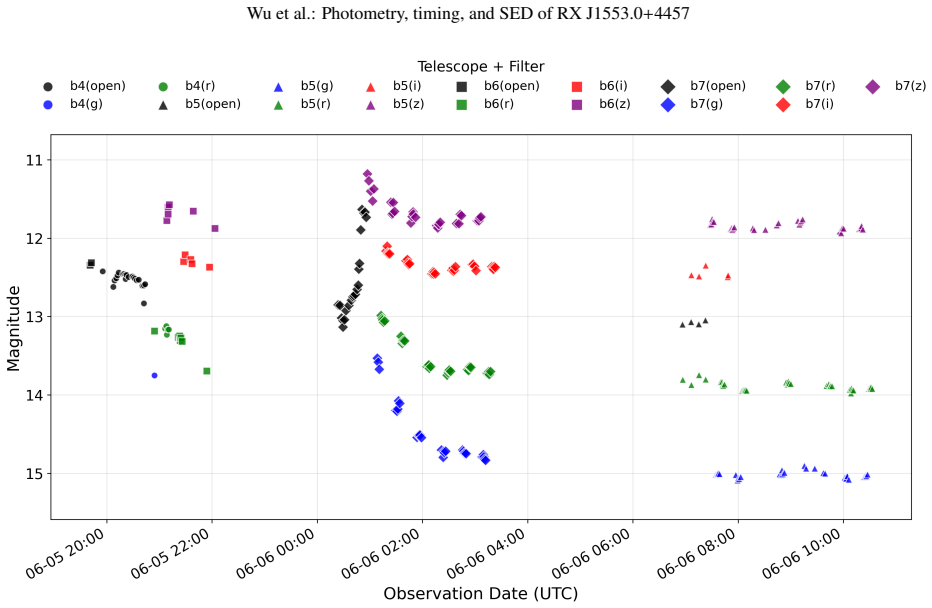
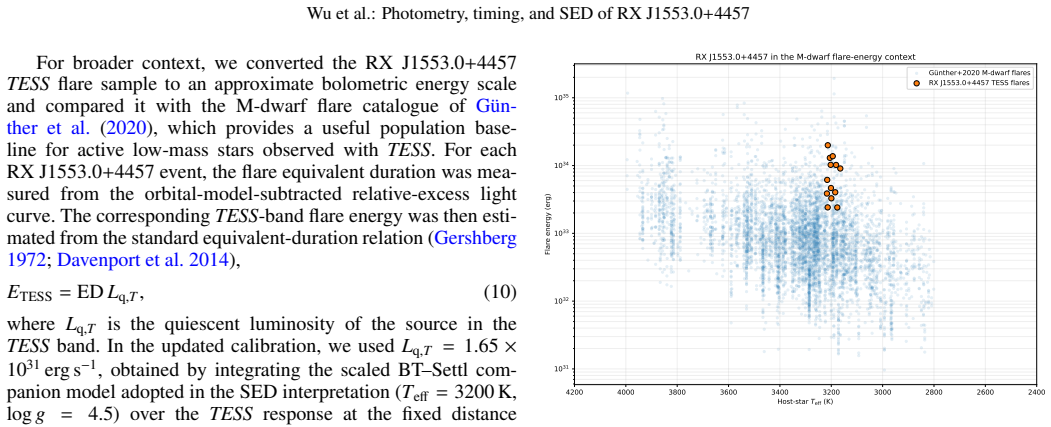
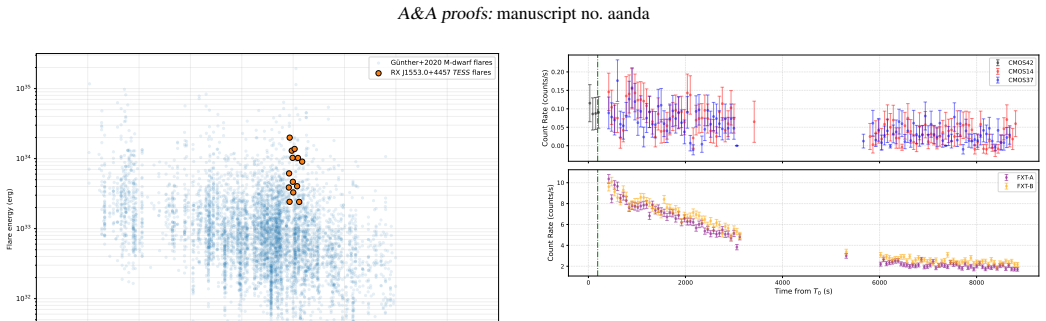
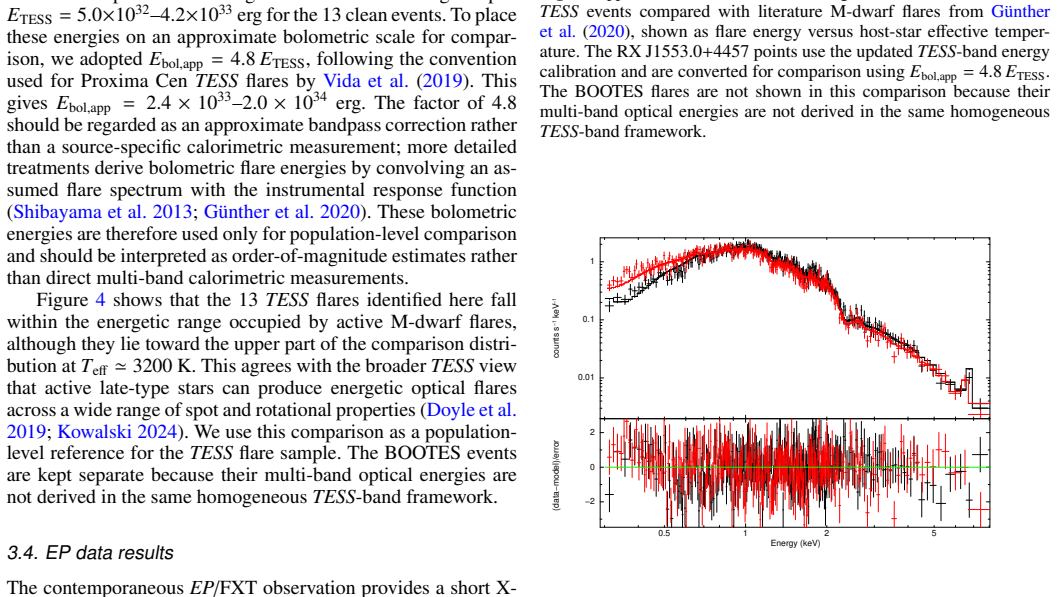
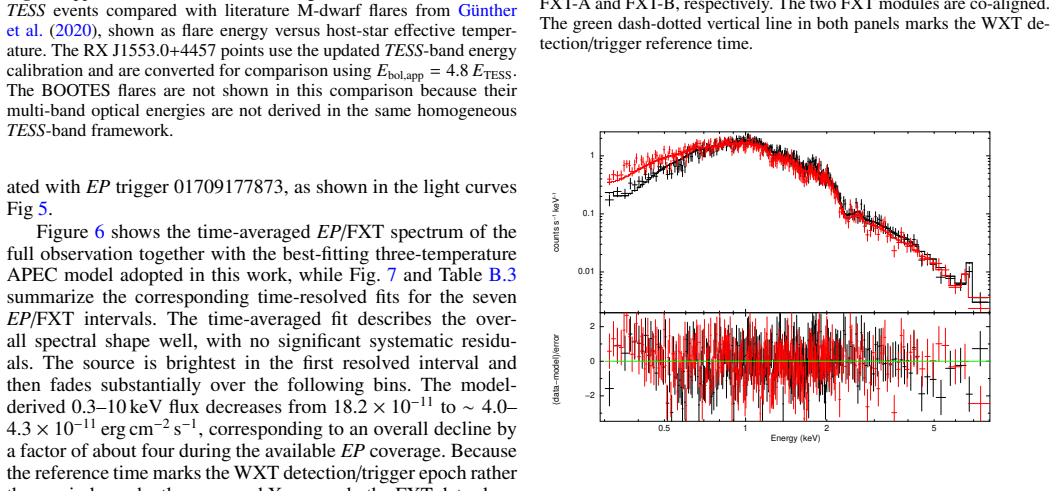
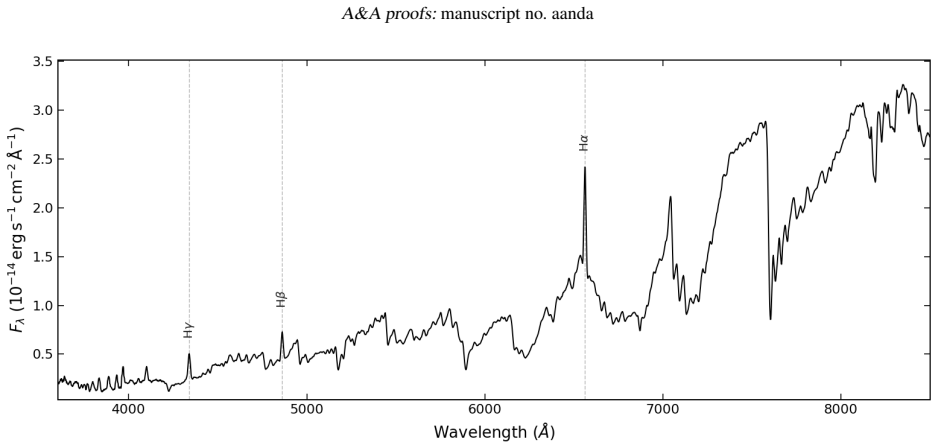
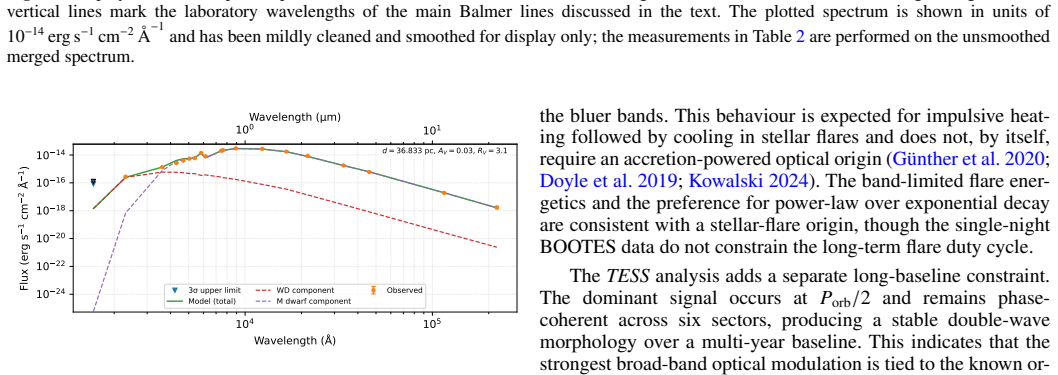
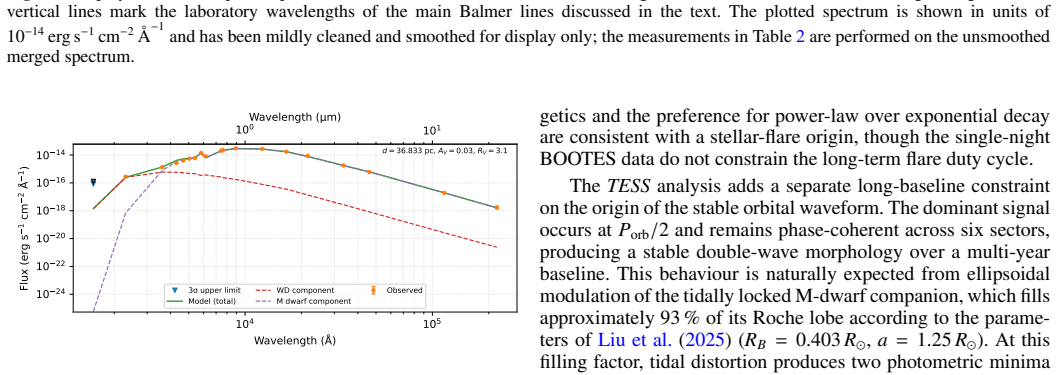
RX J1553.0+4457 (TMTS J15530469+4457458) is a detached post-common-envelope binary containing a cool white dwarf and an active late-type companion. We present a multi-wavelength study combining BOOTES multi-band photometry, six sectors of public TESS full-frame imaging, Einstein Probe/FXT X-ray observations, CAFOS optical spectroscopy, and archival ultraviolet-to-mid-infrared photometry. The BOOTES data reveal two short optical flares separated by about 3 h, with amplitudes of roughly 1--1.5 mag and faster decay at shorter wavelengths. The combined TESS light curve shows a stable signal at P = 0.083782 d, consistent with the first harmonic of the known spectroscopic orbital period, and the folded morphology indicates ellipsoidal modulation from a tidally distorted late-type companion rather than an irradiation-dominated waveform. The TESS flare energetics lie in the active M-dwarf regime. The Einstein Probe/FXT spectra show a factor of about 4 decline in the 0.3--10 keV flux, mainly associated with decreasing emission measures. The broadband SED is reproduced by a cool white dwarf plus a late-type M dwarf, with no clear mid-infrared excess. RX J1553.0+4457 is therefore best interpreted as a detached post-common-envelope binary whose rapid optical variability is dominated by magnetic activity and whose orbital modulation is ellipsoidal, although a weak wind-fed or intermittent accretion contribution remains possible.
Editorial analysis
A structured set of objections, weighed in public.
Referee Report
Summary. The manuscript presents multi-wavelength observations of RX J1553.0+4457 (TMTS J15530469+4457458), combining BOOTES multi-band photometry (showing two short flares), six sectors of TESS full-frame imaging (revealing a stable signal at P = 0.083782 d consistent with the first harmonic of the spectroscopic orbital period), Einstein Probe/FXT X-ray data (showing flux decline), CAFOS spectroscopy, and archival UV-to-mid-IR photometry. The broadband SED is fit by a cool white dwarf plus late-type M dwarf with no mid-IR excess. The authors conclude that the system is a detached post-common-envelope binary whose rapid optical variability is dominated by magnetic activity on the companion and whose orbital modulation is ellipsoidal from tidal distortion, although a weak wind-fed or intermittent accretion contribution cannot be excluded.
Significance. If the central interpretation is secured, the work adds a well-observed example to the sample of detached PCEBs, demonstrating strong magnetic activity in the M-dwarf companion and providing multi-wavelength constraints on component properties and interaction level. The combination of flare detection, X-ray variability, and SED decomposition strengthens the activity-dominated picture relative to purely photometric studies.
major comments (1)
- [TESS light-curve analysis] The distinction between ellipsoidal modulation and irradiation-dominated variability rests on the qualitative description of the folded TESS light-curve morphology (abstract and TESS results section). No quantitative metrics are reported (e.g., relative heights of the two maxima, depths of the two minima, or reduced chi-squared values) comparing the observed waveform to synthetic curves generated from the SED-derived radii, masses, and inclination. An irradiation component combined with spots or gravity darkening could produce a similar double-humped shape, which would weaken the detached classification; explicit model comparison is required to secure the claim.
minor comments (2)
- The flare energetics calculation from TESS data is stated to lie in the active M-dwarf regime, but the method (integration limits, bolometric correction, distance assumption) is not detailed; this should be expanded with explicit formulas and comparison values.
- The SED fitting procedure is summarized as reproducing a cool WD + M-dwarf model, but the specific atmosphere grids, fitting code, degrees of freedom, and parameter uncertainties are not provided; these details would allow readers to assess the robustness of the component parameters used for the light-curve interpretation.
Simulated Author's Rebuttal
We thank the referee for their constructive and detailed review. We address the single major comment below and will revise the manuscript to incorporate quantitative light-curve metrics and model comparisons as requested.
read point-by-point responses
-
Referee: [TESS light-curve analysis] The distinction between ellipsoidal modulation and irradiation-dominated variability rests on the qualitative description of the folded TESS light-curve morphology (abstract and TESS results section). No quantitative metrics are reported (e.g., relative heights of the two maxima, depths of the two minima, or reduced chi-squared values) comparing the observed waveform to synthetic curves generated from the SED-derived radii, masses, and inclination. An irradiation component combined with spots or gravity darkening could produce a similar double-humped shape, which would weaken the detached classification; explicit model comparison is required to secure the claim.
Authors: We agree that the current analysis relies on a qualitative assessment of the folded TESS waveform and that quantitative metrics and model comparisons would strengthen the distinction from irradiation-dominated variability. In the revised manuscript we will report the relative heights of the two maxima and the depths of the two minima in the phase-folded TESS light curve. We will also generate synthetic light curves using the SED-derived radii, masses, and inclination for a pure ellipsoidal model (including gravity darkening) and for models that add an irradiation component plus spots. Reduced chi-squared values will be provided for each comparison to the observed data, allowing a statistical evaluation of whether an irradiation contribution can reproduce the observed double-humped shape as well as the ellipsoidal model. These additions will be placed in the TESS results section and referenced in the abstract. revision: yes
Circularity Check
No significant circularity in derivation chain
full rationale
The paper's claims rest on direct observational comparisons: the TESS-derived period P=0.083782 d matching the first harmonic of an independently known spectroscopic orbital period, flare properties aligned with standard active M-dwarf regimes, and broadband SED reproduced by standard cool white dwarf plus late-type M dwarf models with no mid-IR excess. No load-bearing step reduces by construction to the paper's own fitted parameters, self-citations, or ansatzes; the ellipsoidal interpretation follows from the observed period match and waveform stability rather than being defined by the paper's outputs. The derivation is self-contained against external benchmarks.
Axiom & Free-Parameter Ledger
free parameters (1)
- TESS period =
0.083782 d
axioms (1)
- domain assumption The system is a detached post-common-envelope binary containing a cool white dwarf and late-type companion
Lean theorems connected to this paper
-
IndisputableMonolith/Foundation/RealityFromDistinction.leanreality_from_one_distinction unclear?
unclearRelation between the paper passage and the cited Recognition theorem.
The combined TESS light curve shows a stable signal at P = 0.083782 d, consistent with the first harmonic of the known spectroscopic orbital period... folded morphology indicates ellipsoidal modulation
-
IndisputableMonolith/Cost/FunctionalEquation.leanwashburn_uniqueness_aczel unclear?
unclearRelation between the paper passage and the cited Recognition theorem.
The TESS flare energetics lie in the active M-dwarf regime... three-temperature APEC model
What do these tags mean?
- matches
- The paper's claim is directly supported by a theorem in the formal canon.
- supports
- The theorem supports part of the paper's argument, but the paper may add assumptions or extra steps.
- extends
- The paper goes beyond the formal theorem; the theorem is a base layer rather than the whole result.
- uses
- The paper appears to rely on the theorem as machinery.
- contradicts
- The paper's claim conflicts with a theorem or certificate in the canon.
- unclear
- Pith found a possible connection, but the passage is too broad, indirect, or ambiguous to say the theorem truly supports the claim.
Reference graph
Works this paper leans on
-
[1]
Abundances of the elements: Meteoritic and solar , journal =
Edward Anders and Nicolas Grevesse , abstract =. Abundances of the elements: Meteoritic and solar , journal =. 1989 , issn =. doi:https://doi.org/10.1016/0016-7037(89)90286-X , url =
-
[2]
On the Absorption of X-rays in the Interstellar Medium
On the Absorption of X-Rays in the Interstellar Medium. , keywords =. doi:10.1086/317016 , archivePrefix =. astro-ph/0008425 , primaryClass =
work page internal anchor Pith review Pith/arXiv arXiv doi:10.1086/317016
- [3]
-
[4]
Publications of the Astronomical Society of the Pacific , volume =
Osaki, Yoji , title =. Publications of the Astronomical Society of the Pacific , volume =. 1996 , doi =
work page 1996
-
[5]
New Astronomy Reviews , volume =
Lasota, Jean-Pierre , title =. New Astronomy Reviews , volume =. 2001 , doi =
work page 2001
-
[6]
Astronomy and Astrophysics , volume =
Osaki, Yoji , title =. Astronomy and Astrophysics , volume =
-
[7]
Publications of the Astronomical Society of Japan , volume =
Kato, Taichi and others , title =. Publications of the Astronomical Society of Japan , volume =. 2015 , doi =
work page 2015
-
[8]
The Evolution of Cataclysmic Variables as Revealed by their Donor Stars
Knigge, Christian and Baraffe, Isabelle and Patterson, Joseph , title =. The Astrophysical Journal Supplement Series , volume =. 2011 , doi =. 1102.2440 , archivePrefix=
work page internal anchor Pith review Pith/arXiv arXiv 2011
-
[9]
Astronomy and Astrophysics , volume =
Voges, Wolfgang and others , title =. Astronomy and Astrophysics , volume =
-
[10]
Cataclysmic Variables from the Sloan Digital Sky Survey. V. The Fifth Year (2004) , author=. The Astronomical Journal , volume=. 2006 , doi=
work page 2004
-
[11]
Liu, Qichun and Wang, Xiaofeng and Lin, Jie and Wu, Chengyuan and Li, Chunqian and Filippenko, Alexei V. and Brink, G. Thomas and Yang, Yi and Zheng, Weikang and Liu, Cheng and Song, Cuiying and Kovalev, Mikhail and Ge, Hongwei and Zhang, Fenghui and Zhang, Xiaobin and Xia, Qiqi and Peng, Haowei and Xi, Gaobo and Mo, Jun and Yan, Shengyu and Shi, Jianrong...
-
[12]
Ricker, George R. and Winn, Joshua N. and Vanderspek, Roland and others , title =. Journal of Astronomical Telescopes, Instruments, and Systems , volume =. 2015 , doi =
work page 2015
-
[13]
Publications of the Astronomical Society of the Pacific , volume=
The Tsinghua University--Ma Huateng Telescopes for Survey: Overview and Performance of the System , author=. Publications of the Astronomical Society of the Pacific , volume=. 2020 , month=
work page 2020
-
[14]
Morrissey, P. and Conrow, T. and Barlow, T. A. and others , title =. The Astrophysical Journal Supplement Series , year =
-
[15]
Padmanabhan, N. and Schlegel, D. J. and Finkbeiner, D. P. and others , title =. The Astrophysical Journal , year =
-
[16]
Cohen, M. and Wheaton, W. A. and Megeath, S. T. , title =. The Astronomical Journal , year =
-
[17]
Explanatory Supplement to the WISE All-Sky Data Release Products , year =
-
[18]
Wright, E. L. and Eisenhardt, P. R. M. and Mainzer, A. K. and others , title =. The Astronomical Journal , year =
-
[19]
Riello, M. and De Angeli, F. and Evans, D. W. and others , title =. Astronomy & Astrophysics , year =
-
[20]
, archivePrefix = "arXiv", eprint =
The Eleventh and Twelfth Data Releases of the Sloan Digital Sky Survey: Final Data from SDSS-III. , archivePrefix = "arXiv", eprint =. doi:10.1088/0067-0049/219/1/12 , adsurl =
- [21]
-
[22]
American Astronomical Society Meeting Abstracts \#228 , year = 2016, series =
APASS Data Release 9. American Astronomical Society Meeting Abstracts \#228 , year = 2016, series =
work page 2016
-
[23]
, archivePrefix = "arXiv", eprint =
Preliminary Results from NEOWISE: An Enhancement to the Wide-field Infrared Survey Explorer for Solar System Science. , archivePrefix = "arXiv", eprint =. doi:10.1088/0004-637X/731/1/53 , adsurl =
-
[24]
The Galaxy Evolution Explorer: A Space Ultraviolet Survey Mission. , eprint =. doi:10.1086/426387 , adsurl =
work page internal anchor Pith review doi:10.1086/426387
-
[25]
The Two Micron All Sky Survey (2MASS). , keywords =. doi:10.1086/498708 , adsurl =
- [26]
-
[27]
Brasseur, C. E. and Phillip, Carlita and Fleming, Scott W. and Mullally, Susan E. and White, Richard L. , title =. 2019 , archivePrefix=. 1905.007 , adsurl =
work page 2019
-
[28]
Lightkurve: Kepler and TESS time series analysis in Python , howpublished =. 2018 , archivePrefix=. 1812.013 , adsurl =
work page 2018
-
[29]
The Astropy Project: Sustaining and Growing a Community-oriented Open-source Project and the Latest Major Release (v5.0) of the Core Package , journal =. 2022 , volume =
work page 2022
-
[30]
Lomb, N. R. , title =. Astrophysics and Space Science , year =
-
[31]
Scargle, J. D. , title =. The Astrophysical Journal , year =
- [32]
-
[33]
Handbook of X-ray and Gamma-ray Astrophysics , editor =
Yuan, Weimin and Zhang, Chen and Chen, Yong and Ling, Zhixing , title =. Handbook of X-ray and Gamma-ray Astrophysics , editor =. 2024 , pages =
work page 2024
-
[34]
Gaia Early Data Release 3: Summary of the contents and survey properties , journal =. 2021 , volume =
work page 2021
-
[35]
Bailer-Jones, C. A. L. and Rybizki, J. and Fouesneau, M. and Demleitner, M. and Andrae, R. , title =. The Astronomical Journal , year =
-
[36]
Cardelli, J. A. and Clayton, G. C. and Mathis, J. S. , title =. The Astrophysical Journal , year =
- [37]
-
[38]
Allard, F. and Homeier, D. and Freytag, B. , title =. Philosophical Transactions of the Royal Society A , year =
-
[39]
Bellm, E. C. and Kulkarni, S. R. and Graham, M. J. and Dekany, R. and Smith, R. M. and Riddle, R. and others , title =. Publications of the Astronomical Society of the Pacific , year =
-
[40]
Graham, M. J. and Kulkarni, S. R. and Bellm, E. C. and Adams, S. M. and Barbarino, C. and Blagorodnova, N. and others , title =. Publications of the Astronomical Society of the Pacific , year =
-
[41]
Welch, P. D. , title =. IEEE Transactions on Audio and Electroacoustics , year =
-
[42]
Foreman-Mackey, Daniel and Hogg, David W. and Lang, Dustin and Goodman, Jonathan , title =. Publications of the Astronomical Society of the Pacific , year =. doi:10.1086/670067 , eprint =
-
[43]
G. Stellar Flares from the First. The Astronomical Journal , year =
-
[44]
Rebassa-Mansergas, A. and G. Post-common-envelope binaries from SDSS -- I. 101 white dwarf-main sequence binaries with multiple SDSS spectroscopy , journal =. 2007 , volume =
work page 2007
-
[45]
Rebassa-Mansergas, A. and G. Post-common-envelope binaries from SDSS -- VII. A catalogue of white dwarf-main sequence binaries , journal =. 2010 , volume =
work page 2010
-
[46]
Zorotovic, M. and Schreiber, M. R. and G. Post-common-envelope binaries from SDSS. IX: Constraining the common-envelope efficiency , journal =. 2010 , volume =
work page 2010
-
[47]
Tappert, C. and G. Accretion in the detached post-common-envelope binary LTT 560 , journal =. 2011 , volume =
work page 2011
-
[48]
Ribeiro, T. and Baptista, R. and Kafka, S. and Dufour, P. and Gianninas, A. and Fontaine, G. , title =. A&A , year =
-
[49]
Parsons, S. G. and G. Magnetic white dwarfs in post-common-envelope binaries , journal =. 2021 , volume =
work page 2021
-
[50]
Doyle, L. and Ramsay, G. and Doyle, J. G. and Wu, K. , title =. MNRAS , year =
- [51]
-
[52]
Timmer, J. and K. On generating power law noise , journal =. 1995 , volume =
work page 1995
- [53]
-
[54]
Castro-Tirado, A. J. and Jel. Building the BOOTES world-wide Network of Robotic Telescopes , booktitle =. 2012 , volume =
work page 2012
-
[55]
Gershberg, R. E. , title =. Astrophysics and Space Science , year =
-
[56]
Davenport, J. R. A. and Hawley, S. L. and Hebb, L. and Wisniewski, J. P. and Kowalski, A. F. and Johnson, E. C. and Malatesta, M. and Peraza, J. and Keil, M. and Silverberg, S. M. and Jansen, T. C. and Scheffler, M. S. and Berdis, J. R. and Larsen, D. M. and Hilton, E. J. , title =. The Astrophysical Journal , year =
-
[57]
Arnaud, K. A. , title =. Astronomical Data Analysis Software and Systems V , editor =. 1996 , pages =
work page 1996
-
[58]
Smith, R. K. and Brickhouse, N. S. and Liedahl, D. A. and Raymond, J. C. , title =. The Astrophysical Journal Letters , year =
-
[59]
Fontaine, G. and Brassard, P. and Bergeron, P. , title =. Publications of the Astronomical Society of the Pacific , year =
-
[60]
On the Spectral Evolution of Hot White Dwarf Stars
B. On the Spectral Evolution of Hot White Dwarf Stars. I. A Detailed Model Atmosphere Analysis of Hot White Dwarfs from SDSS DR12 , journal =. 2020 , volume =
work page 2020
-
[61]
Vida, K. and Ol. Flaring activity of Proxima Centauri from. The Astrophysical Journal , year =
-
[62]
and Nogami, Daisaku and Shibata, Kazunari , title =
Shibayama, Takuya and Maehara, Hiroyuki and Notsu, Shota and Notsu, Yuta and Nagao, Takashi and Honda, Satoshi and Ishii, Takako T. and Nogami, Daisaku and Shibata, Kazunari , title =. , year =
-
[63]
, year = 2019, month = dec, volume =
A 3D Dust Map Based on Gaia, Pan-STARRS 1, and 2MASS. , year = 2019, month = dec, volume =. doi:10.3847/1538-4357/ab5362 , archivePrefix =. 1905.02734 , primaryClass =
-
[64]
doi:10.1088/0004-637X/797/2/121 , adsurl =
The Astrophysical Journal , year =. doi:10.1088/0004-637X/797/2/121 , adsurl =
-
[65]
2010, MNRAS, 401, 1670, doi: 10.1111/j.1365-2966.2009.15794.x
MNRAS , year =. doi:10.1111/j.1365-2966.2009.15598.x , archivePrefix =. 0903.2057 , primaryClass =
-
[66]
Masci, F. J. and Laher, R. R. and Rusholme, B. and Shupe, D. L. and Groom, S. and Surace, J. and Jackson, E. and Monkewitz, S. and Beck, R. and Flynn, D. and others , title =. Publications of the Astronomical Society of the Pacific , year =
-
[67]
Zhao, H.-S. and Li, C.-K. and Wang, J. and others , title =. Radiation Detection Technology and Methods , year =
-
[68]
Cort. The Calar Alto. Monthly Notices of the Royal Astronomical Society , year =
-
[69]
Marston, A. and Hargis, J. and Levay, K. and Forshay, P. and Mullally, S. and Shaw, R. , title =. Observatory Operations: Strategies, Processes, and Systems VII , series =. 2018 , volume =
work page 2018
-
[70]
Teplitz, H. I. , title =. 20th Cambridge Workshop on Cool Stars, Stellar Systems, and the Sun , year =
-
[71]
Brinkworth, C. S. and Marsh, T. R. and Dhillon, V. S. and Knigge, C. , title =. MNRAS , year =
-
[72]
Parsons, S. G. and Marsh, T. R. and Copperwheat, C. M. and Dhillon, V. S. and Littlefair, S. P. and G. Precise mass and radius values for the white dwarf and low-mass M dwarf in the pre-cataclysmic binary. MNRAS , year =
- [73]
- [74]
-
[75]
Hurley-Walker, N. and McSweeney, S. J. and Bahramian, A. and Rea, N. and Horv. A 2.9 hr Periodic Radio Transient with an Optical Counterpart , journal =. 2024 , volume =
work page 2024
-
[76]
Rodriguez, Antonio C. , title =. A&A , year =. doi:10.1051/0004-6361/202553684 , archivePrefix =. 2501.03315 , primaryClass =
-
[77]
Rodriguez, Antonio C. and El-Badry, Kareem and de Ruiter, Iris and Rajwade, Kaustubh and Berger, Edo and Connor, Liam and Hurley-Walker, Natasha , title =. arXiv e-prints , year =. doi:10.48550/arXiv.2604.18688 , archivePrefix =. 2604.18688 , primaryClass =
work page internal anchor Pith review Pith/arXiv arXiv doi:10.48550/arxiv.2604.18688
-
[78]
Morris, S. L. , title =. ApJ , year =
-
[79]
Morris, S. L. and Naftilan, S. A. , title =. ApJ , year =
- [80]
discussion (0)
Sign in with ORCID, Apple, or X to comment. Anyone can read and Pith papers without signing in.