Recognition: unknown
White dwarf + M dwarf Detached Binaries in Long Period Radio Transients: Observed Binary Parameters, Evolution, and Population Constraints
Pith reviewed 2026-05-10 03:14 UTC · model grok-4.3
The pith
Two long-period radio transients are white dwarf plus M dwarf binaries with crystallized cores and nearly face-on orbits.
A machine-rendered reading of the paper's core claim, the machinery that carries it, and where it could break.
Core claim
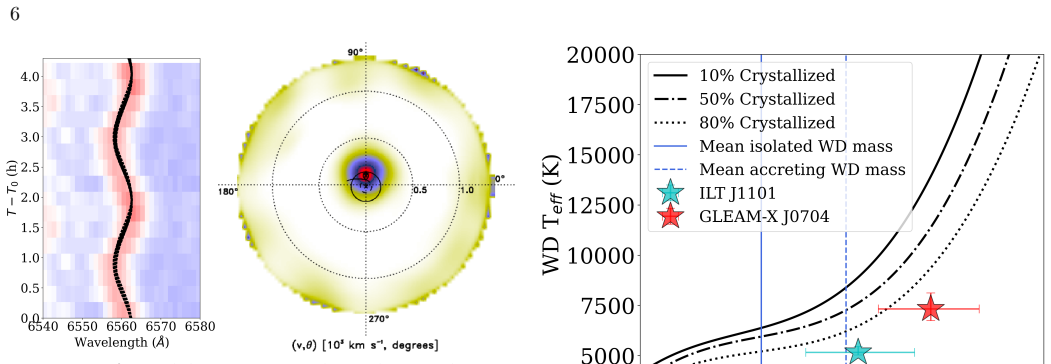
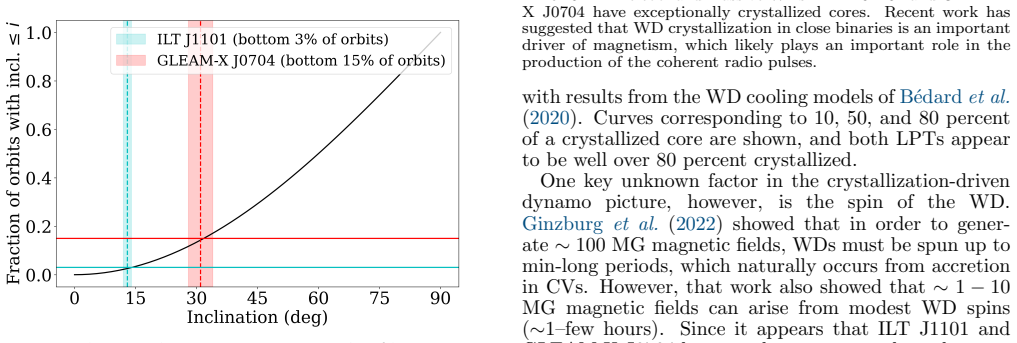
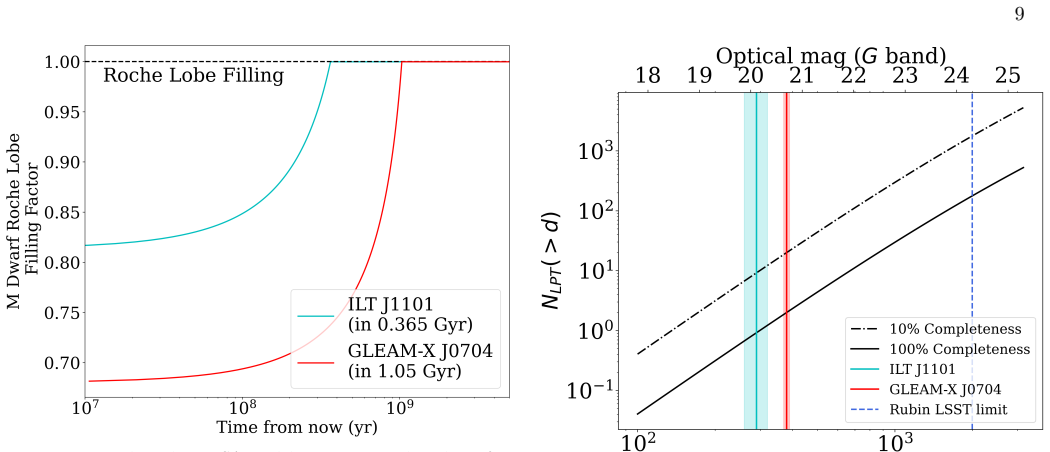
Two of the thirteen known long period radio transients originate in white dwarf plus M dwarf detached binaries. New Keck spectroscopy of ILT J1101+5521 confirms an orbital period of 2.092 hours that matches the radio period, with pulses occurring shortly after maximum M dwarf redshift. Both systems contain white dwarfs of mass 0.84 to 1.0 solar masses and effective temperature 5200 to 7300 K, implying nearly complete crystallization of their carbon-oxygen cores. The orbits are viewed nearly face-on at inclinations of 13 to 28 degrees. MESA models show the M dwarf will overflow its Roche lobe in roughly one gigayear, and the space density of similar white dwarf plus M dwarf LPTs is at least 0
What carries the argument
Phase alignment between radio pulse arrival and the M dwarf's radial velocity curve, which ties the radio period to the orbital period and reveals the binary inclination and white dwarf mass.
If this is right
- The M dwarf in each system will fill its Roche lobe and the binary will become a cataclysmic variable within approximately one billion years.
- Coherent radio pulse production in these systems is strongly inclination-dependent and favors nearly face-on geometries.
- The space density of white dwarf plus M dwarf long period radio transients is at least 10 to the minus eight per cubic parsec.
- Between 100 and 2000 such systems should exist within 2 kiloparsecs if radio surveys are 10 to 100 percent complete, with optical counterparts detectable by LSST.
Where Pith is reading between the lines
- The radio emission mechanism may be beamed along the orbital axis or otherwise require a specific alignment with the binary plane.
- Deeper optical spectroscopy of additional LPTs could reveal more members of this population.
- Precise multi-year timing could test whether the radio and orbital periods remain identical or show small differences due to spin-orbit coupling.
Load-bearing premise
The radio pulsing period is taken to be exactly equal to the binary orbital period so that pulse arrival can be interpreted relative to the M dwarf's orbital motion.
What would settle it
An independent measurement that the radio period differs from the optical orbital period or that the pulse phase is unrelated to the M dwarf redshift maximum.
Figures





read the original abstract
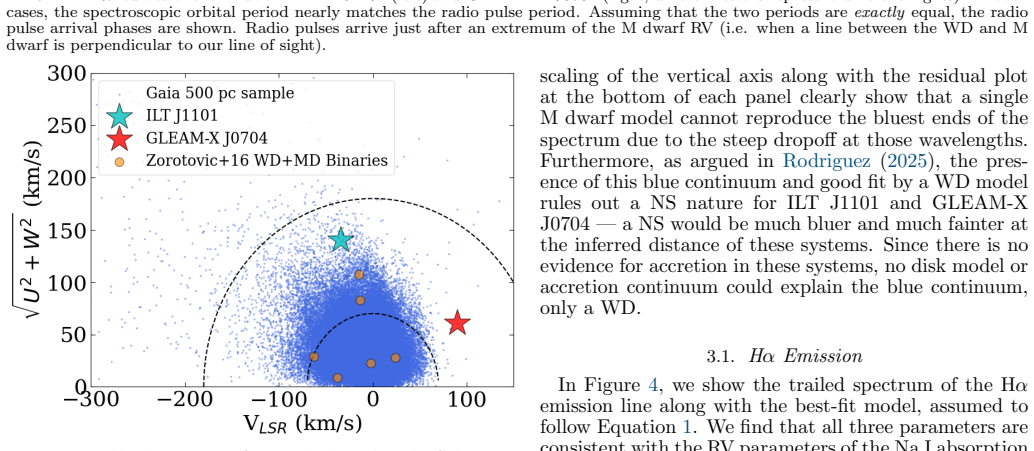
Long period radio transients (LPTs) are the slowest radio-pulsing sources ever found, with the current population spanning periods of seven minutes to over six hours. Two of the thirteen published LPTs, ILT J1101+5521 and GLEAM-X J0704--37, have been associated with an M dwarf closely orbiting a white dwarf (WD) through optical spectroscopy. Here, we present new Keck I/LRIS optical spectroscopy of ILT J1101+5521, which reveals H$\alpha$ emission from the M dwarf and confirms an orbital period nearly matching the radio period (2.092 hr). Radio pulses in both systems arrive just after maximum M dwarf redshift, assuming the radio period matches the orbital period. Based on Gaia proper motions and systemic velocities, we find that these systems are kinematically hotter and less concentrated in the Galactic plane than other LPTs. Both systems harbor unusually massive and cool WDs, with $M_\mathrm{WD} \approx 0.84-1.0 M_\odot$ and $T_\mathrm{eff} \approx 5200-7300$ K, implying that their carbon-oxygen cores are nearly entirely crystallized. Both systems are unusually close to being face-on binaries ($i=13^\circ-28^\circ$), signaling that the production of coherent radio pulses may be a strongly inclination-dependent phenomenon. We present MESA models that show that the M dwarf in each system will fill its Roche lobe within $\sim1$ Gyr, becoming a cataclysmic variable. Finally, we place lower limits on the space density of WD + M dwarf LPTs ($\rho \gtrsim 10^{-8}\;\mathrm{pc}^{-3}$); based on the broader population of WD + M dwarf binaries, we estimate that there are 100 (2000) WD + M dwarf LPTs within 2 kpc if current radio findings are 100% (10%) complete. Current and upcoming radio surveys will be sensitive to many such systems, and M dwarf optical counterparts out to $\sim$2 kpc will be detectable with the Rubin Observatory Legacy Survey of Space and Time (LSST).
Editorial analysis
A structured set of objections, weighed in public.
Referee Report
Summary. The manuscript identifies two long-period radio transients (ILT J1101+5521 and GLEAM-X J0704--37) as detached white dwarf + M dwarf binaries via optical spectroscopy, with new Keck/LRIS data for the first system confirming an orbital period of 2.092 hr that nearly matches the radio period. Radio pulses are reported to arrive just after maximum M dwarf redshift (assuming exact period equality), yielding low inclinations (13–28°), unusually massive and cool WDs with crystallized CO cores, kinematic properties distinct from other LPTs, and MESA-based predictions that both systems will initiate Roche-lobe overflow within ~1 Gyr. The work derives a lower limit on the space density of such systems (≳10^{-8} pc^{-3}) and estimates a Galactic population of 100–2000 objects within 2 kpc depending on survey completeness, arguing that the radio emission mechanism is strongly inclination-dependent.
Significance. If the period equality and geometric interpretations hold, the result would establish a concrete link between a subset of LPTs and the WD + M dwarf binary population, provide the first direct evidence for inclination-dependent coherent radio emission in these systems, and supply falsifiable evolutionary and population predictions testable with LSST and next-generation radio surveys. The combination of new spectroscopy, Gaia kinematics, and MESA modeling strengthens the case for crystallized WD cores in these objects.
major comments (2)
- [Abstract and timing section] Abstract and § on timing analysis: the claim that pulses arrive at a fixed orbital phase ('just after maximum M dwarf redshift') and the derived inclinations (13–28°) rest on the assumption that the radio period is identical to the orbital period. For ILT J1101+5521 the periods are stated to 'nearly match,' yet even a small fractional difference produces secular phase drift over multi-cycle baselines, invalidating the fixed-offset interpretation. For GLEAM-X J0704--37 the equality is assumed without an independent optical period. This assumption is load-bearing for the inclination-dependence conclusion and all downstream geometric and population statements.
- [Abstract and population section] Abstract and population section: the lower limit ρ ≳ 10^{-8} pc^{-3} and the estimates of 100 (2000) systems within 2 kpc are scaled by an explicit but unspecified completeness fraction. Without a quantitative justification or sensitivity analysis for this fraction (and without the underlying detection-volume calculation), the numerical population constraints cannot be evaluated.
minor comments (2)
- [Observational results] The manuscript should tabulate the full set of measured radial velocities, period uncertainties, and derived binary parameters (including error budgets) for both systems to allow independent verification of the inclination and mass estimates.
- [Evolutionary modeling] MESA input physics (initial masses, metallicity, mixing length, overshooting, and the precise definition of Roche-lobe contact) should be stated explicitly so that the ~1 Gyr RLOF timescale can be reproduced.
Simulated Author's Rebuttal
We thank the referee for their careful and constructive review. The comments identify two key assumptions in our analysis that require clarification. We address each point below and will revise the manuscript to strengthen the presentation of the period equality evidence and the population calculations.
read point-by-point responses
-
Referee: Abstract and timing section: the claim that pulses arrive at a fixed orbital phase ('just after maximum M dwarf redshift') and the derived inclinations (13–28°) rest on the assumption that the radio period is identical to the orbital period. For ILT J1101+5521 the periods are stated to 'nearly match,' yet even a small fractional difference produces secular phase drift over multi-cycle baselines, invalidating the fixed-offset interpretation. For GLEAM-X J0704--37 the equality is assumed without an independent optical period. This assumption is load-bearing for the inclination-dependence conclusion and all downstream geometric and population statements.
Authors: We agree that the fixed-phase interpretation and derived inclinations depend on period equality. For ILT J1101+5521 the Keck/LRIS orbital period of 2.092 hr is consistent with the radio period within the combined measurement uncertainties. The available multi-year radio timing data show no detectable secular phase drift relative to the optical orbit, which would be required by even a modest fractional period difference; this supports equality to the current precision. For GLEAM-X J0704--37 the optical identification and phase alignment are tied to the radio period, as no independent optical period measurement was available. We will add a dedicated paragraph in the revised timing section that (i) quantifies the period consistency including uncertainties, (ii) notes the absence of observed drift over the existing baseline, and (iii) discusses the geometric implications if a small difference were later detected. The low-inclination conclusion is presented under the equality assumption, and we will flag the need for continued monitoring to test it. revision: partial
-
Referee: Abstract and population section: the lower limit ρ ≳ 10^{-8} pc^{-3} and the estimates of 100 (2000) systems within 2 kpc are scaled by an explicit but unspecified completeness fraction. Without a quantitative justification or sensitivity analysis for this fraction (and without the underlying detection-volume calculation), the numerical population constraints cannot be evaluated.
Authors: We thank the referee for highlighting this gap. The lower limit ρ ≳ 10^{-8} pc^{-3} is derived conservatively from the two detected systems inside the combined ILT/GLEAM survey volume without any completeness correction. The 100–2000 estimate within 2 kpc scales the local density by the known space density of WD + M dwarf binaries (from optical catalogs) and adopts completeness fractions of 100 % and 10 % to bracket plausible radio-detection efficiencies. In the revised manuscript we will (i) provide the explicit detection-volume calculation using the surveys’ sensitivity limits, sky coverage, and distance reach, (ii) justify the 10–100 % completeness range from the fraction of WD + M dwarf systems expected to produce detectable coherent emission, and (iii) include a sensitivity table showing how the Galactic population estimate changes across completeness values from 1 % to 100 %. These additions will make the numerical constraints fully evaluable. revision: yes
Circularity Check
No significant circularity; derivation is self-contained with explicit assumptions and new data.
full rationale
The paper's chain begins with new Keck/LRIS spectroscopy yielding an orbital period for ILT J1101+5521 that nearly matches the radio period, combined with Gaia astrometry for kinematics and WD parameters. The timing offset ('just after maximum M dwarf redshift') is presented under the explicit assumption that radio and orbital periods match, with no equation or fit that defines one from the other by construction. Population lower limits invoke standard external WD+M dwarf binary statistics plus an explicit completeness parameter rather than any fitted quantity defined by the result. No self-citations are load-bearing for the central claims, no ansatz is smuggled, and no uniqueness theorem is invoked from prior author work. The derivation therefore remains independent of its own outputs.
Axiom & Free-Parameter Ledger
free parameters (1)
- radio survey completeness fraction =
10% or 100%
axioms (2)
- domain assumption Radio period equals orbital period
- domain assumption Standard white-dwarf cooling tracks and crystallization physics apply
Forward citations
Cited by 2 Pith papers
-
Ellipsoidal modulation and multi-wavelength activity in the pre-cataclysmic binary RX J1553.0+4457
Multi-wavelength data indicate RX J1553.0+4457 is a detached post-common-envelope binary with optical variability dominated by magnetic activity on the M-dwarf companion and no luminous accretion disk required.
-
Ellipsoidal modulation and multi-wavelength activity in the pre-cataclysmic binary RX J1553.0+4457
RX J1553.0+4457 is a detached post-common-envelope binary whose light curve shows ellipsoidal modulation from a tidally distorted M dwarf, with magnetic activity producing flares and declining X-ray emission, consiste...
Reference graph
Works this paper leans on
-
[1]
Spectroscopic detection of a 2.9-hour orbit in a long-period radio transient. , keywords =. doi:10.1051/0004-6361/202553684 , archivePrefix =. 2501.03315 , primaryClass =
-
[2]
ASKAP J144834-685644: a newly discovered long period radio transient detected from radio to X-rays. , keywords =. doi:10.1093/mnras/staf1227 , archivePrefix =. 2507.13453 , primaryClass =
-
[3]
J., Hurley-Walker, N., Horváth, C., et al
A new long-period radio transient: discovery of pulses repeating every 1.16 h from ASKAP J175534.9‑252749.1. , keywords =. doi:10.1093/mnras/staf1203 , archivePrefix =. 2507.14448 , primaryClass =
-
[4]
Strongly polarised radio pulses from a new white-dwarf-hosting long-period transient. , keywords =. doi:10.1051/0004-6361/202555131 , archivePrefix =. 2507.05078 , primaryClass =
-
[5]
CHIME/Fast Radio Burst Discovery of an Unusual Circularly Polarized Long-period Radio Transient with an Accelerating Spin Period. , keywords =. doi:10.3847/2041-8213/adeaab , archivePrefix =. 2507.05139 , primaryClass =
-
[6]
A joint SRG/eROSITA + ZTF search: Discovery of a 97-min period eclipsing cataclysmic variable with evidence of a brown dwarf secondary. , keywords =. doi:10.1093/mnras/stae012 , archivePrefix =. 2401.04178 , primaryClass =
-
[7]
, year = 1968, month = feb, volume =
Observation of a Rapidly Pulsating Radio Source. , year = 1968, month = feb, volume =. doi:10.1038/217709a0 , adsurl =
-
[8]
PSR J0952-0607: The Fastest and Heaviest Known Galactic Neutron Star. , keywords =. doi:10.3847/2041-8213/ac8007 , archivePrefix =. 2207.05124 , primaryClass =
-
[9]
The Keck Low-Resolution Imaging Spectrometer. , keywords =. doi:10.1086/133562 , adsurl =
-
[10]
Ultrashort-Period Binaries, Gravitational Radiation, and Mass Transfer. I. The Standard Model, with Applications to WZ Sagittae and Z Camelopardalis. , year = 1971, month = dec, volume =. doi:10.1086/180848 , adsurl =
-
[11]
A radio-pulsing white dwarf binary star. , keywords =. doi:10.1038/nature18620 , archivePrefix =. 1607.08265 , primaryClass =
-
[12]
Disentangling cataclysmic variables in Gaia's HR diagram. , keywords =. doi:10.1093/mnrasl/slz181 , archivePrefix =. 1912.01531 , primaryClass =
-
[13]
doi:10.1111/j.1365-2966.2009.15598.x , archivePrefix =
SDSS unveils a population of intrinsically faint cataclysmic variables at the minimum orbital period. , keywords =. doi:10.1111/j.1365-2966.2009.15126.x , archivePrefix =. 0905.3476 , primaryClass =
-
[14]
, keywords =
Rotation and chromospheric activity in field M dwarfs. , keywords =
-
[15]
A New Electron-density Model for Estimation of Pulsar and FRB Distances. , keywords =. doi:10.3847/1538-4357/835/1/29 , archivePrefix =. 1610.09448 , primaryClass =
-
[16]
, keywords =
Modelling Population II cataclysmic variables. , keywords =
-
[17]
The scatter of the M dwarf mass-radius relationship. , keywords =. doi:10.1093/mnras/sty2345 , archivePrefix =. 1808.07780 , primaryClass =
-
[18]
New evolutionary models for pre-main sequence and main sequence low-mass stars down to the hydrogen-burning limit. , keywords =. doi:10.1051/0004-6361/201425481 , archivePrefix =. 1503.04107 , primaryClass =
-
[19]
A parsec-scale Galactic 3D dust map out to 1.25 kpc from the Sun. , keywords =. doi:10.1051/0004-6361/202347628 , archivePrefix =. 2308.01295 , primaryClass =
-
[20]
Cyclical Period Changes in Cataclysmic Variables: A Statistical Study. , keywords =. doi:10.3847/1538-4357/ad6b0e , archivePrefix =. 2408.07850 , primaryClass =
-
[21]
, year = 1968, month = jul, volume =
Rotating Neutron Stars, Pulsars and Supernova Remnants. , year = 1968, month = jul, volume =. doi:10.1038/219145a0 , adsurl =
-
[22]
doi:10.1111/j.1365-2966.2009.15598.x , archivePrefix =
The chemical composition of donors in AM CVn stars and ultracompact X-ray binaries: observational tests of their formation. , keywords =. doi:10.1111/j.1365-2966.2009.15731.x , archivePrefix =. 0909.3376 , primaryClass =
-
[23]
Physical properties of AM CVn stars: New insights from Gaia DR2. , keywords =. doi:10.1051/0004-6361/201834261 , archivePrefix =. 1810.06548 , primaryClass =
-
[24]
Catalogue of cataclysmic binaries, low-mass X-ray binaries and related objects (Seventh edition). , keywords =. doi:10.1051/0004-6361:20030330 , archivePrefix =. astro-ph/0301444 , primaryClass =
-
[25]
Triple Evolution Pathways to Black Hole Low-Mass X-ray Binaries: Insights from V404 Cygni. arXiv e-prints , keywords =. doi:10.48550/arXiv.2411.15644 , archivePrefix =. 2411.15644 , primaryClass =
-
[26]
The black hole low-mass X-ray binary V404 Cygni is part of a wide triple. , keywords =. doi:10.1038/s41586-024-08120-6 , archivePrefix =. 2404.03719 , primaryClass =
-
[27]
, year = 1969, month = aug, volume =
Pulsar Electrodynamics. , year = 1969, month = aug, volume =. doi:10.1086/150119 , adsurl =
-
[28]
, year = 1968, month = may, volume =
Rotating Neutron Stars as the Origin of the Pulsating Radio Sources. , year = 1968, month = may, volume =. doi:10.1038/218731a0 , adsurl =
-
[29]
Magnetic braking saturates: evidence from the orbital period distribution of low-mass detached eclipsing binaries from ZTF. , keywords =. doi:10.1093/mnras/stac2945 , archivePrefix =. 2208.05488 , primaryClass =
-
[30]
A new technique for calculations of binary stellar evolution application to magnetic braking. , keywords =. doi:10.1086/161569 , adsurl =
-
[31]
2011, ApJS, 194, 28, doi: 10.1088/0067-0049/194/2/28
The Evolution of Cataclysmic Variables as Revealed by Their Donor Stars. , keywords =. doi:10.1088/0067-0049/194/2/28 , archivePrefix =. 1102.2440 , primaryClass =
-
[32]
Slow convection and fast rotation in crystallization-driven white dwarf dynamos. , keywords =. doi:10.1093/mnras/stac1363 , archivePrefix =. 2202.12902 , primaryClass =
-
[33]
The origin and evolution of magnetic white dwarfs in close binary stars. Nature Astronomy , keywords =. doi:10.1038/s41550-021-01346-8 , archivePrefix =. 2104.14607 , primaryClass =
-
[34]
Polarimetric evidence of a white dwarf pulsar in the binary system AR Scorpii. Nature Astronomy , keywords =. doi:10.1038/s41550-016-0029 , archivePrefix =. 1612.03185 , primaryClass =
-
[35]
VLA radio observations of AR Scorpii. , keywords =. doi:10.1051/0004-6361/201732380 , archivePrefix =. 1801.07258 , primaryClass =
-
[36]
Long-term photometric monitoring and spectroscopy of the white dwarf pulsar AR Scorpii. , keywords =. doi:10.1093/mnras/stac2391 , archivePrefix =. 2208.08450 , primaryClass =
-
[37]
The 256-antenna Coherent All-Sky Monitor
The 256-antenna Coherent All-Sky Monitor. arXiv e-prints , keywords =. doi:10.48550/arXiv.2604.13903 , archivePrefix =. 2604.13903 , primaryClass =
work page internal anchor Pith review Pith/arXiv arXiv doi:10.48550/arxiv.2604.13903
-
[38]
The Murchison Widefield Array: The Square Kilometre Array Precursor at Low Radio Frequencies. , keywords =. doi:10.1017/pasa.2012.007 , archivePrefix =. 1206.6945 , primaryClass =
-
[39]
The DSA-2000 -- A Radio Survey Camera
The DSA-2000 A Radio Survey Camera. Bulletin of the American Astronomical Society , year = 2019, volume =. doi:10.48550/arXiv.1907.07648 , archivePrefix =. 1907.07648 , primaryClass =
work page internal anchor Pith review Pith/arXiv arXiv doi:10.48550/arxiv.1907.07648 2000
-
[40]
2023, Monthly Notices of the Royal Astronomical Society, 521, 4024–4038, doi: 10.1093/mnras/stad667
Stellar prospects for FRB gravitational lensing. , keywords =. doi:10.1093/mnras/stad667 , archivePrefix =. 2206.14310 , primaryClass =
-
[41]
A Global View of Post-interaction White Dwarf-main Sequence Binaries. , keywords =. doi:10.1088/1538-3873/ae453b , archivePrefix =. 2601.00439 , primaryClass =
-
[42]
The Open Journal of Astrophysics , keywords =
A transiting brown dwarf in a 2 hour orbit. The Open Journal of Astrophysics , keywords =. doi:10.21105/astro.2307.15729 , archivePrefix =. 2307.15729 , primaryClass =
-
[43]
Discovery of a 36-minute long-period transient ASKAP J142431.2-612611. arXiv e-prints , keywords =. doi:10.48550/arXiv.2603.07857 , archivePrefix =. 2603.07857 , primaryClass =
-
[44]
2026, Long Period Transients (LPTs): A Comprehensive Review, arXiv, doi: 10.48550/arXiv.2601.10393
Long Period Transients (LPTs): a comprehensive review. arXiv e-prints , keywords =. doi:10.48550/arXiv.2601.10393 , archivePrefix =. 2601.10393 , primaryClass =
-
[45]
Searching for long-period radio transients in ASKAP EMU data with 10-s imaging. , keywords =. doi:10.1093/mnras/staf2008 , archivePrefix =. 2511.09770 , primaryClass =
-
[46]
Deep Synoptic Array Science: Searching for Long Duration Radio Transients with the DSA-110. arXiv e-prints , keywords =. doi:10.48550/arXiv.2510.18136 , archivePrefix =. 2510.18136 , primaryClass =
-
[47]
LSST: From Science Drivers to Reference Design and Anticipated Data Products. , keywords =. doi:10.3847/1538-4357/ab042c , archivePrefix =. 0805.2366 , primaryClass =
-
[48]
The Physics of Cataclysmic Variables and Related Objects , year = 2002, editor =
LARPs -- Low-accretion rate polars. The Physics of Cataclysmic Variables and Related Objects , year = 2002, editor =
2002
-
[49]
, keywords =
Revision of the initial-to-final mass relation. , keywords =
-
[50]
An Empirical Measurement of the Initial-Final Mass Relation with Gaia White Dwarfs. , keywords =. doi:10.3847/2041-8213/aaca9c , archivePrefix =. 1805.05849 , primaryClass =
-
[51]
2013, A&A Rv, 21, 59, doi: 10.1007/s00159-013-0059-2
Common envelope evolution: where we stand and how we can move forward. , keywords =. doi:10.1007/s00159-013-0059-2 , archivePrefix =. 1209.4302 , primaryClass =
-
[52]
Structure and Evolution of Close Binary Systems , year = 1976, editor =
Common Envelope Binaries. Structure and Evolution of Close Binary Systems , year = 1976, editor =
1976
-
[53]
A 5.3-min-period pulsing white dwarf in a binary detected from radio to X-rays. Nature Astronomy , keywords =. doi:10.1038/s41550-023-01995-x , archivePrefix =. 2306.09272 , primaryClass =
-
[54]
Novalike cataclysmic variables are significant radio emitters. , keywords =. doi:10.1093/mnras/stv1225 , archivePrefix =. 1506.00003 , primaryClass =
-
[55]
Advances in Space Research , keywords =
Radio observations of magnetic cataclysmic variables. Advances in Space Research , keywords =. doi:10.1016/j.asr.2020.04.007 , archivePrefix =. 2004.11418 , primaryClass =
-
[56]
The Radial Velocity Curve and Peculiar TiO Distribution of the Red Secondary Star in Z Chamaeleontis. , keywords =. doi:10.1086/165905 , adsurl =
-
[57]
Dissecting the donor star in the eclipsing polar HU Aquarii. , keywords =. doi:10.1051/0004-6361/201016373 , adsurl =
-
[58]
2011, ApJS, 192, 3, doi: 10.1088/0067-0049/192/1/3
Modules for Experiments in Stellar Astrophysics (MESA). , keywords =. doi:10.1088/0067-0049/192/1/3 , archivePrefix =. 1009.1622 , primaryClass =
-
[59]
2013, ApJS, 208, 4, doi: 10.1088/0067-0049/208/1/4 Modeling Procyon13
Modules for Experiments in Stellar Astrophysics (MESA): Planets, Oscillations, Rotation, and Massive Stars. , keywords =. doi:10.1088/0067-0049/208/1/4 , archivePrefix =. 1301.0319 , primaryClass =
work page internal anchor Pith review doi:10.1088/0067-0049/208/1/4
-
[60]
2015, ApJS, 220, 15, doi: 10.1088/0067-0049/220/1/15
Modules for Experiments in Stellar Astrophysics (MESA): Binaries, Pulsations, and Explosions. , keywords =. doi:10.1088/0067-0049/220/1/15 , archivePrefix =. 1506.03146 , primaryClass =
work page internal anchor Pith review doi:10.1088/0067-0049/220/1/15
-
[61]
Modules for Experiments in Stellar Astrophysics (MESA): Convective Boundaries, Element Diffusion, and Massive Star Explosions. , keywords =. doi:10.3847/1538-4365/aaa5a8 , archivePrefix =. 1710.08424 , primaryClass =
-
[62]
The Ages of the Thin Disk, Thick Disk, and the Halo from Nearby White Dwarfs. , keywords =. doi:10.3847/1538-4357/aa62a5 , archivePrefix =. 1702.06984 , primaryClass =
-
[63]
A Volume-limited Sample of Cataclysmic Variables from Gaia DR2: Space Density and Population Properties. , keywords =. doi:10.1093/mnras/staa764 , archivePrefix =. 1907.13152 , primaryClass =
-
[64]
Cataclysmic Variables and AM CVn Binaries in SRG/eROSITA + Gaia: Volume Limited Samples, X-Ray Luminosity Functions, and Space Densities. , keywords =. doi:10.1088/1538-3873/ada185 , archivePrefix =. 2408.16053 , primaryClass =
-
[65]
, keywords =
Evolution of cataclysmic binaries. , keywords =
-
[66]
Detached cataclysmic variables are crossing the orbital period gap. , keywords =. doi:10.1093/mnras/stw246 , archivePrefix =. 1601.07785 , primaryClass =
-
[67]
The cataclysmic variable orbital period gap: More evident than ever. , keywords =. doi:10.1051/0004-6361/202348807 , archivePrefix =. 2402.02076 , primaryClass =
-
[68]
, keywords =
Stellar activity and the period gap in cataclysmic variables. , keywords =
-
[69]
Cataclysmic variable stars
-
[70]
Cataclysmic Variable Stars
-
[71]
Constraining the evolution of cataclysmic variables via the masses and accretion rates of their underlying white dwarfs. , keywords =. doi:10.1093/mnras/stab3449 , archivePrefix =. 2111.13706 , primaryClass =
-
[72]
Ram Pressure Stripping of Disc Galaxies: The Role of the Inclination Angle , shorttitle =
White dwarf mass distribution in the SDSS. , keywords =. doi:10.1111/j.1365-2966.2006.11388.x , archivePrefix =. astro-ph/0612277 , primaryClass =
-
[73]
, year = 1994, month = jan, volume =
Binary and Millisecond Pulsars. , year = 1994, month = jan, volume =. doi:10.1146/annurev.aa.32.090194.003111 , adsurl =
-
[74]
Gaia Data Release 3. Summary of the content and survey properties. , keywords =. doi:10.1051/0004-6361/202243940 , archivePrefix =. 2208.00211 , primaryClass =
-
[75]
A 44-minute periodic radio transient in a supernova remnant. arXiv e-prints , keywords =. doi:10.48550/arXiv.2411.15739 , archivePrefix =. 2411.15739 , primaryClass =
-
[76]
Detection of X-ray Emission from a Bright Long-Period Radio Transient. arXiv e-prints , keywords =. doi:10.48550/arXiv.2411.16606 , archivePrefix =. 2411.16606 , primaryClass =
-
[77]
An emission-state-switching radio transient with a 54-minute period. Nature Astronomy , keywords =. doi:10.1038/s41550-024-02277-w , archivePrefix =. 2407.12266 , primaryClass =
-
[78]
The discovery of a nearby 421 -0.5ex transient with CHIME/FRB/Pulsar. arXiv e-prints , keywords =. doi:10.48550/arXiv.2407.07480 , archivePrefix =. 2407.07480 , primaryClass =
-
[79]
A long-period radio transient active for three decades. , year = 2023, month = jul, volume =. doi:10.1038/s41586-023-06202-5 , adsurl =
-
[80]
Discovery of a radio-emitting neutron star with an ultra-long spin period of 76 s. Nature Astronomy , keywords =. doi:10.1038/s41550-022-01688-x , archivePrefix =. 2206.01346 , primaryClass =
discussion (0)
Sign in with ORCID, Apple, or X to comment. Anyone can read and Pith papers without signing in.