Delta Forcing: Trust Region Steering for Interactive Autoregressive Video Generation
Pith reviewed 2026-05-21 09:08 UTC · model grok-4.3
The pith
Delta Forcing constrains unreliable teacher guidance within an adaptive trust region estimated from latent trajectory deltas to reduce drift while keeping reactivity in autoregressive video generation.
A machine-rendered reading of the paper's core claim, the machinery that carries it, and where it could break.
Core claim
Delta Forcing estimates transition consistency from the latent delta between teacher and generator trajectories and places unreliable teacher supervision inside an adaptive trust region, balancing that supervision against a monotonic continuity objective so that teacher-induced shifts are suppressed while responsiveness to new events is retained.
What carries the argument
Delta Forcing, the mechanism that computes an adaptive trust region from latent deltas between teacher and generator trajectories to modulate teacher supervision against a continuity objective.
If this is right
- Autoregressive generators distilled from bidirectional teachers exhibit less persistent drift after streaming long tuning.
- Interactive video outputs maintain temporal coherence across extended sequences even when input conditions evolve.
- The balance between teacher supervision and continuity objective reduces mode collapse toward locally valid but globally inconsistent trajectories.
- Event reactivity is preserved because the trust region adapts rather than applying a fixed restriction on teacher influence.
Where Pith is reading between the lines
- The same latent-delta trust region idea could transfer to autoregressive generation in other modalities where teacher models create similar consistency-reactivity trade-offs.
- Explicitly tracking trajectory deltas might offer a general diagnostic for when distillation introduces bias in sequential models.
- Scaling the trust region size with sequence length or event complexity could be a direct next step for longer-horizon applications.
Load-bearing premise
The latent delta between teacher and generator trajectories supplies a trustworthy signal of transition consistency that can limit harmful teacher shifts without impairing the model's response to fresh events.
What would settle it
A controlled test in which videos generated with Delta Forcing display measurably higher long-horizon consistency scores after abrupt condition changes than baseline methods, while reaction speed to new inputs remains comparable.
Figures



read the original abstract
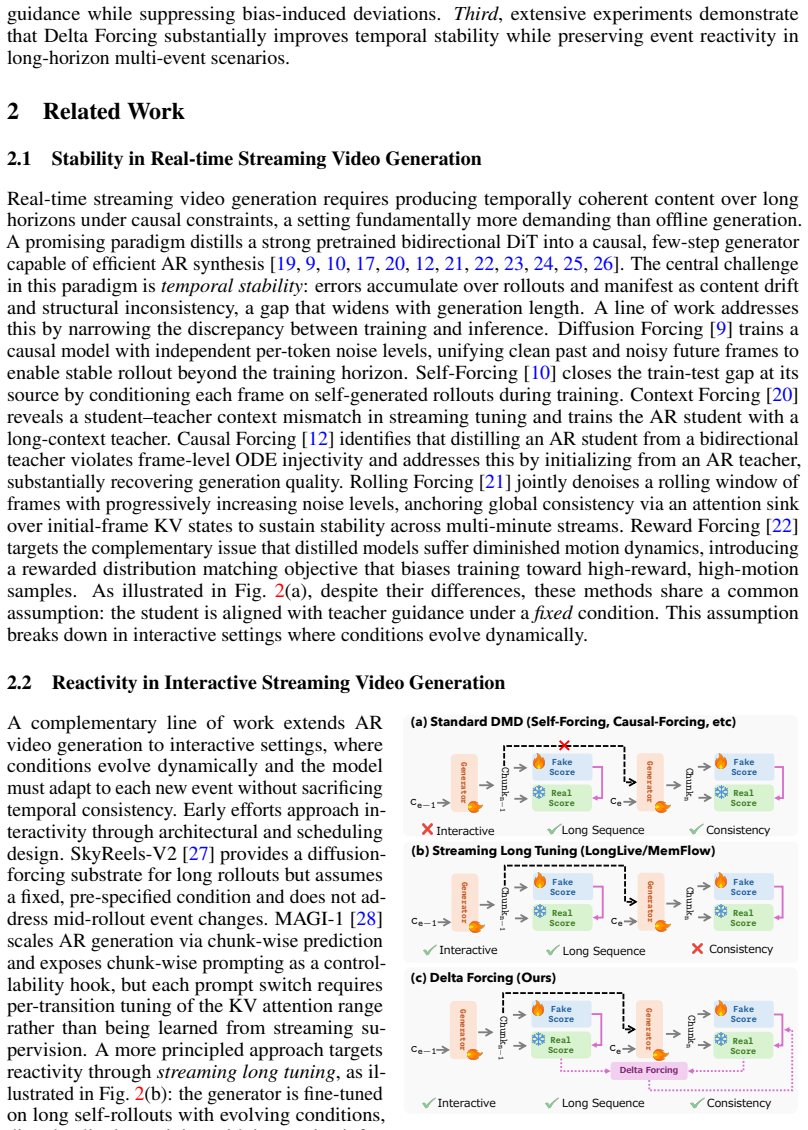
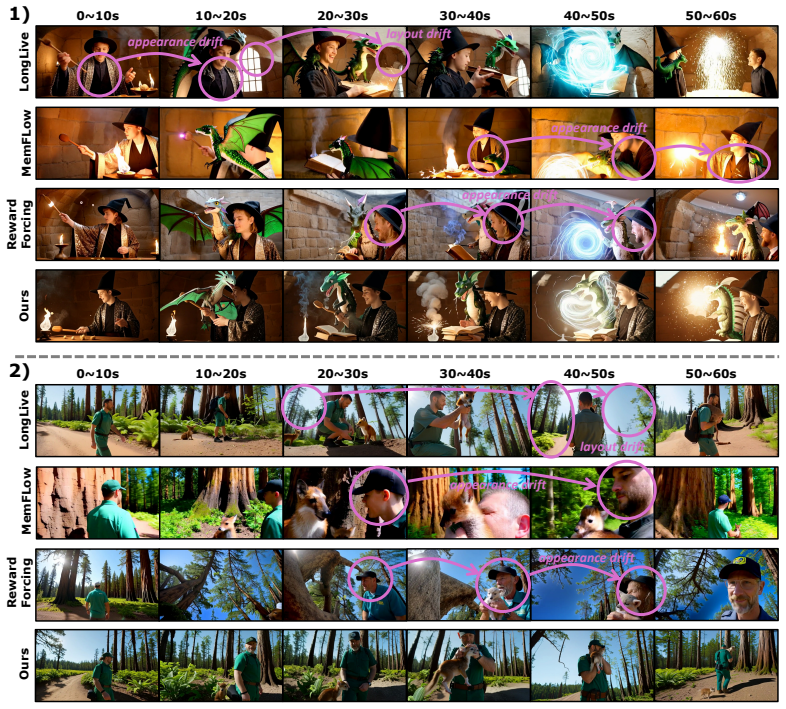
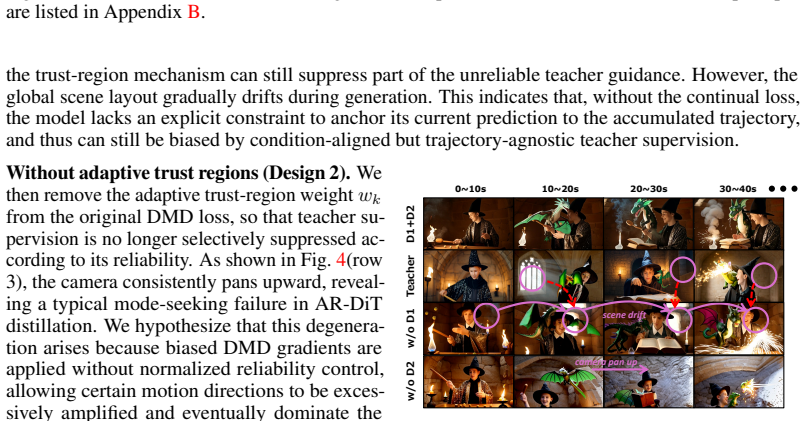
Interactive real-time autoregressive video generation is essential for applications such as content creation and world modeling, where visual content must adapt to dynamically evolving event conditions. A fundamental challenge lies in balancing reactivity and stability: models must respond promptly to new events while maintaining temporal coherence over long horizons. Existing approaches distill bidirectional models into autoregressive generators and further adapt them via streaming long tuning, yet often exhibit persistent drift after condition changes. We identify the cause as conditional bias, where the teacher may provide condition-aligned but trajectory-agnostic guidance, biasing generation toward locally valid yet globally inconsistent modes. Inspired by Trust Region Policy Optimization, we propose Delta Forcing, a simple yet effective framework that constrains unreliable teacher supervision within an adaptive trust region. Specifically, Delta Forcing estimates transition consistency from the latent delta between teacher and generator trajectories, and uses it to balance teacher supervision with a monotonic continuity objective. This suppress unreliable teacher-induced shifts while preserving responsiveness to new events. Extensive experiments demonstrate that Delta Forcing significantly improves consistency while maintaining event reactivity.
Editorial analysis
A structured set of objections, weighed in public.
Referee Report
Summary. The paper claims that existing distillation and streaming long tuning methods for autoregressive video generators suffer from persistent drift after condition changes due to conditional bias in teacher supervision. It proposes Delta Forcing, which adapts the trust-region concept from TRPO to estimate transition consistency via the latent delta between teacher and generator trajectories. This delta is used to adaptively constrain unreliable teacher guidance within a trust region while adding a monotonic continuity objective, thereby suppressing teacher-induced shifts without harming reactivity to new events. The authors report that extensive experiments show significant gains in consistency while preserving event responsiveness.
Significance. If the central mechanism holds, the work offers a lightweight, interpretable steering method for long-horizon autoregressive video models in interactive settings. By directly importing a trust-region constraint from reinforcement learning and grounding it in observable latent deltas, the approach could provide a practical alternative to heavier fine-tuning regimes and help stabilize generation without sacrificing responsiveness.
minor comments (3)
- The abstract and method description would benefit from an explicit equation or pseudocode block showing how the latent delta is computed, how the trust-region threshold is set, and how the continuity objective is formulated and combined with the teacher loss.
- Experimental section should include ablation studies isolating the contribution of the delta-based trust region versus the continuity objective, together with quantitative metrics and error bars for both consistency and reactivity on the reported datasets.
- Clarify whether the method introduces any additional hyperparameters beyond the trust-region radius and, if so, how they are chosen or shown to be robust.
Simulated Author's Rebuttal
We thank the referee for their positive summary of our work and the recommendation for minor revision. The referee accurately captures the core problem of conditional bias in teacher supervision for autoregressive video generators and the trust-region-inspired mechanism of Delta Forcing. Since the report lists no specific major comments, we have no individual points to address.
Circularity Check
No significant circularity; proposal is externally inspired
full rationale
The paper introduces Delta Forcing as a framework inspired by Trust Region Policy Optimization (TRPO) to constrain teacher supervision using latent deltas between trajectories. The central construction estimates transition consistency from these deltas and balances it against a continuity objective, but this is framed as a new adaptive mechanism rather than a quantity derived from or equivalent to quantities already defined inside the paper. No equations reduce by construction to fitted inputs, self-definitions, or load-bearing self-citations. The derivation remains self-contained against external benchmarks like TRPO, with the reader's assessment of minor (score 2) circularity risk aligning with the absence of any quoted reduction to inputs.
Axiom & Free-Parameter Ledger
Lean theorems connected to this paper
-
IndisputableMonolith/Cost/FunctionalEquation.leanwashburn_uniqueness_aczel echoes?
echoesECHOES: this paper passage has the same mathematical shape or conceptual pattern as the Recognition theorem, but is not a direct formal dependency.
Delta Forcing estimates transition consistency from the latent delta between teacher and generator trajectories, and uses it to balance teacher supervision with a monotonic continuity objective.
-
IndisputableMonolith/Foundation/RealityFromDistinction.leanreality_from_one_distinction unclear?
unclearRelation between the paper passage and the cited Recognition theorem.
Inspired by Trust Region Policy Optimization, we propose Delta Forcing, a reliability-aware framework that introduces a delta-based mechanism to modulate supervision online.
What do these tags mean?
- matches
- The paper's claim is directly supported by a theorem in the formal canon.
- supports
- The theorem supports part of the paper's argument, but the paper may add assumptions or extra steps.
- extends
- The paper goes beyond the formal theorem; the theorem is a base layer rather than the whole result.
- uses
- The paper appears to rely on the theorem as machinery.
- contradicts
- The paper's claim conflicts with a theorem or certificate in the canon.
- unclear
- Pith found a possible connection, but the passage is too broad, indirect, or ambiguous to say the theorem truly supports the claim.
Reference graph
Works this paper leans on
-
[1]
Wan: Open and Advanced Large-Scale Video Generative Models
T. Wan, A. Wang, B. Ai, B. Wen, C. Mao, C.-W. Xie, D. Chen, F. Yu, H. Zhao, J. Yanget al., “Wan: Open and advanced large-scale video generative models,”arXiv preprint arXiv:2503.20314, 2025
work page internal anchor Pith review Pith/arXiv arXiv 2025
-
[2]
HunyuanVideo 1.5 Technical Report
B. Wu, C. Zou, C. Li, D. Huang, F. Yang, H. Tan, J. Peng, J. Wu, J. Xiong, J. Jianget al., “Hunyuanvideo 1.5 technical report,”arXiv preprint arXiv:2511.18870, 2025
work page internal anchor Pith review Pith/arXiv arXiv 2025
-
[3]
LTX-Video: Realtime Video Latent Diffusion
Y. HaCohen, N. Chiprut, B. Brazowski, D. Shalem, D. Moshe, E. Richardson, E. Levin, G. Shiran, N. Zabari, O. Gordonet al., “Ltx-video: Realtime video latent diffusion,”arXiv preprint arXiv:2501.00103, 2024
work page internal anchor Pith review Pith/arXiv arXiv 2024
-
[4]
Seedance 2.0: Advancing Video Generation for World Complexity
T. Seedance, D. Chen, L. Chen, X. Chen, Y. Chen, Z. Chen, Z. Chen, F. Cheng, T. Cheng, Y. Chenget al., “Seedance 2.0: Advancing video generation for world complexity,”arXiv preprint arXiv:2604.14148, 2026
work page internal anchor Pith review Pith/arXiv arXiv 2026
-
[5]
K. Team, J. Chen, Y. Ci, X. Du, Z. Feng, K. Gai, S. Guo, F. Han, J. He, K. Heet al., “Kling-omni technical report,”arXiv preprint arXiv:2512.16776, 2025
work page internal anchor Pith review Pith/arXiv arXiv 2025
-
[6]
Video generation models as world simulators,
T. Brooks, B. Peebles, C. Holmes, W. DePue, Y. Guo, L. Jing, D. Schnurr, J. Taylor, T. Luhman, E. Luhman et al., “Video generation models as world simulators,”OpenAI Blog, vol. 1, no. 8, p. 1, 2024
work page 2024
-
[7]
Open-Sora Plan: Open-Source Large Video Generation Model
B. Lin, Y. Ge, X. Cheng, Z. Li, B. Zhu, S. Wang, X. He, Y. Ye, S. Yuan, L. Chenet al., “Open-sora plan: Open-source large video generation model,”arXiv preprint arXiv:2412.00131, 2024
work page internal anchor Pith review Pith/arXiv arXiv 2024
-
[8]
Vidu: a highly consistent, dynamic and skilled text-to-video generator with diffusion models
F. Bao, C. Xiang, G. Yue, G. He, H. Zhu, K. Zheng, M. Zhao, S. Liu, Y. Wang, and J. Zhu, “Vidu: a highly consistent, dynamic and skilled text-to-video generator with diffusion models,”arXiv preprint arXiv:2405.04233, 2024
-
[9]
Diffusion Forcing: Next-token Prediction Meets Full-Sequence Diffusion,
B. Chen, D. M. Monso, Y. Du, M. Simchowitz, R. Tedrake, and V. Sitzmann, “Diffusion Forcing: Next-token Prediction Meets Full-Sequence Diffusion,” Dec. 2024
work page 2024
-
[10]
Self Forcing: Bridging the Train-Test Gap in Autoregressive Video Diffusion,
X. Huang, Z. Li, G. He, M. Zhou, and E. Shechtman, “Self Forcing: Bridging the Train-Test Gap in Autoregressive Video Diffusion,” Nov. 2025
work page 2025
-
[11]
From Slow Bidirectional to Fast Autoregressive Video Diffusion Models,
T. Yin, Q. Zhang, R. Zhang, W. T. Freeman, F. Durand, E. Shechtman, and X. Huang, “From Slow Bidirectional to Fast Autoregressive Video Diffusion Models,” Sep. 2025
work page 2025
-
[12]
H. Zhu, M. Zhao, G. He, H. Su, C. Li, and J. Zhu, “Causal Forcing: Autoregressive Diffusion Distillation Done Right for High-Quality Real-Time Interactive Video Generation,” Feb. 2026
work page 2026
-
[13]
One-step Diffusion with Distribution Matching Distillation,
T. Yin, M. Gharbi, R. Zhang, E. Shechtman, F. Durand, W. T. Freeman, and T. Park, “One-step Diffusion with Distribution Matching Distillation,” Oct. 2024
work page 2024
-
[14]
Improved distribution matching distillation for fast image synthesis,
T. Yin, M. Gharbi, T. Park, R. Zhang, E. Shechtman, F. Durand, and W. T. Freeman, “Improved distribution matching distillation for fast image synthesis,”Advances in neural information processing systems, vol. 37, pp. 47455–47487, 2024
work page 2024
-
[15]
LongLive: Real-time Interactive Long Video Generation,
S. Yang, W. Huang, R. Chu, Y. Xiao, Y. Zhao, X. Wang, M. Li, E. Xie, Y. Chen, Y. Lu, S. Han, and Y. Chen, “LongLive: Real-time Interactive Long Video Generation,” Oct. 2025
work page 2025
-
[16]
MemFlow: Flowing adaptive memory for consistent and efficient long video narratives,
S. Ji, X. Chen, S. Yang, X. Tao, P. Wan, and H. Zhao, “MemFlow: Flowing adaptive memory for consistent and efficient long video narratives,” Dec. 2025
work page 2025
-
[17]
Self-Forcing++: Towards Minute-Scale High-Quality Video Generation
J. Cui, J. Wu, M. Li, T. Yang, X. Li, R. Wang, A. Bai, Y. Ban, and C.-J. Hsieh, “Self-forcing++: Towards minute-scale high-quality video generation,”arXiv preprint arXiv:2510.02283, 2025
work page internal anchor Pith review Pith/arXiv arXiv 2025
-
[18]
Trust region policy optimization,
J. Schulman, S. Levine, P. Abbeel, M. Jordan, and P. Moritz, “Trust region policy optimization,” inInternational conference on machine learning. PMLR, 2015, pp. 1889–1897
work page 2015
-
[19]
Live: Long-horizon interactive video world modeling,
J. Huang, Z. Ye, X. Hu, T. He, G. Zhang, S. Shi, J. Bian, and L. Jiang, “Live: Long-horizon interactive video world modeling,”arXiv preprint arXiv:2602.03747, 2026
-
[20]
Context forcing: Consistent autoregressive video generation with long context,
S. Chen, C. Wei, S. Sun, P. Nie, K. Zhou, G. Zhang, M.-H. Yang, and W. Chen, “Context forcing: Consistent autoregressive video generation with long context,”arXiv preprint arXiv:2602.06028, 2026
-
[21]
Rolling forcing: Autoregressive long video diffusion in real time,
K. Liu, W. Hu, J. Xu, Y. Shan, and S. Lu, “Rolling forcing: Autoregressive long video diffusion in real time,” Sep. 2025
work page 2025
-
[22]
Y. Lu, Y. Zeng, H. Li, H. Ouyang, Q. Wang, K. L. Cheng, J. Zhu, H. Cao, Z. Zhang, X. Zhu, Y. Shen, and M. Zhang, “Reward Forcing: Efficient Streaming Video Generation with Rewarded Distribution Matching Distillation,” Dec. 2025
work page 2025
-
[23]
Anchor forcing: Anchor memory and tri-region rope for interactive streaming video diffusion,
Y. Yang, T. Zhang, W. Huang, J. Chen, B. Wu, X. He, D. Cai, B. Li, and P.-T. Jiang, “Anchor forcing: Anchor memory and tri-region rope for interactive streaming video diffusion,”arXiv preprint arXiv:2603.13405, 2026. 11
-
[24]
J. Chen, C. Bai, X. Xue, M. Xuet al., “Grounded forcing: Bridging time-independent semantics and proximal dynamics in autoregressive video synthesis,”arXiv preprint arXiv:2604.06939, 2026
work page internal anchor Pith review Pith/arXiv arXiv 2026
-
[25]
Streaming autoregressive video generation via diagonal distillation,
J. Liu, X. Liu, K. Mei, Y. Wen, Ming-HsuanYang, and W. Liu, “Streaming autoregressive video generation via diagonal distillation,” 2026. [Online]. Available: https://arxiv.org/abs/2603.09488
-
[26]
Hiar: Efficient autoregressive long video generation via hierarchical denoising,
K. Zou, D. Zheng, H. Liu, T. Hang, B. Liu, and N. Yu, “Hiar: Efficient autoregressive long video generation via hierarchical denoising,”arXiv preprint arXiv:2603.08703, 2026
-
[27]
SkyReels-V2: Infinite-length Film Generative Model
G. Chen, D. Lin, J. Yang, C. Lin, J. Zhu, M. Fan, H. Zhang, S. Chen, Z. Chen, C. Maet al., “Skyreels-v2: infinite-length film generative model (2025),”URL https://arxiv. org/abs/2504.13074
work page internal anchor Pith review Pith/arXiv arXiv 2025
-
[28]
MAGI-1: Autoregressive Video Generation at Scale
H. Teng, H. Jia, L. Sun, L. Li, M. Li, M. Tang, S. Han, T. Zhang, W. Zhang, W. Luoet al., “Magi-1: Autoregressive video generation at scale,”arXiv preprint arXiv:2505.13211, 2025
work page internal anchor Pith review Pith/arXiv arXiv 2025
-
[29]
DINOv2: Learning Robust Visual Features without Supervision
M. Oquab, T. Darcet, T. Moutakanni, H. Vo, M. Szafraniec, V. Khalidov, P. Fernandez, D. Haziza, F. Massa, A. El-Noubyet al., “Dinov2: Learning robust visual features without supervision,”arXiv preprint arXiv:2304.07193, 2023
work page internal anchor Pith review Pith/arXiv arXiv 2023
-
[30]
O. Siméoni, H. V. Vo, M. Seitzer, F. Baldassarre, M. Oquab, C. Jose, V. Khalidov, M. Szafraniec, S. Yi, M. Ramamonjisoa, F. Massa, D. Haziza, L. Wehrstedt, J. Wang, T. Darcet, T. Moutakanni, L. Sentana, C. Roberts, A. Vedaldi, J. Tolan, J. Brandt, C. Couprie, J. Mairal, H. Jégou, P. Labatut, and P. Bojanowski, “DINOv3,” 2025. [Online]. Available: https://...
work page internal anchor Pith review Pith/arXiv arXiv 2025
-
[31]
VBench: Comprehensive benchmark suite for video generative models,
Z. Huang, Y. He, J. Yu, F. Zhang, C. Si, Y. Jiang, Y. Zhang, T. Wu, Q. Jin, N. Chanpaisit, Y. Wang, X. Chen, L. Wang, D. Lin, Y. Qiao, and Z. Liu, “VBench: Comprehensive benchmark suite for video generative models,” in Proceedings of the IEEE/CVF Conference on Computer Vision and Pattern Recognition, 2024
work page 2024
-
[32]
VBench-2.0: Advancing Video Generation Benchmark Suite for Intrinsic Faithfulness
D. Zheng, Z. Huang, H. Liu, K. Zou, Y. He, F. Zhang, Y. Zhang, J. He, W.-S. Zheng, Y. Qiao, and Z. Liu, “VBench- 2.0: Advancing video generation benchmark suite for intrinsic faithfulness,”arXiv preprint arXiv:2503.21755, 2025
work page internal anchor Pith review Pith/arXiv arXiv 2025
-
[33]
VBench++: Comprehensive and versatile benchmark suite for video generative models,
Z. Huang, F. Zhang, X. Xu, Y. He, J. Yu, Z. Dong, Q. Ma, N. Chanpaisit, C. Si, Y. Jiang, Y. Wang, X. Chen, Y.-C. Chen, L. Wang, D. Lin, Y. Qiao, and Z. Liu, “VBench++: Comprehensive and versatile benchmark suite for video generative models,”IEEE Transactions on Pattern Analysis and Machine Intelligence, 2025
work page 2025
-
[34]
Long-clip: Unlocking the long-text capability of clip,
B. Zhang, P. Zhang, X. Dong, Y. Zang, and J. Wang, “Long-clip: Unlocking the long-text capability of clip,” arXiv preprint arXiv:2403.15378, 2024
-
[35]
Improving Video Generation with Human Feedback
J. Liu, G. Liu, J. Liang, Z. Yuan, X. Liu, M. Zheng, X. Wu, Q. Wang, M. Xia, X. Wanget al., “Improving video generation with human feedback,”arXiv preprint arXiv:2501.13918, 2025
work page internal anchor Pith review Pith/arXiv arXiv 2025
-
[36]
Learning transferable visual models from natural language supervision,
A. Radford, J. W. Kim, C. Hallacy, A. Ramesh, G. Goh, S. Agarwal, G. Sastry, A. Askell, P. Mishkin, J. Clark et al., “Learning transferable visual models from natural language supervision,” inInternational conference on machine learning. PmLR, 2021, pp. 8748–8763
work page 2021
-
[37]
D. Jiang, D. Liu, Z. Wang, Q. Wu, L. Li, H. Li, X. Jin, D. Liu, C. Lu, Z. Liet al., “Distribution matching distillation meets reinforcement learning,”arXiv preprint arXiv:2511.13649, 2025
-
[38]
Optimizing few-step generation with adaptive matching distillation,
L. Bai, Z. Zhou, S. Shao, W. Zhong, S. Yang, S. Chen, B. Chen, and Z. Xie, “Optimizing few-step generation with adaptive matching distillation,”arXiv preprint arXiv:2602.07345, 2026
work page internal anchor Pith review arXiv 2026
-
[39]
L. van der Maaten and G. Hinton, “Visualizing data using t-sne,”Journal of Machine Learning Research, vol. 9, no. 86, pp. 2579–2605, 2008. [Online]. Available: http://jmlr.org/papers/v9/vandermaaten08a.html
work page 2008
-
[40]
UMAP: Uniform Manifold Approximation and Projection for Dimension Reduction,
L. McInnes, J. Healy, and J. Melville, “UMAP: Uniform Manifold Approximation and Projection for Dimension Reduction,”ArXiv e-prints, Feb. 2018. 12 Appendix A Motivation Study via Latent Trajectory Visualization To supplement our motivation analysis, we provide a latent-space diagnostic that reveals how existing interactive streaming video generation metho...
work page 2018
discussion (0)
Sign in with ORCID, Apple, or X to comment. Anyone can read and Pith papers without signing in.