Hilbert-Geo: Solving Solid Geometric Problems by Neural-Symbolic Reasoning
Pith reviewed 2026-06-30 22:42 UTC · model grok-4.3
The pith
A formal predicate language turns solid geometry diagrams and text into verifiable theorem-based solutions.
A machine-rendered reading of the paper's core claim, the machinery that carries it, and where it could break.
Core claim
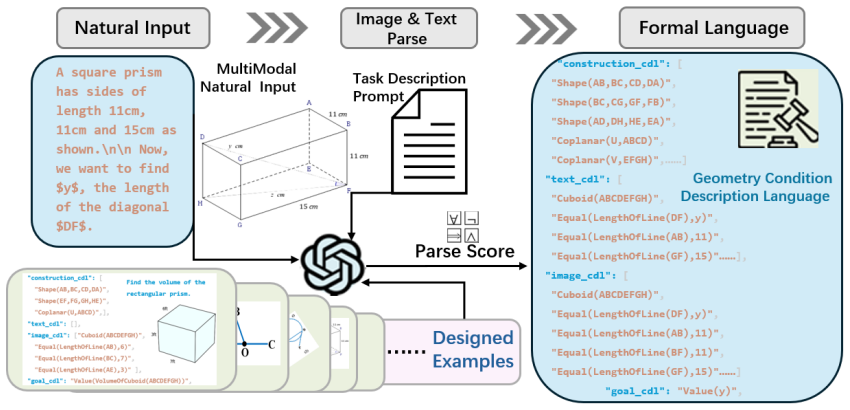
Hilbert-Geo supplies a unified formal language framework with predicates and theorems for solid geometry; the Parse2Reason method parses both problem text and diagrams into CDL, then applies the theorem bank for relational inference and algebraic computation to generate strictly correct and verifiable solutions.
What carries the argument
Conditional description language (CDL), a formalized predicate language for constructing geometric conditions that represents both natural text and visual diagrams to enable subsequent relational inference.
If this is right
- The generated reasoning processes are strictly correct, verifiable, and human-readable.
- The same framework applies directly to plane geometry problems.
- Expert-annotated datasets with formal language annotations, solutions, and answers become available for advancing geometric reasoning research.
- The method substantially outperforms pure multimodal large language models on solid geometry tasks.
Where Pith is reading between the lines
- If CDL representations prove reliable across varied diagram styles, the same parse-then-reason structure could be tested on other spatial reasoning domains such as engineering drawings or molecular structures.
- Expanding the theorem bank with additional solid geometry theorems would allow the system to handle a broader range of problem types without changing the core parsing step.
- Integrating the formal CDL output as an intermediate representation might reduce hallucination rates in larger multimodal models when they are asked to explain 3D geometry solutions.
Load-bearing premise
The conditional description language can accurately and completely represent both natural language problem descriptions and solid diagrams without introducing errors or losing critical information.
What would settle it
A collection of solid geometry problems in which CDL parsing either introduces ambiguities in 3D spatial relations or omits necessary conditions, causing the downstream theorem-based reasoning to produce wrong answers.
Figures






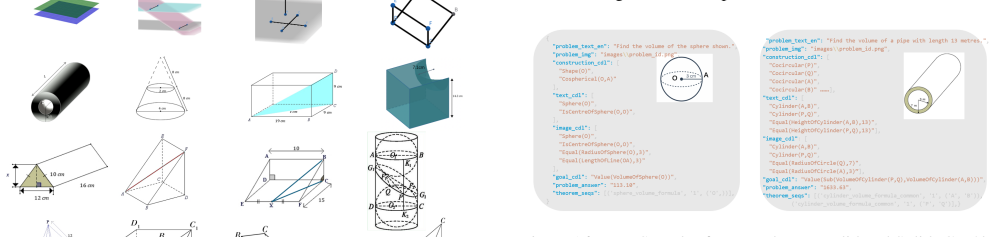
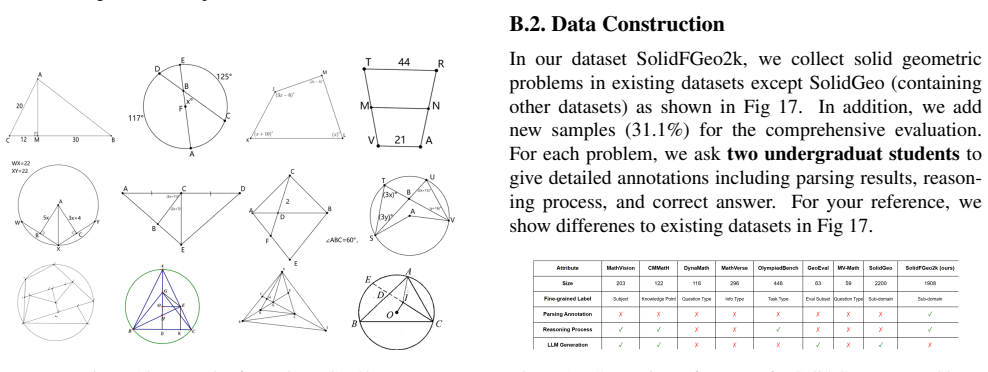


read the original abstract
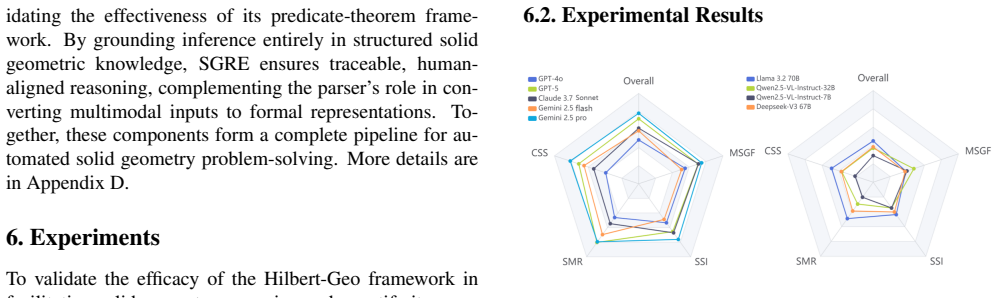
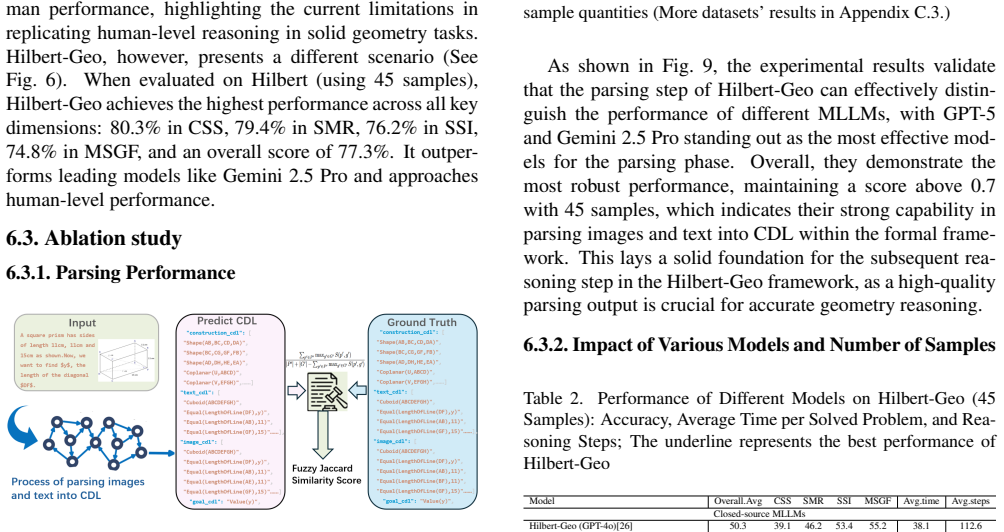
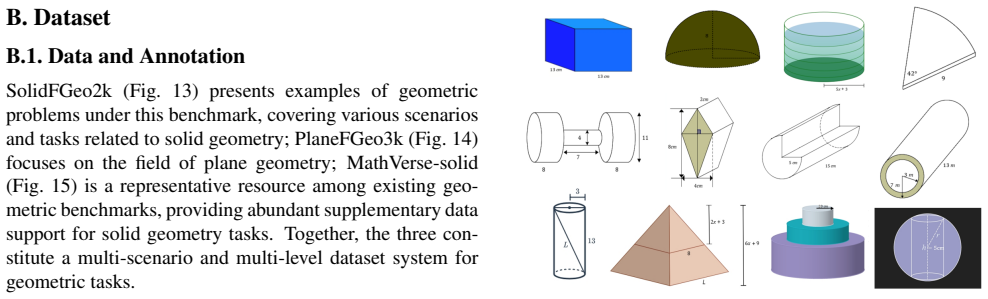
Geometric problem solving, as a typical multimodal reasoning problem, has attracted much attention and made great progress recently, however most of works focus on plane geometry while usually fail in solid geometry due to 3D spatial diagrams and complex reasoning. To bridge this gap, we introduce Hilbert-Geo, the first unified formal language framework for solid geometry, including an extensive predicate library and a dedicated theorem bank. Based on this framework, we propose a Parse2Reason method containing two steps of first parsing then reasoning. In the parsing step, we utilize conditional description language (CDL), a formalized language composed of predicates specifically designed to construct geometric conditions, to represent both problem description (natural text) and solid diagrams (visual image). In the reasoning step, we leverage those formal CDL and the theorem bank to perform relational inference and algebraic computation, generating strictly correct, verifiable, and human-readable reasoning processes. Notably, our proposed Hilbert-Geo is also applicable to plane geometry. To advance geometric reasoning, we curate two expert-annotated dataset SolidFGeo2k and PlaneFGeo3k, which are furnished with geometric formal language annotations, solutions and answers. Extensive experiments show that our proposed method achieves the state-of-the-art (SOTA) performance 77.3% in SolidFGeo2k and 84.1% in MathVerse-Solid (one small subset in MathVerse dedicated to solid geometry), substantially outperforming leading MLLMs, such as Gemini-2.5-pro (54.2% on SolidFGeo2k) and GPT-5 (62.9% on MathVerse-Solid). In addition, our method achieves the SOTA accuracy 80.2% in PlaneFGeo3k, demonstrating the generality of the Hilbert-Geo in geometric reasoning. Our code and datasets are released at https://github.com/PremiLab-Math/Hilbert-Geo.
Editorial analysis
A structured set of objections, weighed in public.
Referee Report
Summary. The paper introduces Hilbert-Geo, a formal language framework for solid geometry that includes a predicate library, Conditional Description Language (CDL), and a dedicated theorem bank. It proposes the Parse2Reason method, which first parses natural-language problem statements and solid diagrams into CDL and then performs relational inference plus algebraic computation via the theorem bank to produce verifiable reasoning traces. New expert-annotated datasets SolidFGeo2k and PlaneFGeo3k are released; the method reports 77.3% accuracy on SolidFGeo2k, 84.1% on MathVerse-Solid, and 80.2% on PlaneFGeo3k, outperforming several MLLMs.
Significance. If the neural parser reliably produces accurate, lossless CDL from raw text+image inputs on held-out problems, the work would demonstrate a viable neural-symbolic route to 3D geometric reasoning that yields human-readable, machine-verifiable proofs—an advance over end-to-end neural baselines that currently lack such guarantees.
major comments (3)
- [§4] §4 (Parse2Reason pipeline): no quantitative evaluation of the neural parser is reported (e.g., exact-match rate or edit distance between automatically generated CDL and expert ground-truth annotations on the test splits of SolidFGeo2k). Without this metric or an ablation that substitutes the parser output for oracle CDL, the 77.3% and 84.1% figures cannot be attributed to the full automatic pipeline.
- [§5.2] §5.2 (experimental comparison): the direct SOTA claim against Gemini-2.5-pro (54.2%) and GPT-5 (62.9%) assumes identical input conditions. Because the test sets are supplied with expert CDL annotations, it is unclear whether the reported numbers use parsed CDL or oracle CDL; if the latter, the comparison to end-to-end MLLMs that must parse raw inputs is invalid.
- [§3.2] §3.2 (theorem bank): the bank is presented as central to the reasoning step, yet no coverage statistics, verification procedure, or failure cases on solid-geometry problems are supplied. This leaves open whether the reported accuracies rest on a complete or curated subset of theorems.
minor comments (2)
- [Figure 3] Figure 3 (pipeline diagram): the flow from diagram to CDL predicates is shown schematically but lacks a concrete side-by-side example of an input diagram, its parsed CDL, and the subsequent inference steps.
- [§2] §2 (related work): the discussion of prior plane-geometry neuro-symbolic systems is adequate, but the text does not explicitly contrast the new CDL predicates required for 3D relations (e.g., occlusion, depth ordering) with existing 2D formalisms.
Simulated Author's Rebuttal
We thank the referee for the detailed and constructive feedback. The comments highlight important gaps in evaluation and documentation that we will address through revisions to strengthen the paper's claims about the full automatic pipeline.
read point-by-point responses
-
Referee: [§4] §4 (Parse2Reason pipeline): no quantitative evaluation of the neural parser is reported (e.g., exact-match rate or edit distance between automatically generated CDL and expert ground-truth annotations on the test splits of SolidFGeo2k). Without this metric or an ablation that substitutes the parser output for oracle CDL, the 77.3% and 84.1% figures cannot be attributed to the full automatic pipeline.
Authors: We acknowledge the validity of this observation. The submitted manuscript reports end-to-end results but omits separate parser metrics and ablations. In the revised version we will add exact-match rates, edit distances, and other parser accuracy metrics on the SolidFGeo2k test split, together with an oracle-CDL ablation that isolates the parser's contribution. These additions will allow the reported accuracies to be properly attributed to the automatic pipeline. revision: yes
-
Referee: [§5.2] §5.2 (experimental comparison): the direct SOTA claim against Gemini-2.5-pro (54.2%) and GPT-5 (62.9%) assumes identical input conditions. Because the test sets are supplied with expert CDL annotations, it is unclear whether the reported numbers use parsed CDL or oracle CDL; if the latter, the comparison to end-to-end MLLMs that must parse raw inputs is invalid.
Authors: The 77.3 % and 84.1 % figures were obtained with the automatic Parse2Reason pipeline that ingests raw text and images and produces CDL via the trained neural parser; oracle CDL is used only for parser training and for the planned ablation. We will add an explicit statement in §5.2 clarifying the input conditions and confirming that all reported numbers reflect parsed, not oracle, CDL, thereby preserving the validity of the comparison with end-to-end MLLMs. revision: yes
-
Referee: [§3.2] §3.2 (theorem bank): the bank is presented as central to the reasoning step, yet no coverage statistics, verification procedure, or failure cases on solid-geometry problems are supplied. This leaves open whether the reported accuracies rest on a complete or curated subset of theorems.
Authors: We agree that additional documentation is required. The revised manuscript will include coverage statistics (fraction of SolidFGeo2k problems solvable by the bank), a description of the verification procedure (expert review plus automated consistency checks), and a summary of observed failure cases or coverage gaps for solid-geometry problems. These details will clarify the scope and completeness of the theorem bank. revision: yes
Circularity Check
No significant circularity in derivation chain
full rationale
The paper introduces a new formal framework (CDL predicates and theorem bank), curates expert-annotated datasets (SolidFGeo2k, PlaneFGeo3k), and reports empirical accuracies from applying the Parse2Reason pipeline (neural parsing followed by symbolic inference) to held-out test portions. No equations, self-citations, or parameter-fitting steps are described that reduce the reported SOTA numbers (77.3%, 84.1%, 80.2%) to the inputs by construction; the results remain externally falsifiable measurements on the released datasets and code.
Axiom & Free-Parameter Ledger
axioms (1)
- standard math Standard rules of logical inference and algebraic computation hold for geometric predicates.
invented entities (2)
-
Conditional Description Language (CDL)
no independent evidence
-
Theorem bank
no independent evidence
Reference graph
Works this paper leans on
-
[1]
Claude 3.7 sonnet system card.https : //www.anthropic.com/claude- 3- 7- sonnet- system-card, 2025
Anthropic. Claude 3.7 sonnet system card.https : //www.anthropic.com/claude- 3- 7- sonnet- system-card, 2025. System card for Claude 3.7 Sonnet
2025
-
[2]
Arnon, George E
Dennis S. Arnon, George E. Collins, and Scott McCallum. Cylindrical algebraic decomposition i: The basic algorithm. SIAM Journal on Computing, 13(4):865–877, 1984
1984
-
[3]
Birkh ¨auser Basel, 2004
Lucian B ˘adescu.Projective Geometry and Formal Geome- try. Birkh ¨auser Basel, 2004
2004
-
[4]
Shuai Bai, Keqin Chen, Xuejing Liu, et al. Qwen2.5-VL technical report.arXiv preprint arXiv:2502.13923, 2025
work page internal anchor Pith review Pith/arXiv arXiv 2025
-
[5]
Relational inductive biases, deep learning, and graph networks
Peter W. Battaglia, Jessica B. Hamrick, Victor Bapst, et al. Relational inductive biases, deep learning, and graph net- works.arXiv preprint arXiv:1806.01261, 2018
work page internal anchor Pith review Pith/arXiv arXiv 2018
-
[6]
Xing, and Liang Lin
Jiaqi Chen, Jianheng Tang, Jinghui Qin, Xiaodan Liang, Lingbo Liu, Eric P. Xing, and Liang Lin. GeoQA: A ge- ometric question answering benchmark towards multimodal numerical reasoning. InFindings of the Association for Com- putational Linguistics: ACL-IJCNLP 2021, pages 513–523, 2021
2021
-
[7]
UniGeo: Unify- ing geometry logical reasoning via reformulating mathemat- ical expression
Jiaqi Chen, Tong Li, Jinghui Qin, et al. UniGeo: Unify- ing geometry logical reasoning via reformulating mathemat- ical expression. InProceedings of the 2022 Conference on Empirical Methods in Natural Language Processing, pages 3313–3323, 2022
2022
-
[8]
Do NOT think that much for 2+3=? on the overthinking of long reasoning models
Xingyu Chen, Jiahao Xu, Tian Liang, et al. Do NOT think that much for 2+3=? on the overthinking of long reasoning models. InProceedings of the 42nd International Confer- ence on Machine Learning, pages 9487–9499. PMLR, 2025
2025
-
[9]
A coefficient of agreement for nominal scales
Jacob Cohen. A coefficient of agreement for nominal scales. Educational and Psychological Measurement, 20(1):37–46, 1960
1960
-
[10]
DeepSeek-AI. DeepSeek-V3 technical report.arXiv preprint arXiv:2412.19437, 2024
work page internal anchor Pith review Pith/arXiv arXiv 2024
-
[11]
Gemini 2.5: Updates to our family of thinking mod- els.https://developers.googleblog.com/en/ gemini- 2- 5- thinking- model- updates/, 2025
Google. Gemini 2.5: Updates to our family of thinking mod- els.https://developers.googleblog.com/en/ gemini- 2- 5- thinking- model- updates/, 2025. Introduces Gemini 2.5 Pro and Gemini 2.5 Flash updates
2025
-
[12]
Large language models: A comprehensive survey of its applications, challenges, limitations, and future prospects
Muhammad Usman Hadi, Qasem Al Tashi, Abbas Shah, et al. Large language models: A comprehensive survey of its applications, challenges, limitations, and future prospects. TechRxiv, 2024. Preprint, version 6
2024
-
[13]
Formal verification meth- ods
Osman Hasan and Sofiene Tahar. Formal verification meth- ods. InEncyclopedia of Information Science and Technol- ogy, Third Edition, pages 7162–7170. IGI Global Scientific Publishing, 2015
2015
-
[14]
Springer Tokyo, 2014
Takayuki Hibi, editor.Gr ¨obner Bases: Statistics and Soft- ware Systems. Springer Tokyo, 2014. Copyright 2013
2014
-
[15]
Solving ge- ometry problems via feature learning and contrastive learn- ing of multimodal data.Computer Modeling in Engineering & Sciences, 136(2):1707–1728, 2023
Pengpeng Jian, Fucheng Guo, Yanli Wang, et al. Solving ge- ometry problems via feature learning and contrastive learn- ing of multimodal data.Computer Modeling in Engineering & Sciences, 136(2):1707–1728, 2023
2023
-
[16]
A survey on large language models for code generation.ACM Transactions on Software Engineering and Methodology, 35(2):1–72, 2026
Juyong Jiang, Fan Wang, Jiasi Shen, et al. A survey on large language models for code generation.ACM Transactions on Software Engineering and Methodology, 35(2):1–72, 2026
2026
-
[17]
Vidhalluc: Evaluating temporal hallucinations in multimodal large lan- guage models for video understanding
Chaoyu Li, Eun Woo Im, Pooyan Fazli, et al. Vidhalluc: Evaluating temporal hallucinations in multimodal large lan- guage models for video understanding. InProceedings of the IEEE/CVF Conference on Computer Vision and Pattern Recognition (CVPR), pages 13723–13733, 2025
2025
-
[18]
A survey on deep learning for theorem proving
Zhaoyu Li, Jialiang Sun, Logan Murphy, et al. A survey on deep learning for theorem proving. InProceedings of the First Conference on Language Modeling, 2024
2024
-
[19]
Inter-GPS: In- terpretable geometry problem solving with formal language and symbolic reasoning
Pan Lu, Ran Gong, Shibiao Jiang, et al. Inter-GPS: In- terpretable geometry problem solving with formal language and symbolic reasoning. InProceedings of the 59th An- nual Meeting of the Association for Computational Linguis- tics and the 11th International Joint Conference on Natural Language Processing (Volume 1: Long Papers), pages 6774– 6786, Online, ...
2021
-
[20]
MathVista: Evalu- ating mathematical reasoning of foundation models in visual contexts
Pan Lu, Hritik Bansal, Tony Xia, et al. MathVista: Evalu- ating mathematical reasoning of foundation models in visual contexts. InThe Twelfth International Conference on Learn- ing Representations, 2024. Oral presentation
2024
-
[21]
Llama 3.3 model cards and prompt formats, 2024
Meta. Llama 3.3 model cards and prompt formats, 2024. Of- ficial Meta documentation for Llama 3.3, release date: De- cember 6, 2024
2024
-
[22]
Autofor- malizing euclidean geometry
Logan Murphy, Kaiyu Yang, Jialiang Sun, et al. Autofor- malizing euclidean geometry. InProceedings of the 41st In- ternational Conference on Machine Learning, pages 36847– 36893. PMLR, 2024
2024
-
[23]
A com- prehensive overview of large language models.ACM Trans- actions on Intelligent Systems and Technology, 16(5):1–72, 2025
Humza Naveed, Asad Ullah Khan, Shi Qiu, et al. A com- prehensive overview of large language models.ACM Trans- actions on Intelligent Systems and Technology, 16(5):1–72, 2025
2025
-
[24]
A symbolic characters aware model for solving ge- ometry problems
Maizhen Ning, Qiu-Feng Wang, Kaizhu Huang, and Xiaowei Huang. A symbolic characters aware model for solving ge- ometry problems. InProceedings of the 31st ACM Inter- national Conference on Multimedia (MM ’23), pages 7767– 7775, New York, NY , USA, 2023. ACM
2023
-
[25]
GNS: Solving plane geometry problems by neural-symbolic reasoning with multi-modal llms
Maizhen Ning, Zihao Zhou, Qiufeng Wang, Xiaowei Huang, and Kaizhu Huang. GNS: Solving plane geometry problems by neural-symbolic reasoning with multi-modal llms. InPro- ceedings of the AAAI Conference on Artificial Intelligence, pages 24957–24965, 2025
2025
-
[26]
Hello gpt-4o.https : / / openai
OpenAI. Hello gpt-4o.https : / / openai . com / index/hello-gpt-4o/, 2024. OpenAI announcement
2024
-
[27]
Introducing gpt-5.https://openai.com/ index/introducing- gpt- 5/, 2025
OpenAI. Introducing gpt-5.https://openai.com/ index/introducing- gpt- 5/, 2025. OpenAI an- nouncement
2025
-
[28]
GPT-5 system card.https://openai.com/ index/gpt-5-system-card/, 2025
OpenAI. GPT-5 system card.https://openai.com/ index/gpt-5-system-card/, 2025. OpenAI system card
2025
-
[29]
Pittalis and C
M. Pittalis and C. Christou. Types of reasoning in 3d geom- etry thinking and their relation with spatial ability.Educa- tional Studies in Mathematics, 75(2):191–212, 2010
2010
-
[30]
Gemini: A Family of Highly Capable Multimodal Models
Gemini Team. Gemini: A family of highly capable multi- modal models.arXiv preprint arXiv:2312.11805, 2023
work page internal anchor Pith review Pith/arXiv arXiv 2023
-
[31]
Measuring multi- modal mathematical reasoning with math-vision dataset
Ke Wang, Junting Pan, Weikang Shi, et al. Measuring multi- modal mathematical reasoning with math-vision dataset. In NeurIPS 2024 Datasets and Benchmarks Track, 2024
2024
-
[32]
SolidGeo: Measuring multimodal spatial math reasoning in solid ge- ometry
Peijie Wang, Chao Yang, Zhong-Zhi Li, et al. SolidGeo: Measuring multimodal spatial math reasoning in solid ge- ometry. InNeurIPS 2025 Datasets and Benchmarks Track,
2025
-
[33]
Thoughts are all over the place: On the underthinking of o1-like llms
Yue Wang, Qiuzhi Liu, Jiahao Xu, Tian Liang, Xingyu Chen, Zhiwei He, Linfeng Song, Dian Yu, Juntao Li, Zhuosheng Zhang, et al. Thoughts are all over the place: On the under- thinking of o1-like llms.arXiv preprint arXiv:2501.18585, 2025
-
[34]
A survey on large language models for recommendation.World Wide Web, 27(5):60, 2024
Likang Wu, Zhi Zheng, Zhaopeng Qiu, et al. A survey on large language models for recommendation.World Wide Web, 27(5):60, 2024
2024
-
[35]
Weiming Wu, Jiachen Ye, Zihao Wang, Ziyi Zhou, Yifan Li, and Luzhen Guo. Nesygeo: A neuro-symbolic framework for multimodal geometric reasoning data generation.arXiv preprint arXiv:2505.17121, 2025
-
[36]
GeoX: Ge- ometric problem solving through unified formalized vision- language pre-training
Renqiu Xia, Mingsheng Li, Hancheng Ye, et al. GeoX: Ge- ometric problem solving through unified formalized vision- language pre-training. InThe Thirteenth International Con- ference on Learning Representations, 2025
2025
-
[37]
Math- Verse: Does your multi-modal llm truly see the diagrams in visual math problems? InEuropean Conference on Com- puter Vision, pages 169–186
Renrui Zhang, Dongzhi Jiang, Yichi Zhang, et al. Math- Verse: Does your multi-modal llm truly see the diagrams in visual math problems? InEuropean Conference on Com- puter Vision, pages 169–186. Springer, 2024
2024
-
[38]
Xiaokai Zhang, Na Zhu, Yiming He, et al. FormalGeo: An extensible formalized framework for olympiad geometric problem solving.arXiv preprint arXiv:2310.18021, 2023
-
[39]
Pi-GPS: Enhancing geometry problem solving by unleashing the power of diagrammatic information
Junbo Zhao, Ting Zhang, Jiayu Sun, Mi Tian, and Hua Huang. Pi-GPS: Enhancing geometry problem solving by unleashing the power of diagrammatic information. In Proceedings of the IEEE/CVF International Conference on Computer Vision (ICCV), pages 1526–1536, 2025
2025
-
[40]
A Survey of Large Language Models
Wayne Xin Zhao, Kun Zhou, Junyi Li, et al. A survey of large language models.arXiv preprint arXiv:2303.18223, 2023. Hilbert-Geo: Solving Solid Geometric Problems by Neural-Symbolic Reasoning Supplementary Material A. Solid Geometry Formal Language A.1. Formal Geometry Representation In the domain of solid geometry, simple geometric bodies serve as fundame...
work page internal anchor Pith review Pith/arXiv arXiv 2023
-
[41]
LetR A andR B be face sets of two valid polyhedra
-
[42]
Execute the operationR result =R A ⊕3D RB
-
[43]
This operation removes the internal contact faces (S A andS B) and retains all external surfaces
-
[44]
According to the generalization of Euler’s formula for manifolds, when two closed manifolds are glued along a simply connected face and that face is removed, the remaining surface still constitutes a closed 2-manifold (i.e., the boundary of the new polyhedron)
-
[45]
∀RA, RB ∈S,(R A ⊕3D RB)∈S(5) Theorem A.2.R A ⊕3D RB =R B ⊕3D RA
Therefore,R result remains a set of faces describing a closed solid. ∀RA, RB ∈S,(R A ⊕3D RB)∈S(5) Theorem A.2.R A ⊕3D RB =R B ⊕3D RA. Proof.LetR A containmfaces andR B containnfaces. Based on Eq. 4: RA ⊕3D RB ={f|f∈R A ∪R B, f̸=S A, f̸=S B}(6) Now consider the reverse operationR B ⊕3D RA: RB ⊕3D RA = (R B \ {SB})∪(R A \ {SA})(7) According to set algebra, ...
-
[46]
PolyhedraAandBshare interface faces(S AB, SBA)
-
[47]
par- allel
PolyhedraBandCshare interface faces(S BC , SCB ). 3.R A, RB, RC are their respective face sets. Left Hand Side: LetR AB =R A ⊕3D RB. RAB = (R A ∪R B)\ {S AB, SBA}(10) Next, calculateR AB ⊕3D RC. The contact interface in- volvesBandC(i.e.,S BC andS CB ): (RA ⊕3D RB)⊕ 3D RC = (R AB ∪R C)\ {S BC , SCB } (11) = ((R A ∪R B)\ {S AB, SBA} ∪R C)\ {S BC , SCB } (1...
-
[48]
- image_cdl MUST include only facts directly observable from the image (e.g., length labels, right-angle marks, shape recognition)
Information Source Separation: - text_cdl MUST include only facts extracted from the natural language description. - image_cdl MUST include only facts directly observable from the image (e.g., length labels, right-angle marks, shape recognition). - If a fact appears in both text and image, include it in both fields
-
[49]
construction_cdl - Geometric construction predicates (IMPORTANT): construction_cdl defines basic construction for entities, and MUST include the following types where applicable: - Shape predicates: define edges/segments of shapes * For segments/edges: Shape(AB,BC,CD,DA) or Shape(OP,PO) or Shape(PQ,QP) * For points (spheres etc.): Shape(O) or Shape(P) * E...
-
[50]
10", "36 *pi
Answer formatting: - problem_answer MUST be a pure number or expression (e.g., "10", "36 *pi"), and MUST NOT contain units or extra text
-
[51]
Core predicate logic: - Length/Height: Equal(LengthOfLine(A,B),5), Equal(HeightOfCone(O,P),12) - Relations: PerpendicularBetweenLine(A,B,C,D), ParallelBetweenLine(A,B,C,D) - Goal: the requested quantity MUST be wrapped by Value(...)
-
[52]
- Quantities allowed in CDL expressions are LIMITED to standard forms: VolumeOfCone, SurfaceAreaOfCylinder, AreaOfCircle, LengthOfLine, etc
Predicate and Operator Legality (CRITICAL): - Only reuse names from the official predicate list; DO NOT invent new construction predicates. - Quantities allowed in CDL expressions are LIMITED to standard forms: VolumeOfCone, SurfaceAreaOfCylinder, AreaOfCircle, LengthOfLine, etc. - Only the following algebraic operators are allowed: Value, Add, Sub, Mul, ...
-
[53]
Important: Output Requirements
Completeness Checks: - Ensure every entity used by text_cdl/image_cdl exists in construction_cdl - Ensure the target entity in goal_cdl exists in the construction as well - Self-check after generation: verify all predicates/operators are allowed, no extra spaces, and no undeclared entities are referenced. Important: Output Requirements
-
[54]
You MUST output a complete JSON object with all required fields
-
[55]
All CDL fields MUST be arrays of strings
-
[56]
Value(VolumeOfCone(O,P))
goal_cdl MUST be a string (e.g., "Value(VolumeOfCone(O,P))") C.4.2. Direct Problem Solving Prompt In addition to CDL generation, the system also supportsdi- rect problem solvingusing GPT models fortesting model accuracy. This approach bypasses formalization and di- rectly generates answers to geometry problems, providing a baseline for comparison with for...
-
[57]
Carefully analyze the problem text and the accompanying image
-
[58]
Show your reasoning process step by step
-
[59]
At the end, provide your final answer in a clear format
-
[60]
10", "5.5
**Your final answer should be ONLY a number or mathematical expression (like "10", "5.5", "12 *pi", "36 *pi"), without any units or text **
-
[61]
FINAL ANSWER:
Put your final answer on a line starting with "FINAL ANSWER: " Example format: FINAL ANSWER: 10 or FINAL ANSWER: 36 *pi Now, please solve this problem: D. SGRE Supplementary Information D.1. Theorem Search Tree and Search Process Figure 24. Theorem Search Tree and a inference demonstration is shown in fig. 28 The search process involves constructing a sea...
discussion (0)
Sign in with ORCID, Apple, or X to comment. Anyone can read and Pith papers without signing in.