Bayesian Classification with Probit-link Split-and-merge Gaussian Process Prior in EEG-based Brain-Computer Interfaces
Pith reviewed 2026-06-28 20:47 UTC · model grok-4.3
The pith
A Probit-link Split-and-merge Gaussian Process prior performs spatial-temporal feature selection for EEG classification in brain-computer interfaces.
A machine-rendered reading of the paper's core claim, the machinery that carries it, and where it could break.
Core claim
The P-SMGP prior allows for binary classification of EEG responses to stimuli by performing spatial-temporal feature selection that captures distinctions between target and non-target ERP responses, leading to reduced computational complexity and interpretable transformed ERP functions while maintaining comparable prediction accuracy.
What carries the argument
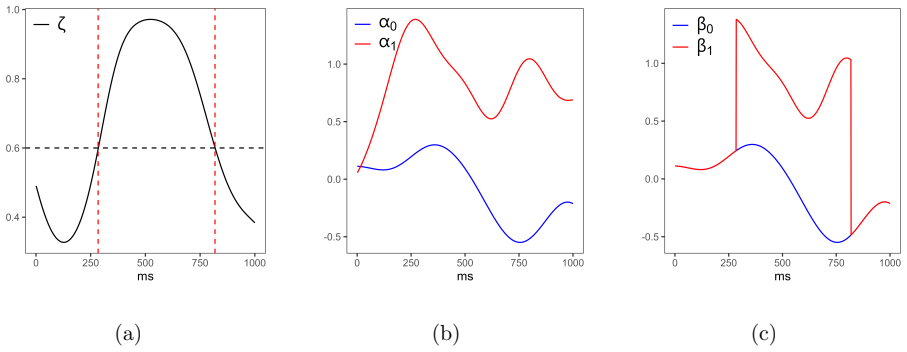
The Probit-link Split-and-merge Gaussian Process (P-SMGP) prior, which integrates split-and-merge operations into a Gaussian process to select spatial-temporal features in ERP data for classification.
If this is right
- Computational complexity in EEG-based BCI classification is reduced.
- Statistical interpretations become available on transformed ERP functions.
- Prediction accuracy remains comparable to existing methods.
- Interpretable, stimulus-level modeling advances predictive and personalized BCI systems.
Where Pith is reading between the lines
- The method could extend to multi-class classification problems in other neuroimaging modalities.
- Interpretability might allow for personalized adjustments based on individual ERP patterns.
- Reduced complexity could enable real-time BCI applications on resource-limited devices.
Load-bearing premise
The split-and-merge mechanism in the Gaussian process prior effectively captures target/non-target distinctions without requiring dataset-specific adjustments that affect generalizability.
What would settle it
A new EEG dataset where the P-SMGP model shows significantly higher computational cost or lower accuracy than standard methods would falsify the central claim.
Figures

read the original abstract
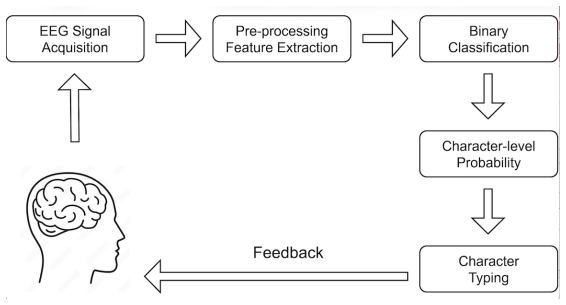
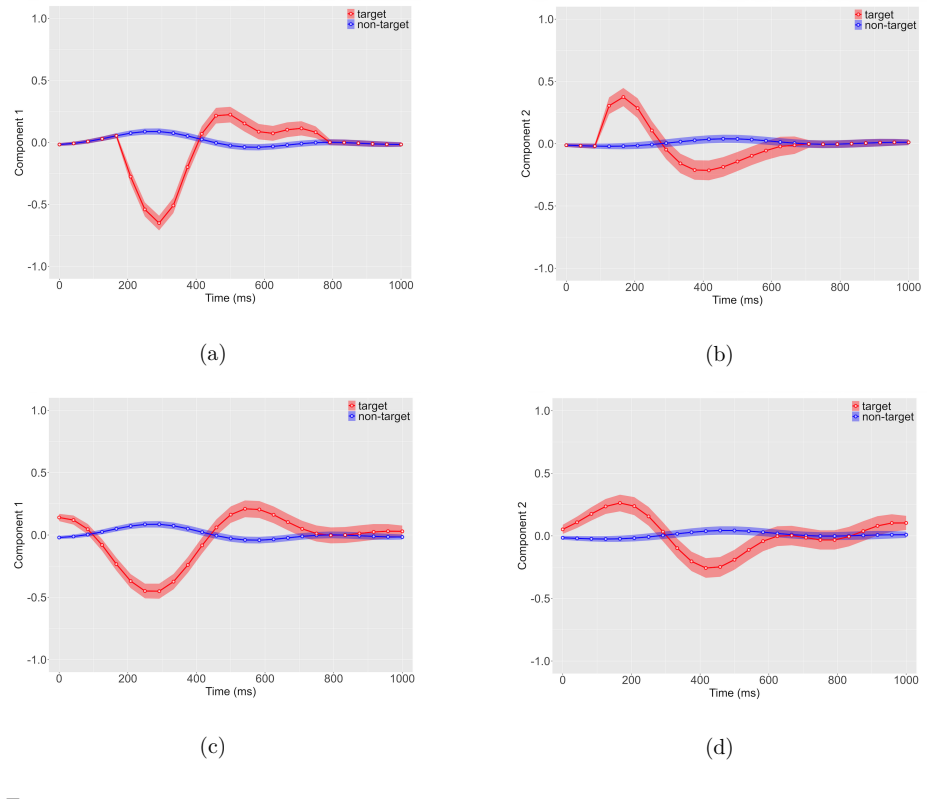
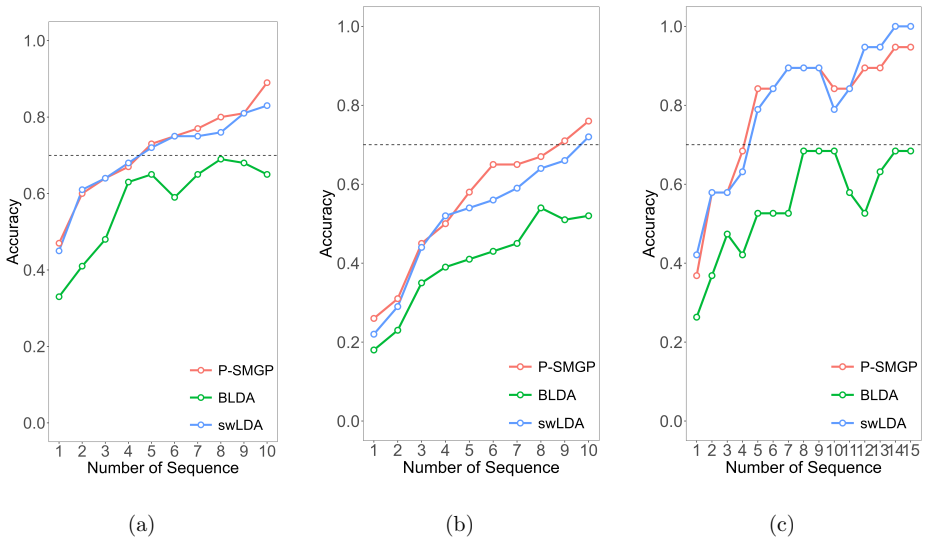
A Brain-Computer Interface (BCI) speller systems based on Event-Related Potentials (ERPs) enables users to select characters by detecting brain responses to visual stimuli, recorded through electroencephalogram (EEG). One challenge is to accurately identify target-related responses, such as the P300 component. However, existing methods tend to ignore feature selection, perform feature selection without interpretability, or require large computational effort or data manipulation. To address these limitations, we propose a novel Bayesian generative modeling framework to the binary classification of EEG responses to stimuli. Our approach employs a Probit-link Split-and-merge Gaussian Process (P-SMGP) prior to perform spatial-temporal feature selection, effectively capturing the distinctions between target and non-target ERP responses. Through both simulation studies and real EEG data analysis, our approach can reduce computational complexity and provide statistical interpretations on transformed ERP functions while maintaining comparable prediction accuracy. These findings underscore the value of interpretable, stimulus-level modeling for advancing predictive and personalized BCI systems.
Editorial analysis
A structured set of objections, weighed in public.
Referee Report
Summary. The manuscript presents a Bayesian classification framework for EEG-based BCI using a Probit-link Split-and-merge Gaussian Process (P-SMGP) prior. The approach is designed to perform spatial-temporal feature selection on ERP responses, reduce computational complexity, offer statistical interpretations of transformed ERP functions, and achieve comparable prediction accuracy to existing methods, as demonstrated in simulation studies and real EEG data analysis.
Significance. If the empirical results hold, this work provides a valuable contribution to the field by introducing an interpretable Bayesian model that integrates feature selection into the prior structure for high-dimensional spatio-temporal EEG data. This could advance the development of efficient and personalized BCI systems by addressing limitations in current methods regarding feature selection and computational effort. The split-and-merge construction and probit link are presented as enabling automatic selection without post-hoc tuning.
minor comments (1)
- [Abstract] Abstract: the claim of 'comparable prediction accuracy' and 'reduced computational complexity' is stated without any quantitative support (e.g., accuracy values, runtime comparisons, or baseline methods); while the full manuscript presumably supplies these in the simulation and real-data sections, the abstract would be strengthened by including at least one key numerical result or range.
Simulated Author's Rebuttal
We thank the referee for the constructive review and positive recommendation for minor revision. The report provides a clear summary of our contribution but does not list any specific major comments requiring point-by-point response.
Circularity Check
No significant circularity detected
full rationale
The manuscript proposes a Bayesian generative model using a Probit-link Split-and-merge Gaussian Process prior for EEG classification. Its central claims rest on simulation studies and real-data empirical comparisons that directly evaluate computational complexity, prediction accuracy, and interpretability of transformed ERP functions. No derivation chain, equations, or self-citation structure is presented that reduces any reported prediction or uniqueness result to a fitted input or prior self-reference by construction; the argument is therefore self-contained against external benchmarks.
Axiom & Free-Parameter Ledger
Reference graph
Works this paper leans on
-
[1]
Statistical Science , year = 1992, month = jan, volume =
Bhatti, M. H., Khan, J., Khan, M. U. G., Iqbal, R., Aloqaily, M., Jararweh, Y. & Gupta, B. (2019), ‘Soft Computing-Based EEG Classification by Optimal Feature Selection and Neural Networks’,IEEE Transactions on Industrial Informatics15(10), 5747–5754. URL:https://ieeexplore.ieee.org/document/8750849/ Bingham, E., Chen, J. P., Jankowiak, M., Obermeyer, F.,...
-
[2]
Conference Proceedings.’, IEEE, Capri Island, Italy, pp. 626–629. URL:http://ieeexplore.ieee.org/document/1196906/ Thompson, D. E., Gruis, K. L. & Huggins, J. E. (2014), ‘A plug-and-play brain- computer interface to operate commercial assistive technology’,Disability and Reha- bilitation: Assistive Technology9(2), 144–150. Publisher: Taylor & Francis _epr...
discussion (0)
Sign in with ORCID, Apple, or X to comment. Anyone can read and Pith papers without signing in.