Latent Space Disentanglement via Activation Steering for Interpretable Attribute Control in Symbolic Music Generation
Pith reviewed 2026-06-28 21:03 UTC · model grok-4.3
The pith
Orthogonalized difference-in-means vectors enable independent steering of pitch and duration in a music generation transformer at inference time.
A machine-rendered reading of the paper's core claim, the machinery that carries it, and where it could break.
Core claim
Utilizing the Difference-in-Means methodology isolates latent directions for signal attributes within the residual stream, and the Dual Steering framework with Gram-Schmidt Orthogonalization decouples these directions to enable independent deterministic control over pitch and duration.
What carries the argument
Dual Steering framework that uses Gram-Schmidt Orthogonalization on difference-in-means vectors to achieve geometric decoupling of entangled attribute directions.
If this is right
- Independent deterministic control of multiple attributes becomes possible even against strong autoregressive conditioning.
- Conceptual interference and signal degradation decrease compared to adding vectors without orthogonalization.
- Steering magnitude shows high correlation with the resulting attribute shift.
- The method works without any retraining of the underlying music transformer.
Where Pith is reading between the lines
- This technique might transfer to controlling other discrete attributes if they also admit linear representations.
- Similar orthogonalization could be tested in other sequence generation domains beyond music.
- Real-time applications could benefit if the steering can be computed efficiently during generation.
Load-bearing premise
The linear representation hypothesis holds for attributes like pitch and duration in the transformer's residual stream, allowing difference-in-means to isolate usable directions.
What would settle it
Observing persistent conceptual interference or lack of independent control after applying the orthogonalized vectors would falsify the effectiveness of the geometric decoupling.
Figures

read the original abstract
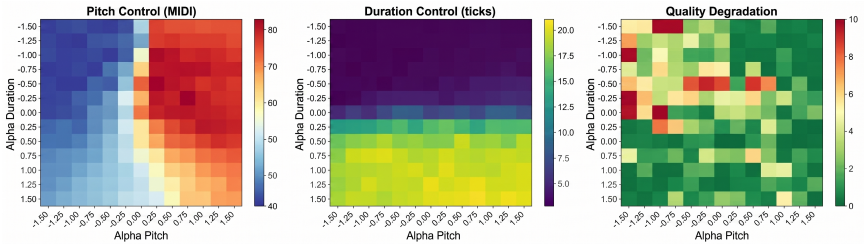
Transformer-based architectures have significantly advanced the generation of complex symbolic sequences, yet a significant gap remains in achieving fine-grained, interpretable control over discrete signal attributes. This paper investigates the mechanistic interpretability of the Multitrack Music Transformer (MMT) and proposes a framework for deterministic attribute modulation without retraining to bridge this gap via inference-time activation steering. Utilizing the Difference-in-Means (DiffMean) methodology, we isolate latent directions for signal attributes, specifically Pitch and Duration, within the residual stream. We validate the Linear Representation Hypothesis in this domain, achieving high correlation between steering magnitude and attribute shift. To address the inherent feature entanglement in multi-attribute steering, we introduce a Dual Steering framework utilizing Gram-Schmidt Orthogonalization. Experimental results demonstrate that this geometric decoupling reduces conceptual interference and signal degradation compared to naive vector addition, enabling independent deterministic control even against strong autoregressive conditioning.
Editorial analysis
A structured set of objections, weighed in public.
Referee Report
Summary. The paper claims that Difference-in-Means applied to residual-stream activations in the Multitrack Music Transformer isolates usable directions for Pitch and Duration, validating the Linear Representation Hypothesis via high correlation between steering magnitude and attribute shift. It further introduces a Dual Steering method that applies Gram-Schmidt orthogonalization to these directions, asserting that the resulting geometric decoupling measurably reduces conceptual interference and signal degradation relative to naive vector addition and permits independent deterministic control even under strong autoregressive conditioning.
Significance. If the quantitative claims hold, the work would supply a training-free, inference-time technique for disentangling discrete musical attributes inside an existing transformer, extending activation-steering methods to symbolic music generation. The explicit comparison of naive addition versus orthogonalized steering is a concrete contribution that could be reused in other sequential domains, provided the reported reduction in interference is shown to arise from vector overlap rather than from already-orthogonal directions.
major comments (3)
- [Abstract] Abstract: the central claim that Gram-Schmidt 'reduces conceptual interference and signal degradation compared to naive vector addition' is load-bearing, yet the abstract supplies no numerical values for correlation, interference metrics, cosine similarity between the two DiffMean vectors, or any ablation that isolates the effect of orthogonalization. Without these quantities it is impossible to determine whether the reported improvement is caused by the geometric step or is illusory.
- [Results] Results / Dual Steering section: the manuscript does not report the cosine similarity (or inner product) between the raw DiffMean directions for Pitch and Duration. If this similarity is already near zero or if either vector has small norm, orthogonalization changes little; the headline claim that geometric decoupling is responsible for reduced interference therefore cannot be evaluated.
- [Methods] Methods: no dataset size, number of tracks, or precise definition of the 'attribute shift' used to compute the reported correlation is given, nor are error bars or statistical tests supplied. These omissions make the validation of the Linear Representation Hypothesis unverifiable from the presented evidence.
minor comments (1)
- [Abstract] The phrase 'strong autoregressive conditioning' is used without specifying the exact conditioning strength or the metric used to quantify control success under that conditioning.
Simulated Author's Rebuttal
Thank you for the detailed and constructive referee report. We address each major comment below and will revise the manuscript to improve clarity and verifiability.
read point-by-point responses
-
Referee: [Abstract] Abstract: the central claim that Gram-Schmidt 'reduces conceptual interference and signal degradation compared to naive vector addition' is load-bearing, yet the abstract supplies no numerical values for correlation, interference metrics, cosine similarity between the two DiffMean vectors, or any ablation that isolates the effect of orthogonalization. Without these quantities it is impossible to determine whether the reported improvement is caused by the geometric step or is illusory.
Authors: We agree that the abstract should be strengthened with quantitative support for the central claim. In the revised version we will add the reported correlation between steering magnitude and attribute shift, the interference metrics, the cosine similarity between the two DiffMean vectors, and a brief reference to the ablation comparing naive addition versus orthogonalized steering. revision: yes
-
Referee: [Results] Results / Dual Steering section: the manuscript does not report the cosine similarity (or inner product) between the raw DiffMean directions for Pitch and Duration. If this similarity is already near zero or if either vector has small norm, orthogonalization changes little; the headline claim that geometric decoupling is responsible for reduced interference therefore cannot be evaluated.
Authors: This observation is correct; the current manuscript does not report the cosine similarity or norms of the raw DiffMean vectors. We will add these values (and the inner product) to the Dual Steering section of the revised manuscript so that readers can directly assess the degree of overlap and the incremental benefit of Gram-Schmidt orthogonalization. revision: yes
-
Referee: [Methods] Methods: no dataset size, number of tracks, or precise definition of the 'attribute shift' used to compute the reported correlation is given, nor are error bars or statistical tests supplied. These omissions make the validation of the Linear Representation Hypothesis unverifiable from the presented evidence.
Authors: We acknowledge that these details are insufficiently explicit. The revised manuscript will state the dataset size and number of tracks, provide a precise definition of attribute shift, report error bars on all correlations, and include statistical tests supporting the Linear Representation Hypothesis validation. revision: yes
Circularity Check
No circularity: empirical DiffMean extraction and standard Gram-Schmidt are independent of target outputs
full rationale
The derivation chain consists of (1) computing DiffMean vectors from model activations for Pitch and Duration, (2) applying Gram-Schmidt orthogonalization as a fixed linear-algebra step, and (3) measuring empirical correlations between steering magnitude and attribute change. None of these steps defines a quantity in terms of itself or renames a fitted parameter as a prediction. The Linear Representation Hypothesis is tested rather than assumed as a uniqueness theorem. No self-citations appear in the load-bearing claims, and the reported improvement is presented as an experimental outcome, not a mathematical identity. The method is therefore self-contained against external benchmarks.
Axiom & Free-Parameter Ledger
free parameters (1)
- steering magnitude
axioms (1)
- domain assumption Linear Representation Hypothesis holds for Pitch and Duration in the residual stream of MMT
Reference graph
Works this paper leans on
-
[1]
Artificial intelligence in the creative industries: a review,
N. Anantrasirichai and D. Bull, “Artificial intelligence in the creative industries: a review,”AIR, vol. 55, no. 1, pp. 589–656, 2022
2022
-
[2]
Black-box creativity and generative artifical intelligence,
L. Tredinnick and C. Laybats, “Black-box creativity and generative artifical intelligence,” pp. 98–102, 2023
2023
-
[3]
Inference- time intervention: Eliciting truthful answers from a language model,
K. Li, O. Patel, F. Vi ´egas, H. Pfister, and M. Wattenberg, “Inference- time intervention: Eliciting truthful answers from a language model,” NeurIPS, vol. 36, pp. 41 451–41 530, 2023
2023
-
[4]
Mechanistic interpretability for AI safety - a review,
L. Bereska and S. Gavves, “Mechanistic interpretability for AI safety - a review,”TMLR, 2024
2024
-
[5]
Toy models of superposition,
N. Elhage, Humeet al., “Toy models of superposition,”Transformer Circuits Thread, 2022
2022
-
[6]
Representation Engineering: A Top-Down Approach to AI Transparency
L. P. Andy Zou and others., “Representation engineering: A top-down approach to ai transparency,”ArXiv, vol. abs/2310.01405, 2023
work page internal anchor Pith review Pith/arXiv arXiv 2023
-
[7]
Steering llama 2 via contrastive activation addition,
N. Rimsky, N. Gabrieli, J. Schulz, M. Tong, E. Hubinger, and A. Turner, “Steering llama 2 via contrastive activation addition,” inProceedings of the 62nd ACL, 2024, pp. 15 504–15 522
2024
-
[8]
Y . Bai, H. Chen, J. Chenet al., “Seed-music: A unified frame- work for high quality and controlled music generation,”ArXiv, vol. abs/2409.09214, 2024
-
[9]
Xmusic: Towards a generalized and controllable symbolic music generation framework,
S. Tian, C. Zhang, W. Yuan, W. Tan, and W. Zhu, “Xmusic: Towards a generalized and controllable symbolic music generation framework,” IEEE Transactions on Multimedia, vol. 27, pp. 6857–6871, 2025
2025
-
[10]
Joint audio and symbolic conditioning for temporally controlled text-to-music generation,
O. Tal, A. Ziv, I. Gat, F. Kreuk, and Y . Adi, “Joint audio and symbolic conditioning for temporally controlled text-to-music generation,”ArXiv, vol. abs/2406.10970, 2024
-
[11]
H.-W. Dong, K. Chen, S. Dubnov, J. McAuley, and T. Berg-Kirkpatrick, “Multitrack music transformer,” inICASSP 2023. IEEE, 2023, pp. 1–5, arXiv:2207.06983
-
[12]
A database linking piano and orchestral midi scores with application to automatic projective orchestration,
L. Crestel, P. Esling, L. Heng, and S. McAdams, “A database linking piano and orchestral midi scores with application to automatic projective orchestration,” inProceedings of the 18th ISMIR, 2017
2017
-
[13]
Attention is all you need,
A. Vaswani, N. Shazeer, N. Parmar, J. Uszkoreit, L. Jones, A. N. Gomez, Ł. Kaiser, and I. Polosukhin, “Attention is all you need,” inNeurIPS, 2017, pp. 5998–6008
2017
-
[14]
Figaro: Gener- ating symbolic music with fine-grained artistic control,
D. von R ¨utte, L. Biggio, Y . Kilcher, and T. Hofmann, “Figaro: Gener- ating symbolic music with fine-grained artistic control,”arXiv preprint arXiv:2201.10936, 2022
-
[15]
Steering language models with activation engi- neering,
A. M. Turner, L. Thiergart, G. Leech, D. Udell, J. J. Vazquez, U. Mini, and M. MacDiarmid, “Steering language models with activation engi- neering,” 2025
2025
-
[16]
The linear representation hypothesis and the geometry of large language models,
K. Park, Y . J. Choe, and V . Veitch, “The linear representation hypothesis and the geometry of large language models,” inProceedings of the 41st ICML. JMLR.org, 2024
2024
-
[17]
Model whisper: Steering vectors unlock large language models’ potential in test-time,
X. Kang, D. Shi, and L. Chen, “Model whisper: Steering vectors unlock large language models’ potential in test-time,”arXiv preprint arXiv:2512.04748, 2025
-
[18]
S. Marks and M. Tegmark, “The geometry of truth: Emergent linear structure in large language model representations of true/false datasets,” ArXiv, vol. abs/2310.06824, 2023
work page internal anchor Pith review Pith/arXiv arXiv 2023
-
[19]
Axbench: Steering LLMs? even simple base- lines outperform sparse autoencoders,
Z. Wu, A. Arora, A. Geiger, Z. Wang, J. Huang, D. Jurafsky, C. D. Manning, and C. Potts, “Axbench: Steering LLMs? even simple base- lines outperform sparse autoencoders,” in42nd ICML, 2025
2025
-
[20]
H. H. Tan and D. Herremans, “Music fadernets: Controllable music generation based on high-level features via low-level feature modelling,” arXiv preprint arXiv:2007.15474, 2020
-
[21]
Compositional steering of music transformers,
H. Young, V . Dumoulin, P. S. Castro, J. Engel, and C.-Z. A. Huang, “Compositional steering of music transformers,” inProceedings of the 3rd IUI Workshop on HAI-GEN, 2022
2022
-
[22]
Genre Controlled Music Generation via Activation Steering
D. Panda, J. K. Joe, H. M. Ret al., “Fine-grained control over music generation with activation steering,”arXiv preprint arXiv:2506.10225, 2025
work page internal anchor Pith review Pith/arXiv arXiv 2025
-
[23]
Smitin: Self-monitored inference-time intervention for generative music transformers,
J. Koo, G. Wichern, F. G. Germain, S. Khurana, and J. Le Roux, “Smitin: Self-monitored inference-time intervention for generative music transformers,”IEEE OJSP, vol. 6, pp. 266–275, 2025
2025
-
[24]
Steering Autoregressive Music Generation with Recursive Feature Machines
D. Zhao, D. Beaglehole, T. Berg-Kirkpatrick, J. McAuley, and Z. No- vack, “Steering autoregressive music generation with recursive feature machines,”ArXiv, vol. abs/2510.19127, 2025
work page internal anchor Pith review Pith/arXiv arXiv 2025
-
[25]
Activation patching for inter- pretable steering in music generation, 2025,
S. Facchiano, G. Strano, D. Crisostomi, I. Tallini, T. Mencattini, F. Galasso, and E. Rodol`a, “Activation patching for interpretable steering in music generation,”ArXiv, vol. abs/2504.04479, 2025
-
[26]
Simple and controllable music generation,
J. Copet, F. Kreuk, I. Gat, T. Remez, D. Kant, G. Synnaeve, Y . Adi, and A. D ´efossez, “Simple and controllable music generation,” 2023
2023
-
[27]
How do large language models learn concepts during continual pre-training?
B. M. Yao, S. Li, Y . Yao, M. Liu, Z. Xia, Q. Wang, and L. Huang, “How do large language models learn concepts during continual pre-training?” arXiv preprint arXiv:2601.03570, 2026
-
[28]
Angular steering: Behavior control via rotation in activation space,
H. M. Vu and T. M. Nguyen, “Angular steering: Behavior control via rotation in activation space,” in2nd Workshop on MoFA, 2025
2025
-
[29]
Composer vector: Style-steering symbolic music gener- ation in a latent space,
X. Jianget al., “Composer vector: Style-steering symbolic music gener- ation in a latent space,” inNeurIPS 2025 Workshop on AI4Music, 2025
2025
-
[30]
Numerics of gram-schmidt orthogonalization,
˚A. Bj ¨orck, “Numerics of gram-schmidt orthogonalization,”Linear Alge- bra and Its Applications, vol. 197, pp. 297–316, 1994
1994
-
[31]
A symmetry preserving singular value decomposition,
M. I. Shah and D. C. Sorensen, “A symmetry preserving singular value decomposition,”SIMAX, vol. 28, no. 3, pp. 749–769, 2006
2006
discussion (0)
Sign in with ORCID, Apple, or X to comment. Anyone can read and Pith papers without signing in.