Self-Revising Discovery Systems for Science: A Categorical Framework for Agentic Artificial Intelligence
Pith reviewed 2026-06-28 16:49 UTC · model grok-4.3
The pith
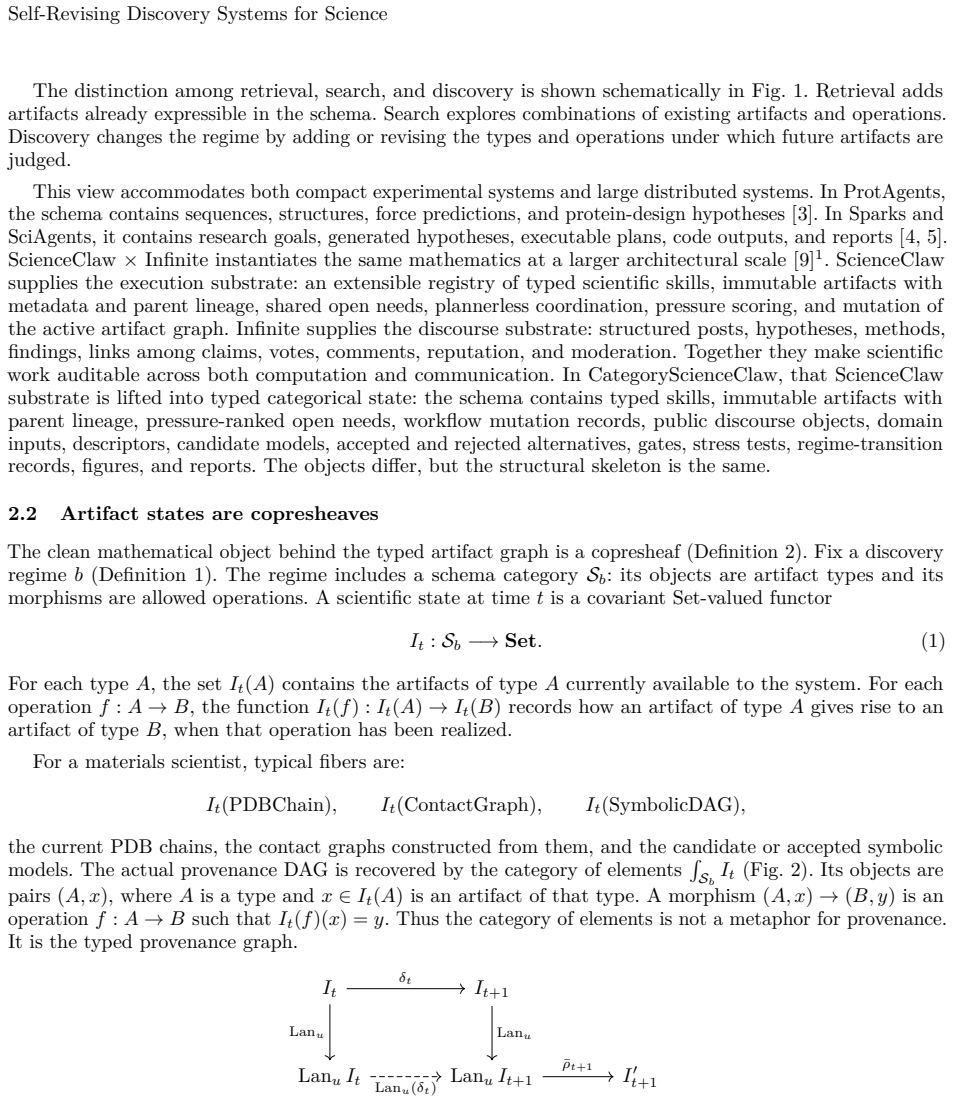
Scientific discovery is a verified regime transition between schema categories, with old states transported by left Kan extension to expose residuals beyond functorial preservation.
A machine-rendered reading of the paper's core claim, the machinery that carries it, and where it could break.
Core claim
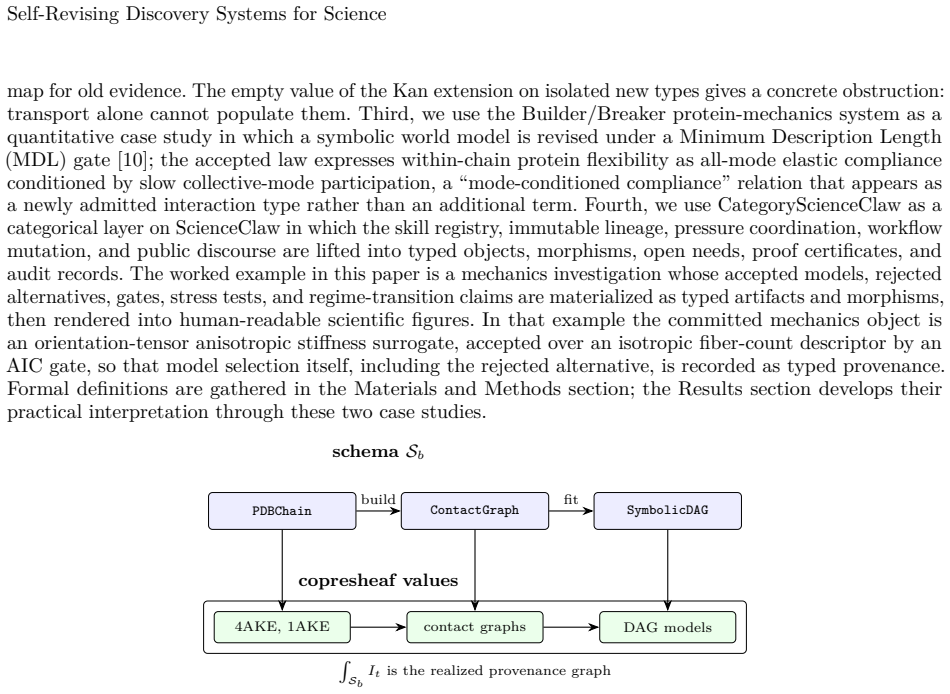
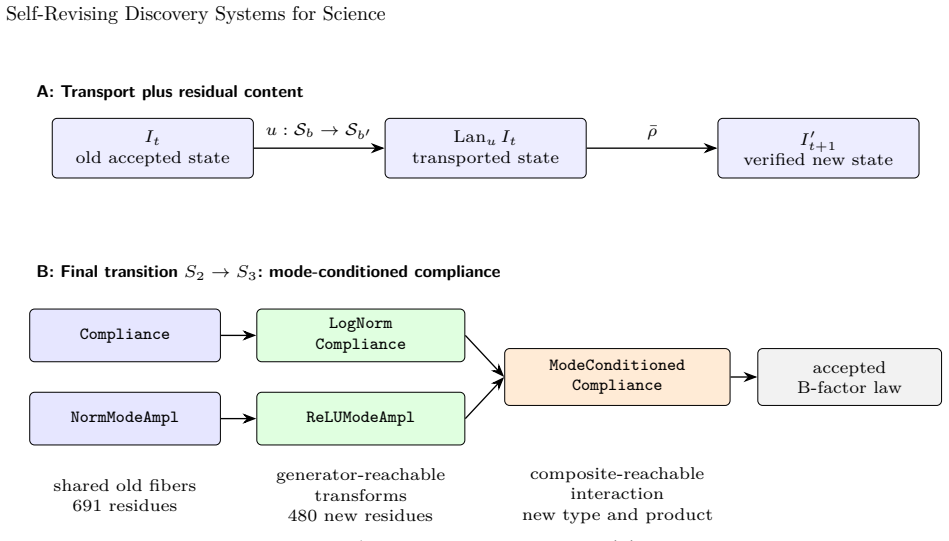
In a fixed regime b the system state is the copresheaf I_t on schema S_b with provenance given by the category of elements; discovery occurs precisely when a verified transition u: S_b → S_b' is performed, the prior state is transported by the left Kan extension Lan_u I_t, and the post-transition state is compared to isolate residual content that cannot be explained by the transported artifacts.
What carries the argument
Left Kan extension Lan_u along a schema functor u, which transports copresheaf states across regime boundaries while provenance (category of elements) records what is preserved.
If this is right
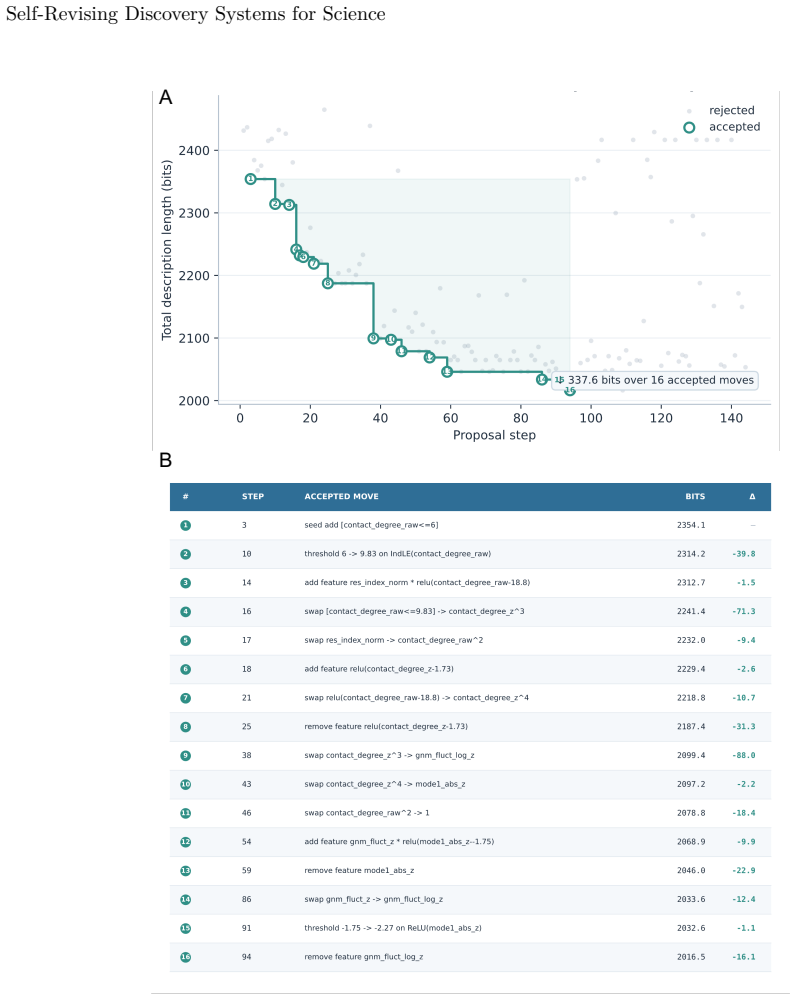
- In the Builder/Breaker system the accepted law is mode-conditioned compliance expressing within-chain flexibility as all-mode elastic compliance conditioned by slow collective modes.
- In CategoryScienceClaw the accepted fiber-network model is an orientation-tensor anisotropic stiffness surrogate over an isotropic fiber-count descriptor, after an AIC gate and perturbation tests.
- The same machinery separates retrieval (no regime change), search (regime-preserving queries), and discovery (verified regime transition with residual detection).
- Both systems produce a proof-carrying knowledge-computation graph that records candidate models, rejected alternatives, gates, and accepted laws.
Where Pith is reading between the lines
- The same transition-plus-residual test could be applied to non-materials domains such as chemistry or biology if the schema categories are supplied.
- An AI that maintains an explicit category of elements for provenance could audit its own history of regime changes without external labels.
- If the residual test is made computable, it supplies a concrete objective function for training agents to seek discovery rather than reward maximization inside a fixed language.
Load-bearing premise
Category-theoretic structures such as copresheaves, categories of elements, and left Kan extensions can be instantiated directly in working AI systems as a complete model of scientific discovery.
What would settle it
A working implementation of the framework that, on a documented materials discovery task, either fails to flag a human-recognized discovery or incorrectly labels transported content as residual.
Figures




read the original abstract
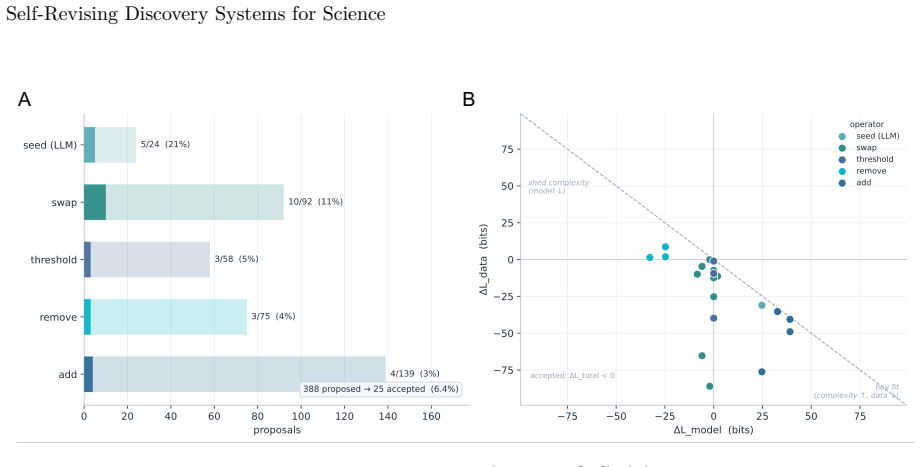
Scientific discovery is not only answer generation but revision of the representational regime in which evidence, artifacts, operations, and verifiers are typed. We develop a category-theoretic account of agentic discovery for materials science. In a fixed regime b with schema category S_b, the system state is a copresheaf I_t: S_b -> Set, and provenance is the category of elements \int_{S_b} I_t. Fixed-regime operation is an update on such states, endofunctorial only when provenance-preserving refinements are specified and preserved. Discovery is instead a verified regime transition u: S_b -> S_b': old artifacts are preserved, transported by the left Kan extension Lan_u I_t, and compared with the post-transition state to identify residual content beyond functorial transport. This separates retrieval, search, and discovery without subjective novelty. We instantiate the framework in two systems. In Builder/Breaker, a protein-mechanics world model is revised under a Minimum Description Length gate; the accepted law expresses within-chain flexibility as all-mode elastic compliance conditioned by slow collective-mode participation, or mode-conditioned compliance. In CategoryScienceClaw, typed skills, artifacts, open needs, workflow mutation, gates, stress tests, and public discourse become a proof-carrying knowledge-computation graph. A fiber-network example records candidate models, rejected alternatives, an AIC gate, perturbation tests, and an accepted orientation-tensor anisotropic stiffness surrogate over an isotropic fiber-count descriptor. Together, the cases show how category theory can be both a mathematical language for discovery and an engineering specification for self-revising AI discovery systems.
Editorial analysis
A structured set of objections, weighed in public.
Referee Report
Summary. The paper develops a category-theoretic framework for agentic AI discovery in science, modeling a fixed regime via schema category S_b with state as copresheaf I_t: S_b → Set and provenance as the category of elements. Discovery is defined as a verified regime transition u: S_b → S_b' in which old artifacts are preserved and transported by the left Kan extension Lan_u I_t, with residual content beyond this transport identified as the discovery. The framework is instantiated in Builder/Breaker (protein-mechanics revision under an MDL gate yielding a mode-conditioned compliance law) and CategoryScienceClaw (fiber-network example with AIC gate, perturbation tests, and an accepted anisotropic stiffness surrogate).
Significance. If the central mechanism can be made explicit, the framework would supply a formal, non-subjective criterion for distinguishing discovery from retrieval and search, using copresheaves, provenance, and Kan extensions as both a mathematical language and an engineering specification for self-revising systems. The two case studies illustrate concrete scientific outcomes (accepted laws and rejected alternatives) that could serve as test cases for the approach.
major comments (1)
- [Abstract and instantiations] Abstract (instantiations of Builder/Breaker and CategoryScienceClaw): the load-bearing claim is that discovery equals residual content after functorial transport of I_t by Lan_u along regime transition u. The descriptions supply only natural-language outcomes, gates (MDL, AIC), and final laws; they exhibit neither the schema categories S_b and S_b', the copresheaf I_t, the functor u, the left Kan extension Lan_u I_t, nor the explicit comparison that isolates the residual. Without these constructions the separation of discovery from search/retrieval remains an assertion rather than a demonstrated property of the framework.
Simulated Author's Rebuttal
We thank the referee for the constructive critique. The major comment correctly identifies that the abstract and case-study descriptions do not exhibit the explicit categorical data. We will revise the manuscript accordingly.
read point-by-point responses
-
Referee: [Abstract and instantiations] Abstract (instantiations of Builder/Breaker and CategoryScienceClaw): the load-bearing claim is that discovery equals residual content after functorial transport of I_t by Lan_u along regime transition u. The descriptions supply only natural-language outcomes, gates (MDL, AIC), and final laws; they exhibit neither the schema categories S_b and S_b', the copresheaf I_t, the functor u, the left Kan extension Lan_u I_t, nor the explicit comparison that isolates the residual. Without these constructions the separation of discovery from search/retrieval remains an assertion rather than a demonstrated property of the framework.
Authors: We agree that the abstract and the natural-language summaries of the two instantiations do not display the concrete objects S_b, S_b', I_t, u, Lan_u I_t or the residual comparison. The framework section supplies the general definitions, but the case studies do not instantiate them. In the revised manuscript we will add explicit constructions for both Builder/Breaker and CategoryScienceClaw, including the schema categories, the copresheaf state, the transition functor, the computed left Kan extension, and the explicit residual identified as discovery. This will convert the separation claim into a demonstrated computation. revision: yes
Circularity Check
Discovery defined as residual after Lan_u transport, making separation from search/retrieval true by construction
specific steps
-
self definitional
[Abstract]
"Discovery is instead a verified regime transition u: S_b -> S_b': old artifacts are preserved, transported by the left Kan extension Lan_u I_t, and compared with the post-transition state to identify residual content beyond functorial transport. This separates retrieval, search, and discovery without subjective novelty."
The separation of discovery from retrieval/search 'without subjective novelty' is asserted as a consequence of identifying residual content beyond Lan_u transport, but this separation holds exactly by the paper's definition of discovery as that residual; the result is equivalent to the definitional premise rather than a derived property.
full rationale
The paper proposes a categorical framework in which discovery is explicitly defined using regime transitions, copresheaves, and left Kan extensions. The central claim that this 'separates retrieval, search, and discovery without subjective novelty' reduces directly to that definitional choice rather than an independent derivation or external benchmark. The two case studies describe outcomes at the level of natural-language laws and gates but do not exhibit the required schema categories, copresheaf I_t, functor u, or explicit Lan_u computation, leaving the separation unverified beyond the framework's own terms. No fitted-input predictions, self-citation chains, or imported uniqueness theorems appear in the provided text, so circularity is confined to the self-definitional core. The framework remains a coherent modeling proposal but does not derive its key separation property from anything external to the chosen categorical operations.
Axiom & Free-Parameter Ledger
axioms (1)
- domain assumption Category theory supplies a suitable formal language for representing and revising scientific regimes, evidence, and operations.
invented entities (1)
-
verified regime transition via left Kan extension
no independent evidence
Reference graph
Works this paper leans on
-
[1]
Buehler, M. J. Generative Retrieval-Augmented Ontologic Graph and Multiagent Strategies for Inter- pretive Large Language Model-Based Materials Design.ACS Engineering Au4, 241–277 (2024). URL https://doi.org/10.1021/acsengineeringau.3c00058
-
[2]
& Buehler, M
Ni, B. & Buehler, M. J. MechAgents: Large language model multi-agent collaborations can solve mechanics problems, generate new data, and integrate knowledge.Extreme Mechanics Letters67, 102131 (2024)
2024
-
[3]
& Buehler, M
Ghafarollahi, A. & Buehler, M. J. ProtAgents: Protein discovery via large language model multi-agent collaborations combining physics and machine learning.Digital Discovery3, 1389–1409 (2024)
2024
-
[4]
Ghafarollahi, A. & Buehler, M. J. Sparks: Multi-agent artificial intelligence model discovers protein design principles.arXiv preprint(2025). ArXiv:2504.19017
arXiv 2025
-
[5]
Ghafarollahi, A. & Buehler, M. J. SciAgents: Automating Scientific Discovery Through Bioinspired Multi-Agent Intelligent Graph Reasoning.Advanced Materials37, 2413523 (2025). URL https: //doi.org/10.1002/adma.202413523
-
[6]
Lu, C.et al.The AI scientist: Towards fully automated open-ended scientific discovery.arXiv preprint (2024). ArXiv:2408.06292
Pith/arXiv arXiv 2024
-
[7]
URL https://arxiv.org/abs/2504.08066
Yamada, Y.et al.The AI Scientist-v2: Workshop-Level Automated Scientific Discovery via Agentic Tree Search.arXiv preprint arXiv:2504.08066(2025). URL https://arxiv.org/abs/2504.08066. 2504.08066
Pith/arXiv arXiv 2025
-
[8]
InAdvances in Neural Information Processing Systems (NeurIPS 2025)(2025)
Agarwal, D.et al.AutoDiscovery: Open-ended scientific discovery via bayesian surprise. InAdvances in Neural Information Processing Systems (NeurIPS 2025)(2025). URLhttps://arxiv.org/abs/2507. 00310.2507.00310
arXiv 2025
-
[9]
Wang, F. Y.et al.Autonomous agents coordinating distributed discovery through emergent artifact exchange.arXiv preprint(2026). ArXiv:2603.14312
arXiv 2026
-
[10]
Buehler, M. J. Why We Must Break the World.Integrating Materials and Manufacturing Innovation (in press)(2026)
2026
-
[11]
Buehler, M. J. MeLM, a generative pretrained language modeling framework that solves forward and inverse mechanics problems.Journal of the Mechanics and Physics of Solids181, 105454 (2023)
2023
-
[12]
Buehler, M. J. PRefLexOR: Preference-Based Recursive Language Modeling for Exploratory Optimization of Reasoning and Agentic Thinking.npj Artificial Intelligence1(2025). URL https://doi.org/10. 1038/s44387-025-00003-z
2025
-
[13]
R.The Logic of Scientific Discovery(Hutchinson, London, 1959)
Popper, K. R.The Logic of Scientific Discovery(Hutchinson, London, 1959). English translation of Logik der Forschung
1959
-
[14]
S.The Structure of Scientific Revolutions(University of Chicago Press, Chicago, 1962)
Kuhn, T. S.The Structure of Scientific Revolutions(University of Chicago Press, Chicago, 1962). 28 Self-Revising Discovery Systems for Science
1962
-
[15]
Falsification and the methodology of scientific research programmes
Lakatos, I. Falsification and the methodology of scientific research programmes. In Lakatos, I. & Musgrave, A. (eds.)Criticism and the Growth of Knowledge, 91–195 (Cambridge University Press, Cambridge, 1970)
1970
-
[16]
Mac Lane, S.Categories for the Working Mathematician(Springer, 1971)
1971
-
[17]
Awodey, S.Category Theory(Oxford University Press, 2010), 2nd edn
2010
-
[18]
I.Category Theory for the Sciences(MIT Press, 2014)
Spivak, D. I.Category Theory for the Sciences(MIT Press, 2014)
2014
-
[19]
& Spivak, D
Fong, B. & Spivak, D. I.An Invitation to Applied Category Theory: Seven Sketches in Compositionality (Cambridge University Press, 2019)
2019
-
[20]
Spivak, D. I. Functorial data migration.Information and Computation217, 31–51 (2012)
2012
-
[21]
Spivak, D. I. Poly: An Abundant Categorical Setting for Mode-Dependent Dynamics (2020). URL https://arxiv.org/abs/2005.01894.2005.01894
arXiv 2020
-
[22]
Spivak, D. I. Learners’ languages.arXiv preprint arXiv:2103.01189(2021)
arXiv 2021
-
[23]
I., Giesa, T., Wood, E
Spivak, D. I., Giesa, T., Wood, E. & Buehler, M. J. Category theoretic analysis of hierarchical protein materials and social networks.PLoS ONE6, e23911 (2011)
2011
-
[24]
Giesa, T., Spivak, D. I. & Buehler, M. J. Reoccurring patterns in hierarchical protein materials and music: The power of analogies.BioNanoScience1, 153–161 (2011)
2011
-
[25]
Giesa, T., Spivak, D. I. & Buehler, M. J. Category theory based solution for the building block replacement problem in materials design.Advanced Engineering Materials14, 810–817 (2012)
2012
-
[26]
Buehler, M. J. FieldPerceiver: Domain agnostic transformer model to predict multiscale physical fields and nonlinear material properties through neural ologs.Materials Today57, 9–25 (2022)
2022
-
[27]
Buehler, M. J. From Atoms to Swarms: The Categorical Spine of Multiscale Materials Modeling and Autonomous Discovery (2026). URLhttps://doi.org/10.26434/chemrxiv.15002850/v1. Preprint, version 1
-
[28]
Goethe, J. W. v.Versuch die Metamorphose der Pflanzen zu erklaeren(Carl Wilhelm Ettinger, Gotha, 1790). English title: The Metamorphosis of Plants
-
[29]
Cranford, S. W. & Buehler, M. J. Materiomics: Biological Protein Materials, from Nano to Macro. Nanotechnology, Science and Applications3, 127–148 (2010). URLhttps://doi.org/10.2147/NSA. S9037
work page doi:10.2147/nsa 2010
-
[30]
Sampling-Based Risk-Aware Path Planning Around Dynamic Engagement Zones,
Lee, N. A., Shen, S. C. & Buehler, M. J. An Automated Biomateriomics Platform for Sustainable Programmable Materials Discovery.Matter5, 3597–3613 (2022). URLhttps://doi.org/10.1016/j. matt.2022.10.003
work page doi:10.1016/j 2022
-
[31]
Fish, J., Wagner, G. J. & Keten, S. Mesoscopic and Multiscale Modelling in Materials.Nature Materials 20, 774–786 (2021). URLhttps://doi.org/10.1038/s41563-020-00913-0
-
[32]
Buehler, M. J. & Genin, G. M. Integrated multiscale biomaterials experiment and modelling: a perspective. Interface Focus6, 20150098 (2016). URLhttp://rsfs.royalsocietypublishing.org/lookup/doi/ 10.1098/rsfs.2015.0098
-
[33]
Jackson, N. E., Webb, M. A. & de Pablo, J. J. Recent Advances in Machine Learning Towards Multiscale Soft Materials Design.Current Opinion in Chemical Engineering23, 106–114 (2019). URL https://doi.org/10.1016/j.coche.2019.03.005
-
[34]
& Govindjee, S.Continuum Mechanics of Solids
Anand, L. & Govindjee, S.Continuum Mechanics of Solids. Oxford Graduate Texts (Oxford University Press, 2020)
2020
-
[35]
Shi, M., Jiao, Q., Yin, T., Vlassak, J. J. & Suo, Z. Hydrolysis Embrittles Poly(lactic Acid).MRS Bulletin 48, 45–55 (2023). URLhttps://doi.org/10.1557/s43577-022-00368-5
-
[36]
Tang, H., Buehler, M. J. & Moran, B. A constitutive model of soft tissue: from nanoscale collagen to tissue continuum.Annals of Biomedical Engineering37, 1117–1130 (2009)
2009
-
[37]
Notions of computation and monads.Information and Computation93, 55–92 (1991)
Moggi, E. Notions of computation and monads.Information and Computation93, 55–92 (1991)
1991
-
[38]
Tirion, M. M. Large amplitude elastic motions in proteins from a single-parameter, atomic analysis. Physical Review Letters77, 1905–1908 (1996). 29 Self-Revising Discovery Systems for Science
1905
-
[39]
Bahar, I., Atilgan, A. R. & Erman, B. Direct evaluation of thermal fluctuations in proteins using a single-parameter harmonic potential.Folding and Design2, 173–181 (1997)
1997
-
[40]
& Erman, B
Haliloglu, T., Bahar, I. & Erman, B. Gaussian dynamics of folded proteins.Physical Review Letters79, 3090–3093 (1997)
1997
-
[41]
Stewart, I. A., Hage, T. P., Hsu, Y.-C. & Buehler, M. J. GraphAgents: Knowledge Graph-Guided Agentic AI for Cross-Domain Materials Design.arXiv preprint arXiv:2602.07491(2026). URLhttps: //arxiv.org/abs/2602.07491.2602.07491
arXiv 2026
-
[42]
P.et al.Mars: Hierarchical multi-agent reasoning systems enable knowledge-grounded material substitution (2026)
Hage, T. P.et al.Mars: Hierarchical multi-agent reasoning systems enable knowledge-grounded material substitution (2026)
2026
-
[43]
Bacon, F.Novum Organum(Apud Joannem Billium, London, 1620)
-
[44]
Parker, London, 1840)
Whewell, W.The Philosophy of the Inductive Sciences, Founded upon Their History(John W. Parker, London, 1840)
-
[45]
Peirce, C. S. The fixation of belief.Popular Science Monthly12, 1–15 (1877)
-
[46]
N.Science and the Modern World(The Macmillan Company, New York, 1925)
Whitehead, A. N.Science and the Modern World(The Macmillan Company, New York, 1925)
1925
-
[47]
Polanyi, M.Personal Knowledge: Towards a Post-Critical Philosophy(University of Chicago Press, Chicago, 1958)
1958
-
[48]
Hacking, I.Representing and Intervening: Introductory Topics in the Philosophy of Natural Science (Cambridge University Press, Cambridge, 1983)
1983
-
[49]
W3C Recommendation, World Wide Web Consortium (W3C) (2013).https://www.w3.org/TR/2013/REC-prov-o-20130430/
Lebo, T.et al.PROV-O: The PROV ontology. W3C Recommendation, World Wide Web Consortium (W3C) (2013).https://www.w3.org/TR/2013/REC-prov-o-20130430/
2013
-
[50]
Bechhofer, S.et al.Why linked data is not enough for scientists.Future Generation Computer Systems 29, 599–611 (2013)
2013
-
[51]
Davidson, S. B. & Freire, J. Provenance and scientific workflows: challenges and opportunities. In Proceedings of the 2008 ACM SIGMOD International Conference on Management of Data, 1345–1350 (Association for Computing Machinery, 2008)
2008
-
[52]
Y.et al.Open research knowledge graph: Next generation infrastructure for semantic scholarly knowledge
Jaradeh, M. Y.et al.Open research knowledge graph: Next generation infrastructure for semantic scholarly knowledge. InProceedings of the 10th International Conference on Knowledge Capture (K-CAP ’19), 243–246 (Association for Computing Machinery, 2019)
2019
-
[53]
Fong, B., Spivak, D. I. & Tuyéras, R. Backprop as functor: A compositional perspective on supervised learning. InProceedings of the 34th Annual ACM/IEEE Symposium on Logic in Computer Science (LICS), 1–13 (2019)
2019
-
[54]
In Proceedings of the 41st International Conference on Machine Learning (ICML), 15209–15241 (2024)
Gavranović, B.et al.Position: Categorical deep learning is an algebraic theory of all architectures. In Proceedings of the 41st International Conference on Machine Learning (ICML), 15209–15241 (2024)
2024
-
[55]
Cruttwell, G. S. H., Gavranović, B., Ghani, N., Wilson, P. W. & Zanasi, F. Deep learning with parametric lenses.arXiv preprint(2024). ArXiv:2404.00408
arXiv 2024
-
[56]
Crescenzi, F. R. Towards a categorical foundation of deep learning: A survey.arXiv preprint(2024). ArXiv:2410.05353
arXiv 2024
-
[57]
& Mendler, N
Aczel, P. & Mendler, N. A final coalgebra theorem. InCategory Theory and Computer Science, 357–365 (1989)
1989
-
[58]
Rutten, J. J. M. M. Universal coalgebra: A theory of systems.Theoretical Computer Science249, 3–80 (2000)
2000
-
[59]
Modeling by shortest data description.Automatica14, 465–471 (1978)
Rissanen, J. Modeling by shortest data description.Automatica14, 465–471 (1978)
1978
-
[60]
D.The Minimum Description Length Principle(MIT Press, 2007)
Grünwald, P. D.The Minimum Description Length Principle(MIT Press, 2007)
2007
-
[61]
Solomonoff, R. J. A formal theory of inductive inference, parts I and II.Information and Control7, 1–22, 224–254 (1964)
1964
-
[62]
Hutter, M.Universal Artificial Intelligence: Sequential Decisions Based on Algorithmic Probability (Springer, 2005)
2005
-
[63]
Estimating the dimension of a model.Annals of Statistics6, 461–464 (1978)
Schwarz, G. Estimating the dimension of a model.Annals of Statistics6, 461–464 (1978). 30 Self-Revising Discovery Systems for Science
1978
-
[64]
O., Lehman, J
Stanley, K. O., Lehman, J. & Soros, L. Open-endedness: The last grand challenge you’ve never heard of. O’Reilly Online(2017)
2017
-
[65]
Wang, R., Lehman, J., Clune, J. & Stanley, K. O. Paired open-ended trailblazer (POET): Endlessly generating increasingly complex and diverse learning environments and their solutions.arXiv preprint (2019). ArXiv:1901.01753
Pith/arXiv arXiv 2019
-
[66]
X., Chen, C.-T
Gu, G. X., Chen, C.-T. & Buehler, M. J. De novo composite design based on machine learning algorithm. Extreme Mech. Lett18, 19–28 (2018)
2018
-
[67]
E.et al.Physics-informed machine learning.Nature Reviews Physics3, 422–440 (2021)
Karniadakis, G. E.et al.Physics-informed machine learning.Nature Reviews Physics3, 422–440 (2021)
2021
-
[68]
& Karniadakis, G
Lu, L., Jin, P., Pang, G., Zhang, Z. & Karniadakis, G. E. Learning nonlinear operators via DeepONet based on the universal approximation theorem of operators.Nature Machine Intelligence3, 218–229 (2021)
2021
-
[69]
Kevrekidis, I. G.et al.Equation-free, coarse-grained multiscale computation: Enabling microscopic simulators to perform system-level analysis.Communications in Mathematical Sciences1, 715–762 (2003)
2003
-
[70]
Brunton, S. L., Proctor, J. L. & Kutz, J. N. Discovering governing equations from data by sparse identification of nonlinear dynamical systems.Proceedings of the National Academy of Sciences113, 3932–3937 (2016). URLhttps://www.pnas.org/doi/abs/10.1073/pnas.1517384113. https://www. pnas.org/doi/pdf/10.1073/pnas.1517384113
-
[71]
URL https://arxiv.org/abs/2006.11287.2006.11287
Cranmer, M.et al.Discovering symbolic models from deep learning with inductive biases (2020). URL https://arxiv.org/abs/2006.11287.2006.11287
arXiv 2020
-
[72]
Leinster, T.Higher Operads, Higher Categories(Cambridge University Press, 2004). 31 Self-Revising Discovery Systems for Science Supplementary Information Self-Revising Discovery Systems for Science: A Categorical Framework for Agentic Artificial Intelligence Fiona Y. Wang1,2 Markus J. Buehler2,3,4* 1Laboratory for Atomistic and Molecular Mechanics, MIT 2D...
2004
discussion (0)
Sign in with ORCID, Apple, or X to comment. Anyone can read and Pith papers without signing in.