Probabilistic storyline attribution using machine learning
Pith reviewed 2026-06-28 11:34 UTC · model grok-4.3
The pith
Distributional autoencoders model full temperature distributions to derive conditional probability ratios in climate attribution.
A machine-rendered reading of the paper's core claim, the machinery that carries it, and where it could break.
Core claim
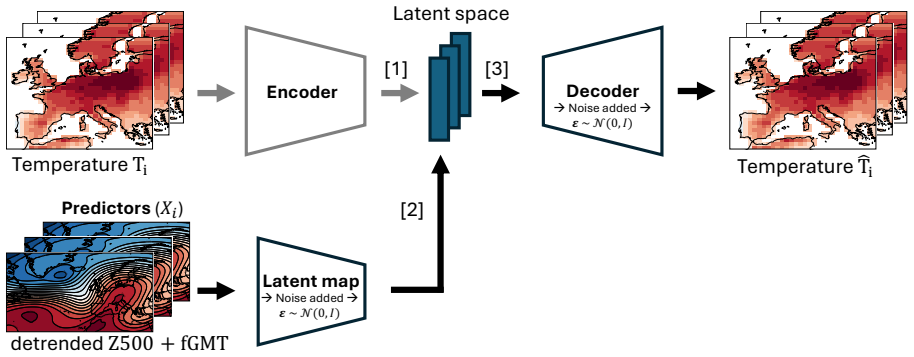
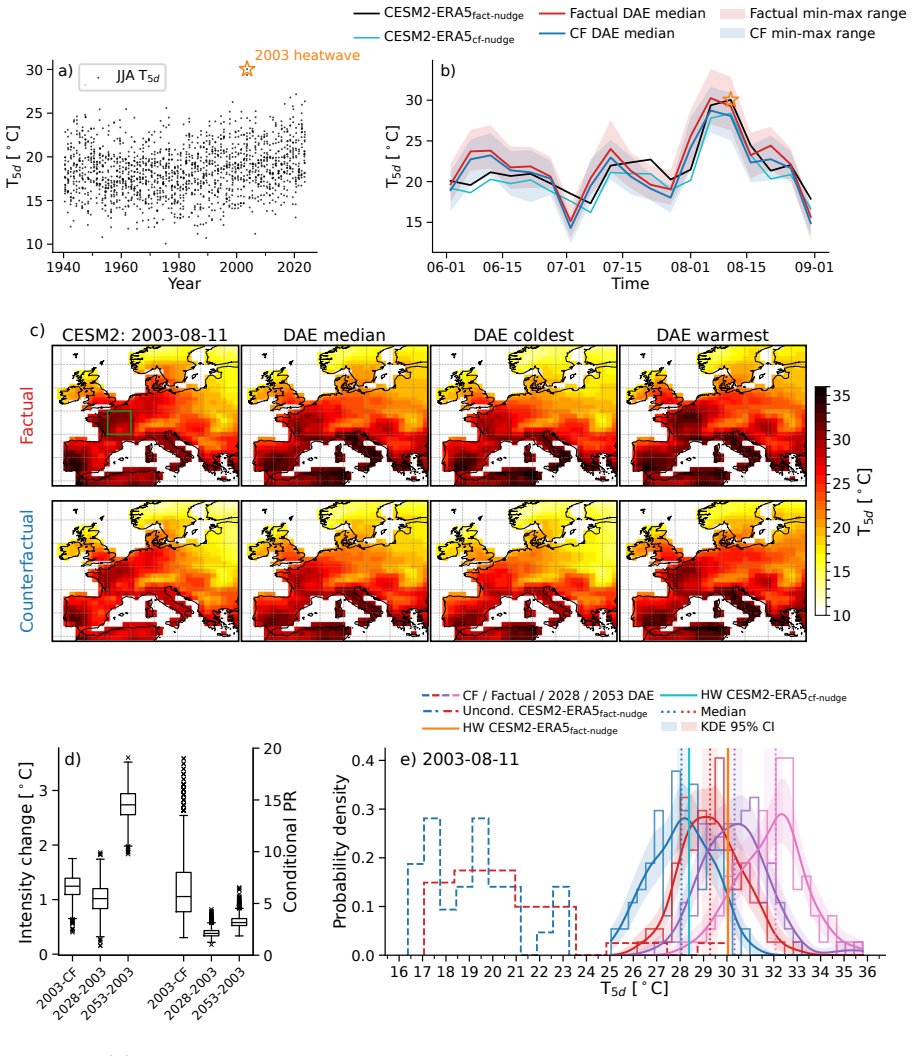
Distributional autoencoders trained on climate model output learn to represent the full conditional distribution of European temperature fields given circulation and warming level. This enables generating counterfactuals for observed circulation under different warming and computing conditional probability ratios, as shown for the 2003 event where intensity rises from 29.3°C to 30.3°C and 32.1°C with ratios 2.1 and 3.2.
What carries the argument
Distributional autoencoders that output the full probability distribution of temperature fields conditional on circulation state and global warming level.
If this is right
- Conditional probability ratios become computable from the modeled distributions for any given circulation pattern.
- Storyline counterfactuals can be produced for future warming levels using current reanalysis circulation data.
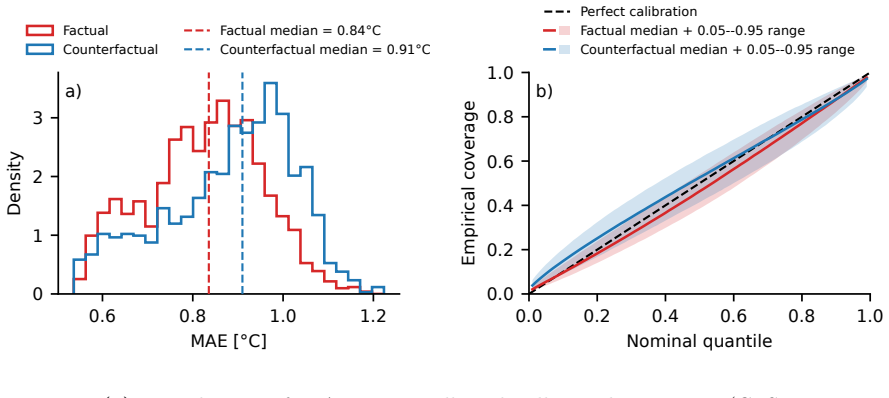
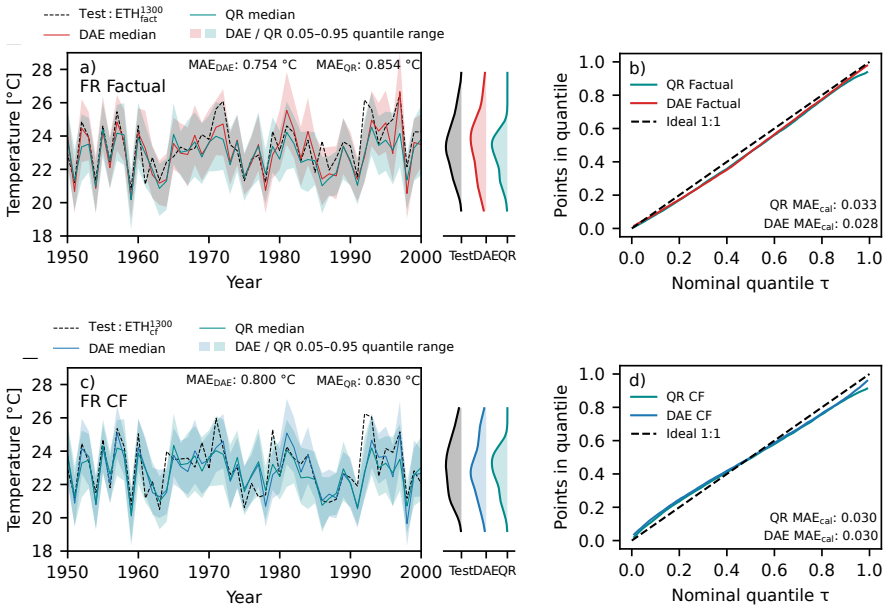
- The approach is validated by comparing distributions across factual and counterfactual climate simulations.
- Heatwave intensities and occurrence probabilities increase with global mean warming under fixed circulation.
Where Pith is reading between the lines
- This could be extended to attribute other types of extremes like droughts or floods if suitable training data exists.
- Integration with higher-resolution models might allow finer spatial attribution.
- The method suggests a general framework for emulating conditional climate responses without full dynamical simulations.
Load-bearing premise
The autoencoder generalizes from training on climate model simulations to produce reliable distributions for real atmospheric circulation patterns at warming levels outside the training range.
What would settle it
Running the climate model at the exact counterfactual warming levels with the same circulation forcing and checking if the temperature distribution matches the DAE prediction.
Figures
read the original abstract
A fundamental goal in climate attribution is to estimate how forced climate change contributes to observed extreme weather events. The storyline attribution method compares an observed weather event, conditional on its atmospheric dynamic state (i.e., atmospheric circulation), in the current, 'factual' climate to an event with very similar circulation conditions in a hypothetical, 'counterfactual' climate. However, physical climate models cannot directly transfer these storyline counterfactuals across different climate forcing states. Statistical and machine learning techniques may overcome this limitation; yet, emulating circulation-conditional extreme events under different climate states is challenging. Here, we demonstrate distributional autoencoders (DAEs) as a versatile method for generating climate counterfactuals. They model the full distribution of spatially resolved European temperature fields conditional on the atmospheric circulation state and the mean global warming level. These distributions allow for deriving meaningful conditional probability ratios, which is a particular advantage of the DAE-based storyline approach. We train DAEs on fully coupled climate model simulations and we evaluate the modelled distributions across different factual and storyline-based counterfactual climate model simulations. In an illustrative case study, we revisit the 2003 European heatwave and we generate counterfactuals for a hypothetical `2003-like European heatwave' using ERA5 circulation, which we hypothesize to occur a quarter century (2028) and a half century (2053) after 2003. The conditional intensity would increase from 29.3 {\deg}C in 2003, to 30.3 {\deg}C and 32.1 {\deg}C in 2028 and 2053, respectively and conditional probability ratios would be 2.1 and 3.2 when compared to 2003.
Editorial analysis
A structured set of objections, weighed in public.
Referee Report
Summary. The paper proposes distributional autoencoders (DAEs) trained on fully coupled climate model simulations to model the full conditional distribution of spatially resolved European temperature fields given atmospheric circulation and global warming level. These distributions enable derivation of conditional probability ratios for storyline attribution. The method is evaluated on factual and counterfactual model simulations and illustrated on a 2003-like European heatwave using ERA5 circulation patterns, producing intensity increases from 29.3 °C (2003) to 30.3 °C (2028) and 32.1 °C (2053) with probability ratios of 2.1 and 3.2.
Significance. If the learned conditional mappings transfer reliably, the approach provides a statistically grounded way to generate probabilistic storyline counterfactuals that hold dynamics fixed while varying the thermodynamic state, addressing a key limitation of direct model-based storyline methods. The distributional output is a particular strength for obtaining probability ratios rather than point estimates.
major comments (2)
- [Abstract / evaluation section] Abstract and evaluation description: the manuscript states that DAEs are trained on climate model output and evaluated only across factual and storyline-based counterfactual climate model simulations, yet the central illustrative results apply the trained DAE to ERA5 reanalysis circulations at warming levels (2028, 2053) outside the training distribution. No hold-out validation or transfer test for reanalysis inputs or extrapolated forcing levels is described, which directly bears on the reliability of the reported 29.3 °C → 30.3/32.1 °C intensities and 2.1/3.2 probability ratios.
- [Illustrative case study] Case study application: the conditional intensity and probability ratio values for the 2003-like event rely on the assumption that the circulation-temperature relationship learned from model simulations generalizes to ERA5 without non-negligible model-observation discrepancies; the manuscript provides no quantitative assessment of this transfer (e.g., comparison of conditional distributions on overlapping periods or sensitivity to circulation biases).
minor comments (1)
- [Abstract] The abstract and main text would benefit from explicit statement of the range of global warming levels present in the training simulations to clarify the degree of extrapolation involved for 2028/2053.
Simulated Author's Rebuttal
We thank the referee for the constructive comments, which help clarify the scope of our validation and the illustrative nature of the case study. We respond point by point below.
read point-by-point responses
-
Referee: [Abstract / evaluation section] Abstract and evaluation description: the manuscript states that DAEs are trained on climate model output and evaluated only across factual and storyline-based counterfactual climate model simulations, yet the central illustrative results apply the trained DAE to ERA5 reanalysis circulations at warming levels (2028, 2053) outside the training distribution. No hold-out validation or transfer test for reanalysis inputs or extrapolated forcing levels is described, which directly bears on the reliability of the reported 29.3 °C → 30.3/32.1 °C intensities and 2.1/3.2 probability ratios.
Authors: The referee correctly notes that the quantitative evaluation is confined to climate model simulations, while the reported intensity and probability ratio values are obtained by applying the trained DAE to ERA5 circulation at forcing levels beyond the training range. The model-based evaluation is designed to test whether the DAE can recover known conditional distributions under controlled factual and counterfactual conditions. The ERA5 application is intended as an illustration of how the method could be used with observed circulation. We will revise the abstract, evaluation section, and add a limitations paragraph in the discussion to explicitly distinguish the validated model experiments from the illustrative reanalysis application and to state the extrapolation assumption. revision: yes
-
Referee: [Illustrative case study] Case study application: the conditional intensity and probability ratio values for the 2003-like event rely on the assumption that the circulation-temperature relationship learned from model simulations generalizes to ERA5 without non-negligible model-observation discrepancies; the manuscript provides no quantitative assessment of this transfer (e.g., comparison of conditional distributions on overlapping periods or sensitivity to circulation biases).
Authors: We agree that the manuscript contains no quantitative assessment of transfer from model to reanalysis. The DAE is trained exclusively on model output, so any application to ERA5 implicitly assumes that the learned circulation-conditioned temperature distribution is sufficiently representative. We will add a dedicated limitations subsection that discusses this assumption, potential effects of model biases in circulation or temperature, and the illustrative character of the 2003 case study. A full quantitative transfer test on overlapping periods would require additional targeted experiments that are outside the current scope; we therefore treat this as a partial revision focused on clearer documentation of the limitation. revision: partial
Circularity Check
No significant circularity; derivation chain is self-contained
full rationale
The paper trains distributional autoencoders on fully coupled climate model simulations to learn conditional distributions of temperature fields given circulation states and global warming levels. These learned distributions are then applied to ERA5 circulation patterns at hypothetical future warming levels to compute intensities and probability ratios. No equation or step reduces a claimed prediction to a fitted input by construction, no self-citation is invoked as load-bearing uniqueness, and no ansatz or renaming is smuggled in; the outputs are generated by the model rather than being equivalent to its training targets by definition.
Axiom & Free-Parameter Ledger
axioms (1)
- domain assumption Distributional autoencoders trained on climate model output can accurately represent the conditional distribution of temperature fields given circulation and global warming level
Reference graph
Works this paper leans on
-
[1]
Allen, Myles , title =. Nature , year =. doi:10.1038/421891a , url =
-
[2]
Annual Review of Environment and Resources , author =
Attribution of. Annual Review of Environment and Resources , author =. 2017 , pages =. doi:10.1146/annurev-environ-102016-060847 , abstract =
-
[3]
Machine learning–based extreme event attribution , volume =. Science Advances , author =. 2024 , keywords =. doi:10.1126/sciadv.adl3242 , abstract =
-
[4]
Artificial Intelligence for the Earth Systems , author =
Global. Artificial Intelligence for the Earth Systems , author =. 2023 , note =. doi:10.1175/AIES-D-22-0035.1 , abstract =
-
[5]
Distributional Principal Autoencoders
Shen, Xinwei and Meinshausen, Nicolai , month = apr, year =. Distributional. doi:10.48550/arXiv.2404.13649 , abstract =
work page internal anchor Pith review Pith/arXiv arXiv doi:10.48550/arxiv.2404.13649
-
[6]
Advances in Statistical Climatology, Meteorology and Oceanography , author =
A protocol for probabilistic extreme event attribution analyses , volume =. Advances in Statistical Climatology, Meteorology and Oceanography , author =. 2020 , pages =. doi:10.5194/ascmo-6-177-2020 , abstract =
-
[7]
Shen, Xinwei and Meinshausen, Nicolai , month = jul, year =. Engression:. doi:10.48550/arXiv.2307.00835 , abstract =
-
[8]
Towards dynamical adjustment of the full temperature distribution , isbn =
Vignotto, Edoardo and Sippel, Sebastian and Lehner, Flavio and Fischer, Erich , month = sep, year =. Towards dynamical adjustment of the full temperature distribution , isbn =. Proceedings of the 10th. doi:10.1145/3429309.3429317 , abstract =
-
[9]
Lang, Simon and Alexe, Mihai and Clare, Mariana C. A. and Roberts, Christopher and Adewoyin, Rilwan and Bouallègue, Zied Ben and Chantry, Matthew and Dramsch, Jesper and Dueben, Peter D. and Hahner, Sara and Maciel, Pedro and Prieto-Nemesio, Ana and O'Brien, Cathal and Pinault, Florian and Polster, Jan and Raoult, Baudouin and Tietsche, Steffen and Leutbe...
-
[10]
Natural Hazards and Earth System Sciences , author =
A methodology for attributing the role of climate change in extreme events: a global spectrally nudged storyline , volume =. Natural Hazards and Earth System Sciences , author =. 2021 , pages =. doi:10.5194/nhess-21-171-2021 , abstract =
-
[11]
Current Climate Change Reports , author =
A. Current Climate Change Reports , author =. 2016 , pages =. doi:10.1007/s40641-016-0033-y , abstract =
-
[12]
Earth's Future , author =. 2025 , pages =. doi:10.1029/2025EF006453 , abstract =
-
[13]
Artificial Intelligence for the Earth Systems , author =
Harnessing. Artificial Intelligence for the Earth Systems , author =. 2025 , pages =. doi:10.1175/AIES-D-24-0090.1 , abstract =
-
[14]
Earth System Dynamics , author =
The. Earth System Dynamics , author =. 2025 , pages =. doi:10.5194/esd-16-239-2025 , abstract =
-
[15]
Externally forced circulation changes amplify mid-latitude regional heat extremes in climate model nudged-circulation experiments , abstract =
Singh, Jitendra and Sippel, Sebastian and Gu, Lei and Knutti, Reto and Fischer, Erich , file =. Externally forced circulation changes amplify mid-latitude regional heat extremes in climate model nudged-circulation experiments , abstract =
-
[16]
Weather and Climate Dynamics , author =
Attributing the occurrence and intensity of extreme events with the flow analogue method , volume =. Weather and Climate Dynamics , author =. 2025 , pages =. doi:10.5194/wcd-6-817-2025 , abstract =
-
[17]
Reconciling risk-based and storyline attribution with
Buschow, Sebastian and Friederichs, Petra and Hense, Andreas , month = jul, year =. Reconciling risk-based and storyline attribution with. doi:10.48550/arXiv.2407.10776 , abstract =
-
[18]
Geoscientific Model Development , author =. 2024 , pages =. doi:10.5194/gmd-17-7245-2024 , abstract =
-
[19]
Annals of the New York Academy of Sciences , author =
Autoencoder‐based flow‐analogue probabilistic reconstruction of heat waves from pressure fields , volume =. Annals of the New York Academy of Sciences , author =. 2024 , pages =. doi:10.1111/nyas.15243 , abstract =
-
[20]
Weather and Climate Dynamics , author =. 2024 , pages =. doi:10.5194/wcd-5-959-2024 , abstract =
-
[21]
Geophysical Research Letters , author =
Linking. Geophysical Research Letters , author =. 2025 , pages =. doi:10.1029/2024GL113540 , abstract =
-
[22]
Geophysical Research Letters , author =
Modeling. Geophysical Research Letters , author =. 2026 , pages =. doi:10.1029/2025GL120122 , abstract =
-
[23]
Nature Climate Change , author =
Increasing risk of mass human heat mortality if historical weather patterns recur , volume =. Nature Climate Change , author =. 2026 , pages =. doi:10.1038/s41558-025-02480-1 , abstract =
-
[24]
Annual Review of Environment and Resources , author =
Attribution of. Annual Review of Environment and Resources , author =. 2023 , pages =. doi:10.1146/annurev-environ-112621-083538 , abstract =
-
[25]
Proceedings of the National Academy of Sciences , author =
Forecast-based attribution of a winter heatwave within the limit of predictability , volume =. Proceedings of the National Academy of Sciences , author =. 2021 , pages =. doi:10.1073/pnas.2112087118 , abstract =
-
[26]
Advances in Statistical Climatology, Meteorology and Oceanography , author =
A statistical framework for conditional extreme event attribution , volume =. Advances in Statistical Climatology, Meteorology and Oceanography , author =. 2017 , pages =. doi:10.5194/ascmo-3-17-2017 , abstract =
-
[27]
The need for multi‐method extreme event attribution , volume =. Weather , author =. 2026 , pages =. doi:10.1002/wea.7779 , abstract =
-
[28]
Carleton, Tamma and Jina, Amir and Delgado, Michael and Greenstone, Michael and Houser, Trevor and Hsiang, Solomon and Hultgren, Andrew and Kopp, Robert E and Mccusker, Kelly E and Nath, Ishan and Rising, James and Rode, Ashwin and Seo, Hee Kwon and Viaene, Arvid and Yuan, Jiacan and Zhang, Alice Tianbo , file =
-
[29]
Communications Earth & Environment , author =
The concept of spectrally nudged storylines for extreme event attribution , volume =. Communications Earth & Environment , author =. 2025 , pages =. doi:10.1038/s43247-025-02659-6 , abstract =
-
[30]
Sánchez-Benítez, Antonio and Goessling, Helge and Pithan, Felix and Semmler, Tido and Jung, Thomas , file =. The
-
[31]
Journal of Advances in Modeling Earth Systems , author =
The. Journal of Advances in Modeling Earth Systems , author =. 2020 , pages =. doi:10.1029/2019MS001916 , abstract =
-
[32]
Human contribution to the. Nature , author =. 2004 , pages =. doi:10.1038/nature03089 , language =
-
[33]
Factors contributing to the summer 2003. Weather , author =. 2004 , pages =. doi:10.1256/wea.74.04 , language =
-
[34]
2026 , eprint=
EnScale: Temporally-consistent multivariate generative downscaling via proper scoring rules , author=. 2026 , eprint=
2026
-
[35]
Geophysical Research Letters , author =
Reconciling two approaches to attribution of the 2010. Geophysical Research Letters , author =. 2012 , pages =. doi:10.1029/2011GL050422 , abstract =
-
[36]
Thomas C. Peterson and Peter A. Stott and Stephanie Herring. Explaining Extreme Events of 2011 from a Climate Perspective. Bulletin of the American Meteorological Society. 2012. doi:10.1175/BAMS-D-12-00021.1
-
[37]
Weather and Climate Dynamics , author =
Could an extremely cold central. Weather and Climate Dynamics , author =. 2024 , pages =. doi:10.5194/wcd-5-943-2024 , abstract =
-
[38]
Earth System Dynamics , author =
Ubiquity of human-induced changes in climate variability , volume =. Earth System Dynamics , author =. 2021 , pages =. doi:10.5194/esd-12-1393-2021 , abstract =
-
[39]
doi:10.5281/zenodo.18172330 , url =
Beyerle, Urs and Sippel, Sebastian , title =. doi:10.5281/zenodo.18172330 , url =
-
[40]
and Merrifield, A
Pfleiderer, P. and Merrifield, A. and Dunkl, I. and Durand, H. and Cariou, E. and Cattiaux, J. and Camps-Valls, G. and Sippel, S. , TITLE =. Weather and Climate Dynamics , VOLUME =. 2026 , NUMBER =
2026
-
[41]
Bastos, Ana and Sippel, Sebastian and Frank, Dorothea and Mahecha, Miguel D. and Zaehle, S. A joint framework for studying compound ecoclimatic events , journal =. 2023 , volume =. doi:10.1038/s43017-023-00410-3 , url =
-
[42]
Journal of the American Statistical Association , volume =
Tilmann Gneiting and Adrian E Raftery , title =. Journal of the American Statistical Association , volume =. 2007 , publisher =. doi:10.1198/016214506000001437 , URL =
-
[43]
Econometrica46(1), 33–50 (1978) https://doi.org/10.2307/1913643
Regression. Econometrica , author =. 1978 , pages =. doi:10.2307/1913643 , language =
-
[44]
Geoscientific Model Development , author =
Latent. Geoscientific Model Development , author =. 2021 , pages =. doi:10.5194/gmd-14-4977-2021 , abstract =
-
[45]
2017 , eprint=
Adam: A Method for Stochastic Optimization , author=. 2017 , eprint=
2017
-
[46]
Statistical Science , author =
Forecaster’s. Statistical Science , author =. 2017 , file =. doi:10.1214/16-STS588 , abstract =
-
[47]
Nature Climate Change , author =
Attribution of climate extreme events , volume =. Nature Climate Change , author =. 2015 , pages =. doi:10.1038/nclimate2657 , abstract =
-
[48]
Weather and Climate Dynamics , author =
A dynamical adjustment perspective on extreme event attribution , volume =. Weather and Climate Dynamics , author =. 2021 , pages =. doi:10.5194/wcd-2-971-2021 , abstract =
-
[49]
Dynamical. Journal of Climate , author =. 2015 , pages =. doi:10.1175/JCLI-D-14-00111.1 , abstract =
-
[50]
Uncovering the. Journal of Climate , author =. 2019 , pages =. doi:10.1175/JCLI-D-18-0882.1 , abstract =
-
[51]
Toward a. Journal of Climate , author =. 2017 , pages =. doi:10.1175/JCLI-D-16-0792.1 , abstract =
-
[52]
Forced and. Journal of Climate , author =. 2016 , pages =. doi:10.1175/JCLI-D-15-0304.1 , abstract =
-
[53]
Improved. Journal of Climate , author =. 2017 , pages =. doi:10.1175/JCLI-D-16-0695.1 , abstract =
-
[54]
Enforcing tail calibration when training probabilistic forecast models
Wessel, Jakob Benjamin and Schillinger, Maybritt and Kwasniok, Frank and Allen, Sam , month = may, year =. Enforcing tail calibration when training probabilistic forecast models , url =. doi:10.48550/arXiv.2506.13687 , abstract =
work page internal anchor Pith review Pith/arXiv arXiv doi:10.48550/arxiv.2506.13687
-
[55]
Monthly Weather Review , author =
Improving. Monthly Weather Review , author =. 2025 , pages =. doi:10.1175/MWR-D-24-0151.1 , abstract =
-
[56]
The. Journal of Climate , author =. 2023 , pages =. doi:10.1175/JCLI-D-22-0666.1 , abstract =
-
[57]
Science AdvAnceS , author =
Physics-based models outperform. Science AdvAnceS , author =. 2026 , file =
2026
-
[58]
Weather and Climate Dynamics , author =
Constructing extreme heatwave storylines with differentiable climate models , volume =. Weather and Climate Dynamics , author =. 2026 , pages =. doi:10.5194/wcd-7-393-2026 , abstract =
-
[59]
Geoscientific Model Development , author =
Do data-driven models beat numerical models in forecasting weather extremes?. Geoscientific Model Development , author =. 2024 , pages =. doi:10.5194/gmd-17-7915-2024 , abstract =
-
[60]
Atmospheric Environment , author =
Interpretable machine learning for weather and climate prediction:. Atmospheric Environment , author =. 2024 , pages =. doi:10.1016/j.atmosenv.2024.120797 , abstract =
-
[61]
Atmospheric Research , author =
One month in advance prediction of air temperature from. Atmospheric Research , author =. 2023 , pages =. doi:10.1016/j.atmosres.2023.106608 , abstract =
-
[62]
Artificial Intelligence for the Earth Systems , author =
Finding the. Artificial Intelligence for the Earth Systems , author =. 2024 , pages =. doi:10.1175/AIES-D-23-0074.1 , abstract =
-
[63]
doi:10.1007/978-3-031-04083-2 , language =
2022 , file =. doi:10.1007/978-3-031-04083-2 , language =
-
[64]
Happé, Tamara and Wijnands, Jasper S and Scussolini, Paolo and Pfleiderer, Peter , file =. An
-
[65]
Paçal, Aytaç and Hassler, Birgit and Weigel, Katja and Fernández-Torres, Miguel-Ángel and Camps-Valls, Gustau and Eyring, Veronika , month = jun, year =. Understanding. doi:10.5194/egusphere-2025-2460 , abstract =
-
[66]
Artificial Intelligence for the Earth Systems , author =
Detecting. Artificial Intelligence for the Earth Systems , author =. 2024 , pages =. doi:10.1175/AIES-D-23-0107.1 , abstract =
-
[67]
Bulletin of the American Meteorological Society , author =
Attributing. Bulletin of the American Meteorological Society , author =. 2022 , pages =. doi:10.1175/BAMS-D-21-0116.1 , abstract =
-
[68]
Frontiers in Climate , author =
Frontiers in attributing climate extremes and associated impacts , volume =. Frontiers in Climate , author =. 2024 , pages =. doi:10.3389/fclim.2024.1455023 , abstract =
-
[69]
Weather and Climate Dynamics , author =
A combined storyline-statistical approach for conditional extreme event attribution , volume =. Weather and Climate Dynamics , author =. 2026 , pages =. doi:10.5194/wcd-7-597-2026 , abstract =
-
[70]
npj Climate and Atmospheric Science , author =
Testing. npj Climate and Atmospheric Science , author =. 2025 , pages =. doi:10.1038/s41612-025-01137-2 , language =
-
[71]
Quarterly Journal of the Royal Meteorological Society , author =
The. Quarterly Journal of the Royal Meteorological Society , author =. 2020 , pages =. doi:10.1002/qj.3803 , abstract =
-
[72]
Critical Reviews in Environmental Science and Technology , author =
A. Critical Reviews in Environmental Science and Technology , author =. 2010 , pages =. doi:10.1080/10643380802238137 , language =
-
[73]
Environmental Research Letters , author =
Targeted weather regimes identify circulation patterns behind. Environmental Research Letters , author =. 2026 , pages =. doi:10.1088/1748-9326/ae499b , abstract =
-
[74]
Sabine Undorf and Bernhard Schauberger and Lennart Jansen and Paula Romanovska and Christoph Gornott and Hideki Kanamaru and Wirya Khim and Laurel Hanson and Stephan Baas , title =. The Impact of Disasters on Agriculture and Food Security 2023: Avoiding and Reducing Losses through Investment in Resilience , year =. doi:10.4060/cc7900en , url =
-
[75]
Geophysical Research Letters , volume=
Local and nonlocal land surface influence in European heatwave initial condition ensembles , author=. Geophysical Research Letters , volume=. 2019 , publisher=
2019
-
[76]
Ferro, C. A. T. , title =. Quarterly Journal of the Royal Meteorological Society , volume =. doi:https://doi.org/10.1002/qj.2270 , url =. https://rmets.onlinelibrary.wiley.com/doi/pdf/10.1002/qj.2270 , abstract =
-
[77]
Quarterly Journal of the Royal Meteorological Society , volume =
Leutbecher, Martin , title =. Quarterly Journal of the Royal Meteorological Society , volume =. doi:https://doi.org/10.1002/qj.3387 , url =. https://rmets.onlinelibrary.wiley.com/doi/pdf/10.1002/qj.3387 , abstract =
discussion (0)
Sign in with ORCID, Apple, or X to comment. Anyone can read and Pith papers without signing in.