Ideals defining components of two-row Springer fibers
Pith reviewed 2026-06-27 21:28 UTC · model grok-4.3
The pith
Polynomial ideals defined for each noncrossing matching cut out the irreducible components of two-row Springer fibers.
A machine-rendered reading of the paper's core claim, the machinery that carries it, and where it could break.
Core claim
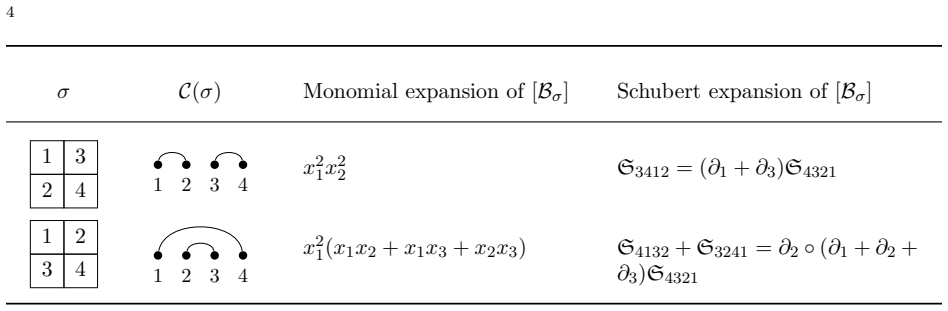
We define a polynomial ideal for each noncrossing matching and prove that these ideals define the corresponding components of the Springer fiber. Using these ideals to compute examples, we give two conjectural formulas for the cohomology class of each component of a two-row Springer fiber. We apply commutative algebra techniques to prove these conjectures for a specific family of two-row tableaux.
What carries the argument
The polynomial ideal associated to a noncrossing matching, constructed in the spirit of ideals for matrix Schubert varieties, which is proven to be the defining ideal of the corresponding component.
If this is right
- The irreducible components admit explicit algebraic equations.
- Examples of cohomology classes can be computed directly from the ideals.
- The conjectural formulas for cohomology classes hold for a specific family of two-row tableaux.
- Commutative algebra provides tools to study the geometry of these Springer fiber components.
Where Pith is reading between the lines
- This algebraic description may generalize if similar geometric descriptions become available for Springer fibers with more rows.
- The ideals could be used to study intersections between components or other operations in the flag variety.
- Noncrossing matchings may correspond to algebraic varieties in other representation-theoretic or combinatorial settings.
Load-bearing premise
The prior geometric descriptions of two-row Springer fibers are precise enough that the new ideals can be verified to cut out exactly the right sets.
What would settle it
A point that satisfies the equations of one of the constructed ideals but does not belong to the corresponding component of the Springer fiber, or a point in the component that fails to satisfy the ideal.
Figures

read the original abstract
Springer fibers are subvarieties of the flag variety parameterized by nilpotent matrices. They are central objects of study in geometry representation theory. This paper focuses on two-row Springer fibers, those corresponding to nilpotent matrices with two Jordan blocks. Irreducible components of two-row Springer fibers are in bijection with two-row standard Young tableaux and also with noncrossing matchings. Inspired by the combinatorial commutative algebra of matrix Schubert varieties, we define a polynomial ideal for each noncrossing matching and prove that these ideals define the corresponding components of the Springer fiber. Our proofs leverage geometric descriptions of Springer fibers established by Fung, Stroppel--Webster, Fresse, and Goldwasser--Nadeem--Sun--Tymoczko. Using these ideals to compute examples, we give two conjectural formulas for the cohomology class of each component of a two-row Springer fiber. We apply commutative algebra techniques to prove these conjectures for a specific family of two-row tableaux.
Editorial analysis
A structured set of objections, weighed in public.
Referee Report
Summary. The paper defines a polynomial ideal for each noncrossing matching and proves that these ideals define the corresponding components of two-row Springer fibers, leveraging geometric descriptions from Fung, Stroppel--Webster, Fresse, and Goldwasser--Nadeem--Sun--Tymoczko. It also proposes two conjectural formulas for the cohomology class of each component and proves the conjectures for a specific family of two-row tableaux using commutative algebra techniques.
Significance. If the claims hold, the work supplies explicit algebraic generators for the ideals cutting out the components, extending combinatorial commutative algebra methods from matrix Schubert varieties to Springer fibers. The conjectures on cohomology classes, when verified in a family, offer a potential route to combinatorial formulas for these classes.
major comments (1)
- The central claim that the constructed ideals cut out the components exactly rests on the cited geometric descriptions supplying sufficiently explicit equations or set-theoretic characterizations for direct comparison; the manuscript should include, in the proof section, the specific equations or loci from the prior works that are being matched to the zero sets of the new ideals.
Simulated Author's Rebuttal
We thank the referee for their thoughtful review and for highlighting an opportunity to strengthen the clarity of our proofs. We address the major comment below and will revise the manuscript to incorporate the requested details.
read point-by-point responses
-
Referee: The central claim that the constructed ideals cut out the components exactly rests on the cited geometric descriptions supplying sufficiently explicit equations or set-theoretic characterizations for direct comparison; the manuscript should include, in the proof section, the specific equations or loci from the prior works that are being matched to the zero sets of the new ideals.
Authors: We agree that explicitly quoting the relevant equations and loci from Fung, Stroppel--Webster, Fresse, and Goldwasser--Nadeem--Sun--Tymoczko will make the comparison direct and improve readability. In the revised version we will expand the relevant proof sections (particularly those invoking the geometric descriptions of the components) to state the precise equations or set-theoretic loci being matched to the zero sets of the ideals we construct. This addition will not alter the logical structure of the proofs but will render the matching fully explicit. revision: yes
Circularity Check
No circularity; proofs rely on independent external geometric descriptions from other authors
full rationale
The paper defines ideals combinatorially from noncrossing matchings and proves they cut out the components by direct comparison to explicit geometric descriptions of the Springer fiber components given in prior independent works (Fung; Stroppel-Webster; Fresse; Goldwasser-Nadeem-Sun-Tymoczko). No author overlap exists with those citations. No self-definitional equations, no fitted parameters renamed as predictions, no load-bearing self-citations, and no ansatz smuggling. The central verification step is external and falsifiable against the cited geometry, so the derivation chain does not reduce to its own inputs.
Axiom & Free-Parameter Ledger
axioms (1)
- domain assumption Geometric descriptions of two-row Springer fibers by Fung, Stroppel-Webster, Fresse, and Goldwasser-Nadeem-Sun-Tymoczko are accurate and usable for ideal verification.
Reference graph
Works this paper leans on
-
[1]
RC -graphs and S chubert polynomials
Nantel Bergeron and Sara Billey. RC -graphs and S chubert polynomials. Experimental Mathematics , 2(4):257--269, 1993
1993
-
[2]
Billey, Yibo Gao, and Brendan Pawlowski
Sara C. Billey, Yibo Gao, and Brendan Pawlowski. Introduction to the cohomology of the flag variety. arXiv:2506.21064 , 2025
arXiv 2025
-
[3]
Sur la cohomologie des espaces fibr\'es principaux et des espaces homog\`enes de groupes de L ie compacts
Armand Borel. Sur la cohomologie des espaces fibr\'es principaux et des espaces homog\`enes de groupes de L ie compacts. Ann. of Math. (2) , 57:115--207, 1953
1953
-
[4]
Webs and quantum skew H owe duality
Sabin Cautis, Joel Kamnitzer, and Scott Morrison. Webs and quantum skew H owe duality. Mathematische Annalen , 360(1-2):351--390, 2014
2014
-
[5]
Webs and smooth components of two column S pringer fibers
Mike Cummings. Webs and smooth components of two column S pringer fibers. arXiv:2602.16910 , 2026
arXiv 2026
-
[6]
On the singularity of some special components of S pringer fibers
Lucas Fresse. On the singularity of some special components of S pringer fibers. J. Lie Theory , 21(1):205--242, 2011
2011
-
[7]
Flags, S chubert polynomials, degeneracy loci, and determinantal formulas
William Fulton. Flags, S chubert polynomials, degeneracy loci, and determinantal formulas. Duke Mathematical Journal , 65(3):381--420, 1992
1992
-
[8]
Francis Y. C. Fung. On the topology of components of some S pringer fibers and their relation to K azhdan– L usztig theory. Advances in Mathematics , 178(2):244--276, 2003
2003
-
[9]
Cell closures for two-row S pringer fibers via noncrossing matchings
Talia Goldwasser, Meera Nadeem, Garcia Sun, and Julianna Tymoczko. Cell closures for two-row S pringer fibers via noncrossing matchings. arXiv:2503.03941 , 2025
arXiv 2025
-
[10]
A flat family of matrix H essenberg schemes over the minimal sheet
Rebecca Goldin and Martha Precup. A flat family of matrix H essenberg schemes over the minimal sheet. J. Algebra , 692:123--172, 2026
2026
-
[11]
Grayson and Michael E
Daniel R. Grayson and Michael E. Stillman. Macaulay2, a software system for research in algebraic geometry . Available at http://www2.macaulay2.com
-
[12]
William Graham and R. Zierau. Smooth components of S pringer fibers. Annales de l’institut Fourier , 61(5):2139--2182, 2011
2011
-
[13]
A formula for the cohomology and k -class of a regular H essenberg variety
Erik Insko, Julianna Tymoczko, and Alexander Woo. A formula for the cohomology and k -class of a regular H essenberg variety. J. Pure Appl. Algebra , 224(2020), 2018
2020
-
[14]
Nilpotent orbits in representation theory
Jens Carsten Jantzen. Nilpotent orbits in representation theory. 228:1--211, 2004
2004
-
[15]
Gr\"obner geometry of S chubert polynomials
Allen Knutson and Ezra Miller. Gr\"obner geometry of S chubert polynomials. Ann. of Math. (2) , 161(3):1245--1318, 2005
2005
-
[16]
Steven N. Karp and Martha E. Precup. Richardson tableaux and components of S pringer fibers equal to R ichardson varieties. arXiv:2506.20792 , 2025
arXiv 2025
-
[17]
Spiders for rank 2 lie algebras
Greg Kuperberg. Spiders for rank 2 lie algebras. Communications in Mathematical Physics , 180(1):109--151, 1996
1996
-
[18]
Lascoux and M.-P
A. Lascoux and M.-P. Sch\" u tzenberger. Polynômes de S chubert. C. R. Acad. Sci. Paris Sér. I Math. , 294:447--450, 1982
1982
-
[19]
Symmetric functions, S chubert polynomials and degeneracy loci , volume 6 of SMF/AMS Texts and Monographs
Laurent Manivel. Symmetric functions, S chubert polynomials and degeneracy loci , volume 6 of SMF/AMS Texts and Monographs . American Mathematical Society, Providence, RI; Soci\'et\'e Math\'ematique de France, Paris, 2001
2001
-
[20]
Combinatorial C ommutative A lgebra , volume 227 of Graduate Texts in Mathematics
Ezra Miller and Bernd Sturmfels. Combinatorial C ommutative A lgebra , volume 227 of Graduate Texts in Mathematics . Springer-Verlag, New York, 2005
2005
-
[21]
Spaltenstein
N. Spaltenstein. The fixed point set of a unipotent transformation on the flag manifold. Indagationes Mathematicae (Proceedings) , 79(5):452--456, 1976
1976
-
[22]
Springer
Tonny A. Springer. Contribution to `` O pen problems in algebraic groups". In Open problems in algebraic groups (Katata, 1983) , Katata, Japan, 1983. Taniguchi Foundation. Conference organized by the Taniguchi Foundation
1983
-
[23]
Shafarevich and Alexey O
Igor R. Shafarevich and Alexey O. Remizov. Linear algebra and geometry . Springer, Heidelberg, 2013. Translated from the 2009 Russian original by David Kramer and Lena Nekludova
2013
-
[24]
Richardson tableaux and S chubert positivity
Hunter Spink and Vasu Tewari. Richardson tableaux and S chubert positivity. arXiv:2510.12391 , 2025
arXiv 2025
-
[25]
Gr\"obner bases and S tanley decompositions of determinantal rings
Bernd Sturmfels. Gr\"obner bases and S tanley decompositions of determinantal rings. Math. Z. , 205(1):137--144, 1990
1990
-
[26]
2-block S pringer fibers: convolution algebras and coherent sheaves
Catharina Stroppel and Ben Webster. 2-block S pringer fibers: convolution algebras and coherent sheaves. Commentarii Mathematici Helvetici , 87(2):477--520, 2012
2012
-
[27]
S ageMath, the S age M athematics S oftware S ystem ( V ersion 10.8) , 2026
The Sage Developers . S ageMath, the S age M athematics S oftware S ystem ( V ersion 10.8) , 2026. https://www.sagemath.org
2026
-
[28]
Orthogonal P olynomials, L attice P aths, and S kew Y oung T ableaux
Jordan Olliver Tirrell. Orthogonal P olynomials, L attice P aths, and S kew Y oung T ableaux . PhD thesis, Brandeis University, Ann Arbor, MI, 2016
2016
-
[29]
H. N. V. Temperley and E. H. Lieb. Relations between the `percolation' and `colouring' problem and other graph-theoretical problems associated with regular planar lattices: some exact results for the `percolation' problem. Proceedings of the Royal Society of London. Series A, Mathematical and Physical Sciences , 322(1549):251--280, 1971
1971
-
[30]
The geometry and combinatorics of S pringer fibers
Julianna Tymoczko. The geometry and combinatorics of S pringer fibers. arXiv:1606.02760 , 2016
Pith/arXiv arXiv 2016
-
[31]
J. A. Vargas. Fixed points under the action of unipotent elements of SL n \ in the flag variety. Bol. Soc. Mat. Mexicana (2) , 24(1):1--14, 1979
1979
-
[32]
Schubert geometry and combinatorics
Alexander Woo and Alexander Yong. Schubert geometry and combinatorics. arXiv:2303.01436 , 2023
arXiv 2023
discussion (0)
Sign in with ORCID, Apple, or X to comment. Anyone can read and Pith papers without signing in.